Live Inspired ~ COVID-19
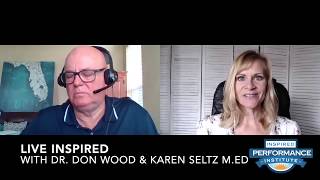
Karen Seltz and Dr. Don Wood share ways to cope during lockdown: turn stay-at-home time into family projects and one-on-one hours with kids, reach out to neighbors, stay connected online. Dr. Wood teaches a 5-6-7 breathing technique (inhale 5 seconds, hold 6, exhale 7) to calm your nervous system.
Chapters
Hello.
Welcome to another episode of Live Inspired. I'm Karen Seltz. I'm here with Dr. Dawn Wood. Amidst these crazy times of the coronavirus, Dr. Wood is going to share with us today how important it is to deal with our stress and what we can do to mitigate it and to get through this situation as best as we can. Dr. Wood, welcome.
Hey, Karen. How are you doing through this virus?
I'm doing fine so far. I have children at home like everybody else does, so we're negotiating that and running low on toilet paper. I'm not one of those that stocked up. We'll see how that goes.
Yeah, but you got food and other supplies?
Plenty of food. How about you?
Yeah, we got. We got good on food. Although it's really surprising when you go to stores and you don't see milk and eggs and stuff like that, you know? You know, I look back to what my parents went through and, you know, during the war, and you think about, wow, how difficult that must have been, how scary that must have been. You know, we really, truly haven't experienced that in our lifetime where this is sort of the closest thing you can sort of get to it. So it's very, very challenging times for people, and that's why we wanted to just sort of share just some things and why it's so important to be able to keep your nervous system regulated during these times.
Yeah, it's so important. And especially when people are at home, they get to deal with their families, who often can push their buttons.
Exactly.
And they need some strategies, some techniques to make the best of this time and to use it, I would say, to get closer to their family.
It is.
Yeah. And closer to themselves, too.
Right. Especially, you know, we don't know what's going to happen and how far. I know in San Francisco, they got people pretty much just staying in their homes. So, again, that's going to provide a whole new challenge. But at the same time, the way I like to look at it, it's a whole new opportunity to actually spend some time. What can you do? You know, because we're so used to being entertained, this is maybe a chance now to take a certain portion of the day and say, this is just family time where we sit and we talk. Right. Maybe play some board games, learn a little bit more about each other. You know, a lot of times we don't share a lot about ourselves with our children and what we've experienced, you know, or talk about, you know, what our parents taught us. So it is a good opportunity so everything has an opportunity, if you look at it that way. So you can see this as, oh, gosh, I got to spend all this time with nothing to do. Or you can look at it as, here's a great opportunity to share some special time, you know, with my family.
Yeah, I completely agree. And one of the things that my daughters have loved hearing about are the mistakes that I've made in life and what I've made.
Mistakes.
Yeah. What do they say? Perfect people really bother us? People who really are perfect.
Yeah.
Well, I don't know. In recovery, we say, don't compare your insides to other people's outsides.
Exactly. Yeah. Yeah. Everybody's dealing with something, you know, we. Nobody gets it. Right. We're not perfect. We're not expected to be perfect. And so there are times where this is maybe a great lesson. You're going to have a chance, maybe if you have done something, maybe that wasn't you at your best while you're dealing with this stress, what a great opportunity is to show your children that you can apologize for maybe the way you reacted. What a great life lesson, because they're looking to you for examples on how to be, how to act, how to respond. And so by admitting that, yeah, maybe I just lost my cool a little bit there, I apologize and make it sincere and sit down and talk about a better way that could have been handled. These are the kinds of opportunities there are right now. You may not have been able to do that because life is just too hectic. Sometimes. You don't stop and think about that.
Yeah, absolutely. And really, I think, extending it to them, you know, was there ever a time in your life when you didn't handle things the way that you would like to, or you'd like to be able to go back and do it differently?
Exactly. And it's a great opportunity to give each child maybe do the hour, you know, so. Child's name is Corey. This is the Cory hour. What do you want to do? Cory, this is your hour, right? You can do whatever you want. Right. Within reason. But you can do whatever you would like to do. Maybe they want to go camping. Right. So you camp in the house, build a tent. Right. Those are the kinds of things, you know, I think back on how, you know, you get really busy, and I remember my youngest son always wanting to do that. You know, let's build a tent in the living room and camp out, you know, and you sort of get busy, and then you finally have to say, you know, that's important. That's Something that he really wanted to do. So you sleep in a tent in the living room overnight. Right. But those are the kinds of memories that, amazingly, they remember. So this is a chance to really build some unique memories. I just spoke at my son's wedding last year, and one of the things that I talked about was that there are moments in your life, and a moment is a nanosecond, but it's a nanosecond that changes your life, and you've had many of them in your lifetime. And what I talked about with my son was I had one of those moments, and that was the moment that he was born. That was a moment that changed my life forever. Right. And we have a series of those moments. Can you identify some moments that have changed your life? And it can be both ways. I mean, generally, you want to try to think of the positive ones, but what are those kinds of moments that are significant to you? And you can start sharing those with your children. Going through albums, going through pictures. What was really interesting is one year we put some albums together. I took old pictures from my parents, their parents as children, and we broke it up into really, sections. And so they had this huge album of pictures, and we actually color corrected the pictures, improved them. Some really old, grainy pictures that came out pretty awesome. And that was our Christmas present to them. So we put it in a photo album. We also put it on a disc. And my children said, that's their best Christmas present ever. So they can go back to that and they can look at pictures of me when I was a kid, my wife when she was a kid, my parents when they were children, so their grandparents, children, their grandparents, parents, you know, all the way back. And it's like a history lesson. And, you know, it's just a great thing to be able to go back and look at. And they still cherish that as really their favorite Christmas present of all time.
Wow. What a beautiful idea. And just so thoughtful and took a lot of time.
It took a lot of time. But it's amazing what we can do now with a printer so you can color correct. So we had some unbelievably old photos that were amazing when you put it in and you do the color correction. And, you know, I'm not a professional by any means, but I took pictures that were sort of yellowed and old and made them look like they were new. I mean, it was incredible. And so we have it all broken into these sections, and each child got their own, you know, and it was pictures of them and special Times in their life. And, you know, that'll be something that they will be able to share with their children and add to it. So this is the time you can do those kinds of things. You've got the time and make it a project with the family. Pick out your favorite pictures, you know, find some things. I've got all the old.
8 millimeter stuff that I'm now also doing. And I did that project years ago, but now I'm taking all the old stuff. My brother, unfortunately had it for so long, I finally got it from him. But all the old film from when I was a kid, and I remember that was one of the things we used to do as a family. We would sit around on Sunday nights and watch the old film. I still remember the best part was we used to water ski. So the thing as a child that I used to love is watching myself backwards. So I'd be water skiing, pulling the boat from behind and coming out of the water. That, to me, was pretty cool. But I remember those things. Right. It was something you did. And people invited friends over and shared family vacations with, you know, neighbors and friends. So it's a great opportunity to do those things. And kids love it. It's a great bonding time. And it's things they remember.
Yeah, beautiful. What can we do if we're stressed right now and can't even get our head? Like, can't wrap our head around being able to do a project like that or spending time with the family because we're not really present. We're worried about everything else, and it's.
Understandable why people would be worried. But this is also a time now to start looking at ways to connect to other people. Maybe this is a time to sort of rely on some friends and family that are maybe better off. Maybe they've got an opportunity to help you, and they may not feel like they should approach you. So I'm not saying you go asking for handouts, but at the same time, if you do need a handout, go ask. This is the time. You'd be surprised at how giving people, especially in the United States. I know a lot of places around the world as well are. But, you know, as an American, we're the most giving nation in the world. Human nature wants to give. Did you know the most powerful word in the English language is help?
No.
That's the most powerful word in the English language. So if you're outside and you scream help, that gets everybody's attention. Everybody will stop for somebody yelling help. And so when you Go. And you start looking for help, and at the same time offering help, paying it forward. Have you been fortunate in your life, you know, and you've got that extra money, that ability to help other people. What a great lesson it is for your children to see you out doing something for other people. Right? You see a single mom or a mom at a store, right? And you just say, let me buy your. I've already paid for your meal. Or don't even have to tell her. Just tell the person taking the cash, the lady behind me, I've got her. I've got her meal. I just put it on my card. Those are the kinds of things that we can do that are just really special during that time. Amazingly, what amount of stress you will have taken off of that person and made them feel better about their day. I just had a client in, and this was really interesting because that's one of the things that she said when I talked to her about, says, tell me some of the highlights of your life. Tell me some of the things that you have done that was you at your best. And one of the things that she said is there was a homeless lady, and she didn't necessarily give her money. She just stopped and talked to her, and it was like she saw her. And so it was like just taking that time to make that person not feel like they're just not wanted or not cared for. She took the time to ask, how are you? Are you okay? Is there anything that you need? Right. And it wasn't a fleeting, you know, just give her $10 and move on. It was like she said, the woman just lit up like someone genuinely was thinking about her in that moment. That's more important sometimes than the money, than the food that you're giving them. Right. So we have, as. Not only the. As a nation, but as the world, an opportunity to see things very differently right now. We've never experienced. I know I haven't. I've never had to think about going to the store and knowing that. Is there milk there? Is there eggs there?
That is just unbelievable that we're here.
Yeah, it is. The only thing that I can come close to is being snowed in. As a kid in Michigan, we got snowed in and we couldn't leave our house for a couple days. We didn't have electricity. And like you said, it's one of my favorite memories.
We were just, like, by candlelight, playing games together as a family. And, yeah, it was like something about surviving that type of situation, like, adversity together as A family and bonded us.
Yeah. Can you remember what you ate? Can you remember anything about that time? What was the most special part about that?
For me, it wasn't about the food. We had gas stove, so we still had the opportunity to cook without electricity. It was playing games and just sitting around wrapped in blankets with candlelight.
Yeah. And it was a time that you remember. I remember the same thing. We got snowed in at my.
Grandfather'S farm, and there was. They didn't expect the snowstorm, so was nothing at the farm except cans of pea soup. Now, as a child, you could. You couldn't have tied me down and put that into me intravenously without me kicking and screaming. Right. And I refused to eat it until I got to the point where. Okay, I'll eat it. I love pea soup today. And you know me, Karen. I am the worst, pickiest eater. Right. Of anything you would think I wouldn't want to eat is pea soup. Right. But I loved it because it tasted so good when you're that hungry.
Oh, gosh.
But that was one of the things I remember. I still remember stepping out of the car and I didn't realize, I guess we were right near a ditch. I went in, right in over my head, straight down. Oh, my brother reached down, grabbed my hand and pulled me out, but I couldn't see. I mean, that was probably but a foot under the snow and then having to walk and all that. So again, but it was another thing with the fire playing games. Right. And. And just surviving. But it was a pretty cool memory.
Yeah.
So it depends on your attitude, on how you come into this. Right. It's just going to be, you know, you hear people and it's sort of jokingly, but sometimes it may be real where people go, oh, now I'm going to have to spend all this time with my kids alone in the house with nothing to do, as opposed to I get this great opportunity to spend more time with my kids because I don't have to, you know, be busy with work. I got a little bit of time to spend. This is not going to last forever. We're the most powerful nation in the world. We've got all these tremendous minds behind it. There's great scientists and doctors around the world. They're a lot smarter than all of us who are trying to figure out answers to it, and they will. We have defeated everything that's ever come. We're the most resilient species ever to exist, especially on this planet. And we'll beat this, too.
Yeah, absolutely. So do you have anything that you could share with the audience, like a breathing technique or something that would calm the nervous system and get them to be present?
Yeah, there's a great one that I usually use with people, and this is a really short little one, but you can practice it. And the more you practice it, you can increase the timing on it to make it even stronger. But I generally talk. It's called 5, 6, 7 technique. And what I mean by 5, 6, 7 is you're going to take a breath in for five seconds, you're going to hold it for six seconds, and then release it for seven seconds. It's a technique I use when people are experiencing panic attacks because we have a buildup of CO2 and less oxygen. So we got to get more oxygen in and get the CO2 out. How this works is. And you can practice this, do this about four times. You start off. And the key to breathing techniques, which a lot of people don't realize, is you want to breathe out first, not in. You want to exhale whatever you've got in your lungs. So you do a push it out. Then you're going to breathe in five seconds just through your nose. So it's like a count to five.
And then hold it for six. 1, 2, 3, 4, 5, 6. And then exhale through your lips with a whooshing for seven.
And then again it's five seconds in through your nose.
Hold for six.
Two, three, four, five, six, and then out for seven.
And do that about four times. And what you can do is then you can start practicing doing it a little longer. It could become 6, 7, 8. If going 5 in is too hard, go 4, 5, 6. Whatever the number is that works for you. What you're going to find is you're going to start increasing your lung capacity and you'll be able to start taking deeper breaths. One of the reasons we get stressed is because we don't have enough oxygen. We do not breathe very well. If you watch a baby sleep and breathe, watch their belly rising, they breathe very, very deeply, right? And if you watch an adult breathe, they breathe from their chest. So we're not getting the amount of oxygen that we really need. And oxygen is a key to reduce stress. So just sort of practice that, do that. If you do that before you go to bed at night, it actually is very, very relaxing, and it'll help you go to sleep. So about four times. Practice it a number of times during the day, not just when you're feeling stressed, but just to practice it to get better. At it. You can do it while you're watching tv. If a commercial comes on, you don't fast forward the commercial, just do it then.
Yeah, I only did it twice and I feel more relaxed. That's interesting. I was a student of Kundalini yoga for a long time. I remember one of the instructors saying that Americans use such a small percentage of their lung capacity. It's cultural. And, you know, with what I know about the mind, body connection, breathing is our personal power. So a lot of times, if I'm personally feeling powerless, that's the first thing I look at, is how am I breathing? And if it's up here, you know, in my chest, I'm like, okay, well, that explains it. And if I can just like mentally, physically drop it down to my belly, my power comes back because I'm breathing into my power center.
Exactly. And that's one of the things that we do in our program is when you're listening to our audios, we have you breathe from your. Feel your belly rise, put your hand on your belly and on your chest. If you feel your chest rise and you're not doing it right, you want to get that deep belly breath. And that takes a little bit of time. So if you haven't done it, that's why I say just practice it until it becomes more natural. So you may, even when you first start doing it, if you haven't really learned how to breathe properly, you're going to get a little lightheaded in the beginning. It's going to be hard to actually keep in five seconds of breath.
If you can't, then go 4, 5, 6, whatever it takes, 5, 6, 7 is generally a pretty good measure. But if you need to shorten it, do it a little shorter. And then as you get longer and better at it, you get more ability to take oxygen in. Right. When you oxygenate the blood that goes throughout all the tissues, it reduces inflammation.
Oxygen is a pretty good tool.
Can you speak to the longer exhalation than the inhalation does something right for relaxation to the nervous system?
Yeah, it's the vagus nerve.
Okay.
So the vagus nerve will get that mess. So we're getting less CO2, right. We've got more oxygen. And. And so what that's doing is telling the vagus nerve then starts sending the relaxation response and then that just calms down the whole nervous system. If the vagus nerve. We've got two pathways, the dorsal and ventral pathway. If we're under stress and the dorsal pathway is activated, that's Your fight, flight response, freeze response, then that's going to shorten your breath, which is then going to exaggerate, right. The amount of oxygen you've got. And then the ventral side will not be feeling relaxed. The mind will be getting messages from the body that was short on oxygen. So when you start breathing out more and you're bringing oxygen in and then holding it and then pushing out the CO2, your lungs are amazing instruments on what they can do and how they can circulate that oxygen for you. And then that's just going to teach your nervous system that you're safe and the message of relaxation goes through.
Right? Yeah. I knew there was something scientific to it. I wasn't sure what it was. Thank you.
Vagal tone. If you hear a vagal tone, I mean, that's a key. If you've got a good vagal tone, you're probably doing everything right. You're not under as much stress. Right. And your vagus nerve, which is key to health.
If that is constantly being activated on the dorsal side, which is your stress side, then it's going to activate inflammation, which is going to affect immune system, going to affect neurotransmitters. You're going to be getting sicker and feeling bad. So we can actually. We have so many great tools within us to actually do it all on our own. Just got to use it.
Yeah. Excellent. This has been fascinating. Is there anything else that you'd like to share with people? Any parting words?
Survive this time?
Yeah, one of the big things, and I talk about it from, really from my dad's experience. My dad fought in World War II and when they came home, this is one things they talked about. They never talked to anybody about it. They never talked about what they'd experienced and their fears and the things. I don't care. Humans are not designed to go to war. Right. That's not in our DNA. I mean, we're designed to survive. Right. But to do the amount of killing and things that these soldiers experience is really hard. So they came home and never talked about it. And they would just assume that they were just going to go back into their jobs, into their work, into their families. And we saw a spike in domestic violence, a lot of stuff going on with abuse, sexual abuse, physical abuse, because they had no release, no way to talk to about it. So if you're under stress right now, find resources to help you. It's not weakness to ask for help, it's actually strength to ask for help. So if you're getting stressed, have Somebody that you can talk to, somebody that would help you. Could be a friend, could be a relative. It doesn't have to be a therapist or psychologist. Could be a pastor. Wherever you go, wherever you need to, don't be afraid when you're under this kind of a stressful situation to reach out and ask for help.
Yeah. And I had my Toastmasters meeting today. By video, we use Zoom. And, you know, we noticed that even though we couldn't be together physically, just seeing each other's faces gave us that sense of community and belonging that we all need. So I encourage everybody to. To get familiar with some technology. WhatsApp, you can call internationally and do FaceTime. If you have iPhones, you can do FaceTime. You can do Zoom for free on the computer. So, yeah, just connect with your loved.
Ones at this time, more now than ever. It's a great time because it is a scary time. It's unprecedented. We've never seen anything like this. And I don't care who you are. I mean, I'll admit that I'm concerned. You know, this is a time in my life when I'm saying, you know, I really don't have a lot of certainty about certain things, and that's what creates a stress. And so we look to our leaders, right, to come up with some answers for us. Right? But if you're the leader in your family now, it's a time, right, to start leading, right? Showing people that there's. We will come through this. There's no question we'll come through it because we've got really great people working on it. But at the same time, while you're getting through it, this is your time to show some leadership. Or if you're really struggling, ask for some help from a leader. That's what they're doing. And it's amazing how generous people are when you just ask for help. It's the most powerful word in the English language. Help.
Yes. And just decide, who do you want to be during this time? Like, who do you get to step up and be and do it? So thank you so much, Dr. Wood. This has been really helpful. I invite everybody to use that breathing technique. Connect with all your loved ones, your family. Enjoy this time. Reframe it and follow us on YouTube. If you're not, please share this video with anybody you think this could benefit, and we really appreciate you watching. Thank you so much, Dr. Wood. Thank you for.
Thanks, Karen.
More from Dr.





When you’re in the middle of a panic attack and someone tells you to “just breathe”.

Once a panic attack starts, you can’t stop it. Here’s why and what you can do about it. #panic


The first sign of healing wasn’t what happened. #anxiety #emotionalpain #fightorflight

The threat ended. The situation changed. Your life moved forward. #weneedtotalk #anxiety

