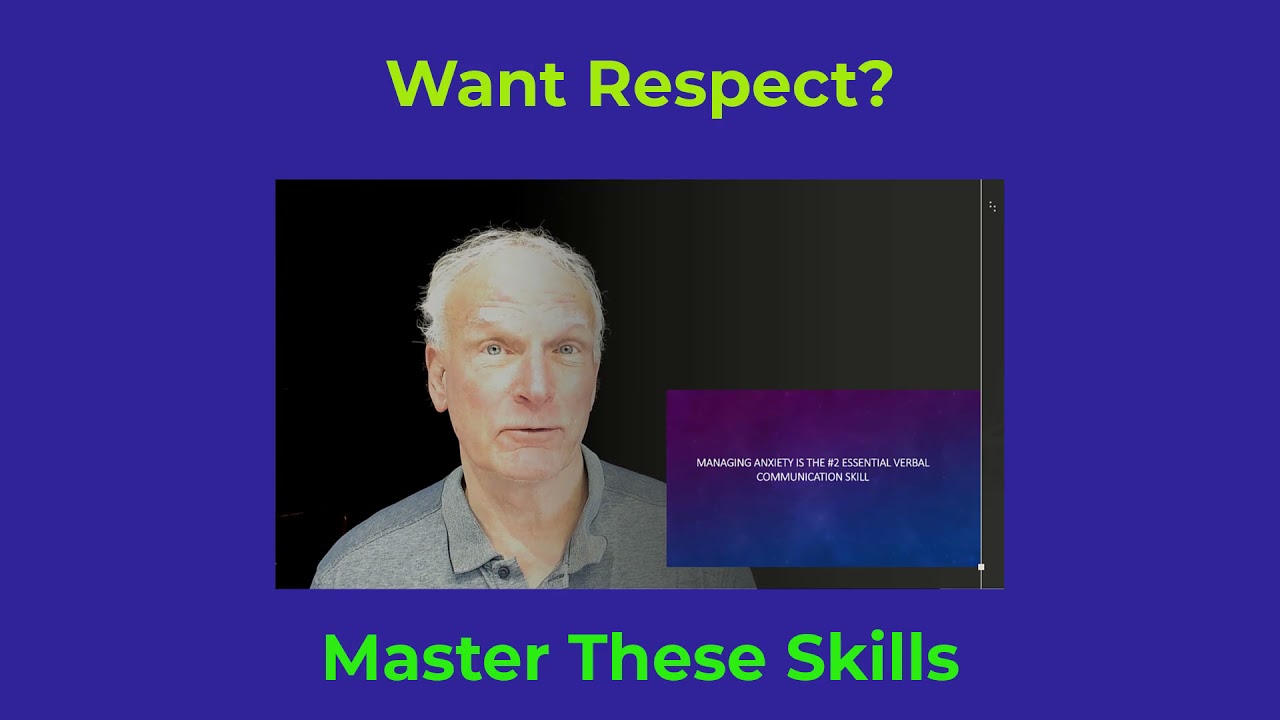
This content was created by Doug Noll. This content was uploaded by Doug Noll. This is a YouTube video titled "4 Essential Verbal Communication Skills" (published May 2, 2021) featuring Doug Noll as the sole presenter. It is an instructional/educational monologue for business leaders and rising leaders about verbal and nonverbal communication. The speaker outlines four core verbal skills: reflective listening (four levels: emotions, meaning, words, and instructions), managing anxiety (labeling feelings), organizing remarks (frameworks such as What / So What / Now What and Problem → Solution → Benefit), and connecting with audiences (use active, direct "you" language rather than passive voice). The video also briefly covers nonverbal cues (attending/following skills, speech speed and volume, tonality, facial expressions, body language) and directs viewers to DougNoll.com for more resources.
Chapters
Hi, Doug Noll here. And in this video, I want to talk about the 4 essential communication skills for business leaders. And so if you're a business leader or you're a rising business leader, see, these are the skills that you must master to be an effective communicator. So what are these verbal communication skills? Well, there's conversation. For example, where you're just talking and it's pretty informal. There's also listening, where you are listening to the other person and you're not saying much yourself. There is presenting, which for a lot of people can be very nerve-wracking, and we'll come back and talk about that in a few minutes. And there is persuading or selling. And finally, there is answering questions. So some of these verbal communication skills that we want to think about include conversation, listening and reflecting, presenting, selling and persuading, and answering questions. So there's also nonverbal communication. I'm not going to take much time in this video to talk about these skills, but these comprise 93% of all communication. Let's go back and take a look at that a little more closely. So nonverbal communication includes all of these things: attending skills, following skills, the speed, at which you're speaking, the volume at which you speak, your tonality, facial expressions, body language, and the expressiveness of your voice all communicate information. And as I said, this constitutes 93% of what we communicate. So these are skills that have to be mastered as well. So what are the 4 essential verbal communication skills? It's not what you expect. The first critical skill is learning how to listen. And you really have to master 4 basic skills. You have to learn how to listen to and reflect emotions. You have to learn how to listen to and reflect meaning. You have to learn how to listen to and reflect the words that people are saying. And you have to learn how to listen to and reflect instructions, procedures, and lists. And each of these is a different level of what we call reflective listening. Each is a skill that you can't do innately. You have to learn these skills and you have to practice them. The second skill is managing anxiety. Well, now you might not think that managing anxiety is a communication skill, but if you're like many people, when you have to speak to somebody, you might be anxious. It might be a tense situation. It might be conflict. It might be that you have to present in front of a group and you don't like public speaking. You might be introverted, and you might find that anxiety gets in the way of presenting yourself as a professional, clear, concise, authoritative figure. Well, there's a really simple way to manage your anxiety, and that is to simply acknowledge it and label it. And you would say something like, I am really, I'm feeling really anxious right now. I'm really nervous. I feel really anxious and nervous about what I'm about to do. And brain science shows that when you label your anxiety, your anxiety is reduced significantly. So that's the easiest and fastest way to manage your anxiety when you're going to be talking to somebody or giving a presentation. The third communication skill is organizing. Let me bring this up. So many people freeze when they have to speak. And basically what this is about is two kinds of communications. There's a spontaneous communication where you're asked to talk on the fly in the moment versus having a prepared communication, such as a talk where you might have a PowerPoint or some other skill. Well, the reason that we freeze is because our brains cannot structure information fast enough. And so we're wondering what the heck we've got to talk about. And so we want to try to develop structured information models that help us in any situation, be able to speak eloquently, clearly, concisely, and authoritatively. And it turns out there are two simple ways to do this. The first is what is known as the What, So What, Now What model. So let's suppose that you're in a business meeting and somebody calls on you to speak and you don't even know what you, you're completely unprepared and you don't know what you're going to say. You could say, you start off by talking about, well, what is this really all about? So what? Why is this important? And why is it important to us right now? And why is it going to be important down the road? And now what? So what are we going to do about this? So you can simply speak using the what, So what? Now what framework? Another really good framework is problem, solution, and benefit. Well, what's the problem we're facing right now? What are the possible solutions that we could be looking at? And what are the benefits if we can solve this problem? Another way of looking at this instead of problem is opportunity. So you could say problem, solution, opportunity, or opportunity, solution, benefit. The key is by having these two models, whenever you are spontaneously asked to speak, You won't freeze. You'll have a model that you can instantly rely on to help you communicate effectively and authoritatively. The third critical communication skill is connecting. And you'd be surprised at how many people have a difficult time connecting with their audience, an audience of 1 or audience of 1,000. And the reason that people are afraid of connecting, is because they were afraid of rejection. Because as children, when they tried to speak out, they were often invalidated or put down by their parents or their peers or their siblings. And so we've grown up with this fear of connecting with people on an intimate emotional basis in a business setting or a professional setting. And it's a killer because if we can learn how to connect, we can bring people along with us and become extremely effective leaders. So, two things to think about. The first is avoiding the use of a passive voice. So, when you use passive voice, for example, it would be something like, "Most people— it's commonly known that XYZ." That is a passive voice. It's a voice of non-attribution. Or maybe you are explaining something to a group and you would say, "So, there are three things that have to be noted here." 1, 2, and 3. That's all passive voice and it's language of disconnection. What you want to use is active voice or language of connection. So you could say something like, "Today you are going to learn item number 1, then you're going to learn item number 2, and when you've completed that, you're going to learn item number 3, and when you're done with all this, you will have mastered XYZ and become experts in this." field of knowledge. So you notice how I'm using a "you" statement to connect with the audience, and it's a very direct, active voice. So watch how you connect with people with the language that you use. The 4 basic critical communication skills are: learn how to listen and reflect, manage your anxiety, organize yourself, and connect using active language instead of passive language. So that's it. If you enjoy this and want more information about all of this and much, much more, visit my website, DougNoll.com. I have tons of resources and courses for you so that you can learn how to become an effective business leader.