What to Do When Someone Talks Over You (Works in 90 Seconds)
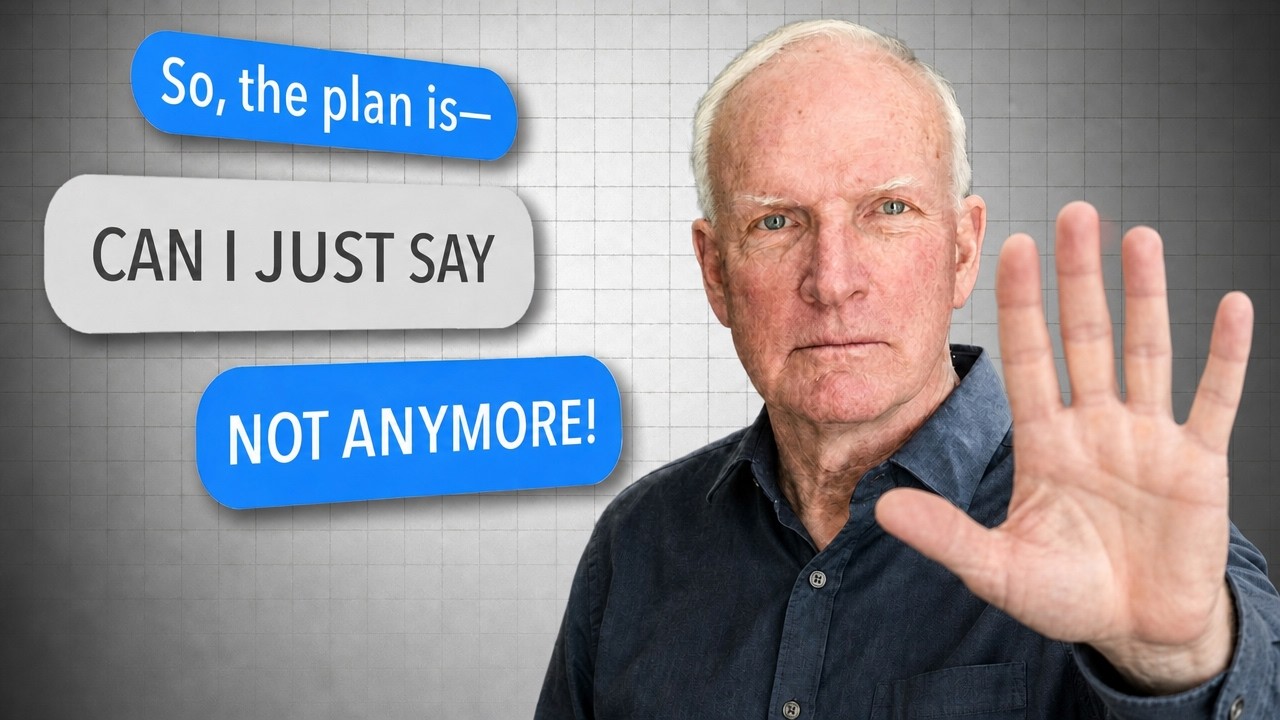
Doug Noll, a lawyer and prison trainer, shares a three-step system to handle interruptions: reset yourself in 90 seconds, stay quiet so the interrupter exposes themselves, then use their name and label their emotions to de-escalate.
Chapters
Have you ever had somebody completely talk over you while you were in mid-sentence? Most of the time it probably makes you completely shut down and you don't know how to get back into it without making things worse. Well, I've spent over 40 years as a lawyer and trained everybody from prison inmates to corporate executives on what to do when someone talks over you without raising your voice, without making a stink, without losing respect. There's a wrong way most people use that makes it worse and a right way that makes it a lot better. It's based on neuroscience and it works every single time without failure. That's why we taught it in Prison of Peace in maximum security prisons, because we knew that it would work every single time without failure. And that's a place where lives are at stake. By the end of this video, you'll know both and you'll never lose control of a conversation again. So let's get started. When someone talks over you, your brain at a very basic level detects a threat. It's dangerous. It's like a saber-toothed tiger is about to pounce on you, and your brain reacts to that person that's talking over you exactly as if there were a saber-toothed tiger in front of you. A part of your brain called the amygdala fires off and it starts sending signals saying, "Fight, run, freeze, do something, you're in danger." So your natural reaction is to defend, to get sharper, to get louder, to push back, to become more aggressive. You're in fight mode right now. And then of course what happens is that you trigger the other person. They don't realize perhaps that they're being rude by talking over you. And when you sharpen your voice or fight back, their amygdala gets triggered. And now you're in this escalating cycle. Both prefrontal cortexes are offline. Nobody's listening, nobody is reasoning, it becomes pure emotional noise. So what are the specific mistakes that we all make if we don't know any better? Well, we try to yell or outshout each other. And why do people yell and shout in arguments? It's because it's a cry for being heard. If I yell louder, maybe you'll hear me. And if you yell louder at me, maybe, maybe you'll feel heard. And what's so interesting about arguments is the one thing that would stop the argument is the one thing we don't do, which is listen the other person into existence. Sometimes we'll try to talk faster. That's something I used to do as a trial lawyer. Beat them out, beat them and come back into the conversation. But that signals anxiety, not authority. I used to do that because I was afraid of losing, not because I had the better argument. Sometimes people will go sarcastic and will say something like, "Am I interrupting you? Did the end of my sentence bother you?" These might feel momentarily satisfying to say, but they're devastating to the other person and they're devastating to your credibility. They signal that you're rattled, and rattled people don't command rooms. The other thing is that none of these responses actually address what's going on. Interruptions are not communication failures. They are bids for control, and you cannot win a control battle by entering it. I learned early on that in court, the lawyers who talked the loudest were always the ones who lost the jury. The ones who paused, stayed measured, kept their ground were the ones the jury leaned towards and listened to. And that's true outside the courtroom as well. So if these responses make things worse, what actually works? Well, there's actually a 3-step system, and the first step is the one almost nobody does. So let me explain. The first thing you want to do when somebody interrupts you is make sure that your nervous system is regulated. Make sure that you are emotionally under control. So, notice what's happening to yourself. Your jaw tightens. Your chest rises. Your mind starts firing off. You're trying to think of a response. Probably your vision tightens. And you stop thinking. That's your amygdala firing. And if you act from that state, you have already lost. You cannot de-escalate a room you've already added heat to. My foundational teaching is that your nervous system is the instrument. If it's dysregulated, everything that follows—your words, your tone, your presence—will carry that dysregulation into the interaction and the problem will just escalate. So what does self-regulation look like in the moment? One breath. Not dramatic, not visible, just a deliberate pause before you respond. And if you want to be really good about it, take 2 inhales with your nose and 1 long exhale. See, we go something like— Breathe. Try that right now. Two inhales through the nose and then a long exhale. You feel how you relax? That breath is the gap between stimulus and response. It's where your prefrontal cortex comes back online. It's how you go from reactive to intentional. So here's the science. Emotions have about a 90-second neurochemical lifespan. The initial flood of the amygdala hijack, when you get highly reactive and want to lash out, peaks, and then begins to subside if you don't feed it. The breath buys you that 90 seconds. It's not a mindfulness exercise, it's a neurological reset. You're basically giving your thinking brain, your prefrontal cortex, time to catch up with your emotional brain. And here's the other thing: in a room where there's upset, the person who pauses before responding does not look weak. They look like someone who does not need to react. And that reads subconscious immediately. It's called emotional contagion, and it's the same quality that makes calm lawyers win juries, and calm mediators settle rooms that nobody else can. I learned this early. The moment I felt my own system start to spike in a mediation session, I would take a breath before I would say anything. Not because I was composing a clever response, but because I needed to be regulated before I could be useful. Your emotional self-regulation is the prerequisite for everything else. You cannot lend calmness to somebody else unless you're calm within yourself. So Step 1 is not about what you do to them, it's about what you do to yourself before you do anything at all. It only takes 10 seconds to calm yourself down. Before Step 2, here's what you need to know: staying calm when being interrupted only works if you can regulate yourself first. I put together a free guide called the 90-Second Emotional Reset. It's the exact system I use to teach executives and incarcerated people for getting back to calm when someone's emotions are running high. You can use it in any situation. It's completely free, of course. The link is in the description. Just click on it and download it. So you've kept talking, they're still going. Here's where most people break. They start to get louder, to compete. Step 2 is the reason you can't do that and what to do instead. So, they're louder, you want to get louder to shut them down, and it feels like matching energy. It's actually a concession. The brain reads this increased volume as a threat escalation. Both amygdalas stay activated. No one's prefrontal cortex comes back online and no one is capable of actually listening. Basically, a shouting match is two hijacked brains competing to be heard by an audience that's already stopped listening. You're not winning that. No way. You're just exhausting yourself. So stay They know exactly where you are with your volume. Stay quiet. The discrepancy that creates your calm against their escalation does more to damage their position than any sharp response could. The room sees someone grasping for control. They see someone who already has it. That read happens in nanoseconds, and it's all subconscious. I taught this inside of maximum security prisons. Inmates who had spent years surviving through dominance, the ones who learned to stay steady while others escalated, were the ones who became the actual leaders and peacemakers in the room, not because they were the loudest, but because they were the calmest. You're not trying to dominate the interruption. You're making it visible. Let them show everyone what they're doing. Your composure is the frame. Next step, number 3. Basically what you're going to do, say their name clearly and firmly. Jefferson. One word. That's it. This is a pattern interrupt. Hearing your own name is one of the strongest pattern interrupts in the brain processes. It bypasses emotional flooding momentarily. It snaps attention, not because it's aggressive, but because it's personal. The brain is wired to orient towards its own name. It creates a micro-window, just a little tiny moment where the other person's prefrontal cortex partially re-engages before the amygdala can flood it again. And that window is your opening. If it doesn't work, repeat the name again slightly louder. Not louder out of frustration, just more deliberate. Jefferson! The second use normally lands. Choosing a name is, at the behavioral level, a form of what I call affect labeling. It's a direct declarative signal that says, "I see you. I'm addressing you specifically. Now we're in this together." The brain responds to being seen the same way it responds to having its emotions named. I've seen this over and over again in mediation. In rooms where two people were talking over each other constantly, the single fastest way to reset the dynamic was to name a name. It didn't matter how heated things were, a name cuts through. Before the last piece, I want to give you something that directly sets up what you're about to Here, because knowing what to say after the name only works if you know what not to say. For that, I put together a free guide called "What to Never Say in an Argument." It covers the exact phrases that backfire even when you mean well and why the brain responds to each one the way that it does. It's completely free. The link is in the description. Okay, so you've been interrupted, you're self-regulating, you've named somebody. What you say in the next 5 seconds determines whether you get the floor back or lose it for good. And here's exactly what to say. Basically what you're going to do is name their emotions. It's going to be really simple because the emotions when somebody's interrupting you is typically you don't feel heard, you feel invisible, you're angry, you're frustrated, you don't feel respected. That's it. So it'll go like this. Somebody interrupts you in mid-sentence. You stop, you take a couple of breaths. Jefferson, you don't feel heard. You're really frustrated. You're angry. And right now you feel invisible. And you look them right in the eye as you say that using a "you" statement. You don't feel heard. No one is listening to you. You feel ignored. The person who is interrupting you in that moment does not feel heard. It's not about your listening. It's just that that person feels ignored and invisible and can't stand it any longer. So their own anxiety, their own need to be heard and visible provokes them into interrupting you. The core methodology applies at this moment. You're naming the emotion clearly, directly, and without accusation. Not "Hey, you're being rude," which is a character judgment, or "Hey, let me finish," a request that can be ignored, you are identifying the specific emotional experience that is causing the interrupt and you're reflecting it back. The moment you use those two magic words, "You feel," you've made it about their feelings, not their behavior. The phrase works because it's declarative and specific: "You feel invisible." Same structure as affect labeling: direct, you-focused, behavioral. Your tone of voice should be calm, not cold, not aggressive, just matter-of-fact, the way you name any other observable fact, like, "It's raining outside." You're not feeling heard. Same register, same tonality, same volume, same speed. When you name what someone feels, it does not invite defensiveness, it doesn't attack character, it names the feeling, it validates the emotion, and provides exactly what the speaker needs to hear in that moment. And it allows their prefrontal cortex to come back online so they can start thinking again. There is a version of this that fails every single time, and yet it is still being taught all around the world, and that is active listening. So you've probably heard it like this: "I feel like you don't respect me," or "I feel ignored," or "What I think you're feeling is not being heard." The moment you add "I feel like" or "It seems to me" or "I think you are," you shifted focus to yourself. The brain, still partially hijacked, reads that as your problem, not theirs. And their brain goes into escalation mode. So active listening, Nonviolent Communication, any communication style that uses an "I" statement in the middle of an interrupt is only going to make things worse. Keep it on them. Name their feelings with a "you" statement. "You feel..." Here's the piece I want to leave you with because this just isn't about interruptions. This is about what's actually happening in every power dynamic you've ever been in. And once you see it, you can't unsee it. Interruptions are actually bids for control. Not rudeness, not disrespect. A brain-level attempt —to grab attention and redirect influence. Once you understand this, it helps to remove the personal sting. And when you stay grounded while they're escalating, you're not just managing an interaction, you're demonstrating something to everybody present: calm, leadership, emotional regulation, and empathy. The kind of strength that does not need volume to be visible. This works everywhere the dynamic shows up because all human brains are exactly the same. Someone's amygdala firing, and reaching for control. Your regulated nervous system holding ground. In every mediation I've ever conducted, in every courtroom I've ever been in, in every high-conflict session inside a prison or boardroom or corporate executive suite, the person the room trusts is never the one who gets escalated. It's always the one that didn't have to get escalated. So don't escalate. Keep your pace. Use their name to snap attention back. Label the emotions calmly with a "you" statement. That sequence in that order. It works in any room, in any stakes. If what you've heard in this video resonates with you and you're realizing that the way you've been handling these moments has been costing you more than you know, I want to offer you the full system. I've put together a free masterclass called "How to Stop Any Fight in 90 Seconds." It's the complete framework on how to read what's actually happening in a conflict, what to say, how to stay regulated under pressure, and how to apply all of it whether you're in a boardroom, a relationship, or a room that's about to blow up.. It's completely free. The link is in the description. And if you're dealing with a specific situation in a relationship or team or in your board or some kind of other dynamic you haven't been able to crack, I do one-on-one strategy calls. We'll look exactly at what's happening and build the response. You can book it for free from the link in the description. And if you're wondering whether the system works, I've used this in prisons for over 10 years. I've taught it to executives, physicians, doctors, couples, people who thought they had tried everything, and they all transformed. It works because it's not a trick. It's neuroscience. And once you learn it, you can never go back, and you will never be rattled the same way again. Well, that's it for today. Thanks for watching. See you in the next video.
More from Doug


When the Amygdala Fires, Talking Is the Worst Thing You Can Do (Here's What Works)

Every Difficult Conversation Is Actually Two Conversations (Most People Miss the Second One)






Why Traditional De-Escalation Makes Emotional Flooding WORSE (Prison-Tested Neuroscience)