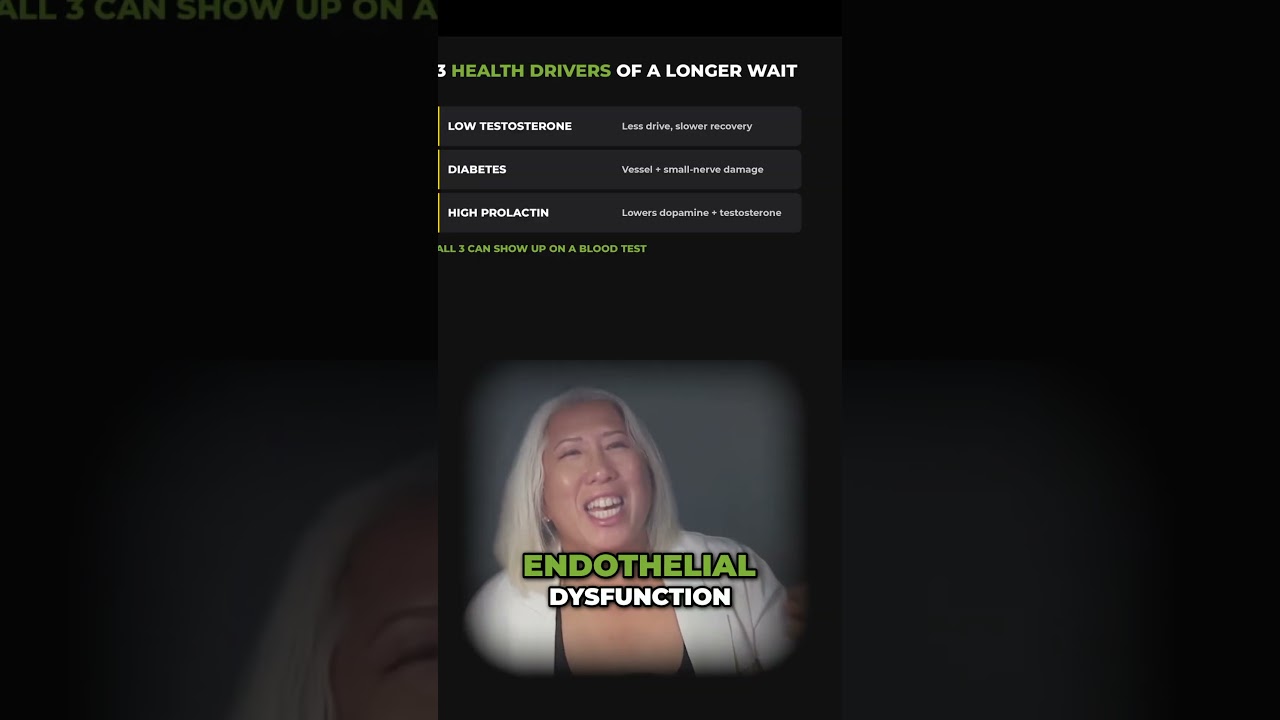
A YouTube episode (Sexual Health for Men podcast) by Dr. Anne Truong explaining how common gum disease can contribute to erectile dysfunction. The episode links oral inflammation and bacterial translocation to endothelial dysfunction: damaged endothelium produces less nitric oxide, permitting plaque formation, clotting and reduced blood flow to the penis, which reduces erection firmness. The host also describes age- and lifestyle-related declines in nitric oxide, and gives practical prevention tips (regular brushing/flossing, electric toothbrush, Mediterranean diet, high-intensity interval exercise ~3×/week for ~1 hour). Episode closes with membership/promotion details.
Questions this video answers
Brush morning and night and floss daily; use an electric toothbrush for better cleaning.
Mediterranean diet.
High-intensity interval exercise, at least three times per week, about one hour each session.
Well, hello there.
Stay tuned today because you are going to learn why gum disease and ED is related because it is so interesting. And this new research, I want you to stay all the way to the end because I want to show you what the whole inflammation cycle is like and how simple things that the gum disease can affect your ED.
This podcast is for you. The Modern Man. I'm Dr. Anne Truong, your host. I'm an intimate health medical doctor and best selling author of the book Erectile Dysfunction Fix. I'll do a deep dive into sexual health and performance and how it affects men of all ages and backgrounds. So let's get started and be sure to visit my website@sexualhealthfulmenpodcast.com for more information and resources from the show. See you on the inside.
Foreign hello there, modern man. Today I'm gonna talk about gum disease and how it's related to ed. Something as common gum disease like yes, yes, you, that can actually affect ed. So guys, if you're not brushing, you're not flossing. And, and when you do brush, you have a little bit of bleeding. Well, you're gonna have some issues because that creates inflammation. So stay tuned for the whole episode because I'm gonna talk about how the blood vessel gets inflamed and what goes on when the, the, the endothelium or the lining in the blood vessel is not working well and how it reduces blood flow and that then reduces blood coming into the penis causing ed. So let's dive into this. So gum disease is very common as we know, and it happens every time you brush your teeth and then you have some bleeding and then you have some swelling and sometime even some pain. I have to say I'm not the best person at flossing every day. I, I have to admit I floss about three times a week if I'm good and if I'm on vacation, probably not as good as I should be. But I do brush and every day, morning and at nighttime. But when you have gum disease, it actually causes inflammation of the gum. That's why you start bleeding. Then bacteria set in there. So when bacteria gets into the gum, it actually will go to the, your blood into the blood system. So when it goes to the blood system will then affect the endothelium. Now the endothelium is the lining of the blood vessel. That is the lining that the blood flows through. So I'm going to show you on this picture that I have here that will show you the endothelium. Now those that can see this on YouTube. You see that the endothelium, the one cell lining and on the innermost layer of the blood vessel, that's where your blood is flowing in and out. And then the middle part of the blood vessel is the smooth muscle. And the smooth muscle is what contracts and relax and it is affected by nitric oxide. So when nitric oxide is produced by the endothelium, it relaxes the smooth muscle and that's how the smooth muscle relax and contract. That's how you hear the sound. You get the blood pressure reading of the top number, which is a dog and bottom number diastolic. The, the top number is when you're the blood vessel relax and the smooth muscle of the blood vessel relax and you get that top number. And then when it contracts is when you get the bottom number. And when the elasticity of the smooth muscle of the blood vessel doesn't relax as well, that's when the pressure is a little bit stiffer and that's when you have a higher reading of the blood pressure. I don't want to get us straight, but essentially how you get at high blood pressure is because the elasticity or the inflexibility of the smooth muscle affect how it expands and contract. And when you have high blood pressure, it means that you have decreased elasticity of the smooth muscle. So how the heck does it affect ed? Right. Well, when you have inflammation, such as something as simple as gum disease, it affects the. The barrier affect the function of the endothelium. And I'll show you on this next slide right here. So the endothelium, the endothelial cell actually generate produce nitric oxide. And we know that nitric oxide is good for blood flow. It relaxes smooth muscle and it also act as a barrier as well. And it also prevent excessive inflammation and it also produces prostacycline, which is an anti inflammatory substance. However, when endothelium is not healthy, just from being having inflammation or gum disease or even high blood sugar or a poor diet or even not even exercising and having high blood pressure and smoking, it actually become. It activate the oxidation cycle which is the ros and then it loses the production of nitric oxide and then it ha. It becomes more inflamed. So when it becomes more inflamed, the barriers start to be broken and then toxins start to go into the smooth muscle layer of the blood vessel, creating something like this picture here that I'm showing. Because when your endothelium is damaged, such as by high blood pressure Like I talk about, and saturated fat, which is, you know, diet full of fried food and high carb and pastry and smoking, it actually will damage endothelium. And then the cholesterol and the calcium seep into the muscle layer which, which then create the plaque like substance. Plaque is like a nodule which then block the flow of the blood flowing into the, the blood vessel. Now endothelium actually prevents the platelets, which are the clotting factor of your blood from clotting. So when it's not working well, there the tendency to clot. So when you have clot clotting with the plaque, bad things happen. That's when you start having decreased blood flow to the heart or decreased blood flow to the penis. So essentially when you have inflammation, if you see the top picture here, the endothelium, that lining right there that you have, you have a big opening where blood flows in. But when you have your endothelium is damaged, you can see in the bottom picture. And that little hole right there, the little gray hole that you can see right in the picture is the only part that the blood can flow through. The rest is infiltrated with plaque, cholesterol and fibrin. So that's why you're not getting enough blood flow. So that's what's happening in the penis because you're, you're supposed to get blood flow like the top picture, big opening, but then the, the bottom picture opening like this. So that's all the blood that you're going to get into, into the penis. It's being compromised because the blood vessel itself, which deliver, deliver blood, doesn't have as much a big opening for the blood to flow into. That's why you see symptoms of ed. And the first thing that you notice is that, you know, the, the p. Penis is not getting as firm as it used to be because you're not getting as much flow in which then expand the corpus cavernosum or the muscle of the penis, which then prevent the blood from flowing out. So the first sign is really more, you can still get an erection, but you get, you notice there's less firmness. So this interesting slide that I wanted to show also is that when you get older, when you get older, nitric oxide production is also affected as well. It decreases. And the, the red line that you see is a person, an average person, that your nitric oxide production start to decrease at around age 30, right? And it drop, drop, drop, you know, it dropped down a slope. But from, you know, 10 to 30, you're good you had 100% nitric oxide production. However, from this picture here, when you have a poor diet and you're not exercising even when you're younger at 20, you still, you have about 70% of nitric oxide compared to a person that has a better diet and exercise. But then it dropped. It's, it slowly decreases as you age. And let's say for instance if you take a 40 year old person, you go up there, if they're not exercising or not eating well, you only have 40% of nitric oxide production versus a person that exercises at the age of 40 have about 90, 90% of their nitrous oxide. And you and also on this picture here that you have, if you exercise and have a good diet then you don't decrease your nitric oxide until you're the age of 40. So when you do have decreased production, it is slower than someone that not have not have a good diet and exercise. So guys, what you eat count and how you exercise also count. What type of diet should you eat? A Mediterranean diet. What type of exercise should you do at least three times a week, an hour at each time. I recommend high, high intensity interval exercise. And let's talk about gum disease again. So gum disease is important because you need to brush because it does cause decreased blood flow which then lead to ed. But how do you fight gum disease? What what your dentist tells you all the time when you were younger is brush in the morning, brush at night and floss daily as much as you can and you know you're doing well when you're brushing your teeth, you're not bleeding. I recommend that you use an electric toothbrush that will actually clean a lot better and it also goes, you know, deep inside to the the root of the tooth as well. Just simple things like that will actually go a long way. Never underappreciate things that we do in a daily basis guys, because it does count. So stay tuned for the next episode and I will talk more about surprise surprising reason causes of ed. I'll see you next episode and don't forget to look at the link down below to join my modern man club. It's a club where I coach and educate you so you can stop ED in this trap and start healing and start performing again. And also in the membership I give you access to my health and exercise Health fundamental app as well. You get discount on supplement as well and you get a chance to work with me in the in the membership portal and I will see you next time.
Thanks for listening to the Sexual Health for Men podcast. If you love this episode, then please take a screenshot on your phone and post it on Facebook, Instagram, or wherever you post. And be sure to tag me and let me know why you like this episode and what you like to hear in the future that will help me know what's great for you. And I would love to give you the most incredible free gift design to help you improve performance quickly. Go to my website@sexualhealthformenpodcast.com to get the book the Five Common Costly Mistakes Men Make When Facing Ed. I would appreciate it if you subscribe and leave a review on Apple Podcasts or wherever you listen. And just know that you can have sexual vitality for life. I appreciate you. Until next time.