Dr. Anne Truong Interviewed by Graham Ledger, One America News Network, 04-23-2020

Interview (Apr 23, 2020) with Dr. Anne Truong on One America News Network. Dr. Truong describes COVID-19 as clinically heterogeneous (approx. 80% mild; other groups include 'happy hypoxic', indolent crashers, and super-acute cases), reports early data suggesting high mortality for ventilated patients (referenced New York data: ~88% mortality among ventilated patients in a large series), and says clinical management has shifted toward preserving non-invasive respiratory support and prone positioning. The discussion covers hospital financial strains from canceled elective procedures, concerns about liberal COVID-19 diagnosis in emergency departments, and testing strategies: Dr. Truong cites seroprevalence studies (Stanford/Santa Clara ~2.4–4%; Los Angeles similar; a town in Italy ~10%) and notes implications for under-ascertained infections and potential temporary immunity. Host emphasizes random sampling over mass one-time testing and questions using testing as the sole reopening criterion; governor Gavin Newsom's testing targets (25,000 by end of April, goal north of 60,000) are quoted.
Chapters
Country because of them, do we? Joining me now from Washington D.C. owner, operator of Trong Rehabilitation center for Regenerative Cell Therapy and Daily Ledger contributor, Dr. Ann Truong, MD. Doctor, let's talk about treatment. Let's talk about what you folks are doing on the front lines, as they say, as the mainstream media likes. You folks are on the front lines, which you are. That's fine. And what your colleagues are are doing right now. What is happening in terms of treatment, what seems to be working for folks who have come down with a woo on coronavirus?
Yes. So we know at this time that COVID 19 is not a homogeneous disease. So it can vary. Like you mentioned before, 80% of people that are infected with this are mild. However, the other 20%, the distribution is quite varied. You have a group that's called mild like the first group I mentioned and the second group is called kind of happy hypoxic group. Where they are, you know, in the hospital at their oxygen saturation level is low, almost down to the 70s, to the 50s. But they're not in distress. They are, they are breathing, they're talking. In fact, they want to go home. But their oxygen level is low. And that's the one that you need to monitor because they can slowly turn around the corner. And then there's another group that is called the indolent group who crashes and can go very quickly around day four, day five of admission. And then you have the super acute group who came in in severe distress. What we are looking at is that we know it is not homogeneous and that the old criteria to put patient who is in respiratory distress is, you know, if they have needing requiring oxygen less than 6 liters or their oxygen saturation is less than 93, that's when you start thinking about more aggressive respiratory assistance measures like putting them on the ventilator and so forth. But the data that we saw.
Go ahead.
Yeah, go ahead.
Yeah.
So the data that actually came out is that patient actually do worse on the ventilator and they actually have a very high death rate that came out. This is the data from New York city looking at 12 different hospital at about 5000 patient is that when they're on the ventilator, it's actually their mortality rate is about 88%. So the move has moved toward more of a non ventilated treatment to maintain these patients on non ventilators as much as possible.
And that would include, I forget the term you call, you doctors call it when you have your patient lie instead of on their back, they lie on their stomach because of just the way lungs are positioned on our bodies as human beings. But there's a headline, doctor, that caught my eye, and it goes to what you're talking about. This is out of the LA Times. This is the headline. Where are the strokes and heart attacks? Doctors worry patients avoid ERs. Numbers have plummeted by a third to a half according to physicians overseeing emergency departments. I would make this hypothesis, given the information that I know how to answer that question, and that is this liberal diagnosis, this liberal use of COVID 19. So a patient comes in who may have a pulmonary problem, may have a heart condition, and instead is listed in the hospital as COVID 19. Why do I say this? Because you know as well as I do that these hospitals are getting more money from the federal government, from Medicare if it's a COVID 19 patient, and they're getting even further dollars compensation if they use a ventilator. So, so this circles back to what you're talking about, Dr. Truong, and this is very, very important. Are some doctors, are some hospitals over diagnosing the Wuhan coronavirus when it should be, for example, a heart condition? Are they overusing ventilators because the compensation is 3x what it normally would be? Now, I know this is a tough situation, a tough question for you to ponder as a doctor and I assume as a member of the ama, but these are very real questions.
Well, I think at this point it's hard to see that. But the traditional way of seeing it as a traditional way of treating a patient on ventilator is if the oxygen saturation level drop and they have, they seem to be respiratory distress and they, they're requiring higher oxygen, then you. We'll put them on the ventilator. But what we're finding out is that that's not the case with COVID Covid act like a high altitude sickness. So they have a perfusion and ventilation problem, mismatch rather than, you know, fatiguing of the respiratory muscles. So you're right in that if the patient has higher acuity, if they're on the ventilator, then icu, then they have more reimbursement for the hospital side. But as in whether, you know, there is a preponderance of intubating them because of reimbursement. I don't think that would be the case. But I think that traditionally this is what was the way that they used to treat ARDs, to use those criteria. But COVID 19 patients don't act like ARDs. They act more like high altitude sickness patient, from what is seeing right now coming out of the data.
And we also know that cdc, through the International Classification of Diseases, the icd, when somebody dies, we know that the CDC wants to classify these deaths, assuming that it was the Wuhan coronavirus, instead of actually doing an autopsy and finding out, no, actually it was heart disease. And that's a real problem. But I want you to hear something from the governor of the largest state in terms of population in this country. His name is Gavin Newsom, and he's talking about hospitals now reopening for what I guess we would call normal business. Roll tape.
We are in a position today to begin to pull back and lean in by beginning to schedule surgeries once again throughout not only our hospital system, but our broader healthcare delivery system. These are surgeries that, yes, are scheduled, but also are essential.
Two things on this, Dr. Number one, we know hospitals have been going bankrupt because they have stopped all of what you would call elective surgeries, among other things. And we know that there are hospitals that are in real financial trouble. This is why. This is one reason why I believe this governor is caving here in this aspect. He's got six criteria, right? And this is one of the six. And he's saying, okay, we'll go ahead and move on this because his hospitals in this state are dying. That's number one. Number two, the predicted surge from this guy Newsom and Cuomo. And Cuomo in certain parts of New York, I should say, but other blue state governors, your state in Virginia, the predicted surge in the hospitals, which is the reason that they stopped all this, quote, elective surgery, never happened. And so many states are in a quandary right now with their hospitals.
Right. And you're correct on that, is that this was all in preparation for the surge that we thought that would happen with COVID 19 influx. And we didn't see that because, you know, at the local hospital where I'm at, you know, the elective surgery were canceled and the units were prepared for the surge and step down. ICU units were prepared for patient needing ventilators, and there were more room being created for ICU patient, but that really didn't happen. And what we see, what you mentioned before was that patient that usually go to the ER for heart attacks or fractures or for shortness of breast or chest pain before wasn't coming in. However, I do want to mention that know in the ER if somebody is coming in for a problem, and we know that Covid can range from shortness of breath fever, cough, but it can even be just abdominal pain or can be just, you know, nausea, vomiting. So on the ER, there's more preponderance of diagnosing COVID 19 at a lower threshold than it is. And they're assuming right now that most people coming into the ER is most probable COVID 19 and they're probably going to be tested.
Isn't that interesting? That's very interesting from the front lines. Dr. Truong, could you hang on for a minute? I want to speak with you a little bit more. Coming up next, testing, testing why predicating the reopening of states on widespread testing is a political red herring. Also ahead, attacking anyone who disagrees to.
Use it as a science experiment.
I'm not willing to the community that I love and grown up in to do that.
I sent your new prescription to the pharmacy.
Any idea how much it will cost?
You have a Choice, insurance or GoodRx. I have insurance. Insurance is not what it used to be. People struggle to get their prescriptions covered and prices keep rising. I recommend GoodRx. You get free coupons to save on your prescriptions. Compare prices to find the best discounts.
GoodRx Smart.
Stop paying too much for your prescriptions. Download the free app today.
I'm Frank Siller, chairman and CEO of the Tunnel to Towers Foundation. We started the foundation to honor my brother, a firefighter who gave his life saving others on 9 11. And we've been supporting our frontline heroes ever since. We have been there for our military, police and firefighters who serve and protect our country and communities. Now the foundation is here for our selfless healthcare workers who risk their lives in the line of duty every day. Battling the COVID 19 pandemic, the foundation is supporting the families of fallen frontline healthcare workers who lose their lives in the COVID 19 fight and leave behind their children, as well as supplying hospitals with personal protective equipment to keep healthcare workers safe. But we need your help. I'm asking you to join us on our mission to do good and support these heroes. Please donate $11 a month by going to tunneltotowers.org or call 1-844-bravers.
We're building on the public private partnership that the president rolled out with pharmacy and retail companies like cvs, Walgreens, Rite Aid, Walmart and Kroger to accelerate testing for more Americans in more communities across the nation. We're going to be increasing access to testing for under tested, underserved and minority communities. And we're working closely with partners and states to establish sites in areas most in, in need of increased access to. Testing, page two.
Now, testing, testing, testing. Yes, but what good is testing to me if today, if tomorrow I go to Costco, Right? So today I'm fine, tomorrow I go to Costco, which is still legal last I checked, and I touch something or someone and contract the Wuhan coronavirus. Okay. Testing clearly is not the answer for the public at large. It's a measure of the moment in time. Right? Massive indiscriminate testing should not be a criterion for reopening life, should it? Joining me now once again, Dr. Ann Truong. Doctor, my point is this, is that we don't proactively test for the flu. For example, we can't expect to test the entire population of the United States and 330 million people because again, it's just a, it's a snapshot of a moment in time. Tomorrow somebody could contract the Wuhan coronavirus. So what is the point in terms of predicating, reopening our society on massive testing that is going to be accurate today, but not accurate tomorrow?
Right, you have a point there. And I want to point out a study that was actually done recently, in April by Stanford University in California where they actually look at about 3300 individual that is asymptomatic. That means that they do not have any symptom, do not know if they've been healthy. And they tested the 3300 patient individual actually and they found that about 2.4% to 4% of those individual actually have the antibody for COVID 19. So that means that if they have the antibody, that means that they were probably infected more than two weeks ago and the antibody had started amount response. So what that mean if they extrapolated to sex and to ethnicity and to age and to the population in Santa Clara overall and extrapolates to the population, it means that there's 50,000 to 85, 50 to 85 times more prevalence than what is the actual case that's reported in Santa Clara. So what that means is like what you said was that there's probably a lot more cases than we thought is currently at this point and more probably be more accurate, maybe look at blood test to see who's had it and perhaps who is immune to it temporarily at this time. And I want to point out LA also did something similar and extrapolate, they have about 2.5 to 4% as well. And Robio in Italy have tested the whole town and they have a 10% antibody that's existed. So I Would advocate probably looking at.
Some antibody testing and the similar testing, by the way, test results. A study like this was done in Asia. Same thing, you know, somewhere between 4, 5 to 10% of the population have the antibodies, which means they were exposed to it one way or another, which leads to herd immunity. But maybe more importantly, that lowers the mortality rate exponentially down. And I've run the numbers, doctor, and you have to take my word for it, when you run those numbers, the mortality rate is lower than the seasonal flu. One more soundbite from the governor of California though. This has to do with testing roll tape.
From 2000 at the end of March to now, a goal by the end of April of 25,000 tests, 16,000 on average. Today get to 25,000 by the end of this month. Our goal is north of 60,000 tests.
Okay, a couple of things on this doctor. We need to test when doctors say to test. If in my opinion, massive scale testing again appears to me to be a waste of time. What is not a waste of time though would be random sampling. If you sample, say for example, Santa Clara county, find out what's going on there, scientifically done. And you sample in certain parts of New York City, random sampling, you find out effectively what's going on. Doesn't that make sense?
Well, it does make sense, but you have to consider whether it's a homogeneous population that you're sampling. And the sampling population is really a reflection of the whole population of the area looking at. So that's something to consider that's been done before to look at prevalence. So certainly a consideration. Like you said, one thing is that, you know, you can have mount up the number of testing, but you have to understand whether it's enough PPE to do the test. And there's also enough reagent, which is the fluid that developed the test available. So if you're doing about 50, 80,000 tests a day, is there going to be enough material is what I'm concerned about. Because right now, that's what we're facing right now.
But again, we need to test the people who are sick, the people who you say we need to test the people on the front lines like yourself, doctors and nurses and people working in the healthcare industry, people who may be first responders, people who are exposed to a lot other people may be grocery store clerks, fine. But just massive non random sampling makes absolutely no sense. And by the way, good luck living in Virginia and practicing in Virginia, where you have a governor there now, having you folks on lockdown until June 10th where he comes up with that number June 10th, I would like to know, but maybe he's been consulting with the guy in California. Dr. Truong. Thank you. Coming up next, holding the Communist Chinese government accountable for the outbreak of the Wuhan.
More from Anne
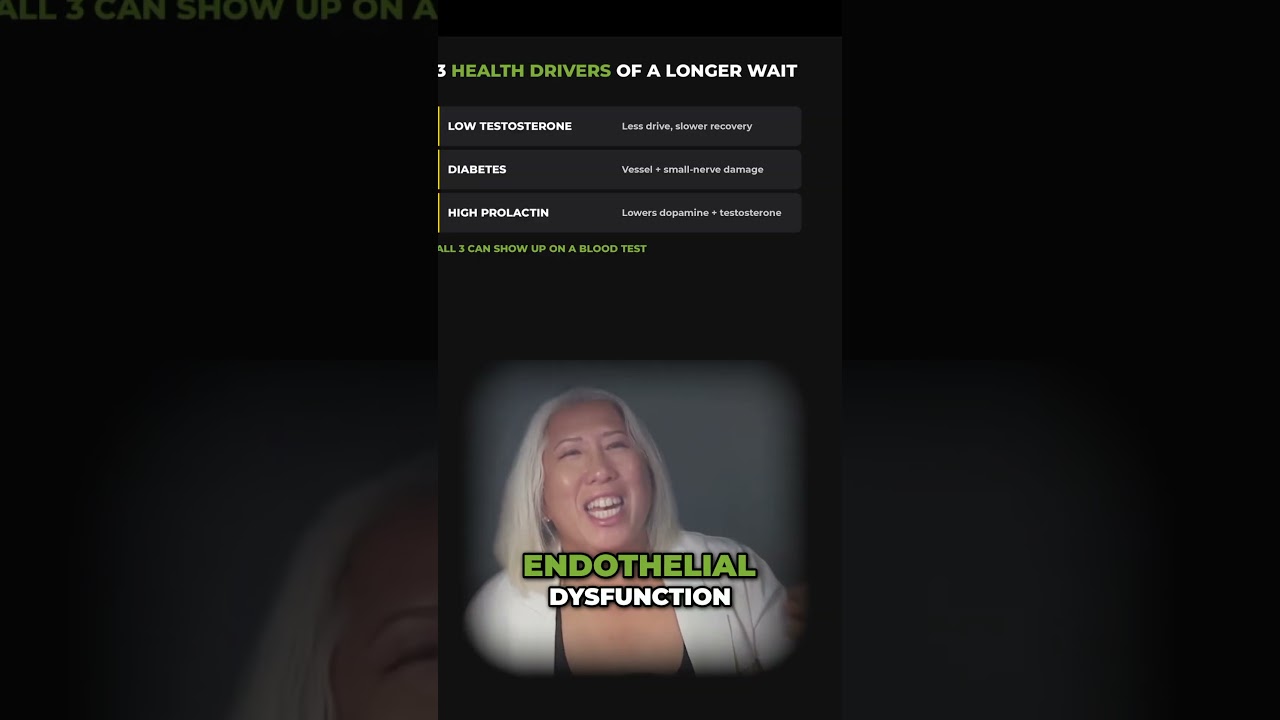
3 Health Conditions Behind a Long Refractory Period #LowTestosterone #MensHealth #shorts

Does the Refractory Period Get Longer With Age? #RefractoryPeriod #MensHealth #shorts

5 Common Medications That Can Slow Round 2 #MedicationSideEffects #MensHealth #shorts

Why Round 2 Takes So Long: The Brain Chemistry #RefractoryPeriod #Dopamine #shorts
Long Refractory Period? It Could Be Early ED #ErectileDysfunction #RefractoryPeriod #shorts

Is Your Medication Slowing Round 2? SSRIs Explained #RefractoryPeriod #MensHealth #shorts



