How Sleep Can Improve Your Sex Life
A podcast-style YouTube episode (Dr. Anne Truong MD with husband Bao) explaining how sleep affects male sexual function. Main claims: adequate REM sleep is necessary for nighttime/morning erections and for testicular testosterone production; insufficient sleep raises cortisol and lowers testosterone via HPA/adrenal mechanisms, contributing to erectile dysfunction (ED) over weeks; sleep-related hormonal changes also affect metabolism (insulin resistance, belly fat) which can further lower testosterone (aromatization to estrogen). Practical guidance: aim for ≥7 hours sleep (ideally sleep window near 10pm–7am), target sexual activity about three times per week to "exercise" penile function, and expect hormonal/functional recovery in roughly 3–6 weeks after restoring sleep. The episode also notes calories burned during sex (~150 kcal men, ~100 kcal women) and that men experience multiple nocturnal erections (average ~3–8/night).
Questions this video answers
At least 7 hours (ideally within a ~10pm–7am window).
About 90% in the testicles and 10% in the adrenal glands (per the speaker).
About 3–6 weeks (speaker gives ~3 weeks as earliest and commonly 3–6 weeks).
On average about 3–8 spontaneous erections per night (speaker cited studies saying 3–8, sometimes 5–8).
Approximately 150 kcal for men and 100 kcal for women (average values given).
Chapters
This podcast is for you. The modern man. I'm Dr. Anne Truong, your host. I'm an intimate health medical doctor and best selling author of the book Erectile Dysfunction Fix. I'll do a deep dive into sexual health and performance and how it affects men of all ages and backgrounds. So let's get started and be sure to visit my website@sexualhealthformenpodcast.com for more information and resources from the show. See you on the inside. Hello. Hi. Welcome back TO this is Dr. Ann and my lovely husband Bao.
Hello.
We are here today and today we're going to talk about how is sleep affect your sexual function? Because that is the question. Because we, the first thing that we, we do when we're busy is we compromise our sleep. But do you know that if you don't have enough sleep, that is going to affect how you perform in the bedroom and it can take as early as within three weeks and we're going to explore that today and have a discussion about it. So you know, for instance, you need at least seven hours of sleep, particularly from 7pm to, I mean some from 10pm to 7am in the morning to get that adequate buildup of testosterone hormone that gets created in your testicles at nighttime. Because that's when, when you're asleep, you're in REM sleep. So you're in REM sleep, your testicles make more testosterone. In a man. Testosterone, 90% of it is made in the testicles and 10% of it is made in the adrenal glands versus for a woman, 50% of it is made in the ovaries and 50% in the adrenals. So getting rapid eye movement or REM sleep is critical for, for development for hormone. And during REM sleep is when you actually have a morning or nighttime erection. So do you notice that?
I do. But what happens though, if you sleep more than seven hours, does that mean that you have more capability in getting the erection or doesn't really make a difference?
Well, actually that's a good question. If you sleep more than seven hours, it doesn't help more, you know, it just means that you're more rested. But if you sleep more than seven hours, sometimes your body will just kind of wake up naturally. Ever to a point where you so exhausted you sleep more than you need to. Your body just telling you you need to sleep. But if you are well rested, you will wake up when your body's ready to wake up without an alarm. The point is your body heals physically from 10pm to 2am and mentally from 2am to 6am the multiple studies have shown healing start at nighttime, not during the daytime. So sleeping is essential for healing and sleeping is essential for healing, particularly, you know, down there as well too. And that's why a lot of us spend time in bed at nighttime and, you know, sexual activity.
Well, I know that if I don't get a good night's sleep of a minimum of seven hours that you say the next day, next morning, my morning erection is not as hard.
Yeah.
And also the next evening or even during the daytime, I don't. I don't feel like I'm rested or have the libido or the urge to have intimacy. So sleeping or sleep deprivation plays a role, is what you're saying in ed.
Right, right, absolutely. And to dive a little bit deeper into it and get a little bit nerdy, which I love about the hormones, is that when you're not have enough sleep, your adrenal gland, which then secretes more cortisol, because when you're not having enough sleep, your body senses stress. Do you release more cortisol? So when you release more cortisol, your body feel that, oh, my goodness, I'm stressed. Well, the first thing I want to do is shut down my testosterone. I'm not going to make as much testosterone because I got to prepare my body to run away from the emergency and not be prepared to have sex. Right. So what happens is your testosterone level decreases and your cortisol level increases. So they fight for each other and they fight for the receptors in the cells. So it's critical that you manage that stress level too and know that the cortisol level affect the testosterone level. So too much of cortisol not good. But then again, too little cortisol is not good as well. And all of that cycle is called the hypopituitary axis and what we call the adrenal fatigue. Essentially, you know, when you're stressed, it's good that you have high cortisol, so that way you can adapt. But then when you too much stress, you continue to be high, high, high, high. And then your body says, I can't handle this. I'm just gonna do decompensate. And then your cortisol level drop because you can't adapt anymore. You go drop, drop, drop, drop. And then you hit rock bottom barrel, and you can't adapt to stress. When you can't adapt to stress, you just rock bottom barrel. And then what happened? You have no hormones left? You have more, no more thyroid hormone left. You have no more sex hormones left and you just become totally, you know, burnt out. And that's what's called the adrenal fatigue stage three.
So that's why you always want me to sleep a lot. Is that for selfish reasons?
Yeah, that's why I'm always stressing.
Well, I get it.
Try, try to go to bed at least seven hours and at least between seven, I mean 10pm to 7am and we're not the best at it either. We're night owls. You know, we go to bed at midnight and, and crawl out of bed around like 7am we need to do a better job at trying to go to be because our body needs that physical rest more than anything and, you know, more. So you don't have enough sleep. What happens when you don't have enough sleep?
Well, you get grouchy, you feel tired, your whole day is spent really drinking 10 cup of coffee and which is not good for you. So I mean, sleeping well is the key to health and most importantly for ed, to help prevent ed. Right. I mean, so let me ask you this. What's the frequency though? How long can I go without sleeping the seven hours and not have it affect the ed? Is it something that if I don't sleep within two days I get ED right away or is it overtime?
Well, it's actually cumulative over time. Probably would take about six, three to six weeks or so, you know, until your body senses an imbalance. I was just probably say about six weeks until you start seeing like a little dip in the levels. And that will compound with the effect that I talk about with cortisol as well too. Right. You'll, you'll see cortisol level rising and then you also will see on top of that, you know, changes in fluctuation in your blood sugar level because cortisol will also raise your blood sugar level as well. Then you become a little bit insulin resistant and then you start putting a little bit of fat around the belly. Do you know that for men that when your testosterone level is low, when you have less hair on your legs, when you start losing hair on your legs, or that you start gaining a little bit of fat around the love handles and the belly and. Or you start to have a little bit of fat around the breast area.
So that's hormone imbalance, right?
Right. What happened is that the testosterone gets converted to female hormone estrogen in that fat, so it takes away your total testosterone, which make you a male. And then again it all ties back to men make their testosterone in their Testicles and the testosterone are replenished in the testicles, and that's where the production is made. All right, and when is it made? It's made when you're asleep, during REM sleep. That's when you have nighttime erection or morning erection. And in fact, studies have shown that actually men can have up to five to eight spontaneous erection at nighttime. Do you know that?
No, definitely. I definitely see that. I mean, I know that in the middle of the night I get that and then early morning and then when I get up. So for me it's about three to four times erection throughout the whole night.
Well, that you know of.
That I know of.
That you know of. Yeah, that you know of. So, you know, put in a comment below how many times you think you have an erection at nighttime or morning time? Because, you know, average about three to eight times according to a study. But many men will probably report maybe the same or less. Right? Because sometimes you don't know. You probably when you were younger, you probably have a lot more as well too when you're younger. Your, your testosterone level is the highest when you're in your 20s. That makes sense. Right? And you're in your 20s and it start declining when you're around 35 and decline about 1% every year.
So what, what happens if. So, so if you don't sleep a whole lot, sleep deprivation, less than seven hours, and you correct that over time, how long does it take for you to get back on track again in having ed? Is it something that you can recover in one week of sleep of seven hours, or it just takes more time? Once you've fallen into the pit hole of having ED because of sleep deprivation, how long does it take?
Right. Yeah, now that, that's a good question because let's just say you have a project and you've been staying up late and trying to finish that project and well, you know, your body is plastic, meaning is very adaptable. So it will probably take you again probably about three to six weeks again to normalize your. Yes. To reset again, to get back on schedule again. About three to six weeks is what the time frame is for healing and reestablishing homeostasis. Again, it's not overnight around that time because that's when we see changes in hormone levels and when we see like for instance, if you change your diet, if you eat a low fat diet, low low carb diet, and within four to six weeks we see a change in your cholesterol, your blood sugar in your blood, but you don't See it right away. It takes some time for your body to get to that homeostasis and cellular changes levels, I would say probably between like more optimally around you know, four to six weeks time frame.
So it sounds like it's by not sleeping a whole lot that's hormonal or chemistry imbalance. How much of that is also plays a role into the mind. How does that affect the mind? Besides the physical? What you've explained chemistry. What about the mind, the psychology?
Well, of course. You mean you're talking about like lack of sleep.
Yeah, lack of sleep.
Yeah, well, lack of sleep as you know, when you said that when you have lack of sleep, your mind is not as sharp and you don't have. Your memory is impaired, you have lack of focus on you and your what you need to do and lack of energy, more fatigue. So certainly sleep is essential for mental and physical resetting.
Okay, so also not put you in the mood, right?
Oh, definitely. I mean, when you have lack of sleep, who's in the mood to have to have to be in the mood for sexual activity, right? So that's why, you know, the bed is the most preferred way to have sexual activity, because you want to encourage sleeping. Let's mention that one of the reason why after you have sex, there are hundred hormones that are released in your body and in your brain that actually promotes sleep. Like hormones such as oxytocin and various hormones that is released that actually make you go to sleep. So after the effect of sex, what happened? You get sleepy, right?
You get tired.
You get tired, spend a lot of energy. Yes, not only spend energy, you know, for just, just FYI, men spend about 150 calories during sex and women's about 100 calories. So you know, it does consider moderate exercise when you have sex and the longer you go, the more energy you spend. So you know, sex is moderate exercise.
But you know, on a side note with that, you guys out there in the audience wear your watch, your iwatch.
Your Apple watch, right? Watch.
Yeah, because we've done it just out of curiosity to measure heart rate and calories burned. And what she said is very true. You do burn calories and your heart rate do go up, especially when you reach your orgasm. Which is very interesting. Very interesting, right.
It's a good metric to follow and it definitely is accurate in about 100 calories for women, 150 for men. But that's on an average. But getting back to my point, as I was getting back to my point was I was saying that you Know, the sleepiness that you get after orgasm is promoting sleep and good sleep. Right. And there's a hundred hormones and substances are being released, but you get this peace, the sense of peacefulness, the sense of connection and relaxation that you get and calmness that you get after sexual activity. And if to. Why to promote sleep. Right. And sleep is essential. So you should not be considering taking a medication for sleep, because sleep is like blinking your eye. It should be natural. And if you aren't able to sleep, you should really look at the cause of why you're not sleeping and treat that cause. Instead of trying to take a medication to induce you to sleep, maybe you should have more sexual activity, either with a partner or maybe solo.
I hope for more sexual activity and.
Try to induce that natural hormonal release in your body to induce that calmness. And we know the frequency. What the, what the. You know, the optimal frequency. It's about three times a week. You know, sexual activities optimally, it's kind of like exercise three times a week as well, every day if you can, you know, but you know, at. At the least three times a week. And I mean, I tell my patient this, when your body will. Doesn't. Doesn't tell difference whether you have orgasm, ejaculation with a partner or with Solo. And it's still the mechanism of an erection and orgasm and ejaculation. And I tell my patient, when you have that, it's like clearing the pipes. You know, you need to exercise your penis muscles and you need to clear the pipe, clear the plumbing three times a week. So that way you exercise those muscles, you don't use it, you lose it. So you don't use your penis muscle. Guys, it's going to start atrophying, it's going to get scarred down, it's going to get smaller. And then when you try to use it, you're surprised, oh, it's not working as well. Well, of course you're not using it as you should. It's like you're not going to the gym. And after six months or nine months and not going to the gym, you're going to expect to go in the gym and try to do that shoulder curl of £100 like you used to do. No, you're going to have to kind of work your way into it. It's the same thing. Your penis is also a muscle itself, and it needs to be worked out.
Well, I mean, I think it also helps to reduce stress. And also I do know that if you have intimacy frequently per week at least maybe three, four times a week that I feel less tense, more relaxed. And now I know why, from what you're saying, because it's true when you have intimacy and you, you know, throughout the whole week, you just feel a lot more comfortable. It's like your. Your pipes aren't clogged and your water's not running through, and you feel so much better. So I can see how that's happening.
Clear the pipes. Clear the pipe. Those of you that are my patient.
Today is clear the pipes.
Clear. Yeah, clear. Clear the pipe. Exercise the muscles. Use it or lose it. Same thing with your biceps. Your biceps curls, you know, use it or lose it. Because don't expect the. Your, you know, your penis to perform if you don't train it right to perform. Because, you know, you have to train it. And there are ways that, you know, there are penis pumps that are available and that you can exercise with. In my past episode, I talk about the penis pump and how to use it and how to optimize it. And the penis pump can bring in more blood flow to the muscles. It'll help you get an erection as well and get you started as well. And to help you exercise the muscle, clear the pipe and get it started. And there's nothing wrong with doing solo if, you know, if there's no partner available. Of course, optimally would a partner be optimal situation, but, you know, not sometime that is, you know, not available at this time. So, yeah, to end with sleep is critical, but it's the number one thing that we give up with our busy life and running around, I have to say that we're probably at fault with that to ourselves.
Better.
Yeah. And I know that, you know, a few weeks ago we were moving and we had maybe five hours of sleep, right? And we were cranky. We were not clear in our thinking and certainly not was not up to par three times a week, for sure. And sexual, yeah, sexual activity was definitely not on our mind at that time, but we made up for it since, you know, we settled down and we preach what we talk about as well. So. And, you know, I would like to hear what you guys think about this episode. Put some comment down below. Let us know what you think and make sure you check out our website at Sexual Health for Men podcast. We love to hear if you have any questions or anything. We'd like to. If you'd like me to answer that in the future episode. See you the next episode.
Bye. Bye.
More from Anne
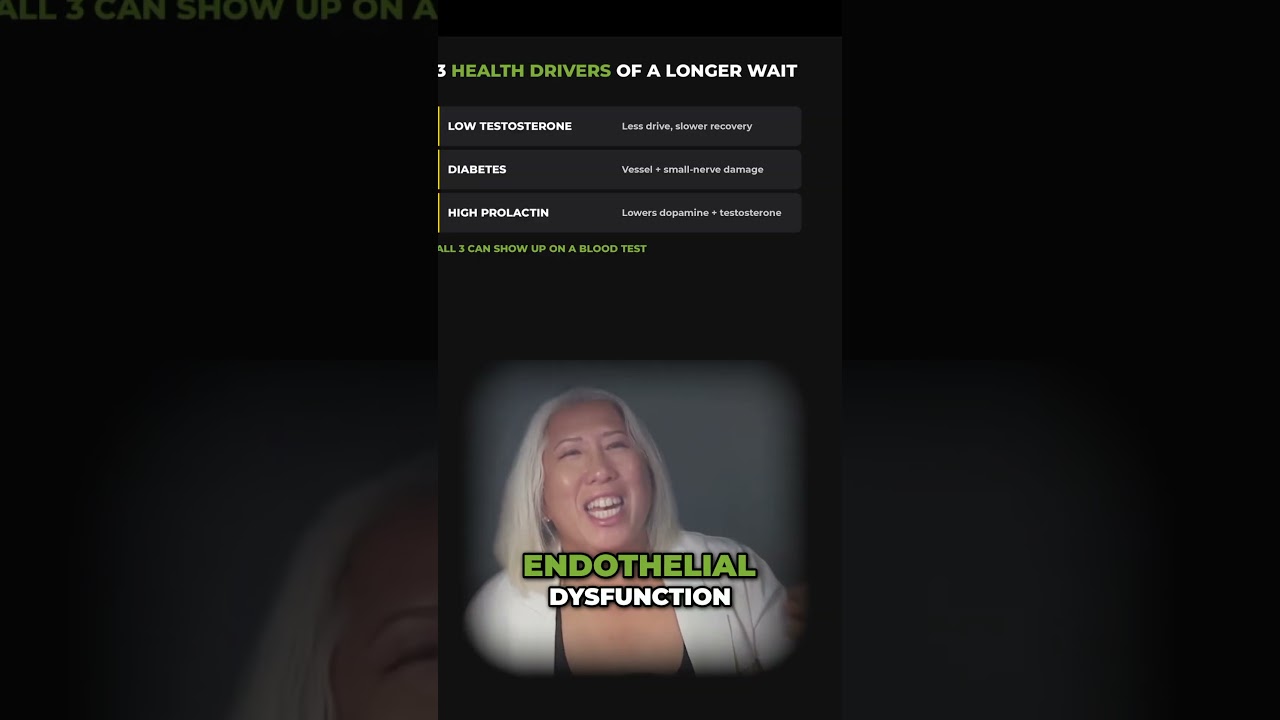
3 Health Conditions Behind a Long Refractory Period #LowTestosterone #MensHealth #shorts

Does the Refractory Period Get Longer With Age? #RefractoryPeriod #MensHealth #shorts

5 Common Medications That Can Slow Round 2 #MedicationSideEffects #MensHealth #shorts

Why Round 2 Takes So Long: The Brain Chemistry #RefractoryPeriod #Dopamine #shorts
Long Refractory Period? It Could Be Early ED #ErectileDysfunction #RefractoryPeriod #shorts

Is Your Medication Slowing Round 2? SSRIs Explained #RefractoryPeriod #MensHealth #shorts



