What is Vitality? How to Boost Your Vitality | With Dr. Allan Mishra
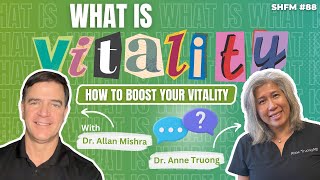
YouTube interview (Aug 2023) with Dr. Allan Mishra, an orthopedic surgeon and early clinical researcher on platelet‑rich plasma (PRP). The conversation covers Dr. Mishra’s history developing PRP for tendinopathies (especially tennis elbow), evidence timeline (pilot 2006, larger trials including 2014 and a 230‑patient randomized trial), and the concept of “vitality” as purposeful, vigorous, connected living. He presents a four‑pillar “vitality flywheel” (physical, mental, social, spiritual), highlights inflammation as a common driver of aging and sexual dysfunction, and offers four practical anti‑inflammatory recommendations ("staple your mouth shut"—eat less sugar/less often, participate in sports to prevent sarcopenia, be social, serve others) plus behavioral exercises (Mission Impossible framing, million‑second challenge). The episode also includes host Dr. Ann Truong’s sexual‑health oriented wrap‑up and a promotional section offering a free “Good Morning Wood” smoothie recipe, nitric oxide testing strips, and a 30‑day trial of the Modern Man Club.
Chapters
How does vitality affect your sex life? Find out the four tips that you can do right away that will improve your sex life.
Stay tuned.
Well, hello. Hello, everyone. I am so glad we have a Special guest today, Dr. Alan Mishra, a board certified orthopedic surgeon and, and wanted the pioneer of platelet rich plasma and prp. And I want to put a full disclosure. I have known him since I first started prp. Have a little bit of a crush on him because I would go to a conference, oh, my God, he's speaking. I want to listen to what he has to say because every word coming out of his mouth is solid gold. If it weren't for him and bringing platelet rich plasma or PRP to limelight, I wouldn't be here doing what I do. So thank you for being here.
Oh, Ann, you're so sweet. And I really, really enjoyed meeting you at that recent regenerative medicine meeting in person and talking to you for a great time. I'm looking forward to connecting with your audience about how we can optimize their vitality.
Right. So Dr. Mishra was one of the first doctors to actually use PRP in a clinical setting setting. And I've always wondered what the backstory is as a surgeon. You do surgery, why all of a sudden you're looking at another alternative that's not a surgical treatment for tennis elbow. So please tell us about the backstory about that.
Well, it's interesting and I think it's common in medicine sometimes for patients to want to have something new for them. Patients really don't want to have to have surgery. It's not like you wake up in the morning and say, hey, it's my birthday. I want to have surgery today day. So people were looking for an alternative, myself included, to using cortisone as a treatment for tennis elbow. Tennis elbow is obviously very common. Right. So cortisone, when I was first studying to become an orthopedic surgeon, was obviously one of the most commonly used treatments. But I started seeing people who had complications from cortisone and things like dermal atrophy or they would get better and then they would get worse, especially their skin would get thin. And then one of the very first procedures you learn how to do as an orthopedic surgery resident is tennis elbow surgery. And one of the reasons why is it's relatively straightforward. You make an incision on the outside part of the elbow, you get down to where the tendon is, you get down to where the bone is, you remove any of the degenerated tissue and then you repair that. But just before you finish the repair, you use something a little nice called a rongeur, which you scratch up a little bit around the bone or you cause some bleeding. It's one of the very few times in surgery that we literally cause some bleeding. And I remember, I don't know, I must have been a second year resident or maybe I was in med school. I don't even remember when I first was exposed to tennis elbow surgery. But long time later I'm thinking, okay, what really makes the story surgery successful? Is it the surgery or is it the bleeding? And if it's the bleeding, could PRP actually make a difference? So, you know, I did publish that first study, the pilot study with 20 people. We then went ahead to do a prospective randomized trial all over the.
What year was that again?
The first study I think was published in 2006 and then the second was in 2014. But what gave me a lot of confidence is what when one of my colleagues from Europe, Taco Gosin, published a two year prospective randomized trial of PRP versus cortisone and found that PRP worked. So I was a little, maybe not confident until he did his work on the other side of the pond. And then when we did the third study, which was a 230 person prospective randomized trial, we all used the same form of prp, a Leukot rich version of prp. We all use the exact same protocol. And I'm very, very happy to say that this now has stood the test of time. I can't believe I've been doing it for so long, but it now seems to be a reasonable, valid treatment for tennis cell. So that's pretty cool. It's using really a component of your own blood platelet rich plasma. What I like to say, and this is also true for vitality. The power to heal yourself can come from within. Right. So your, your own blood is coursing through your, your bone marrow, your veins, and we just concentrate that and then put it back into an area where you're not healing it very well. And I know you do this for a variety of other issues that people may have, but the same is true for your vitality. And I think one of the things we need to do for our vitality and I look for to our continued conversation here, is we need to sort of collapse our internal barriers to success sometimes get out of our own way to be our most vital version of ourselves.
Yeah, we're definitely going to dive into that later and why we need to have vitality. But can you explain, and I know you know, on a deeper level than I am, how does PRP so that way our listener can understand platelet rich plasma, which are the platelets in our blood. How does it help with healing? How did it help that pain in the elbow and uncortilate? How does it help with knee pain? And how does it even help rejuvenate, decrease inflammation, increase blood flow to the sexual organs? What does our platelet do that help with that?
It's actually kind of easy. This is how I explain it to my patients. It's like the next time you cut yourself and for guys maybe shaving your face or you know, cut your finger. I actually, I don't know if you can see this. I cut my finger a few days ago and, and what happens is awesome, right? We don't bleed to death. The reason we don't bleed to death is our platelets get there to stop. You know, they create a little plug. They create a little platelet plug. And within that platelet plug is sort of this entire mechanism by which you heal your skin. You stop, you rejuvenate your skin. So platelets stop the bleeding and then they kind of spit out their guts, which is a whole bunch of different little, you know, molecules that can stimulate a healing response. So that's the process that has begun with the platelets, but it's obviously very complex. There's a lot of interactions between platelets, white blood cells, the tissue that's wherever you're putting it, and it orchestrates a rejuvenation of that tissue. That's pretty spectacular. Now, I'm going to be honest with you. I've been at it for a long time. I do not really completely know. I do have a lot of data that I'm looking at right now in terms of pathways, in terms of specific things. It could be a lock and key. Unfortunately, there's about 3,000 different molecules in PRP, so unlocking the exact one or two or five that are doing it, it's giving me a headache to thinking about it.
Kind of like the more you know, the more you don't know, the more you learn.
Well, that's probably true.
Right?
That's probably true.
And I.
The good news is it's only. It's your own stuff. That's, that's what I like about it. It's your own blood concentrated and put back into you, typically within the same, you know, setting.
Right, right, absolutely. And, and it's. I call it Your natural medicine itself. And there's no better medicine than that. So that's good. So does that mean that if anyone come and see you for elbow pain, that's your go to treatment? Is the PRP first? And this is in 2006. This is when they were all getting surgery after they failed multiple cortisone injection and physical therapy. Is that kind of like the algorithm now? And so the second correlation to that is that you're a surgeon and the next step would be surgery. Now you're doing prp. How were you regarded by your peers at that time?
Well, I think when I first started it, I think a lot of people thought it was pretty crazy. But I had an intuitive sense and I think this is important for people to think about is I had a really strong intuitive sense that I was correct. But this is the but is important. I was my own skeptic. So one of the reasons you're talking to me, I think is because I did the hard work of doing the studies to prove that my intuition was correct. And then I had colleagues that I had never met and never talked to take the work that I had done and replicate it. So over time, there's now been unbelievable number of studies that have replicated the initial findings. So if I just anecdotally said here, and here's 10 patients that I did, they all did well, you wouldn't believe me and you shouldn't believe me as much as if you looked at all the published peer reviewed data that is piled up in favor of the safety protocols for prp. And one of the other ones that was published was in England. They're looking to try to optimally treat patients, but they could reduce the number of tennis elbow surgeries by 80 or 90% using PRP. So even though I'm a surgeon, or especially because I'm a surgeon, I understand the risks and complications associated with it. Now, with tennis elbow, it's not very high, but it's expensive. Right. And so if you think about the difference between surgery for tennis elbow versus using prp, it's probably a tenth of the cost when you include the anesthesiologist, the operating room and all that kind of stuff. So, yeah, maybe I torpedoed some of my tennis elbow surgery cases, but I know, especially in the context of publishing those papers that I've hopefully helped not just the people that I've taken care of, but the people who've read my work and been able to apply it to thousands or maybe tens of thousands of patients.
Well, I appreciate it is. I appreciate that because you didn't publish it then, like you said, other researchers wouldn't have replicated the work. And then like before we started, you said the ripple effect. You started the ripple. And now the ripple effect, the 10,000 phone compounded. And it's helped probably millions and probably billions of people with that at this point. In fact, if you're in a third world country, you don't have access to medication. You just use your own blood, draw out the blood, maybe you need a centrifuge, and that's about it. And it's probably a lot cheaper as well. So the effect is enormous. And I can't imagine if you didn't publish it, where would we be at this time with regenerative medicine? So how were you regarded by your peers after you published the data about prp?
They were appropriately skeptical. And again, I think over time, it's changed when people who are independent, looking at what you're doing and you know, one of the things I think we talked about when we were at this regenerative medicine meeting about a month ago is the paper, that first paper that I published, I was no rocket scientist. I was just doing something new. Is one of the top cited elbow surgery article of literally all time, and it's the most cited elbow surgery article in the 21st century. So that means that a lot of people read it and a lot of people looked at it, and then a lot of people tried to say, is it good or is it bad? So I think the initial response was skepticism, appropriately. And then it's now morphed into, wow, that's very interesting. And now I literally teach other orthopedic surgeons and other people how to best optimize the use of regenerative medicine, as do you. And it's so exciting, right? I mean, we together, it's not me, it's thousands of people like us who are doing this. And we are hopefully honestly trying to identify novel, transformative solutions for people with difficult problems. Right. And if we do that in a less invasive way, I hope I don't get kicked out of the American Academy program. Okay. If we do that in a less invasive way that doesn't require surgery, then that's what we should be doing. Because I think of my job as to try to identify the best solution for my patients that has the least invasive manner and the least complications and the highest upside. So that's actually where PRP has taken over. Not for everything in terms of 10 tendinopathy, but if you have tennis elbow and it's if it's not severe. And by the way, it's not for everybody. Sometimes people come to see me and then they think PRP is going to cure end stage arthritis or it's going to, you know, the tendon is not attached to a bone. It doesn't reattach a tendon to a bone. Have that disclaimer out there. But if you're in the mild to moderate version and you failed other treatments, what I do want to put a nail in the coffin of is cortisone, because cortisone is not a good idea for tennis elbow and more. I've been saying that for more than a decade. I think, Ann, I was more right about cortisone being a bad idea. And so that's probably what drove me to pushing PRP as much. Because cortisone is not a benign treatment for tennis elbow.
Absolutely. I myself had actually cortisone in my plantar fascia and I ended up tearing my, my fascia because of just one treatment. At that time I didn't know any better. So right now you're looking at your patient interest. Whether it's a non surgical or surgical, it's still the patient's best interest. And overall, that's why we're physician. Right. And that's why I applaud you for that because you believe in doing what's best for your patient. So currently, right now, orthopedic surgeon statement regarding PRP and what condition that they think that it will be helpful for.
At this point in 2023, it's constantly evolving and I don't think the American Academy of Orthopedic Surgery should have the final say on that. I think there are a lot of different organizations that are trying to contribute to that. And one of the things that came out of the meeting that we were at is because of my unique position being sort of on multiple different sides of this equation, is my goal is to say why can't we all get together with more, more consensus statements about consensus statements. What I can tell you is more about the data. And the data is getting better and better for specific types of tendonitis and specific forms of arthritis. Probably the top two that are reasonably well defended in the literature are tennis elbow and mild to moderate knee osteoarthritis. But what's unsolved, there's a lot more work. Those young people who are listening to me who are thinking by going into research or I was not actually thinking of doing a ton of research, even if You're a clinician and you're trying to make a contribution is try to help solve these equations of what is the exact best formula to match the best indication. So I'll flip that around and I'll say in your world, what are the best applications or indications for prp? Because I would love to hear from an expert like you, what do you find as being most meaningful?
Right. And I appreciate that actually. So for the listeners, if you have tennis elbow and if you're young, if you just have a stiffness with your joints or maybe just pain with exercise, there is another option beside cortisone injection into your tendon, like your elbow or your shoulder or your knees, and look into that for platelet wedge, plasma and before surgery. So just another alternative, and that's what I wanted to kind of get the message out there is that seek another alternative there. So let's move forward. And Dr. Mishra now the father of PRP, he published data and everybody is like, wow, where PRP is a new alternative here. And I love it. That's what got me started in it in around 2000 and I believe in 10 as well. And so you then kind of geared towards more longevity and vitality. What motivate you to kind of gear towards that direction.
So it's interesting and they're connected. So I got invited to go to a meeting in Hong Kong to present my PRP research at the Chinese University of Hong Kong, which is on the mainland of China. And it was in July. It actually happened to be on my birthday when I was going to be presenting. And I tried to get my family to go with me, but then, and they looked at the weather in July in Hong Kong and they're like 99 degrees and 120% humidity. So they didn't really want to go. But we always wanted to go and I always wanted to go to Australia and specifically to go scuba diving in the Great Barrier Reef. So it's not exactly close. But prior to the meeting in Hong Kong, we went on a family vacation to Australia. And just before I departed to go to the meeting, we were in a small town called Port Douglas, which is in the northern part near the Great Barrier Reef. And I went running on this beach, it's called the four mile beach, about two miles down, took a little swim into the Coral sea, came back and the last day I was there, I'd been doing this and of course my phone didn't work. I'd been on vacation, I was with my family. But I had this really sort of lightning bolt kind of moment as I stared at the Coral Sea, I was like, I feel really vital. And I'm like, okay, when I go back to Silicon Valley, which is where I've lived and practiced for 25 years, how am I going to replicate this? And then specifically, how can I find a biomarker for vitality? So at that juncture, I'd had at least 10 years of doing research with PRP. So my thought was when I came back that I, I was going to find the Holy Grail, I was going to find what is a biomarker for vitality. And so literally, and I spent about a year flipping through anybody and everybody who would listen to me here in the Bay Area and literally all over the world, and then doing my own exome, doing my own salivary cortisol, wearing anything I could wear to figure out whether my heart rate variability or other things were connected to my vitality. But the second little light bulb went off is, well, there's two. The first one was, it's not just your physical vitality. Your cholesterol, your glucose, your. Everything can be perfect, blood pressure, but other things can screw up your vitality, your social well being, your mental health, your spiritual well being.
So now what is vitality? Can we go back? What do you define as vitality?
So my working definition, and one of the reasons I call it Vitality Explorers, I'm continuously exploring, what is that word mean? I'll probably do that for the rest of my life, but here's my working desk definition. Purposeful. Vitality is purposeful, vigorous and connected living. So purposeful, vigorous or energetic and connected living. So each one of those words is selected carefully. So knowing your purpose is really important to your vitality. Having vigor or energy is important. And especially you and I are doing this right now. It was lovely to connect with you in Vegas, but it's also lovely to connect with you for this podcast. And too often we forget that those are as, or probably more important than our physical well being. So that led to this idea of four pillars. Physical, mental, social and spiritual. Which is not really a unique idea, but the idea of them being connected in a circle, almost like a flywheel, sort of called the vitality flywheel. The best example of that is sleep. So if you sleep better, you're going to be better able to, you know, handle whatever physical things are in the next day. Your sleep is also very connected to your mental well being, and that sort of enhances it. And what I had forgotten is that your social connectivity is hugely connected to, to your overall sense of vitality. And then the second little thought, if I may, this is the thesis I have for vitality explorers is that vitality is a skill. And as soon as I figure that out, Ann, I applied to teach a course at Stanford on how to enhance your vitality. Provided 2 to 300 pages of my notes on it, and then I taught that class eight times. It led to the publication of this book of mine, Dare to be Vital. And that has led me to unbelievable opportunities of trying to do what I love to do, which is try to optimize vitality one person at a time.
Wow. Vitality is a skill. I love that. And so to recap, vitality is purposeful, vigorous and connected living. And I like that because you got to have a purpose in what you're doing and the energy and the vigor in your life. And then connected living, it's a social right. So there's three things that everybody, all human being want is health, health, wealth and relationship. Right. Relationship is a connected living and health is energy, vigor and wealth is in financial stability. Not making billions and millions of dollars, but more financial stability. So that way you not stress out and maybe have that purpose and what you need to do for financial stability. So it very much aligned with the three main core needs of everyone. Everything I do I kind of connect. Okay, is it health, wealth or relationship? I love what I do because I focus on sexual health, which is really two of those pillars which is relationship and health. And then if you have that, then you will have the wealth as well for stability. So can you go into a little bit about your flywheel which involving the physical, social, mental and spiritual and what are some of the pillars in each of the flywheel there?
So thank you, by the way, Ann. And I do think we should make sure we have time to talk about it because I think it's directly connected to the work that you're doing. So in the physical well being that could be things like your ability to, you know, connect on a fitness thing with aerobic, anaerobic endurance, flexibility and the mental well being that's very, very tightly connected to the social well being. So if you are lonely or if you are not connected to other people, your mental well being, as good as it could be, and the opposite is actually really true. And I have a lot of different specific things that I try to teach people about how to enhance their vitality. But if I may, I have idea about and I try to do my homework. You don't know me too well, I'm a big time boy scout and trying to do my homework, so. And I know exactly what you do, which is not in my area of expertise. Memo to any of my patients. I flunked urology and ophthalmology and dermatology in med school. I never took those subspecialties. But I wanted to try to understand in the context of, you know, sexual health, what is the thread between the top things that are associated with issues? So it can be cardiovascular, it can be things like diabetes, obesity, and it can be your mental health help. But what's connected to all four of those? And again, we're having a conversation, so you tell me. You're the teacher here. I'm just the student. What's connected all four of those is inflammation. Okay. And so one of the massive markers of aging that I've discovered and other people have validated is that inflammation is connected to aging. If you'd like, I have four suggestions for your eyes.
Absolutely, go for it. Because I'm a big anti inflammation person too. So it's all about inflammation, inflammation, blood flow.
Okay. They're a little snarky. I hope that's okay.
All right, I'm ready.
Okay. And you're going to give me a grade on this. Okay. Because this is not, I'm asking, I'm not telling people here, but my first thing to decrease your inflammation, and it's one of the chapters in my book, it's staple your mouth shut. Okay. Now why do I say that as opposed to, to just eat better or, you know, don't eat as much? Well, you're going to remember that. Here's the data. And one of the things I do with Vitality Explorers, all of my work is back it up with peer reviewed published data because that's when we take the thread from my beginning with prp. What I'm doing with vitality, I hope, is to provide specific, scientific, actionable, what I call info snacks. So here's an info snack for you. If you take a 12% reduction in your calories, you're gonna just at 12%, which is not like crazy, you're gonna have decreased inflammation in your body and increased immune function. That's not my opinion. That's based on peer reviewed data. So the first one is just to admit that you're putting too much in your mouth. And the Dr. Mishra diet book has three pages. Eat less sugar, eat less and eat less often. Okay, that's it. Less sugar, eat less and eat less often. Okay.
Less sugar.
Well, it's Pretty straightforward. Remember, I'm an orthopedic surgeon. So you know, I have a little joke for you. Do you know where you can hide a hundred dollar bill from an orthopedic surgeon?
Where?
In a book. Okay. Okay. And then do you know where you can hide a hundred dollar bill from a plastic surgeon?
I don't know.
You can't. The plastic surgeons will always find it. Okay, so. So remember. Okay, let's do the other three. So number one is to staple your mouth shut. Number two is to participate in sports to avoid or prevent sarcopenia. Now, sarcopenia is a fat fancy word that means lower muscle mass. But lower muscle mass is really tightly associated with increased inflammation and something called CRP or C reactant protein. So when I was trying to study vitality biomarkers, CRP or C reactive protein, which is just a measure of how much inflammation you have in your blood, is associated with inflammation of a variety of different types. But you can have less inflammation if you have more muscle. Okay, so participating in sports doesn't mean you have to be on the soccer field. It could be hiking, it could be walking, it could be using rubber bands, it could be, be going to a yoga class. It just means to do anything to get moving. So number one, staple your mouth shut. Number two, participate in sports to avoid or reduce your risk of sarcopenia. Number three, pretty easy. One, just be social. Okay, now social again, staggering to me and is if you are lonely, your inflammation markers, it seems obvious, but they've actually done studies on this that your inflammation is elevated if you are lonely. And so the suggestion I have if you're lonely or not connected with other people is to do some of these other things, maybe participate in a class you'd like. And if you're not lonely, if you're in a good space, if you're listening to this, I have 102nd challenge for you that is today to send a text message to three people and just say, hello, how are you doing, Ann? Hope you're doing well. Don't ask for a favor, don't ask for somebody to get you an appointment with somebody. Just text three people you haven't talked to in a while and your vitality will rise because you're going to help them. And then the final one is really connected to that and that's to serve others. When you serve others, especially in need, it's crazy, but there's papers out there that show that you have decreased inflammation. So let's review those. Staple your mouth shut. Number two, participate in sports, number three, be social. And number four, for serve. And they're all s words because they'll help you with your sexual health. Okay, that's my question.
Oh, when you were saying that, I was thinking of tape with your mouth shut. The mouth, the muscle.
Right?
The mouth, the muscle, the heart, which is social. And serve, serve. The other is your mind. Yeah. So this is what I'm thinking. Like mouth. Right. Mouth, heart, muscle, mind, all create the connection between that. And then your body will feel stressed. Because your body is stressed, you'll have inflammation. Right. And so I want to ask the listener, and this is solid gold. It's so basic, but it's so powerful. Sometimes the most basic thing or the most meaningful, powerful thing of all is what I find is that today, just to decrease your inflammation and increase your. Maybe your happiness is to text or pick up a phone and call someone that you haven't talked to in a long time, not just somebody that you're thinking of, that you just want to connect. And I've heard that before, and I used to do that. I have to be better and resume that and just say, hey, I'm just thinking about you today. That's all you have to do, but be amazed what the impact on the other person is. In fact, I receive a card. One of my girlfriend I've not talked to in years, and she just sent me a card, said, I'm just thinking about you. It just made my day. I had a terrible day that day. And I saw that card. Everything was erased within like three seconds after opening up that card. And I felt so much better. One thing I wanted to say, what are the biomarkers that you look for for inflammation in saliva or in blood work? What are those? Biomarkers?
Yeah. So that's that deep, deep, dark rabbit hole I went down for a year. And they're so variable, and I mean, they're dependent upon what you do. So let's say you. You listen and you go to the gym and you go work out, and then I measure your inflammatory markers after that. Well, they may go up before they come down. So if you take your salivary cortisol, which by the way, if you've ever tried to do that, you're supposed to spit in a little cup before you've had anything to eat or drink in the morning. And it's like trying to come with up with saliva in your mind. You can't do anything right. I found that a lot of these things just don't make any sense. I lean back into this idea of how are you feeling? Just be honest. How did you sleep last night? 0 to 10. How are you overall feeling? And then keeping a little bit of a record of that for yourself because it could be connected to your physical well being or you could have had a fight with your spouse or a challenge at work, or maybe somebody you know has an illness that they're battling. Maybe you're disturbed by some political situation that you have no control over. So there's so many different variables in there. I'm not sure we're going to be able to reduce it to. In fact, I'm pretty sure we're not going to be able to reduce it to a biomarker. I think we need to take a holistic approach. And that's why what I have is maybe a little other snarky assignment because of a movie I watched last weekend. Can I do that for your.
Yeah.
Okay. So I'm a big Mission Impossible.
Oh, me too.
All right. Okay. So I went to go see the newest one. There's not going to be any spoilers.
Oh, no, I didn't watch it either. So don't say anything. I haven't seen it yet.
Okay. But here's my assignment is to choose the impossible mission. So Tom Cruise, also known as Agent Ethan Hawk, is given at the very beginning of the meaning movie that. Okay, take. Is this your mission? You get to choose. All right, so that's kind of way, way back to the TV show that was a million years ago. Your mission, should you choose to accept it, is to work on your vitality. Remember, vitality is a skill. And here's the second thought. Vitality and is not something I can give you. It's not something your government, your doctor or anybody else. It's a gift you give yourself. And here's how you give that to yourself. You make better choices, decision decisions and take ownership over those choices and decisions in your life. Now, we don't have agency over everything, meaning we don't have control over everything, but we do have control over some components of our lives. And here's the third. So vitality is a skill. Vitality is a gift you give yourself. And the third one, and this is, I think the most important one, is to bet on yourself. Now what happens if you bet on yourself? If you bet on yourself to make better choices, if you bet on yourself to each day try to become a better version of yourself, something crazy happens, your confidence soars. Because who's more important to think that you can actually do it than you okay, So I don't know whether this is a crazy idea. I'm sure people have talked about it. Maybe you didn't have enough time in med school or undergrad to do philosophy classes. So I'm sure there's a lot of philosophers who've talked about betting on yourself or have talked about how your confidence can soar. But when you do that and then you take those other two, you think, okay, I can't give it to you. I got to do something for myself. And then you realize it's a skill. And if you realize that vitality is a skill, you can get better at it. Like, if you want to play better golf or better guitar or better piano or anything, you got to practice it. You got to work on it, and over time, get these little micro wins. And the final thing I have for you, if you choose to accept your mission.
I love it.
And your listeners, your viewers, is to take what I call the million second challenge. Because you and I can talk about it, you and I can think about it, but we need to put this concept into action. And this is what has resonated a lot with my students, with the clients I work with, with Vitality Explorer. And it's in the Dare to Be Vital book. It's to figure out what is my biggest need. Okay, could be physical, mental, social, or spiritual. Just pick one. And that could be diet. It could be connecting with other people. It could just be, you need a tranquility timeout, you need some mental time up. Or you need to figure out how to get out of your own way and stop thinking only about you and thinking about other people. Spirituality, serving somebody in need, whatever that biggest need is, write it down on a small piece of paper. It's got to be like a card. Okay. It can't be something very big. And then on the other side, write three things, three specific things you are going to do in the next million seconds. And that's about 11 and a half days. So whenever this is out there, whenever you're listening to it, look at the calendar and circle it about 11 and a half days from now. That is when you have to get those three things done. So when you do this, this specific exercise is one of the best ways to enhance your vitality, one of the best ways to care for yourself and also to care for those people around you.
Well, I love that, because one of the challenges I work with men with sexual dysfunction is the mental part. Because the brain is the larger sexual organ. It's not the organ below the belt. At all, because I know that there are. Erectile function is working, but they still have issues because they're still overthinking it. They have performance anxiety. They worry they cannot be up to par. They worry about is their wife or their partner gonna be receptive and so forth. And that create this glitch in their brain that's not flowing through to send the hormones and the neurotransmitters to flow through. And that's really helpful in thinking about kind of breaking through that mental fog that they can perhaps work as an exercise they can work on to focus on that. So having said that, what do you think is the biggest challenge with the men with sexual dysfunction in trying to get out of their way, in overthinking it and complicating it and just how to relax their mind? Some of them have to think that they have to be these porn star that can last for hours. I actually treat porn stars and they're not. It's all fantasy. They take multiple medication and they get injected with Trimix to make it last. It's multiple cuts. So it's not like they're doing it continuously like we see on in the movies, you know, it's like, again, it's fantasy. But when we watch it, we associate it. Oh, this is what it should be, right? So it's not like you're not going to talk to your. Your best friend about it and so forth. So having said that, how would you have. I demand and hey, you know what? Take it easy on yourself, you know, and your partner and how to get out of that fog.
Well, I'm gonna have to give you a massive disclaimer because this is your area of expertise, not mine. And I would say if we can take it in the context of saying, how can you be your best self? How can you be your most vital self? Here's my suggestion, and that is to try to silence the voice of judgment in your head. So you may have one little devil here and one little angel here. And the thing that I found about people who can be more successful and more vital, it's not that they don't have doubts and they have doubts. It's not that they don't have difficulties or challenges in their lives, because they absolutely do. It's that they can somehow ignore or block out that voice of judgment that says, you're not going to be able to do this. You're not going to be able to make the choices. And if they can do that. And again, it gets back to betting on yourself. It's something that you can do. It's back to a little bit, to the PRP thing we talked about, you know, PRP coming from within. And here's. Here's what I've also discovered. Within each of us is a massive, incredible power to help ourselves. So sometimes we're looking for somebody else to help us, some program, some person, some doctor. And what I found is that. And I try to do this for myself and for my patients and for my vitality students and clients, and say, you got to break down that barrier for yourself, whatever that excuse is. I tell people to stop binging at the buffet of excuses. And I say, instead of thinking of that excuse as something I can't do it, turn it into a barrier. Barrier. And then figure out a way to go up, around, or through that barrier. And so when you do that, you can say, okay, I gotta climb up. I've got to do this. And those little steps I'm going to finish with maybe one last. My favorite book. Can I do that from growing up.
Yep.
This is going to give away my age a little bit. The Little Engine that Could. Okay, do you remember the little blue engine that could.
Yeah.
Okay, so little engine, blue Engine that could got a heck of a gig, right? You got to pull the big train up over the mountain. And for those, excuse me, young people out there that don't look at it. This was a book that was first published in 1930, but it's still around today. And what that little engine told himself or herself, I don't really know, is that I think I can. And then I know I can. So after a while, I think I can. I think I can. Transformed into. I know I can. I know I can. So that's my suggestion, but it's also, as we've talked about, to take ownership over your choices. So if you're overeating and under exercising and not connected socially and not sleeping well, well, guess what? Those are modifiable things for you to work on. So I don't suffer fools here, Ann. I think people need to realize that, again, there are certain things that they can take control over, and they need to take over ownership over those choices if they're going to be their most vital self.
Right? And I love that because oftentimes we always say, well, it's out of my control, and he's this, she this, and I can't be that way. And I wish I knew this earlier. I just kind of found this out maybe five years ago. It's kind of basic, but you are in control of your emotion. No matter what somebody else does, how you react to it, it's up to you. And there's this acronym. Have you heard of this acronym? That's ctfar. It's that circumstances happen and then your thought to that circumstance and then your feeling to that circumstance, and then your action to that feeling and then the result. And I think that this came from the coach called Brooke Castello. Coaching principle is that how you react to a circumstance is based upon your thought and then you feeling to it. So it's you, not the other person.
Right.
So if you get angry and become irate and so forth, you can say, well, the other person stimulated me, but it's you that is interpreting that circumstance. And I love that because I take it to heart. And anything that really happened, I just think about that step. And it's not like I teflon it, but I minimize the effect it is on on me according to what's going on that day. So I don't blow up or get angry or, you know, become reactive from that. It's like what you say is like, I love what you said in that silence, the voice of judgment. And we are our own worst critic.
That's for sure.
Right? It's so true. And we always question ourselves as well, too. So I love your definition of vitality. And on that church, it's very tied into sexuality. Right. I've learned. And that's one of my passion, is that most people just think, oh, you know, I have ed. I'll just pop a pill and my ED is gone. I don't know how many times you hear patients go, oh, I have diabetes. I don't no longer have it. I'm on medication now. I don't have diabetes anymore.
Right.
I have high blood pressure. I'm on medication now. I don't have high blood pressure anymore. That's not the case. If you don't take the medicine, you still have the problem.
No, I think, and the idea is, and it's not just for our two specialties, it goes across the board for medicine, is that there are a lot of things that are under the control of the patient's choices and decisions. And sometimes people go, well, maybe I want to lose weight because I want to look better, or I've got diabetes, or I have a history of heart disease and I have family they don't want to do. You know, I don't want to die of a heart attack or a stroke. I think those are okay. But if you get to the why of your weight? Weight. I'll tell you that the number one reason I try to stay lean is I feel better. Like if I were four or five pounds heavier than I am right now, which I might have been during COVID I might not have looked completely different, but I felt that. And when you think about you, and I know the science of that is that the fat cells are adipocytes, they just spit out inflammation, they're inflammatory factories. And so when people say, okay, can you give me an anti inflammatory? Well, here's an anti inflammatory. Try to lose five pounds and then your knees will feel like you lost 25 pounds. So I'm trying to empower people and I may even get kicked out of being a doctor because I'm trying to empower people to do the things in a non pharmacologic way whenever possible. That's because there is a lot of things under our control that don't require us to take a pill or get an injection or things like that that are lasting. And then this idea of doing a little bit over time, the I think I can every time I either connect with somebody socially, I go to work out, I serve somebody in need. Here's the thought I have, there's a paradigm I have and that is I'm putting money in my vitality bank account. Okay? So we are all taught to try to save money for our retirement. We're all taught to put money away so that we have money. But wealth can't buy you house when you're in your 60s, 70s, 80s or beyond. But if you start just like, you know, wealth management, health management, the sooner you start, the better you're going to be. So I don't want to be into my 70s, 80s and hopefully 90s and not be able to do as much as I can. And the final thing, the final reason I would suggest to do all this is one of the biggest things that I see in people is they have repeated regret. So I'm trying to avoid future regret and I'm trying to avoid future pain. All right. Now that's a weird thing to think about, right? It's actually a really powerful concept when you apply it. So right now I'm not in pain, I feel good, but how am I going to stay there? How am I going to be able to do this when I see my patients back? And I actually finally solved this equation, like, why am I doing all this vitality stuff? And then I realized as an orthopedic surgeon, I don't save anybody's life. I Just try to enhance their vitality. And so a lot of what, Ann, you and I have been talking about now, I'm bringing back into my practice and saying, listen, yeah, we can operate on your elbow or shoulder or your knee, but in order to optimize that surgery, let's work on the things that you can work on. And so I have little things in my office where it says, if I go to the gym, I feel better, or if I lost 25 pounds, my knees don't hurt anymore. So when I'm out of the room looking at an MRI or doing something else, people are staring at that. One of the most important ones is when you go up and down stairs five to seven times, your body weight goes through your hips and your knees. So a lot of people who are overweight may lost 5 or 10 pounds. You know, they're experts at losing weight. Just ask them. They've done it many times, right? So. But I say to them, look, if you lost five pounds, your knees will feel like you lost 25 pounds. And so we as physicians, as providers, as people who are trying to care for other people, I think we need to study the science. I think we need to boil it down into things that people can chew on and then take responsibility for.
Does it actually work when you tell them to do that, to lose some weight so they can take some pressure off of their joint? Does it motivate them to do that?
I have hundreds and hundreds of patients over last several years. I didn't really do it until about three years ago, but it has allowed me, I think, to become a better physician because I do not ignore it. I have a dietitian and a nutritionist. I work with lots of smart people and lots of resources that I give to people. I don't just tell them, hey, go lose weight. I give them lots of different options. But here's what I don't do. I don't let them get away with it, okay? And I tell them that this is something that's part of. Part of the equation, and it's something we have to. And I'm here. I just did it yesterday. Three or four times I just said, I'm here. But when I see you in a month, I want you to lose five pounds. How are we going to get there? And I know this is going to be crazy. Actually, this is the first time I'm probably publicly discussing this, but it's a huge part of what I do. I need to do this because it's the best way to optimally treat the patient and also anybody else. And that's not just about weight, by the way, what we just talked about. And I'm going to hold you to it. I want you to text three people when you're done and connect socially. I want you or anybody else who's listening.
You got it. I will do that.
So thank you for the opportunity to speak about this. I really appreciate it.
I really appreciate you being here as well, too. And I think we got a lot of value from Dr. Mishra on vitality and just all also on PRP and sharing his wisdom. Make sure you check out his book. Can you show that book again? Dare to Be Vital Upside Down? It is on Amazon, right?
Yep.
Dare to be Vital. And also sign up for his newsletter, Vitality explorers, with an s.com to get his newsletter. And he publishes often on LinkedIn as well. And in fact, I've learned quite a bit today from you as well. One of my selfish reasons for interviewing my guests is to always learn from them as well, too. And collaborating, like you said, and sharing together, we are better than alone. So having said that, make sure you connect with Dr. Mishra because he had so much wisdom to share. And look at him. He looks great. He looks like he's 40 years old.
I am 40 years old.
And what's so great about this is that he's an orthopedic surgeon who thinks like a functional medicine doctor, almost like a PMNR doctor like myself.
Well, we should break down those barriers as we do, you know, and like, we had a great dinner with a bunch of different types of doctors, and we shouldn't be silent. We should be helping each other and, you know, other place people can find. Where I'm doing is I publish all this stuff on a substack site called Vitality Explorers that's up there for free. So people can find that or you can connect with me on LinkedIn. And Ann, I hope that you and I can continue to do what we just did, is cross, fertilize and collaborate and learn from each other. That'll enhance everybody's vitality, both in your world and in mine.
Absolutely. You enhance my vitality. And I will be texting three people today, and one of them is going to be my high school friend.
Great.
And I graduated high school in 84. I grew up in San Jose, California, and I went to UC Berkeley for my undergrad, so I couldn't afford Stanford. I got in, but I couldn't afford it. It was just too much. And Berkeley gave me a full ride. I'M like, yes.
Well Berkeley and Michigan where I went are sister type of schools. So they're awesome schools.
All right. So thank you for being here.
Hello there. Want an Amazing sex Life? This free gift is going to give you more sex by helping you get harder and lasting longer. Let's talk about the most sensitive subject the effect that aging has on your sex life. If you're over 40, there's about 67% chance that you have to deal with one or more of these issues. You sometimes go soft in the middle of sex. You sometimes have trouble lasting long enough to climax. Your retin just doesn't feel as hard as it used to be. You and your penis is not as sensitive as it used to be. You cannot reach orgasm or ejaculate. You sometimes have trouble getting in an erection. These things lead to frustration and embarrassment when you cannot please your partner. My name is Dr. Ann Truong and I've been treating men for issue like this for over 25 years. As a board certified medical doctor who specializes in men's health, I helped over 7,000 men reverse the effect of ED. As a way to introduce you to the ED treatment that I offer, I want to give you the most incredible free gift ever. But don't let the fact that it's free gift fool you. This powerful gift will help you get harder and stay and last longer and may just revolutionize your sex life, making sex more exciting, more thrilling and an amazing experience again. How is that? Now here's what you're going to get in this most incredible free gift. Number one A Good morning Wood Smoothie recipe. This is my specially formulated antioxidant recipe that will help you get harder and stay in stimulating more blood flow. It is formulated to increase your nitrous oxide level which is one of the biggest keys to making you harder and firmer more often and will also help you last longer. It is filled with lots of greens that create more nitrous oxide in your blood. This smoothie will give you that morning wood effect and will also make you harder on demand when you need it most and you'll see the effect in about several weeks. Number two Nitrous Oxide testing strip. You will also get two of these strips which you will use along with simple instruction to test your nitrous oxide level in your saliva. Nitrous oxide is a gas in your body and is required for good blood flow to the organ. The strip can determine if your nitric oxide or deficient which can help us advise you on the best way to reverse your ed. Even more important, since ED is an early warning sign of problems with circulation and heart health, this can also be a great way to prevent heart related problems such as strokes and heart attack. Number three and the best part of all, a 30 day free trial access to the Modern Man Club as part of our mission to make men hard again, we launched the Modern Man Club as a way to provide education and support to community of men who's on the path to reversing their edge. With pre recorded and live session being offered every week, I will help men regain sexual health through training support. I will be there all the way with you to hold your hand through so that way you can overcome ED and have your best sex life members rave about this session and the sense of community they gain by being a member of the Modern Man Club. And all you have to do is to say maybe to this offer and once you say maybe you will be on your way to a more fulfilling and exciting sex life. So all you have to do is fill it down the form below and then I will see you on the inside.
Thanks for listening to the Sexual Health for Men podcast. If you love this episode then please take a screenshot on your phone and post it on Facebook, Facebook, Instagram or wherever you post. And be sure to tag me and let me know why you like this episode and what you like to hear in the future that will help me know what's great for you. And I would love to give you the most incredible free gift design to help you improve performance quickly. Go to my website@sexualhealthformenpodcast.com to get the book the Five Common Costly Mistakes Men Make When Facing Ed. I would appreciate if you subscribe, leave a review on Apple Podcasts or wherever you listen and just know that you can have sexual vitality for life. I appreciate you. Until next time.
More from Anne
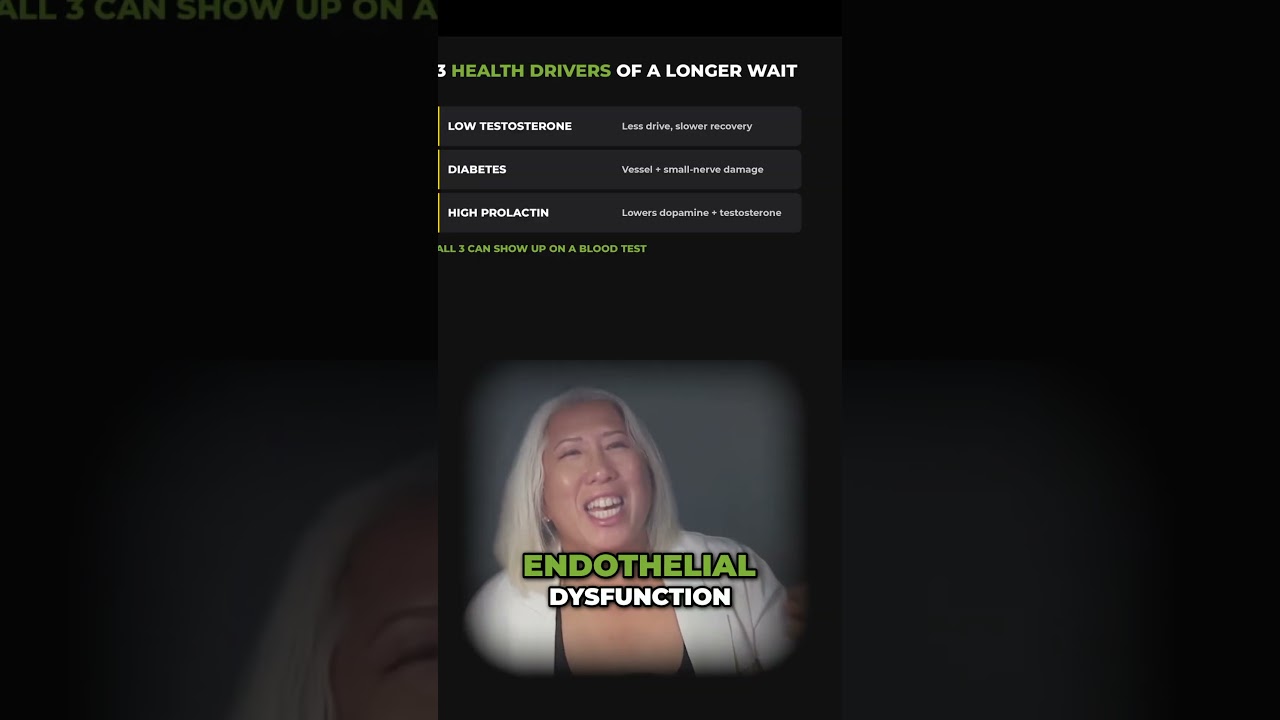
3 Health Conditions Behind a Long Refractory Period #LowTestosterone #MensHealth #shorts

Does the Refractory Period Get Longer With Age? #RefractoryPeriod #MensHealth #shorts

5 Common Medications That Can Slow Round 2 #MedicationSideEffects #MensHealth #shorts
Why Round 2 Takes So Long: The Brain Chemistry #RefractoryPeriod #Dopamine #shorts
Long Refractory Period? It Could Be Early ED #ErectileDysfunction #RefractoryPeriod #shorts

Is Your Medication Slowing Round 2? SSRIs Explained #RefractoryPeriod #MensHealth #shorts



