Why I Can't Get Rock Hard Anymore
Dr. Anne Truong (intimate health MD and author) explains why men may stop getting "rock hard" erections as they age by framing erectile dysfunction (ED) as a spectrum and mapping causes to six interacting systems: brain (sensory arousal), emotion/psychology, hormones (testosterone, cortisol), nerves (parasympathetic vs sympathetic), blood vessels, and penile muscles. She emphasizes initial treatment with lifestyle and behavioral changes—sensory foreplay, stress reduction, sleep, Mediterranean diet, HIIT exercise, and pelvic use—before escalating to medical options (PDE5 inhibitors, shockwave therapy, PRP, testosterone replacement). The episode stresses that ED medications address only vascular/erectile mechanics and can mask or hinder natural upstream processes if relied on long-term.
Chapters
This podcast is for you. The modern man. I'm Dr. Anne Truong, your host. I'm an intimate health medical doctor and best selling author of the book Erectile Dysfunction Fix. I'll do a deep dive into sexual health and performance and how it affects men of all ages and backgrounds. So let's get started and be sure to visit my website@sexualhealthformenpodcast.com for more information and resources from the show. See you on the inside. Well, hello there mama man. In this episode I'm going to talk about a problem that a lot of guys face as they get older, not being able to get rock hard erection. So I'm Dr. Ann Truong. We know that a lot of men struggles with getting rock hard erection as they age. We're going to go and talk about the causes of this problem and some solution you can try and hopefully at the end of this episode you'll have a better understanding what's going on and some ideas on how to fix it. I would appreciate if you subscribe, review and comment. I would love to hear from you. So let's talk about why you're not getting rock hard erections when you get older. Well, that, that is a sign of the beginning of erectile dysfunction. Now, erectile dysfunction is defined as inability for a man to get a firm erection for satisfactory sexual relations. And that spanned from a spectrum of longer to get an erection compared to when you were probably when you're mid-20s, late-20s, it takes you longer to get firm. Or that when you do get firm, it's not 100% like it was when you were younger and maybe around 80%. And then the next part is that when it's firm, you lose it during penetration or during the erection or the intercourse. And then also including premature ejaculation, unable to orgasm, as well as unable to ejaculate, all the way to inability to have an erection at all. Now, if you're able to have an erection at night or in the morning, like a morning erection without stimulation, that means that your mechanism of having an erection is still intact. It's just that when you're getting ready with a partner and you're not able to get an erection, there are other things involved. So I want to stress that an erection spans from from able to get an erection and not able to all the way to this end spectrum, not able to get erection at all. So there's a myth that says, well, I don't have ED because I still get erection. Well, that's wrong. You can still have ED and have erection and that. Well, I can ejaculate orgasm, therefore I don't have ed. That's also. That's also not correct as well. So let's kind of go back to what is the natural sexual response for a man and a woman to have an erection. Now, woman can get an erection as well. That woman has a female penis, which is the clitoris. The clitoris is 4 inches long and it looks like a wishbone. And it is an organ purely for sexual pleasure. It has no other function beside for pleasure. So women, you can get an erection as well. It's just that you don't see it. 90% of the clitoris, it's hidden behind the clitoral hood and it goes back and out like a wishbone. So but you can get an erection. And the. For women, the labia majora as well, the labia minora is also erectile tissue as well. Now, for a man, you have the corpus cavernosum, which is the two muscles that line the shaft. And then underneath that is the corpus spongiosum, which is the muscle that surround the urethra is the hole where you urinate, and that encompasses the shaft. And then you have the glans, which is the tip. Now, how do you get an erection? There's actually a very intricate, complicated process that involves six systems in your body. But we just take it for granted because it appears so naturally. But. And all these system have to work perfect and synchronize with one another. So the. But it all starts right here in the brain. So to get an erection, to get the sexual response, it starts here. We. And how do you. How did that start? You get sensory input from your eyes, from the smell from your nose and the taste from your mouth, the sound from your ears, and also from touch. So any type of sensory stimulate that feed into the brain. And it goes to the amygdala, which is the part of the midbrain right behind your eyes. And it goes to the limbic system. And that stimulate emotions, emotion that you, you may have. That's what senses the arousal. And then hormones start getting released in the pituitary gland. And then so the first system is the brain. Second system is the emotion or psychological. And then three is the hormones. And then the hormones stimulate the nerve in your spinal cord here. That goes to the sympathetic and the parasympathetic nervous system, which are two nerve chain that go down along your spinal cord and. And also within your spinal cord as well. And that. So there's the nerve and the next system is the blood vessel. So the nerve will stimulate the blood vessel in the heart. The heart start beating a little bit faster, your blood vessels start to open up. So that way you can get more increasing blood which flows down to the penis. And then the last system is the muscle which is the corpus spongiosum and the corpus cavernosum like the muscle of the penis. And for a woman, the woman do have corpus spongiosum, corpus cavernosum which is the clitoris itself and also the labia. So there's increasing blood flow and then that's how you, the sexual organ gets engorged and, and how you can get arousal that will stimulate you to get to an orgasmic state and then ejaculatory state. Woman can also have ejaculation as well. So there are six systems that need to start. And if you go on my website truongrehab.com, you can see the 6 system that interplay with one another like the brain, the emotion, the hormone, the nerve, the blood vessels and then the muscle that need to all happen in order for you to get a sexual aroused response for a man, for as an erection. Now if you take Viagra, Viagra, all it does is, is to produce, prevent you from reabsorbing nitrous oxide. Nitrous oxide open up blood FL vessels to promote more blood flow. So what, what you take Viagra, it works on, on your penis and give you an erection. But essentially you take a Viagra, you're hijacking your natural response to create an erection. So you're just going to step six which is the muscle and you're skipping step one to five. You're skipping the brain, the emotion, the nerve, the blood vessels and you know, all step one to five, which is it was critical to create a sexual response. So that's why over time when you're taking these ED medication you essentially lose your, your natural ability to have an erection because your body just gets confused. It doesn't know how, how to do it anymore. It doesn't know how to go from step one to six because you're, you're already taking medication for step six to happen. Yeah, it feels good to have a short term relief that you're able to get an erection with Viagra and the medication. But in the long run you're shooting yourself in the foot and you're going to end up in a black hole and you're hijacking your natural response to have an erection. So back to the basics so those are the six systems that need to occur in order to get an erection. Well, that's the cause. So sometime if you're, if you're not spending time to get the sensory arousal to get your brain aroused and produce that hormone, you may not be able to get an erection because it starts in the brain. So it starts in the brain. So you have to be in the mood, you have to be aroused by the sensory. And in my podcast episode, we, you will hear us talking about sensory arousal, getting into the mood, planning it out and not being stressed and spending the time to communicate. Touch, kiss, and even using aphrodisiac food to stimulate your, your sensory of the vision, the smell, the taste, the sound and the touch. If you do that, your brain will be overloading, you'll be aroused. So if you, if you find out that you have ed, the cause may be that you're distracted, you're not spending enough time for sensory arousal. The next part is the emotion. Are you stressed? The next part is emotion. And that if you're too stressed, you're not thinking about sex, or that you're not not getting enough sleep, or there's underlying anxiety and that will play a role in the transmission of the arousal that need to go through the, the brain that can transfer down to the nerve. So it could be that emotion, anxiety, depression, distracted, stress. So that system number two, system number three is the hormones, the hormones responsible for a male libido, an erection is testosterone. Is the testosterone level normal? Is it low? Is it low? Then it may play a role in the erectile response as well. And then number four is the nerve. Mainly for a man to get an erection, he has to be relaxed. In order for him to get relaxed, the muscle of the penis have to be relaxed actually to get an erection. When the muscle of the penis, corpus cavernosum is actually contracted, it's actually in its flaccid state. Yeah, I know that sounds contradictory contradiction because you're like, well, when the muscle, when the penis muscle is in the non erectile state, the actual muscles, the corpus cavernosum is in a contracted state. When you have an erection. Those muscle, the corpus cavernosum, corpus spongiosum have to be relaxed in order for it to expand. So and that goes to the parasympathetic nervous system which is responsible for erection. The sympathetic nervous system, which is the nerve is responsible for fight or flight or emergency that save you from an emergency situation, that's responsible for ejaculation. And that if you're stressed or you're not getting enough sleep. The sympathetic nervous system overrides the parasympathetic nervous system and therefore it may contribute to you not able to get an erection. So that's the nerve. The next part is the blood vessels. Well, that's in the blood vessel. That's where if the blood vessels are not able to relax and expand to allow the blood to flow into the penis, then you're going to have decreased blood flow problems. Kind of imagine a pipe. When you're younger, your pipe is, you know, this big, but then as you get older, your pipe may get smaller. However, other condition that affect how the opening of the pipe or your blood vessels are high blood pressure, high cholesterol, diabetes, those are the main thing and smoking, those are the main factors that can actually make the blood vessels smaller or constricted. That is not able to expand and therefore you're not able to get more blood flow to the penis muscles. That's why lifestyle, such as what you eat, how you exercise, all that play a big role in affecting the opening of the blood vessels. And the next system then is the muscles, the muscles of the penis. Like I mentioned before, in order for the penis to have an erection, it needs to be in relaxed state and that it needs to be able to expand. So there. If you don't have a frequent erection, your muscle will actually atrophy or get smaller. And then the plasticity or the expansion of the penis muscle is not as flexible as it used to be. So that will affect it as well too. And so that's why I keep saying, well, you don't, you don't use it, you lose it, you don't use it, the muscle is not going to be as flexible, not going to be responsive. And that, you know, if you don't use it, you're not going to get that blood flow that is needed to go into the penis because you're not exercising your muscle. Kind of like when you go to the gym, you don't go to the gym often, then your, your muscles in your arms and your leg will atrophy or get smaller. But if you go to the gym frequently, which at least three times a week, then it's going to be challenged. So every time you go to the gym, you get more blood flow to the muscles and therefore it expands and then the muscle rip. And then how you get bigger muscles, well, the penis muscle doesn't rip. But if you get, if you continue to get blood flow down to the penis muscle, the responsive capability of the muscle to respond is a lot better. So having said that, those are the six response and those multiple depth can be involved. If it's not working well then it's going to be a dysynchrony of the erection part. So how do you treat that? Well, you treat it by looking at the six systems. Well first let's look at the first system. Is the brain the largest sexual organization? Right. Are you spending enough time in sensory arousal before, before, you know, during or before intercourse? You know, get sense, you know, use your five sensory responses to get aroused. And two, how's your emotion? Are you anxious? Are you depressed? Are you just focusing on performance only now you can still have a good sexual response and have orgasm without looking, concentrating on just the end result of getting erection and penetration. And we'll talk about that more in our episodes as well about performance anxiety and focusing more on emotional bond and communication. So that emotion number three is hormones. You know, what's your hormones level. So if your hormone, if your testosterone level is low, which can be easily be done with measuring your blood level and make sure that you're not don't have any other causes. I also want to mention that cortisol level is the stress hormone that gets released. If the cortisol level is high, it's going to affect the other hormones as well. It can affect thyroid, it's going to affect insulin and therefore stress. Stress is what raises the cortisol level and continuous stress raise the cortisol level for too long and then it becomes too low and then you're just. Your hormones are not responsive at all. So cortisol level is important, that's related to stress and stress is also going to affect your hormones and stress can affect your sleep and stress can affect your emotional state. So we're on hormones. So get your testosterone level checked. And is it low? Well there are certain things that you can actually increased it. How? Well you can increase your own testosterone level by sleeping better. Like, like get restful sleep of seven hours a day. Go to bed by between 10 to 6 that that's when your body heals is at least sleep seven hours. And how, how do you get your raise your testosterone level? Well, weight loss. I've seen many of my patients that has low testosterone levels and they lose about 10 to 20 pounds and they exercise about three times a week which is high high interval training their testosterone level double without any additional supplemental testosterone treatment. Now if you know you find out that your testosterone level is low, change your diet to a Mediterranean diet. Start doing high interval Training, which is, you know, hiit training. All you need to do is about 30 minutes three times a week. And then you know, see, see what your weight is. And then try to get seven hours of sleep. And don't focus on just the performance, focus on bonding, communication. See what does that, see what happened. Because you'll find out that your testosterone level may raise enough to a level that may affect your erection. So that's hormone. But then if you find, if you do that your levels are still low, then the, the, your doctor who, who is experienced in doing hormone replacement therapy is able to give you additional hormones such as testosterone. Either can be taken as an injection or through pellet. The next part is the nerve and the nerve is a parasympathetic and sympathetic. In order for you to get an erection, the parasympathetic nervous system has to be dominant over the sympathetic nervous system. Which parasympathetic is called the breed and eat. Because it's a system that help you reproduce. That's why it's breed and then system that you know when you're relaxed you want to eat, you want to enjoy. So that has to be the predominant nervous track. And how do you do that to relax, enjoy mindfulness. And to be and know that you know it, you, you need to activate the parasympathetic by enjoying the sensory. Like I spoke about before, we're activating the arousal system in the brain and meditate. Meditation will help activate the parasympathetic nervous system as well as slowing down your breathing. When you slow down your breathing and take diaphragmatic breath. Diaphragmatic breath is breathing into the nose and hold it for a count of six and then breathing out to your mouth and hold it for a count of six. It's called diaphragmatic breathing, like yoga breathing. And when you do that, you actually will slow down your heart rate, slow down your breath rate, and that will activate the parasympathetic nervous system. So those are just some strategies for you to tap into. And then the next system is the blood vessels. Well, the blood vessels are under autonomic nervous nervous system control. And so the way that you can open, help open up those blood vessels more is what you eat, what, what you put into your body. If you eat. Yeah, you know, I'm, you know, if you, you drink sodas or if you eat a lot of carb or that that will, will kind of produce insulin resistance and insulin resistance will affect your thyroid and then will raise your cortisol level and will Actually decrease your testosterone. So change your diet, decrease the carb, decrease the red meat. And I suggest a Mediterranean diet. A Mediterranean diet. You allowed to have a glass of red wine a day and you even allowed to have multigrain bread. But not focusing on red meat and not focusing on carb, but getting a lot of fruits and vegetables into your daily diet regimen. I can't tell you how many patients I have that they're. Daily diet regimen is coke or diet coke followed by fast food. Well, that itself will cause insulin resistance which then will decrease your testosterone level, then increases your cortisol level and that's what's going to affect your erection. So blood vessel can be controlled with diet and then also exercise. If you do high interval training exercise, then you'll be able to only 30 minutes three times a week. You'll be able to allow the blood vessel to expand easier and it becomes more flexible. Right, that, that's how exercise work. Exercise will also help with the heart. The heart will be able to pump better as well too. And I always tell my patient, you know, in order to you, for you to get that erection again, I want you to feel like you, you when you were in your teens, you know, 18 or in your 20s, when you feel horn, you're aroused so easily and you get that flush feeling, you get the heart rate and the sweatiness is that when you're feeling around and, and that is what if you get into that state, you're there. So the next system is the muscle. So the muscles of the penis. When how do you do that? Well, make sure that you use it or lose it. You know, there are ways to have healthy. You can get an erectile response with a vacuum pump where you use a negative pressure pump with cylinder where you know a negative pressure will help you get an erection through the pump and that will help you bring in some more blood vessels into the muscles as well. It's almost like taking your penis to the gym. That will help with the expansive capability of the penis muscle and getting some feedback into it as well. Or you know, have sex more often, then you get more blood flow into your penis and help the muscle expand better. So there are definitely ways that you can do at home to activate the sexual response through those six systems. And then if you do all that and still not working well, then time to see a doctor who is able to be the sexual expert that understand the six system. And one way to increase your blood flow is doing low, is getting treatment with low intensity shockwave therapy and that will help increase the blood flow as well as the flexibility of the penis muscles as well as activating the nerves that are in the penis. Another treatment is platelet rich plasma PRP injected into the penis which then help create more blood flow which also rejuvenate the muscles of the penis as well decrease inflammation in the penis. And then the third method is hormone replacement therapy where you get extra additional testosterone that you can't make on your own which then will help with the testosterone, actually help with, with nitrous oxide which, which help with increasing blood flow to the penis and, and diet. And I can't stress to you how, how important it is for diet and exercise because the diet will help with the insulin resistance which then help balance the hormone and also the exercise which then help with the heart, with the heart pumping as well as open blood vessels. So that's why we stress diet and exercise. You start with that first. Start with getting enough sleep and start with de stressing and not focusing on just the end result. And when you start with that you'll be surprised that you're going to go get result and go make remarkable progress. Because I feel that it's, you need to start that part first before you go for additional treatment. Because I see it work in my patient and, and I see the blood levels changes and even if you just change your diet, your liver function test will also improve and as well as your cholesterol. If you change your diet and you exercise, your cholesterol levels go down. So you can get rid of taking those anti high blood pressure medication, those high cholesterol medicine or even your diabetic pill. If you have diabetes, that's gonna affect your erection as well. So that's a quick review of the causes of ED and treatment and answers to question why you're not getting rock hard erection. I love to hear your feedback and I will see you in the next episode. Modern Man Take care.
More from Anne
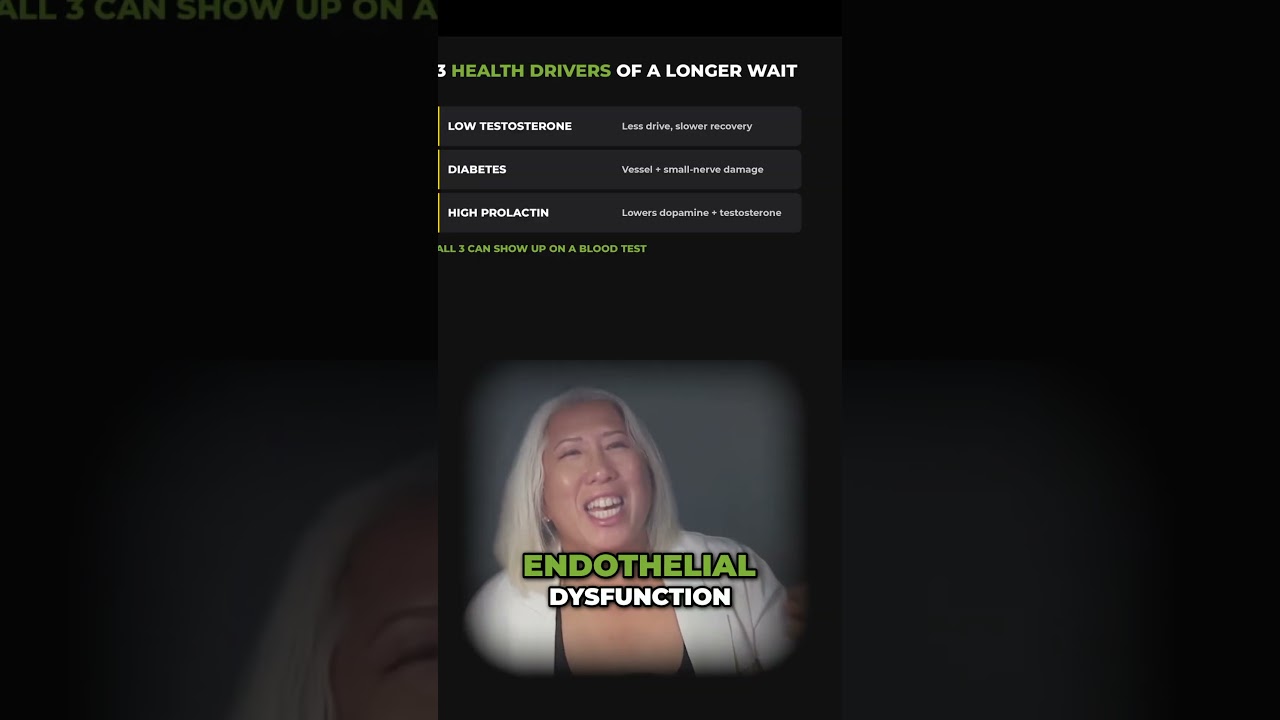
3 Health Conditions Behind a Long Refractory Period #LowTestosterone #MensHealth #shorts

Does the Refractory Period Get Longer With Age? #RefractoryPeriod #MensHealth #shorts

5 Common Medications That Can Slow Round 2 #MedicationSideEffects #MensHealth #shorts

Why Round 2 Takes So Long: The Brain Chemistry #RefractoryPeriod #Dopamine #shorts
Long Refractory Period? It Could Be Early ED #ErectileDysfunction #RefractoryPeriod #shorts

Is Your Medication Slowing Round 2? SSRIs Explained #RefractoryPeriod #MensHealth #shorts



