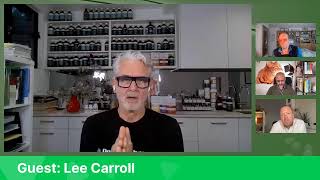
Lee Carroll, chief medical herbalist for Real Mushrooms, explains ergothioneine, a powerful antioxidant found in mushrooms that works like a vitamin in your cells. The conversation covers dosing for humans and dogs, why mushroom species matter for different cancers, and how to test products for quality.
Chapters
What were you bleaching?
The reason we're all laughing there, I was holding up for people on podcast, I'm holding up an image of— I wear two rings on my wedding finger, it's a habit I got into, I don't know why, but the first ring was the first ring my wife gave me, the second ring is my wedding ring, and they're both silvery stuff, and they were dirty because I've had them on for whatever, 20 years, and I put them in a glass of Coca-Cola for about maybe 3 hours, and they've just cleaned up pretty well. I thought they'd be sparkling, they're not like brand new clean, but clean enough that I do worry what my Jack and Coke—
So what else do you use Coca-Cola for?
Because that's just one— Oh God, just, just a rare— I have little cans because little cans of Coke are obviously the nicest, full fat, full sugar. Just if you're going to do it, do it right. And it's just on a rare occasion after a few beers if I fancy something. This is a rare occasion, guys. I'm saying once or twice a year I might have a Jack and Coke with a load of ice.
Oh, I love it.
God, I'd love one now. Anyway, we're talking about health tonight. But yes, so we are the Raw Pet Medics, guys. It is Tuesday the 5th of November, and you're going to see us scrolling across the bottom there, patreon.com/rawpetmedics, where we do a little extra bit on the side after 45 minutes on Facebook. Anything you can do there, we really, really appreciate it. We're going to be here anyway, whether you can or you can't. Did anything terribly exciting happen this week, guys, before you want to get on to the main event, which is Lee Carroll?
All right, no, but I will apologize if you hear the thunderous explosions.
Yeah, it is fireworks night.
Do it in the UK. Yeah.
So we traditionally let off fireworks and absolutely destroy the psychology of cats and dogs up and down the country.
Yeah. So I'm going to be going straight out to my goats after this just to make sure they're okay.
Do your goats fall over like in the movies? Do they do that?
Well, last year they aborted.
Oh no.
Which is not funny at all. No, they don't. They don't look up into the sky and carry on going backwards. What a ridiculous defense move.
I mean, How is that a defense? I mean, you're definitely getting eaten, you know. It's pointless way of protecting yourself, playing dead.
Okay guys, I'm gonna, I'm gonna bring this court to order and say that, uh, it's— we've got really, really important stuff with Lee Carroll. Lee Carroll is a, a herbalist, one of the leading herbalists in the world. We met him in San Diego. He was one of the, uh, best dressed guys in the whole place, and there were some very well-dressed gentlemen, I can absolutely assure you. But there he stood in all his glory, wearing very blue glasses, I seem to remember, Lee, and very dapper indeed. And his sartorial elegance is matched only by his profound knowledge of herbs, which is deep broad and entertaining and educational. So Lee, it's wonderful to have you here this evening. How are you?
I'm great, thanks, Nick. It's a pleasure to be here, and Brendan and Conor. And you forgot that you said that I had the brain the size of a planet and it was full of mushrooms.
Who said that?
You did.
I did?
Yeah, there you go.
It's not bad.
That's pretty good.
Yeah, I was, I was impressed. Yeah, I think you said that on a, on a live from, uh, New Orleans.
No, there you go.
Ah, that's the one.
Yes.
Okay, we were somewhat creative in New Orleans.
Yeah, we were. It was a creative—
and, uh, welcome to my clinic. You're, um, you're, you're in my herbal medicine clinic where I see patients right now.
That's amazing. And it's 5 in the morning with you because you're in Australia, Lee, is that right?
Yes, it is 5 in the morning here, so amazing. I don't normally get up this early, but anything for you guys.
We will return the favor, I can absolutely assure you. Lee, give us a 1-minute history of how you got to where you are now, and more importantly, give us a few minutes on what's really, really exciting you at the moment. I hear you've just started your own website, for example.
Yeah, thanks, Nick. That's hard. That's a hard task in a minute. So I started in, I started in the herbal medicine industry in 1990, and I'd done a botany degree, and I was about 30, I think, in 1990. And I got the job as a production manager at a company called MediHerb in Australia, which is one of the leading practitioner brands. And that, that created a love affair for me of herbal medicine. And it's a long time ago now, clearly. And I was with that company up until early 2020, and then I discovered mushrooms. And I was working for a small company in Northern California, and I got to create a small line of mushroom-based products. And that introduced me to Namex, which is the parent company of Real Mushrooms. And Namex is the biggest supplier of of mushroom extracts in North America, and COVID killed off that gig that I had in, in, uh, in Northern California. I created an online course as a pivot because I wasn't able to travel. I was, I was in the US about 100 days a year doing herbal medicine education into the practitioner community across the whole country, and I started doing The education— I created a Clubhouse channel called Myco Revolution, and that introduced me to the people from Real Mushrooms. And so I've been interacting with Skye and Adam Chilton for quite a few years. And then earlier this year, we reached an agreement where I would be the chief medical herbalist for Real Mushrooms. It was in February, and I'm loving it. It's a fantastic company, and mushrooms have really opened my eyes to, you know, a whole area of medicine that I hadn't ever looked at before. As a herbalist, I'm a bit ashamed to admit that I didn't know that much about mushrooms, and in the last 4 years I've done an incredibly deep dive, and now it's my primary focus from an education point of view and a much bigger thing in terms of what I do in clinic.
So does that truly move you into a herbal— sorry, into a medical mycologist instead of a herbalist. What— how does that work? How do we go? Or do you just stay herbal?
Is that—
yeah, I just stay herbal. I think herbs, herbs and fungi, uh, well, fungi were considered a plant up until 1969, and they were put into their own phylum. So I think the term herbal medicine predated 1969. So I think being a herbalist does it. But being a mycologist means you study fungi and you're into their biology. And I, I did quite a few units of mycology in my degree, but that certainly doesn't make me a mycologist. I do know how to use them in clinic though, which is the important part.
It is indeed.
And tell us about your, your new website there, Lee, that you've got a course on there, I believe.
Yeah, so I had a couple of websites previously and I wanted to create a school and I didn't want it to be about me, so I called it Herba Meditari, which which is herbs and mushrooms, and to meditate and to ponder and to examine, et cetera. And I thought that was a great name, but it didn't resonate with people. And the branding— people know who I am, but they don't know these obtuse names. So I combined the websites together. So I've always had Lee Carroll Herbalist. That's been my clinic website. So now I've got just the one website. So there's information there for patients as well as practitioners, and that's where the course is based. And I'm working towards developing some patient and consumer-based courses as entry level into mushrooms because there's just so much misinformation out there from, from the marketing of big corporations. It's really confusing for people.
So if people want a really good herbalist, then they can contact you at LeeCarrollHerbalist.com.
They can, yeah, I do.
Okay, that's great.
And what about, uh, sorry, I, I pay a fortune to have insurance that allows me to practice anywhere in the world.
Wow, amazing. And what about, uh, veterinary, uh, veterinary herbs, veterinary mushrooms? Well, how do you interact with that? Were you something to do with, with the Five Defenders, for example?
Um, No, that was Real Mushrooms' first product.
Okay.
And then Rob Silver, who's the vet for Real Mushrooms, put that into— yeah, he has been on the show— put that into a smaller capsule that was more suited to pets. My entry into the veterinary world has been veterinarians coming to my herbal medicine seminars for many years, and particularly in California, I would always have maybe 10% about 90% of the audience would be veterinarians. And so I learned that particularly dogs have got very similar physiology. They don't have all of the same diseases, but if you can understand the physiology and the clinical application, it translates pretty effectively across to a canine. Less so to a cat, but still applicable.
Sure.
So for all of our listeners out there that are interested, I heard you say that we can give them a code, they can go onto the website, they can register for your courses. If they've got interest and get on there. Is that right? Are we going to be able to put a post up with a code for them to get in?
Oh, that code was just going to be a special offer for you three.
Oh, I was actually going to push you and say, I don't want to pay anything. Okay.
Oh man, we need to give the listeners a bit of an insight into your course.
Well, yeah, I'll work out how to do that. The course is designed for healthcare professionals, so if you've got any veterinarians on the call, I'll give at the end, I'll give you a code that will give them a 20% discount. How's that sound?
That's amazing. Lee, I can't imagine there's a whole lot of footage of dogs eating mushrooms out in the wild? What do you know of dogs and wolves eating mushrooms? And second of all, the incredibly unique compounds that are in mushrooms, which you can tell us about shortly, is it that they come through the prey into the carnivore, or is it belly contents, or where are you thinking the mushrooms communicate with dogs?
That's a very good question, Conor, and I have given that quite some thought, and There are a lot of animals that eat mushrooms in the wild. So, you know, boars eat mushrooms, deer eat mushrooms, all the rodents eat mushrooms, many primates eat mushrooms. The evidence around dogs and wolves eating mushrooms is a bit scant. So my take on this is that humans and all animals and fungi are very closely related. We've got a common ancestor that's about a billion years old. So we share a lot of genetics, much more than we do with plants. Plants are more ancient. And the physiology of animals interacts very well with the chemistry that mushrooms deliver. Just like, you know, a dog, you know, never ate echinacea in the wild, but if a dog's got an immune problem, then echinacea would be a really good medicine. So From that same point of view, I think that we would need to see mushrooms more as a medicine for an animal. And when you understand the chemistry and how the chemistry of the mushroom interacts with the physiology, then you can match up the health parameters. And I think that in a modern world, animals have got stresses and strains on them just like we do. That they're not evolutionarily adapted to deal with. So, you know, animals have to deal with all of the same chemicals in the environment, for example, and, you know, a lot of the psychosocial stresses and strains that aren't natural. And combination of herbs and mushrooms can help ameliorate that, can help prevent stress from becoming bigger problems. And, you know, the diets that they eat disrupt the the linings of the vascular system. And, you know, there's a lot of disease processes that develop from that. So I think that probably seeing a mushroom more as a medicine rather than a food.
I bet it's like CBD, you know, like cats and dogs are far more sensitive to CBD. They need far less per kilo of body weight than we would. And when you think about it, they have a whole endocannabinoid system receptors crying out for CBD. And while your body produces— Yes, they do. Mimic-like compounds. I suspect that they would be getting CBD through their prey from the various places that we store CBD. They would eat the whole prey and benefit from it. But if that's the way you get your CBD and not direct from plants, you would be far more sensitive to the compound. So I'm sure mushrooms, because deer eat a ferocious amount. I used to study the deer diets and they would have a huge amount of mushrooms.
I think that, you know, going back on what I just said, there's a molecule in mushrooms called ergothioneine, and fungal cells control intracellular stress in the same way that animal cells control intracellular stress. It's just kind of the mirror image. So in a human, glutathione is the primary intracellular antioxidant, and ergothioneine is the backup. And in, in a fungus, it's the other way around. Ergo is the dominant antioxidant, and ergothioneine is the backup. So, um, one of the dominant— one of the highest places, uh, of concentration of ergothioneine in the animal body is red blood cells. So it's from what you've just said, you know, I just realized that's probably the smoking gun in the, in the answer to this question. So animals that are eating other animals and, you know, eating their blood, eating their liver, eating their kidneys Interesting. These are all places that are high in ergothioneine. And it also makes sense of the human cultures that eat blood. So, you know, you guys eat blood sausage and I was always like, it actually tastes really good.
It's amazing.
But there's a rationale for it beyond just the obvious iron.
Yeah, that's the Helsinki. Anna Heinborgman said to me and Nick there one day, she was talking to me, blood sausages. She goes, oh yeah, we've blood pancakes, something similar. And I was thinking, blood pancakes, gross. How to ruin a pancake.
I know you spat my coffee all over the computer.
There's no need for blood on pancakes, surely blueberries. But anyway, she said, oh yeah, we give them to dogs that have seizures. And I'm like, what? And she goes, yeah, it's— she goes, I'm absolutely confident there's something in there that relieves seizures in dogs. And then when I looked into it, there's a whole heap of morphine-based compounds coursing around the blood. And I found two studies that found in cats in the zoo it had, it had doping-like effect on the cats in the zoo by feeding them blood. So there's definitely something going on. So she just noticed it by using it and she just saw the blood is very interesting. That's interesting. Dogs, we feed, we feed bled animals to dogs, so there's not a whole lot of blood. The meat still can be red, but chicken, no, turkey, fish. And so you can actually buy dried blood online. It's an ingredient that really could be in more food if we— and we can buy it very, very cheaply. We can add it to the dog's food and they eat it with gusto. Dudley owns it. So yeah, there's something to that. Very interesting.
Yeah, well, the ergothioneine piece is a really interesting part of that because, um, in humans that have low levels of ergothioneine— and this happens as we age because we don't eat enough mushrooms— uh, it's very highly associated, and there's really good epidemiological data to support this, that, uh, it increases the risk of all of the neurodegenerative diseases, you know, Alzheimer's and Parkinson's and Mild cognitive impairment, vascular dementia. And that's why you produce this product. And that's, that's why we produce that product.
Yeah, so I was just going to ask, because we've talked about cognitive decline and things like that, that, you know, we could use this for. Is there other things, any CNS issues, you know, TIAs, you know, that transient ischemic attacks, that spasm of the vessels? Vascular dementia is better than you know, other types of amyloid deposition? What's the best thing that this will go for, and/or does it just pretty much do anything to do with the CNS?
Well, it's much bigger than just the CNS, so it's a pleiotrophic molecule in the animal body, and all of the cells, so, you know, humans and animals have got transporter proteins to bring that particular molecule into the body. So it has all of the characteristics of a vitamin, but it doesn't kill you quickly if you don't get it. You know, like, you don't get vitamin C, a human will get scurvy and die very quickly. But with— if you lack ergothioneine, it shortens your lifespan and it reduces your health span. So you have more disease and you don't live quite as long. So, you know, if you just tweak that definition of a vitamin, it probably would fit.
Yeah.
So, um, the role that ergothioneine plays is that it supports cells when they're extremely stressed. And inside a cell, glutathione levels will go up and down depending on the stress. So if you've got a place that's very highly stressed, then there's a lot of dynamic action going on. And if glutathione is in an oxidized state, then the cell is exposed to the damaging consequences of the reactive oxygen that is is being produced. So ergothioneine exists in two forms. It's kind of like a clever antioxidant. And in a healthy cell where there's no stress, the pH is like, you know, 7.4 maybe. When there's stress, the pH changes ever so slightly, and that allows ergo to flick into its thiol form, which performs the antioxidant functions. and then it protects the cell while, while the glutathione is being regenerated. So it's a buffer and it looks after all of the cells in the body. But there's a number of sites like the retina in the eye, for example. Red blood cells have got very high levels of it because it controls the reactive oxygen action with oxygen binding with iron inside a red blood cell. The linings of the blood vessels. So it's not just about the nervous system, but cardiovascular diseases are increased as well when you don't get enough ergothioneine. Older animals become more frail and more sarcopenic when they don't have enough ergothioneine. The lactating breasts of animals overexpress the ergotransporter, so ergothionine gets delivered to the young preferentially. So there's a need for it in neurological development as well, which that area is not very well understood at the moment, but I think that it probably plays a really important role in proper neurological development. But just about any disease, there's research looking at all different sorts of things, osteoarthritis and improving sleep quality in aging animals.
Well, Lee, this is absolutely amazing. This is kind of the vitamin that we never knew we needed, almost.
Yeah, exactly. Yeah.
But, but also, I was just thinking, Are there, are there peoples around the world who actually eat enough ergothioneine such that they have great longevity? Are there certain peoples that we could do epidemiological studies to see the advantages of eating mushrooms for longevity?
That's a good question, Nick. And there are a couple of studies on that, and they're not extensive. Like, they haven't looked at, like, the Blue Zone people that, like, you know, live well into their hundreds. Um, but you can correlate the daily, um, intake of ergothioneine, and in the US it's estimated to be 1.1 milligrams per person, um, per day. And, uh, it probably needs to be at least 5 milligrams to be healthy. And you could compare that with a population in Italy, for example, and the porcini mushroom, which is probably one of the signature mushrooms of many countries in Europe, is naturally very high in ergothioneine. And our early ancestors, if you go back 16,000 years, if you go back 50,000 years, you know, our human ancestors and also our Neanderthal cousins, the archaeological evidence is that they were eating vast amounts of mushrooms. So in Italy, they're estimated to be 4.6 milligrams of ergothioneine a day. And there's a longer— it's only a couple of years difference, but they live longer than Americans, for example, and they get less neurodegenerative disease than Americans. And when you put it on a graph, you know, there's some countries like Finland and other things, there's clear associations with you know, the lowest levels of ergothioneine having the highest morbidities.
It's interesting, I'm looking at the food sources of ergothioneine here, and, uh, um, beef liver and beef kidney are okay sources of ergothioneine. That's where they get it from, and blood. So liver, kidneys, and so— but oyster mushrooms have 5 times the amount of ergothioneine per 100 grams of fresh mushroom compared to 100 grams of liver. So based on the doses you were mentioning there, you'd have to eat a gruesome amount of liver. You'd have to eat, um, if there's 1 to 2 milligrams of ergothioneine in 100 grams of beef liver, so you'd be eating 100 grams of beef liver a day, whereas you could be enjoying far less oyster mushrooms and they're not really—
Yeah, true. Yeah, yeah. So plants, but the plants also have some. So if you're human and you're eating red kidney beans and other things. But there's about 100 times less concentration in a plant. Plants get their ergothioneine from the fungus that grow in the soil.
Oh, wow.
And modern farming practices have disrupted that transition. So modern plants don't have the same levels of ergothioneine.
Oh, yeah.
What about the seasonality of it, Lee, in that mushrooms up tend to be kind of autumnal. So will it be that people are getting loads and loads and loads for 3, 4 months in the autumn, and then— and that may be preparatory for winter, which is a stressful time, cold, you know, back in the old days, cold and starvation. Or do they get enough then that they— that lasts them through? Or do they dry their mushrooms so that they can carry them through I don't know.
Well, it's probably, it's a bit of both, but I think from an evolutionary point of view, which kind of has created the, you know, the, the environment that, you know, that we're talking about.
Yeah.
The ergo is clearly important, you know, to animals and, and particularly humans. And the fact that it's got a very long half-life, it's got a 30-day half-life. So a water-soluble vitamin like vitamin B has a half-life of, you know, maybe 20 minutes. You know, you can, you can see it in the toilet, you know, very quickly after taking a tablet. So I think our early ancestors would have, and Conor's deer, would have gorged themselves on mushrooms when they were available. And then the body's storage mechanism would have retained it until the next flush, you know, or the next season would have arrived.
So, okay, so you can retain it, you can retain it for 9 8, 9 months till the next season.
If you took 10 milligrams today and you could radiolabel that 10 milligrams, in a month there'd still be 5 milligrams left. So if you're taking hundreds of milligrams, you know, over the course of months, then it builds up and you've got this like incredible reservoir.
Yeah, like that's the same. It's the same. Like, I totally agree what you're saying. Like the coenzyme Q10, for example, that's another antioxidant. Okay. And yeah, You can store it, so you can eat it, and nutrients and these sort of things come to you in waves. So, you know, I'm stuffing mushrooms into me because it's October, and that's when you see the deer, or the female deer, gorge on acorns and mushrooms. And yeah, you would store it in your liver and kidneys and bones and stuff. But like, the fact that like, coenzyme Q10, ergothionine, and CBD aren't on like the critical— it's not a vitamin, but it's still important— it's so obvious. It's hard to understand how it's not on the critical list of nutrients. You can't live without coenzyme Q10. If you stop eating coenzyme Q10, you will die soon. You need it for cellular energy and all sorts of stuff.
Yeah.
And so it's probably the same with ergothioneine. It's just because it's just not on this set list of vitamins, which have a whole heap of hormones in there as well, and minerals. It's like, who made that list? I mean, there's a whole range of compounds that aren't on that list that are utterly essential. For life that we don't seem to talk about as much.
It's a good point, Conor, and I think it's still early days in the science of ergothioneine, and there's a lot of data, but there's not yet enough to convince the bureaucratic, you know, boffins that control this stuff to, you know, make any changes. But another point that highlights ergothioneine's significant entanglement in our evolutionary processes is that it doesn't only work as an antioxidant. In a healthy cell, it gets into mitochondria, and there's an enzyme in mitochondria that takes sulfur sources like cysteine, and it produces pyruvate and hydrogen sulfide. So in a mitochondria, ergothioneine speeds that enzyme up. It's— I use the acronym MPST. It's got a really long name that's not that important. And in mice, and there's just the one study at the moment, so this is kind of brand new science, It speeds up the mitochondrial production of pyruvate that gets converted to acetyl-CoA, and that goes into the electron transport chain to make more ATP. And the hydrogen sulfide interacts with NRF2, which is the master regulator of antioxidant status in the cell. And I think the reason for those two things is that if you've got more respiration in the mitochondria, you need a little bit more antioxidant support to deal with the reactive oxygen from the improved respiration. So in healthy cells, you get more energy out of your mitochondria. So globally, your body's more vital and it's more capable of doing the work that the tissues and organs need to do. And in these mice, they ran just with a— I worked out what the human equivalent dose was. I don't know what like a dog equivalent is, but it was just 10 milligrams a day, and they ran 19% further than null ergo mice. And they— this their maximum speed at peak velocity was 28% faster.
Oh, what? How much of this should we be taking this every— Yeah, exactly right.
I think 10 milligrams a day is probably a good dose. We don't know what the dog dose is yet, but I would think that, you know, you could, depending on the size of the dog, you could give a dog 1 or 2 capsules a week. And they've got the same biology as us, they would store it. So it doesn't have to be—
and I'm guessing if they're critically ill and under therefore an undue level of stress, then there's no harm to giving them a daily dose whilst they're in that critical phase. No, it's really hard to overdose. On ergothioneine?
Oh, it's impossible. Yeah, the scientists that did the overdosing studies, they gave up at 9,000 milligrams per kilogram.
Yeah, that's a lot.
We don't want to waste any more money on this.
Yeah, yeah.
So it's very safe.
So I know that Real Mushrooms have done a lot in their production of mushrooms to make sure that they're getting the best quality product out there in their things. Is there something that they're doing to enhance the amount of ergothioneine in the oyster mushrooms that they're growing? The golden oyster mushrooms that it says on the pack, or is it, is it just naturally going to be a steady state for those particular types of mushrooms?
That's a good question, and I think it's just based on simple Mendelian genetics. So golden oyster naturally produces high quantities, and you can just start looking at the different strains of golden oyster that are available. And if you're looking for a particular molecule like ergothioneine, you can grow the mushroom and test it. So Varieties have been found that are ridiculously high, like nearly 10 milligrams per gram dry, which is just ridiculous. And that's where the focus is. And to put 10 milligrams on a label with a natural product is really technically quite challenging because there's natural variation and there's stability issues with products that have to sit in a bottle for 3 years on the shelf. So a little bit of pure L-ergothioneine from a yeast source. So you can take the genes out of a mushroom and put them into a yeast, which is a different sort of fungus, and teach it to grow pure L-ergothioneine. So you combine the two together, you can get the, you know, 10 milligrams reliably every time you take a capsule.
Brilliant. And so, and do Real Mushrooms also, do they test every batch? Do they make sure that what's on the label is there, or is it taken from, you know, the estimations that they first looked at, and then it's just repeatable, therefore they just put it in?
Yeah, every— good question, Brendan. Every batch is tested for those particular molecules. Every batch is tested for beta glucans, and the consumer doesn't ever see it, but there's a technique called thin layer chromatography, and Chromatography in science is the art of separation. So if you mix the mushroom in, in some solvent, you can dissolve out all the chemistry that's in the mushroom. And there's, there's hundreds of different molecules, and you can't ever identify them all, but you can visualize them using this chromatography technique where you can create a, a visual representation which is like a fingerprint. And then there's there's reference samples for mushrooms that are known to be good quality, and then all of the samples that yet come in get compared to that standard reference so that there isn't any drift or deviation from all of the stuff that can't be measured kind of analytically but can be visualized. It's a bit hard to explain that.
I wonder what else is in there. Like, we talk about ergothioneine now, but you can only imagine how many compounds are in there. How many?
Oh, oyster mushroom is pretty— I hesitate to use the word magical because it has other connotations, but it's got a lot of— I've got a lot of special properties. And, uh, there's, there's quite a lot of clinical trial data in, in children, for example, just with regular oyster mushrooms and the— from a beta-glucan point of view. And when you consume the beta-glucans from oyster mushrooms, it decreases the number of infections that children get it decreases the severity, it decreases the complications on quite low doses. So if you've got young children, feeding them mushed up oyster mushroom would make a lot of sense. But there are other chemistry elements in there that make it unique, and it's never about the one thing. And in my clinic, I use a lot of standardized products, but that just means that we're looking at one molecule. All of the other stuff is there. It's just that we need quantification so that we can get dosage right. So that's, that's why ergothioneine is kind of standardized so that we, we can, you know, have a more modern discussion around the use of it.
Can I give someone a quick tip on cooking oyster mushrooms? As a 10-year vegetarian, oyster mushrooms are these big ones, the big kind of floppy over, kind of like an open hand of a mushroom. And They cook beautifully on a pan and butter, okay? But leave them alone. So chop them, like run down the middle of the stem and flop them onto the pan, bit of butter, heap of salt, and don't touch them and let them caramelize to that kind of brown effect on each side. You don't need to keep stirring the pan or you'll make softy, gloopy mushrooms. But when you do them like that and make these almost steak-like pieces of meat, they are the most meat-like of all, of all plant— well, it's not a plant, but you know what I mean, of all non-meat items, it's the most meat-like. It was just utterly delicious. To eat and so good for you. So it's, uh, it's, uh, yeah, anyway, there you go. Completely.
But he's never turned back from a bacon sandwich.
Yeah, I can give you some tips on cooking a bacon sandwich.
That's a very good segue into Lee. Take us through your day or your week and your consumption of mushrooms, just as a kind of a ready reckoner for people to just to see how much mushroom and what type of mushroom that you're, you're consuming or trying to consume each day, each week, each year?
You know, that's, that's a good question. I'm clearly a mycophile, but even as a mycophile, it's hard to eat mushrooms every day. So, okay, there's just, there's just what you've got these for, and that's why you've got the supplements. So I recommend to my patients that if they want to engage in mushroom mushrooms, you know, appropriately, it's around 400 to 500 grams a week of a fresh, of a fresh mushroom.
Half a kilo a week.
That's quite a lot of mushrooms.
That's a 500-gram punnet. Yeah, you get that.
That's a, yeah, so big punnet. Yeah.
It isn't actually that hard to do. You could, you could just divide that into 3.
Yeah.
And you could, if you made them the main meal in 3 meals, then, you know, like 150 grams of mushrooms as a meat substitute works kind of well, but you get tired of it. You know, like, people need a bit of variety.
And you can make mushroom soup, or you can put them in your stews, and you can use them as a sideline, as opposed to, oh no, Mum, not mushroom lasagna again.
Eat the mushrooms! Eat the mushrooms!
So that's what my girls, which are my dogs at the moment because my children have actually left home, probably because I was force-feeding them things that they Oh, brilliant. So, um, you were actually in conversation with us over in San Diego, and there was some interesting snippets that I wanted to press you a little bit on, because so many of us reach for turkey tail when it comes to cancer treatment. And I think you were mentioning that actually there's so much more to mushrooms and different mushrooms for different cancers. Do you want to elaborate on that a bit, or is that sort of trade secrets and what Real Mushrooms are about? Are we allowed to touch on your discoveries about other specific mushrooms for specific cancers?
Sure, yeah, it's a challenging conversation to have because mushrooms have got various different types of beta glucans, and when we say beta glucans on the label, you know, depending on the mushroom, there might be 20 or 30 or 40 or 50 or 100 different species of beta-glucan that, that make up that quantity. And back in this, in the '60s, scientists started looking at, at, say, shiitake mushroom, and they discovered that there was a particular beta-glucan that they named lentinan, which was a small fraction of the total polysaccharides and beta glucans that were present. And they found that if they purified the extract and just got that particular molecule— so it's an expensive process that, that wastes a lot of the good stuff. So to just get concentrated lentinan, you've got to throw a lot of the good stuff away. They found that it was really highly effective at prostate cancer and also a range of gastrointestinal cancers, for example. and the trick is getting the concentration of those beta glucans to the level. So you need a, you need a more specialized product, and it would be wrong for people to think that mushrooms on their own would be an effective treatment for cancer. Mushrooms are fantastic for cancer prevention, and they, they engage all of the aspects of the immune system that are naturally designed to remove the development of any cancerous tissue before it becomes a problem. But in terms of supporting, you know, an animal or someone with cancer, the research is pretty compelling that, you know, all of the conventional therapies that would be appropriate for that particular cancer, the mushrooms make them work better, and they make the animals more resistant and more more robust in terms of their general health so that they can survive the treatment and, you know, be healthier as a result of that so the treatments can work better. I think so.
Go ahead.
Sorry, can I go on?
I just like, you know, it's such a cool thing at the moment, mushrooms, that people hear cancer and they start lobbing in mushrooms left, right, and center, but they don't realize what you're just after saying there is that certain mushrooms are better for certain cancers, and then there's a whole dose thing and it really shows that for people that like me that don't know anything about it, it's like you need to get some advice. This is a really useful tool. So do pick the brains of, if not Lee, somebody who knows that this is an enormous kingdom of useful tools here that can be used far more correctly than just lobbing in mushrooms because somebody said this was your anti-cancer blend when research is showing there's specific use like a, you know, a fine scalpel. I think that's really—
yeah, a way to avoid that kind of conundrum is to be preventative, which is probably the hardest thing to ask someone to be. Uh, it's, it's possibly easy with, with a pet because, you know, you've got control. When you're doing it for yourself, you know, there's all of the, you know, the psychological stuff that comes in. So having a range of mushrooms like the 5 Defenders that Real Mushrooms has gives you all of the different angles that the beta glucans have on the immune system in the body. And the science isn't really quite complete in this area, but I think there's a lot of pharmacokinetics going on when we consume the mushrooms. So by pharmacokinetics, I mean, you know, where do the beta glucans go in the body? You know, what effect is the body having on these beta glucans when we consume them? And you look at a mushroom like Cordyceps and it's got an affinity for the lungs and the kidney. And how do you, how do you explain that? You know, I think that the immunological tissue, say in the lungs, you've got very highly specialized immune cells that support all of the challenges that lung tissue has to face, all of the particles that get breathed in, all of the, you know, potential bacteria and viruses and mold spores and all that sort of rubbish. and I think the polysaccharides of cordyceps get internalized and have a greater influence over that location just because of where the immune cells, say the dendritic cells or macrophages, like, you know, or monocytes move these things around within the body. So the science isn't really clear on that, but when you look at how mushrooms support different organs and tissues in the body, it makes sense to have a blend, and you do that blend on a regular basis to prevent the development of any health conditions. And then when, when though, when conditions are observed and you need to treat them, then the dosage changes. Okay, yeah, so you would be having a higher dose.
Would you get enough ergothionine from taking the 5 Defenders as a daily supplement as opposed to going after the ergothionine um, would you save the ergothioneine for when it hits the fan?
That is a good question, and I think that, like, the right answer is that there will be a little bit of ergothioneine in those other products, but not sufficient, um, you know, to drive the equation. And I think a little bit of the, uh, the Ergo Plus makes sense. And like I was saying earlier, with a dog, you know, maybe a small dog, 1 capsule a week, you know, maybe a bigger dog, 2 or 3 capsules a week. You know, and medium ones in between would maybe be enough. But Rob Silver and I are discussing this topic and he's trying to get his head around what the right dosing would be for animals.
Yeah, isn't it? It's like, how much antioxidant do you need in your storage if you're only drawing on tiny bits at a time? You know, it's like, how much coenzyme Q10 do you need? Nick loves a bit of that in kidney disease. And, you know, if you have some stored, is that enough? Is some enough? Can you keep loading up bricks outside the well-built house? You know, it's like, yeah, cause some—
again, it's a, it's a pharmacokinetic thing. So when you consume ergo, it gets into your bloodstream, and then the tissues that it first comes in contact with are going to be the ones that maybe take it up. So maybe you've got to fill those up first before it spills over into more distant locations in the body. And we mentioned red blood cells, so red blood cells don't take it up in the blood, they take it up in the bone marrow, and it gets built into them. But, but in the blood, neutrophils avidly take up ergothioneine, and in a neutrophil, ergothioneine helps to improve the oxidative burst that kills off pathogens. So it improves the killing effect of those cells. Maybe neutrophils are sucking up a decent amount, then the liver will take up its portion, and then the endothelial cells in the vascular system take up their little bit, So I'm thinking that, you know, if you want to get it to places like your brain where it's got to get through the blood-brain barrier, so there's a more challenging kind of route of entry, then there needs to be slightly higher doses, you know, regularly so that it can actually get there. Does that make sense?
Yeah, absolutely.
Yeah, it sounds really, really good. Lee, this is absolutely amazing information. I think people are going to be really excited about it. Would you stick around with us for a further 10 minutes? Could please plan into your morning a little bit further, because what we do is we're going to shut down now and then we're going to go on to our Patreon. We have Patreon supporters who allow us to do what we do, and we'd like to give them a little extra 10 minutes. I would like to, within that 10 minutes, ask you about the beta glucans that you've talked about. What are they? How do they interact with the body? What are the receptors? And that whole, that whole, uh, area of, of, of biochemistry. Would you be able to give us a few thoughts? Yeah, sure. The boys have got their questions as well.
It's a fascinating topic. I'd love, I'd love to share my thoughts on that.
That'd be amazing.
That's your website there, lee-carroll-herbalist.com, to check out what Lee's up to at the moment. And, uh, get some reliable info. I bet you that this information is very, very confused out there because there'll be a whole lot of people taking— it's like a new subject, it's like probiotics, everyone's an expert, and then you realize you just know nothing, no, absolutely nothing. I've probably just been making a mess of it. But we are Raw Pet Medics. You'll find us on patreon.com/rawpetmedics. And thanks everybody on Facebook. I can see there's a lot of questions coming through there, so We can't get around to them now, but we might put them to Lee another time. But other than that, we will see you, Patreons.
Yeah, I mean, wonderful. And thanks to Real Mushrooms who've come on and are answering some of the questions themselves as well as we go. But I'm sure there'll be even more fired towards Lee for him to try and address. I'm sure it's been wonderful. Thank you everybody for coming on and look forward to seeing you next week.
Lee, please come, come back and see us. This is just— there's just too much information. It's so amazing.
Yeah. And, and for those of you who want to follow up, if you just find us in about an hour on patreon.com/rawpetmedics, uh, you'll see the last little bit that we've got of time with Lee. So catch us there. Cheers.
Thanks, guys.
And thank you, Lee.
Thank you so much.
My pleasure. I've loved it. It's been










