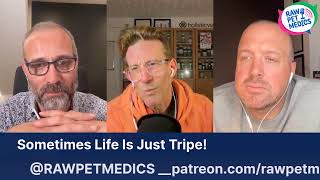
Donna Wills, a veterinary nurse turned physiotherapist, discusses her memoir about losing her collie Logan and navigating pet bereavement. The conversation covers anticipatory grief, a 17-point practical checklist for euthanasia, and coping tools from self-forgiveness to homeopathic remedies like Ignatia and Star of Bethlehem.
Chapters
—to jump in. Hey guys, here we go. So welcome to the chaos that is Raw Pet Medics. We are here today— well, I say we, uh, Bren is here, but he's going to nip off and get a little jumper because he's a bit chilly up in the north. It's chilly up north. And, um, uh, we've got Rita Hogan who is nipping over the pond to come and see us, uh, over here in England. But is going to nip over to Mallorca where the Raw Feeding Veterinary Society are having a conference. She's going to be speaking. We are massively looking forward to her words of wisdom and her soothing, healing presence. The wonderful Heather is with her, and we're really looking forward to seeing both of those guys. So Rita, you're very welcome to be our honorary raw pet medic.
Oh my God, how are you doing? I am so honored. To be an honorary RPM. I'm having a, just a grand time in Ilkley. Ilkley. Ilkley. Ilkley. We're having just a wonderful time with Bren and just loving it. I love England.
So, I'll try and link it down in the bottom. Ilkley Moor Bartat. There's a song called Ilkley Moor Bartat. You'll have to get Bren to play it for you. That's how you'll remember it. I won't try and sing. But this evening we are introducing somebody who I met at London Pet Show recently, who's an extraordinary person. She is Donna Wills. She was a vet nurse for 22 years and now is an animal physiotherapist. Her— did we plan this? Her company is called Animal Physiotherapy Limited, which is pretty easy to remember. And she's worked with thousands of patients. Her specialty is chronic pain in osteoarthritis. But Donna is remarkable. As well as a long list of accomplishments, she's recently written a wonderful book called The Best Goodbye, which describes her final, unfortunately, journey with Logan. Morgan, her beloved collie dog. And she's published this book. You can find it, I imagine, at all good booksellers. Buy it from your local bookshop if you possibly can, rather than Mr. Bezos. But if you want it quick, then Mr. Bezos, I'm sure, will deliver it tomorrow if you order it right now. She's also done a DVD on puppy massage. Uh, not sure where people can get hold of that, but I will ask her in 2 seconds. But as well as all of those, she is a mother to a thriving daughter who's about the same age as mine. That's how I know that one. And, um, she is also a counselor because she was frustrated with things not happening in her local area. Most of us just sit and whinge. Not our Donna. She went out and became a counselor so that she can actually make things happen. So that's the kind of go-get-em kind of gal that she is. And on top of all of that, she is a gymnast. She teaches gymnastics, and she is going to teach me to improve my handstand. So she is now my new best friend. Donna, it's so great to see you.
Donna, before we go any further, Please, I want about 15 minutes of B-roll of him collapsing on his face as he starts to try and do handstands.
It's going to happen.
For those of you on podcast, I'm just doing V signs to Brendan because basically the only time he's upside down is when he falls out of bed. So there you go. That's for you, Bren. Absolutely special. Yeah, Rita, do you know why we do that, actually? Do you know where that comes from? Donna does, because she's read every book ever made. But it comes from— there was once a battle, I don't know, back in the old days when they were using bows and arrows. Okay. And what they used to do with the— if they caught the archers, they would cut off their two fingers. And so the archers of the opposing side When they wanted— When they wanted— When they wanted— The Battle of Agincourt. It was Agincourt. Okay. When they wanted to demonstrate their contempt for the French, I think it would be, they would go like this to say, I've still got my two fingers. And so it became a rude sign. In the United States, you go like this, which means something completely different. But in the UK, this means a kind of a soft—
Just for all of those guys out there who were finding us in America, and we've temporarily had to move away from Judy Mordorin's page because of exactly what Nick has just been doing, which is being rude.
Well, I have to keep up the honor of the show. He's not here. He would have had at least 3 bloodies and an F-word by now, if not an SH1T kind of word as well. So somebody has to maintain the quality of our broadcast. Absolutely. Let's get serious now. So Donna, you— so we're going to be talking tonight about grief, okay, which follows on really nicely because we've just lost a very good friend called Maudie. Maudie Lambert, who's human, and she, she died recently. And so grief and Maudie are in our minds. And so it's really, really appropriate that you're on tonight to talk about another aspect of grief. Tell us, tell us a wee bit about your book and about Logan and why you wrote the book, if you would be so kind.
Yeah, no problem at all. And I mean, I think first I definitely want to say I'm so sorry for your loss because, you know, it's horrible and grief is always just really crap. So yeah, I will show you my book. There you go. The Basket of Lime. I wrote it when I had lost Logan and I'd actually lost him for 2 years at the point where I started writing that. That's how long grief takes. And I say that as in, I wouldn't say I feel no grief now. What I would say is grief is a really long process. And if you're crying at any point in years later, don't ever blame yourself because that's the trouble. You find yourself thinking, oh, for goodness sake, don't be silly, pull yourself together. And I did exactly that. I was driving home from work one night and a really cold wind triggered, like, just hit my face and it just triggered me to have a flashback to the night I lost Logan because it was that cold wind. And, and it just made me spark all my feelings, all my emotions. They all came rushing back and they hit my gut. And then I was like, oh, for goodness sake, it's been 2 years. Don't be so crazy. And then I was like, hang on a minute, why am I telling myself off here? Because at the end of the day, I love my boy. He was my absolute world. And then I was telling myself off for telling myself off because I was like, well, this is crazy. And so all these wealth of emotions were going on. It was all too much. And by the time I finished getting home, I realized I clearly needed to do something. So I put pen to paper and had to write myself some notes before I could even get to sleep that night because I was just so, like, so emotional. And anyway, I just kept writing in the end. And I mean, there was literally hours and hours I would just spend up writing late into the hours just because it was so cathartic for me. And a month later, the book was written and I, and I felt a lot better. I cried so much writing it. But I also thought, hmm, I think this book needs to be shared because I know I'm not the only person that feels like this. And I'm also, because of my nursing history and my physio history, I have supported so many people through this same journey. And I'm going to use the word same lightly because it's the grief journey, that's the similarity, but we all feel it differently and that's okay. But I would say for me, a lot of the people I've supported have definitely been the, you know, the really upset, you know, really struggling people. And I feel proud to support them, but I also feel in a position where I understand it, I know it, I've seen it. And so therefore, I just had to share it. And so my book isn't about telling anybody what to do. It's literally my memoir. It's my journey of you know, why me and Logan had such an amazing bond. The fact that we'd had 16 years together, which was nearly half of my life, and, um, and, you know, he was with me through makeups and breakups and having my baby and all these sorts of things. And so our bond was huge. And then when he started to get older and started to deteriorate, I was then looking after him. I was this, you know, huge primary carer. It was a huge amount of time taken up cleaning him up and You know, as they need more help, same with people, as they need more help, you get more bonded, more close. And then, you know, my— I called this book The Best Goodbye because it's also the journey I went through emotionally of having— of burying my head in the sand to start with, because that's what we all do. Denial, denial, denial. Then realizing, actually, I need to be organized, I need to be prepared, because what I wanted to do was give him the best goodbye. I felt like that was the final gift I could give him and the biggest gift I could give him. And in turn, I gave myself a gift by giving him that gift because I felt better by being prepared. So as horrible as it is, and as much as we don't want to think about it, I've shared all my emotional rollercoaster so that everybody can understand that this is how it is. And then I do go on to talk about how it was for the euthanasia, for the days that followed, how I felt, what I went through. So it's my journey. It's not everybody's journey. And I also know that I was privileged to be able to give him that choice. But I'm so glad I did. So, yeah. And so my book is there to help people, basically. Wow.
Thank you so much. That's amazing, guys. Rita, Bren, what, what, what emotions, what thoughts does that stir up with you guys?
I think it's great that you wrote the book. I mean, I mean, I think that with all the isolation that people are having, you know, having a book where you can hear someone else's journey and it may not be your journey, but there's parts of the journey that will be the same and that will echo kind of what you're feeling as far as grief is concerned. I know in my book, The Herbal Dog, I have a section on grief. And when I was publishing my book, you know, my publisher was like, Do we need this section? I mean, it's on grief. It's not on herbs, you know, it's not on the physiology, it's on grief. And I was like, absolutely, absolutely, because it's such a big part of being with our animals. And, you know, 9 times out of 10, we're going to outlive them.
I feel very strongly that we have to start talking about this because people do just bury their heads in the sand. I know why I did it too. But that doesn't make it right. And so the more we talk about it, the more we normalize it, the more we open the conversations, the more we can help each other. I mean, the one thing I really— I've had a lot of people say thank you to me after, and a lot of people have read it after the event, even though I thought it was good for before the event to help people get prepared. A lot of people haven't found the strength before but have read it afterwards and been grateful. But the other thing I've also found is that I talk to people at shows or wherever about it, and, you know, often they say, oh no, no, I can't talk to you about that, I can't talk to you about that. And then 10 minutes later, they're still stood there talking to you about it, even though they don't say they don't want to. But actually, I think we do want to. It's just that we don't know that we want to. And so we have to be invited to do so. And the more opportunities that come, the more it normalizes it and the more we can talk about it. Because, yeah, it's important.
And I would say, you know, it's great you found that way for you to process through the grief as well. And I think, but everybody's individual, and, you know, as we treat in homeopathy, you know, grief in individual ways, um, I think everybody needs to find their way of remembering all of the great times they've had with, whether it's a pet, a loved one, you know, whatever they've lost. I think it's a good way for some people to just think, I've got this moment in time. Sometimes that's a wrench because it's had to be an euthanasia with an anaesthetic, but actually that's just a moment, a glimpse in time compared to a lifetime of great memories, of interaction of relationship that actually needs to be part of the remembrance in that grief. And it's, you know, you're right. I think for many people, if they would just take pen to paper and write down all of those great moments, that the reason why they are grieving so much, the love that has generated that grief, I think that in its own right is a pathway to healing. But for some But for some people, there's other help out there. And we've got to remember there are agencies that will help you. They can talk to you about what you're feeling and draw that out of you that way. If you don't feel you can put pen to paper and do it in your way. No, completely.
So at the back of my book, I've got a 17-point list, and it's suggestions of things you could do, not that you have to do. But it's so that it does touch on that variety, because it's not going to always be the case. For some people it might be making a photo book, for some people it might be putting all of their little trinkets together. One of the things that I did was I didn't really want loads of memorabilia after the event. I didn't want my little memory trinkets, like little fur beads and all that stuff, I didn't want it to be afterwards so that there was always a memory that came with grief. I wanted them to be before, so I bought loads of those little memory things before the event so that I had all those. The only thing I got after the event was an ashes, um, jewelry, which obviously I couldn't do before, um, because I didn't want to have those memories associated in that way. So you're 100% right, there's lots of different ways. And my husband writes some things down, but he hasn't ever written a book. I mean, obviously that, you know, that is a very you know, special thing that I've, I've done and I feel proud of. But he, he did— when he was processing, he used to write just little notes. He had literally a notepad by his bed so that he could just write a little memory that flashed into his brain, because otherwise he couldn't sleep because it was just— you'd be whirring over. And then he was always scared that he would forget, and that was what made him like, oh, write it down, then I won't forget. I write it down, then I won't forget. Um, I could well understand it. And it's actually one of the things that's really quite nice is much as, you know, social media is a double-edged sword, one of the things that's really nice is the positive things that come out of it. And, um, and actually the Facebook Memories and things like that are really nice because they pop up and you can have a, oh, I remember that, oh, I remember that. So there's so many ways to do your memories to help yourself process grief. You're right, there are tons of professionals out there as well, um, and, you know, some of it is freely available to access from like Blue Cross and the RSPCA are also doing now a new grief support thing going on. So yeah, there's lots of it and I'm thrilled about all of that and it's good everybody knows.
Well, I think that also, you know, having the courage to speak out I think is commendable in that I think that as pet owners, a lot of us are trivialized in our grief in that you know, it's just a dog or it's just a cat. I recently endured it's just a chicken. I actually lost my rooster last night. I'm out of the country, you know, he got taken, I guess. And, you know, most people would be like, it's just chicken, you know. But I think that the more people that talk about grief, because grief is physiological, it can settle into the body when we're not talking about it, when we're not grieving. When we're in denial and we're suffering in silence because people are afraid to speak out or even tell someone, "Hey, my cat died," or "My dog died," or "My chicken," you know. But you spent like dogs and cats, like, and horses, you know, I lost a horse. I had that horse for over a decade. And, you know, my partner had her horse for 27 years, you know, day in and day out, day in and day out. And the care that goes into these animals, I think it's really important. I love that you wrote this book because it gives other people a voice and other people, it can give other people courage to help resolve their grief and feel heard. Exactly that, exactly that.
I mean, it does trigger some people as well, and that's why there's a trigger warning on the book, because some people feel historic guilt as well from, from previous situations and stuff. So I'm really only too conscious that there is a wealth of emotion that can come from this. And I think it's also really important to recognize that just because you've dealt with grief in one way at one point in your life does not mean you'll deal with it in the same way at every other point in your life. Absolutely. I mean, when I've lost, um, any of my furry family members in the past, uh, as a child, I did not feel the same as I did when I lost my Logan because my age was different, my brain was different, our relationship was different, and the care level was different. And so it's not to say I wasn't upset— I was hugely upset when I lost my other animals— but it definitely didn't cut as deeply as it did with Logan. And then I've had repeated people tell me there's always a special one, and, you know, maybe this is it, maybe this is true, maybe I'll never feel this badly again when it's another, when it's one of my other dogs, but I don't know. And equally, I would definitely say I've got chickens as well, and when I've lost them, it's been a nightmare. We cry our eyes out. You should see the blubbering mess I was when I took my last one to the vet, who, the vet was amazing and saved her life, and she was fantastic, so she's still wandering around now. But, um, you know, The point is I have lost some, and you know, it's just— it doesn't matter. You're quite right, it doesn't matter what they are. If you're emotionally attached, you're emotionally attached. And I think it's also important to recognize that some people do not get emotionally attached to their animals in the same way, and that's fine. That's their choice.
Everyone grieves differently, but it's personal.
So, um, you know, it— yeah, it's, it's such a It's okay and it's good to acknowledge that we're all different and nobody should feel guilty about that, but absolutely nobody should say to anybody, "It's just, uh," because that just so isn't true. I mean, you know, my Logan was my absolute world and my husband knew it and my daughter knew it.
Well, I don't know if Nick can find the study, but there was a study that came out, I think it was this year or late last year, about how the loss of a pet can actually be more traumatic than the loss of a human friend, right? And I looked at that study and it was, it was pretty fascinating. But I don't know the name of the study, but it did come out in the last 2 years.
It doesn't surprise me at all. I mean, you know, it's a very triggering conversation for people because, you know, I know that it can get very personal. Like when you try and put labels on how this grief feels and comparing it to X, Y, or Z. Um, you know, but at the end of the day, I mean, the amount of crying that I did when I lost Logan, we all did as a family. I mean, our faces were just swollen messes, our tummies were awful, the physical pain you have, you know, was just immense, let alone the emotional pain. And, you know, you— it's so linked. I mean, my whole body ached physically. And, you know, I fell asleep by passing out, so it wasn't like I fell asleep because, you know, you're, oh yeah, I'll go to bed now. No, it was just because I fell asleep through absolute just being shattered. And so that was it. So it, it's horrendous, absolutely horrendous. And, you know, we all do that whole, I'm never doing this to myself again, and all that jazz as well. And those are all also conversations I have with people afterwards about 'Cause the guilt that comes after you've lost your dog as well is a huge thing that needs discussing because you feel guilty for everything. You feel guilty for having time back. Like for me, I was, I mean, I outline all of this, I'm very honest in my book, where I was doing so much care for Logan 'cause in the end he did have more needs. He was still really happy, but you know, he did soil himself at times, so I'd have to clean him up and all that stuff. That was fine. And so where he had those needs, when he then wasn't with us anymore, all of a sudden I had all this time back and I couldn't believe how much time I must have spent in his care. I mean, a lot of that was just giving him cuddles, but that was fine. And it's still, you know, once he was on your lap, you're like, no, I can't move now because I'm looking after my boy. And so the guilt I felt for thinking, oh wow, I've got actually time to do other things, was absolutely insane. And I shouldn't have felt guilty, but it was so weird that that was the emotion that I felt. And so yeah, there's, there's so much to try and process with guilt. And yeah, that was where that was going, was, you know, people talk about is it right to get another dog soon or later or when or if, you know, and all those things again, so, so personal. For some people, they absolutely need to get another one, and no one's saying they're replaced, but just get another one in the house. And then for other ones, they don't, they need to have some space, and that's all fine. For us, we had said no, we're gonna have a break, we'll just have a— because we had Swagger still at the time, we were just gonna, you know, carry on with Swagger and just, you know, have some guilt-free holidays afterwards, um, so we didn't have to worry about, but you know, what to do with the dog, um, and then Bonnie landed up on my doorstep because she needed physio from a rescue and she had no mummy. And so, you know, she needed a mummy. And then that was that. She didn't go home. So you never know what fate will do with you either. That's fabulous, Donna.
One of my favorite movies is called Groundhog Day. And unbeknownst to many people, it actually goes through the stages of grief. This guy has to relive the same day again and again, which is a bit of a grief thing, actually. Possibly. I've never even thought of that, and I've seen the movie probably 6 times. But just talk to us a little, if it's something that you cover in the book. And the book, by the way, I'm just going to plug it because I think it's important that people have some communication with that book. It's by Donna Wills, W-I-L-L-S, and it's called The Best Goodbye. Can you just talk to us a little about the stages of grief, of whether you looked into it and whether that applied to you or it applies to other people? I'd love to hear Rita and Brent's take on, on that, if that's something that, that speaks to you at all.
So I make it absolutely abundantly clear I'm not a trained counselor or anything like that. I have done bereavement counseling through my nursing. And I know that the stages of grief is something that's talked about and discussed, but I, I did look into it a little bit, but I didn't pay a ton of attention to it because I, because I believe that it's so personal. So rolling through those stages is going to be quicker at some, some people than others, and each stage is going to be quicker for some than others. But also, more importantly, the more I realized is that it's not one stage, then the next stage, then the next stage. It's like tissue healing. It's actually all mixed together. And it's not linear. Exactly. It's not linear. So there's one, then there's the other, then there's the other. And so the whole staging thing came a bit pointless to me. And so I kind of thought, well, if I was a psychologist, maybe I'd need to understand it more and, you know, apply some science. But for me, I was just living it. In reality and sharing that real for me. So, so yeah, I don't like— I couldn't even tell you what the specific order of those events are. I just know of them, if you sort of—
Yeah, absolutely fine. It's just science likes to dissect things and kind of put things out on a— and create linearity where they're in the real world. There may not be linearity, but just for the sake of it, because I found it very, very useful in my grief journeys and just to know that other people have gone through or have experienced this maelstrom of things. So just for the record, the stages of grief are 5 stages of grief. The first is denial. The second is anger. The third is bargaining. And I kind of thought, oh, what's bargaining about? And they say it's trying to regain control or make deals, often with a higher power. For example, if only I had done X, maybe this wouldn't have happened. Et cetera. The fourth is depression, which is, you know, pretty understandable. And then finally, it is generally, generally recognized that there is then acceptance. There is some kind of equilibrium with, with the, the emotions that go there. Rita, Bren, stages of grief. Yeah, no, useful, not useful. Where are you guys on that?
Useful in the sense for me, in the sense that often people get stuck. So you're right, it's not linear. All of those emotions can rush on at once. They can rush on in different heights and one day you'll feel one thing and one day the next. Yeah. The when it needs further help, I mean, from a homeopathic point, and we see this with other pets within the household, is when they get stuck in one of those stages. And that becomes the prominent one and they stay in that stage. So they may become withdrawn, divorced from the reality. They don't want to accept what's going on and sometimes they just need help and there are remedies for that, as I'm sure there are herbs. There are, you know, sometimes there's uncontrollable crying, you know, they just can't stop. Of howling or meowing or calling or trying to find where the other pet is. And for people, that can be the same. And that's fine to do that. But if you get stuck in that and you're stuck in that for days, that can become a point where sometimes things like Ignatia can be really useful. If your pet is really withdrawn or you're really withdrawn and just can't see beyond the thunderclouds, that's when Natrum Muriaticum can be really useful. So these are remedies of grief that we talk about where we're angry about what's happened, where we are stuck in a resentment for the fact that we've had to lose a loved one. Staphysagria can be a really useful remedy for grief. So look, these are not the only remedies for grief, but they are just examples of where if people get stuck, that's the point. That's where counseling can help. You know, if you're stuck, but actually don't be afraid to go through those emotions, to express those emotions, to feel all of those different emotions through your journey. That is part of the fact that you loved the one you've lost so much. And, you know, eventually you'll come to acceptance, but that is, you know, a process. And don't expect it to be over within 5 minutes. Totally, totally.
It comes to mind, just even within the last few weeks, I've had a case which is very, very interesting. There was a little Scottie, she's about 5 years old. 3 years ago, she lost her best buddy. They used to play together, another dog within the household. And she had been depressed visibly. This wasn't just, oh, I think she's a bit depressed. This was a dog who was the life and soul of the party. Who has been under-functioning and significantly less responsive for the entire period of 3 years. She was on fluoxetine because she had Scotty Cramp problem, which we thought perhaps could have been provoked by extreme emotion, as well. I prescribed Sepia, and this dog has climbed back to the level of vitality that she had before. So she was, you know, Bren, you rightly say that you can get stuck, and if you get stuck within those, that, that, that process, that's when homeopathics or counseling, whatever, can be very useful. And so that was a a very good example of stuckness within the grieving process. You have to go through a grieving process in order to heal, just as your skin just doesn't go zip. There is this, you know, you've got stage 1, stage 2, stage 3 of skin healing. It's exactly the same with the soul, with the mind. There is a healing process that takes place there. So homeopathics, among other modalities can be very useful. Rita, what herbs, where do you go with this area?
Well, I mean, think that, you know, there's a couple things. There's one, you know, you're an individual and you're gonna grieve much differently than other people. And I think that some people may judge how people grieve. Like, some people may, well, I can't believe they got a dog 2 weeks later. You know, some people grieve that way. Some people have to move on to the next, you know. And I think it's important to understand that the dogs choose us, right? They're choosing us. They're part of our life path and they have their own life path. And there's nothing we can do inherently when their time is their time. And, and that we're not responsible for that. I think that's a big thing. Dr. Lynda Loudon, she's a lovely emergency vet, but she also does a lot of euthanasia and I've never seen anyone approach it with such grace before. Like I never, she's just amazing. And she really talks about how, you know, kinda like I say in my book, at the end of the day, right? Our dogs just want to know that we love them, right? And that love causes grief. And so like, get it, I think what Bren hit it on the head when he said, you know, if you get stuck, in that emotion. You know, if you're there too long, like, and it's a detriment, it's starting to be a detriment. You're not getting outta bed, you know, for a month, right? And you know, you're losing your job. I mean, there are things then you need help. You need help with either homeopathic remedies, reaching out to someone in the community. You know, herbals, I love Mimosa, Rose. Rose is just a gentle, loving remedy for the heart. Star of Bethlehem, gorse, gorse flower essence for when you lose hope, right? For when hope, you feel your hope going away forever, loving another animal. You know, I don't ever wanna have another animal. I'm done with dogs, even though you love 'em so much, right? It, it, those are wonderful remedies. And then like aspen is lovely. I always talk about aspen because So many people are stuck in guilt and shame, you know, for not knowing enough, not knowing enough. Like, well, if I would've known that now, I wouldn't have lost my dog 3 years ago. And that's just a rabbit hole I don't think we should go down, but we may need something to help us with that. And Aspen is really just about kind of having that, that space that you're having where you're waiting for the shoe to drop. You know, okay, what else is bad is gonna go on in my life? You know, what else is gonna happen? And you get that kind of resentment feeling. So there's lots of remedies I talk about in my book. And I think that, I just think the state, when you talk about the stages of grief, you know, I think Nick, I think they're pretty real. Like, and I don't think they look like everyone else's, you know, I don't think that when you lost your dog, like, you may not have had like distinct boundaries in those stages of grief. But when you look back, you know, years out and you can kind of see them. I've had deep loss over the last 10 years and I can see them. They were non-linear. They were non-linear. But like being angry, I went through anger. I went through doubt, I went through, um, denial. Denial for sure. That was before they died. Yeah, right, just denial, like, it's— this isn't happening. Yeah, yeah.
No, I just— I— that's what I was really waiting to say as well, was in talking about the stages thing, we, we should also talk about the fact that pre-grief is a huge thing. I mean, I was grieving Logan at least 3 years before he actually went. So that's not a short amount of time, and it's, it's all— it's anticipation. Anticipatory grief is also what it's called. And, you know, you end up— you just, you, you know it's coming and you don't really know how to put your head through it. So I would say you go through all of those stages before it's even happened, and then again afterwards.
Yeah. So, right, yeah, I found that, uh, with my mother actually. She was ill for several years. And actually, the pre-grief helped with the grief because I felt that I'd done the distance. And so it was just dotting the i's and crossing the t's when she actually passed. So I found that pre-grief was actually really helpful in that you'd had that pain and it lessened it when things actually came to a head. So interesting.
It is. I think for me it's what helped me to get organized, and that's— so that for me it was a good thing from that point of view. I don't know that it helped me with the pain because I was so painful afterwards, but I can definitely see with a human for sure, because that's even longer period of time that it goes over, that it would, you know, I, I can I've been through some human loss to, to think that I can definitely see how that is definitely different as well. And, and because such a long period that that can be. Um, and you know, I have had clients before as well where I've said, look, you know, I'm not a psychologist, I'm not a counselor, but I, you know, I think you're suffering pre-grief, you know, because they're crying at me and their animal's still there right in front of them. And you know, you have to have sort of a bit of a sort of conversation of, look, you know, enjoy them right now. And although I can see you're worried, you're upset, and all those sorts of of things, and I'm here to support you. You also do need to make some plans and enjoy your time right now. And I've had several clients when I've had that conversation, because they're crying, they've come back to me like a week later and gone, actually, I am so glad you told me that. I had no idea, but you're completely right. It makes total sense, and I feel so much better now. So I think realizing that you can pre-grief is another huge part of dealing with the whole process. But of course it's not something that we're again used to talking about. But if you talk to people about grief, then they talk about pre-grief and anticipatory grief. So they know about it, but it's not something we as people talk about. So yeah, important.
Yeah, as a society I think we're really bad. I think the medical profession and the veterinary profession as well is bad at dealing with these things. It just— we just got the last 5 minutes or so, guys. So I'm just wanting to kind of round things up. What I'd love to do in Patreon, Donna, if you're able to stay with us just for 10 or so minutes, I'd love to go through some of the strategies that you would suggest, kind of top 3 strategies. Rita, would love your top 3. Brent, your top 3. And I'll see if I can think of my top 3 for the Patreon. But just to share some important insights, if you don't mind, just things that need to be said because the audience is much bigger on Facebook than it is on Patreon. So if there's stuff that you need to say in your— and you probably said it in your book, The Best Goodbye by Donald Wills, he says, plugging. Did you notice that? That was a little bit— I appreciate it. Okay. Because on podcasts they can't see the image and what have you.
I see the £1.50 winging its way to to you right now.
Yeah, can't wait. Can't wait. Okay. Um, yeah, Donna, just, just essential things that we can't have a conversation without mentioning.
Yeah, absolutely. Um, but I also— sorry, I was interrupting your flow probably, but I just saw in the comments that Jodie has said that she's just had a loss this week. And so I just wanted to say I'm so sorry, Jodie, and make sure you do reach out and get some help if if you need someone to talk to. So yeah, sorry, I just wanted to say that. And my 3 top things are: forgive yourself, be kind to yourself, it's absolutely fine. If you are, have, do have an older dog, please, or, you know, an older pet of any sort, just don't, just get organised. Don't try and bury your head in the sand, get organised, understand where you're going to get your euthanasia, how it's going to look, how you want prepare the environment. Do you want it done at home? Do you want it done at the vet? If, if the vet— which vets? Just try and be organized. It doesn't mean that it is going to go that way. I mean, there's tons of people that have had done birthing plans and all sorts of things that go wrong in life. But the point is, if you feel prepared, then it will help you feel better. And then just know that there are people out there to help you afterwards. If I've got to do it down to 3— I've got 17 points in my book. So yeah, make sure that you know who you can go and talk to and make sure you do get some help.
Amazing. Rita, where are you? You're just, just 3, the first 3 things that come to mind when people are either in the pre-grief or the, or the grief scenario. Where, what would you say would be in your essential first aid kit?
Is he talking to me? Yeah. Oh, in my essential first aid kit? You'll read it. I trust you on that one. Would be Rose, Star of Bethlehem, and Mimosa. Those are, I love those ones for grief. You can go through a period of crying with those, but they will help, they will help relieve, you know, help you release it. Okay.
Are they tinctures or are they flower essences? Flower essences.
And Mimosa is usually a tincture, but you can use the flower essence. I like flower essences for grief. They're gentle. I love them. So this would be like the—
The Bach flower essences or these are these— Not all of them.
Yeah. Not all of them. The Star of Bethlehem is for sure. Yeah. I think, I don't know if rose is or not, but I don't, I just, you know, it's just flowers to me, but I can't remember what's in the Bach or not, but— Okay.
Where do people get hold of those? Just briefly.
Just Google them. Okay. And Flower Essence Society is very good. You can go to batch.com. Just, you know, make sure they're someone who knows what they're doing, I guess. But they're pretty readily available. I have a lot on my website. But my, I think my biggest thing, like, is the guilt factor. That's the biggest thing, like working on whether it's through a remedy, whether it's through you know, reading or reaching out in your community. We don't have the answers, right? And feeling guilt for not having the answers, for not choosing the left door when you should have turned the right door, you know, using natural when you should, maybe you should have done a conventional, like all of those things that we just put on ourselves. I think that's like, that's my biggest message to people is you know, just if you want to write it down, burn it, throw it in the garbage. Just the guilt thing is, I think sometimes it's like a blanket that gives, that helps us feel that we can grieve, like we have a reason to grieve through the guilt. And I think grieving through joy is the joy and love because there's no, there's no grief without love, you know, is, is more conducive to finding your true self in the relationship with your animal or the, or the human.
That is fantastic. Okay, so let's jump over. Brent, I'm gonna cut you off there because it seems like I'm driving the bus today. But let's jump over to Patreon and let's talk about strategies because Because this is a topic which is so ill-addressed in medicine with humans and in veterinary medicine with animals, pets, you know, even if you've got a cow in the garden who's been there for 10 years and she dies, that's gonna strike you massively. So I think we shouldn't decry any creature leaving us physically and the impact that they can have. So Let's jump over to Patreon. Donna, really want to thank you for sparking so many new thoughts and emotions in this really, really, really very important area and ill-addressed area within medicine. So I really want to thank you. That's not it. We could talk more freely in Patreon. But if you could stick around for 10 minutes, that would be really, really great. I think that a lot of people— I know at least one client who I think will have chimed with an awful lot of what you're describing.
And I think I'll also help guys. I'll talk a little bit about, you know, that conversation with your vet and, you know, what to take from it and, you know, what they hopefully, if they're trained appropriately, will be talking to you about in those early stages that Donna was talking about, you know, before the actual time comes. So yeah, let's talk about that over on Patreon.
Yeah, we'll talk about that.
Everyone else, you know, that's— it's been great. So thank you, Donna, for joining us. And for everyone, if you want to find us, you can find us over on patreon.com/rawpetmedics. We'll be posting there in about an hour and you'll be able to find the follow-up over on that site. Join us for the price of a cup of tea, pint of beer, cup of coffee, maybe a gin and tonic, just depends what you wish to purchase. And that would be gratefully received and it allows us to get these great guests on and invite them over to our wonderful homes.
And one last plug for the for the books that we've discussed today. Donna Wills has written The Best Goodbye, and that's by her. And Rita Hogan has written The Herbal Dog. Is that right, Rita? Yeah, that's it.
That's it.
The Herbal Dog. Such a simple title. And there are so many other books with similar titles. It's called The Herbal Dog, where she talks about herbal and flower essences. To help with many things, including grief. So guys, absolutely fabulous. That was just— I feel, I feel a bit better after that, actually, after that session. It's been really, really lovely. Thank you. Thank you. Thank you. We're going to have a 2-minute break and then jump onto Patreon. That's going to be recorded and then pumped out onto Tinternet in about an hour. So, Brent, thank you very much for being at the controls, twiddling the knobs and all those kind of things.
Thank you. Cheers. Take care, guys.
Cheers. Thank you, guys. Thank you, Donna. Thank you, Rita.