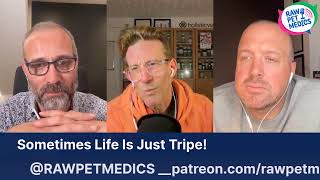
Rita Hogan, Peter Tobias, and Dr. Brendan Clarke discuss why early spay and neuter cause surgical menopause and hormone imbalances in dogs. They cover hormone replacement therapy, herbal protocols like licorice, and alternatives like ovary-sparing spay and vasectomy. Research from DogRisk shows how hormones affect metabolism and microbiome.
Chapters
Good morning, everybody. Here we are, here we are. We are in Mallorca. We've just had the most fabulous conference. We were talking about hormones, we were talking about dermatology, we were talking about dogs, we were talking about real food, we were talking about holistic medicine, we were talking about herbal approaches to, to health and hormonal health. And Peter was talking about a holistic approach using the best of both worlds, the conventional and the holistic world. We've got a road sweeper coming by us just here, and we're all here. Brady isn't here, but I think that probably improves the show fairly dramatically. But Bren is here, and Rita Hogan is here, and we have Peter Dubious is here. Dr. Brendan Clarke is here.
Repeater.
Repeater.
Repeater. So Rita, what are your takeaways from the conference that we've just had? It's Sunday morning, the other guys have gone off to the beach, and we are hanging back to record this for you.
We were just creating talk while the sweeper went.
Somebody has to maintain a veneer of professionalism here. So Rita, Rita, Rita, Rita Hogan, canine herbalist extraordinaire, clinical canine herbalist, herbalist, herbalist, herbalist, herbalist. Give us your take on what you've learned and what are your takeaways from our meeting this weekend.
Oh my God, this weekend has been so fabulous because we had Caroline Ingraham give the fantastical— that's a word— fantastical speech about absolute— and that's where we are. If you could see the view, you would know that we are in Harry Potter land. And about Zoopharmacognosy. And then we had Anna—
Heine Bjorkman.
Thank you for that, boys. Thank you. Heine Bjorkman. She showed us all the research from DogRisk and all of the wonderful work they're doing for our dogs in general behind the scenes. A lot of people don't realize that, but they are doing the most phenomenal work for dogs. And we learned that their work is going to be expanded into cats, CatRisk. Go kitties. And we talked about hormones at the conference and Peter was discussing the phenomenal results that he has gotten with his dog Pax by doing hormone supplementation. And going from a dog who could barely walk and have a freestyle life to going on hikes and running through the water and the phenomenal results of doing supplementation there. And then I discussed herbs for spay and neuter for dogs that have been spayed and neutered that don't have access to hormonal replacement. And I just think that there are so many wonderful things coming together. About not just providing longevity for, for our dogs, but thriving through that longevity.
Exactly right. I think it was a, a wonderful coming together of conventional and alternative approaches to health coming together under a holistic banner, because holistic medicine for me is anything that works. I've actually pinched that. Carvel Teakert was the head of the American Holistic Veterinary Medicine Association, and he coined that phrase. Holistic medicine is anything that works, which is lovely. So if you give a treatment and your dog stops itching for a month and then is back to square one, that's not good holistic therapy. But if you work gradually to move from a sick dog to a healthy dog, sick cat to a healthy cat. Anything that gets you there is arguably holistic medicine. Peter, what would your take on holistic medicine be integrating the best of what would be considered alternative therapies and more conventional therapies? Where are you on that?
You know, I think that everyone who starts with holistic medicine has some sort of aha moment in the whole process and we switched from Western to being very, very strictly holistic, most of us. And then, suddenly we realized that some of the pieces of the puzzle actually come from the conventional medicine and that actually regards hormones and other parts of medicine that we just can't be without, whether it's emergency medicine and some other parts. But, what I really love about this conference first, like, it's amazing to get together in person. And, you guys, if you have not been to the conference, you have to come next time because it's just so nice to be with like-minded people and we make friends and friendships. And it's also really beautiful to see how dedicated people are and how most of the work that is done here actually comes from within the heart. And it's just like really fulfilling and just inspiring. And also the fact that putting the pieces together is actually the way to go and that it doesn't need to be about camps and division, but it can be actually about coming together and sharing information and I learned from these guys and, uh, and I can also share some information. And it's really, yeah, it's just great. Like, I, I kind of had a little aha moment because I, I'm relatively shy speaker, even though some people don't believe it, I am. And I started, I went to, uh, Florida, I met these guys there, and now I'm in Mallorca and I'm really starting to realize how important it is for not only for evolution of medicine and veterinary medicine and how we care for our dogs ourselves but we can really come together as a community, be more powerful, and it just, you know, it just really grows. So if anyone has not been to this conference, keep an eye on these guys because they're organizing some fantastic stuff.
Right, Peter, that's really, really good. Brent, uh, what are your thoughts from the weekend?
Well, it started out with us thinking we were going to have a conference just about dermatology and then we sort of expanded it into behavior and the connections. And then it sort of came on that a lot of people wanted to talk about hormones and, you know, the influence of that on disease. And I found that really, really interesting and current with where I'm at in practice and looking at— for those cases that are refractory and not responding to treatments which are well chosen and seem to give some degree of change, but then they slip back quite readily is what we can do out with that. And it was pointed out that we've got this current theme that because of neutering policy, we've got, as Rita was just saying about Peter's dog, you know, an opportunity to make change with hormone replacement. And hormone replacement is becoming very notable in human sphere just because of all of the information that's coming out from what's happening with menopause and perimenopause and the appropriate treatments. And then we were having a discussion because effectively we're creating surgical menopause not just in female dogs which are being neutered with spaying, but actually also with the male dogs which are being castrated. We're effectively creating the same set of risk factors. Now, not every animal is going to be predisposed to that, but we are still in that scenario of creating those risk factors for at least 20% of cases, as we see in the menopausal side of things. So it was really interesting. I loved Rita's stuff on the phytoembryonics and looking at some of those. And I've taken away some of those protocols. I'm going to be trying them. I'm going to be pumping her for information about where I can get some of those, those stuff. And The— but also from Peter's point of view, just some of the conventional things to look at what's already available, you know, with superlaurin, what's already available with some of the testosterone and estrogens. But knowing that that's not the whole picture. And I think I'd really like to explore today here the next steps as to what we think we might be adjusting in our protocols whether that be testing, whether that be, you know, what's on our wish list to do for testing to be able to develop further what we're currently doing, and whether we'd already take away changes to our current protocols. Rita, you've got a protocol. Peter, you've got a protocol. It'd be interesting to see if you've taken away that you might tweak something after this weekend. So for you, Rita, first, what What other things might you be looking at? Or are you satisfied that you're just on a golden path?
No, no, never on a golden path. You know, I think in general my goal for myself and my career is always a reflection of nature, always a reflection of others in my community and what I can learn from them. I learned a ton this weekend. I'm going to be looking at using inhalation and self-selection of essential oils for hormonal balances, lemon. And, you know, we did some licorice work this weekend, which was phenomenal. I, you know, working with clients and helping them and working with vets next to each other, like working integrative health with vets. And when I say integrative, I mean, I'm talking about not just conventional mixed with holistic practices, but, but also, you know, herbal being that holistic practice, how we can come together to have better outcomes. Like now I know we can do ovary sparing spay and vasectomies. That's an option. We can do hormone replacement. And the vets that are working at hormone replacement. So I might make a suggestion that they talk to their vet or find a vet that can help them with that and see the outcome. And then I can come in and, you know, I'm not a vet, I don't treat disease, but I can make an herbal protocol and teach other people how to work with herbs to support their dogs with those individual herbs that are gonna help bring it to the next level. And I think that that's all we can ask for because that baseline theory that we've created, like yesterday someone mentioned, referred to their dog who is 8 as old. We've gotta get outta that conversation. That is manmade. Aging, and it's not proper aging. And we have to get out of that conversation and push that baseline back to an old dog is 16, 17, 18 years old. And that's in my lifetime, I'd like to see that happen.
And it was also really interesting what you're saying. It's not, you know, if for those that are neutered, it's not too late. It is literally that we need to do some other things. So the adrenal glands taking over the production of those androgens, what we can do to relieve the stress on those adrenal glands, you know, what what is it that we've got as tools that we can already use to do that? And there are some great, great supports out there.
Can I say one more thing? And one of the things that I got from being around all these wonderful veterinarians this weekend was just how hard they're working to change these things. And I think the travesty is that we spay and neuter our dogs and, you know, you work with your vets, Your vets don't know, right? Currently, that's what these guys are out to change. But we spay and neuter and we just don't get any support. And I know that so many people are frustrated with their dog's outcome and they don't, aren't associating it to hormones. They're not associating it with like that limping and cognitive behavior and even anxiety could be from the lack of hormones in the dog's body. We're just not having that conversation. And I felt like this weekend with all of these people from all over the world coming together, that that conversation is getting started.
I think that it reflects some of the conversations I've had. I've spoken to several women about perimenopausal and menopausal problems, which is a natural change in hormonal balance. But what we do as veterinarians and with the patients that I see is that 80% of the animals that I see have been artificially induced to go through an andropause, a menopause overnight. Yeah, at least nature takes 5, 6, 7, 8, 9 years to take women gradually through this process. We do it overnight, and in some cases we'll do it before puberty. And so I think with the population of animals that we're seeing at the moment, there is an enormous number of animals who are in hormonal chaos. And I think we need to realize that first of all, and that may be contributing to the many, many pathologies and the pathologies that are stuck that we can't move on, just to reflect Bren's thoughts there. Peter, you've got a fantastic example with Pax. Pax, by the way, is sitting right here with us right now. He's in the shade. He's pretty cool, pretty happy. Just, do you want to just briefly tell us his story just as an example, just to allow people to begin to grasp the depth of problem that we can see and the frustration of that problem and a possible root out of that problem?
Yeah, so I'm a big believer that animals come to us almost always to teach us lessons. And when I got Pax, I kind of thought, okay, I have nutrition dialed and supplementation dialed, and I know how to do physical therapy and exercise and all that. And so then Pax had to be neutered because he had one undescended testicle. And second, he was also being trained for my sleepwalking as a service dog. And I sleepwalk That's just what nature gave me. And so Pax went through the training and then basically without compromise he had to be neutered. So we neutered him and within 3 to 4 months he started limping. And it was very interesting because he started limping— the first time I noticed him limping was when Dr. Karen Becker visited Prague with Rodney. And Dr. Karen Becker is actually the first person who started addressing the spay and neuter or started pointing to it in you know, maybe 10, 15 years ago. And people were just not ready to even hear it. So it's almost like if I— and I do believe in the universe working in the background— Pax basically demoed what was happening right there. And then it just continued declining. And from happy, healthy dog that had beautiful shiny coat and was energetic and just full of joy, I started to see this decline. And I was thinking, wait a minute, like 2 and a half years, it's just way too early for him to get to get old or older. And I started, you know, searching for things because he started injuring his psoas muscle, which is the hip flexor. And then it would be just shifting lameness and he would be better and then worse again. And obviously, I went through physical therapy and different supplementation and needle therapy, acupuncture, nothing really worked. And then I decided to connect with my former colleague who is a board-certified rehabilitation expert. And he was too busy to see me. And, I was thinking, oh my goodness, I can't wait. And so, I started looking online and discovered the work of Dr. Michelle Cutler and Linda Brent who've done the research that is really profound and suggesting that the luteinizing hormone elevation, which is the pituitary gland hormone that stimulates the gonads, if the gonads are missing, if the gonads are gone, suddenly the luteinizing hormone starts attaching to different areas of the body and tissues. Cruciate ligament tears, thyroid gland issues, cancer, all that has been connected scientifically in research to luteinizing hormone elevation. So, you know, then I thought, oh my goodness, my dog possibly may be suffering from, from this LH disease, which is the, the official name now. And so I kind of waited for maybe a month, and then I decided to put Pax on HRT. Hormone replacement therapy. Pretty much within 2 months, he was better, but still the occasional limp. And within 4 months, we were hiking and swimming. And since then, it's been like 8, 18 months now, he has not limped. I've had 5 dogs now under my care or in connection with my care, and they all, from the age of 2 to 17, have improved. And so that's been really amazing. And, um, So, once you learn something, you can't really go back. And then, if you really want to make a shift and change in the world, then you have to share it and you have to also be ready for some people saying that this is nonsense and it doesn't work. But, I actually estimate that the rate of metabolic disease that has resulted from the hormone absence is actually much higher than 20%. And, I dare to say that because if you look at the function of metabolism and every Everyone can actually look it up online or with AI and you see what testosterone and estrogen and other hormones do. I would say that the lineup of treatment, every treatment would be nutrition, maybe supplementation, herbs, and then go into actually hormone replacement therapy before we start doing crazy procedures and drugs and all that because many of the problems that I've seen actually happening just disappear. And I have one example. Pax also was sensitive to chicken. That disappeared. His spine was kind of twitchy and he showed some sensitivity. That all disappeared. I feel him and examine on a regular basis and I myself am really surprised how amazing he is. And all the other dogs that I've seen being on HRT are doing well. So I'm sure that there is some dog that may not doing as well, or maybe things need to be tweaked a little bit. But now we're at the point where we need to do research. Ideally, let nature take its course, not take the testicles and ovaries away if we can actually preserve them. And we can, so we can prevent homelessness, and at the same time we can actually spare these poor dogs of going through the andropause and menopause early and, and causing real serious developmental challenges, especially in early space. And, and neuter. So, you know, this is a, from my perspective, kind of a revolution that we were thrown into without even expectations. Like, I did not expect to be so excited about medicine and healing at 61 because, you know, this is amazing, you guys. So I, I know that we're gonna do a good job together.
It's fantastic. It's, it's, it's just, for me, it's, it's, it's, uh, surprising that we as a profession thought that removing gonads would be without serious consequence in most cases. But it seems that, that the, the modern research is showing that you get a tsunami of LH, luteinizing hormone, and there are LH receptors on pretty much every tissue in the body, and it can cause chaos with any and each of those tissues. So I think that the door is wide open for research and looking at the pathologies that are as a direct result of neutering at any stage in life, because you will get this tsunami of LH at any stage of life. And, and, um, we are beginning to realize those things, but I think that there's some very interesting research to go to come forward. But the take-home message, guys, is if you're having problems, then look up— and nowadays it's very easy to look up these things— look up the effect of too much luteinizing hormone. And if you've got a neutered dog, male or female, they probably have too much luteinizing hormone floating around in their blood, which will be potentially causing problems. Bren, you got thoughts?
Yes, I think the last bit Linked to that was really interesting stuff that's going ahead with DogRisk at the moment, CatRisk coming, still great, is they're looking at the metabolome, they're looking at the metabolomics. And what's important about this is we're then reaching beyond just the spay/neuter question, which is serious, big issue that we need to resolve, that we can give supports with herbs from very early age as soon as they're done for those that have already been done. Not waiting until they've got a problem, which Peter's doing, not necessarily looking at hormone replacement straight away, but just the herbs. But the thing about the herbs is, going back to this metabolome, is for all of those entire intact dogs that may be exhibiting slight differences, nuances from, you know, the settled dogs. So they may be a little bit more anxious. They may be that they already have disease, but they're entire. but they have dermatosis of some description, or they have lameness and inflammation of some description. Now, we've talked endlessly about diet and what that can do for those, but actually looking at maybe— and we're seeing this in the human space for longevity— it's actually not just your hormone balance. So that not just the balance of testosterone for men and estrogen for women, it's a balance with progestogens, a balance with testosterone and estrogens in both sexes, but also then looking at how we metabolize those. And that can be then a devastating predisposition to cancer if it goes the wrong way. But actually that there are changes that can be made. Now, some of these changes we might need to make fairly early on so that they're not on a set path. You know, we were hearing from Manal talking about within the first 6 months, the microbiome can be set within that period. And after that, it's a real struggle to push it to make an effective change permanently without it resorting back. So that's a really interesting— for everybody, that means that you— it's not just genetics you get from necessarily parenthood, but also the metabolome— sorry, the microbiome. And therefore that can predispose you. Those microbes are also controlling how you metabolize things. Because they're switching on and off genes. And if they change how you metabolize your hormones, that can be a predisposition to all of the diseases we've just talked about. And wouldn't it be amazing with the testing that they're doing if we can actually come up, like with humans, a Dutch test or something that's a simple urine test that you can send off and you can make some adjustments preemptively to your pet's life, you know, with some supports with some dietary change, you know, those sort of things. That's what I'm also really excited about, not just the spay/neuter thing, which is serious, but, you know, let's face it, we could make a big change there by just not neutering them. But there's other things that I think would come out of that, you know, whether the false pregnancy question as to one of the reasons that people are neutering their dogs, you know, actually is just a change in how their concentrations of those different hormones are. And if we can effect a change, that would be wonderful. So those, those are sort of ending thoughts. Um, last, last thoughts then from you, Rita. Um, just closing thoughts because it's quite noisy here and we'll probably just need to wrap it up.
Um, I think my last thoughts is, uh, you know, we just have to remember that everything's connected and that when we start taking out organs, it's at a cost. And so we're, we're figuring out that cost. And for those, you know, a lot of dogs get spayed and neutered because of they might get testicular cancer or they might get mammary tumors. Like you just said, there's so many things at play. You know, a healthy dog is a way of life and we have, you know, slowly look at our water quality. What if, are we using too many plastics? There are so many things that are hormone disruptors. Endocrine disruptors and that do affect our genetic expression. And I think the more research into that is going to be phenomenal for what we can do in the long run.
Yeah, I think for me it is a lesson in humility that, you know, you come out of vet college, you think you know something, then you go into practice and you realize you know very, very little. And then through, for me, 30 plus years in practice, you think you know something. And possibly this weekend I've realized there's so much about the microbiome, there's so much about the metabolome, there's so much about the hormone status of the animals that we see is embryonic in its discovery. It's very exciting. Peter just said, I never thought I'd be excited about medicine, but I think medicine and health and holistic lifestyle is a massively exciting place to be, and we are going to be taking that forward in the Raw Feeding Veterinary Society. We're going to create a community of people who are interested in these things. We're going to support each other. So if you, if you are interested in this aspect of life for yourself, for your dog, for your cat, then please check out Raw Feeding Veterinary society, rfvs.info. I just thought I'd put a little plug in there. Peter, your closing thoughts?
Yeah, I think that all well said. I don't have much to add, but sometimes we have too much anxiety about making mistakes, but I have one rule, and that's the rule of least regret. So if we actually feel that we have run out of options and we have something that is a little novel, maybe not as explored, we really have to go there. If we feel that we would regret if we didn't. That's one thing. Second, I want to send a message to everyone who is upset about us not recommending the conventional neutering and spaying because we are not necessarily saying have uncontrolled breeding and homelessness and so on. So the rescue organizations and societies will be actually doing hormone-sparing sterilization, I hope, soon. And it's not much more difficult and it can be done. And that way we actually will preserve the health of animals. And third, we are launching, and I hope it's okay to say, that we are launching a website that is called hormonehealthfordogs.org, hormonehealthfordogs.org, and you can register. It's a website purely dedicated to hormone issues and therapies, and we'll be having conversations there. And there's a new program coming in November 2025 that I hope you will enjoy.
Do you want us to share that QR code so that people can link on that? Yes, so we'll share that. And I think that's a way of people getting to join that organization and see how things go. And I think, you know, guys, this is a conversation that needs to continue. I think it would be great to have you back into the studio where we can actually talk without loads of background noise and invite some other interested parties to sort of enter into that conversation of where we should be going with this. So great, thank you for joining us and being part of tonight's conversation.
Fabulous. My, my parting thought would be, uh, there are two types of medicine. There's outdated medicine and there's updated medicine. And I'd like to think that we are keeping up with the updated medicine, and that's what we've been doing this weekend. Guys, it's been fantastic to see you. Rita Hogan and Peter Tobias and Pax, uh, thank you very much. Brady, you should have been here. Uh, so, uh, it's good night from them and it's good night from us.