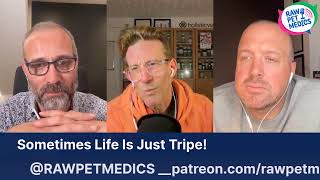
Dr. Conor Brady, Dr. Barry Sands, and Dr. Odette Jardine discuss alternative medicine in veterinary practice. Conor's chronic elbow pain resolved instantly after Odette performed muscle testing and a pelvic adjustment. They explore how emotional and energetic states transmit between owners and pets, citing research on biofields and heart-brain coherence.
Chapters
Good evening, everyone. How are we doing?
We're here.
Can you hear Every Breath I Take this week?
I'm sorry.
No, but it would make a great song.
That song was written— that's such a freaky song when you think about what he wrote about. He was a schoolteacher writing about perving on an underage kid. You know, I mean, every move we are using— it's Sting's tune and it's one of the biggest Hits ever. And, you know, Every Breath You Take, I'll be watching you. What's he doing, peeping in windows? What are you doing, Sting? You know, you're supposed to be a schoolteacher. That's what the whole song's about. He's written a few songs like that. Interesting stuff. But anyway, guys, we are Raw Pet Medics, and thank you for joining us tonight, 18th of November. And we are going to be talking about energy. Thanks to those who join us on patreon.com/rawpetmedics. Folk there give us the price of a cup of tea. Each month, and that's when we do a little bit on the side. So we'll keep hopefully the two ladies— you can only see one of them at the moment. You can see Dr. Barry Sands above me, and Odette Jardine is floating around in the ether, which is quite topical for the energy conversation we're about to have. And we are trying to call her as if from a séance onto the show, and we're struggling. So we'll see. We'll get the Ouija board out later. So thanks to those on Patreon. We appreciate that and we see you all. So thanks very much, guys. Is there anything that you're dying to talk about briefly before we start talking about—
I'm dying to say, Conor, have you remembered to put your microphone on?
I have. Yes. Everything is ready to go. I am raring to go. Is there anything you have during the week that you want to say before I tell you my amazing Odette Jardin story?
Yes, I do. I've just started writing a book and I'm very excited. And if anybody would like to contact me from the world of Patreon, Patreon, or from the world of Raw Pet Medics, and just say what you want in a book about the controversy, the how to go from being a skeptical raw feeder, from being a skeptical vet, to being somebody who's embraced and can see the real value of raw food. If you can, if you can contact me, it is not going to be mimicking Dr. Conor Brady's book in the slightest. It's going to be a, it's going to be a different slant. How do we get people over the line from being, uh, interested or with a view to raw to get them to see the real value and how to make that impact their dog's life? So if anyone's got any thoughts, I would be really, really grateful.
Nice, Thompson. When did you decide that? You've been threatening that for a while. When did you—
I've been threatening it for about a decade. Yeah, I decided I did. I just started listening to a book and it just sounded really simple. This guy was just laying out some really simple stuff on calisthenics and I just thought, I can do that for Raw. Yeah, so there we go. That's cool. The book was born and I'm, I'm just researching it now and I'm very excited. Not as excited as I am to see Dr. Barry and Dr. Odette here with us. Yes, in the, in the virtual studio this evening. Good evening, good evening, ladies.
Dr. Odette looks suspiciously frozen. She No, she's not.
No, I can see the eyes move.
Okay.
I don't know whether she can hear us.
I don't know if she could hear us.
Okay, listen, I'm going to start with my Odette story anyway. In San Diego at the Feed Real conference, I had a sore elbow at the outside of my elbow. They call it golfer's elbow, possibly tennis elbow. Can't remember the outside of my elbow. It's happened to me once or twice in my life. It's just a constant pain and it gets worse and worse and worse over the weeks that you ignore it. This has been going on months. And I was sitting there massaging my elbow and I was— I flinched when I put my elbow on the ground as I sat in the grass. And Odette asked me what was wrong. And I said, oh, it's this bloody elbow. It's just a constant pain that I've had. And she goes, oh, I can take a look if you wish. And so I said, have at it. You know, Odette has many skills and she can talk to us later about them. But she— so she explained to me that she's going to do some muscle testing to find out what is wrong. She could— and this muscle testing was very new to me, but I was surprised how un-new it is to everybody on Facebook, I commented about the success of Odette. I mean, it took her 5 minutes to not only diagnose the issue. She said, I suspect that the problem is in your neck. She introduced me to muscle testing, which is a way to see exactly where the weakness was or where the imbalance was. I don't know, Barry, talk to us about that. But very quickly, Odette had moved up to my neck. She goes, I think your problem might be in the neck. And then very quickly she said, oh, it could be lower down, it could be in your pelvis. And then Odette said the fateful words, I think the problem's in your sacrum, which is the second last bone in your spine, part of your tail. And Odette couldn't have known that I was in a bad motorbike accident 10 years ago and I cracked my sacrum and I was sitting on cushions for a long time after that. That was quite a sore experience. And so the body keeps the score, as they say. And Odette then, because she's got some chiropractic in there and a few other bits and pieces that I'm doing her a disservice, I'm sure she's got all sorts of stuff. And she's a small kind of person. She goes, do you want me to have a look at my car? And I just know about chiropractic from the movies where it's like that crunch. And I was like, I do have that. She goes, go on your hands and knees. And she just leans on my pelvis for a very short moment. And after about 10 seconds of leaning on my pelvis, I could barely feel her there. She just goes, how's that? How's your elbow? And I was like, how's my elbow? I mean, you've just been leaning on my butt. How could it possibly help my elbow? And then I extend out my arm and the pain is completely gone. As of today, a month later, no pain whatsoever, completely healed. Where a doctor had told me more exercise, and I was in the gym, it's not— I don't need more exercise. A physio was saying certain exercises, anti-inflammatories. And I was like, no, why is the pain sore? And Odette explained that when you've got this kink in your nervous system, I'm not quite sure what the words to use here, but she goes like this, it's just not firing properly. And then other things are taking over that shouldn't be doing those jobs. And you start to get some itis in whatever, and that is the pain. And as soon as she freed it up, it instantly cured my elbow. And I've been told since by everybody on Facebook that, oh, it's not just that, it can work for so many things. Odette was showing me how you could test supplements. You can see if your body wants a supplement, I'll be able to push your arm down and all this kind of stuff. It was the most interesting hour and a half of my life sitting on that grass talking to Odette. And I realized I just know absolutely nothing about the world and how it works at all. And I will start with Dr. Barry Sands because Odette's just struggling to come in here at the moment. But Barry, can you tell us what that muscle testing is? What, what is muscle testing? Can we start with that?
Yeah. So muscle testing is a modality that people learn. It's also called kinesiology.
Oh, same thing.
Yeah, it's the same thing. It's using your ability to speak to the body or speak to the subconscious energetic layers of the body through a practitioner touching parts of the body and using your arm or your another part of you to see if it's a yes or a no situation. So there's lots of different ways that you could tap into the subconscious energy field of the body. Like you said, the body keeps the score. And you— the body knows exactly what it needs and where the imbalance is. And it's really up to the practitioner or the person that's interfacing with that other person to help kind of adjust all that and figure that out. So when you do the muscle testing, a lot of times we'll have a person like hold out their arm and then just sort of, you know, kind of push it down. Yeah, you know, I think that's what Odette probably did with you.
That's nice.
Right. So she's— and if you, if you hold strong when she's, or when you're, you know, touching other parts of the body, then you know that that's a strong part. And if your arm goes down, there's a weakness.
It went down. Yeah, instantly. As soon as she touched my hand, my arm stayed strong. She touched my wrist, my arm stayed strong. As soon as she touched my elbow, I couldn't hold my arm up.
Yeah, and she might have also— when she went, when her other hand went down to your sacrum, your arm dropped as well.
Same thing.
Yeah, that's right. So there was a blockage and a weakness there. And so that's how you kind of know as a practitioner where in the body you need to sort of focus on. And so then that she went with her hands and, you know, her little magic hands and went and did a little bit of adjustment around your pelvis, and then all of a sudden things got released. You know, and they say, well, how did it affect my elbow? Well, it's from the nervous system. So the sacrum and the neck are connected through a spinal column. Right. And so as soon as you release the sacrum, the cervical region will naturally release, you know, along that spinal line. And then all the nerves coming out of the neck are innervating the arm. And so there was a link between the neck, the sacrum, the neck and the, and the elbow. So I guess anatomically, that's how that would work.
Yeah, it reminded me of something like Christmas tree lights. You know, it's like there was just something was out. And once it was fixed, things just flowed perfectly. Nick, sorry, what were you gonna say?
No, I was just gonna say, Dr. Conor Brady, that is very, very, very interesting. And I would, I would imagine that half the people listening to this podcast are going to be thinking, well, that's really obvious, that's fantastic, really glad that we're having this discussion. But the other half are going to be saying, how can that possibly be? If there is a neurologist, and you're not a neurologist, I'm not a neurologist, I'm not looking for, you know, the ultra neurological detail. But is there, what would the scientists say? Would the scientists be able to measure anything in Conor that was wrong in the first place and then that, that was changed?
Is—
well, how can we interface? Because I've been looking at kinesiology for years and it's never really struck me as being so, so, uh, life-changing. But Conor had this experience and it's brought it back to me to think maybe it is a really powerful modality. Because if you can't talk to a dog and you've got, I don't know, a supplement, and you think, is this supplement going to work with this dog? I, you know, you don't know, you have to try it. But if you're able just to to use the— yeah, use the client, the owner, as a surrogate. And you can say, okay, you touch the dog, I'll measure your arm because it's difficult to do it directly with the dog. And you say, right, do touch a strong part of the dog, right, we get a good arm response. There's no— there's no— there's a good strong arm. We then put the pot of nutrient into the hand of the owner on the dog, and then we get a weak response, we might be able to infer that that supplement on paper is good, but for that dog at that moment, it's not the thing. Is that correct? There's about 5 questions. Yeah, I'm just thinking out loud.
So Conor, can you now simplify what you just tried to bring?
You can do it bit by bit. So the least important bit of it is what would a neurologist think of this?
Well, I mean, I don't know if that's really truly the question because you're comparing conventional understanding with holistic modalities. And, you know, a neurologist would not even pay attention to that, honestly.
There must be some crossover, though. Yeah, because we are working with the physical world. We're working with energy. Neurologists work with the physical world because things called nerves, they work with energy, which is, you know, a conduction impulse.
Right.
But there must be some common ground there somewhere, you'd have thought.
Yeah, well, I mean, there is, but in the conventional— for the conventional neurologist, they don't even value chiropractors.
Yeah. Yeah.
So I feel like that's not even a fair question.
Okay.
You know, to throw neurologists, conventional neurologists in there because, you know, they think about the body on a kind of a different level. And when you, like, even with a chiropractor, they're all about the alignment, you know, the alignment of the spine is very important because you need to open up to allow the blood flow to be optimized and then the nerve impulses to be, you know, more succinct. But when you're talking about energy medicine, that's a whole other level. Yeah.
Yeah.
So it's a little bit like you've got a neurologist looking at an elephant and you've got an elephant specialist looking at an elephant and the neurologist goes, well, there is, there is some, you know, nervous activity here. But the elephant is the elephant specialist saying, well, there's the emotional side of the elephant and there's the digestive side of the elephant and there is homeopathic remedies that we could use to treat the elephant and what have you. It's a broad view versus a very narrow kind of historical coming from a place of zero understanding to coming to a limited, very physical and scientific understanding. Is that about it?
Yeah, because when you're looking at like a holistic viewpoint, you know, like you have to say like no one part is explicable to the whole. Yeah. You know, because it's all You know, everything has a relationship with something else. And then you add on the energy fields around that and the understanding of why does muscle testing work. It's really tapping into a subconscious, the energetic field that is driving the physiology from the outside in.
Yeah, I think basically we are streets ahead of these guys. It's just that we're not very good at explaining it because we can't really. We just talk about energy, we talk about balance and what have you. But What often happens is that 20, 30 years down the line, they discover a machine that can measure something and then they catch up.
Yeah, we don't have the tools to measure dark matter. It makes up 97% of the universe. Yeah, we don't know what it is because we don't have the right tool to look at it. We don't know how to measure it. We know it's there. We just— yeah, so it doesn't stop it being there. And so this, this, this energy field, like, this is something we can measure. It goes for many feet outside the body. And it shouldn't surprise people. We're electrical beings. We have, we have synapses firing all the time. And you can measure this. Lots of machines do. You got from EMFs to all sorts of things. You can actually measure the magnetism that comes off people, a heart to a brain with a lot more coming from the heart. From feet away, you can measure this. So it really calls into question this, you know, the whole energy and what we're missing and that kind of stuff. Can you speak to us about this, this energy? Like what sort of stuff are we missing besides muscle testing? I mean, what else is going on? What do you do day to day that you use in the energy type stuff? The type of energy sphere?
Oh, poor Odette.
We can see you, Odette. We just can't hear you. She's gone again.
So, you know, from the energy realm, you can use many, many, many different things. From— I talk a lot about biofields and biofield entanglements with my clients and the conversation of what you feel as a human being, your animal picks up in that way. And so there's been this question that I've had in the veterinary world to all veterinarians. Have you ever noticed that the owner has the same disease as their pet? Yeah. You know, and everyone says yes.
Yeah.
Like, yeah, absolutely. And then I'm like, okay, well, how is that possible? And what is happening there? And it's all energy. And it's this entanglement of our biofields that are being broadcasted to an animal who finds you very emotionally relevant and then takes on that energy in such that it changes their epigenetically, their DNA, so that they start excreting and making certain proteins or deep downgrading or upgrading their, um, their encoding of their DNA proteins to express a certain disease phenomenon, you know. And I can't, I can't really, I can't prove that, but it is a plausible explanation of how we are entangled through our, um, through our, through our biofields. Like you mentioned, the, you know, you can measure this field out from your heart. There's a magnetometer that can measure it out at least 6 to 9 feet.
That's right.
Right, that comes out of your heart. There's a huge broadcast electromagnetic field. And within that field, there is information. And information is your emotions and your thoughts and all the stuff that's getting through.
Yeah.
And your animals tap into that.
Like radio, like Wi-Fi. I mean, it's carried in waves. Light is waves. Sound is waves. You know, everything is waves and energy. And so if we understand how mobile phones work, work and communicate with satellites, you accept that. And you have your Wi-Fi, you know, we all— this, our Bluetooth earphones, we accept all that. We accept that, that fish, salmon can find their way back to a river, that pigeons can home around. Like, we accept sharks and platypus can dig for— we accept they all use the electromagnetism, but we definitely don't. I mean, that is just ridiculous to suggest that we are not— that what you're saying is not going on. I see it all the time with people that they're they've got the same illnesses. Has that— has nobody done any work on that to, to, you know?
Well, I bet Sheldrake has.
I bet Sheldrake has.
Yeah, yeah, yeah, he has. And he wrote that book, you know, about how dogs know when your owner's coming home.
Yeah.
Um, so he's done a lot of research on morphogenic fields. And I work with the HeartMath Institute.
HeartMath, that was it. Yeah. What do they do? What do HeartMath do? Give me some examples of some of the stuff they've, they've, uh, come out with.
Um, well, they've been around for about, um, 30 years or so, and they do scientific research on the heart's intelligence and how you can shift your physiology by going into states of coherence, which is a deep conversation between your heart and your brain and creating this alignment, a physiological alignment within your system, and how that changes your biofield rhythms and your heart rate variability. So that you can do a lot of stress management and build resilience and, you know, and, and create just health inside your body. So, you know, that's what they, they research that, and they also research the how energetically humans can affect the geomagnetic pulses of the Schumann resonance around the Earth, you know, and how we can actually change the frequencies of that collectively as a, as a species. Interestingly, they also tap into trees and how the trees are communicating with each other and along the planet. So they have a global initiative research that's going on about the trees as well. So a lot of, a lot of interesting stuff coming out from HeartMath.
Yeah. HeartMath put up monitors on a dog and on a kid and they separated the dogs and their hearts went into not arrhythmia. What's the word? Incoherence.
Coherence.
Yeah. So it went to the wonky phase when they were separated and when the two of them got close to each other, not even in the same room yet, as they got the heart rates— Mabel was the name of the dog, I remember— and the heart rate just plateaus, just gets nice, even. I can't use— I don't have the words.
Yeah, so that study— that study was, um, they were in two separate rooms and, um, Josh was the boy and his dog Mabel, and they hooked them both up to heart rate variability monitors. And they wanted to show that if Josh went into a state of coherence, how would that affect Mabel? And so as soon as he went into a state of coherence—
is that calm? Is that— what's state of coherence? Is that calm and positive? Coherence is, or is it the opposite?
It's a— it is— there is a calmness, but it's a little bit different because it does change your physiology. It's when you are creating your— the conversation between your heart and your brain and keeping that in sync. It's basically the brain getting into a conversation with the language of the heart. You know, it's, you know, what you love and what you think are the same exact things. It's a bigger conversation to have about coherence, but, um, and it's super easy to train someone how to get into that physiological state. Um, but when during the experiment, when Josh went into that state, they proved that Mabel, the dog, her heart rate and her heart rate variability became the same exact thing. So she went into a state of coherence just by him doing it. And so that showed that there is this connection between the human and the animal. And they were rooms apart. They didn't even see each other.
They did. They've done lots of studies on this, by the way, guys. There's loads of published research, really solid. Racehorses and their jockeys, where they tell the jockey, you know, walk down this path. And on the fourth time you walk down, a guy with an umbrella is going to jump out. And the jockey's like, oh no. So the they measure each other's heart rates on the horse and the jockey. The first time everything's fine, the second time everything's fine, on the third time everything's fine, and before the fourth one even begins, the horse is starting to get the flutters because they're so connected that the jockey is starting to feel a little bit anxious because he doesn't want to be on top of a, you know, half a ton beast when it rears up on its hind legs and the horse is already jittery. So they can— you can actually just even thinking about it Young moms will tell you this. You go out on a date and as soon as you come back, the baby wakes up and cries. How could the baby possibly know we were home? Like, it's a real thing. I'm telling you, I've seen it so many times. I'm sure that's it. The baby just knows mom's coming home. I'm told I am down for that. I just, I see it and people will testify to it in the Facebook comments. And we're going to see loads of people commenting on that.
Yeah. And they actually did a study on how a mom and a baby can connect with their heart rhythms and their brainwaves.
Oh, this is a really interesting part. But as Fiona has pointed out, and I've put the question up at the bottom of the screen there, and I get a lot of this from clients when they have that conversation about their connection to their pets, their connection within families. And, you know, some people will talk about their dog is taking that disease energy from them. Yeah, there's all of that stuff that goes on. But Their concern is if they've got a health condition, can they pass that on to their dog? What ways would you instruct people if they are concerned about their own health that they can shield their beloved pets from taking on that energy? What's your answer there? Or have you come up with anything for that?
Yeah, yeah. I mean, I've been working with this for the last 10 years, I think, you know, this phenomenon that's happening. And the first First and foremost, people need to understand that they shouldn't feel guilty or blame or shame around that kind of thing. Animals are there energetically to do a bunch of stuff. One, some animals will pick up, will take on the disease, like share it with you. Others will take it from you so that you don't get it. And then others will just be this sort of rock and a soundboard to hold space for you with the disease. So not every animal will take on that energy. It's really, it breaks down to just an awareness and a learning piece. Because when you recognize that shared phenomenon, it's an opportunity for you to start healing yourself. And when you start doing that, then you're going to notice the shift in the animal. So it's, I always tell people, it's like, you know, healing humanity one dog at a time. You know, and allowing them to see that as a mirror and a reflection of what's happening inside of them, and then to do a deeper dive into their own physiology. Because a lot of our— or you can even say that all of our diseases in our bodies are unresolved emotional conflicts that are coming from this emotional situation, these traumas that needed to be metabolized. And that weren't. And so they get seeded in a certain part of your body that is kind of metaphorically expressed, if that makes sense. So when you heal people on it, when you're thinking about healing on an energetic level, you start with the emotional conflicts and going back to, you know, what happened.
Oh, so there is— I mean, it gets really deep and it's great to see, you know, these people are so enthusiastic and, you know, all of our, you know, Patreon viewers and, and everybody who's out there on Facebook looking at us right now, um, and the level of which they go to for the health of their pets. But now seeing people suddenly have those light bulb moments of actually spending more time on their own health as part of that journey is so important. And I'm glad that you've sort of raised that. But as a practitioner, there is also an element, isn't there, of how you interact? And you must have to go through a process to ensure that when you're interacting with patients, that again, how that energy is passed on between you as a practitioner and the pets. Oh, and she's gone. She didn't like that question.
We are, we are without women again.
Nick's frozen, so I'm just going to unfreeze him for a minute.
No, I can see him.
No, on Facebook he's frozen. On Facebook he's frozen. I'm just going to unfreeze you for a moment.
Okay.
I mean, it is mind-blowing, isn't it? All this.
Incredible.
And I think it's a real shame that there is such a gulf between the practitioners. Kinesiology has been around for yonks.
Yeah.
And, and that's not even wacky. There are those, there's, you know, um, psionic meds and all these things. And it's just such a shame that, that science won't even entertain looking at this stuff. You know, there are phenomena there that would be easy to, uh, to, to, to examine, to, you know, do, do do studies to say there is something there, but we just don't know what it is. You know, the muscle testing, for example, I imagine that would be very easy to run some kind of trials on.
Sure, it was physically— Odette thought that I might have been a cynic. I'm a skeptic. If people don't understand the difference between those two, a cynic is someone that goes, bullshit, whereas a skeptic goes, oh, maybe, you know, tell me more and then I'll make up my mind. So I'm firmly in that latter camp. I probably started life as a cynic because I did a science degree and I was taught that we had all the answers. And then you realize over time you don't. But Odette started with a physical example to show me with the arm testing, as Barry was explaining. She says, look, you know, you're a big strong man, Conor, put out your arm there and don't let me put it down. So I'm holding it there so she couldn't get it down. And eventually then she can get it down just by touching the sore part. But she showed me how to do it and the people that were there. So we were just going around to people all day, just go and stick your arm out, watch this. And I can't get your arm out big big strong men, no problem. And it worked a treat. And then she said, you just hold your hand over their head and interrupt the field of some— for me, it was beams of energy coming down on my head. And she just puts your hand overhead and then the— and it interferes with the field and their arm goes down. Like, it was bizarre. And it was working on everyone. But I've since tried it, Barry, and I tried it on a physiotherapist. I don't know what it is about physiotherapists, but they're firmly in the cynical category when it comes to anything else but physiotherapy. I have found. But this physiotherapist was, I mentioned about kinesiology and muscle testing and she was like, bullshit. And I was like, oh, do tell us everything you know about muscle testing. And I said, I'll demonstrate it on you. And so she goes, okay. And I shouldn't have done that because I'm not the person to show her about muscle testing. So I said, put your arm out and I said, hold it nice and straight. And I couldn't get it down. And she goes, now watch this. And I do some hocus pocus above her head and I go to push her arm down and her arm won't go down. And I'm like, oh no, I look like an absolute dickhead now. So what is it? What's that?
So there's a lot of different techniques of how to interface with the energy fields that are around the body. And the whole arm thing is just one way. I mean, people can use it with their— they're making a circle with their fingers and using their own finger to come through. It's really about understanding what's truth and not truth in the body. And it's intention around that and being a clear conduit to receive that energy is really important. So like to your question before, like how do you as a practitioner like not get in the way of other people's stuff? And it's, it is actually to become that clear conduit for energy to come through, which, um, in certain trainings, depending on how clear you want to be, you need to, you know, deal with your own stuff. You know, you don't want to put your traumas on somebody else or your projections onto something else. And I think a lot of the therapists and the doctors out there are always doing that. I mean, it's all ego-based medicine, and so they're always putting their stuff on you, and that's not healing, that's just, you know, advice, you know. So when you become a clear conduit, you don't— when you step out of the way, you're just able to sort of feel the energies and change with that. So when Odette sort of turned her hand up and said, okay, this— I'm blocking it now, and so I want to see what's going to happen in your body, in her mind, she's— there's an understanding and an intention around like, this is what I'm doing, you know. Thoughts have frequency and impact and intentions have, have energy. So it's, it's putting those two things together, you know, with the idea of healing the body, you know, and allowing, you know, the best, the, you know, the system to just go for its, for its highest good in a way. I don't know if that makes sense.
Barry, is there, is there just thinking about Conor's experience, is there a really foolproof test that people can use on themselves or on a, on, you know, a child, a loved one, whoever might be around, not the dog because there's certain complexity there, or maybe it is with the dog. Is there a kind of a surefire way that people can just see a very simple black and white response? For example, you're doing the ones that I've seen in the past is you do a test with the arm and you kind of get used to how much people resist, because if they're really cynical, they'll go, this is a rod of iron and you will not move it.
Yeah.
Which is what the physiotherapist probably did. It's like, this guy is not going to move my hand at all. But if you just got somebody, you just say to them without any preempt, you just say, right, just hold your arm out and let me just test.
Yeah, that's a better way to do it.
Then you give them a bag of sugar and you just see if there's a difference.
Yeah. So one of the ways that you can test that with somebody or even yourself is to, first of all, you have to understand that working with these energies, it's subtle. These are subtle frequencies. You know, it's like being the kid and having imaginary friends that only you saw. Right? I mean, you saw these imaginary friends because you're tapped into that realm of through imagination creation. And so to them it was like, oh yeah, can't you see? And I was like, no, I can't see anything. Right? So there's a subtlety to it. But one of the things that we'll do to start the process is have that person hold their arm up, or you can have the individual just make a ring with their middle and thumb thumb finger and then use their index finger as a tester to see if they could break the circle. Yeah. And using— trying to use the same amount of pressure and asking yourself, um, the question, like, identify your— like, lie to yourself and have truth to yourself. So I would say, okay, my name, my name is Barry, you know, my name is Barry. And then I see what that feels like, and then I, then I would say something that's not true. You know, my name is John. My name is John. And you could, and you could feel there's a difference of the, of that energy. And if you do to somebody else, and they're holding out their arm, and you say, okay, just gently, it's really gentle, like, resist me first, say, okay, I'm going to push down, resist me. Right. And so then you get the idea of gentle resistance. And they say, okay, you know, my name, my name is Barry. 'And then my name is John,' you know, and then it comes and you just kind of get a feel for that. Yeah, I mean, anyone can hold tight and resist, you know, if they want to.
But I, I heard that, um, practitioners of this can do it at distance. So I mean distance like over the phone. And we know, we know of that, guys. Uh, I'm just not gonna bother naming them because I'm just— he has been called by very high-up people for racehorses that were in serious trouble before a show. And they called him— yeah, by very high-up people in England. And they called him and said, is there anything you can do? And he goes, yeah, bring the phone over to the horse. And they're like, what? The person, the person, the person ringing them knew exactly what they're doing. Everyone else is like, ridiculous. And the horse had 6 days to get over the illness, and on the last day they called him and, and—
oh my goodness. Well, yeah, I think certain powers are watching this broadcast. It's just too much for them to handle.
Well, to talk to address that, I mean, there is a thing called remote healing and it's not woo-woo. I mean, it really is science. It's quantum. It's quantum science.
Quantum. Yeah.
Quantum physics. And it's the, you know, the entanglement theories.
Yeah, these measures. Sorry, go ahead. Tell us about that. Tell us about that.
You know, it's like Einstein said, it was spooky action at a distance. You know, that's what he called it. You know, when you were trying to explain when they did the entanglement studies where you separate particles, they did it. I don't remember the year it was, but they took a particle, separated it in half. Off, and they put it along fiber optic channels about, you know, I don't know, I think 14 feet apart on each, on each direction. And then they measured what, what they would do with one particle, if what would happen to the other particle. So they would spin one particle in one way, and they noticed that the particle that was separated did the exact same thing at the exact same time. So there was no lag time. It was instantaneous. So they were doing the exact same thing. And so that was the entanglement experiment, which Einstein said, oh, it's like spooky action at a distance. I don't know. You know, it debunks the whole speed of light thing because it's faster than the speed of light because it's instantaneous. And yeah. And so this, this idea of muscle testing and getting involved with the subconscious, you don't even have to touch the person. You know, you just go into— for me, when I'm doing my practice, it's more of an intuition where I'm tapping into that field through my, my other sense of knowing. And then I will kind of get an idea of what substance I want to use on this animal. You know, I'll go through that process like, is this one better for you or this one better for you? And then I get an answer. You know, and then, then I trust it. And so, and it usually is correct and it's very helpful. But in the remote viewing, because there's this, um, you know, that there's no difference between physical things through space-time, where you can interact with someone through these fields, it's through your intention and you're being open to the possibilities of healing and tapping into that field. And horses, animals are easy because they don't have an expectation.
Yeah.
You know, of the healing.
This sounds incredibly close to prayer. Think of the effect of a group of people being asked to pray for somebody and them actually doing that. I don't know if you guys, I mean, I remember going to church church as a kid, right? And, you know, when they said, you know, do something, I'm just sitting there thinking about football and anything. I can't wait till it's finished, you know. So it was never— but can you— if there is something to this, and like Barry was saying, they have measured this, they've measured this quantum effect on the other side of the Earth as well. They haven't— and in the space station as well. They've just— they have measured this effect. I wonder if this sounds very close to prayer, where if you absolutely mean it And it sounds like the placebo-nocebo effect. I mean, all these things are very similar. That girl's TED Talk is unbelievable. And which one, if you've got a reference for that, I will find it before the end of the talk. I think it's called Placebo-Nocebo. She's explaining the nocebo effect where you tell somebody there's no hope, they're very unlikely to recover.
Yeah.
And there's astounding examples of where the person was given the wrong diagnosis and dies on the day, that kind of stuff, you know. You know, but that's like so much to this that we can't even talk about it. We can't bring it into like it's not the University of Edinburgh have studied, University of Nottingham have studied. What was the word you used there, Barry? Remote viewing or affecting? Yeah, yeah, yeah. They've put CCTV cameras on people that aren't connected. And so sorry that the people aren't, but the camera is and the person sitting in a room with a CCTV camera on them and the other person is is far away. And all the trouble we're having with the computers tonight, guys, Cloudflare is down, which is an enormous internet server. And so half the world is having massive problems at the moment. It's all over the news. You can see it. So this is why we're dealing with this.
No, it's not the wonky energy conversation.
No.
If only entanglement would mean we didn't have to have the internet.
Yeah. It's a lot of stress, but it convinces more people when I tell you the University of Edinburgh have looked at this, the University of Nottingham, the CIA have multiple case reports on this. I mean, who else is going to— they've studied identical twins, particularly when you've been born in the same amniotic sac and 1 in 4 can sense, you know, you're cold on a hand or hot on that, like unexplainable stuff without some sort of distance. And so what's the short of the distance? Why would it just keep on going? You could be in Australia as long as I'm thinking about the right thing.
Yeah, are you guys familiar with Lynne McTaggart?
No.
So she's in London and she, um, she wrote, uh, she's a researcher and an author and she has written two books, I think more than two books, but, uh, called The Field and another book is called The Intention Experiment. And so her life's work has been exactly that, like getting people a group of people to intent on something like, you know, peace, to stop a war or to heal something across the globe and show the effect of how that works. And she works with a lot of universities and a lot of scientists, and it's all documented in her books.
So they're amazing books. Yeah, I met her once. And so she is, she is a spectacular person. That's for sure. Barry, would you be able to give us some case studies? How you use this incredible and difficult to comprehend modality? Could you give us a—
On Patreon.
On Patreon. Yeah. Would that be okay? Just hang around with us just for another 10 minutes and give us some case studies of dog came in and it looked like this. But actually, we did some testing and it was that and this is what happened.
Yeah, I have a couple. I could, I could share a couple of cases with you.
Absolutely brilliant.
And then just before we go, let's give those couple of books out there for Nicola Cresswell because she'll be, she will be falling off her chair right now. That's Lynne McTaggart. So L-Y-N-N-E M-A-C-T-A-G-G-A-R-T. And there is The Field from back in 2001. And 2006, I think, is The Intention Experiment. So have a look at those. Really interesting.
I'm going to share it. I'm going to share this Intention Experiment that they have up on them. Oh, look at this stuff. She's got a book with the same name of Odette's book, What Your Doctor didn't tell you. Now we know where Odette got the name for her book from.
Don't say things like that. She is watching us. Odette, thanks for joining us on Facebook and replying to loads of people.
Odette's book is fantastic. I finished it, by the way, and I did actually read it. What Yvette Didn't Tell You is a fabulous book. So that's Odette's book. Barry, I mean, are you doing Zoom consults for people that are listening on Facebook? We'll jump to Patrick in a second. Is there somewhere people can look at the stuff you're doing, reach out to you? Do you do Zoom consults or do you just You know, how do you communicate with people remotely?
Remotely, right? That's right. So I do have a website. It's my name, drbarrysands.com. And I do do telemedicine consultations for those that are not local for me. And I also have a practice. Oh no.
That's awesome.
Did that leave you?
No, you're still here.
No, you're still here.
Don't start cursing.
Okay. Something just popped up in my screen.
Yeah. Yeah.
Okay, cool. DrBarrySands.com. That's cool. I'll share that underneath this about Lynn's—
Yeah. And actually on my website too, I'm in the process of a continual survey of the energetics of the human-animal bond. And it's a 1-minute survey that asks clients about like, have you ever had had a disease or condition that is similar to your pet. And so, and I'd say, yeah, and from all the people so far that have answered, 51% said yes. And then they go on to explain like what they were, you know, anxiety, physiological, cancers, immune-mediated, you know.
So you just see every disease now as dis-ease. Do you see it all as it can't all be an emotional trauma. I mean, like, really, do you see like all disease? Do you see like the cancer that's plaguing the West and not plaguing other regions of the world? Do you like— surely environmental factors are smashing us. How do you— how do you tear the two apart?
I mean, for me, I have this protocol called the BioEpic Protocol, and that breaks down the system between the three things: bioenergetic, biophysical, biointelligence, and biochemical. And so, yeah, we're all interfaced, you know, we're still humans, right? We have physiology. And so we work with biochemistry, which is foods, toxins, you know, whatnot, medical pharmaceuticals and, you know, supplements and everything. And then there's the biophysical, you know, you're traumatized, you hurt yourself, you get hit by a car, you hurt yourself in a sports injury. Right? So the body has to heal on those levels, but then there's the energetic and the intelligence part of it. And what I found is that you could take all the supplements in the world you want, eat the best diet and do all these things, but yet you're still not getting better. And there's always this, this, this icing on the cake that needs to be addressed. And once you address that emotional context and that energetic context, then you will heal. And, you know, because we've all met those animals that are on, you know, these perfect diets, you know, those 2.0 pet parents on the great supplements, the great microbiome, the raw food diets or things that are super organic and healthy. And then you turn around and then their dog has cancer. Like, well, you know, I was doing everything right. How did that happen?
Yeah.
You know, and then when you start getting deeper into the conversation with the owner, you realize that there is this underlying thing that hasn't been addressed and it always ends up being this, this emotional thing.
Yeah.
Yeah.
Amazing.
Great. So everyone, that has been amazing. Thank you so much, Dr. Brady. We've got Odette Souter, of course, is in the sidelines looking at the messages as we speak. And of course, she's also talked to me about that coming direct to us on Patreon. So we'll do an individual one-to-one, maybe Conor or myself, just an interview with Odette on Patreon so that she can also be part of that conversation because she's got so much to share. So that'll be great. But for now, if you want to join us on patreon.com/rawpetmedics for a price of a cup of tea, as only Nick would have, or a pint if it's—
Oh no, I'd have a coffee.
Oh, you'd have a coffee. Strong black coffee would do me. Then please do join us over on that side. Give us some support so that we can continue to bring you these excellent guests and also lots of information. But for now, we're going to be recording over on bit on the side. And so if you want to join us in about an hour or so over on Patreon, that would be great. Take care.
Cool.
See you guys. Good show.
Yeah. Have an energetic evening.