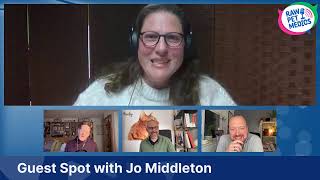
Jo Middleton, founder of the International School of Canine Psychology, discusses the rescue dog crisis: a 25% rise in vet costs and 51% increase in relinquishments in 2024. She outlines a consent-based rehabilitation model focusing on confidence-building, identifies three silent triggers (pain, nutrition, sleep), and emphasizes that educating owners matters more than training the dog.
Chapters
sorted out 5 seconds before we, before we jumped on. Good evening everybody, here we are once again guys.
We are the Raw Pet Medics and we do this every Tuesday at 7 PM. We are delighted to see you. We've got Joe Middleton on with us today. Really want to say thank you to all our Patreon supporters. You can find us on Patreon if you just go there and look for Raw Pet Medics. Uh, you can find us on podcasts and you can find us on YouTube. If you do go to YouTube, please like, click, subscribe, do all the stuff so that we can really SEO all our content. But tonight we're with Jo Middleton. Conor, you invited her, so I'm very happy to let you drive the bus this evening if you fancy.
Absolutely, I've got my driver's license all ready to go. Have you got your Zoom mic on?
Oh, hi!
I remembered and you two didn't. Is that correct? Yeah, buddy. Uh, nice one.
And I'll try not to shout tonight because obviously I come across really loud.
Your mic is a bit robotic tonight, uh, Bren. Yeah, well, listen, I've only met Joe recently. I actually did a talk for, for Joe's group Tuesday the 11th of March. I actually did a talk with Joe's group last year on, uh, kind of an effective nutrition on behavior type business. And so Jo is very much in the behavior sphere. So she is a cognitive-led dog rehabilitation and behavior expert. So I like the sound of that. Director of Canine Principles, check it out. And she specializes in cognitive-led dog rehab in particular, which I want to talk about tonight. Her expertise lies in helping rescue dogs rebuild confidence and emotional resilience. And so as I was chatting to Jo last week, we got to chatting about animal rescue and what's going on lately in the whole welfare sphere. You know, we got chatting about, you know, what was going on in shelters, but particularly what you do with rescue dogs when they're adopted. We all adopt a lot of rescue dogs here and there, and they come with, you know, their own needs. And I'm not sure if everybody's kind of totally aware of little aspects to that. And there's also a lot of rescue bitches that come out of that horrible sphere. And I was hoping that there might be a bit of reciprocal help here so we can hear hear a little bit about this, uh, the figures, some of the stats of what's going on and what it's like in, in, in that for, for the, for the welfare groups at the moment. How are they doing? How are they coping? Uh, but also, is there anything that you guys may be able to offer in terms of health and rehab of, uh, you know, overworked, uh, for these poor brood bitches that are coming out? So, um, that is it encapsulated, and that is what Joe is going to help us with. So Joe, can you tell us a little bit about yourself? Who are you? What do you do?
Yeah, sure. So, um, I basically am a complete dog geek and have been all my life. Um, I head up, as you said, Canine Principles, also the International School of Canine Psychology and the National Institute of Canine Ethics as well. We're very much focused on the kind, calm consistent ethical approach, which is all science-backed, and obviously more and more scientific research coming out all the time that we're keeping abreast of to back up our methods over coercive punitive methods. But personally, I've been involved in the rescue space for 25-odd years and have fostered, uh, we stopped counting at 100 dogs in 2013, so literally hundreds of dogs, many of which have been ex-puppy farm dogs. And for the last 15 years or so, I've been working with a charity called Forever Hounds Trust, and we have dogs from, um, off the track for racing greyhounds and lurchers. Anything pointy, really. Yeah, anything pointy that's a sofa surfer. So I'm very passionate about, um, helping dogs in need and have seen too many things that humans have inflicted on dogs, um, to not be fueled to make a difference in, in that area.
Yeah. What are the figures like today? How are we doing Um, was there any effect of COVID Was there an uptick, downtick? Where are we since? What's, what's going on today?
Uh, well, I was at a parliamentary meeting a couple of weeks ago with Mark Abraham, um, who organizes the, the meetings. Um, and it was really cool on one hand because not many people understand what it's really like in rescue and the challenges that are faced. So it was cool to be in a room full of people that understand and all want to make a difference and all have the same fire in their bellies that I do. But on the other hand, it was really frustrating because I have been in, in the area for a long time and the challenges just seem never-ending. And although there seem to be baby steps, it's like one step forward, two steps back all the time. So from a kind of stats point of view, um, last year a 25% increase in veterinary consult costs was seen by charities. Um, so that's not including the treatments, that's just the consults. Um, so that in itself is another dog that could be helped with the extra money that's having to be spent on veterinary consults. Um, there was a 51% rise in relinquishments reported by one charity in 2024 alone.
What?
Which is massive. Another charity reported that they get 150 calls a day on average with people wanting to relinquish their dogs.
Oh, why do you think that is, Jo? What's, what's changed this year? And also, just going back to the, the consultation thing, is that because there are more consultations going on, or is that because the price of each consultation has risen by 25%?
Because the price has increased by 25%.
25%.
Yeah, I think they were an Essex-based charity, um, that reported that. So it's crazy. And also the, um, the, uh, negotiation— because usually charities historically have had some sort of great rates agreement with veterinary practices, but there seems to be a reduction in the amount of veterinary practices that are open to that. And obviously veterinary practices are running businesses themselves, they need to stay afloat, they need to bring revenue in to cover their costs, so it all plays a factor. But what I think, whether anything has changed, I mean the post-COVID influx of dogs is obviously a factor, but we were having similar problems post-recession in 2000, after the 2008 recession, and then over the years with the economy, and there always seems to be a reason to give a dog up.
Okay, so it's economics, you think?
Potentially.
People just can't afford them. Okay.
However, during lockdown— sorry, Nick— during lockdown, the amount of dogs that, that were being brought into the homes. And, and we kind of predicted it was going to happen post-lockdown because the, the price of dogs went through the roof because the demand was there. Um, so people were breeding and breeding to keep up with the demand. And then now people are back to work and life's picked back up and, and their lifestyles don't adapt to, to the dog.
It's devastating, isn't it, that the, you know, people's perception of a dog is literally just a commodity, you know, when they have plenty of time, but actually they're not had the foresight necessarily in some circumstances. I know many of our followers are thinking about this long and hard, but, you know, for the general populace, that there has been almost like it becomes a commodity. You've got time on your hands, have the dog, not realizing 3 years' time your circumstances may be totally different and you know, that's devastating to see. And we see a lot of that in veterinary practice where people have almost gone, I can't cope with this, you know, I've chosen a breed that I like the look of. They've not had necessarily the understanding or the, you know, the education to understand how that dog might be, and they suddenly change to a Border Collie doing next to no exercise whatsoever, being locked up in a house and going nuts, and then they wonder why they have to relinquish it because it's chewing stuff.
Yeah, can I ask on the back of what Joe just said, just a question to Bren, if this is an economic thing, let's say people are struggling a little bit and you can expect relinquishments to increase when that happens, do you see the same in veterinary practice, Bren? Just as an aside, have you seen in 2024 an increase in people that can't meet their bills? I know that's a significant percentage of that you have to allow for each quarter, don't you, Brian? So has there been an uptick in '24 for you that would copy those figures?
I don't want to bang that economic drum and get into politics, but, you know, I think we overall need to understand there is a devaluation of currency that has gone on post-COVID because they pumped a lot of finance from government into, you know, effectively, how do you think they paid for furlough? You know, it's not because they had a big stash of cash. They printed lots of cash. What's the consequence of that? It devalues that cash. And the downside is then the cost of living has gone up for everybody. And unfortunately, that's also your veterinary team that's working hard to deliver those services. And if they don't keep up with that, let alone the cost of all of the equipment has gone up by that amount. All of the drugs have gone up by that amount. You know, it isn't, you know, these places aren't one-man bands. Quite often there's a whole structure behind it. And even if you looked at the cost of groceries, look at cost pre-COVID and post-COVID, you'll suddenly understand, you know, that the majority of them have gone up by an enormous amount. And so, yeah, we're constantly having to come up with novel ideas. Whether that be, look, you subscribe to a practice. You know, many independents are even doing this, that you subscribe to a practice. That means that you effectively can cost control your consultations because they're included in that subscription. And so they're just paying a monthly fee that allows them to visit the vet as many times as they need to, to get that attention that they need. And I think, you know, just ask your vet about those options if you're struggling to pay one-off consultations. It's a way of spreading the load.
So what do people do? I imagine in times of hardship, as your linkages go up, and if there wasn't a strong economic play, it means less donations coming into the charity at the same time. What does a charity do when they get 150 calls a day and they don't have a bed for one, let alone 150? What happens? What's the fate of those dogs?
The mental health toll on the rescue teams is just absolutely horrific. Because if you imagine you come into the world because you love dogs and you want to help dogs, you're not necessarily a people person, you're not necessarily— your communication skills maybe are better with dogs than they are with humans. And then you're having to literally sentence dogs to death every day because you haven't got the space. It's just a horrific position for people to be in and to put people in. And I know in the veterinary industry as well, the suicide rate is one of the highest in, in any industries because we genuinely get into what we're doing because of the love of animals. And then we're put in this position where we're literally having to sentence dogs to death. And I think the education and having these frank conversations about things is the only way that we can really keep getting at the mission, um, to make a difference accomplished in, in the smaller senses. Because a lot of people, like you're saying about getting the wrong type of dog, a lot of people will walk past a greyhound in kennels and find a Jack Russell because it looks cute and it looks fluffy. Well, actually, that Jack Russell's going to turn into some sort of Tasmanian Devil at some point, uh, whereas the Greyhound would have slept peacefully on your sofa and been happy with just a walk a day.
That's very Jack Russellist.
I've got one. I've got one.
Yeah, you're less scared of the breed if you own the breed.
Yeah.
Yeah.
Joe, what sort of What sort of nutritional problems do you come across, and/or what kind of disease processes? Are there particular disease processes that you come across in the rescue scenario that the— I was going to say normal dog owner, but that's the wrong way of saying it— the private individual may not come across?
So I think pain is a massive one. There is pain, nutrition, and sleep are my three silent behavioural triggers that I like to look at because they're not— they're usually— it's usually the symptoms that are seen rather than actually the dog just needs to sleep, it just needs to rest, or it's actually— it's got some sort of gut challenges going on because of the nutrition it's had and so it's in discomfort, or actually it's got really bad arthritis and that's not been addressed, and so it's in pain. So they're kind of the three that I, I really look for. Obviously, a vet check for new dogs coming in is really important to try and rule out any pain, illness, neurological kind of stuff, mobility issues. But then also looking at the impact of past trauma and stress and how that affects everything as well. In an ideal world, obviously all dogs would be raw fed, but from a rescue perspective, they're reliant on donations. And unless they've got a, a partner in a raw food company that's able to support the dogs in their rescue. It's a real challenge for rescues to feed raw, predominantly because they just haven't got the funds available to do so. So I don't know if that answers your question or if I just went off on my own.
It's sort of, but I really am interested because I also love to talk about the health impact of sleep, and loads of people talk to me about, well, the dog's sleeping on the sofa for 20 hours of the day, you know, what's your problem? Of course they get good sleep. So just fill us in a little bit more of the impact of sleep on behaviour and health, and what do you say to people to look out for? You know, what is good sleep?
So you're looking for the really deep sleep, so that when the remedial sleep— so when you're looking at the dog, it's laid out flat on its side and you're able to really see the deep rising and falling of the chest and it's slowed right down compared to their normal breath rate or their normal breath rate when they are resting, their normal resting breath rate. You're looking for the really slow, deep rise and fall of the chest. And it's the same as with humans. When you haven't had enough sleep, it affects every area of your waking time, including how your brain's functioning, including your thought processes and your general well-being. So if you haven't had enough sleep as a human, I'm sure we can all relate at some point in our lives to having not had enough sleep. You're naturally more cranky and you're naturally more reactive to different situations that perhaps you wouldn't have been before. So ideally what you're looking to do with your dog is find a safe space where it can hide itself away, where it's going to be undisturbed. Disturbed. You're going to create dedicated times that are downtime so that your dog has the opportunity to relax. And when we're talking about the Jack Russell, that, for example, is one breed that we would most likely see, um, where they find it harder to switch off, and we need to actually create an environment for them where they're able to, to relax and, and sort of decompress and actually chill, because naturally they want to know, what's that, what's that, what's going on, what's going on. And so for them, it's quite hard for them to come down from that heightened state that they're in.
So what would that actually look like, Jo? Sorry, Brent, just jumping in, just to say, so you say that there would be a safe space and there would be designated times. So safe space, what would that look like? Is that kind of, you'd have a cardboard box or a special enclosure somewhere? Away from the kitchen, which is probably going to be busy, or just if you take us through that on a practical basis. And also, what kind of times are you saying? 3 hours in the morning, 3 hours in the afternoon, or take— just take us through the day.
Yeah, so we're kind of looking for about 16 hours plus sleep a day for a dog if at all possible. And what we want to see is a safe space that's away from where the busy areas of the home are. So a dog will quite often position itself in a doorway or position itself in the middle of a room so that it can get some rest because it knows that then every time you move, it's going to be disturbed. So it will be made aware that you're, you're moving and it might need to follow you to make sure you're safe, or it might need to follow you to make sure that actually it's not missing out on something super exciting like you're cooking the dinner or something. So to get it used to having that safe space, and it could just be that it's the bed positioned round a corner. You're not going to put it near the TV where it's going to be really loud for the dog because their hearing is so much greater than ours. So what might be a normal TV level for you would be really, really loud for a dog. We really like the the sleep playlists that are available. They're designed specifically for dogs, and they're done in a way that are created so that the dog is— that there's sounds that the dog's going to relax to. So if you can get used to putting one of the sleepy playlists on, if you literally just look up sleepy dog playlist, loads of them will come up for you. Yeah, they're brilliant. And if you start to condition the dog that the sleepy playlist comes on, and that's when we're not going to be engaging in play, we're they're going to be relaxed. But you need to make sure that the dog has toileted, the dog isn't hungry, and it's had everything that it needs. A bit like when you're trying to get a baby to sleep, but literally the same. All its basic needs are met and it's able to then relax. And what we do with the sleepy playlist is then get to a point where when the sleepy playlist comes on, the dog starts to associate that with downtime, and it knows that it goes to its safe space. What I would just say about— you said about a container or something to put them in. What we do see a lot, we bring dogs over from Ireland on transport runs, and we see a lot of dogs who get crate trauma or trauma to the noise of the metal clangy noise of a crate. So if you are going to use a crate, then I'd recommend a soft crate if you've got a dog that's been transported and may have that trauma. And I'd also recommend that the crate is covered so that it is an enclosed safe space rather than a goldfish bowl. And then you're not going to shut the dog in the crate. You're going to start off by just maybe putting a reward in the crate and letting the dog venture in to get the reward, something that's high value to the dog. And you're going to build up gradually to that being where the dog goes for sleepy time rather than shutting it in, you're trapped and that's it.
So talk to me about— so we're talking about rescue dogs here in particular because a lot of people listening are going, my dog has no problem sleeping. It's like, yeah, well, your dog hasn't been through the mill, you know. So let's imagine for the dogs that are lucky enough to get into the shelters in Ireland and the UK, because so many don't— I mean, you were saying to me they have days once they get into a pound, you have days for that dog to be found, you know, that's how quick the turnover is. So this is a serious mega, mega issue that we don't talk about enough, but when the family rescues a dog, none of them are dog trainers, they might have had a dog before, and talk us through the first 24 hours and week. Like, so, like, I was told back in the day, tell me if I'm wrong, when I was working in shelters, is that the advice we used to give out would be that the natural reaction for people when they adopt a pup is to really mollycoddle it and spend every single moment of the time with them. And, and, uh, I know we were told now, I was being coached by a fairly guy that was a bit more kind of you know, uh, he said no, no, he was always encouraging people, said just give the dog a bit of space, just leave her alone, put her down some nice food, a nice quiet environment, put them in with Granny and Grandad, and she'll come out of her shell in her own time. Not to be going after and trying to put this human stuff on her. It's like you fall over, you bash your head, and you get up off the ground and you go, am I okay? And the person that's looking at you is going, you know, and you go, oh shit, I'm not okay. And you've got to be in your face, you know. So this is the way it was explained to me. Has things moved on in the last 30 years? I assume they have. What's the first 24 hours? What's the advice for a family adopting a rescue, a pup that might have been through some, some shit?
Yeah, that's a brilliant analogy, isn't it? Because if you've really hurt yourself, you often can't feel it yourself, and it's someone else's reaction that makes you go, oh my gosh, I'm bleeding.
Yeah, yeah, yeah.
So yeah, very much the same, I guess, from an analogy perspective. If you imagine that you have a child, a toddler that has been exposed to a trauma and they land into a foster home, they don't know anyone, they've lost all of their belongings, everything smells different, everything sounds different. And obviously dogs, because they've got such an enhanced power of scent, they smell in layers, whereas we smell like if I'm cooking a soup, I will just smell that I'm cooking a soup. They will smell that there's the carrots they'll smell that there might be some chicken, they smell the different layers. So they've got all of those increased sensory overload things going on as well as the fact that they don't know who they can trust anymore. So the first thing that we need to think about is making sure that we are respecting their space and things are on their terms. And that's why I really like focusing on cognitive-led rehab for dogs because everything needs to be consent-based as far as possible to build the trust. It's a bit like having— if you imagine having a bank account that's called the emotional bank account, you're not going to make a withdrawal from that bank account until you've paid some money in. And it's very much the same when you've got a rescue dog. You need to pay into that emotional bank account before you can ask for something in return. And even if that asking for something in return is simply putting a harness on the dog. You need to make sure that everything is on the dog's terms. You're inviting the dog into your space, you're not going into the dog's space. So first of all, we're going to be looking at creating a safe environment before you even get the dog. You're going to establish a quiet space where the dog can decompress. You're going to make sure that loud noises are minimized. You're going to make sure that there's a predictable possible routine to help them feel safe and secure. Whenever a dog comes into our home for the first time, we go straight through the home and out into the garden and wait until they toilet. When they toilet, there's gentle praise. If they're open to taking a treat reward, then they will get a treat reward, but many dogs are too stressed so they're not able to take a treat at that point, but we offer it Then they come into the home. So we've established outside is where the toilet is, and then we come into the home. Doesn't work, they usually toilet in the home as well, but we try to keep building that pattern that outside is where the toilet is. And then what we see far too often, sadly, is— and I can see why— is that the adopter is really excited, they've got this new dog, they love their new dog, they're are so infatuated with it and they want everyone to share that amazing rush of emotions that they're feeling. So they invite the family around to meet the new dog. No, no, no, no, no. Don't even tell anyone you've got a new dog for the first couple of weeks while you're trying to figure out and get to know each other. And then you can decide when and how to introduce people. And definitely don't invite them into the home. Meet people outside for the first time and parallel walk, not head on, you're walking together with them so that the dog is not under any pressure at all to react. We need to work on that positive reinforcement, paying into that emotional bank account and building trust at first.
Yeah, that's cool because there is a tendency to— here's another one, I don't know if this— I'm trying out all my 30-year-old training principles and seeing how many of them still apply, but here's another one: dogs know where the boundaries aren't, kids know where the boundaries aren't, but so it's nearly unfair to allow the dog when the dog comes in, particularly if they've been in shelter for a while and, you know, they're going to be weeing and pooing on the floor because that's where they wee and poo. So you've got to train that out of the dog, and that's, it's a little bit harder than just a puppy because this imprinting period we talk about when you're training, it's, it's, it's, you know, it's slightly, slightly, it takes a bit more time in the older dogs. But also they're jumping and climbing all over chairs and furniture sometimes because there isn't, you know, the same kind of boundaries that they're used to that they had in pounds. And so do you— should you be bringing in the boundaries from the start and go, sorry, buddy, no, not on the table, you know? And he's like, who are you? I'm standing on the table, you know. They know where the boundaries aren't. Am I to reinforce those boundaries from the very start? I mean, it's all, you know, very positive and paying into this bank account. I get that. I like the analogy. But I mean, he also needs to know that, look, no, buddy, please don't chew the table leg. No, no, please don't, you know. Or is it a matter of restricting his access to the kitchen and blocking off the bits you love because you're bringing in a rescue dog and he's going to have a week of getting used to the place. How do you— what's that bit involved— what's involved there?
Yeah, it very much depends on the individual dog. So there are some dogs, for example, that you can't even get close enough to touch. So even if they were on the furniture, you would never sort of pull them off or anything. What you're looking to do is redirect their attention onto something that you want them to do. So you're not rewarding the behaviour, but what you're doing is distracting them with a toy or distracting them by inviting them outside or doing something that is more enticing than what they're doing that they shouldn't be doing. So gradually it becomes less and less. Things like putting chairs on the sofa so that they can't climb on the sofa if you don't want them on the sofa, making sure that the chairs around the table are tucked in flush so that they're not able to climb on the chair to climb on the table. Jack Russell does that. But just making sure that you're setting that dog up for success rather than thinking, being precious about what you've got. And you have to expect teething problems when they first come into the home. The first maybe 2-3 weeks, you're going to think that you've got a perfect dog, and you're going to be over the moon that you've got a perfect dog. What you've actually likely got is a dog that's just experiencing learned helplessness. So it's just watching, it's just thinking, right, actually I'll just be a bit subdued because I'm not sure how to act, and I need to process, and I need to get that function back where I can actually start to make choices for myself. And then when it is in a position where it's able to make choices for itself and start to think more as the free-thinking being that it is, it's able to actually, um, find out what the right choices are from your perspective, because it's not sure at that time what you deem as the right choices and what you deem not the right choices. But we need to make sure that we are supporting that dog in making the right choices by not punishing the bad choices, or what you would think is the bad choice. To the dog, there's no such thing as a bad choice. But from a human perspective, you might think that cocking its leg on the sofa is a bad choice. We're not going to tell it off for that. We're just going to pop it in the garden and clear it up. And then when it comes back in, we maybe will do something that warrants some praise. So that we're able to invite it to do something positive and praise the good and ignore the bad.
Yeah, that's cool.
Yeah, training them to go to command helps also with that because it means that you can praise them doing something good outside, you know, so you wait for that opportunity to associate something good and then praise them for that and that side of things. I would really like to ask you In these circumstances where dogs are being rescued and placed in a new home for the first time, I come across quite a lot of vets that are overusing, in my view, some of the behavioral drugs that are now available for the veterinary market, and often trying to look at other herbal or supplement options that are good for for owners to use in those circumstances instead of some of those fairly heavy drugs. Is there anything that you've used in, in your cases that you've found really useful, very helpful, or do you avoid any sort of supplementation in those first, you know, few days of going into the new home?
Yeah, Pet Remedy has helped a lot with some dogs, and You Move do a calm supplement as well. So they're the two that I've used. Obviously there are many others available out there, they're just the ones that I've used. When— so again, it's very much, as each dog's individual, it's very dependent on the individual dog and what additional support they might need in those scenarios. But I've also— dog skullcap and valerian as well is another one. That I've used. But some dogs don't need anything at all. Other dogs might just need that additional crutch for a little while until they've sort of come to terms with their new surroundings. But from— so when Conor and I spoke a week or two ago, there's a charity called NatureWatch, and I've just been speaking to the guys at NatureWatch, and what they've done is created a breeding map for the UK. So although you have to be licensed to be a breeder, there's no limitations on the number of dogs under that license. So there are some in Ireland, and there are many in the UK that are high-numbered as well, but the ones that stuck out in my head were like 250 breeding bitches under one roof.
Oh my goodness. Yeah.
So when you've got dogs that are kept in a small container, their only coping mechanism for any stress is going around in circles because they have no space to do anything else. Their food, what food they get, is thrown over the side. They often don't have daylight. And when they come into rescue rescue after having been bred from season after season, having eaten off the floor and amongst their own feces, when they come into rescue, they've got so many things that we need to unpick. They've never lived in a home environment. They're not used to the TV, the hair dryer, even people walking upstairs. They think like Chicken Little and the sky is falling. Bloody hell, it's crazy. So When we're looking at dogs that need an extra bit of support and an extra crutch and medication, they're the kind of dogs that are institutionalized that really need that support to come to terms with what's going on in their lives.
Oh, the poor— absolutely amazing.
Um, Jo, you mentioned Pet Remedy. Uh, they do several versions of, you know, it's all the same, uh, essential oils, vetiver and, and valerian and bits of pieces. Which ones do you find the most useful and how do you use those? Is it the plug-in or the spray or— just take us, take us through, because that's something that people can get hold of online. Yeah, they may be able to use it with anxious dogs at home.
Yeah, I honestly don't know which one I've got. It's in a spray bottle and I spray. Sorry, that's not much use at all.
They do, they do a plug-in as well.
Yes, I don't use the plug-in because because I like them, um, to have the choice of whether they smell it or not. Yeah. Um, so I'll spray it on a blanket or spray it on something that's, um, around, like on the side of the sofa or on their crate, so that they're able to choose to go in and out of the crate. They choose to sniff it, um, as, as they wish. Um, that said, if I only had the plug-in, I would use the plug-in, but I use it, use it in a mild way. So maybe not right next to the dog, further away. And then if I felt it wasn't having an effect, move it nearer to where the dog is. So maybe upstairs to start with, and then in the hall if needed, and then in the room where the dog is.
And sometimes even wait for the dog, because if the dog goes and sleeps next to it, you know, as they need that.
I was just going to say that. Yeah, that's too pharmacology, but yeah. Plug it in further far away from them and do they gravitate to that part of the house and that's zoo-pharmacology stuff. What about resident dogs? You've got this dog coming in with their, with, you know, and your resident dog. Is it best that they're first introduced out in the park side by side going for a walk? What about the resident dog? How do we handle that?
So yes, outside, not in the home, and parallel walking from a safe distance. And then as it is safe and the dogs are happy to do so, moving closer together until they're walking side by side. If possible, if your resident dog is clicker trained or you have some sort of click reward or voice reward mark that's timely, every time your dog looks back at you, click reward, so you're rewarding that checking-in behavior. Um, and then so with the ex-breeding bitches, and obviously there are stud dogs as well that are kept in horrific circumstances, with, with those sort of dogs, um, they don't know what a reward is necessarily, but they're able to watch and learn from the other dog. The same with the greyhounds that we get in We've recently adopted an ex-working collie who's been on the sheep, on the sheep, in, yeah, on the sheep in the hills in Yorkshire all her life, lived in a kennel, never known anything else. So with those sort of dogs, they've never known human home environments. So to have another dog to learn from is really important. So that initial introduction to the resident dogs and making sure that they've got an ally in them is so key.
Yeah, Joe, just in— we're coming into the last 5, 6 minutes here. I'm sure you've got a lot of messages too that you'd like to get out to people. And also, it would be great if you could describe how people can help you, because the stories you're telling is just horrendous, and people's hearts are pouring out, I'm sure. So anything that people can do to help you do your thing And another request is we do a 10-minute section after this. Would you be able to stick around and just give us a little bit more insight? Because what you're saying is, is A, wonderful, and B, harrowing. And we'd love to pick your brains a wee bit more. So just for now, how can people help you? What are the messages you want people to really, really understand?
Help to educate people, I think, is the, the main message. People don't understand the situation. This is real life. It's been like it for as long as I can remember working in rescue. But if you're not involved in that world, you don't know the extent of what's going on. So for example, yes, dogs have to be microchipped. No one has to be registered on that chip. So for example, with greyhounds, yes, they're chipped and yes, they've got ear tattoos, but we see people chopping the ears off to get rid of the tattoos and dumping the dog, but the chip's not registered to anyone, so there's no accountability. We have dogs coming into the rescue system that are microchipped, but again, the chip's registered to out-of-date details or to a previous owner that doesn't want the dog anymore. So making sure those microchip details are up to date and helping raise awareness to DEFRA that chips need to be registered and they need to make that a legislative requirement. There needs to be accountability there. I think education is— obviously I'm completely biased because it's, it's what we do at Canine Principles and the International School for Canine Psychology, but I think education empowers dogs. And I think that we all have a responsibility to empower ourselves with that education to do the best that we can by our dogs. And of course, what you guys do with the nutritional information and education is such a key cornerstone of that. But we need to do it in all areas of dogs. You wouldn't have a child— and well, you might— and not educate yourself on how to look after that child properly. And we shouldn't be doing it with Don't get me started. I've got a little soapbox down here, do you want it? Let me at it. But yes, so I think to help, if you can, um, can just make sure that you're spreading the knowledge that I've shared tonight, spreading the, um, the knowledge of empowering yourself with education, training, humans in my mind is more important than training dogs. We need to understand canine body language, we need to set realistic expectations. They're free-thinking beings, they're independent. We need to be consistent in our, in our behaviour around them, and we need to make sure that everything is done with love and positive reinforcement.
Amazing. Tell us about your websites and where people can reach you.
Yeah, sure. So I've literally just started a YouTube channel, so @Jo Middleton. It might be @Jo_Middleton, but I'm on YouTube. You can find me on there. Um, on Facebook, um, Canine Principles or the ISCP, the International School for Canine Psychology. Um, or just drop me an email at joe@canineprinciples.com.
So at canineprinciples.com. Okay, that's fabulous.
There's lots of courses on the ISCP that people can— I can see a great variety of, depending on your need and what you're looking for. So that would be a good way to start. It's interesting you said, like, you know, you say the same thing most of the top trainers say, which is like, it's not about training the dog, certainly with these rescue dogs that are coming in, it's about training the people. And, you know, the rescues are so flat out busy, it's like they can't give that aftercare to the family. And so there has to be a bit of an onus on the family that when they're taking on these dogs, there needs to be a bit of preparation, a little bit of, you know, getting ready for just from a training point of view. Everyone thinks they know how to train a dog. It's very frustrating, as you know, like, you know, you talk to people and they always want to tell you something about training the dog, and it's like, bloody hell. So when we jump over to Patreon, can you just give us a couple of what are the top tips for training when it comes to training with a dog? What are the top things you wish families were ready to do with a rescue dog, the basic kind of training, you know, and what are the top tips that you have for training people and not the dog?
Ah, top tips for training the people, not the dog. Is that what you're saying, Conor?
That's it.
What are your top 10 things that you wish every dog owner knew? 10?
Off the top of my head? I'm good, but I'm not that good. All right.
Top 3. Yeah, okay, so when we go over to Patreon, we'll, we'll, we'll go the top 3 things that you wish, uh, every owner knew.
I bet I can go 15, Nick. I bet I can go 15.
Hang on, you just, you just gave me a—
you've just haggled yourself upwards.
That's fine.
Okay, but as many as you can. That would be amazing, Jo.
That was, that was That was superb.
You've scared me and delighted me all in the same measure. So thank you very, very much. That's amazing.
Thanks for your time, Jo. I appreciate that.
Thank you for having me on, guys. Really appreciate it.
Absolutely, no problem.
So if you want to join us, um, over on Patreon for the excerpts of the top 3 to 15, depending on how many we get through, uh, tips for training your humans, uh, then please do join us over on patreon.com/rawpetmedic. I'll get it right this week. Thank you, guys. And for everyone else, thank you for watching. We look forward to seeing you next week for yet another episode. Do we know what we're doing yet? Should we decide a minute before like we do every week?
Shall we do CBD?
Because CBD is a huge one. That's a two-parter.
We're supposed to be doing that, but Joe's a lot more interesting.
Yeah, CBD is enormous. In fact, there's another supplement. There's another supplement for anxiety. Have you used CBD at all, Joe?
Nope, nope, nope.
Interesting.
Yeah, well, there you go.
It's something I'd like to learn more about though, so I'll be tuning in.
Well, tune in next week.
We'll do CBD.
That'll be good.
Brilliant.
Thank you, Joe, and thank you everyone for watching. Do remember to catch up. We will be posting this in about an hour's time over on patreon.com, so please, uh, do bear with us while we have a chance to have a chat, edit it a little bit take out Conor's excuses and be able to post it. So please do tune in then. Thank you.
Well done, Joe.
Thank you.










