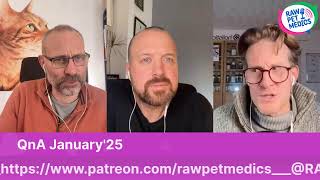
Dr. Conor Brady, Nick, and Brent examine the H5N1 bird flu outbreak, questioning media narratives around pet risk. They argue the Oregon cat case was misrepresented, critique PCR testing methods, and discuss lab-leak origins and gain-of-function research funding before proposing regenerative farming as an alternative to intensive agriculture.
Chapters
Talking about AV flu on the 28th of—
and that's Nick priming his microphone. So we are actually very organized.
He's ignoring what we're saying.
Yeah, but what—
for himself. So we're just going to mute him.
Yeah, exactly. No, you've ruined my joke now, Nick. Excuse my language. Anyway, hello, we are Raw Pet Medics. We are very professional and we love a bit of natural pet nutrition and health. So you will find us on Patreon, or Patreon as Nick says,.com/rawpetmedics. So anybody that can goes in there and gives us the price of a cup of tea each month, and we deeply appreciate you all. And so we do the last quarter of the show in Patreon, and it's somewhere we can do slightly juicier topics too. Certainly with the topic we're talking about tonight, we're going to have to be slightly careful. I just wanted to put a caveat, people watching, it'll be easier for people listening, you'll understand what I'm talking about. Tonight we're going to talk about bird flu, avian influenza, and inevitably in the conversation over the next 45 minutes that's going out over Facebook and YouTube, particularly YouTube, we have to watch, they have very strict policies about a certain therapy that comes in this sort of shape that you put in your arm, you know, and we often give them to babies and all sorts of things, and it was used during the last years a lot, and it could be mentioned again in this chat on bird flu. So anytime we mention these things, we're going to hold up something that looks like the thing that you might actually put in your arm, so we don't have to say the actual word, just in case we're saying something in a negative light. That's just to protect us, although no doubt AI is just watching us going, 'Chumps, I know exactly what you're doing.' So anyway, for people on—
breaks up and it crackles and then it's just a dead feed. This time it truly may be something sinister on social media.
So, uh, so anyway, we'll be, we'll be careful. And, uh, but I know it's a very, very hot topic. Before we get into it, anything you want to get off your chest, guys?
Uh, I've been in bed for the last 2 days, so—
oh no, I know you're a quiet boss.
Yeah, take it easy. Yeah, I haven't eaten anything all day. I can't even tolerate tea and coffee. Yeah.
Oh no, this is a lovely cup of tea, Nick. I have to say, this is one of my better ones that I've made this year. You haven't got bird flu by any chance?
Well, I might do. I might do. No, my eyes are okay.
Peacock flu.
You look good. Yeah, peacock flu.
Yeah, I haven't got any conjunctivitis, but I just feel just washed out and horrible.
Oh, sorry to hear that, buddy.
We'll survive. It's okay. Thank you for saying. Yeah.
Absolutely. What about you, Brent? What's been going on in the world of Brendon?
So lots of interest in RawSafe, strangely.
Oh yeah.
And, you know, so we're having to look at producing some information about what companies are doing to ensure reduced risks within, you know, from any biological agent within raw food. And it's just been really A lot of it is talking about rationalisation. What is that real risk? You know, is it a risk? Is it actually a perceived risk? Or is it just a, you know, well, literally just nothing to worry about at all?
I think that's a good place to start the conversation, guys, with what is the actual risk? Yeah, because I mean, every time you get in your car, you are at risk of dying, you know, but the the risk is pretty low. Every time you get in an aeroplane, you risk— you have a risk of dying, you know. Whereas, you know, if you go and start talking about underpants again, isn't it? Uh, no, no, I won't talk about underpants. Um, but there is a risk with everything, and it's just a question of, you know. And so with certain viruses that come along, some of them are really horrendous. Ebola, yeah, you don't want to play with that. But maybe— so I think if we can quantify how much of a risk to various species avian influenza is, that's perhaps the place to start.
Yeah, definitely.
Now, I just— before, because Conor can be quite modest, he's done a— on, on drconorbrady.com.
That's me.
Yeah, is that—
yes, that's it.
So on drconorbrady.com, he has done a 90-minute— and we've taken the mic the other day, but I've actually just gone and seen it because I haven't been able to do any revision for this topic, and it is really, really, very good. And so if anybody wants the background and the, the statistics and the papers and the, you know, the whole shebang, then it's a good one to go to. So if you go to— and he's not paying me any money for this, unfortunately.
Yeah, thanks, Nick.
DrConorBrady.com. And what's the title of the piece?
It's just Bird Flu. I bet you Karen is in Facebook now putting up a link. That would be Karen's style. So you'll see it, it's been posted on a few. If you type in Bird Flu on my Facebook page. I've done a number of posts, so it'll come up there. But, but yeah, I divided into 6 videos as well because not everybody wants to watch the whole thing. The reason it's so long is because the first 20 minutes, 25 minutes is recapping over the last 4 years to say, how did that go for us? What lessons have we learned? And what have we learned about, you know, the new technology that came out? How did we fare? How did it treat disease? Did it reduce transmission? And, you know, let's talk about excess deaths and all that kind of stuff. So that was mentioned in the first half hour. Maybe not everybody wants to listen to that. They might not be ready. They just want to jump into the part 2 stuff. So I made it that way. As it happens, everybody's watching the 90 minutes, so they're watching all the videos through, it seems. So it's a good way to go. Did you see the post I put up today, guys? The cat— in relation to how you queued us up there, Nick, and you're saying the risk to everybody— dogs don't seem affected by this at all. Straight out of the traps, nothing. There's no dogs being mentioned here at all, but cats are getting a mention here and there, and there's a few examples. The one example that everybody is repeating up until today, and they won't repeat it anymore, is this cat in Oregon that died of bird flu. And that was the titles of every single newspaper article. This cat died of bird flu from eating raw dog food or cat food. That was, I mean, very confident. All the papers, the usual groups warning us. And the Oregon State Department were involved, a vet, and the vet said this was strictly an indoor cat, the words out of his mouth, and they found it from the raw dog food. And the company involved, Northwest pulled the product immediately even though they had a kind of safety officer on board saying, hey, you know, they opened a— they sampled an open packet and not any of our closed packets. And on this strange thing anyway, people got their knickers in a twist and they're urging Cam along with a few others, people are saying we've got to cook our raw dog food. I said, hang on a second, we don't know anything about this cat, we don't know anything about this case. And to cut a long story short, Susan Tixton from Truth About Pet Food via FOIA requests. I think Dr. Lauren— Laurie, um, uh, Kozier actually, uh, uncovered it.
Oh yeah, FOIA for people, just—
oh yeah, yeah, Freedom of Information. Yeah, and, uh, they went after the, the Argonne knowing, smelling a rat, as most of us did, and they pursued these vets. And what they found was behind the scenes, they mentioned that the cat wasn't actually an indoor cat, that the cat was— went everywhere with the owner, in inverted commas, that it had access to wildfowl, which is how cats normally pick up bird flu. And not that they ever succumb to that, but very rarely succumb to it. A handful of cases in the last 10, 20 years. A single cat in Germany, 2 cats in Austria kind of thing. So that was the first thing that they knew about. And then the second thing they knew about was that all the samples that they tested, the closed samples of this company Northwest, are enormous. You're talking a million pounds in weight. That's, let's say half a million kilos of this cat food, of this raw product, had been released before this cat got sick. So you can think how many meals and perfectly healthy animals. And they sampled all their closed containers and they didn't find any. They only found avian influenza viral particles in the open container. That would never stand in court anyway, even without the background knowledge knowing that they were blowing zero in their closed containers. You can't sample an open container using PCR. So this is 100%, this example, single example of a cat is 100% false. Not false, but 100% stinky and misleading and odious. And thank God for the FOIA requests and stuff. So check out Susan Thixton's page, Truth About Pet Food, and you'll see that article for yourself. So straight out of the traps, this one death that they try to hold up and remove fresh food from every pet in the West is utter nonsense. And £1 million of that product. Can you think of the damage Northwest have endured because of this? They did a recall straight away. What a good company. And the cost financially to them to be seen as a company that's putting out bird flu products. Another product in California, the titles, the only other example of cats that have died, that have gotten sick from avian influenza, gotten sick. These are cases, and all the titles of the articles, I'm not going to read them out, are saying 5 cats sick in California because of this one product sold across farmers markets in California. It turns out that one household, one cat had been sampled, other four were assumed to have it, and the cat wasn't sick. So these ideas of cats being sick with avian influenza, when you look into the cases, it's inevitably highly questionable. So we don't have a lot of bodies at the moment. So in relation to cats—
shame, isn't it? Because if you get to the point where— and the reason that they did the recall was because unfortunately Somebody has said to them, we found a positive inside one of your bags, even though it was open and nearly empty.
Yeah.
And if that hadn't have happened, there isn't really any legal process that would have made them have to do a recall because, as you said, people would immediately have had to look at all of the other circumstances for that cat and work out what else it might have actually died from. Not with, and therefore, you know, be looking truly at other things and opening their minds and being a little bit more investigative to what's causing this disease that's killed this poor cat. And I think as soon as somebody finds a positive, you know, we have people finding positives in cats for other diseases. And, you know, we all laugh about the vets that, you know, we think would say that the cat got run over because it was eating raw food. And, you know, you get some of the diseases which, fair enough, could have come from raw meat if it wasn't frozen. You know, toxoplasmosis, for example, something like that. Neospora. You know, those sort of diseases, but that are killed by freezing. But they blame the raw food, which has been frozen for nigh on 3 weeks at least, if not longer, before that cat's been exposed to it. But they don't talk about the hunting that that cat's done through the year, the fact that that cat might have been sat on that infection for the last 6 months, and it's only because of other stressors other disease that's compromised it, that that disease has become positive. And we're sort of falling into that realm of perceived risks and blame being put at the foot of raw food where there isn't actually a long stream of evidence that it's got to be there.
Yeah.
And really, those— it's diabolical that those inspectors did all of the other tests, found a whole raft of negatives.
Yeah.
And insisted that really they should withdraw the food.
Yeah.
Um, because yeah, there's debate as to whether it was in the food because the same batch was there.
That stinks.
I think it's very convenient for the powers that be, whoever they may be. They've been wanting to get rid of raw in the States and less so but a little in the UK for many, many years. And this is just a fantastic ideal opportunity because it's not, oh, you know, we're going to injure some, some cats or, or ostriches or whatever it might be. It's, did you know that there may be a risk to human beings even though it's small and infectivity is low? And if you even get this, this version of avian influenza, it's a really very mild disease. That's irrelevant because what they do is they'll just whip up a storm of fear like they did 5 years ago. Um, and I think they're just playing out exactly the same playbook because it didn't work very well— it worked pretty well, but it did— they weren't able to carry through with all their, their plans. And so they're having another go, and this time they're adding cats and other animals, cows and chickens, to the mix. For political reasons. Is that unfair of me to take it to those extremes, do you think?
No, it's, it's, it's definitely spot on. And I think the bit that we're missing here is that, that, uh, they're using, uh, PCR again to identify cases because nobody's getting sick. It's pink eye in humans, it's non-existent threat to dogs. A couple of examples of seals have washed up dead in one particular area. I said, well, that's not how it works. Seagulls don't all just poo in one particular area, you know. Virus have always swept through populations. So when you tell me 10 big cats got wiped out in the zoo, I'll go, yeah, that's always happened. There are some nasty viruses that lay out cats. Check out, just type in thousands of cats dead in Cyprus. Check out the new coronavirus going through the islands in Cyprus, and now it's landed in the UK 2 years ago. And this killed thousands of domestic cats in Cyprus over a few months. Like, it runs a new type of coronavirus. So these viruses have always swept through, but now through the glory of PCR, you can make a whole lot of something out of a whole lot of nothing. It's great for seeing what's there, but it doesn't tell you if you're suffering the body or not. And the important number to remember, or the word, is cycles. How many cycles has the PCR done to detect this tiny infinitesimal fragment of viral particles? Because if you've got lots of virus, snot pouring out your nose, and you're coughing all over everybody, you won't have to do many cycles to get enough DNA that we can see what's going on. Is it virus, bacteria, what is it? But if you've only got a tiny infinitesimal amount, because we're all walking around with viral particles of pretty virtually every disease on the planet, 10% of the planet walking around with TB, but not active TB. So we all have like, you know, 100% of us have COVID now, but you're not active COVID. It's okay to have the viral particles, it's part of the process. But PCR can detect those particles in you. So if I, as Brian said, get hit by a car and I'm lying in ICU and they do a PCR test for COVID, am I suffering COVID? No, I just, I'm housing COVID. I'm giving a little, a free ride around the place, but it's, it's it's not bothering me. So the important number is— and they can't make an infectious go of it. It doesn't work. It's not enough goo to get the job done. So if a cat was eating a piece of raw dog food which had been made on a chicken that saw a bit of avian influenza and just— but not a dead bird, a perfectly healthy, awake bird, you know, if that tiny little particle happened to make its way into the cat that way, dosage is important. So this PCR thing is really, really important. And it turns out that the NHS and the HSE and the CDC all used 45 cycles, which everybody said is absolutely preposterous, that there was no way that particle could ever be causing a problem in the body. Why did they do that when we know anything over 33, it just results in all these cases? So when does that—
case 5 years ago. Yeah, yeah, when they started doing all of those tests and ridiculous levels of cycling. What are they doing, do we know, for avian influenza?
We don't know.
And what is And what is the good— you know, would it be if they did 16 cycles and they found a positive, would that be, you know, with symptoms?
So they can't— you can't just be with symptoms. Yeah, so if you have— and an autopsy will show you if you've got avian influenza and the bird's died of it, it'll be white-out lungs like COVID. I assume whatever influenza looks like to a person that dies of influenza. So autopsy, like when you say a zoo lost 5 big cats, you're telling me the zoo didn't do any autopsies? All zoos do autopsies on big cats. I mean, they're extremely precious animals. They're charities for the most part. So yeah, the PCR thing with symptoms is handy to know what you're looking at if someone in ICU has a raging fever. It's a handy tool, but to say you roll it out in the face of a pandemic is crazy. We know it didn't work out for us. It just gave us loads of cases because people weren't sick around us, so we needed cases so we'd shit our pants and stay in and follow the rules and, you know, scare the pants off them, as Matt Hancock said, your dude. And so the cases bit will be used in this instance 100%, it's going to be used, the PCR cases. They will go hard, they will sample flocks, they will sample workers in those farms, they will find avian influenza. So if you get the flu, like Nick, if Nick was sampled now, he might have avian influenza. He's a vet, he bumps into shit all the time, so he's going to have all these viruses. And so what is Nick suffering? Well, whatever PCR, whatever you look for with PCR, you can say Nick was suffering in today's world. When actually the dude's just got the flu, he's just got a cold, you know. So it's a very hazardous time. Yeah, a man flu. And, uh, and the cases will be used to scare us. So that's, that's definitely what's going to happen. Definitely.
That's really interesting what you said there, because literally, you know, we're now talking about, oh, we're worried it's going to jump species. Well, I believe there's 24 species which have already been found to have avian influenza on board. And it's not surprising when we've had huge populations of wild birds in the UK dying of avian influenza. There are different clades, as Nick was talking about earlier before show, before we came on, but ultimately these are H5N1, so of the same viral type that we're talking about here. And huge swathes of wild birds hit massively around the coast of Scotland, you know, all of those massive bird populations that are up there for the seabirds, um, just devastated by bird flu. I have seen on farmland, you know, you'd occasionally see the farmer would shoot one, or, you know, a few dead from poisonings or whatever, of, you know, various rooks and ravens and horrible stuff that they do to them just to try and keep them down from the crops. But I remember 2, 3 years ago when avian flu first hit the UK, walking out into fields and you'd find 15, 16 dead birds, literally just laying dead from getting at the animal feed and things like that. And it's devastating. And not just on one day, but repeatedly day after day. And you sort of like, you start to question, what's it doing to my animals, let alone to the birds out there? But, you know, we've got to look, that is virus out there. I wouldn't be surprised if I've got virus positive in me.
Yeah.
Am I sick with it? No.
No.
You know, is it causing these cows to be sick? Is it found in milk? It is found in raw milk. You know, so it's not just birds.
That's another thing they've been trying to get rid of. Yeah, raw milk.
Yeah.
Yeah. So it's, it's one of those things that we need to sort of say, at what point does it become endemic? And let's be positive here. What would be the way out of this is when something becomes endemic is what can you do to help the immune system of mammals, people, whatever it is, to keep their immunity up and become naturally immune to this. You know, even those farmed birds, you know, to try and promote their health so that actually they are more likely to become immune and not suffer from—
Good luck with that. Good luck with that.
Like, we know what it's going to resort to. Yeah, first thing that they'll use.
Yeah, holding up a big pen, which looks awful, like the delivery system of the new Like, um, listen, the Bill and Melinda Gates have been funding gain-of-function research into avian influenza since 2009 in American universities.
So that's just calling it dual function.
They call it dual function, and the reason of the dual function, for people who don't understand, is gain-of-function is no longer a cool term, can't be using that. So dual function means we're going to make it as transmissible and deadly as possible, okay? So we want to increase the harm from this, this body, and we also want to, uh, so we can also have a therapy created and ready in this case for this particular epidemic, which they predicted since 2015. They've been warning us it's going to be bird flu, it's coming 2020, 2021. We've been warned in advance by the same people. During COVID we were told it's the next one's going to be much more dramatic.
So I think they said January 25th.
They actually said January 25th. Isn't that incredible?
Clever guy.
Some incredible predictions. And then of course, you know, Bill Gates's incredible, you know, timings with his— he invests in BioNTech in 2019, who happened to make the exact therapy that we needed during the last pandemic, and then dumped his shares, and then a week later said, actually, they're not really working. This time has the nasal spray for avian influenza, and guess what we really need to take? We need to take the nasal spray. So there is a couple of worrying kind of incredible timings and stuff related to it, but I would say it's the same it's the same suspects. And so far, we're not seeing a lot of harm. But I think a really important paper that came out was one that showed that this is most likely another lab leak, okay? And it's been released from two places, accidentally released from Netherlands in the end of 2023, and accidentally released from another Western lab in the US in end of 2023. Now, this is dreadfully unfortunate because when you rely on wild birds to transmit the disease, it actually takes time. Because the birds have to migrate and get from A to B to spread the stuff and poo everywhere and hit enough people and hit and land on enough heads and whatever, however else you get bird flu. And so however it works, but it takes about— they've got the figures— it took 9 years for the last version of avian influenza in 2009, I think it was. It took 9 years to get from wherever it popped up in China, but it did, and it took 9 years to get to Europe, and it took another 9 years to get from Europe the US population. So it's a slowly spreading thing, it's not like an airborne virus, but this new bird flu that was accidentally released from the two Western labs at the same time just ensured very rapid spread. And so now we are all dealing with it at the same time and probably helped the predictions that people made. So we are in the middle of something here. At the estimate, since '21, since this particular clade and then the accidental release a couple of years ago, they reckon quarter of a billion birds are dead, quarter of a billion, and that is— they are culling huge, huge quantities of birds at the moment, duck farms, they are getting it. So their current approach, as Brendan was saying, how can we help the animals? Well, we're not talking about helping cats and dogs and humans, none of us are affected by it. What can we do for birds? Well, how about not cramming them into concentration camps and then exterminating them? Do you know how they kill them? They're not obliged to kill them humanely. So CAFOs have two ways of killing birds en masse quickly. They turn off— a CAFO is a concentrated animal feed operation. You've got 1,200 of them in the UK. We've one or two in Northern Ireland. They're mega farms where they— battery farming without the cages in between them. And so they do two ways of killing the birds. They turn off the air vents and choke them to death, or they pour foam over their heads and choke them to death. That's how those birds are going to die. That's how all those hundreds of millions of birds have died so far. And it's common for the UK, and I'm very, very wound up about it.
It's like, what would happen if they didn't kill the chickens? Okay, that would be the thing. What kind of, what kind of, um, uh, fatality rate would they get in a very high thousand bird?
Um, it's really, it's really high in CAFOs. It's less high in outdoor-reared birds. For example, this ostrich example which we were going to start with, this poor girl rears 400— she's rearing 400 ostriches over in Australia, over in the US. and bird flu went through our ostriches. They're outdoor animals, obviously. I love ostriches. They're such dorks. Do you ever get close to an ostrich a couple of months ago? Oh, yeah. Was it a fun one? Oh, sorry, I thought you thought you said you met an ostrich a couple of months.
No, no. A couple of months.
No, no, no, no.
These hit a couple of months ago, right?
Yeah, that's right, a few months ago. So went through our population, 400 birds and it took 10 of the ostriches. So she has well over 300, 350 birds left. and now they're fighting fit because you're past the infectious stage and bird flu is not going to come back around again. If it does, you wouldn't even know they had it because you get it once badly, second time you battle it off. And so now their state, the local state, is saying all those birds have to be dead by February, even though they've got immunity, which is crazy. They're still pushing the hatred of natural immunity even though it clearly was more effective against, you know what, the last 5 years compared to the, you know what, therapy. So they are pushing that and they want to kill all our birds. And she's trying to say these are part of a study. We're seeing bird flu go through outdoor reared populations, but chickens are another matter. Chickens are bred, they don't need to survive long, they're dead at 10, 11 weeks. So K4-reared chickens on mild doses of antibiotics, incredibly weak, very sickly little birds, they— that'll— it'll annihilate them. So it'll go through the flock, very high fatalities. But not all dead.
The more conspiratorial among us would begin to think about Bill Gates and his ilk controlling the food supply. Because all these birds are getting killed, it means the chicken prices— chickens are going to be more difficult to get hold of and eggs more difficult to get hold of. Therefore, the price is going to rise considerably. Henry Kissinger 40 years ago said, control the food, control the population.
Okay, and of course that would happen even if we go to a more extensive system. The cost of birds will go up, you know, it would go up.
There's ways around this. Sorry, there's ways around that particular— that's what everyone always says. So cage-reared for cheap chicken. Okay, not that we're, you know, but that's one thing to do. But they at the moment subsidize junk food industry. Okay, so all the financial subsidies for CAFOs and junk food industries can actually be given to the more proper rearing of animals with more space, better ventilation, outdoor-reared animals. Subsidize the hell out of that and save yourself on the health system. So the false economy to think cheap junk food is actually saving us the people anything— what it's doing is it's making the filthy people, a very small few people, a lot of money with our taxpayers' cash. So we are funding the production of shit food and those concentration camps, when actually that could be redirected to small farmers in Britain and Ireland who have the best farms in the world. But are they getting their proper subsidies? You know, are they going to get rewarded? They're going to get it under the kibosh. And so yeah, the subsidy bit is interesting, Brent. I heard somebody else already give that answer, I just copied their answer, by the way.
So yeah, and I think what's really useful though is to say to people, look, you know, just be a bit more mindful. Go for the extra expense of that more organic or extensively reared regenerative bird, but use it to death. Eat every bit. Don't just eat the roast and then the rest goes out to the foxes or whatever. You can make 5 meals out of a roast dinner.
You really can.
Yeah, that's the thing, you know, down to the last soup and everything else. And that's what we've always advocated here, is really to think about how you can use every last bit of the animal so that that's not a wasted life.
Totally agree, totally agree. So if you can get 5 meals out of it, out of a, let's say, um, £15 bird, when you can buy a bird for what, £4? From some very cheap— I'm kind of guessing because I don't do the— but it's about that kind of differential. I mean, you can get very posh, you know, £25 plus, but you can get very well-reared birds for maybe 3 times the price. But if you get 5 meals out of a bird that's 3 times the price, then you're still quids in. Yeah, so you'd have a roast initially And then you would— help me with this, boys, I'm no cook—
curry.
And then you pick off all the bits.
Yeah.
And you'd maybe have sandwiches the next day. Then the, the day after that, you take off whatever's left and make a curry out of that. You then, with all the bones and gristle and what have you, you can make a stock, a stock which will make a couple of days worth of soup. Or you can— and if you get sick of chicken soup, you stick it in the freezer.
He's just adding mushrooms and making a risotto.
Oh yeah, you can make a risotto. Very nice. Okay. Oh, very good. Oh yeah. Anybody got any idea?
Have you ever made a risotto, Nick?
I haven't, but my wife makes amazing risotto.
Elaine makes a nice risotto. I've not made one either.
It's quite fun to make because you're just pouring in a little bit of stock.
And there's wine involved. Yeah. Yeah. Any food that I get to splash a bit of wine in, I'm always happy to make that. I always get the sample of. So, Bren, this has got a high fatality rate for chickens. So, you know, it's going to lay out a lot of chickens. It's going to— we are set to see a serious increase in chicken prices, egg prices, and we do have a hostile vet in the industry that wants to see raw gone. And so poultry, it could be difficult for raw dog food producers if they have to start sampling their products using PCR at high reps. We're in big trouble. Because poultry will be removed from—
Oh, this is the really interesting thing because if we test the meats across the range and not just poultry, but, you know, all of the lamb and beef and everything else, and we keep a library of what has been positive and has caused no illness whatsoever. And that, you know, because this is the thing, when you've got one cat scenario, or even 15 cat scenario, but you're giving out millions of meals and you're in the situation, because across the industry that's what's happening, there's millions of meals, it's not one manufacturer, you know, because let's face it, it's not going to be just one source of chicken is going to one manufacturer, it's going to many. You know, you've got to look, you're back to the risks. Well, boy, you know, you've got some devastating drugs out there that, you know, when you talk about doses that are issued, and I've been scared to death when I've actually pressed them for the information because they're limited to saying, well, if it's less than 1 in 10,000 reaction rate, then it's extremely rare and don't worry about it. But when you push them and you find out a reaction rate of 1 in 20,000, And if that reaction rate can be fatal, but then you look at the amount of doses that are given. So this isn't number of cases, this is number of doses. You know, there are drugs out there that will lead to the death of a cat. Okay. And there are, you know, that's a 1 in 20,000 risk. They can say it's really rare, which most vets are assuming that's like 1 in a million. Okay, but 1 in 20,000, yet they're selling millions of doses of this, and that means hundreds, if not thousands, of cats are dying. Okay, and that's— then in those situations, when you look at that and you look at how little information is getting out there to the general public about those cases, and then you look at as soon as there is a virus found, which is actually probably ubiquitous, i.e., it's in everything by now in the UK, if you do 43 cycles of PCR, then, and then you start blaming it and scaring people into, oh, if you, if you don't, if we don't do this and ban that, then we're all going to get exposed. Sorry, we've probably already been exposed. And the proof is that actually the real risk is so low that we're being panicked for another agenda.
But how, who are we going to talk to, Nick? Who do you put this? I mean, this all seems very sensible from Branson. Who, what are we going to, who do you say that to? Who, what power have we got to say to anybody to do anything about this?
Well, I think if we look at what happened over the last 5 years, If you look at masking and masking children and social distancing and all these other really non-scientific interventions which caused infinite harm, yeah, everybody going home and shutting the door for weeks on end has caused a lot of problems with teenagers in particular. But lots of people with lots of puppies as well, if you know, just want to get, you know, down granular about it. And it looks like therefore the government is, is on board with these control measures. And so I think that appealing to 99% of the government, the UK government, and who knows what the incoming Trump government is going to do. But weaning in the wind in the UK, I'm not sure that's going to do anything at all. I think we need to find immunologists and bird specialists who can see the big picture and can help to develop a narrative that we can then go reasonably to the government and say, by doing what you're doing, it seems incredibly illogical. Just thinking about the the death rate in chickens, you know, so if you've got a house, a house of 40,000 birds and you have a 25%— what, what is the mortality rate? Yeah, 25, 50, 50%. Let's say it's 50%. If you cull those birds, correct me if I'm wrong, but you've got a 100% mortality.
Exactly, that's exactly it.
And all those birds who survived that attack will then be immune.
And they can eat the dead ones. That's what I thought you were going to say.
No, I wasn't going to say that.
That's not a good idea, guys.
What I'm saying is that, you know, if we're running out of chickens and we're running out of eggs and things, we need to change our perception of this thing. Obviously, the government is going to come along and say, well, we must vaccinate, okay, with— does anybody know anything about the avian flu vaccine?
I think the thing you've got to understand is time. These birds are 6 to 7 weeks old. Yeah, yeah. To become immune and to get over the inhibition of growth that's happened during that illness. A lot of the flocks are being culled for economic reasons, but actually you're not actually going to get them to a proper weight by 6 to 7 weeks. So, you know, that they're literally doing a clear-out. They're accepting, you know, to try and effectively blast the henhouse and restock it, you know, once they've tried to get rid of virus. So you just can't do that. So it's not just mortality rate, it's morbidity rate, and therefore the impact on the economics of—
what's morbidity rate? Just explain that.
That's illness. So if they're ill and therefore not able They're not going to eat as well. They're not going to eat as well, they're not going to put on weight, they're not going to thrive, they're not going to thrive, and then your meat quality probably will be poorer, you know, they'll be more fibrous, all of the rest of it. So there's all of that impact.
They're not going to breed from these chickens even though they're now immune, so we're not going to have this glorious system.
However, if, yeah, but if the wild if it's endemic in the wild population, which is, which is, i.e., it's inevitable, or we can assume that it's present at the moment, what possibility over the next 10 years or so, or 20 or 30 years, is there of having flocks which are completely immune?
None is the answer.
So therefore, zero. The policy that we're doing at the moment, which is culling, that will not in the long term create a situation where we can then raise birds.
No, if it wasn't endemic, if it was like just, you know, they were importing, there was outbreaks because of, you know, bringing virus onto a farm from distinct, and they were tracing where that had come from, and that's the whole point of this 1-kilometre kill zone, the 3-kilometre isolation zone and stopping transport. I get that, you know, it's what they did for foot-and-mouth, it's what they've done for—
it's in the air, but this is every bird in the country, over the farm, you know.
Yeah, but obviously it's also the closer you are to the bird, the more you're going to be at risk of the virus, okay, because there's going to be— it's that Brownian motion, the spreading out of virus, it's going to be less particles per square meter, or sorry, cubic meter, if you're that much further away. That's what they're going on. So yes, of course, wild birds or everything like that would do that. But as you say, and that works if you've just got isolated farm outbreaks of certain viruses that are not endemic. But as soon as you start to talk about endemic disease, i.e., diseases which are throughout the wildlife population, The task to try and get on top of that, I mean, look, they've been battling against TB for a century plus, you know, um, in trying to deal with that in various ways. Um, and realistically, are we any closer, you know, with what they're trying to achieve unless they absolutely annihilate the wildlife? They're turning now to vaccination.
TV.
So that's what they're ultimately going to turn to.
They're turning on, on that, on that, right? So they're turning to, uh, this new, uh, the word that you're using is vaccination, and that's just incorrect, okay? So a vaccination is something that you guys do to pets, and you know, whether it's a bit of a live virus or it's a dead virus, and they could put some aluminium with it to piss off the immune system, and then it'll react to hopefully that and not like, you know, the bit of dairy that you're eating that day, and so the, you know, or peanuts that was in the peanut oil that came with the vaccine and that kind of stuff. So that's the typical vaccine thing. The new therapy that came out 4 years ago doesn't operate like that. It's mRNA-based and it's nothing to do with the vaccination. They use the word vaccination so they could get in under the protection of you can't sue these guys when terribly bad things happen. We'll pay for it, the government will pay for it, which means our taxpayers will pay for the damages to our people from taking it. So that's why that term was used. It also got it through quicker through the process. So I understand what you're saying, Brendan, but they're going to rely on— they're going to rely on this new mRNA platform that they developed during COVID And we know how that went. We can look back and we can look at the data and we can see not only— like, first of all, it cannot stop transmission. It was never studied or produced to do that. And this particular one, they've got 3 ready to go for this avian influenza pandemic. It's incredible that they have them ready to go. But they have the 3 of them ready to go, and they're very, very, very leaky. We'll talk about the efficacy of the, of this therapy in Patreon. I think we'd be safer, but for now they're extremely leaky. I mean, it'd be like being honest about the last ones, that's how leaky they are. It's just like, that's not going to stop transmission, so they're going to rely on this therapy. And, um, that's it, that is mRNA technology, okay? It gets into every single bit of the bird, it gets everywhere. As we saw, more than 50% of women had menstrual issues after the, uh, after the last one, and it's everywhere. It'll get into the wounds, get the eggs, it'll get into, into all your food. It's— this new stuff is going to be in the food. We don't know anything about this, this stuff long term. All we know is that when they re-analyzed Pfizer's data, they found that there was 1 in 800 doses resulted in serious adverse reactions, okay? Not just a mild headache, hospitalization, life-changing events. 1 in 800 of them from their own data, the data that the FDA fought for to say we will release it over 75 years. The FDA used our money to defend Pfizer to release that data. So we know it was of no risk to kids, and we're putting 1 in 800 in very serious trouble. So these therapies have serious, serious trouble. Here's the kicker, um, as of 2023, they now have mRNA technology that they can feed. So you can— they have— there's a pomelo fruit, and they put— made pomelo juice, and they put the mRNA platform into the pomelo juice, fed it to rats, and the rats picked it up. So they've been working on that for 10 years, and 2 years ago, we just realized we can do it. Isn't that great? So now we've got two mRNA platforms ready to go for avian influenza and one normal type of vaccine, and we have these therapies ready to go. Have we started buying them? Yes, the EU have already started buying the mRNA platform and they're ready to go. 600 million doses, I think, was one of the figures that I saw quoted in the video that I did, but it's at the end. But so as of 6 months ago, we've been loading up on these and we're ready to go. As Bren said, there is no way out for these birds. We are going to use these therapies and the population is going to be eating them. That's a fact. And so we know these are the vaccines for the birds, not for people.
What about vaccines for to protect humans?
No idea. I don't know what's going to happen when we eat the— well, I don't think they're ever going to try and release that on humans because people know humans are getting sick. It's just there's no—
I mean, we had some— I mean, have you ever heard of Q fever?
No.
Okay, so Coxiella is a sort of prototype bacterium that's— so Coxiella brunetti is found actually in cattle and actually causes quite severe sickness in vets, farmers, and slaughtermen. But, you know, the vaccine was atrocious. It absolutely caused so much more problems than the actual disease, even though the disease would lay people out. Nobody's ever heard of it because they realized they just couldn't roll that one out because of how bad it was. And I think, you know, we've got to just take for a moment, you know, the— it's great, the, the latest out, um, uh, outbreak in Shropshire that a poor farmer has been found with the disease. I can't imagine what he's going through at the moment, how alarmist the press have been about it, and, you know, probably what the health officials are doing to him to make sure that, you know, he's isolated and everything else. But actually, he's only been found with the virus, not suffering from it.
He might be perfectly well, maybe with a slightly pink eye.
Yeah, just the fact his flock was just destroyed. You know, and they decided to— heartbreaking, you know. So, but from a point of view of they're using that already to do the alarmist, this is why we're doing this, you know, rather than, you know, taking a realistic— actually, what about all the other hundreds of farmers that have been through that that have not tested positive?
Yeah, that's it. Yeah, can't talk about them. Let's not talk about them. So this stuff is definitely, like you said, How the hell are we going to get out of this one? I mean, they are absolutely adamant. I think the problem is the UK government signed a 10-year deal with Moderna to produce like hundreds of millions of vaccine— of, used to use the word, um, hundreds of millions of doses of this every year. So they, they're in, they need to sell these things. It's like your stock is piling up and you've got to sell it. Uh, so they are— this stuff is definitely going to go into the meat chain. It is definitely going to be fed to you and your kids and it's like, how do we feel about that? What are we going to do about it? The government are not listening. The vets are against us. Let's face it, the veterinary industry is more than happy to see raw dog food under the bus, not thinking about what's going to happen then. And yeah, some of them, yeah, okay, fair it is. So I wonder what we can like— I honestly don't like— people wonder why I'm so animated about it because I just see it as so dreadfully wrong and dangerous. I love chicken, you know, I love eggs. I eat a terrible amount of eggs. That's all my kids eat. And it's like, what are we going to do here? If this is in the food, where am I going to get my eggs? You know, how am I going to buy my eggs? Are my, my already put eggs?
You have a big coop outside the back of your new place.
Yeah.
Where you've got your own little chickens.
I do. I do indeed.
Shielded from public's view so that you can keep them sort of—
Quiet chickens. Yeah.
Okay. I bet they've got a human avian influenza vaccine up their sleeves somewhere. So in the time that it takes for us to jump onto Patreon, then I'm going to have a little look at that and just see what I can find. Should we jump over? Because we can be a bit more frank.
Debbie Williams has just said to you, we'll all have to become vegans, Conor. Oh, well done, Debbie. You've wound him up.
Yeah, that's a biggie. Yeah, I think Rod Alfred's going to explode. And also, by the way, the only lean meat we really have the only lean raw dog foods we have truly easily sourced lean is chicken, duck, and turkey. You know, when it gets into lamb and beef raw dog food, the fat content rises, and it's like, it's going to be bloody hard to produce lean raw dog food if they take our poultry away. Too easy. If they kill 50% of the flocks out there over the next 2 or 3 years, you guys are going to see a terrible sting in the cost of feeding. And if you have a Labrador, you know, sell your car. It's going to be like feeding venison every day. So I think it's— we're in— I honestly, because of the, because of the guy who was involved in funding the gain-of-function research, because Gates is saying this one in 2020, says the next one is the one you're going to see major changes. He's the biggest private landowner in, in the States. He doesn't farm meat, he farms grain. He sells Bill's Magic ultra-processed burgers, you know. He thinks cow farts are heating the environment, you know. He loves cheeseburgers, you know, and flies everywhere in a private jet. So like this guy is saying, and his friends, all the same people are saying, this is going to be a big one, this is going to be big. And so I'm actually inclined to believe him this time. I think we're just at the very start, but I think, oh, I think this is actually going to cause major, major friction. So it's going to totally disrupt the food chain. I totally, I totally believe that. Like I said, Brendan, there's no way out for these birds. They are— these farmers are going to wait for a therapy that gets them back farming, you know. What else can you do? So what if you have 20% of your flock is still alive? What are you going to do with those birds? Now that they're immune, nothing. You're going to kill them in a couple of weeks because they're—
So we're going to talk more about the depths of this on Patreon. I'd just like to say to Karen, um, rather than you flying off to the moon, or any of us to the moon, to Mars and escaping all of this madness, maybe we could turn that around and anybody who's alarmist about this can be flown off to Mars.
Good.
And leave the rest of us to enjoy Yeah, a wonderful Earth.
Um, very extensive regenerative agriculture. So where we, where we live in harmony with, with pathogens, with our flocks, with our plants, with our soils. That, my friend, is the future.
Yes, it is.
The billionaires, they can all go off to, uh, they can go to Mars.
That's okay. They can afford it.
I thought you were on that wagon already. Anyway, just— all right, Lordship. Anyway, guys, we're going to go over to all of you guys. Thank you for all the thanks and for sticking with us. Loads of people watch tonight. You know, do say how great it is to see you all commenting. It's a shame we can't all share all of those comments all of the time. For those that are on Patreon, please come join us over there on patreon.com/rawpetmedics. You'll be able to see us there. Of course, you can catch up with the full audio on your favorite audio file from Audible through to Spotify. Yeah, what's happened? You know, why have they not picked up on it?
It's BBC.
Oh, okay.
I think we're a bit contentious for that.
We already know Nick.
I have no doubt my name is on a list.
All Well, good. All the cool kids are on that list. They've all got great taste in music. That's just the way it is.
Okay, we'll see you on the other side, guys, on the Velma side.
Jump over.
All right, thanks, guys.
See you guys.










