RawPetMedics FB Live: Fermented foods
Dr. Conor Brady, Brendan, and Nick explain how to ferment vegetables safely for pets using salt and acidity to prevent botulism. They cover SCOBY and kombucha, walk through a cabbage-beetroot-carrot recipe, and answer questions about kefir, meat ferments, and probiotic strains for dogs.
Chapters
We're gonna hide that for a moment. I think they don't need that just yet, do they?
Oh, there we go.
Yeah, a little teaser, a little teaser. Gentlemen, are you well?
Not really, no. I've just had— I've had, uh, very sick kids now for the last week, 10 days. Um, a toddler pretty bad, but the baby lashed with this what they're calling RSV. It's on the big, big spike of it at the moment, which is a bit not the time of year for it, uh, Anyway, smothered, I got onto you guys and said, oh my God, give me some treatments. I even posted on my Facebook page something I never post, personal stuff. I said, give me your ideas. And the ideas that come from people are unreal. Like, you know, simple things like VapoRub on the feet, which I've been told, but you forget, put the socks on, that will get to the lungs better. And I thought, this is fantastic. So anyway, lots of little treatments later and they're on the mend now, but I can kind of feel it cooking into me. So it's like your immune system keeps it at bay while you deal with the kids. And then when you're finished dealing with the kids and no sleep for the last 10 days, you can kind of feel like, uh-oh, here I go. So anyway, I'm grand. I've got a bit of tissue here, as you can see.
Very expensive.
Only the best drying tissue to cover my nose. Anyway, what about you, Bren? How are you getting on? Any drama?
Oh, life's a drama, isn't it? No, it's been— I've been just really enjoying a little bit of getting together what we're going to do tonight. And you've been busy just seeing, speaking to a few people. Yeah, just going through the questions that I always had about fermented foods just so that I could maybe impart some of those, because I'm sure those are the questions that many guys out there have as to why this stuff isn't going to kill them. And yeah, just Yeah, life is whizzing by, isn't it? Yeah, it's just like, oh yeah, um, saw some horrible stuff about the vaccines. And, uh, after you, after you were posting all of this stuff, um, that, uh, about your kids, and I was thinking, oh, I'm not even going to go there, guys. I know so many of you out there ask us about what is our view on the vaccines, but realistically it's a personal choice and we don't think it's appropriate for us to comment any further on that.
For sure, for sure. What about you, Nick? Any exciting developments?
Well, I got this for my birthday, okay, by Holly Davis, who's a big Aussie fermenter and cook and amazing person. And so I've been dipping into that this week in preparation for talking to you guys and for all you lovely people who join us, which is absolutely marvelous. Hello, Michelle from Chicago, for example. Amazing, amazing, amazing. It's great to see you. So also, I've been making kombucha. That is my kombucha. I was looking— I was asking Brendan if he was able to put it on and he wasn't able to get it on.
What is it?
It's moldy because I don't have a SCOBY.
Moldy tea, is it?
Basically, it's fermented tea. Yeah, it comes from Russia, Poland, places like that. And, um, uh, I will put those photos on Patreon so you can see the picture of the SCOBY. And by the way, do you know what SCOBY— SCOBY— do you know what that stands for?
Scum on something.
It is, it is symbiotic culture of bacteria and yeast. Oh, that's good. Of bacteria and yeast. And it looks like your abdominal fat or your— or tripe. Yeah, it really does look pretty disgusting.
I'm like, oh, I don't want to touch it.
But actually it creates this amazing thing called kombucha, which is mildly fermented tea. It tastes fantastic. All the sugar is fermented away. It's got a very slight tang, a very slight fizz to it. In the summer, you can have it cold out of the fridge. In the winter, it's just kind of hearty. It's a hearty drink to make, and I'm going to tell you how I make that.
So tell us, tell us that you had a wonderful quote from one of your favorite books on the individuality of fermented foods.
I love that.
Read that out to the guys.
Let me do that. Yeah, thank you very much. So this is from the wonderful Michael Pollan, P-O-L-L-A-N. And he says, to ferment your own food is to lodge a small but eloquent protest on behalf of the senses and on behalf of the microbes against the homogenization of flavors and food experiences now rolling like a great undifferentiated lawn across the globe. It is also a declaration of independence from an economy that would much prefer we remain passive consumers of its standardized commodities rather than creators of idiosyncratic products expressive of ourselves and of the places where we live, because your pale ale or sourdough bread or kimchi is going to taste nothing like mine or anybody else's. So let's hear it for fermentation.
I really love that quote when I read it. I'm not sure whether it's read out. I love that.
I didn't go to to the Royal Shakespeare College for nothing, you know.
Yeah, but you know, like, people obviously get such a buzz from doing this. People get a buzz from doing anything themselves, you know. We're so far removed from it. We've been given this convenience lifestyle, TV dinners in the early '70s, and we leapt onto this idea. But like, you know, so few of us, you know, the lockdown did a few things for us, and people started doing this stuff themselves. And everyone gets a buzz out of it. People were emailing kefir beans to each other, talking about their sourdough bread. How to make kombucha flavoursome because I taste and it's absolutely rotten. And like a couple of other things that, you know, anytime people presented themselves and say, look what I did, so I could get that individuality thing and each little region is different and I love that idea, it's fantastic. Yes, that's good.
Absolutely. I would say that this is a book that I like, you know, Nick's shown his, I'm showing mine, the Noma Guide, I think Interestingly, Bianca, you've said that they actually refer to the SCOBY, as Nick has, as the little bit of slimy sort of cellulosey goo that you actually get posted out to you to start your kombucha. So interesting that you feel it's not the SCOBY, that's the actual liquid that is under there.
Talking of which, boys and everybody, I have put up on Patreon The exact link that I used from Amazon— other world-dominating horrible corporations are available— but the exact link that I got the SCOBY from, basically for $6.99, they sent me a little bit of SCOBY. You put it on top of your slightly sweet tea and you leave it for 2 weeks and off you go. It's as simple as that. You know, if I can make it, anyone can make it. It's so, so simple. But I'll take you through it. I'll take you through it. Now, Brent, you've got some amazing stuff to show us. Do you want to kick us off to a wonderful roaring start with your fermented?
Well, I said, yeah, I said to a couple of clients that I'll show them pretty much what— how to make this really easy. Okay. And so what I thought I'd do is just give you— sorry for this inferior cam, you know, but hey, it's there.
Brent, get rid of us and then you just take the floor for 5 minutes.
Yeah, well, we'll just— I'll tell you what, we'll hide this for a moment. You guys can still shout out.
Yeah, okay.
Yeah, so all that we've got basically is it's a really good way at this time of year of disposing or using up sort of veg that you've got. There's all sorts of things like weird and wonderful beetroot that you've got from the garden that you want to deal with. Something really interesting from the Noma book is that actually you can use the lactobacilli, the wild form that's on the outside of your veg. So if I've got here, this is a cabbage that I faithfully grew. Can you see this monster? It's just—
yeah, beautiful.
So this is red cabbage from the garden that's going to have on the outside of it all of the lactobacilli just waiting to get in there into the stuff and help fermenting. So you can just use that. I cheat a little bit and I'm going to go through that as to how I cheat in a moment. But just briefly, proportions, because people wonder— I wondered what it was about this that stopped the food from turning to a lovely fermented preservation of all of those nutrients. To actually being something that is just a rotting mess and decomposing in a jar. And actually, as Nick was pointing out earlier, it's really down to the level of salts that we add to reduce some of those pathogenic bacteria maybe getting in, and the acid that the lactobacilli produce. And they should— so things like the Clostridium, things like Clostridium botulinum, which is the botulism, doesn't like the lack of oxygen, but it also detests any salt and acid. So actually, although we are going to get rid of some of the pathogenic, some of the horrible bacteria by keeping this as an anaerobic fermentation, the salt and acid stops some of those other horrible bacteria from becoming a problem. So Let's just go through. Basically, take your cabbage. Okay, we'll get rid of that for a second. So what you've got here, that's about 750 grams, just to give you an idea.
Just move it over to your right a little bit.
Your right, yeah, perfect.
There you go.
Okay, so that's that. We add to that just any other chopped veg, so that could be beetroot, that could be carrot, anything that's got You've got to imagine these bacteria want sugars, okay? They want to ferment those sugars of these veggies. So if you can open that now to a kilo, so that's about a kilo's worth of stuff, you want to be adding about 2% by weight of salt. What does that mean to a kilo? That's about 20 grams, which equates to I measured it out earlier, about— can you see that?
Lovely.
Now, this is serving spoon, is that?
Yeah, so this is, well, it's a tablespoon, okay, just think of a tablespoon, okay, tablespoon of salt. You just sprinkle that over and then you get your hands in, okay. Now, here I've used a really nice quality sea salt, okay, you know, so from Cornwall, that's a lovely sea salt. You can use Himalayan salt, so you know, the typical pink stuff. Okay, just all of those will add different flavours in there. And nutrients that people will add, you can add little bits of chilli. Okay, you can even add a little bit of ginger. Okay, all of these are really good options. Just give that a really good mix in. So I'm just gonna, you know, now that's getting the bacteria. If we hadn't been scrubbing our hands so much from all of this COVID sort of bio-protection, then your hands would be covered in lovely bacteria as well that adds your own personal taint.
Oh, your own personal puff.
Okay, so you know, that's the individuality, if you like. Also your veggies grown in the garden, they're going to have the individual stuff going on. So all of that, mix up, and then pretty much once you've got rid of that, start stuffing it into a jar. Yeah, pump it down with this. Can you see the liquid just comes to the surface? Okay, so I use something along this line.
That's—
you're getting the stuff to go below effectively that fluid line.
Did you add— did you add fluid?
No, the salt will draw out all the water from the veggies as well as you pummeling it with this will just get all of that in.
Okay, and then what Holly Davis does is she does it on the floor and she uses her fist and body weight to get that effect.
Now I would just say use a nice open jar, you can get a wine bottle, okay, that just measure it so that it fits into this just enough fill it with water, so that's about 750g weight, and it just slides in and then it just sits onto all of that to push all of that below the fluid line. Okay, and then what that has done— now, if you wanted to do a starter rather than just use your own stuff, then what it's worth doing is just getting something from the supermarket shelf that's an unpasteurized sauerkraut, or this case is kimchi, and you literally just pour off some of the liquid as a starter into your veggies and that will pre-start it. I do some other things which I'll add seeds and stuff like that, so pumpkin seeds chopped and sunflower seeds, things like that. Again, that just adds it in. My dogs eat this quite readily. People worry about the level of salt. You know, at 2%, it's really quite palatable. They can go up even as high as 10% in some cases, but I think that's really salty. 2% should be absolutely perfect.
I think the science on too much salt consumption has kind of moved on a little bit as well. I wouldn't be worried about good quality salt. You're not eating the whole kilo of fermented veg in one go. Zed Boyle is asking, Brendan, What age is the stuff we're looking at in the jar? Is that literally— this is stuff I prepared earlier today, or that looks to me like a few days old.
Yeah, so that's a few days old. I'm going to talk to you— that actually has been fermenting for about a week, but I just thought for the sake of not cramming stuff in and using— so once you've got that jar, you literally, you can do the whole tea towel thing. This is just to stop critters from climbing in. Okay, so literally put a rubber band around leave that, then there's no sort of airlock, so effectively the fermenting gas can come out. You're not going to end up with any exploding jars or anything like that in the fridge or anything like that. Now remember, this does not go in the fridge. This should be— so depending on the flavor that you want can also vary with the level of heat that you allow this to be at. So room temperature, summertime, you're going to get a different flavor to something that's brewed in the wintertime at a much cooler temperature. So choose your room. Generally, you know, a good 17 degrees constant is nice. If it's really cold in your house, you might want to just put it in the airing cupboard. If it's really warm in your house, you might just want to find a cooler room and let that ferment for, as I say, 7 to 10 days, at least 2 weeks. You should still have no problems. And actually, once you've got that and you're quite happy with that, what you can do is I tend to decant it into smaller jars, like something like this. And then you can halt the fermentation process by sticking it in the fridge. You can even freeze these. Okay. And that just stops the gas building up again. If you don't— you do— you should realistically still burp the jars now and again just to stop too much. Now there is garlic in this mix, so when I've just done that, I've got a real waft of garlic. That was a real pleasant addition. That's one thing that I would say. Remember, you're fermenting this in the house. Just think, my wife nearly killed me when she realized I'd put garlic in there and I'd left it to ferment in one of the rooms that she walked into and she just said, oh my God, can you please open the windows and move that out of the house? So just have a little think when you're making these products about what the end smell might be like. But really, I mean, some people will feed this not just within 2 weeks, 3 weeks, but 3 months down the line. It's still preserved, it's still good. I've eaten this myself. My dogs had some of this just last night, this stuff in the jar, and that is literally, what, probably 6 weeks old. Just because you make a kilo's worth, it lasts a long time.
Yeah, I can imagine that. A kilo of fermented veggies. I'm laughing to myself as you kind of, as your partner says, you know, there's a smell of fermented veggies in the bedroom.
At least you have a jar of fermented veggies.
It's clearly the jar of fermenting cabbage I have under the bed. There's some good questions coming up, Bren, as you're doing that. Okay. So the first one here, which comes up quite a good bit, Pauline Thompson, are fermented foods okay for dogs with yeast issues?
Yeah, so this is a really interesting— I think yes, they are. I think they're really useful because, you know, and you can remember the other thing to look at is if you're wondering, oh well, I'm worried about is it acid enough quickly enough, if you've got an unpasteurized With Mother apple cider vinegar, you can cheat a little bit and add some of that into your mix as well. Okay, so you've got extra additions in this. It's like adding apple cider vinegar into their food. So great for yeast issues, great for actually improving their microbiome because you're adding bacteria in. Okay. And they're not just swallowing that, they're going to get that, lick it off, you know, move that around. So that is probiotics in action, a bit like the Luka, you know, you're adding probiotics into those areas. Yeah, some people would even say if you've got a really good culture, you can use it like the Luka spray and spray it onto those yeasty areas.
That's cool.
Um, yes, it should be okay. I think the histamine question is something we need to, to address.
We'll come back to that one because that's important. Nick, what about this for a question? I've asked you this a number of times, and I'm— so here we go. VayCaltrols, this is the question that slowed me down about fermented foods for dogs, and she's nailed it here quite, quite eloquently. I give my dogs fermented veg and kefir, but am I right in thinking that fermented veg and dairy will produce microbes that are great for helping to digest veg and dairy? So are these the right probiotics to be feeding carnivores? Are there any meat ferments that we should be doing? Wouldn't these be more appropriate for dogs?
I think it's a great question, and I don't think there are many people doing meat ferment. Now, we were having a chat just before we came on that there are, there is, there are a lot of traditions where they get— say, in the Faroe Islands. Now, let's, let's do another one. There's, there's this one, I think, up in the Orkneys or somewhere, and they get little baby— you know, I think they're called skewers, you know, the little babies, like the fledgling skewers. They, they can try and fly off the thing, and any that don't make it lands below, and they, they gather all these up and they, they put them in a sheep's stomach or something really pretty extreme, and then they bury that under a big rock for about 6 months, and then they come and pick that up, and that is one of the most amazing delicacies in that part of the world. And that— so that is the tradition of fermented meat. So there is a tradition, but we have moved away from that so immensely. I mean, you could say Salami is slightly fermented, perhaps. Yeah, because it just sits there and it dries. So maybe there's an element of that.
So I think there are some really great meat ferments that you can do and that takes a sort of a step beyond where you've got to start to get into that. I think the benefit of the fermented veg for me is it's actually releasing a lot of the nutrients from the plant material, but also the bacteria themselves produce nutrients. Which are, you know, when you add this to the diet, you're not actually going to get a lot of those bacteria transitioning all the way through the stomach into the, the bowel, to be honest, because it's the nutrient and the, the release that they're going to give to your dog after those bacteria are gone. If you want these to actually transfer bacteria into the guts of your dogs and cats, then actually you need to do, as Nick said a few weeks back, think about giving them something like kefir or a live culture right at the end of the day, just before they go to sleep. So it goes straight through the stomach. Okay. Without a lot of digestive process and acid, or you need to give the sporulated form. And we've talked about the, the phytospore and things like that, correlated probiotics to make it through the stomach.
On the back of that, Vase's point would be, and I know she's probably saying this now at the screen, would be that Yes, but we are putting in kefir based on stuff we understand of plant eaters and, well, omnivores, whatever we want to call ourselves. And that stuff is great for our intestines and the diets that we eat. But is there a whole lot of point in adding kefir to a carnivore who has a belly full of meat, has intestines full of meat? To part answer that, there is some good studies on where they use Lactobacillus and Bifidobacterium, which would be real dominant cultures in the human intestinal tract, slightly less so in dogs. Dogs have a big varied dominant flora, they've got like 10 different groups where we would have a slightly narrower range, for want of better words. Anyway, they put in Lactobacillus and Bifidobacterium into dogs and they got the same benefits we were getting in humans for a short amount of time. And as that paper explained, they said that these guys are going into a slightly hostile environment they're not expecting these lactobacillus and bifidobacteria to get in there and start reproducing and live. They're expecting them to live for a certain amount of time to exploit the byproducts that they produce. So lactobacillus and bifido, they were examined from a behavioral point of view, and they got positive behavioral effects from that. So I'll share that study on Patreon tonight. But that, so that partly answers Vei's question. It's not like they want these probiotics to live forever in the dog's intestines because they won't. The probiotics, it's like throwing troops at the guns, you know, it's lava in there for these guys. But they do spend long enough to have an effect like that S. boulardii that people use for dogs with really bad gut infections. And they try a bit of this yeast called S. boulardii. It doesn't live very long in the dog's intestines, but while it's there, it kicks bacteria's ass because it produces all these byproducts that we know yeast do. So that's partly answering the question. And coming back to the fermented meat thing, Now that I think about it, dogs wouldn't eat that much fermented meat. Dogs eat fresh meat. It's the fermented veggies that you guys are saying the dogs—
I said that when I saw my dog with a rotting rabbit in her mouth this morning.
Yeah, true.
Like, I still haven't seen a dog eating the intestines of a rabbit. Have you guys seen that?
I think they eat the whole thing. I've seen cats and dogs eating the whole thing apart from kind of the teeth sort of thing. Beatrice Milodose, they're saying dogs are not interested in the digestive tract. I mean, the digestive tract starts here and ends at the anus, and I think that a hungry wolf pack— yeah, plural, lots of wolves— or dog pack or whatever it might be, they're not going to turn their noses up at intestine. Now, they may not go into the rumen of a sheep or something like that and wade around and sloop it up like a little kind of soup before they start as a starter, then probably not going to do that, but they will be absolutely covered in it and therefore they'll be ingesting it as they groom when they go home. But also I think they will eat the intestines. In a wonderful book by Sally Fallon Morell called Nourishing Diets, she describes the amazing thing where the American Indians— and this was actually seen in, you know, only about 4, 5, 6 4, 5, 6 generations past, as an act of bravado and just to show who was macho, the most macho, they would get some sheep intestine or some buffalo intestine and they'd have about 3 or 4 meters of this and they'd have 2 big guys either side and they would have to eat their way in towards the middle and it's whoever got to the middle first won the contest. Now you can't tell me that there isn't a lot of fermented vegetable material there. And that's exactly from where I'm looking at it. That's exactly what these wolves— because that's good eating. Intestines makes good eating. Yeah. Lots of the traditional people, humans all over the world eat it. And I cannot think that wolves won't eat the intestine. Rumen, maybe, maybe not. Intestine, I think they are going to go there on their way to the kidneys, on their way to the spleen, you know, on these high nutrient density.
Yeah, organs. I think Mac has the most amount of videotape of wolves out there, and he's got, you know, thousands and thousands of days worth. And he's got 3 quotes in his book, in his 2 books, and all 3 quotes are the same thing. The, um, the stomach is of no interest to the wolves. The rumen is no interest to the wolves. The stomach contents are of no interest to wolves. So there isn't videos of this, like, at all. There's no footage at all of And I've got footage of dogs eating sheep and cattle, and they don't eat the rumen, the belly, which is usually expanded by the time the poor animal is pulled out. And they get, they get eaten inside if the dogs do want to eat inside. So dogs and wolves don't seem to eat the front end, but the intestines, yeah, maybe. I just, I'd love to know the answer to that, but I do actually think what you're saying sounds kind of right. They'd just be covered in the stuff. You know, you see a hyena, but a hyena will eat anything. A hyena eats like anything from cold on up to room, and the hyena will eat anything. And wolves seem to be a bit more particular, kind of like your big cats. You just wouldn't see them. So I'm interested to see if anybody has ever seen their dog eating a rabbit. Please comment in the section there, because Bren's dogs definitely do, which is really interesting. And so maybe of the smaller animals— and we know the dingoes eat the bellies of smaller animals, so anything smaller than a rat, because it's too much hassle to try and shake free that little stomach. So you'll see that dingoes eat more berries and fruit in the tropics of Australia because they eat a lot of birds and they couldn't be bothered shaking free the stomach contents, they just eat the whole thing. So there is a small amount of the animals, but the bigger guys, a whole belly full of grass, I can't imagine that would be a whopper of a meal for them. But maybe the tripe on the outside and, you know, who knows. But very interesting.
So if we look at fermentation, there's a few reasons why humans ferment stuff. So obviously the most obvious is to preserve things through the winter and things like that. Because as somebody said today, fish come in shoals, so you get loads and loads and loads. You can't eat them all in one go. You know, buffalo come past in enormous great herds, and so you can't eat all of those. So if you've got some way of preserving them, preserving them when you haven't got a fridge, the fermentation is really good. It will inhibit antinutrients and toxins. Yeah. When you've leptins, for example, if you, if you ferment or soak, you can get rid of some of these, these elements of food which will inhibit, like phytates, for example, and therefore it will liberate nutrients. It will liberate minerals. If you sprout or ferment vegetables, then you get minerals out of the vegetables that you wouldn't otherwise get, which is so cool.
Yeah, that is amazing, isn't it?
And therefore those people, those animals who eat those things, they're going to do better than, you know, Billy— oh, I don't like that because it looks a bit gross— who sits on the side. It inhibits pathogens. Yeah, acid. Most bacteria don't like acid, don't like salt. Probiotics. And then obviously it's probiotic and it's prebiotic. And here's one that I heard today. A postbiotic. If you have a prebiotic and you put it into a bacterium, you get a postbiotic. That's one to— that's what a kind of— yeah, isn't it? Yes.
I, I have a couple of interesting ones here. Um, some of the earliest mention of fermentation or evidence of fermentation was how many years BCE? I've no idea what BCE means, but I imagine it's like BC. So what does the E stand for in BC?
It's before the Christian era. It's because Muslims weren't, and other faiths weren't happy that it was so history was so Christian orientated. So BC, before Christ.
Well, interesting.
We're not interested in Christ. Let's make it Christian era.
Okay, cool. Very good, Nick. So how many years, how many years before the Christian era do you reckon was the first evidence of fermentation? I have a guess.
100,000 years in the Rift Valley. I think they were fermenting milk from cattle and sheep and things like that.
That's exactly what I have here. Yeah, that's what they reckon of stomachs of cattle and sheep and that kind of thing. Bang on, Nicholas.
Same book.
I just typed in interesting facts on fermentation so it sounds smart. I couldn't bring nothing to the— I knew you nerds were studying. Um, so evidence of fermented alcoholic beverages date back to Neolithic China, uh, 7,000 BCE, which is interesting. Um, and I've got a couple of questions, lads. Okay, so in your opinion, okay, so normal winemaking, does that involve fermentation?
Yes or no? Yes.
Yes, that's fermentation, is it? Okay, simple. Fizzy wine— I just left my wine out too long, I didn't get to it, I opened up the top and it fizzed. Is that fermentation?
They have to add sugar, don't they? To make champagne, you've got to add a little extra sugar to give it an extra kick. So I think it is fermentation.
Okay.
Yes, because it's production of the CO2 is from that fermentation process. So that's what they're encouraging to happen.
My wife was right. Okay, a food in brine in the supermarket.
Not necessarily.
Not necessarily. Can they sell raw? Can they sell raw unpasteurized fermented veg in the supermarket?
Yes, they do.
Yes, they do.
But that is a supermarket brand of kimchi. That is unpasteurized.
Okay, cool. Right.
All you guys who just— who are kind of thinking, oh, I don't know how to start with this stuff, just go to Sainsbury's and get some fermented veg, just a small pot. Cause it's a fine taste. And just have a little bit, and if you don't like it, give it to the dog and then try another flavor. That's how you start. I would say don't start making it yourself because you may hate it.
What about blue cheese? Is blue cheese fermented?
I've got more, but yes, it is because it's cheese.
It's okay.
You can't get to the cheese without fermenting. Okay. Okay. Blue cheese. Whether there's mold in it, which I hate, is part of that fermenting process.
Yeah, he did need his blue cheese that time. Do you remember when Nick and we were scavenging off his plate like wolves?
Oh, rockfish, rockfish, amazing, amazing.
What about rotten fish in a can? You know that delicacy I assume is something for somebody?
Well, they actually— it's fermented, so we often talk about that. That's very classically like what Nick was talking about of burying animals in a sheep's stomach and keeping it anaerobic. That fish in a can is actually fermented down. We call it rotten, but actually it is truly a fermented protection because the likelihood of actually getting botulism from those is really, really low if it's done properly.
In Indonesia, they're very big on fermented fish.
I'd like to make a comment. Somebody mentioned about botulism in honey, unpasteurized honey, and not feeding it to dogs under the age of 12 months because of this risk of botulism. Now I researched this on the back of that, thinking, I've never come across this. Where's this risk from? And they basically, in Pakistan, there was a couple of cases of young babies that were being fed honey that had botulism in. And you've got to understand, botulism, Clostridium botulinum, can come from usually the soil and earth of riverbeds and things like that. So depending on how that honey is stored can mean that that botulism isn't necessarily killed because it's not necessarily going to ferment to create an acid environment. Yes, it may be anaerobic, but there is nothing out there that would suggest that that transference of stopping— so this was one case, or so, two cases actually. No, they talked about two cases. Out of the millions of jars of honey.
Like the odds.
And literally what has happened is this risk aversion came in that actually, if you look on the NHS site, they state don't feed it to children under the age of 12 months, purely and simply because they don't think that those children will have mature enough immune systems to deal with the levels of botulism that they may get from that honey. Now, I think that's a risk aversion, and it's not truly a reflection of the level of botulism that's within the honey industry. And also, we can't take a 12-month cutoff for a baby and transfer that as a 12-month cutoff for a dog because the immune systems are just on a totally different level. By that 12 months, that dog is doing all sorts of stuff which, you know, that baby would be nowhere near. So I think we need to adapt that, that little honey exploit. That was on the back of something we said at the KennelCoff.
That's interesting. That's interesting. I mean, yeah, like you said, 12-month-old puppy is a— if that's a knee-high dog, an 18-year-old person in their head. The first year is a rapid increase in maturity. So a 12-month-old baby, that's just That's a dog of a couple of months old. That's an interesting point.
But for a lot of these ferments, we've got to remember the salt and acidity, okay, is what's going to stop us from succumbing to these clostridial problems.
Okay. Right. That's cool. And the acidity, I didn't see you adding apple cider vinegar into your mix when you were showing us earlier on.
You can add it because it adds as a starter. Okay. A little bit like the kimchi juice would. It can add as a starter and it sort of starts the acidity in there as well. But actually that acidity should come through that first 7 days from the fermenting process.
Okay, cool. Okay, so you don't need to add the apple cider vinegar, but people do. Okay. The national dish of South Korea is a fermented vegetable.
Kimchi.
Very good. Okay. I thought that was very clever. Do you know— this is my last question. Do you know what a dosa is in Italian food?
No.
No, me neither. Check it out, guys. It looks absolutely delicious. Dosa is a fermented batter of rice and lentils. It's the thing they cook really, really thin on the big flat joke, and then they add the little bits and pieces in, which I just thought was a pancake. But that's a fermented batter. So now I am interested to give this a go. I need to do one of these things just to show I can do it.
This is really easy. Can I just take you through this very, very— and what I want you to take away from this is how simple it is. Okay, so you go on Patreon. I put a link to the scope. Oh, look at that. I'm getting blown up here. So, um, you, you, you go on to Amazon and you pay £6.99 and they send it through 3, 4 days later. Oh, we've got the whole thing, guys. Yes, just you and I. Okay, and this is one I literally took earlier, and this is our one in the middle of the kitchen at home. And what you do is when the SCOBY comes, you brew up some really strong tea of your— of whatever you fancy. Darjeeling or Earl Grey or even Typhoo Builder's Tea, whatever it might be. Nice and strong. You add some sugar, they'll give you all the details. So you've just got this vat, maybe 4 liters, 5 liters. You can make as much as you like, really. And then you— and it's sugary, and you have to put in plenty of sugar because the bugs have got to live on the sugar, and they turn the sugar into acid, which tastes amazing. And preserves the, the whole thing. And you leave it for 2 weeks. You put— you see, I've got a, just a piece of paper, kitchen, kitchen towel with a— something like that. Yeah, no, it's not, not even that, that grand. It's— this is basically super, super simple. This is just an open-top Kilner jar. It doesn't need to be that posh. Anything will do as long as it's clean. And you use a rubber band to hold that, otherwise in the summer you get loads of fruit flies in there, and they're not very pleasant to drink. And And that's it. You never use metal in them apparently, so when you stir them or if you're trying to get something out or something, you use wood. And that is about it. It is that simple. In the book, Holly Davis, she will take you through that.
How long have you got, Nick, to drink that? Is there like a time limit before my SCOBY goes from pleasant to rotten?
No, it'll just get slightly more acid. And then this is the SCOBY. Can you see the— when I say it looks like tripe, literally it does look like— how— and that's kind of off-putting, I have to say. But then you get used to it because all this, all the goodness below it, all the liquid tastes like manna. It's like, it's very slightly fizzy, very slightly acid, very refreshing. It's just, it's a fantastic thing. And when you know how much good it's doing you And there are things in there that science doesn't even know about.
How do you flavor it, Nick? Do you just lob strawberries into it and go, there you go, eat strawberries?
It's it. That's it. That's how you drink it. So I use Earl Grey and Thai food because Thai food gives it real body and the Earl Grey gives it a little hint of something as well.
I need to educate you with Yorkshire tea.
Yeah.
If you like Yorkshire tea, we'll make a Yorkshire tea batch. And off you go. It's— it is as simple as that, guys, and it's exciting.
You know, this one, they talk about things like you can just do elderflower teas, you can do the fruit options that you've talked about, you know, if you've got a flavor that you prefer, you can go for that. You don't have to do a tea. There's so many different ways of creating kombucha mixes. So yeah, no, it's really good And remember, you know, everybody's worried about these things are going to go off, they're going to go rotten, they're going to— you know, well, no, you're producing a way of preserving foods. This is how they used to preserve foods so they could get all the way through the winter and out the other side and actually maintain those flavors until the next harvest.
That's cool.
So you've got to think, actually, if it's preserved well, it will last. The only things that are your enemy are going to be allowing oxygen to get into the jar and become effectively, you know, it's aerated, and the top surface dries out enough so that you can get molds and things like that growing on it. So that's what you want to be aware of. But once sealed in the jar in an anaerobic with juice, it will last for months and months and months.
All right, when people talk about their things exploding, is that like when you showed us about the— you've got the clip-close lid and you said, oh, you need to open it it now and again. I am never going to remember to open up anything.
So like, what happens if it's not at room temperature? If you stop the ferment, if you basically put it down to fridge level or you even freeze it, it will stop the ferment and then you're not going to have gas being produced.
But in a cupboard it will keep on going like a grenade and then kill you.
If it's warm, yeah.
If it's sealed.
That one in the country with the big stone thing. Yeah, I know that you have one of those out the back of your house. Just, you know, that keeps me going.
Which house?
Country house?
Fine house?
It'll be terribly ironic if your fermented veggies that are supposed to be good for you actually end up killing you.
We've got 3 minutes and Nicole Martel Keller rightly is keeping us on track and saying don't forget about histamine, so let's just do a little bit. For me, again, I like it really simple. If you give some fermented food to your dog and the dog is not very well, there may be a histamine, or they get really itchy, or they get squitty or something, then it may be that there's a histamine element. Therefore, give it a miss. In very simple terms, I think that would be a plan. Anybody got any thoughts on histamine?
I'd absolutely agree. If you've If you're pre— so the, the Toxic book that I've talked about in the past, I'm going to go there again, talks about if you've got mast cells which are preloaded throughout your gut and ready to, to rumble and you give them really high doses of fermented foods or even apple cider vinegar or actually even something that's different to them in their diet, that can cause dehiscence of those mast cells and cause the reaction that you're worried about. I think if the food is balanced, then actually you don't just get the histamine locally, okay, which can actually improve the digestion, the acidity in the stomach and things like that, but actually you're also imparting the enzymes which stop those histamines passing across the borders and into the depths of the organs because all of the deaminases and the transferases that you get in your system normally to reduce those histamine levels quickly should be active within those foods if you've got it right.
Okay, that sounds good. I was always on the fence about it, but it made— like, as with all good kind of fear stuff, it makes perfect sense at the start. It's like, yeah, what about the histamines? That doesn't sound good. But then when you explain it, actually, it does kind of put my mind at ease. Yes. Like, I am swung by the whole, like, you know, in a rat's, in a rabbit's intestines, any, all the plant matter in there would be fermented. It's a fermenting environment. That's how it works. You give these little microbes a home and they digest most of the stuff you can't. You think you're digesting all that food, you're not. Your gut flora is taking the lion's share of that and adding their own bits and pieces to it. So the intestinal tract actually would be a deeply nutritious source of kind of bits and pieces in a ready absorbable form for the dog. So I get that. So now I get that actually you can— I used to think, well, the intestines isn't the same as a jar. It's very similar. There isn't— I imagine some bits and pieces are being added by the rabbit that we can't possibly replicate, but I think this sounds like a pretty good, uh, worth a shot. And too many people swear by kefir. When you go on to the likes of Patricia's page, Raw and Holistic Cat and Dog Support Group, there is too many people that say, yeah, no, kefir is working out brilliantly for my dog. I was a little bit of a a skeptic at the start. I thought, no, dogs' gut acids will annihilate gut flora coming in a bit of spoon of yogurt. But if you feed that sort of stuff, as Nick was saying, do it outside of the meals, keep it away from the most harshest of stomach acids, and you hope that a lot of it will shoot through to the intestines, and you might get a better chance of some of that hitting the intestines where these guys release their good byproducts and give you some goodies. So yeah, I'm a convert, guys.
I'm convinced. And start small. Start small. If in doubt, just start small and just go easy and gentle. I think is—
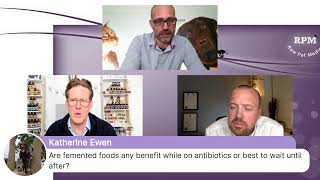
I can just say to Catherine, yes, fermented foods, but really you need some bacteria that get through into the gut rather than just into the stomach. So actually, when you're looking at some of these ferments or the probiotics, yes, there is loads of evidence to give it even while they're on antibiotics, even though the antibiotics are going to destroy some of them. You will get benefits from the studies that show that if you give probiotics at the same time as antibiotics, you will actually get good results. And so I think there's a specific study in relation to metronidazole and the use of probiotics at the same time, and actually reduction in side effects from that.
Yeah, Mr. Zeb Boyle, God bless him, is saying Juliette Dubaracq-Lévy— if you don't know her, just have a look Zeb's note there, he's saying that she said that all her dogs went straight for the intestine in their prey, which is interesting.
Yeah, it's interesting. Love to see that. And a bit more wolf stuff, we need to get out, get on a wolf expert and see if they've seen it. Um, that was really good, guys. We didn't even get a chance to talk about Answers Pet Food and their use of probiotics and that kind of thing, which I think is probably ever so slightly separate to ferment. We'll bring them in another time and explain how how all that works, because there's a great story behind the concept of that business despite a bit of the hullabaloo lately. Uh, so it's, uh, it's, it— there's really good, uh, stories behind that. But we are beyond time here now. So, uh, guys, I love that tonight. I learned an awful lot. Um, and just to reiterate to people, Raw Pet Medics on patreon.com. Guys, if you go to patreon.com, you'll find us under Raw Pet Medics. Uh, we are stripping out all the audio from our previous shows and every show from this on and making a podcast out of us. So we have a podcast guru lad who is doing all this for us, and, uh, we'll be able to produce that podcast for you. We'll put it up on Patreon, we're going to put it up on Acast and shorten it down to 30 minutes of our best stuff. So that's what your money has done for us, guys. We've decided to go with the podcast idea, and, uh, yeah, that'll all be available on Patreon as time goes on. So thanks to everybody that comes to us and buys a coffee, greatly appreciated.
I'll put a recipe for a good fermented mix for your dogs on Patreon too, so look out for that. What's up next week, guys?
I'm not sure. The beauty of us, of having a podcast, guys, is that you can take us with us, with you, when you go walking the dog.
RPM coming in your ears. Oh no.
And that as well.
On that wonderful note. Oh, okay.
Anyway, uh, right, watch this space and we'll tell you what we're doing next week. I can't, um, okay, yeah, I can't beat that from Conor.










