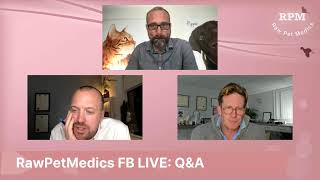
In this livestream, hosts Nick Thompson, Brendan Clarke, and Dr. Conor "Brian" Brady discuss a wide range of topics related to human and canine health. They begin with casual banter before moving into personal diet habits, emphasizing the benefits of skipping breakfast, low‑carb, and intermittent fasting for humans, citing books by Terence Keighley and Jason Fung. The conversation shifts to raw feeding for dogs, covering feeding schedules (once‑daily vs. multiple meals), the merits of intermittent fasting for pets, and the impact of meal timing on pancreatic health. They debunk the myth that high protein causes joint disease, arguing that variety of meat and proper minerals are more important, and discuss elbow dysplasia, SLO (symmetrical lupoid onychodystrophy), pancreatitis, and regurgitation. Practical advice is given for treating SLO holistically (raw diet, niacinamide, biotin, fish oil) and for managing anxiety and fireworks using desensitisation, CBD, essential oils, and environmental modifications. They also address how to add calories to a lean dog’s raw diet (gradual fat addition, coconut/olive oil, animal fats) and discuss pre‑ and probiotics (PhytoSpore, Hyperbiotics). The hosts promote their Patreon, announce upcoming charity voting (Compassion in World Farming, Sustainable Food Trust, BVA Animal Welfare Fund), and preview future Q&A topics. Throughout, the tone remains informal, conversational, and supportive, with occasional humor.
Chapters
I'm Nick Thompson, this is Brendan Clarke up at the top, and this unlikely lad over here is Dr. Conor Brady. And how are you, lads?
I'm good. I'm actually a bit disappointed in my pen. My pen looks very cheap. Look at that cheap yellow pen with the plastic broke off, and you're holding something very posh. Hang on there a second.
Mitsubishi. Mitsubishi.
Mitsubishi. Very nice. Jeez, I actually don't have a posh pen. This is embarrassing.
I'm even looking for a pen. I'm like, you know, I've got phones, I've got stuff.
Brendan is Mr. Digital, guys. If it's got more than one button, Brendan—
I like my notepad. I like the notepad and pen. You always know where you are with notepad and pen, except in the rain, then it's not good. Or in a fire. Yeah.
Or if you lose it.
Yeah, many reasons why it's not great. But we've had a good week, lads. Has it been very exciting? I hear you're— I heard you're laid up, Brian.
Laid up? Oh yeah, well, I've got a bit of a shoulder injury, uh, which I've been treating. I went to the chiropractor yesterday, uh, he pummeled it to death. I could barely get dressed this morning.
It's so sore.
It's like a torture thing, isn't it? You just got to put yourself through it.
It is like when you work your muscle, like if you have a game of tennis for the first time in 10 years, or you work something different, it's like, oh my ass. And the next day you're picking your legs up trying to get them out of bed. Oh, it's so sore.
I'll tell you what, I was trying to do some backflips when I was younger. I used to do a flick-flap backflip, okay? When I was younger, and I'm talking only about 7 years ago, I would be able to do them on a good day.
Nice.
And Ellie and I were trying to do these things, and she's a lot better at it than me. And we were camping, and so this was about 2 months ago, and ever since I've had a bad shoulder and my wrist.
Talking about wrist injuries, Nick.
I'm gonna sound like I'm just saying it to go along with the gang, but guys, I'm, I'm back in the swing and going to the gym a bit. So for the last 2 weeks, I'm back at it, and it's like, okay, here we go. I'm making a good effort, but I swear to God, I just did— I started 2 or 3 days ago on arms, and I can't lift my arms above my head. I just did too much. There was young lads around me doing— I could do heavy weight. It's like, oh my God, I'm in agony. Anyway, look, before we start off, I just wanted to mention about Patreon, get it out of the way here. Raw Pet Mayo on patreon.com. Thanks to everybody who's chipped in so far, guys. It really helps. And if you can afford the price of a cup of coffee a month for us, that's all we ask. That's great. It really helps out our site. If you can't, no problem. Free to view as always. So we really appreciate that. And just while we're waiting for the rest of the people to come on, I want to just go straight out of the traps with a great cue and what a great Q by Emma Rutherford, which was, what did you eat today? I'm not sure if you saw this on the Facebook page, but I have to say that's a cracking question. So what have you guys— okay, that's an impromptu question. What did you guys eat today? I've had a very good day, so I'm ready.
I'll go with this because I've got a few things to say here. Number one is I don't think that many human beings have ever eaten a complete and balanced meal like ever in the history of man. Okay, discuss. It's not— it's the first thing to say. And yet, and yet we are, we are pummeled by the, the kibble companies to say thou shalt eat a complete and balanced meal. And the Raw Feeding Veterinary Society, their next online meeting— and Brendan, you'll know the dates better than me— their next is to formulate or to— what's the—
yeah, it was nicely put actually. What was that line? To formulate or to— I'm going to have to look for it now.
Create.
Create. Formulate.
Yeah.
I don't think they're mutually exclusive, but I know what you mean. Okay. Well, one is you just put it together like you do for human food. The other one is you count the calcium and the selenium and the carbs and the fat and you make it complete and balanced. And I am of the create— I'm of the let's just do some proportions and let Mother Nature and our own metabolism take the initiative to get things right. Anyway, that's a very long way of saying you've had a bad diet today. No, no, not really. It's not, not particularly. So the first thing is I don't eat breakfast, okay? Haven't done for about 6, 7 years after reading a book called Breakfast is a Dangerous Meal. There's another book for you guys. Breakfast is a Dangerous Meal by Terence Keighley, I think. Dr. Terence Keighley, who got to about 58 and he was doing everything right as far as he could see. And he found that he was pre-diabetic and he couldn't believe it because he was a doctor. He was doing everything the way it should be done. And so he looked into it for about 5 years. He did research this book for 5 years and found if you're over a certain age, and that's about 30 in human years, you should really think about stopping breakfast because that's when you should be going out and hunting for your food, not tucking into Kellogg's and high-carb, high-sugar things that we do in the West. So I didn't have breakfast, and that's preemptive to say I did have a pita. I'm on a really low-carb thing at the moment. I haven't had carbs for about 7 days or so. No sugar, no bread, no pasta, no, no nothing.
Bloody healthy.
Yes.
Green. So let's, let's get this right.
So no refined carbs, refined grain carbs. I eat lots of vegetables. I eat a lot of vegetables, a lot of salads and what have you, but it's, it's refined. So if it's kind of white, you don't eat it. So flour and pasta and all those things. So, no breakfast, and that's preempted to saying, for lunch, I had a pitta bread with a lot, really thick cheese, and a little bit of pickle on top of that, and a little bit of watercress on top of that, and loads of butter, and that was lunch.
Yeah, cool. That's it, one pitta bread. Must have been a big pitta bread. That's my guess.
We know how much he can eat when he eats.
When I eat. I eat a lot. So tonight I'm going to go home and I'm going to eat probably a kilo of food to make up for breakfast and not very much for lunch.
You can't cut the calorie thing. What about you, Brian? What have you had?
So I'm absolutely with Nick. I would say there is a great book, which is Why We Eat Too Much, which actually by Andrew Jenkinson. It is a— I've mentioned it before, but it does talk about Guys, don't just dive into some of this stuff. Yeah, just take it easy. Don't really accelerate and think— and there's a lot of people repeat that message because that's the biggest way to fail at trying to adjust your diet. So do, do it gradually. I generally don't eat a lot of breakfast. I may have a cup of coffee or tea, or I stayed with a friend, went to Chelsea Flower Show last last week, brilliant, whilst these two were working hard on some conference somewhere in the States. And I was just astounded, but she just introduced me to the simplicity of just chopping a little bit of ginger into a cup, pouring on hot water, and that's it. Just the freshness of that. But this morning, gosh, shall I give you the take? So I had a busy day at work today, so it was— I actually started Didn't eat much yesterday at all until the evening, fairly late on. So I decided because I ate late, I was going to actually eat well today. So I've had— I started with a cup of coffee, a blended full-fat raw eggs, cream, milk, and banana smoothie with 2 scrambled egg and smoked fish and a little bit of avocado. And then I had lunch. I had a smoked salmon salad with 4 eggs and avocado again. And that's, that's, that's my meal so far.
That's not bad.
I'm thinking I'm ready cooked so that it's because my wife's away at the moment, so I'm doing all of this myself. So the So in the oven waiting for me. In fact, actually, the cats are streaming around the oven because there is a roast chicken with roast veg. So no potatoes. Well, there is this sweet potato, but there's roasted peppers, onions, and the chicken, and my mouth is watering just thinking about it.
Nice one. That sounds fantastic.
I wish I didn't ask that question, A, because we've gone quite a long time, but B, because mine does not compare as favourably. I also skip breakfast, guys. The Nobel Prize prize has been handed out a couple of times over the last 4 or 5 years for similar type ideas, which is one was about circadian rhythm. So they can say, verifying what Nick is saying, you're not supposed to roll out of your bearskin cave and drink a gallon of milk and eat some Cheerios, which is pure sugar. Doesn't— I mean, they look like sugar, fair enough, but all refined carbs are pure sugar to your blood. Terrible start to the day. You're supposed to be, you know, chasing down a dinosaur, punching them in the face to get to your berry bush or whatever. So like, you are supposed to put off breakfast. You're not supposed to break your fast unless like you're really hungry. Okay, that might be a reason to do it, but The days of forcing your porridge into you 'cause your mom is screaming at you to eat it, and it's like, I'm just not hungry. A cup of coffee, I love a cup of coffee in the morning, so I'm never gonna stop that. And I had a Buddha bowl, which the guys called the Happy Pear. In Ireland, they're a big deal, not so big in England, but they're all over the TV and radio here, but they have a vegan shop in Greystones. It's fairly, it's cool. But anyway, they do this food where it's a mixture of 8 or 10 really high-quality food items. You know when you get a really good veggie restaurant or whatever, and each dish is just delicious, and it's that, it's about 6 or 8 of them packed into a box. Delicious. I only got through half it for lunch, and then you eat the other half for dinner, and it's like, it's such a treat. And you look at it and go, it's all organic, it's all like the best food you could possibly make up together. And it's like, it's where I'm actually doing an advert for them here, but it's like €10 or €12, and people go, oh, it's a bit expensive, is it? And it's like, have you seen the amount of high quality? There's water sprouts, and like, you know, like, there's everything has been done so carefully, beautifully. And it's like, that's not expensive, guys. You know, €6 is crap. You know, you're buying some cheap refined. So anyway, that was my investment for today and I absolutely loved it. And you're stuffed after because I'm a devil for grazing. I find it very difficult working at home. My fridge is downstairs. It's hard to say no.
So yeah, I'm going to say if you're a devil for grazing, graze on something that's high fat, high protein. Yeah, that's high fat and protein.
Yeah, nuts. Nuts are fine.
But I honestly, you know, if it's anything that's that, it quite, removes that hunger very, very quickly rather than finishing a full packet.
Yeah, people will be surprised. It's a lot for people to take in that, you know, everyone's coming back to a full butter, loads of cheese, like dairy saturated fat. And it's a lot of— again, if you listen to half the books that the lads are recommending, that's going to set you straight. But things are coming back to that, and people go, geez, you can't eat anything these days. Now we're going back to the stuff. You're going back to the totally normal unprocessed stuff, and that is the way it's supposed to be done. So that— there goes 15 minutes.
Indeed. But I just need to quickly come in. The whole thing about Jason Fung says in one of his latest books that Nick's advocated on— I think it was The Cancer Code— that actually, as humans— and well, actually, as all species— there is— it's a total myth that if you stop eating, that your energy levels will go down. It's actually a driver to keep your energy levels. And actually what happens is that your body accommodates for the reduction. So you've got to be careful you don't starve yourself for too long because your body will shut down all of its metabolic pathways to try and preserve energy. So it will shut down so many things, but actually you will continue to develop as much energy so that you are ready to go out and get the food. Because it's just nonsensical evolutionary-wise for any animal, if they start to not have food or miss a meal, to suddenly become lethargic and not be able to function, because that would stop them then being able to go out and get food. So it's actually a normal process for us to go through a fast period and then to be able to still function.
Yeah, we did the fasting before and we said even if you can't do a long fast, you can do intermittent fasting, which is get your feeding done with the circadian rhythm, which is like put off your breakfast till 10 or 11, get your food finished, eaten by 6 o'clock, and your stomach is now 16 to 17 hours off a day. And that intermittent fast, it takes up to 16 hours. It takes 8 hours to digest and assimilate your meal, another 8 hours for the body to do everything. Everything's screaming for nutrients and it has to do all that. But after 16 hours, it gets bored and it goes, right, what will I do now? And it goes to autophagy and it starts to zap cancer cells and whatnot. So intermittent fasting is way more doable. Again, it's baby steps. Like you said, people think it's you have to go on this mega diet and it's like, well, it's not. It's just baby steps. Stop putting sugar in your coffee. Chapter 1, you know, make these little steps where after a week you do not want sugar in your coffee. I always had sugar in my coffee, but this could have been a whole show on this.
And this translates great to our pets, you know, as reiterate that actually take baby steps. If you can't change them totally, look at the useful additions that you can put onto their food. You know, just add add some raw egg, add some green veggies and things like that blended down. Add some things on top of, give them some raw food on top of their food. Don't panic. Just take the baby steps.
Someone was saying there, do you fast your dogs? What's happened with the fasting, because it's such a hot, cool topic at the moment, that if your dog is gut sick, I'd be recommending fasting. Like I think of a gut sick dog as an engine with black smoke belching out of it and you're trying to hook up a trailer to it many times a day. You know, so I often think, you know, bit of time off is not so bad. But I think the mistake that people are making— people think that dogs would have in the wild hunted a big animal and gorged and then not ate for 3 days and then gorged again. And I really don't think that's the case with dogs. I think dogs are smaller, they need to eat more regularly, they're scavenging carnivores. Yes, there would be periods where they couldn't find bugger all to eat, but when you will eat anything, it does open up the amount of times you're going to be nibbling. So I would say that, you know, long fasts probably weren't that normal unless they could have, if they could avoid them. But yeah, I fast, I would happily, I'm trying to get all these meals done within a 6-hour, 7-hour window. He gets 2 meals a day. He gets it like 9 o'clock in the morning when he comes back from his walk and about 4 o'clock in the afternoon. And that's it. I don't give many snacks at nighttime. So that's an intermittent fast for me. But I don't do long fasts. But I know Neis, top vet in Barcelona, does quite prolonged fasts depending on the malady she's looking at. And whatever Nea says, really, I'd be listening to. So, yeah, so, so what about you guys? Do you fast your dogs?
Yeah, every day. Bluebell gets fed one meal a day. She's 2 and a half years old, she's a whippet, she's about 13, 14 kilos or so. So you'd think that she would be, you know, uncomfortable with that, but she just sails through it. Yeah, that gives her pancreas 23 and 3/4 hours every single day to rest, and it allows her gut to, to rest. And I think it's really, really healthy because the pancreas can regenerate, but not when it's busy.
Yeah.
And there's a lot of pancreatitis out there, and for me, it's, you know, feeding twice, 3 times a day may be contributory to that.
Yeah.
I think in the old days, it used to be you'd feed the dog, uh, biscuit and meat unfortunately, pedigree chum. But if you go way back to the old boys, they would feed their dog about 4 o'clock in the afternoon, and that would be it. It was traditionally you fed the dog once a day. Yeah, when the kibble brigade came over from the States, they started saying, ah, how can we increase sales? I know, let's advocate feeding twice a day. Yeah, because it's an admit— because you'll automatically feed more food when you feed them twice a day. So We feed the puppy, she gets fed twice a day, and then Bluebell gets fed once a day, and the puppy will go on to once a day. If you've got a dog who's really prone to twists, then you might want to go for twice a day. But, you know, you're talking Irish Setters and Danes, perhaps. Apart from that, but the thing is, Bluebell, really deep chested. Wolves, really deep chested. So we need to do— yeah, we've done a talk on twists.
It's actually—
that's coming.
It's one of the Q&As, but honestly, God, that should be a whole show because it's So let's just save the bloat. That was one of the Q&As I've highlighted in red that I wanted to skip. What about you, Bren? Are you fasting your dogs a lot?
Yeah, I mean, I just wanted to answer a couple of the things that have been out there. Yeah, so there's one about puppies. I think the other were about people feeling faint if they miss a meal. I just think about insulin resistance and insulin, okay, might reflect the diet. And that's also true for some of the dogs' diets as to why they can get into that ups and downs if we don't feed them regularly on processed diets. I hate processed diets, but it is one of those things that we sometimes see them almost pestering. But actually, I also say don't just feed at one time every single day. For my dogs, they will have a breakfast, they then may miss the evening meal, and then have a breakfast and dinner the next day, and then miss the breakfast and have a dinner or even a supper late at night, and I just vary it so that actually their stomach is never preempting, I'm going to get a load of food. I would say I never have had a problem with my dogs having a full 24 to 48 hour fast. Okay. And I have done 48 hour fasts for them just to sort of like try and get them stimulated to doing a bit of apoptosis. My eldest is getting quite old now, so unlike you guys, you know, with young dogs, you know, when you've got a Labrador who's 10 and, you know, ongoing, you just think, yeah, I'm going to start to really try and recycle, you know, some of those cells a little bit more and be a bit active on that. I would say for those that really struggle, you can use bone broth as an intermittent during those fast days. That can be sometimes useful just to feed the gut flora. Rather than feeding the dog, I would say that's a good option. But yeah, I have no problem with fasting, and I think a lot of people worry about the pukes, okay, that if their dog is, you know, not regularly eating, then, you know, will they get the pukes? And I would say, the only time I've really experienced that is if I feed a bone meal, I give them a carcass to chew on and nothing after it, or I just give them wings or I just give them a neck and I don't give them any— and I'm not talking duck necks here, I'm talking like venison neck or something bigger. And then you don't give them anything afterwards. And that's the last meal before they have then a long period of fast. Then I would say, yeah, occasionally I've come back to just a small amount of bone material in a yellow vial and that's it. But that's the only times that I've really experienced that. Yeah, actually, next week, just to say, we are talking all about regurgitation, vomiting. Thanks to our sponsor, Nick, you organized.
Yeah, Carla Pearson at No Bull Facebook group. Carla Pearson, she's sponsoring next week. Thank you, Carla, that's absolutely fantastic. And she's really interested. She deals with a lot of bullies and bulldogs and what have you, but then regurgitation is a big deal.
Yeah, there's a few people talking about hunger pukes in the morning, so we can, we can skip that. That's also one of the Q&As for tonight. So we've done— we touched on hunger. Yeah, so we'll just leave all puking to next week.
Do watch next week.
We did— we mentioned last week, guys, that we were going to nominate 3 charities before I forget, because we're already halfway through the show and we haven't even started hitting the Q&A list here. So, um, we were going to pick a charity each, so, uh, and we're going to vote for it, okay? So we want everybody else to vote. You guys are going to vote there, and there's 3 charities to choose from, okay? So I'll just name mine first as I'm talking here. I would like to put forward Compassion in World Farming. Um, so let's hear about that. This is a charity, um, that is, uh, been supporting for a few little years. Um, so they're a world thing, okay? So it's not just an Irish or British thing or whatever. And just reading the couple of lines in there about, they're campaigning and lobbying constantly for animal welfare around the world. It campaigns against the live export of animals, certain methods of slaughter, and all systems of factory farming in Europe and abroad. So it is very much about increasing the space of every animal and the end that that animal gets. So mass slaughtering facilities cleaning up their act and, you know, and employing the very best methods. So the animals don't see it coming as much as possible. So everything they say, I kind of get behind. So that was my charity, guys. You want to pick one?
Yeah, Brendan and I are very keen on the Sustainable Food Trust, and I've got some, um, some gen here. It says the Sustainable Food Trust is a registered charity that was founded by Patrick Holden in 2011 in response to the worsening human and environmental crisis that are associated with the vast majority of today's food and farming systems. So this is cleaning up the planet, this is cleaning up farming, this is trying to create a system whereby we might have something to live on in 100 years' time, which I think is quite important.
Cool, sounds good. And then, Bren, BVA.
So BVA, so the British Veterinary Association, um, have a charitable fund which is the Animal Welfare Fund. Uh, they are proponents of welfare in animals as from farming all the way through to our pets. They will take stances on trying to promote improving health for whether that be down to how animals are kept in intensive systems and trying to get them into more extensive systems, all the way through to talking about breeding brachycephalic breeds and how we can actually improve their airways and try and promote breeding through to, you know, just thinking about stuff to do with operations that may take place for our pets, and they're constantly trying to review and promote the veterinary profession to change their views on normal procedures.
Yeah, sounds good. Cool, guys, they say where to vote. You vote there in the comment section, 1, 2, or 3. So we'll just count them up later. So 1, 2, or 3, lash it down, and by the end of the show, we're going to be donating 10% of our Patreon haul each month to this charity for 6 months, and then after 6 months we'll all pick them again, and, and that's how we'll keep doing that. So it's just, it's just something to do, isn't it? It's, it's, we've got to, got to help out. So, okay guys, let's do some Q&As here. Can I start with one that left off a page for me from Debbie? Because this, this comes up now and again, and I really like this one. So is it true that Berners, Bernese Mountain Dogs, shouldn't have too much protein in their diet. So this is the too much protein myth. If so, how do I manage this on a raw diet? I've been feeding raw nearly 5 months using complete premades. My dog is now 10 months old and has been just diagnosed with severe elbow dysplasia and early onset arthritis. A double whammy at 10 months raw feeding for 5 months. I want to keep her on raw. I'm very confused, and I believe that the vet has put her off the idea of feeding raw. So you do hear this, it's like as soon as there's an ailment in a raw-fed dog, although albeit raw-fed for 5 months, it's like it's the raw food. It's like, well, what about all the elbow displays you saw on dry food? What was that? That wasn't the dry food. So as soon as this happens on a raw food diet, it's the raw food. But who knows? So who wants to kick us off, guys?
Yeah, so there is a bit of a myth about when we feed raw food that we're feeding protein, that we see that meat as protein and only protein. Now, there is a really important— you know, a lot of the books we talk about talk about the insulin load, so the glycemic index and the glycemic load of food. And it's really important to understand that not just carbohydrates are converted into glucose, okay? And that puts a stress effectively on our insulin pathways and pro-inflammatory and, you know, so many other things that are going on, but actually protein in excess, especially if we effectively put it through some degree of processing, and that, you know, at the extreme is full kibbling it or through to just cooking it, you will actually shunt the body into using that protein as energy and actually making it go through pyruvate pathways to create a glucose load. In the body, but it's the fat that will satiate within that diet. And actually, we aren't just feeding protein. Even if you feed breast meat of a bird, there are going to be fats within that. Even if you feed, you know, a steak from an animal, there's going to be fats within that. So it's not just pure protein by weight when you're doing that, which is why it's so hard for people that go through these formulators to say, well, that was pure protein within that piece of meat that you've put in there. It's got so many other things in, especially when it's been reared on an outdoor field.
It's definitely a higher protein diet though, Bren. I mean, there's no doubt about that. Dry food is the minimum legal amount you're allowed to include, as if that's a good way to feed a dog.
So I would say it's a balance there, you know, I'm just suggesting that it's not just about protein. Okay. And I would say that, yes, it is of higher protein and I think there are benefits and I think that the body will be able to split down and utilize some of the stuff that it needs directly from that raw. And but it will also produce energy, etc. through that. But I would try to encourage people not to just think about using pure meat necessarily from the animal. You've got to use so much more.
What do you think, Nick? You think too much protein can cause joint disorders?
I think protein, not so much. I think it's more to do with, has the dog had good variety of meats? Because all meats have strengths and weaknesses. All meats have, or all animal material have different levels of minerals, and maybe they've been only concentrating on beef. That's quite a common mistake, is that, you know, raw meat. Okay, we've got to feed the dog beef for the rest of their life. There's a lot more that, you know, you've got goat, you've got pork, you've got rabbit, you've got venison, you've got fish, you've got all sorts of things. And I think many people, when they're first starting off, they don't give enough variety. And I think pound to a penny, if your genetics is right— that's assuming the dog had great genetics and you haven't got parquet flooring where the dog is going skidding around all, you know, for their entire puppyhood, then I think that if you're giving variety, then you're going to be turning on the epigenetics to create the best joints that that dog is able to create. Yeah, I can't see how the diet would cause that, because if the dog is a bit calcium deficient, you will turn on parathyroid, you will turn on your absorption of calcium, in order to balance that up.
Yeah.
So the idea that you can predict how much any individual's calcium or phosphorus or selenium or whatever that they need, I don't think so. Yeah. Kibbles don't contain any collagen or any, any chondroitin glucosamine.
That's definitely where I was going to go. Like, I'd like to know if Debbie neutered this dog early. That would be a big, a big thing to find out if Debbie's listening. I haven't seen Debbie come up in the comments there. So Debbie, if and when you do come up, let us know if you neuter the dog early. There's a massive link between early joint disorders and pups and certainly giant breeds and neutering early. So that would be something to know about. But there's not a single study that I've seen where too much protein— so that supports the too much protein myth. There isn't like a preponderance of evidence that says when you feed lots of fresh protein to an animal, it ends up like this because, you know, carnivores live on protein and fat. That's what they eat. And dogs are surely meat eaters to a very, very high degree. So for meat to suddenly cause a dog to suddenly go lame is pretty idiotic when he needs his legs to go and find the food to keep him to get that joint disorder in the first place. So it's utter poppycock of the highest order. Now we have engineered some pretty weird animals here. We've got these giant breeds and chihuahuas and everything in between. And so yes, we have introduced a few genetic little mishaps which you know, shit happens. You can do your very best and you can get unlucky despite your best efforts. But there's nothing in the science to say too much protein is causing that issue. There's only actually science to show that the more carbohydrates you feed dogs and challenge them, which is great study by, I think it was Reynolds in sled dogs, where he had 4 teams of sled dogs and he fed them 4 levels of protein from minimum protein, which is all dry food proposed by the industry, 18 to 20% protein, and then like 25% protein, 30% protein, 40% protein. And what they found was the dogs on the lowest carbohydrates had no injuries, and the dogs on the most carbohydrates had the most injuries. So when you stress test dogs on low protein diets, they don't do well. And that, that along with all a very— an awful lot of circumstantial evidence that would suggest, as Nick just touched on, why would you cut out the building blocks of joints? Why would you not give glucosamine, chondroitin. And why are you waiting for your dog to walk around on bamboo legs, as Rodney Habib says, at 8 years? Why wouldn't you give it when he's a pup and every day until that point? You know, collagen, hyaluronic acid, glucagon, glutinone, these are just buzzwords that are dropped into food for seniors as if, oh, you might like some Co-Enzymes on Q10 now. It's like, I would have liked that every day. So all this stuff is paramount for good solid joints. You just can't cut this stuff out and think, well, I think it's better if we feed them 60% corn. That's made by a candy company, that's got my dog's joints at heart? Give me a break. So I think that too much protein myth serves the industry very well. It's perpetuated still, which is— it's dying a death. You don't hear it too often. They still talk about it in kidney disease, and yet they have nephrectomized dogs where the cruel— back in the day when they used to do really horrible experiments, but they just, you know, solder off the kidney function of the dogs, leaving them with, you know, 10% kidney function, 20%, 30%, and replicating kidney failure. And the more protein you feed dogs as they advance through kidney failure, the better they do on a number of measurements, glomerular filtration rate and all the things that you care about. Now it gets to a point where your kidneys are so badly working that, you know, even protein becomes a problem. Okay, but that's end-stage kidney disease. So even when they push the protein myth in kidney disease, actually we've got the studies to back that up and say, no, it's completely wrong, nothing supports what you're saying. So It's unfortunate that the vet turns around and said that's because of the diet, because Bernese are very susceptible to elbow issues, elbow dysplasia, and God knows what else, you know, because it's unfortunately been bred in. And we try to avoid it as best we can, but cutting out the crucial building blocks is definitely no solution to this issue. The neutering thing would be the most interesting, but that'd be my tuppence worth. I think it's a complete myth, complete nonsense. We have nothing else to go by.
Debbie, was she carrying a bit of weight, would be the thought? Because if she was a bit on the heavy side, that could have stressed the joints perhaps.
Yeah, arthritis as well, Nick. You know, where would you be getting arthritis at 10?
Yeah, did she kind of jump out of a Range Rover every day, 3 times a day? You know, that's going to look—
lots, lots of also environmental influences here, you know. You know, we don't even know about the environment that they're in. Are they in a rural environment? You know, is there lots of spraying of crops going on? Is there, you know, lots of other stuff going on within the house? You know, just so many things that we don't— you know, we can be as minimalistic and as holistic in our own homes as possible and insulate our dogs, yet as soon as we step out the front door, they're exposed to so many things, from traffic to you know, what the council are doing to the paths and parks, to what's going on in the fields, etc. It's, yeah, there's just an endless number of things that can be pro-inflammatory. A book by Nathan, so Neil Nathan, says Intoxic.
Okay, we've got a couple of particular ailments here which I think people would really appreciate some, if you can give elevator pitches. A dog recently diagnosed with SLO, would you treat it using the conventional approach of antibiotics and steroids and vitamin protocol? Is there a more holistic way? Do the lads have a more holistic way of treating SLO? So that question's come up a couple of times in the Q&As in the past, so can we just do a very quick spiel on that for the people that are affected? What is it?
So immune-mediated condition often affects the nail beds, causes deformation and loss of nails. Often differentiated from fungal growth within the nails and chronic infections. So a bacterial infection of the nail beds is often perceived as the, the thing. So often they will be treated with antibiotics or antifungals for long periods of time, sometimes even with topical bathing, to try and work out if that's the thing. Ultimately, you need to do a biopsy of the nail bed to have a look and see that immune-mediated condition going on. Once diagnosed, you're then into other things. And absolutely, yes, you know, for me holistically, yes, there are other ways to treat this. You don't have to necessarily go down the steroids, but for some dogs, for their immediate welfare, they may be popped onto steroids by their primary vets, and then it's for us to then help help improve the underlying health of the dog to then get to a point where they can be weaned off those steroids. So I think, you know, balance always welfare. You know, I'm not going to advocate to you guys to not go to your vet and get them treated as soon as, because it can be uncomfortable.
Okay, okay. Nutritionally speaking, I think that obviously a raw food diet is an absolute must, even though they've got immune-mediated disease. If their immune system was really, truly, utterly, utterly broken, they would have died of a total body infection a long time ago. So it's just that they've got a problem with their, with their nail beds. The next thing is niacinamide is worth looking into. Niacinamide can be very useful. You'll find doses and things online. The other thing is biotin is very, very useful. And the other thing, thing to get them started. If the vet is saying we could use steroids but we may not have to, you can just go in with fish oil, heavy, heavy dose, you know, 5 times the dose for a month or 2.
Don't you think we were on the same wavelength, Nick?
Is that just to cool off the inflammation? Is that what you're doing, like a fire extinguisher for the body? Is that just to cool off, like, just general inflammation?
You're giving A lot of high, very high level.
Yeah.
Yeah.
Okay.
And SLO is— SLO is, is an autoimmune disease where your body thinks that something's attacking it here. And so it takes out the tissue at the, at the nail bed.
Bummer.
And classically you get nails falling out. They just, you know, oh, look, there's another nail that fell out overnight.
No way.
No good reason.
It's not.
Yeah. No, but it is very manageable with food alone in many cases, although as Bren says, you might need to just get that welfare under control for the first few weeks with a bit of steroid. I don't like steroids, but it's—
when I need it, yeah, it's uncomfortable. Um, there's two questions which are just gonna— I'm just gonna mess into one here. Um, okay, fireworks season is fast approaching, I've tried everything with my Westie, uh, and anxiety was another person. What do you think of CBD? So Well, if I could just shoot off with this one. In guide dogs, you used to have the fireworks issue, and you don't really want the problem when you're walking down the road and he's guiding you. So in the first 5 months of life, you know, that's your critical period. Most of us have missed that by the time you realize the dog has an issue. But there's sound effects on YouTube now called Crash Bang Wallop and a few other different kind of things. And what you can do is you can work to desensitize your dog to these issues. He's either having a negative response to it or a positive response bearing in mind, guys, I was trained 15 years ago, so, you know, her training moves on, and then suddenly I'm an absolute, uh, you just, you know, a caveman. But, um, this is how we did it. We would desensitize the dogs with, uh, very, like, set the very, very lowest on the speakers and be feeding the dog treats and playing. And the next day it would go up a tiny bit and go up a tiny bit until eventually, you know, it becomes just totally normal. It takes a little while. The longer, the more fearful your dog is, the longer he's been at it Ideally, these sound effects are played to your pups as they are the guide dogs when they're young, and it's like, okay, yeah, that's what a train sounds like, that's what a bus sounds like. They hear these things before they see them. Fireworks are a bit of a devil, they're not going away, but you should do that. You keep your dog in, you turn your radio up, that kind of thing. Try not to mollycoddle them too much and let them know that there's something wrong. When you fall over and split your head, you don't want people looking at you going, because then you know you're in trouble. So, um, so, but to tie that in with the CBD The CBD is brilliant, but I've written a really extensive piece on that 2 weeks ago because I had it from my magazine 2 years ago. And CBD is unbelievable. And dogs, we've got a whole endocannabinoid system crying out for CBD and a lot of other CBs. And we used to get it in our diet, and people think it just comes from dope and hemp, but actually it comes from lots of different foods. But you are very sensitive to it, and dogs particularly, because they only get it from eating the herbivores that ate the herbs. So they're very sensitive to it. So they actually need a lower dose than we do, pound for pound. But yes, it absolutely works, but it only works if you're deficient in CBD. It's not like you can keep giving CBD and you get calmer and calmer. It doesn't really work like that. So try your CBD. There's a lot of calming, um, lots of like— type in Holistic Hound, type in any of these guys, um, Nick's wife might have some calming stuff. And any, any of these products are based around the same kind of compounds that, you know, are really, really good. You can actually burn incense and burn oils, essential oils in different rooms. So you can say, well, will frankincense calm my dog down, which it probably will. You can actually burn the frankincense oil in a different room that the dog doesn't normally go into. And if the dog gravitates towards the oil and sleeps in that room, you've got your answer that it works. So there's a number of ways to calm down anxiety-riddled dogs. I'd be finding out why he's anxiety-riddled. Gut dysbiosis is my new absolute, you know, all negative behavior, I can't stop talking about it with gut dysbiosis now. All your happy chemicals come from your gut, 90% your serotonin and all that. But even all the stuff the bacteria produce, your butyrate, your GABA, that's all coming from your gut flora. And when they're not happy, you've got this colitis, IBS issue, you don't get these things. So multifactorial answer, lads, I've probably overstepped my mark there, but Any other favorites for anxiety? What do the vets do?
I find this is really useful. Brendan's got something similar, but this is one that we use. There you go, they're both VetPro. They're very, very similar products. Yeah, and really nice. Lynn Hockney was saying about fireworks and mollycoddling, but it is okay to reassure your dog. Do you want to just differentiate between between that. I think if you're transmitting anxiety because you think, oh God, they're the fireworks, that's going to be harmful. But if you're going, everything's absolutely fine, there is no problem at all. So it's the same thing, it's engaging with the dog, loving, cuddling, cuddling the dog, but transmitting a peaceful—
Yeah, I think, I think that's it really, giving them the freedom to, to hide, you know, giving them a safe space within, create a den You know, let them do their own thing, have, you know, create a light shield, I like to say, which is actually don't turn the lights off and draw the curtains, draw the curtains and turn the lights on and put the TV on so that actually the flashes don't come through that because the background light is actually stopping that. And the TV or some sort of sound, turn it up slightly more than you would normally do because again, that creates a sound barrier rather than trying to muffle sound, try and create a background sound which actually distracts from the noises going on.
Oh, then call the lads over and have a massive session. Get the tunes up.
Yeah, champagne corks, and they won't hear the fireworks.
Yeah, and please watch which channel you put it on because you just, you know that if you're going to go out and do this and you skip from like, yeah, firework display going on.
Yeah, let's, let's finish this one. There's a few obesity ones again, but you know, we've done a couple of— we've done, we've done a lot on obesity, guys, in the past, and we have done a night on it, I think. Um, but here's just a very simple question: what's a healthy way, or let's say an effective way, to add calories to a raw diet for a lean dog, for a too lean dog? What's a, what's a healthy way of jamming in some calories into a dog's diet? Like more lean food or do you lean towards the fatty?
Which, which, so whichever way you do it, do it gradually because, because a lot of dogs are on the edge of pancreatitis because of about 18 different reasons. So just whatever you do, do it slowly. And my go-tos would be coconut oil, but also olive oil.
Yeah.
And if you can get a hold of animal fats, then they're good. But do it slowly, build up slowly.
Yeah, okay, cool, that's good.
Where do you go with that?
No, I absolutely agree, you know, if you're going to move them on to those sort of things, do that sort of transition. It's just also getting the liver to cope, to produce the bile, to cope with the fats and things like that as well, I think is really important. You know, the more varied the diet, the more you can, you know, if the liver is more primed to absorb certain nutrients, then the bile pathways will build. And actually, you know, suddenly going from almost fat-free, for example, to full fat, you know, can be a real shock to the system. And you'll get soft stool, you'll get oily stool because they just literally haven't accommodated for it.
Yeah.
Or pancreatitis.
Yeah, well, is now— this is the whole— is that going to predispose pancreatitis? This whole thing, this whole subject about is high fat going to cause pancreatitis?
No, but I said it was the trigger. There's 18 other things that may be going wrong.
All right, yeah, yeah, the trigger. Yeah, fair dinkum, that's, uh, that's, that is. But in general, yeah, that takes a bit of tea. Have we done a pancreatitis night? Surely, to God. I thought I was old and now I've realized that you're almost being— I think one of the stats is that two-thirds of healthy cats and dogs suffer some form of pancreatitis, but I like to include two-thirds of healthy dry-fed cats and dogs experience some form of pancreatitis by mid-age. So I would say, yeah, very, very prevalent, totally undiagnosed, and it's Apparently it's like a gunshot to the guts. That's how painful it is with acute bout of pancreatitis. Shocking that, you know, and the poor old dog. So I hate pancreatitis. Yeah, I like a bit of fatty meat, uh, so if my dog is lean, um, I love a very lean dog. And I really want to put up a post, maybe we'll get it done by next week, of this bell-shaped curve at the moment where, you know, uh, lean is not great in dogs, but this is perfect, and then it goes down to overweight. I think that's nonsense, that bell-shaped curve. And I like a very lean dog. So when someone tells me their dog is lean, I always kind of say, oh, it's great, don't worry about it, lean's fantastic. You want this, you know, not so much saluki shape, but you want, you know, a very lean, long-distance running Mo Farah shape to your long-distance running animal. He's not an ambush predator, he's a long-distance running animal for the most part. We've all different breeds, you know, but I like a bit of fatty meat. People increase the amount of lean raw dog food that they're feeding because some of the premades are very lean. I agree, I like a lean kind of raw dog food But if you keep feeding more lean food, you will break the bank unnecessarily. Just increase the fat content slightly. All the tips the lad said. I like fatty beef mince and, you know, whatever works for you. Fatty pork mince is pretty cool too. Lads, it is 10 to 8 and we've only got through 5 of those 20 Q&As that we had to get through tonight.
That's because we gave a full menu at the very beginning.
Yeah, yeah, that was great. That was good. I love the questions are really good and they're getting more specific as As the years go on, the questions just get tighter and tighter, don't they? And it's like, it's interesting.
You know what, I love the interaction of these guys, you know, the comments that they're making, the— yeah, how pressing it is to what we're talking about and helping each other as well. So thanks guys for all of your comments, that's been brilliant.
So I just want to ask that Nicola Fahey question: a good pre or probiotic? I really don't even know the answer to prebiotics anymore. My mind is away with that. I think most of the dog's prebiotics come from beautiful foods I know you're feeding, Nicola Fahey. So I'm not quite sure where we are with all that. Prebiotics, plant-based prebiotics work in dry-fed dogs. We've got studies for that. But in raw-fed dogs, I think their prebiotics are probably coming from the meat and stuff they're being fed, gristle, bone. But the probiotics, the lads like Phytospore, which is a cracking probiotic, and there's Hyperbiotics for Pets, which I like because they're in time-release capsules but there's a few in time-release capsules, so they're the kind of cool ones. And that you can get both of those in Ireland. Lads, can you— I keep asking you the same question, I'm sorry for not remembering the answer. Here's another old time. Can I order PhytoSpore from a vet and deliver to my house, or, or a vet supplier, or can I only go through a vet to get it?
Uh, you don't need to rock up at the vets, get your dog examined to get PhytoSpore. You can contact Brendan or me, and we can supply direct.
Boom, there's the answer. So check it out for the lads of Vital Sports. Brilliant. And hopefully no Brexit-related issues getting it across the pond. So there we are at the bottom there, patreon.com/rawpetmedics, guys. If you can, that's great. You'll find us there, and soon to find all our old content there as we, as we make the shift. So we have somebody in mind to help us do all that now, thanks to your help at Patreon. So if you can, great. If you can't, no sweat. We're going to be here next week like an old pair of shoes, that comforting.
So next week, well, everything from pukes and regurgitation. Nick organized this one, so thank you, Nick.
Yeah, that sounds good. Looking forward to it.
Ready for your tea time on a Tuesday night. Yeah, I might not eat so much that day.
No, have your tea. All right, that's great. Thanks everybody for joining us. That was fantastic.
Really appreciate it.
Stay safe. Thank you. See you guys here in a week.










