RawPetMedics Feline Fridays: Kidney Disease 2
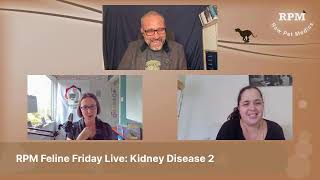
In this live panel, hosts Brendan, Amaya, and Julianne expand on feline chronic kidney disease (CKD) after an earlier introductory session. They review how owners can recognize CKD at home (weight loss, increased thirst/urination, changes in urine volume, smell, vomiting, grooming issues) and discuss the strong link between dental disease, systemic inflammation, and kidney health. The conversation moves into nutrition, contrasting biologically appropriate raw feeding with conventional prescription renal diets, addressing concerns about azotemia, phosphate, protein levels, omega‑3 fatty acids, organotherapy, and the importance of tailoring diets to each cat’s preferences (self‑selection). Monitoring protocols are detailed: blood work (BUN, creatinine, SDMA, calcium/phosphorus ratio) and urine testing (specific gravity, protein‑creatinine ratio, microalbumin, crystals, pH) with practical tips for home urine‑sample kits. The panel also covers age‑related and genetic forms of CKD (e.g., polycystic kidney disease), environmental inflammation, and the rising incidence in younger cats. Holistic and emotional aspects are explored, including color‑therapy, chakra‑based energy work, and the impact of caregiver stress on the cat. Strategies for managing nausea (herbal teas, vinegar, clay, spirulina, peppermint, ginger) and improving appetite (bone broth, warmed foods, organ meats) are shared. Grooming challenges, coat health, and quality‑of‑life considerations are addressed, with advice on gentle desensitization and professional grooming. The session ends with a brief Q&A, logistical notes for future live topics, and a call for viewer questions.
Chapters
See, I love to introduce people whilst they're laughing, and it's usually because they're laughing at me, which today is actually true.
It's happening.
Oh my goodness.
So hopefully we've actually gone live. These guys can catch up soon. So, um, from— somebody's gonna need to check their Facebook channel just to see if that's actually working.
We are, we are.
Hi guys, so this is not déjà vu. This is us catching up because we overran so badly last time that we actually need to properly review treatment, diet, and monitoring for kidney disease. So we're going to do that properly today, but I think before we start, we should just point people back to the last recording if you want to know a bit more about what kidney disease is and, you know, the sort of getting to grips with that for your cat and the diagnosis from your vet, please look at the last recording and then we're not going to have to go through everything again. But Amaya, just to give my voice a break, go on, quick resume of kidney disease before we go into treatment.
Beautiful.
Okay, so kidney diseases are very complex. Let's say it's not about the kidney itself, but We need to understand a little bit that kidney disease, it has very different levels. And actually you can have the kidney very well damaged until you actually have symptoms or you really have a problem. So for me, for example, we have to categorize disease from insufficiency. So we have to make that difference and actually treat it accordingly to what the stage the cat is. And we understand there is a staging around the iris and we have to look into that, but always considering what the cat is being fed, the emotional side, and adapt the treatment towards that. And also make sure that the supplements are actually helping in each, in every single case, right? So if it's inflammation, you can have a more inflamed kidney, you can have a more smaller kidney. So it's good, it's good to have a really good diagnosis and then add the supplements accordingly. I don't know if that's great.
I think that's brilliant. You know, just, you know, we've— look, guys, you know, since last time we met, we've been on a conference in Barcelona. Julianne couldn't quite join us there, but, you know, we had a great great time. Had an excellent presentation from Nick, one of our other raw pet medics, on renal disease. Happens to be in dogs, so boo hiss. But from a point of view of some really interesting information in that, and we're not going to show you any of the videos from that weekend because that's just, you know, another matter altogether. But from there, but if you want to see the videos of the presentations, which is slightly better option, then please do look at the rfs.info. Those videos are coming up to be viewed, and there's some great information, even great from Amaya. You did a great talk for— Oh, thank you.
Sounds surprised.
Why does she say that?
It was great.
It was really good. Yeah, yeah, I know, I know the information was really good, but when you listen to yourself, it's like, my God.
Oh, don't. I had the last lecture of the day and I was going, oh, it was like fingernails down a blackboard, you know, it's that. Hey, hi Heidi, it's nice to see that you've joined us and all the other guys actually, we can see you there in the background, you can pop a little note in the comments if you want to and just say hi, it would be great to see who's with us and Obviously we know loads of you guys are actually watching us on record, so, you know, hi to you guys too. So, oh, Julianne, anything that you particularly took away from last time about renal disease that you were sort of like, oh, I didn't realize that, or something else that came up?
Yeah, do you know what, it was interesting. I love it when we get together because we've all got different perspectives and different backgrounds, you know. So I was sat here last week almost kind of like soaking up all the information. And I'll be honest, I didn't realize that you could have insufficiency and disease. You know, I thought it was just like, it's just a bad kidney, you know, it's just urinary problem. So I was really surprised with how, how much detail you guys shared and, you know, how much we can be specific about it. So Maya and I are firm believers of self-selection. Every cat is unique. And I love the fact that when we talked about this last time, we spoke about the different levels, the different tests, different supplements. And different ways to support your cat. So it's not just like, have this tablet and they'll be fine, which I know for some people is what they want. And I do know that when you are going round about the houses and trying to find an answer or get your cat well— because I've been there with my sweet girl Pickle when we were trying to deal with their diabetes, you know, sometimes you do want that win, that fix, that make it better. But I think for me, you know, it was a really great session because it gave us a lot of information of options, you know, options that we can not only look at and try, but also ones that we can rule out. Because I think it's important, just, you know, just as important to know what doesn't work and what you have tried that you don't go back to. Do you know what I mean? Not just like, let's test for this and give that medication or go down this route, you know. So I love the fact that we were able to give, you know, that in-depth breakdown of it. And I must admit, it blew my mind a little, you know. I didn't realize that there was so much that we could do to support them. And like you said, Brendan, we've only kind of covered half of it because we got to the session— end of the session last week. I'm like, we haven't done this and we haven't done that. And as the organized one out of the three of us, I was like, we've got to do a part two because you've got to finish all the rest of it. So, so yeah, I, I love the fact that we, you know, we gave a lot of detail. And touch wood, I hope it never happens, but if I do end up with either of my boys that we deal with this disease, you know, Last Time will be the first place I go for information because I want to go to my vet armed with information, armed with questions, armed with resources, you know.
Yeah, and I think, you know, all of those guys will realise out there we could probably put a whole day together on renal disease. It's just like, you know, one of those things. So we'll try not to go too off the path and waffle on too much. Any of you guys, if you want to put comments in, if you've got specific questions about treatment and monitoring today, I think that would be great. I think, Julianne, actually it would be great for you probably to take over a little bit of the Q&A part of actually asking us questions here, because we'll probably come up with some solutions and some thoughts, but often there's an element of, um, we will just talk about what comes to us first. We won't necessarily talk about what's most interesting to clients and, you know, from the patient's point of view. So yeah, I think it's really good if you're— because You're also the really organized person that's got this.
It wants it in my head. I'm already like, hey, yeah, we could do this, you could do that, I could ask this topic. Already I'm like listing it in my head.
I think that's great. Do you know what? I've just had to fly by the seat of my pants.
I know you're just like, okay, Juliane, you control the session today.
Come on, just ask. Yes.
I am so down with that. Right, Pete, here we go.
Oh boy, this is— I'm gonna regret this.
Love it, love it, love it. So the mic comes over to Naturally Kat, ready for RPM kidney disease part 2. Let me think. Okay, so some of the things that we didn't cover that I would like to, you know, share with people is, you know, we talked about kidney, the, the kind of science behind it all. I want to go to a little bit about behavior. So, you know, if you guys are in your surgeries or your practices, what, what happens for people, for guardians to come there with their cat? So, you know, I've got an idea as a behaviorist what I would see, but I say to clients, you know, have you had a vet check? Do you see what I mean? So I'm going to put this to Amaya first. What would people see at home with their cat that would potentially give them an idea that there is kidney disease present? Like, what would happen in the home? What would we look for?
Okay, I can say this from my own experience, but because I already, well, recently had a chronic kidney disease, and well, she passed away now, but the thing is that one of the things is make sure as a As a parent, the teeth are clean. That's the first one. I mean, make sure that you open the mouth and there's nothing. Or if you have an issue with dental issue, please make sure to address that. The first thing for me, because that is a future chronic kidney disease. And I struggled a lot with my cat because it was really difficult to treat her. And nothing seemed to work completely. You had some good times and bad times and stuff. But then it wasn't that easy to treat. So that's the first thing that once a summer came around, I started noticing that the cat was losing weight. And I thought, the first thing I thought was, was about teeth, you know, I said, okay, we have to address the teeth again and we have to work on that. But the thing is, it was also a kidney disease going on. And, and what— that's, that's one of the things. So first of all, if you have a young cat, just make sure the teeth are always controlled, right? And then, um, for if, if you already have a— if you want to just, uh, the symptoms of kidney disease, I would look for weight. That's one of the first ones for me. Then the amount of water that they have, water intake. Then if they usually start to have this vomiting that it's not the usual vomiting that they For example, I know many pet parents think that cats' vomit is normal, which is not, but many people think this is normal, that they have to lose their hairballs and stuff like that. But the important thing here is that even if you think that, which is not, just make sure, even if you think that, the vomits start to change and they look more water, waterly-like, you know, and they start appearing, for example, during periods of long, long periods without eating. For example, it starts at in the morning, very early in the morning. You can start having a big, big size urination. I don't know how to say that.
Big wee?
Yeah, big wee. Yeah, exactly. So for example, if you have a, uh, I usually use this agglomerate kind of, uh, little, uh, and what happens is that, uh, you notice the size. And I, I know the size of my cat's wee.
Me too.
Yeah. And I know I have two cats and I know which one pee, which one poo, and the different colors and sizes and everything. So I noticed that one of them started to grow and it starts to smell as well. Even though the density of urine actually goes down, the smell is different. It's not the smell of urination that you would expect normally. You will have a different smell. And those are like the biggest, because then if you are like a freak like me, I noticed that also the cat smell different. And that's, that's another one that I noticed, but I know not everybody would.
No, totally agree. Yeah.
And, and then another thing that you can look into is, uh, in the case of hyperthyroidism, because that's a, a chronic, um, disease, open, an open door for chronic disease, uh, make sure that if you have any, any single behavioral change, like for example, maybe the cat has got more active, but sometimes it gets a little bit more aggressive than he used to, or he just does something that's different from what he used to do, make sure you rule out hyperthyroidism.
Yeah, lovely. Thank you. Thank you, Amaya. Brendan, do you want to answer Cynthia's question just so we can make sure we cover everybody's? You popped it up on the screen just a minute ago.
Yeah, there is a little bit about the sort of inflammation. I mean, look, just anything including pancreatitis can be a result of that inflammation from dental disease that Amaya was just talking about. And actually trying to resolve that is one of the ways of reducing inflammation in the system. We know, and Amaya, actually you brought this up in one of your talks about the different foods and how they can cause inflammation within the gut because that also encourages parasitism in some descriptions. So, you know, actually moving to raw actually does actually cut down that level of inflammation in its own right. So, you know, just doing that, I think, are two big inroads into reducing inflammation within the system. Of course, in the acute pancreatitis case, you've got to treat that, get the pain under control, get them resolved from that. But remember, some of the other issues, the IBD and the CKD, the pancreatitis is just a symptom of those going on. So it's almost a resultant, it's an acute thing, it's really critical because it can impact their quality of life massively, but actually just having the other two diseases going on can cause the pancreatitis. So actually chicken and egg, which came first, you know, it's up for debate there, but just as Amaya was saying with the dental disease, was that the prelude to what her cat had with kidney disease, or was it the other way around? You know, we've got to look at what's going on with that because certainly bad teeth gonna inject bacteria into the system all the time. You're going to have to deal with the results of what the kidneys will suffer from if those bacteria are circulating. So actually, part of the treatment that we're going to be talking about today, I would be saying, is a dental assessment and actually removing some of issues that are going on there. People panic about anesthesia around kidney disease, and honestly, talk to your vet, make sure, even get a referral if you're not happy that they're happy about dealing with the teeth under those circumstances. But as long as they're getting adequate fluid control, they're monitoring blood pressure, they're checking parameters whilst they're doing that procedure, and there should be no reason why there are increased risk beyond getting the teeth dealt with. You've got to weigh that up. Chronic dental disease is probably a greater risk to your cat's kidneys than the short-term anesthetic risk that's going on.
And another thing, it is very interesting what you mentioned because people are very afraid. And also, once you— in my experience, it changes a lot the treatment of chronic kidney disease when you have a dental issue. And my cat, actually, she started eating raw when she was 6 years old, I think. And she was really difficult. It took me a year to switch her to raw. And then I believe that was one of the key elements that actually made everything more difficult because she was already, you know, she was already difficult to change. You have to adapt the food all the time. And well, that along with the teeth and along with the chronic kidney disease, everything was a mixture of things. So, and I think that I would like to say about this also is try to do your best, but don't go crazy because at the end of the day, the most important thing is that you give quality of life. These are all chronic things. And I dealt it as a personal thing and it was, it's really difficult as a vet not to find a solution for things. So I believe that as a guardian, it's even worse because you have to ask for a solution. And the thing is that you have to try to do your best and think, okay, what is best? To have the teeth cleaned, to have this short anesthesia, to feed them correctly instead of just you know, saying, oh, I have to feed renal prescription diets or whatever. Now, if the cat wants to eat something else, just let it. It's, it's a chronic disease. You're not gonna find, you know.
I think that's a really good point, Amaya. And I think that, you know, we need to be aware of the emotional side of it, which we didn't get to cover last, last time, you know, for the cat and for the guardians. You know, I, I've got the chakra colors around my logo because I'm all about the energy piece, you know. And I know we don't talk about it that often, but our energy, our emotions will impact the whole situation. You know, so when I think about Pickle and dealing with her diabetes, it's slightly, you know, different illness. But, you know, I was at times frantic about getting the right food in her, doing the right thing, you know, and that energy, that stress will come out of me and she will feel that as well. So like you said, if you're dealing with a chronic illness or multiple illnesses, try and do one thing at a time. You know, be kind to yourself as you're working through the, the jigsaw, essentially, because, you You may not find that miracle cure that makes the cat healthy, well, and brilliant and no issues, but you can manage whatever disease you're facing. You can make improvements to their diet and be kind to yourself as you're going along that journey because we're all trying our best for our cats and sometimes we don't feel like we're winning that battle and it feels like a battle. But there are moments when they do eat the food that you put down or the results were okay and it's important to celebrate those and to kind of feel those as well because you know, our emotional state will affect our cats and vice versa. You know, we are so connected with our animals. So thank you, Amaya, for saying that, because I do think it's important when we're talking all about the sort of science to also remember that piece, because, you know, when we're looking at how to make the cat healthy and well, it's not just the physical health, you know, it's their emotional health, their mental health, and all of that together. So thank you for that. Okay.
Oh, I wanted to ask you something. This question is for you actually, because I did some color therapy with my cat and one of the questions I usually get, and well, I tried to do it with blankets and light and everything, but what is your best approach for color therapy in a kidney disease or maybe kidney with heart, with teeth, with everything? How do you choose colors?
That's a great question. So one of the things I would say is when you're stroking the cat, where do you feel the energy? So everybody can feel energy, you know. Do you feel it around their kidneys? Is it, is it hot? Because if they— if it is, you know, again, due to inflammation, I would be looking at using, you know, a piece of orange fabric or some orange color to reduce the sacral chakra. If your cat is dealing with multiple, you know, multiple things, you know, there are dental problems and, you know, they're not eating right, I would recommend some form of like rainbow fabric. You know, I don't always offer— I don't often recommend rainbow because it's all the colors of the chakras, it's all the energy bits of the body. Yeah, exactly. And it can be overpowering. But there are some cats, particularly I'd say 15 and over, that do enjoy the kind of rainbow fabric because, you know, they are out of balance in a lot of places for a multitude of things. So fabric is great. If you can't get it, you know, you can always use paper. I know that sounds crazy, or any t-shirts, you know, any clothes that you've got. So, you know, the, the, um, the thing doesn't matter what it is, you know, it's about the color that gives off the frequency, that gives off the energy. So have a, you know, stroke your cat, see what you notice. And I would say, you know, my go-to would probably be to support the sacral, which is orange. So if you want to charge that area, if you want to give it energy, it needs to be a nice warm orange. And If it feels very hot and, you know, there's a lot of energy there, it needs to be like a lighter orange. So I hope that helps. It's nice to have a question.
And what about the moonlights? Those change color. Does it help? The what? There's called moonlights, which is like a moon, but it's a lamp.
It's a normal lamp. Oh, you mean like— Yeah.
That you change colors into it. You can change colors.
I plucked the moon out of the sky. Yeah, it looks like the moon. Put it on the side. No, no.
I would say any, any kind of complementary stuff, you give your cat a choice, you know. So if you've got— absolutely, if you've got options to use light, to use, you know, I don't use sound myself, but sound, color, whatever, give the cat a choice. So don't put it in their cat bed. Put the fabric or the light somewhere, you know, that they could go to if they want to. So like your office or your bedroom. Don't put it near food. Don't put it in their cat beds. You know, don't change their core realm. Give them the option to use it if they want to. Go on, Brendan.
That was the bit that I was going to say, a bit like zoopharmacognosy. I love to actually give, give some different environments for your cats to explore and actually, you know, give them a bed that they like in each of those little rooms with that sort of stuff in. People think you've just got a themed home that you're going in and like you've got the red room. Well, hey, if you've got a red room, it's up to you. I'm not even going there. Anyway, just— she's passionate, guys. So from a point of view of— you land yourself in so much trouble, Gillian. I bring it out in the best of them. So from a point of view— she's blushing too. But give them those different rooms and just actually just let your cat be and see where they gravitate to. Because actually, if they gravitate to those areas that fit with what Julianne's just been talking about, then obviously those are things of ways to monitor. Do they need more help? Do they need more therapy? Or actually, if they're gravitating to other things, then, you know, that's again something else. Well, maybe we've got things right and the balance is getting there, and it gives you a way forward. So always give choice, a bit like zoopharmacognosy. I think we need to move on, guys, because we're going to be over the hour before we know it. So come on, Julianne, get that passion.
Okay, okay, so one of the things I was going to ask about is, is kidney disease age-specific?
Oh, so I'd come in with that. So there's a couple of diseases such as polycystic kidney disease, so that's a genetic trait to having cystic structures within the kidneys, quite common in some breeds, okay, so some of the sort of Birmans, things like that, you can have, you know, polycystic kidney disease. There are genetic tests for that now, so Labaclin I've talked about before, you can do a swab inside the mouth and send it off and they'll do that. It's not just for dogs, there are, but ultrasound will sort of tell you. And so if you're getting the symptoms that Amaya talked about with weight loss increased thirst, increased urination, you know, just lack of energy, then get the test done by your vet. Okay, you know, starved sample in the morning, that's part of the monitoring. Get those tests. But generally speaking, it will be a consequence of challenges through their life, and therefore as they get older, because the kidneys don't regenerate, you will find more older cats with problems.
Okay, there is a saying today that they, they're, they are getting younger and they're getting renal disease even now, like at 4 or 5 years old. But the thing is that I notice a lot of mistakes into the diagnosis. Usually it's due to something else and not particularly kidney disease. What do you think about that? Brendan?
Yeah, I think, you know, look, the environmental challenges that we've got, we're coming back to inflammation, you know, the amount of, you know, moldy houses that because of how we've sorted out our ventilation and the sort of environments we live in, you know, those black mold spores aren't just bad for our health, you know, they're bad for our pets' health too. You know, the amount of pollution, you know, Maya, you're in the middle of Madrid, you know, no wonder you want to move, you know, the level of— not for long, she says, I'm out of here. But from the point of view of all of that particulate matter, all of the chemicals, the toxins and things like that, all will add to inflammation within our pets, let alone the foods, those processed foods increasing the levels of inflammation. If you stuff your child full of processed foods for all of their life, do you think they're going to live as long as your grandparents Probably not. Okay, and so it's the same why I think that we're seeing it. I don't think it's a breeding thing. I think it is literally a serial nutrition thing that we are giving our pets. And there are actually some great studies out there on if you give bad nutrition, how the fertility of those pets actually reduce, the vitality of those kittens going forwards reduce, and literally you can destroy your line within, I think it was 3 generations. Just by feeding some really poor quality foods with, you know, less than optimal nutrition. So, you know, just be aware of that. It's a consequence not only of what you're feeding your pet right now, but what their parents were fed on too.
Okay, fascinating. Okay, so what did— what other elements did we want to cover?
So we've talked today, so we've talked about a lot There's a couple of things here. Nutrition, yeah, looks people are asking, you know, there's things like bladder stones, there's a little bit about, you know, putting them on to prescription renal diets. Nick's talk does go into this a little bit, as you know, actually at the conference. I think we must deal with that. Amaya, do you want to start or shall I?
Yes, you start, you start. I've spoken a lot today.
So look, We know that if you feed a biologically appropriate raw food, people panic because their waste products for protein digestion may go up. Okay, so we call that azotemia, we call that an increased blood urea nitrogen, okay, which is the areas of the protein chopped off in metabolism, and an increase in normal creatinine levels, which is a cycling of a byproduct when the muscle goes through and those kidneys filter that out. And together, if those two waste products rise, we call it an azotemia. Now, if we're feeding a lot of muscle mass in their diet, obviously those two things are probably going to increase. And in fact, we know that that happens. Okay. But it doesn't mean that they're unhealthy. It just means that those levels are raised. So if you are going to get a blood test done, think about going to a vet who feeds raw and understands that those levels may be higher. However, they also raise with renal disease, okay, kidney disease. So we will be monitoring that as part of that, along with a few other parameters, something called SDMA, which is another enzyme that we're looking at to see how the kidneys are coping, actually an early indicator of kidney damage going on. We're looking at the calcium and phosphorus ratio, so how much calcium to phosphorus ratio. There is, we talked about this last time a little bit, but the higher the phosphates go, the more we want to be saying, okay, we might need to control those in the mechanism. But actually, we know from feeding raw foods, as long as they're not supplemented with an artificial phosphorus, okay, in the diet, we know that actually the diet does not affect from raw products of plant and animal, the phosphate levels circulating in the blood. There's actually a few studies out there now that show that that doesn't happen with those natural sources. So, you know, you shouldn't be panicking that, oh, well, that diet's going to have a high phosphorus in because of the meat content. No, that does not compute in reality. It might be a good theory, but it's not in reality. It's actually the foods that are putting mineral supplements into them to try and balance them that actually are more dangerous to your pets. So look out for those that put a balancer in of minerals.
So why do vets recommend a prescription diet? What is so— what is the premise about how to fix your cat or how to make them well from this renal prescription diet?
We've all gone through it. You know, we've been through the now generation. You know, those of us who are old enough in the '80s, we were all talked about how to just get it you know, you could purchase it off the shelf and done and you don't have to think and it just becomes, you know what, I don't have time to sit down with people as we've just had, you know, already 30 minutes talking about this. We had an hour last time, you know, they've got 10 minutes to think about talking and of that diet is probably a fraction of a couple of minutes. Is it not just easy for them to go, well, these guys surely have investigated the best way to feed. Here's a bag of that, off you go, that's going to help to feed your cat now on with renal disease. Not quite right because actually there's so many problems with those diets, okay, that are misleading and, you know, phosphate binders and stuff like that that are coming in to try and counter what they've done with the diet. Actually think about talking to a raw nutrition person to do biologically appropriate diets and you may find another way which is actually more attractive to your cat's feeding and actually keep them from starving to death. You know, we actually turned a corner probably in about 2005, 2010 to actually say, guys, low protein is not the answer in these renal diets. You know, you are just creating a cachexic, a starved cat. So you might be resolving a short-term issue with their azotemia, but you are actually creating a long-term issue of starving the patient, probably because they won't eat it in the first place. But secondly, because there isn't enough proteins within that without them starting to digest their own. So yeah, it's laziness.
Look, for example, I've been, I've been going to a friend's practice to, to do some days there. And the thing is that she has a half an hour or an hour consultation because she's a holistic vet. Vet. And, uh, for me it still was too stressful because I had so many questions to ask and I had to deliver everything in half an hour. And I was like, ah, no, but I haven't asked you about some other things, you know. So, um, I, I do agree that people, uh, usually vets don't have the time, and actually they are paid for, uh, you know, to produce to be productive in a certain time, right? So that's really hard for them. But at the same time, we are forgetting the most important thing for me, that it's every cat is unique and you cannot put a bag. You can, you know, some cats are going to thrive in that type of food, luckily. But in a way, you cannot feed. And that's something that as vets, we should understand that you cannot treat every single renal patient the same way. And I always see the same treatment for every single cat. It's like, oh, okay, let's do this, this, and that. So that's one of the things, if you, I mean, if some vet is listening to this, my advice would be you can have that as a, you know, as a simple kit to say, this is my protocol for kidney disease. But then move away from that and try to adapt things for the individual, because that's the only way you're gonna thrive. And as a guardian, you should do that, the same thing. Sometimes you would have to study the renal disease yourself and ask your vet these questions. But we need to, as guardians, we need to push vets to do better. And as vets, we need We need to start being more curious and more treating the individual.
Lovely. Thank you. So Brendan, if we've got a cat that, you know, is potentially a little off their food, they've— we found out that they've been diagnosed with this, you know, what, what food sources would you say would, would you go to, to tempt, to tempt a cat? You know, what food could we think about or what changes to diet? Obviously getting them off dry, but you know, what would you say to people like try and use this, try and support your cat with this.
Yeah, look, really interesting when you get these azotemias and the phosphate climbing. Okay, so those are other things that can happen that can affect their appetite, their sense of smell, their, you know, desire for the foods quite dramatically. So do make sure that, you know, their noses are clear, they've not got dry crusts and everything else because they've got dehydration and everything else. Keep them hydrated as much as possible. Sometimes tempting them with warmed foods, you know, that we've talked about bone broth before. I'm quite happy with bone broth even in renal disease. Okay. From a point of view of just encouraging them to that, even then pouring that onto some of the colder raw foods and just choosing some simple foods as long as they're not allergic to it, there's no reason why you can't get a minced chicken as a base. Okay. To start with and then build from there, making sure that you're giving some organs within that, some of the kidney healthy kidney from those prey animals is actually just as good for them. You know, this is organotherapy. Some people will look at it, you know, if they've got renal disease, having a look at whether they'll take those. Some of the vitamins, the B vitamins in the liver are really useful. You know, something that's rich in flavor as well for them. And working out, you know, are they truly a chicken cat or are they a fish cat? I've got my fish. Look, just to remind everybody. Okay, had to get it on there. So from a point of view of just making sure that you're, you know, thinking about the types of foods that they would want to eat, you know, there's no point in suddenly going off and finding quail and thinking that that's going to be the best food for your cat when your cat's never come across it and is like averse to poultry. You know, you you've got to think about how you can make that food as attractive as possible, and certainly not feeding little kibble bits of cardboard in a dish and just thinking that that's going to work. Okay, you've got to think about— it's got to have moisture in it, it's got to be flavorful, and you know, it's got to be enticing. You've got to create some vapor from that too.
Lovely. Am I answering?
And also just not give the prescription diets of wet food as well because that's part of wet cardboard with gravy.
Yeah, right. Just so there's a couple of questions we need to address, but just Jennifer's popped up with— so we'll go to the others in just a minute. Wouldn't feeding fish not be a great idea due to the mineral content of fish, or do you mean as a topper to entice the cat to eat?
Oh look, there's lots of things like omega-3s within fish that are great for kidney disease. Okay. You know, would I say that minerals in that— sorry, would I say that fish as a sole diet in itself is a perfectly balanced diet? For me, no. But certainly there is no reason why you shouldn't be including oily fish within the diets for cats to encourage that omega-3 level. Reducing inflammation, sure, that's one of the primary ways they think it works, but it definitely has benefits for cats with kidney disease. There are actually supplements created with omega-3s for that purpose of improving renal patients.
Lovely, thank you. Kathleen, we've covered a little bit of this, but she just— we didn't address the second part. Are there any clues or info that she can be looking at to determine without getting the stone analysis?
Oh yeah, Crystal. So urine sample monitoring is probably one of the key monitors that I would say to all guardians with renal patients is, you know, keep getting those urine samples into your vets. If you've not created a kit that you can monitor yourself, and there are other things with microscopy and stuff that you should encourage your vets to do as well as the dip test, and I would just say hold on, you can look at getting that sample in initially, I say weekly once they've had the initial diagnosis, check check protein creatinine ratios because that's also a good monitor. They will need to look at microalbumins to determine how well the kidneys are filtering and whether they need to add any other medicines or considerations, herbal medicines, to the diet to help with the kidney function. And I would say checking for secondary infection is really, really important. So making sure they're not coming down with a urinary tract infection, especially that's emanating from the kidneys. So that's really important. And then looking at things like crystals again, which can cause further complications. So the crystals are really telling you, along with the pH of the urine, the likelihood of stone formation, types of stones that are forming. So that's how to determine about what you were talking about, the sorts of stones that were there. Going forward for the monitoring, once you've got them stabilised and you're happy that they're not fluctuating with what's happening in their kidneys with infections, etc., once a month at least, I would say it doesn't have to be expensive to pop a urine sample into your clinic and just get them to test to make sure that you're not missing anything.
Lovely. Amaya, anything to add to that?
I would add the specific gravity. That's for me also very important to measure if you can, because, well, it is different if you feed kibble than if you feed raw. But usually when you get renal disease, it starts to go down. So when it's a good way to measure if the kidneys are filtering correctly or not, and it's very simple. And, and also if you are taking a sample from the litter box without hydrophobic, uh, uh, sand or whatever, um, I would make sure that, that it's very well clean because if you're looking for infection or secondary infections, you might have to, you know, be very, um, very thorough with the hygiene, uh, to take that sample, right? So that would be just my ad, but I completely agree with Brendan. For me, urine samples are the best and it's easy it's less stressful. You can measure the— monitor the renal disease like more frequent than with blood tests. There are sometimes it's really hard for certain patients. So for me, urine samples are the best.
Yeah, and definitely think there are these smart cat test kits over here which are like a little plastic bead rather than the posh hydrophobic sand that Amaya was talking about. And they literally— you can then just take a sieve and clean them afterwards with boiling water and then reuse them down the line. But it just means you've got a little pipette to take the urine out clean from the litter tray and then pop into a tube to be tested. So those are available from your vets. They are commonly used.
Okay, lovely. So just looking at Mary Rose's comment, is the matting on our cat's hip— is the matting on our cat's hips on otherwise beautiful fur linked to kidney disease? She can't reach there to groom and won't let us comb or cut them out. Any suggestions? She's so sensitive. So I'm going to just speak about this for a minute and then I'll pass it over to you guys. So one of the things I would say, it probably is linked to that. So, you know, the coat and what they can deal with, what they can manage will be linked to the internal physical response as well. So, and grooming is something that some cats will tolerate, some cats won't. And particularly if there are mats there, if there are knots, you know, and they need help and support. You can try to do it yourself, or you may need to get a professional involved. It depends, as we've talked about before, and Amaya mentioned about how stressed is the cat going to be, you know, is it worth getting a groomer in or taking them to a groomer to get support with it? One of the things I would say is when you have quiet time with your cat and it's just perhaps the two of you, you know, start to introduce a brush. So just have it next to you on the side, get her used to being around it, you know, you know, gently stroke her with your hand ever so gently, and then just just like the back of the brush, not even the bristles, run down her coat. So you do a bit of behaviour modification work with her and the brush, and also bring in some treats, you know. And of course, you know, we mean species-appropriate treats. So make the experience a positive one, to be with you, to be around the brush, to experience the contact with her body. And just be gentle, you know. If we've got a bruise or a soft spot on us, you know, you're a bit cautious, a bit wary of it. And if anybody even comes near you're a little bit reactive. So, you know, lots of verbal reinforcement. You know, your tone will make a big difference, your energy as well. So when you work with her, you sit with her, don't have the brush and think, right, we're going to get a, you know, have a go at it because it needs to be done. Yes, it does need to be done. You do need to support her, but just take it slow. And just every time you're with her, you know, bring the brush in, desensitize her to it. And, you know, eventually you will be able to work with her. It'll just it would just take a little bit of work. But what are your thoughts? So Amaya, let's go to you first. What would you say?
Well, I do agree with you and make it positive because grooming, not all cats like it. And maybe you have hyperesthesia or skin rolling syndrome. So what I would figure it out if that comes, if it's in that area, You can also have something in the bladder as well. So yeah, it might be linked to, to kidneys. But for me, kidneys, I don't see it as much in the, in the skin reaction as I can see, for example, crystals or urinary infections or anything caused by anything in the bladder. Right. One of the things, if she cannot reach there, my question would be Is it overweight? Because usually obesity can cause this increased sensibility as well. And also, if you— it can also promote bladder or any cystitis or anything. So I would consider if she's too sensible in that area. What about their food? What about about, you know, the weight management. What are you doing with that? And right, that would be my first suggestion. And then behavior, of course.
Thank you, lovely. Brendan?
There's definitely— there's other things to do with that as well, that the more secondary symptoms they get of ulceration of the mouth and things, the less likely they're going to want to groom themselves. It's one of those quality of life questions that we You know, we'll look at, you know, are they eating enough to sustain themselves or are they losing weight? Are they interacting and wanting some attention from you and actually being able to get that? Okay. And thirdly, are they able to look after themselves? You know, are they incontinent? Are they having accidents? And are they actually keeping themselves clean or are you having to groom them? And often we do see the cat's coat deteriorate as they feel more sicker, they will start to just do less to look after themselves. Now, absolutely right, there are going to be some areas which become super sensitive. So classically, if you've got kidney disease, you will have back pain over where the kidneys are, you know, as a referred discomfort. And so you will see cats that are sensitive and not going to groom themselves there or not wanting to be groomed there. So you will get irregularities in coat, and we see that, you know, you see patients patients that will have various internal diseases and different areas of their coat will become roughened or, you know, standing up on end or, you know, not seeming to be wanting to be groomed because of that referred problem. So yeah, do take note of it, it is worth looking at.
Yeah, lovely.
They lose flexibility as well, you know, they want to move and they get to those places and you notice that they struggle as well.
Yeah, okay.
Well, there's a few other things we've got here that we probably just need to make sure of. I think that one, Heidi, actually reflects on people worried about thiaminase, which is a vitamin B enzyme within some fish, okay. Now usually it's freshwater fish, it's not usually all fish, and there are definitely different levels in different species of fish. And if given excessive amounts raw, then they could become thiamine deficient, which is a vitamin B1, and that could lead to other complications. However, that's the reason for cooking fish in people's eyes as to why they would do that. It's not actually something that's essential for all fish to be cooked. Okay, I think the other one is this is really important when we come into sort of long-term control here, and that is looking at how we control that nausea. So Amaya, you know, you know as well as I do there's some conventional drugs out there that will be used, but what's your complementary approach to controlling nausea?
My favorite thing is self-selection, but let's review a bit of the ones that I would use. It's chamomile. It's one of my favorites because actually all my cats, all the patients I had, chose chamomile, angelica root, and sometimes I offered it as hydrosol and maybe calendula as well. And then I make sure if I'm doing— if I want to know the effects of that kidney disease, for example, and how it's affecting the stomach, I would never use drugs like famotidine or anything like that because for me the option is not to reduce the chlor—
the stomach acid.
Yeah, yeah, yeah. Because that, that will mean that the food is not going to be well processed before getting into the intestines. So for me, sometimes has been— is not in— not all patients, but a little bit of vinegar, just a drop or two in the food actually promoted a healthy amount of stomach acid and made sure that, you know, the nausea, it was addressed. But not— it doesn't always work. I usually go with very, very small dosage, like a drop or something, and then increase slowly. But as a treatment, that would be one of the things that best works worked with me. So you can add it into the bone broth, you can add it into the food, and then I will just let them choose. And I never had an issue with that. And self-selection has been the key element for me. What about you, Brendan?
Yeah, look, appetite stimulants such as alfalfa, sometimes I will add into that combination of Berberis and Taraxacum to support the, the kidneys at a so we call that a mother tincture, so a low potency, something like that, even maybe up to a 6x. Just, I usually drop that into their water. Some specifics, if you're getting a lot of irritation, inflammation, and vomiting, you know, sometimes Nux vomica or Iris vers can be useful as remedies for that nausea. You know, they're going to use some of the things There are drugs to reduce the sort of central trigger zone activation for nausea now, rather than using drugs which stop the propulsion of vomitus. But I still say that that's not necessarily addressing the underlying condition, and actually sometimes it is down to that nausea is an indicator that your azotemia is out of out of control, that you're actually getting increased levels of blood urea nitrogen within the system, you know, what do you need to do to reduce that? So sometimes increasing their fluid intake is enough to reduce their nausea and just getting their fluids up. There are, you know, it was mentioned last time, some vets will train you to give subcutaneous sterile fluids so that you can do that at home rather than going into the clinic to rehydrate them if they're getting particularly nauseous. But ultimately, it may come down to if they've got a concurrent disease infection, you might need to think about getting an intravenous drip, so a drip into the blood vessels, so that you get them hydrated as quickly as possible. And hopefully that's just short term. If it becomes long term, that's a quality of life question again.
Exactly. I forgot about offering into the self-selection the, the clay the white clay, because it also suits the stomach a lot. And that should be self-selected. I never use clay forced in any way. But many, for example, my cat used to like a lot to have white clay. I offered her all sorts of clay and she always went to the white one. And also some days, not every single day, but some days she got to the spirulina as well. So, you know, it's a good thing to offer spirulina, not especially for nausea, but, you know, if you let them choose, you can see what the issue is. Sometimes it would be regulated, that acidemia that they have. Sometimes the nausea would be because of hydration.
And, you know, see, I can just imagine myself as a clumsy bloke with big feet clunking downstairs in the morning and then coming across 15,000 dishes of different things that were, uh, wondering what am I treading in. That slight slime of aloe vera juice right between the toes as well.
But just to add to my self-selection, I would be offering some herbs, you know, as well.
As well.
So like you talked about a couple of powders there, Amaya, and you know, I'd also recommend peppermint, you know, as the cooling effect on the tummy. I would also suggest chickweed macerated oil and then ginger, ginger root, you know, think about what we would have to settle our tummy, you know, it can work for them as well. So putting it down on the floor, letting them choose. So we are at time, guys. I mean, like, where is that hour gone?
So should we do kidney 3? No, I think we covered loads off there, and I hope that you guys found it really useful watching this. And if you've got any comments or questions, please pop them in the comments below. And we've just got so many more topics to cover, so we can't keep on talking about kidneys.
No, we've got a long list What are we going to talk next time, do you know?
You know Julianne's got it written down, so let's just ask Julianne.
I've got it on my Trello board, everyone's recommendations. So, well, maybe we could put a poll out and see what people like. So our next live is Friday the 11th of November, so the 11th of the 11th at 1 PM. And I know that all three of us have put topics on the card, and I know that we're all like, do mine, do mine. So I, I, I, you know, I don't know, we'll have to wait and see. I think maybe we could put a poll out and see what people say.
Yeah, yeah, great stuff. All right, uh, thanks guys for watching. Hope you've enjoyed it. Um, join us for, for more next on the 11th of the 11th. Look forward to you on Feline Fridays.
Thank you everyone, nice to see you again.
Take care, bye-bye.










