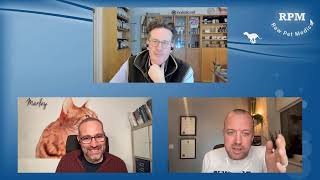
Nick and Bren discuss yeast infections in pets, covering Malassezia on skin and Candida in the gut. A Pet Biome report found increased E. coli in dogs on long-term vegan diets. They cover diagnostic methods like fecal testing and treatment options including MCT oil and S. boulardii.
Chapters
I might finish that later. And we're back again. You were saying, Nick, I bet you do know the size and your torso and length of— I bet you do when it comes to ordering. You look like a guy that does.
I kind of, but I will just go for usually for either— I usually go for a large. I usually go for a large t-shirt, but I'm not particularly large. You guys are probably broader of the chest than me.
I'm flirting with it. Large is like my 30s, and now for some reason everyone's making large a little bit too small these days. And so I can't think why. Dr. Conor Brady.
I can't think why that might be the case.
Rip-off.
Anyway, I put 'science is punk' on the front of them. I bought 3 and I thought—
You need to stand up again because the States haven't seen it.
Look at that, it's even written like a punk. I thought that's cool because— and the reason I got that is because I kind of thought it was a cool saying, but now I realize it's incredibly nerdy and my friends will devour me if they see me wearing this. But I was thinking like, you know, science has got no respect for authority. And that's what I mean, science is punk. There's just zero respect for authority. Authority doesn't come into it. Obviously it did in the last 3 years or so, and it became like an authoritative thing that somebody said something and you don't question it, which is obviously the complete opposite to science. That's just some political bullshit. But science is just questioned all the time. So there's no respect for authority. And I really, really like that phrase. And I was on that podcast there, as we alluded to earlier, that James Smith podcast, a lot of following. And, you know, it goes down pretty well on a few different platforms, but on Facebook there's a couple of mean comments. And I was surprised because, you know, you get these, don't you, when you're doing this stuff all the time. But it seems to be coming less and less onto the page. I would— for me anyway, it used to be on the page all the time. I don't know about you, Nick, but you'd always be batting off these occasional comments. Now it doesn't seem to come onto the page. But that was— it was surprising how many vets and vet nurses, to be honest, because they identified, they were happy to say and then it was just quite negative and quite angry. And I was like, ooh God. And I guess, look, there's so many people listening that some people are hearing that information for the first time. So isn't it interesting that like we're talking to dog nuts, we're in the dog world and we're talking to people that get it, want to hear it. But when you surprise people with it in a like a, that aren't doggy, you know, they were there for fitness and nutrition and health. And then you say to them, you know, 1 in 4 of them have dogs and go, heads up guys. I mean, think about what you're thinking about for yourself. Look at the dog's bowl. And I'm so, I kind of got surprised. I was thrown back 6 or 8 years to kind of, you know, why are you so shocked and angry about that? You know, and so that's why I put on my science as punk teacher and I just said, guys, you know, it's, it's quite simple. There's studies there and they'll say, where are your studies and all this? And I'm like, I'm dying to write things back, but it doesn't look good that you, you do the to and fro. Anyway, that's what my last few days have been consumed with, lads. Any, anything exciting with you guys?
I've got some, a little story for you. Uh, I, today I drove down to Chichester. I used to work down in Chichester. I worked with Mark Elliott for 4 years. Hello, Mark, I'm sure you're watching this. And, uh, and so went to this practice because they, uh, have drifted away from the, the, the goodness of raw food, and they wanted— and they had, um, uh, our friend Mike Davis, uh, Dr. Mike Davis, there about a year or so ago, and he was talking to them about how dreadful raw food is and how wonderful kibble and safe and just, you know, the bee's knees, as you can imagine. And I— and they invited me to come along and put the other side of the coin. Oh, so I did that. And I had 3 and a half hours with them. I was talking to vets, I was talking to vet nurses. We had a great time. And I was going on like I was Brady.
I was—
couldn't stop me, couldn't stop me, couldn't stop me. So I was really, really delighted, and they were totally up for it. But what was really, really funny— yeah, I used to work down there, and I walked in and I saw the receptionist. She said, oh, hi, I'm Sue. Uh, 20 years ago you came along and put my Shetland pony to sleep. And I said, oh, Sue, I'm so sorry, I'm so sorry. Did it go okay? She said, yeah, it was absolutely great, you were lovely, blah blah blah, which I was— God for that. And, and her 10-year-old daughter was there at the time, okay? And now her 10-year-old daughter, as was, is now one of the lead vets at this practice, okay? So yeah, so last time I saw this, she was crying. Yeah, because I just put her pony to sleep. And now here she was, a fully trained veterinary surgeon, and fantastic, and, and very up for raw food. So Nikki, brilliant, great to see you today. And the, uh, let's have a look, the other person, uh, who I saw came along was the other vet there who said, oh yeah, you sold your old car to my dad 15 years ago. What are the chances of that in one veterinary practice? The two vets, the only two vets in the practice, and I had connections with both of them inadvertently.
Small world.
How amazing is that? So There you go. That was an eye-opener.
And what was the chat like with Davies and co?
It was very anti-raw, and it was a very similar argument to the kind of thing that he's been saying for the last 10 years. I think he hasn't changed, bless him. I don't think his— you know, it's just, it's really dangerous. And the Veterinary Defence Society will not back you up if you are thighs raw food and there is a problem, you know, somebody gets an infection or something like that, they will not back you up. In fact, they will if you've given an informed choice to the owner to say, and you've said wash your hands and do it properly, then the VDS will actually— will actually— VDS, Veterinary Defence Society, the insurance company who covers vets for problems. So, and he'll show the slide of the child who's got salmonella and, you know, having a really hard time with salmonella. What have you. And also, it's really interesting, the one that was kibble fed— no, the head nurse said, oh yeah, uh, last year Mike said that he would send me some papers showing how, um, raw food had infected children and things like this, and she'd never received them. I said, well, that's interesting, because about 6 years ago he promised me when I did the BVNA, the British Veterinary Nursing Association— I, I spoke to the BVNA, 200 vets and vet nurses all in one thing, and there was Marge Chandler and, and Mike Davis, and, and, uh, I asked him, you know, please can you send me some papers on, on, on damage to dogs or to humans, and I haven't received it yet. So Mike Davis, if you're watching this, please could you send me those papers? I'd be really, really grateful. I'm sure he's an avid fan of this show.
Yeah, Mike Davis is at Omni now, isn't he? The vegan pet food.
The vegan pet— have you got some stuff on, uh, vegan food?
That was an appropriate Yeah, so yeah, I just wanted to highlight that.
Yeah, Mike Davies is advising on Omni now, the very well-advertised vegan pet food. And also I see that Jean Dodds wrote a book, or did the front of a book for vegan pet food. Did she do the intro or did she co-author?
I think she did the intro, but I'm kind of surprised at that.
Yeah, me too.
I've heard something from one or two people, but I am surprised that she went there because—
Yeah, the other half of Diana Lavrardoux is keen on it, I think, and she had written half of Canine Nutrigenomics, great book. And so she was keen on that. So I think that might have been the second kind of effort, you know. But while we're speaking about vegan diets, I found two little doozies. One was sent to me by somebody that was listening to the cast and sent it out to us, and it was from Animal Biome. Does everyone know who Animal Biome is, guys? They're the— oh, this is Pet Biome, actually, sorry, not Animal Biome. Same idea, they'll look at the dog's poo and tell you.
Different company.
Yeah, different company, probably a British company looking by the names that are on the group, but it's a Facebook page and they know a lot about probiotics and they look at the poo and that kind of thing. But anyway, that's what their job is. She said, Carol Hughes, we are receiving some interesting results from fecal samples of dogs fed long-term, i.e., longer than 6 months, vegan diets, there was a marked increase in percentages of E. coli. E. coli, diarrhea and colitis, known to proliferate with an increase in dietary resistant starch. And on and on and on then after that. So I thought, oh, that's a doozy. That's the first time anyone's ever thought maybe feeding a completely alien food to dogs is going to have the same effect as feeding alien food to cows. And you get this ridiculous upset in gut flora and, you know, terrible cows farting and dogs cows don't eat corn and dogs don't eat corn. So, you know, so that was a problem with the vegan stuff. So I thought, well, that's going to be interesting. I wonder what the long-term effects are in this, in this dysbiosis and higher percentages of E. coli. I haven't seen any studies looking at that, but that will be interesting. But the next one I thought was even more interesting, and that's when somebody was— it was a guy online just saying, guys, can everyone please stop eating fake burgers and just like understand that this stuff is awful. He was trying to— he was celebrating the fact that the shares are falling by 20% last year and people aren't picking up what these companies— and Bill Gates has faced it— is putting down. So they kind of said, right, these— this, this very strange stuff, soy, you know, soy protein, which takes a horrible amount of chemicals to grow, a monoculture, terribly destructive kind of way of growing stuff. They grow this stuff, then they ultra-process the hell out of it in machinery that you can never do yourself, and then they add bits of vitamins and minerals and pretend it's just like a burger now. And then they put it in a heavy plastic box and then ship it across the world to you. So there's no— what benefit to the environment is there on that, on that kind of process compared to a cow eating grass and pooing it out and being part of a cycle, you know? So he just dropped in and he said, and to boot, he said, beef isn't just about protein and fat and vitamins and minerals and all that nonsense. He says there is just so many things going on in meat that don't go on in other plants, such as L-carnitine. And we've all heard of L-carnitine, you know, it's an amino acid. We all assume it's a type of protein and it's only found in meat, hence carny, which is, you know, hence the name. Hence the name L-carnitine. And so he just drops in, he goes, for example, did you know that more than 50% of vegans present with deficiency in L-carnitine? It's called hypocarnitinemia. Hypocarnitinemia. Yeah. And 53% of vegans tested in quite a large study because you're going to have nutritional deficiencies if you're going to go vegan. You have to— that's why you have to supplement and be aware of what you're doing. So vegans are usually quite up on their nutrition because they're aware of the bits that could be lacking. But these are amino acids that aren't talked about. And he said there's profound behavioral implications for people that are low in that. And he said here, but also in vegan diets, you can expect the intake of methionine and lysine will be significantly lower in this group due to the exclusive consumption of plant proteins, which have a reduced content of these critical amino acids. Approximately two-thirds of carnitine requirement in omnivores come from exogenous sources. In other words, your carnitine is, it's 2/3 of the carnitine you need we are consuming. So you need to get it. The results demonstrate the risk of alternative nutrition with respect to the intake of essential amino acids, particularly methionine and lysine. This is in humans. And I just thought, how interesting. How are the vegan pet foods accounting for this? You know, like what else is in meat that is just so important for a meat eater? And it's just not kind of considered. So I kind of thought, I'm going to go down that road a little bit and I'm going to see, right, what nutritional issues pop up from being on a plant-based diet. And that's like we're omnivorous, closer to herbivorous, you know, whereas dogs are as carnivorous as you could possibly hope. A little touch of omnivory now and again. So I'm going to go down that road and I'm going to see what kind of nutritional deficiencies might pop up. And then I'll see if these studies, these vegan studies are looking for that. That's most important. So that wagged my tail for a bit.
I'll tell you what, who goes into this in a really big way and Rach Mac says she's packed, she's moving house by the sounds of it and she's packed all the books and she was almost threatening saying, don't, for whatever you do, recommend another book. Okay, so Rach, I've recommended this one before, so technically this is not a new one, but I'm just going to re-emphasize. And you guys in the States, you may not have seen this one either. It's by Jane Buxton, Jane with a, with a Y, and it's called—
can you see that one?
Oh yeah, The Great Plant-Based Con by Jane Buxton. And she goes through these arguments with with respect, but with meticulous care and her style. Gentlemen, you've got to read the book. It's a really, really well-written book because she has these arguments and she just presents them like a dream. Yeah, she's brilliant. So it's a great book to read if you're interested in veganism. Great. Good for you. If you're interested in vegetarianism, great. Good for you. If you're interested in that argument, it. It's a really, really— it's, it's a bit like Shanahan, you know. We used to go on about Shanahan a lot. It's of that caliber. It really is very, very powerful indeed.
Yeah.
Um, so there you go. Uh, uh, Bren, any, any thoughts before we kick off with yeast? We are going to talk about yeast.
We are going to talk about food, and I am super conscious we're nearly a quarter of an hour in and we haven't even touched on the subject yet. Some great stuff. I've actually been looking at methylene blue over the weekend. Oh yes, some really interesting stuff on methylene blue. No, no, I think I'll save it for next week because, you know, it's a bit biochemically and there's some great stuff in there, but it is, it is really, really interesting. And no, you don't need to take enough till your pee turns blue. You just need to take a couple of drops. It's a little bit— do you remember that iodine story that you told, Nick, where if you put a drop of iodine on your skin If you need it, it absorbs in. Was that you or was that Conor? It was one of you.
That's not me.
Brady.
No, that's not me.
All right. Anyway, similarly with methylene blue, they talk about the same scenario, but it is really interesting. You may have heard about nitrous oxide and some people promoting it as something really great for your health in the short term, but long term can cause all sorts of problems. I'm not going to talk about what it can turn gangrenous if you take too much of those nitrous oxide promoting drugs. But it is something that you've got to be aware of. Now, methylene blue is actually something that reduces your nitrous oxide, and they've actually found that longevity-wise, it is much better for your system than any of the drugs that short-term improve that, improve that nitrous oxide just because of the what it does to oxidizing tissues, etc. So very, very quick.
Nitrous is not just the stuff that they give you when you're having a baby.
Nitrous. Sorry, I said nitrous oxide by accident because it is the stuff that you take from gas. We have got it in the practice as an extra pain relief, gas and anaesthetics. So you were taking it all the time while your wife was having the baby?
We were in a baby having, you know, a baby, how to have a baby class. What's that called? Anyway, and you're there and they're telling you what's going to happen and she goes, and listen, man, you don't have to do too much when the action, when the show starts. You don't have to do it. Just don't be standing there eating tuna sandwich. And I literally, for my first gig, was eating the tuna sandwich, and Elaine never lets me forget it. She was in there for ages. And so yeah, tuna sandwich and then hooping on her gas.
Anyway, tuna sandwich this hand, mask in this hand, ready to go.
Um, lads, we are the Walkout Medics. You'll find us on patreon.com. We do actually talk about serious topics, and tonight it is going to be about yeast. And we do appreciate any support you can give us on patreon.com. It does help us to focus and prepare for these talks, although the first 20 minutes probably didn't show that. Guys, who would like to start us off? Yeast.
I'm going to start you off with, by saying podcast. We also podcast. So wherever you normally get your podcast, check us out. RPM, we've got a brand new logo. Thank you, Ellie, for doing our brand new logo. Check that out. You can listen to us as you walk the dogs or whatever you fancy doing. And off you go. So there you go, podcasts. So what happened was some lovely people came to me and I was at Crufts on Sunday.
Okay.
All day Sunday at Crufts, talking to people about raw food and all sorts of things all day long. But one, one, one guy came up to me and said, we love what you're doing on RPM, carry on doing it. It's absolutely great. And he said, please, could you talk about, you know, reeled off about 20 things. And one of which really struck out was the yeast thing. And he was saying, please, we talk, we have a lot of conversations, quote, this is more or less quoting because I had a lot of conversations that day. And he said, we have a lot of people who talk about dogs got yeast on their skin and we tell them not to feed vegetables. And that went into my head and I thought, oh, that's not quite right. So very briefly, I'm going to give you my take and these guys no doubt will give you their take on it as well. But from where I'm coming from, yeast, which is, which is called Malassezia pachydermitis if you want its Sunday best name, Malassezia comes along as a secondary. All dogs have a little bit of it, all humans have a little bit of it, but it only comes out to play when the skin is unhappy. How do you make skin unhappy? The answer is either you've got fleas or mange or some kind of parasitic infection, or you've got some kind of sensitivity. The three types of sensitivity: indoor— you can tell I can, I've got this in a, in a list in my mind— indoor allergens, yeah, house dust, house mite. You have a sensitivity to those things, your skin gets itchy. Or you're allergic to outdoor allergens, which is pollen, grass pollen, or tree pollen. These are the dogs who get more itchy in the spring, summer, autumn. Or you are allergic to, you are sensitive to food. That is, every time you give the dog chicken, dog gets really itchy. If the skin is unhappy for long enough, you will get secondary infection, either bacteria or yeast or fungus. And the yeast that takes over is called Malassezia. So from where I'm coming from, and please, if you've got information to the contrary, if you've got information that if you feed veg, you will grow yeast on healthy dog skin, please let me know. Because as far as I can tell, and guys, I want your input here, if you've— I think if you've got a healthy dog, you can feed veg, you can feed even high-carb veg like, like root vegetables and things like that. I don't advise that's a good idea, but I don't think feeding those sugary foods will give you yeast of any sort. In humans, it could give you candidiasis, but that's a whole other kettle of fish. And Bren will tell you about the metabolism of Candida versus the metabolism of Malassezia in one second, I'm sure. But I just want to really, really get that through, that yeast is only there because the skin is unhappy. And for me, that is because mainly the main thing is you've got atopic dermatitis. The dog has atopic dermatitis. It's allergic to pollen, or if the dog is allergic to house dust, house mites, molds, there's those kind of indoor things. And because it is unhappy, the yeast takes over because it likes slightly warm, slightly red, slightly damaged skin. Okay, so that's my take, and I really wanted to say that, and so I'm just going to say it once more. I don't think you can create yeast on skin in a healthy dog regardless of what you feed that dog, especially with veggies and especially with sugary rooty vegetables. Gents, your thoughts?
So I'd go first with yeast is a very broad— it's like saying fungi. Okay, so yeasts are a subset of fungi which are effectively small buddings single cellular fungal material, and they are a larger group, and you have multiple different types of yeasts. Okay, so just to say Malassezia yeast is Malassezia is not correct in the sense that Malassezia is a type of yeast. There are many types of Malassezia. Pachydermatitis is the one that is the one for dogs, particularly in ears. Skin, etc., alongside superficial staphs and streps that would be found as commensals on the skin. The ones in the gut are different, okay? And there are Candidas within the gut, okay? These are ones which we would commonly think of as sugar feeders. They are naturally found there in balance with bacteria, but when they get abnormal, you can actually get Candida plaques. And this is something that actually affects dogs as well. I was looking into this because Nick raised the question, is that a problem with dogs? And there is candidiasis in dogs, and you can get plaques which actually cause increased leaking of gut because of the filaments going into the gut wall and causing irritation. Those are the ones that tend to drive you to want to need more sugars as well, which is really interesting for humans. So it'll be interesting if it does also drive that desire for sugary, starchy foods for dogs too. But so there are those, there are then the groups of the Saccharomyces, so the cervisiae, which is the brewer's yeast, and that's— boulardii is one of those which can be a really good prebiotic, and that's something that Conor's written a nice little article on a few weeks back, I think it was, on your page. Yeah. So there are, there's a number of different yeasts, each have different purposes. I would say the ones that are in the gut, interestingly, do thrive on sugars. And I think if you get them that sugariness in balance in there, not only is it the yeast, which I think is possibly secondarily an issue, it's actually the other things with starches and sugars and processed foods causing gut issues, which may lead to inflammation, which may then lead to skin irritations, etc., separately. I think it's really interesting when you look into the metabolism of Malassezia, that that's all about essential oil, fatty, fatty acids, and there's a whole list of them. Really interestingly, many of them are found in normal skin creams and things like that. So you've got to be a wee bit careful about if you're seeing this thickened elephantile skin that's brown and looking, or even black, and looking horrible, and you think that you're going to soften it up with a nice oil of ole skin balm, that you might actually be feeding those fungus. I always find that acidifying those areas with a little bit of apple cider vinegar seems to do a really good job of reducing those plaques. Far more than using those nice, smooth, oily balms.
Interesting.
I'll share that paper on the feeding of Malassezia.
Rachel Maddox has just asked a question. Can leaky gut be a cause for yeast? Well, I'm going to— I'm just going to go with that for one second. Leaky gut will potentially cause inflammation in the skin, which and any disruption of the skin can then cause secondary infection with yeast. So indirectly, yes. Rachel? Yes, I would say so.
Yeah, definitely. If you upset the gut flora, you kind of feel like the good gut flora keeps its foot on the neck of yeast. And when you disrupt that and take them out of the way, they release compounds to stay in charge. You know, they are— they want this host and so they don't move over easily the same way pathogenic bacteria, lots of them don't move over easily. They release compounds to stop the good guys is growing. Hence things like S. boulardii, a soil-based probiotic. It's kind of like weed in the garden, I consider that. Sometimes if you've got a stubborn gut infection, and it works with Giardia too, unbelievably, is that you can throw this S. boulardii in before you use broad-spectrum probiotics to try to help kill the pathogen before you throw in the good stuff. That's the way I'm thinking about at the moment. I look at this gut-skin axis that goes on, and I often believe that if you've got a little fire in the gut, it's almost inevitable you're going to have problems with the skin. So if you've got a terrible dysbiosis driving huge amounts of inflammation, you're going to see skin issues. So when Nick's talking about a breakdown, something's made the skin unhappy. There's nothing quicker that makes the skin unhappy than an unhappy gut. I see everything as a little house on fire. And so, yes, malassezia is this condition on the skin, which is a different type. It is the— he likes oxygen. And the one inside your gut, these Candida species, they form these plaques and they, they adhere, they stick to your guts. So a great solution inside and out for both type of yeast conditions is MCT oil. MCT oil, uh, it prevents the yeast kind of hanging on together, so it actually reduces yeast numbers, which is one of the few things that does inside the gut. And it works for skin, for malassezia. I just get a quick Google as Brendan was talking to see if MCT oil works on malassezia as well, and I've got a great study there that I'm going to share on the Facebook page after the show. It does. So there's a good one to have in the cupboard. I think the clever thing that yeast does when it's in the guts, particularly because we're blaming the guts here— I am anyway, just for some angle, you know— is that yeast wraps itself in indigestible fiber, cellulose. Clever little yeast. You cannot kill yeast. It's the one probiotic, soil-based probiotic. You can throw yeast on top of food, you don't digest them because they're wrapped in cellulose. And so they sit there and they're protected in the guts. And so people put in these natural compounds hoping to reduce yeast numbers in the guts. Green olive leaf, garlic, MCT oil. But if you don't digest the outside of that yeast first, he's pretty, pretty impenetrable. So the digestive enzyme is cellulase, which digests the cellulose, and only real big herbivores like cows and sheep and goats and whatnot produce cellulase. So we feed a digestive enzyme with cellulase, or even just a bit of pure cellulase like salt on the food, and you put that digestive enzyme on the food and it digests the outside of the yeast.
Yeast.
And now your MCT oil and a couple of little bad things that yeast don't like really work. And the last tip about yeast is if you've got a bad yeast bloom and there's lots of it there, you're chronically itchy. So interesting what Bernd said, that it infiltrates the tissue. I'm thinking of this show that I'm watching, The Last of Us or whatever it's called, and it's all about this cordyceps fungus, you know, and we know that it can control ants and all sorts of— they make animals do really weird things. They're so amazing, fungi. They get in there and they demand sugar. I'm not surprised. So simply cutting sugar out of your diet doesn't kill Candida because it just, it just hibernates and it just sits there and then you have a grape and the thing grows again. So you need to digest the outside and hammer it. But if you pile in yeast-killing compounds like your digestive cellulase on high dose and your natural compounds on high dose and something else you read and put that all in at the same time, you risk killing Candida all of a sudden. And if you do that, it releases all these horrible compounds that's inside it and your dog gets really, really sick. And so the, when you're killing these, you move on to your supplements really gradually. Otherwise you could be down at your vet with a really sick dog and the vet's going to say, I told you not to use the dark arts, you know, use this, use these drugs that are safer. And so there's a, it's called a Herx effect. And a Herx effect is where the thing when it's dying causes you trouble. And so you don't want to kill it all of a sudden. You want to kill particularly Candida slowly. So you move on to your supplements slowly and it'll take a week or two they say it's like a terrible hangover when yeast is being killed en masse. So I thought that was kind of cool. If they're trying to kill—
gotta say that candidiasis, as it happens with humans, is not that common in dogs. Brent, can you just give us a little bit more about the plaques? Because that's— I always say to people, dogs don't get candidiasis, but you're saying there's some work to say that you can find Candida which are Candida albicans, which is a yeast in humans. If you take too many antibiotics, you can get an overgrowth in on the inside in your gut of Candida. And unless you starve it and kill it, as, as, as, as Dr. Conor is saying, then it will grow. So just tell us about dogs and candidiasis in the gut.
Yeah. So definitely nowhere near as common. As probably is with people. And again, I've seen a number of people using thrush as a comment, and unless they actually know that this is Candida albicans, you know, then I would suggest that in my head thrush is limited to Candida in that sense of the word. And I think, you know, then, so yeah, we're mixing up yeasts, yeast infections, the different types of yeast and, you know, those terms. And so, you know, especially with the ears, for instance, that's a Malassezia. It's not necessarily a yeast, you know, Candida down the ears, you know, unless they do a specific culture to find that out. Now, for dogs, I've come across this twice in my career, so I'm not saying it's super common, and I would say that, you know, but it is something that I've seen and we've gone in, done the cultures of the plaques that we've found, and they've had classic leaky gut. So what this means is that they have been sensitized to so many proteins. So this is one where you find them rather than just being sensitized to one or two proteins like beef and chicken, and you think, yeah, I've got to exclude those and we've got to move them on. They've truly, rather than just having a hypersensitivity sensitivity truly shown antibodies. So IgE to just about every single protein they've ever eaten. And as soon as you put them onto a new protein, you know, within a matter of, you know, 2 to 3 weeks, you can start to see the antibodies rising against those new proteins. And that suggests to me that there's significant infiltration allowed by the gut contents into the immune system. And this is fairly classic for what you'll get with these plaques where they infiltrate into the tissue and expose the immune system to all of the stuff leaking around them. So I would say not common, but it is noted, and I have seen two. And, you know, that's just me as one vet.
Two? What are we— what is candidiasis?
So candidiasis in the sense of Candida is there. Okay. You do a general check for Candida in dog species, you would be able to find it. Okay. It's ubiquitous as one of those organisms.
So it's normal in dogs.
Yeah, yeah, yeah. Candidiasis is where you actually have a disease which basically the Candida has got to a point where it's forming almost cultures on the gut wall and actually creating a significant diseased area around.
Okay, so it's got overgrowth. Yeah, it's overgrowth of Candida. So it should be there in just a tiny bit here and there, but actually because of antibiotic use, for example, it overgrows. Yeah, you kill all the good bugs and the yeast goes, yippee, nobody in the way, let's grow and grow and grow and grow and disrupt the, uh, enterocytes, the, the, the, the gut lining. And therefore you're absorbing these proteins and therefore getting this IgE response. It's like, oh my God, there's turkey in, in the 'Let's zap that with an antibody,' and thus you've got your allergic to turkey for the rest of your life.
I have a theory on them. You know, when people present with these allergy tests and whatever about the foods and stuff that are on it, and you often find that these dogs often exhibit intolerances anyway, you know, IgG kind of reactions to pollen and dust mites and whatnot. And you think this is unusual because this wasn't here before, or else we would have seen it. This is popped up for a reason. So leaky gut is a classic cause of that. People will say, oh well, he's now allergic to dust mites. It's like, well, that's not quite right unless it's an IgE reaction. It could just be an intolerance. So this— and what I see it as, I see this broken down gut like the castle walls are crumbling. And so the dog is inhaling huge amounts of pollen. You go for a walk, you sniff a plant, you're inhaling huge amounts of pollen and dust mites. And those go through the food bowls too, and they can sneak down the little broken holes, and that will trigger the immune system as well. Anything that comes through that gap is going to be tagged. It can be a half-digested protein you ate. It can be a, you know, a— that was my thinking. Am I anywhere near close to anything there with that? Because I've been thinking that for 5 years now.
And so the exposure to pollens, the reason that some of those environmental things are so much more relevant to allergens, so much more common than food is because they are literally going to be exposed in the airways to very fragile, very narrow gaps. You know, oxygen's got to pass across the endothelium within the lung. You know, if you're breathing in pollen particles and you've got exposure, or in your sinuses, you know, if you've got inflamed sinuses already, you know, further aggravation by inhaling pollens, you know, it's going to easily be exposed to your immune system. If you've got a diseased skin or anything like that, yes, you can pick up allergies such as house dust mites, things like that. If your dog has already got a skin disease for whatever reason and then they are lying in an area that is going to have house dust mites, then yes, they can develop house dust mite allergy. Or if they are exposed to excessive growths of malassezia because we've given them antibiotics to deal with the dermatitis, you know, and the infection. The yeast overgrow, all of a sudden their broken skin is exposed to excessive numbers of yeast. So of course they are going to then risk becoming sensitized.
Nice. Those way better particular malassezia, way better hypothesis, that one. Glad I asked you, Ben. Pity I did it publicly, but yeah, excellent. I've got two little tips as they come to mind. One is that there's a company called F.E.C.L.A.B. F.E.C.L.A.B. Actually, maybe you guys do it too. I'm just after it. But there are swabs that you, if you think your dog has a chronic malassezia skin yeast issue, then there's swab kits you can buy that are posted to your house that you can swab the dog and you can put them back in the kit and post them back to the vet. And if there's a chronically high number per whatever space they look at, then they can tell you very quickly and cheaply and efficiently that there's a yeast condition. But your local vet can do it too, really quickly, because it's a matter of swabbing these guys and looking under the microscope. Like, it's quick, quick stuff. So my question is, skin checking for a yeast condition on the skin seems easy enough. How do they check for a yeast condition in the guts?
Good question. How did you know that those dogs that you saw there, Bren, had definitely had Candida plaques in their gut. Did you see them? Did you endoscopy? Investigate endoscopy.
Okay.
And you, and you, and you, you sampled those?
Yeah, you sample that, you look at it.
And is the alternative then to go on to a company that, you know, if we didn't want to do scopes and whatnot, you know, we've got a very sensitive little dog, is the alternative to use a poo sample and take a look at the biome and go, look at your yeast. Is all over the place. Is that what you guys do? How do you—
I guess that that is something more recently that people could do to look at yeast overgrowth. I think, you know, it's going to be there anyway, so it's about looking at numbers, isn't it? And that's a very difficult thing when they're doing a lot of these biome things are not just doing a shotgun analysis of the stuff, they're doing cultures first. So it's a hybrid in my eyes of what's going on. It's not just a mold it off and let's look at the outer culture coming out. Why do they culture? And then they take the sample of that and then they look at breaking that genetic code down in order to look at what's going on. So there are, there are very few labs that I have found that actually don't do a primary culture first.
Okay.
And then take the scoop of the little thing that's cultured on the disc to look at. And this is one of the reasons why I said the other week, you know, 80% of the gut microbiome is still unknown because we are stuck in culturing the bacteria first before we then look at what's going on.
Do you want to explain to the people what culturing is, just in case a lot of people that haven't gone through it?
So you take a sample, okay, you usually put it in nutrient broth, okay, yeah, obviously, yeah, it's going to be some gone. All right, what sample of what? Yeah, okay, so poo sample goes into a nutrient broth, okay, that builds up the numbers of bacteria that can thrive in that broth. They then take, uh, um, that and put it onto agar plates so that I'll spread that out, and then they'll look at little colony-forming units on those plates, okay. And they may even use specific plates which will, um, develop cultures of specific type of bacteria and they will then take those and actually, you know, put those into the machine to determine exactly what they are genetically.
Yeah, okay, there are limitations to doing that, to doing the, the culturing. And I think what we should do, guys, is go over to Patreon and discuss the pros and cons of culturing and the ins and outs of culturing.
Yes, what do you think? A couple of tips for skin conditions, easy skin conditions Yeah, yes, let's do that.
That'd be really good.
Yeah, that was key. That was quick, guys. That was quick. I think we're— I think I was rabbiting on to start off. That was very quick. Um, first time we've covered this still live here, mate. Oh, we are? Okay.
Yeah, you can tell he's had a heavy day. He's going to apologize to Dr. Judy's followers again for being slightly late.
So bad. That was so bad because before Judy was made away to Christmas time, we were doing this Christmas thing and I didn't realize Judy was there. She was in for a 2-hour wait or something. And then something else happened the last time I speak to her. And this time the clocks went back in America. They don't go back at the same time as ours, or forwards. Spring forward, fall back. So theirs went forwards on Sunday. So I wasn't expecting—
oh, did they?
So when I was—
I was giving them the wrong time anyway for tonight.
So I was on that RFDS kind of thing and then I was I was like, oh no, I'm gonna go. So, uh, yeah, okay. Anyway, guys, we'll discuss my issues.
Patreon, let's go to Patreon. Let's talk about, uh, culturing.
Yes, guys, I hope you've, uh, enjoyed tonight. If you want to, uh, support us and join, uh, join us, uh, in a little bit for the Patreon, it's www.patreon.com/rawpetmedics. Um, you can also re-listen to these podcasts in their entirety on any of your local services, from Spotify to Amazon to Give us another one. Go on, Nick. Who do you listen to?
Oh, I use Apple.
He's there, he does listen to us.
It's the stat. No, it just appears. I've got all my, you know, very subversive podcasts. I'd love to see him comes up in that.
I'd love to see your list, Nick.
Yeah, you're welcome to. Yeah, seriously. So it's just the stat. If you've got an iPhone and you know what a third of people have, then just have a— there's a button that you press for podcasts and you just choose, you just put in Raw Pet Medics and it will take you there. It is not complex. I can do it.
It's not complex.
For a moment there I thought you were going to say, and all you have to put in is subversive and Raw Pet Medics comes up.
Yeah, I can tell you what to look for if you want subversive.
Message me privately.
Anyway, great guys. We'll see you all. Very good.
Thank you, everybody.
Next week, guest next week, isn't it?
Yes, next week. Yes, we'll announce somebody absolutely 100% confirmed and, uh, so just give us a day on that. Yeah.










