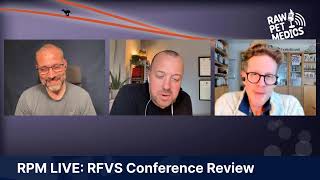
Dr. Conor Brady, Nick, and Brendan recap the Raw Feeding Veterinary Society conference. Matt Muir presented data showing raw-fed dogs live longer with lower rates of diabetes and GDV. They discuss gut microbiome complexity, nutrient deficiencies in high-fat diets, and why young vets need community support.
Chapters
Hello everybody, um, thank you for bearing with us. Uh, let's just give you a minute to get back logged back on.
You can tell us who's going to be first.
Yeah, uh, okay, I guess it's recorded anyway, so— well, no, I know, I— you've got to share it with everybody else because it's for their benefit, not for us. Okay, but before they come on, the idea is anybody who was there at the Raw Feeding Veterinary Society conference. And, um, what did they find, uh, was the most fascinating point? Ah, Fiona Murray was the first one back, and then Janet.
Oh, can you hear us?
Is that good? Can we— can you hear everybody? Uh, Nikki, Cheryl? Yeah, sound is better. Okay, that's good. Okay, I'll wait till a few more are in. Yeah, I don't have to repeat myself, but, but I'm just thinking, you know, um, um, Cheryl, Cheryl, was she a Cheryl or Cheryl? We call her Shazney, so that's not gonna help. Cheryl, no, but I know somebody else is Cheryl.
Cheryl.
So, uh, Fiona, uh, Cheryl, Anybody else who was there, what were your favorite bits? Please tell us. Maudie wasn't— Maudie was there.
Yes, gosh, I know you were rather tired, Nick, on a couple of nights.
And no, no, well, we got the train back with her, so I know that she was there.
Yeah, you literally just told me yesterday you were speaking to her for 4 hours on the train. Literally on the train.
We were. We had a great— No, no, no, we had a very in-depth— it's just I can't remember seeing her much during the day at the conference. Joseph Kent, greetings. Joseph, where are you from and what dogs have you?
Joseph, that's a new name. I like seeing new people. I met a stockist at the show and she said that it was a stockist and she said her name and I didn't know her name and I thought how nice things are now at the moment, that with Karen helping me with the business and more stock is coming on board, that I used to know them all by name. I knew their phone number off by heart because you'd be checking in with them going, do you want anything else? And, you know, back in the day. But it was so nice to meet a couple of those people at the, at the events. So you get to meet these people and also you get to see some new products. Do you know what I kind of liked? I'll give them a plug for nothing. The Innocent Hound treats, I liked the, the air-dried treats that they were doing, and I like the staff, and I was chatting to them. So if the owner of Innocent Hound is watching for some reason I think your staff are lovely, very well clued in, lovely high-quality treats. There you go, they're for sale in the UK, but that's for no other reason but I enjoy talking to them. So I like the stands at the back, I like chatting to the businesses, and I do like new products, as I made very clear in my talk particularly. Anyway, guys, we are Raw Pet Medics. You will find us on patreon.com/rawpetmedics. Anything you can afford there is great per month, so, you know, price of a cup of tea per month. It really does us a favor, helps us to do our things. Yeah, like putting on kind of extravagant, extraordinary shows on the 2nd of December. So we do have the RPM show coming up on the 2nd of December, and with all these awesome prizes, we'll be talking about a new prize every single day. I talked about Carn Leah yesterday, we'll talk about another company tonight. But we did want to let you know about one of the little competitions we're running because we have so many prizes to give away, and it's a kind of a portrait with your pet. and we just put the post up today and you'll be able to have a look at it on Facebook. And this is classic Fiona Murray kind of touches to when she puts on, you know, the whole idea of, you know, not Generation Game but Beat the Eggheads and all that kind of stuff. Fiona's great at this as an event organizer. That's what she— or not an event organizer, what is she? What does Fiona do? Nobody knows, but she's definitely a very organizing person. So listen, this is a portrait with your pet. So you find a painting that involves a person and a dog, and then you try to replicate that in your garden. It'll make more sense— or in your house or wherever— but it does need to involve a you and a dog, and you're trying to replicate the image. It'll make more sense when you have a look at the post on the Facebook page, but check that out, guys. You get your entries in, and there is a fabulous prize for— look at that, there's an idea.
So, so, uh, uh, hang on, let's have a look at that. I was just off on another thing.
Thing.
Uh, there you go. So it doesn't actually need to involve you and your dog. Yeah, you don't have to be in it. Yeah, but just try and make up a famous image involving your dog, like a girl, girl with a pearl earring. Yeah, you somehow hang a pearl. Please don't pierce your dog's ears. Um, not for this, not for this event anyway.
Yeah, yeah.
Uh, uh, or you get the Mona Lisa, and if you can get your dogs to just give that kind of um, interesting smile. Yeah, then, um, you're on. There's your—
Am I the only person not impressed by the Mona Lisa? I went to see it.
I'm not that impressed. I mean, what's it all about?
I mean, I've seen way better paintings. That is just a very average—
But that was quite a funny one.
Oh yeah, that's not bad. Yeah, I like that. Needs, uh, needs dogs.
It definitely needs the other one that we saw, Bren.
The E-Moon scream, that's my favorite thing.
The Van Gogh?
Oh, I thought you meant Moon.
That's only so good.
You have to tell people on the podcast what you're showing, don't forget.
Oh yes, so there's a couple of photos, so there's a slight conversion from the classic, so we just thought that some of those would suit if you want to find a photo and then recreate it with yourself, that's fine too.
Yeah, check out the post.
Brendan just showed a picture of a shot that we saw in a little pub next to the station that we went to on Sunday, and it was a picture of the Mona Lisa who was smoking a pipe wistfully and had a dirty martini in the other hand.
Lovely.
And it was quite, quite a nice, quite a nice picture. And in the same place, we saw this, and I'm showing a picture here of Vincent van Gogh in a suit looking really quite smart and quite modern, taking a selfie with a selfie.
That's cool.
Yeah, it's a very, very cool— I doubt you'd be able to get your dog to go anywhere near that one.
Yeah, take the phone to his paw. But listen, that is the first part of the news updates to pay attention to. So just a quick— and we'll pick a winner on the day and we'll sit through the images up on the screen and it'll be a bit of fun. And the other thing was that there was another post 2 days ago showing there's a bit of a buddy system. It turns out Manchester is enormous, and so we have a bit of a buddy system there. So we put up a post yesterday and you can check it out. And so people that are traveling by themselves or getting a bus by themselves, have to walk from whatever stop to whatever, you can team up. And that post is going really well. There's lots of people that are driving on their own and there's someone saying, I'm on a train from here, I'll get the train with you, I'd much rather be with someone. So that's kind of cool because it's kind of like an RPM posse. So you might be coming from the same town as somebody else.
Conor, just explain Buddy Up, what that means, just for people who are not familiar with that idea.
I don't know, people that don't want to travel by themselves, you know, they might be coming from Liverpool, they're going to Manchester on a train, and there's somebody else coming from Liverpool, they hop on a train to meet them in the restaurant down the road. Or, you know, it's a big event and some people arrive on Friday night and the show starts on Saturday morning, so they might want to be in the same hotel or meet up in the same hotel, you know. It's just a way of getting around together.
And Nick's gone. Yeah, yeah, yeah.
Very pensive looking, you two.
Hotel and half a mile, half a mile to the nearest place. Then you can get, you can organize a buddy because we're trying to put everybody together so that we can look after each other. So that's the basic idea. So if that's you and you're going on your own and you fancy even some companies, somebody starts a good idea, I like that idea, it is a great idea, jump onto Facebook and you'll be able to see other people who are in the same situation and you'll be able to, we will all help each other, that's the bottom line.
Cool, sounds good. And finally, Fiona will kill me if I don't say the fourth thing, Fiona grabbed us, she said it's like herding cats and so she grabbed the three of us on Friday night at RFES and she, to be fair to her because she's doing all the organizing, and so she said, don't forget that registration's at 9, but we won't kick off until 10. So registration's at 9, then a bit of talking at the back and meeting people and whatnot, and then we'll kick off the show at 10 o'clock. So just—
are we doing teas and coffees at that stage? I imagine we are, aren't we?
I'm sure there is.
So you can get there for 9 and you can have a chinwag and meet people. That's half the battle.
Okay, meeting with people.
I like that. Yes.
Networking. Yeah, you meet people like, you know, you bump into— we're sitting there on Saturday and Nicola Cresswell comes in with an RPM Live Live hoodie on her, and it's just like, that is so cool to see. It's like, it's such an honor. It's like, my God, somebody thought to, you know, wear to the event. And it made me feel bad because you wore your t-shirt as well, Nick, and I didn't wear mine. But I'm going to be wearing the clothes on the day for sure.
Brady, you're a loser.
I am a loser.
What can I say? What can I say?
I'll try.
Hang on, I've got a picture. I have got a picture. This is a picture of— oh, hang on.
Oh yeah, that's good.
Yeah, hang on, I've got the, I've got the photo. I've got photographic evidence. Nicola, you're an absolute star because you're not the smallest in the picture, Nick.
Yeah, yeah, yeah, you can love that image. So Nick's holding up an image of the three of us with, uh, get into the shot.
Yeah, it's me and Conor just crouching down.
You look like, uh, you look a bit like the Abominable Snowman. You're just kind of sent in because otherwise it would have just been your shoulders and down. But, uh, yeah, so that's a nice pic.
Good on you, Nicola. We were very pleased to see that. That's, um, and also her two— there must be—
I can't remember their names now, I'm sorry. They're sitting beside me.
I'm Jude.
Emma and Jude. There must— there'll be a prize in there somewhere, I think, boys, for that show of solidarity. Put your name in the prize in there.
Stick your name in the hat. Isn't that what Fiona was saying? Stick it down in the hat. Oh, I can't wait for this show on cycle. It's gonna be brilliant. Stick your name in the hat every time somebody does something that we like or is fun or is cool. Stick your name in the hat. And then—
and it means that you can get your name in the hat 5 times or 6 times, which means it increases your chance of getting a prize by 5 or 6 times, which is a brilliant idea. So lots of smart aleck comments and funny comments and clever comments and all that.
Yeah.
Yeah.
We'll put—
yeah.
Flag Nick off. Come to us. We'll tease.
Put the name in there.
Yeah.
Yeah.
I like the sound of that. So yeah, guys. What did you, uh, what did you think of the show? We're at the, we're at the RFES and it was a conference and it's kind of like the raw feeding next generation, what's coming up. Uh, and so we had a number of speakers. Uh, Brandon was doing one, I was doing one, Matthew Moore, uh, Amaya did one, and we had, um, girl Gemma that did the research on the vets that we can talk about. Uh, where does anybody want to start? What, uh, I'm gonna jump in your head.
I'm gonna, yeah, I'm gonna jump in. I thought, um, uh, everybody says that Brendan's presentation first thing in the morning was very good, but I didn't see it. But he thanked me on 3 occasions.
I thought he was just going to say, I didn't.
It was the first sunshine I'd seen in weeks, so I just sat and drank tea in sunny Ilkley morning light. I just thought, ah, this is beautiful. Yeah, it really was very, very beautiful. So here you go. Here's a kickoff. Matt, Matt Muir, if you haven't come across him, do Google him. He's good. Matt, Matthew Muir, he runs a company. What's the— he was, but they may not have seen that. So what's the company called? Uh, Lyka, uh, L-Y-K-A. It's an Australian food company, and Matt Muir has a brain the size of a planet. And he uses it for the betterment of—
he does use it for the betterment of the veterinary profession. But Nick's breaking up, so I'm going to take over at that point. So he was always self-conscious about ultimately pronunciation of the numerous bacterial cultures. So from a point of view of Being able to— oh, I think Nick's back. Oh, he's moving.
Sorry.
So being able to get through his talk and talk about a different microbiota and how to preserve that for the betterment of the pup's health, I think was excellent. And hats off to the guy. I love him dearly. And I think he should be back now in Chile. Where he's educating 500 or so health professionals on raw feeding and nutrition over there, which I think is just amazing.
But you are mixing up two people there. Nick started with Matthew Moore and you're talking about Christian.
I'm talking about Christian. Yeah, he went to Christian.
Oh yeah. Okay. Sorry. Yeah.
Okay.
Christian is the microbiome.
Yeah.
Yeah. That talk was phenomenal. But Nick was talking about Matthew Moore, who's somebody—
the size of a block. Parat Planet.
Yeah, yeah.
Although he does like her, he does actually run a holistic practice, and it really was very much about holistic medicine, holistic approach to health, yeah, rather than, rather than the food per se.
Yeah, a million miles an hour Nikki was saying with the factoids, and, uh, now it's like me, me watching somebody else talk as fast as I do, and I'm like, whoa, that is, uh he is a phenomenon of that. He reminds me of your friend Rowan from The Health Sensei, Bren, and your partner in crime there, who is a functional nutritionist. And those guys talk a lot about methylation, peptides, how important methylated vitamins and minerals are, you know, good quality absorbable vitamins and minerals where there's no conversion process needed by the body. And every single thing he said, I was going, oh, that sounds really important. 'Oh, that sounds really important.' You're writing down notes and you come away feeling a little bit thick. And so that is a good talk. It's like, 'Oh, I've got a lot to look at.' So anyway, Nick, you were talking about Matthew Murray.
Sorry, I lost the signal there for a second. Don't know why, blame it on Elon Musk. And he was saying that the average age of dogs in the UK is 11.5 years, but the average age of the dogs in his practice is 14 or more. Oh, that in itself. Now I think there's a study in there somewhere because most of his dogs are eating fresh or raw food. And, um, I mean, he looks after them.
So just to bring something side— a little bit of a side ball into, uh, yeah, it is, um, is that when you've got a general practice, they generally are starting young and they will carry on through and admittedly until they pass away. And they'll, there'll be various conditions, acutes of course, road traffic accidents, all of those sort of things. What I would say is if I filtered out my general practice to the referral practice, of course I see many more older dogs join my referral practice because they're older. And they need more help from complementary medicine. So I wonder how much there is an element of he's seeing older patients for longer and he doesn't have the short end, i.e., the, the accident end, in the same month. So that would be a question back to him.
That's fair, that's what you want. And but how do you refer to practice? What makes you think that? Sorry, what makes you think he has a referral practice? Maybe he's—
I know, because he does, he does talk to, uh, because he recruits patients in where he's talking about complementary medicines, acupuncture, traditional Chinese medicine, all of that. That's going to be referral stuff, you know, people who come to him for that when they've got a condition.
Yeah, cool, that's a good point, that's a fair point. Um, so Fiona is tagging on there, Nick, and not to steal your thunder in case you were going to say it's okay, but he had, he had other stats and he was saying, did you hear he made a stream of kind of stuff? Now listen, this is anecdotal stuff because he's not done a study, but at this stage I am more trusting of the anecdotal comments from people because they always seem to come in on top. But, um, so it's always a good guide. But as Fiona says, thousands of patients under his care and little to no diabetes. One case of GDV, one single case of GDV in years of doing this, and that was they were trying to get the dry-fed dog off the raw food, and in the process dog a GDV, which is bloat, guys.
And I'd agree, I'd agree with that, you know, compared to a standard practice. That's amazing. So compared to a normal practice where you, I would say most of them report at least one a month that they're doing a GDV, you know, we probably do one a year. I think it might even be 18 months since the last one, and those are the kibble-fed dogs within our That's unbelievable.
Just what we thought and just what the literature suggests because the gas is coming up from the— it's a fermentation gas that is, so therefore it's most likely food related. I mean, it's a good place to start, or perhaps the disease called—
fermentation gas if you read all the papers and the science, but there are certain nutritionists that still believe it's because the dogs are gulping their food.
Yeah, yeah, as it's just—
mention his name.
It was very convincing, the idea of that, that the air was coming in the throat was was convincing, but, um, yeah, it's a little bit, a little bit silly.
That's fermentation.
We now know. Yeah, like, so, um, so that's it. GD, what else did he say, Nick? He talked about diabetes.
He talks about vitamin D status on present— presentation influences outcomes. The minimum is 40 units of vitamin D, which is the same in— I'm just listening to Ivor Cummins. If everybody doesn't know Ivor Cummins, the Fat Emperor. He does a podcast and various bits and pieces, and he's very fascinating to watch. He's done a deep dive on human cholesterol and statins and also vitamin D. So if you're interested in those things, Ivor Cummins. And he says the minimum for men, 50, uh, 40, and the minimum for women is 50. But there are studies in places like Italy— do you know Italy has the lowest vitamin D level in the whole of Europe?
What?
Yeah, especially among women, especially among women. Maybe it's because how, uh, in older Italian women, they tend to, you know, like dress in black and, you know, stay indoors and what have you. I don't know, there must be some cultural—
they have to get more sun than we do. I mean, Italy people get more sun than we do.
There is more sun in the sky, but it doesn't necessarily mean that you're going to receive it.
Wow.
So always shaded or always covered. Yeah, absolutely.
Yes.
Yeah, yeah, exactly. And he— and what was really interesting, um, Iver Cummings— this is going off Matt Muir, but an equally clever— he's an Irish fella, you know. You know, there are one or two clever Irish fellas. We're in the presence of one, and Iver Cummings is another. And, um, sorry, and I would say, and I would say the same, I would say the same of the English. I don't subscribe to the thing, the, the Irish English putting down the Irish. I don't subscribe to that because I'm half Irish as well.
Very good.
Anyway, where did that come from?
I don't understand the link.
Don't worry, don't worry. Okay, so, uh, he was saying that you can, you can look at the influence of vitamin D on, on cancer, on Alzheimer's, on your response to certain viruses that may have been around in the last 3 years. On all viruses. In fact, your, in your response to vaccination, vitamin D is absolutely massive. Every cell in the body has a vitamin D receptor. Yeah, it's big. Vitamin D is a whole lot bigger than just keeping your bones in good shape.
Yeah, and the figure, the figure you're using, Nick, you're saying, I think you're saying, uh, micrograms, are you? 30, 40, 50 micrograms? Because the human dose in international units is like 4000 international units if you want to have big dose, 5000, which I'm not talking about the dose, I'm talking about your blood, your blood figures.
I'm talking about, you know what, I can't remember in the UK, it's maybe micrograms per deciliter or something.
But on the packet, when people are shopping on the packet, they want it. It might say the figure in weight on it of how much vitamin D, but most most of the time they try to standardize it to international units.
They do.
Yeah. And so they give you a big dose, but then there's different types of vitamin D3. Which one do you go for? There's good types. Yeah, there's all this kind of jazz, which is where Matthew brought the talk. And there was another guy there, Ron, and I wrote for Ron, you're listening, where into functional nutrition, which is where I'm not. And I do want to spend the next few years getting into that where it's talking about the actual methylation and having these really high quality vitamins and minerals that are ready to go as soon as you take them. And there was an interesting side note on that. Someone was saying— I was listening to this dude doing a talk, and, um, while I was over there actually sitting there at nighttime listening to stuff, actually, as well as listening to it during the day— that's how dedicated I am. And he was saying, um, that, uh, I think it was, uh, he was talking about, uh, folic acid, and he was saying folic acid, you know, we put it in everything, and we tell pregnant people take your folic acid, protect the neural tubes and avoid any sort of, uh, mishaps down the line. Okay, that makes sense. But the problem is folic acid is the dirt-poor version of folate. Folate's the good stuff, and it's in all over— I mean, it's in every single food you can think of, and it's great, and there's plenty of it around. But folic acid is the oxidized, poor version. So think zinc oxide to natural zinc. And so this is a problem because 44% of women can't absorb folic acid. And I thought, oh, that's interesting. But then he tags on another gem and then he goes, and what do you think happens to the undigested mineral that you've added in? So I'm thinking dogs can only digest about 10% of the zinc oxide that's fed to them in dry pet food. What happens to the other 90%? And the person's saying, you poo it out. And he goes, no, everything you put in there, there's going to be something there to eat it. And so you are going to drive dysbiosis. You're going to have some other little animal there that's going to want to live on that, a different bacterial colony, and you'll shift things. And now they're exploring the idea that it actually causes dysbiosis in people that can't digest folic acid. It induces dysbiosis, and that dysbiosis can lead to depression. And so when you start talking about postpartum depression, which they still can't figure out because it's such a complicated, horrible thing for someone to have to go through with a brand new baby, but now they're wondering, is this— is that it's a form of dysbiosis? And you taking folic acid when you can't digest it is not a good idea. So I thought that was so interesting because, you know, take folate, good idea. That's this whole methylated idea and a good quality folate product for sure. But taking folic acid is crap. And so it's for half the people that are taking it. So I thought that was kind of interesting. And that's where Matthew Moore was going with his D3 and, and all the other minerals he was talking about them. Isolated type of resveratrol, I think, which is the stuff in blueberries, and all these cool things you can add in. And he's mad about longevity, and I just, I could barely take in the information.
I was like, so, so somebody asked earlier about, oh, because it was really hard if they're online and sometimes in the room if they were towards the back because so many of us crammed so much on the slides that they could barely read it. Yeah, so, you know, we're collating all the slides, so if you're on the platform form, okay, the Mighty Networks for RFES, there will be that resource to look at the slides for those talks. They'll be very specific for those talks, and it'll be very specific for those members that have paid for the conference. So for this year, for those members can see past conference videos, they will then, you know, be able to get those talks alongside those. They'll flick through. So It's just to make it a little bit easier so that you'll be able to see those videos and slides at the same time.
Yeah, yeah. What was Gemma saying? Gemma was the young vet. What was Gemma—
Gemma was doing a paper, did some research, uh, talking how to talk to, uh, your vets, um, about raw, but also how vets talk to people, wasn't she?
She was kind of coming from both, both directions, which is really interesting. And for one so young, I was very impressed.
Yeah. Yeah, she's a young vet, Nick. Is she just qualified or is she in the middle of it or what's she doing?
I think she's what, a few years out? She's what, 2, 3, 4, 5 years out?
Okay, okay, yeah.
And very wise. Took me 20 years to get there, so well done, Gemma. Yeah, that's for sure.
Yeah, I think her research kind of, um, it's a survey of vets, you know, and people using raw food and The answers from the raw feeders probably weren't that surprising, you know, a little bit more mistrust of nutrition information from their vets. That's been done in a couple of papers before, and I think that's kind of understandable, to be honest. But hearing the vet side of things, and one of the lines that we spoke about at the end when it came to the questions, FAQs at the end, was that the vets are waiting for more research and they need more research. And I had to kind of comment on that, and I kind of like point is that like, well, we do have quite a number of studies here now and the question is how much more research, you know, like what exactly, what study are you waiting for before a leap is made mentally, you know, and more to the point is are you putting the same critical need of research before you jump to dry food? Did you look at a study? Did you look at research? Is there a particular type of study that convinces you dry food is good? Let's have a look at that one, and then I'll see if anything exists in the dry v raw kind of debate. Because at the moment we can't seem to produce enough of us. They're just like, it doesn't matter. I mean, last week we just had one coming out that dry-fed dogs suffer more otitis, and the younger you feed the food to the pup, the more likely they are to develop otitis. This is interesting stuff. If you feed it to mum, they're even more likely to develop it. So like, this is interesting stuff. And so I kind of said that, and she agreed. She was like, yeah, like like, if you're playing this research game, much like the smoking kind of industry did, it's like, oh, there's not enough research, there's not enough. So I think it's pretty clear. They said, well, we need a definitive study, but that definitive study just never quite, never quite did it in court. And 30 years later, now we know. So it's a game that I don't like playing, really, the old research game.
Guys, I must run and just get a lead because otherwise my machine's going to run out. It's been 1 hour and it's run out of battery. That's why I need you.
Yes, thank you.
There's a couple of people joining you actually that are at stations, so Martina, we'll catch you soon. You know, we understand if your battery's running out at the station. From a point of view of— there's a couple of other questions came up. If you're a member of the RFVS but you didn't pay for the conference, you won't get access to those slides or conference recordings unless you pay for them. So you, you know, it's going to be reserved for those people that paid for the conference, and I think that's justified for, um, just the fact that that is actually one of the main ways to raise funds to do further research within the RFES. So yeah, Rebecca, if you want to, um, uh, contact us through the network and you'll be able to purchase a recordings ticket, okay, then they should be able to give you then access. So if you're, if you miss the conference and you want to still join in and listen to those talks, then please do contact us and the RFES and we'll be able to connect you so you can see all of those all over again because they were recorded, which is marvelous.
Yeah, listen to Rowan Godfrey here. Rowan is in Kenya. 'Um, so I didn't know you're in Kenya, Rowan, because I see you commenting all the time and I actually thought you're, you're next door. And the, the nice thing about living in Kenya is that the vets are very open-minded. No vet would dare dictate to anyone how to feed their dog.' I thought, yeah, well, there you go, that sounds kind of cool, especially you've got so much wildlife going on around you.
I mean, yeah, it doesn't make sense, doesn't it?
Yeah, totally. Yeah, you know, maybe it's a country that's used to predators and predation and prey and it's a much more natural phenomenon, whereas we are separated from that. We don't see our animals, we don't see them being slaughtered, we are separated from it. Fiona Murray has a good comment here. That's our Fiona. And Fiona said, Gemma said something that made me very sad. She's only out in '21, so she's 2 years a vet, and in her first 6 months she was so stressed that she said she did not have the headspace to make good nutrition recommendations, so still defaulting to what her colleagues were doing and recommending prescription kibble. I mean, you can totally understand that, and that's something that Amaya has said, who is El Presidente of Raw Feeding Veterinary Society. And in her opening message to everybody, she was saying, trying to describe to people what the Raw Feeding Veterinary Society means to her, because it's a professional organization for vets and vet nurses. And, you know, people like me sit at the back and get to listen, but it's for professional vets and vet nurses, and you hear this vet, Amaya, she says, I'm a young vet and I had ideas about getting into nutrition, but there was nowhere I could go. There's nowhere to talk about it if I wanted to talk about fresh nutrition. She felt that she was a bit out on her own, and she said it was a lonely place to be. And she said when she found the Raw Feeding Veterinary Society that it was therapeutic, as we always say when we get together. It's just therapeutic to be able to talk about— who wants to talk about canine nutrition? Not your family, not your partner for the most part, not your friends. They all just think you're weird and boring. But then you get amongst it and people just love it, you know. So she said it was a release and it was like a little kind of a, kind of a home because nutrition is such a huge subject. It's not like it's one small thing, it's an enormous facet of health. So I like that idea. And it's sad that Gemma, this young vet, is so stressed, so busy. To expect these young vets to stay ahead of the game in all these different fields that they are expected to do— I mean, nutrition is just one tiny little part of us, you know. It's it's to expect to stay ahead of the research and the studies and the nonsense and the groups in all the different facets from physiology and surgery and anesthesiology and blah blah blah blah blah. Like, it's hard work for a young vet to do that. So yeah, I can sympathize with her. Tough, tough deal.
And everybody's welcome to the Raw Feeding Veterinary Society conferences nowadays. They were vet-only because we thought vets would be a bit shy about speaking in front of non-vets, but actually it works really well. Having non-vets there really brings an extra frisson because you only attend that kind of event if you're very, very geeky and very, very into food. So I think that maybe inspires vets a little bit. Yeah, here's Mrs. Jones, who's, you know, never been to vet college, and she knows more than me about amino acids. Yeah, it's like, oh, let's think about that again.
Yeah, wow.
Yeah, she's been feeding raw for 30 years. That's bloody inspiring, you know. Yeah, yeah, you know, it's brilliant. There's a nice, there's a nice, um, back and forth with, with, with everybody there, and there's no us and them, I can tell you.
Yeah, and there's still debate. I mean, because for all we will talk about optimum nutrition and you know, with that optimization, you know, where do we go, what standard is there, you know, that we still have a frank discussion about, you know, Mark raised the whole, well, look, how hard can it be, can we simplify this, is there a space still for people that want to just relax and feed raw prey, you know, that side of things, and, you know, there is a discussion that Ultimately, that could be a really good way forward for many, many people to relax. But there's that whole thing of the more you dive into it, the more complex you realize that nutrition is. And actually, to try and optimize that, especially for the breeding bitch and where we're going with the puppies, sometimes you need to fortify those because they're prey that we create through farming is not the prey they would normally pick up out on the field. Okay, and that's the difference to me. Yeah, is that we have created Frankenstein monster meats that are purely and simply nowhere near as nutritious as what they should have been.
And remember that point, Brent? Remember the talk we were at Open Helsinki and, um, Steve Brown was on and he was chatting and he said whatever about the fact that we're rearing these animals in barns where they never see the sun and they eat grain as opposed to proper prey and bits and pieces, so they're high in omega-6 and all this other stuff that you wish they had they don't have, so there's that, but he says the bigger problem is that people are then feeding much higher fat meat to their dogs and so raw dog foods he believes are quite high in fat And the problem is most of the nutrients that your dog, that you expect to be in the diet, are found in the redder part of the diet. There's of course fat-soluble vitamins in your fat, A, D, E, K, and your omegas, all that, but there's way more in the meat and bone and that kind of organs and that sort of stuff. So when you eat the fat on the outside of the skin and fatty cartilage and fatty bone on a fatty piece of chicken, you actually reduce the amount of space where you can hold nutrients. So actually it contains less nutrients. So the day— that's dangerous. And then you feed less of the food to try and lower the weight of your dog or something. So your dog—
lower the calorific intake.
Yeah, the calorific intake. And your animal can move into nutrient deficiency even though you're on really good quality food because the fat content is too high. They are used to eating very lean meat. So there's a number of ways that when you're at these talks and you go, oh, that's a very good point, he says the fat content of these raws are way too high, particularly when you go for products like lamb and pork. There's no way of getting the fat out of those meats as much as they try to keep them lean. They can be— the chicken and beef products are always one part fat to one part protein. That's 2 times fat to protein on a metabolizable energy basis. That's high fat stuff. And yeah, so that's the sort of stuff that these— I've got one more thing I wanted to highlight. Christian brought it up first and he stole my thunder because I had it in my talk as well.
And I saw you writing your talk at the back of the room.
Yeah, can't leave that out. So Christian, like Christian was saying that, Christian was talking about gut flora and microbiology and that kind of stuff, loves that. And what he was saying, and as I also said, was that we have a big focus on, you know, Clostridium is bad, Clostridium difficile. We all don't want Clostridium. And if you see too much Clostridium difficile, it's bad. So what you remember from that is Clostridium is bad, Clostridium is bad, take an antibiotic and napalm all Clostridium. And as he said, like, there is many, many, many species of Clostridium. This one does this, this, this, and this. This one does this, this, and this. All beneficial stuff. And it's like, where's the bad? And he goes, and even many people can walk around with some of the more troubling bacteria, but it's no problem until you have a bit. Dis-ease in the environment and then this thing grows. And I had a similar point. And so one of the studies was saying that like, you know, some raw-fed dogs have more different species of Clostridium. So like, Clostridium is largely a beneficial, if commensal, bacteria, which means sometimes good, often just hanging around waiting for an opportunity, but not to hurt you. So, and I said the same point about E. coli. Loads of E. coli species do different things. They digest different things. They regulate the oxygen content of your gut. They eat oxygen, which is good news for all your anaerobic bacteria in your gut. That oxygen kills them. So you can't just get rid of E. coli with a, with a broad spectrum antibiotic. And it's like even yeast, as I said, I was saying, like yeast does lots of things that we get thrush and we hate us and that's annoying. Take something that kills all the yeast in your body. Candida albicans, that yeast is wonderfully beneficial. It's trophic. It feeds other bacteria, it mines them, it keeps pathogenic E. coli in check. They hate each other, E. coli and Candida. So you annihilate one and the other one might grow. And so you introduce disease by using all these antibiotics and anti-life chemicals and chemically preserved dry food and fluorinated water and all the anti-life in your floor that goes up the dog's nose, as recently we saw with the atopic dermatitis dogs. So many things can disrupt this, and we've spent too long talking about bad bacteria and anti-life and working against these. And the point I got from Christian, hopefully for some from my talk, was that we need to start working with this community because we don't understand them. It's just a complete dark art, and there's many more of them than us, and they are just far superior in terms of just evolving around our crappy ideas.
The research needs to go on because there is, you know, this whole thing at the moment. We've got regulations across Europe and including in the UK, which is, you know, as soon as there's a salmonella, it doesn't matter what species it is. Yeah, you've got to ditch the food. As soon as there's an Enterobacteriaceae that's over a certain level, they want you to ditch the food. They, you know, for, for all of those coli forms, you know, that are beneficial. Yeah, you know, if you're creating a dead food because you are so— you must sterilize it with a kill step, you must give farges, you know, all the rest of it into that. I think there's always that worry, well, what is the consequence to that? You know, so I think that there is still so much more research to be done. And it's not just about creating a pro forma either of this is right for every single I've seen so many of the animal biomes, the pet biome products where you'll send your feces off to them or your pet's feces. I haven't tried that one on my own yet. You should. But then just to see, you know, the results come back so often, it's almost like a pre-typed report of and add this and add that and take these probiotics you have on the shelf and it's like And which, you know, for you, the end customer out there, where you're seeing maybe your dog, or, you know, if you're lucky, two of your dogs, you might get two different reports and you think, oh, that's great, you know, it's personalized to my dog. For me, when I'm seeing 30 or 40 of these reports and you're going, well, that looks remarkably similar, that looks quite the same. So I'm really interested interested to see how individualized they truly are because I think that's too much of the pump it out.
Yeah, I think so as well. I agree with that. I'm worried about those reports, I think. And also I think Christian was saying, don't take a poo profile of your dog when he's got acute diarrhea. It's like, what do you think you're going to find? You're going to find like— and I suppose if you're looking for an exact type of nasty pathogen that might be something. But yeah, it's very confused. And moving to the whole world of probiotics, you know, there was a slide in Christian's talk that he didn't present, but it was like they're having a look at probiotics and they're like, when they test them, it's like some of them didn't have the species they mentioned, a lot of them didn't have the amount of colony-forming units they promised. The thing is, you have to reanimate that freeze-dried tablet, and the freeze-dried process kills a certain amount of them, but you hope that it has this 10 billion CFUs at a minimum, but it doesn't when you've got 5 or 6 different species, have a few of that, hardly any of that. So it's a real strange numbers game. And I was showing studies that long-term use of probiotics have problems. In fact, some probiotics don't work out for people, actually made them sicker when they were taking it for a specific issue. So it is complicated and it's moving on, but it's great to be able to stand up in front of people and say, as my very first line was, 'You know, I'm Conor Brady and I'm confused.' And it was like, you know, I'm looking back at things I was writing last year and disagreeing with myself.
And that was only because he'd had 5 gins the night before.
Yeah, yeah.
Am I in the right hotel?
Yeah. Has anybody seen my trousers?
Yeah.
But it's like, it's a good thing because, you know, some people are so— when you pigeonhole yourself in and you sell yourself as a an individual kind of— I can think of a few vets that put words in front of their name and they're so belligerent about how raw food is bad that they just can probably never come to the table. They'll probably never admit that what they're saying was incorrect because their whole life has been— their whole building has been built on this. But whereas we stand up and we can kind of go, yeah, look, whatever I said about probiotics last year is just out the window. Look at these 3 studies in 2023 that came came out. And it's like, I totally disagreed with myself last year, and I didn't feel bad at all. And everybody in the room was saying, oh, this is an interesting development. So there's no, um, you know, you never have to hold back. You never have to say, oh, I'm after making a mistake. You know what, this vitamin D is actually much better than that vitamin D. It's great to be able to flip-flop like that.
Abraham Lincoln said, the man who can't change his mind can't change anything.
Yeah, yeah, true.
Yeah, in fact On that, on that, we should jump to Patreon. Just, we should, there's one or two points that I just, 5 minutes, perfect, I need to run.
So if you guys still want to join us on the Eventbrite, uh, there are, um, I think they're still just saying with the buddy-up system, you know, have a little look at the tickets, um, and see where you're at. Uh, we will continue just to say what the prizes are and the companies that helping us put this event on. So thank you to all of them, and let's see you guys over on Patreon. Yeah, that's patreon.com/rawpetmedics, and we'll post that shortly. So thanks, great to see you all. You know, for all of those jaded souls out there that just, I've just about recovered from the weekend. It was wonderful to see you, um, and we hopefully, uh, we'll see you again next week, um, if you can't join us on Patreon now. Cheers!
Join us in Manchester 2 weeks on Saturday. Please come and join us.
Yeah, it's gonna be awesome. Yeah, see you all then.










