RawPetMedics Tuesday Night Live: Discovery: Parts unknown!
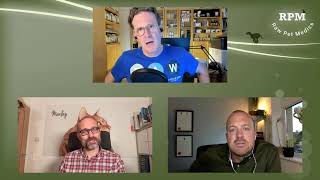
In this live‑stream, Dr. Conor Brady hosts a relaxed, conversational interview with veterinary practitioner Dr. Nick Thompson (joined by Brendan) that traces Nick’s personal background, professional evolution, and current work in raw feeding and holistic veterinary care. Nick explains how his parents’ medical and homeopathic influences shaped his “head‑and‑heart” philosophy, leading him to reject conventional veterinary practice in favor of alternative approaches such as homeopathy and species‑appropriate raw diets. He recounts his early career in Yorkshire pig practice, his shift to raw feeding after reading Ian Billingham’s “The Bath Diet,” and his subsequent involvement with raw‑food companies, speaking engagements, and tele‑medicine nutrition consults. The discussion also covers his collaboration with his wife Ellie on the DermaDog line of essential‑oil‑based pet products, the growth of the Raw Feeding Veterinary Society (including an upcoming conference in Barcelona), and his use of podcasts, Patreon, and social media to disseminate information. Nick shares his future vision – more webinars, teaching, research advocacy, and possibly a book – while acknowledging challenges such as travel sustainability and occasional hostile audience questions. The tone is informal, enthusiastic, and self‑deprecating, with a clear focus on promoting raw feeding as the optimal diet for canine health.
Chapters
You were live. Dr. Nick, and therefore he's there.
Unknown parts. Yes, yes. Um, yeah, good evening everybody, welcome to Raw Pet Medics. Uh, we're going to be talking about me, which is fascinating, I'm sure. I'm sure everybody's, um, absolutely delighted with that. Um, I can only see me on the screen, which is slightly disconcerting because, uh, when I can't see you two guys, I just worry a bit like 3-year-olds If I can't see you, I don't know what you're up to, so I'm not quite sure. Lovely to see Bianca and Fiona, and hello Gemma. And there's Bren, very good. Now that I can see you, I feel a lot more comfortable.
I don't know what we were saying about him.
That's a very nice professional picture of you there, Nick, sitting in the chair with the dog. When did you take that? Is that a new promo shoot you did?
Yeah, I did a little shoot in London. Oh yeah. 3, 4 years ago. I know it didn't really come out very well because the photo is good and what have you. But look at the expression. I was trying to get this dog to do something and the photographer clicked every time I was going, yeah, yeah, like this.
Yeah.
And so the first thing I thought when I saw that picture, one, well, somebody said it on the Facebook thing, that's not his dog.
Before we had our dog, actually.
The second thing I said to my lovely wife, Chris, who chose that photo of you, Nick, was, do you know, that's exactly how he dances.
But anyway, yeah, that's a little bit later on in the evening. I'm quite smooth and graceful earlier, my friend.
Photographers, they like an odd picture. They like an odd expression. Like, but I did have to do something to get a few photographs to the website, and I'm looking at the photographs going, dear God, I look really tired because I, you know, I got the two young kids at home. It's like, I look 42, which is the age I am. And he goes, well, that's what you look like. And I said, well, you're gonna have to do something about that because I look like I just woke up. And then the pictures he picks out, I'm like, oh, and he goes, oh, wonderful expression in that one. I said, don't pick that one, like, pick a normal one. He goes, that's what invites people in, a normal photograph.
I said, I don't—
I'm not looking for normal, I'm looking for airbrushed. Perfection. And he goes, I don't think that's the message you're trying to push out. So I had all these expressionful pictures on my website that I wouldn't be totally happy with either. So I feel your pain, Nick. That's photographers, maybe they see something we don't.
Does it look like a nurse has approached you with a rubber glove from behind? Is that what you're saying? It does.
I've just sat on something rather uncomfortable in that chair. The dog was great though. The dog was playing to cue the whole time, but I was struggling to try and get it right.
The colors are nice and stuff. Listen guys, we are on patreon.com/rawpetmedics. That's where you can find us, and we really appreciate anybody that is there helping us out. Price of a cup of tea or coffee or even a pint every month would be fantastic. It helps us keep things going on this side of the fence, and it is most appreciated if you can. If you can't, no problem. Times are hard, about to get a bit harder coming into winter, as all the talk is at the moment. So we totally understand. So we do appreciate anything you can do, and no problem if you can't. But Raw Pet Medics on patreon.com is where you'll find us.
And so yeah, I'd like to share something amazing. And we have just between us, literally about 2 minutes ago, worked out that we are available as a podcast on Audible, Apple, Acast, Spotify, and most of the common podcast providers. So if you like what you're hearing, you can, you can hear. We've got 71 on YouTube. I just looked today, we've got 71 Hits on YouTube.
No way!
Majority of those are going to be podcastable, and you'll be able to use those when you go take the dog for a walk if you fancy us in your ears.
Yes, when you take the dog for a walk.
So be careful, be careful what you—
that's cool. I like that idea. I like that we're on Spotify as well. I mean, that's, that's pretty cool. So, uh, well done.
It's frightening that we could be coming on the walk with you. That's the downside.
Yeah, yeah, yeah, absolutely. So what are we talking about tonight? Anything interesting?
No, not really.
Yeah, I don't know. I mean, there was this, there was this guy who kept posting pictures of, um, just so it's, just, just so it's, it's large enough. And, um, Conor, you can— we're just hidden picture-wise, but just so that this is him.
Explain, guys. Good picture. So she— so I've just read a text from somebody. Um, so I was, I was 55, I hasten to add, 55. on Friday, Friday the 9th, 9th of the 9th, that's my birthday. And, um, and Ellie, to my great surprise, got me this fantastic, uh, number plate. It's NT Go Raw. I read it as 60 Raw and thought, oh, she's 5 years out. How out? My wife is 5 years out. And, uh, but actually, what if we can, if it's legal, we're going to put a little rivet just on this, on the beginning of the the loop of the 6 to make it look like a G. So it says NT Go Raw. So I hope you like that. I love it. I've always thought—
Not that I'm into advising about illegal things with people in the better side of the law within the family, but you can't put a rivet in the wrong place. But what you might do is one of your children may accidentally stick a little play sticker on your number plate.
Yeah.
By accident, that you knew nothing about, that could be peeled off.
Yes, I think a bird poo. You could hold a budgie and squeeze them, get bird poo on it. That'd be perfect.
Don't believe this at home, folks.
Yeah, so Nick, you're 55 now, so do you want to just kick us off about a little bit about yourself? Because, you know, you've been kind of one of the longest heads doing this really, certainly in the UK. Certainly that I know of, you were the very first person I ever saw talking about this. Do you want to start? Where do you want to start? Do you want to start? Where do you start?
I'll tell you what, let's start at the beginning because I've been— I haven't scripted this in the slightest, but I have just been thinking about where are my influences. And I think one of the biggest— do you like my t-shirt, by the way?
Very cool.
Yeah. Hopefully it says raw in your screen, not wall.
Yeah, that would be unfortunate.
Not the most appropriate.
Anyway. So I've just been thinking about it, and I think it comes from my parents. My dad was a doctor, my mum was a nurse, and so both were very compassionate and very, you know, with it, medically literate. But I think my mum came from a very compassionate point of view, and she was very interested in homeopathy and essential oils and personal development and, you know, that all that kind of deep kind of spiritual psychological stuff. And my dad, he did— he's a— my mother, by the way, was 7th of 12 from a family in Galway. And my father was raised as a, you know, in a kind of conservative Methodist Sunderland, you know, just very traditional way. He's a grammar school boy. But he did physiology at Leeds and then he got a scholarship to do medicine at Magdalen. So, you know, quite a bright boy. And he came from a much more kind of intellectual space. But they met in the middle, you know, both thinking about medicine and how the body works and how can we make the body work best. But one was kind of very slightly more touchy-feely and, you know, about simpatico. And the other was much more from a from a kind of intellectual perspective. And I think I'm kind of smack bang in the middle of that. So I feel that that is where I got— that's one of the major reasons that I'm here today doing what I'm doing, that I'm not doing the intellectual, I'm not a conventional vet doing whatever it might be. I'm not working in a university doing whatever they do there, which we all know about. But, you know, and I'm not a spiritual healer or Reiki master, although great respect and kudos to people who are. So I'm kind of sitting somewhere between. And so on reflection, I think that that's, um, there's a lot going there. And the other thing, so that one of the guiding principles is that, is that use your head, use your heart, come together. And we all— I grew up with animals, rode horses as, as a kid in a really bad way and hated it, uh, and we had dogs and we had cats and we had rabbits and we had hamsters and, you know, all the whole, whole nine yards. And the other thing was, it was very much— it was— grew up, and as we all do, but I think I really took this to heart, was to do the right thing no matter what. Do the right thing. So when I— so if we jump forward, and I'm not going to be talking for 45 minutes, guys, I promise. I'm going to let you get away. Uh, when, when I was— I qualified in '92 from, from Edinburgh, and, uh, within a year I was very interested in homeopathy because I just thought, oh my God, there's so many cases that just keep on coming back and I just can't, you know, I can't cure them. What can I do? There's much more to this than meets the eye, and I think we've discussed that before, but, um, Then when I discovered raw food, within a few years of really settling into that idea and developing my ideas in homeopathy and in natural medicine, um, I, I just thought raw food really is where it's at. And, and therefore I would feel bad if I didn't let as many people know as I could because it's obvious. It's stunningly obvious that feeding a species-appropriate diet is the key way to fundamental health. You know, if, if you feed a really bad diet— a really good diet, but you over-vaccinate and you use too many chemicals and, you know, the dog is really, really stressed, then you're not going to make— you know, you're not going to be super, super healthy. But if you've got the diet in some kind of good shape and you're giving plenty of variety, then that is the foundation for really taking off from the food point of view. So there you go. Those, for me, after a week's thought, is these are the two influences: do the right thing no matter what, and this kind of head and heart approach to medicine. There you go. That's it. We can go to the pub now.
And so just asking, so where did you start out? Was this right? Is this where you first started? Did you start a little bit further upfield?
Yeah, no, it's really, really good. And Lizzie— not Lizzie— Christina Deron, who was one of my— can you see Christina Deron? She's 20 down there. It's a big, big paragraph. Thank you, Chrissy, that's really fantastic. So she was a client and she was one of some of my first visualists, and then she moved to Canada and she's been, she's been a fan and supporting the Facebook group and sending visual clients to me ever since. So thank you very much, a million thanks, Chrissy, to you. So, so I started in Yorkshire in— let's have a look— I started in Yorkshire in 1992. And it was in a pig practice because it was the only, only place I could find. But actually, I learned a lot about preventative medicine because the thing is, you don't want to spend money making pigs better. You want to try and keep— get them better and keep them better, getting the diet right, getting the housing right, getting the stress levels right and everything else. So actually, that was really formative with, with, with, with, with health. What's health about? It's about getting it right, keeping it right, as opposed to fixing it. So started in Yorkshire, there in, in just near Bridlington. And then after 18 months there, I moved to Helmsley. They call it Helmsley, but it's Helmsley if you're a soft southerner. And that's in the Dales, Yorkshire Dales. So the next 18 months I spent bombing about in the Yorkshire Dales in this little Subaru Justy, little 4-wheel drive thing, up and down the Dales. I was going up, up, up the Dales, so high up the Dales, you know. We would do a TB test once a year, those— in those days, I think. And I would be the only vet they would see from one year to the next because they just got on with it themselves. And I learned stories about putting cobwebs on the— when you dehorn cattle, you put cobwebs on the horn in order to promote clotting and other wonderful things. And they would, they would serve you sandwiches cut up like, like you were the Queen, you know, bless her, by the way. And, and it was absolutely lovely. It was, it was very, very much James Herriot stuff. But during those, those formative 3 years, yeah, 18 months and 18 months, I came to the conclusion because I did the Landmark Forum, which I'd love to talk to you about in a second. I did the Landmark Forum and I thought, do I want to be a conventional vet who has an interest in alternative medicine, or do I want to be a real alternative practitioner who is gunning for health and vitality with a minimum of conventional intervention. And guess what? Being the extremist that I am, I thought, I can't do— I can't do the compromise thing. So the phrase that I always say to people is that I came to the conclusion in those practices that I didn't feel comfortable. Oh no, that was a bit later when I did go to Mark Elliott's place. So Yorkshire, I came to the conclusion I wanted to be an alternative practitioner. So I moved into the practice with Mark Elliott in Chichester. God bless him, he's an amazing practitioner. We fell out after about 4 years, but we made up very quickly and we're good, good buddies now. So all is well in that, in that department. I only spoke to him a couple of days ago, actually. So there you go. So 3 years in Yorkshire, and I decided that I wanted to be an alternative practitioner. I'd started my homeopathic training at that stage, and when within the homeopathic homeopathy, I learned the phrase of, um, remove obstacles to cure. And that's— that was my lead into food. I'll shut up for a second.
That's cool. I love that. Now, remove obstacles to cure, like, uh, give us a couple of examples of that.
Give me—
give me an example of what you're talking about.
Well, if you— if you—
if you—
if you're treating, uh, and this is what we used to do back in the— in the '90s, we would treat with homeopathy and send them home on kibble. There's an obstacle to cure. Kibble is an obstacle to cure.
Yeah.
Or over-vaccination. We, we knew about, about over— I'm not saying don't vaccinate, guys. I think it's a necessary evil in some situations. But I'm saying, uh, over-vaccination, which is what we were all doing in the '90s, um, that's an obvious obstacle to cure. I was vaccine, uh, critical even in those days. Okay, I learned it through homeopathy, through, through, uh, being taught by Mark Elliott, being taught at the Royal London Homeopathic Hospital, uh, next to St. Ormond Street in London. Did our training, some training there. And this is— that's, that's what they were talking about, you know, remove obstacles to cure, seek that which needs to be cured. Also to treat the, treat the per— treat the patient, not the disease. These were the philosophies that we were being taught. And so I've been marinating in those concepts for 30 years. I'm a vet 30 years this year. Yeah, qualified in '92, and now it's 2022. I can't believe it. I've been a vet longer than I've not been a vet. Yeah, which is That's mad. It is remarkable. Yeah, but yeah, really remarkable.
And you realize you're getting old when the weeks start flying by, and before you know it, the end of the year is coming. Christmas is on the way. It's only 3 months off.
It's like, yeah, it's true.
And another year's gone, and your wife thinks you're 60.
Yeah.
When did you, uh, when did you realize the whole Raw thing? When did you first come out of the covers, uh, break cover and, um, start kind of speaking? Because you've been out the front for as long as I've known Raw, which, you know, is nowhere early as you. But so, like, when did you first break cover and say, I need to start speaking about this? This is, this is crazy.
Yeah. Um, well, uh, Brendan and I have got a really good mate, uh, um, uh, who is called Pete, who is— who was the chairman of the British Association of Homeopathic Veterinary Surgeons. And he came back from Australia— he was, he was teaching homeopathy in Australia— and he came back with this little white book. In fact, I should have got a copy just over there, by this, by this funny bloke called Dr. Ian Billingham. And it was called The Bath Diet. And another one was called Feed Your Dog Bones and Grow— Give Your Dog a Bone. Okay, so he came back with these books, and I thought, ah, it's not very well produced. Oh, publication.
Exactly.
But I did read it, and it's quite well written. It's written in a very kind of simple and attractive way. So God bless Ian Billingham for making it not officious and sciencey and difficult to read. So he's done a wonderful job. And I mean, look, that's why we're here, because of Ian Billingham. Let's face it. Anyway, he wrote this book and I read it. And initially I just thought, yeah, but there's kibble and it's really convenient and it's scientifically formulated. And that's what we were taught at college. And therefore kibble, you know, but very, very, very, very quickly. And I think it was a road to Damascus thing. I think, and this is maybe just I'm making it up because I've been through it so many times, but I think very quickly within, you know, in my mind it was an overnight thing. It was like, oh yeah, of course, yeah, yeah, in my mind because I'm a genius, obviously. It's that, but I think it was probably over a couple of weeks. I just thought, yes, absolutely right. Again, going back to my folks, We never ate out. We never ate processed food.
We—
mum would cook every day, every night. And so processed food was, was, was completely foreign to me. And therefore, all these little pieces came together. Elimination of obstacles to cure, healthy food. She was a health freak. I've told these stories on the pet longevity thingy. If you want to laugh, have a look at that. Yeah, I was being given vitamins and minerals and supplements as a kid in the '70s. And so it all came together in the kind of the mid-'90s. And when, when did I start speaking about it? Probably '98, '99. Definitely by 2000, because by 2000, I was working with Craig Taylor at Anglian Meat Products, who was the precursor for their now Nature's Menu. And so we would— we were working together, we were kind of formulating and lecturing. So that— there you go, that's actually— now I think of it, that was probably when I first started. He came along and said, listen, I know you're into raw. So I must have said something about raw somewhere along the line, but he got on to that and he said, we need somebody to lecture on raw and talk to people about raw. And so we kicked off that in about 2001. Craig, you're probably not watching, you've probably got better things to do, but it's about then that we started. And what they did is John Bowen— you know John Bowen, the, uh, the behaviorist— he and I both went along and were supporting Craig in feeding species-appropriate food. And so somehow, I think we were both— he put us both on the, on the back saying, these two veterinary surgeons strongly recommend feeding raw food. And so my mug was on the back of a million packs of this food, which is my claim to fame perhaps. But it's really funny because I finished with a girlfriend around that time and she used to take great delight in every afternoon when she fed the dog in slicing through my face.
Stabbing at it. Yeah.
And little did you know that tonight we have Join us live.
This is her life.
Yeah, we wouldn't do that to you, Nick. Wouldn't do that to you. Yeah, we used to chuckle because we used to be selling the stuff from, uh, Angus Meats.
Angus Meats, yeah.
With Nick's face on the back of it.
I remember that.
I remember that. There used to be constant comments about Yeah, I wonder whether he gets away with that. How long before he gets dragged in front of the Royal College?
Anyway, so far so good.
Yeah, so they were one of the first companies to be doing this because I don't remember that they were pretty much the only show in town. That was pretty brave for them to be sticking their neck out and investing, uh, um, so much cash into that setup, uh, and to be plugging along kind of on their own. There was really 1, 2, and 3 companies there for a good 10 years. And so that was interesting. What was the worst— could you tell me the worst experience you had up on stage talking about raw dog food?
The worst experience on stage was with Brenton.
We went—
yeah, I've had no bad experiences. I've had no bad experiences, okay? Literally, I've spoken to students, I've spoken to vets, I've spoken to— I've spoken to small groups, I've spoken to farmers, I've spoken to the Hunt and Shoot Brigade, you name it, okay? Uh, Clarkie comes along and it all goes to you know what, okay? I'm not gonna actually blame him because he actually saved me. It's just I somehow got onto a slightly the wrong tack with them, and then they were, they were winding me up with their— with these questions saying, well, how can you possibly think raw food is a good thing if you believe in homeopathy? And kind of inane and slightly stupid questions like that.
Yeah.
And they just wound me up. I don't think we'd eaten that afternoon because remember they had pizza after the event.
Oh, if that was hangryness, I don't know what is.
I mean, from a point of view, I just got slightly pissed off. Okay. And slightly arsey with them. And then I had to— and then I finished my thing, I sat down, and then Brendan came along and saved the show. So Brendan, thank you for that.
How do you say it?
Ever since, ever since, he's never worked with me ever again.
I've never worked with him until now when I work with him every week. We've got Brady as the referee, as the person in the middle.
And so why— what did— would Brendan come along? Was he a slightly more calming influence? With, or like, was his message?
No, not really. I generally get on really well. It was just that, I don't know, it was just kind of slightly the wrong crowd. And they, they were— I mean, this is when, 2008, 2009 or so? It's quite early, something like that, possibly. And they were all, you know, able to text. They had a running Twitter feed or something. And so they were kind of feeding in. Yeah. To one of— maybe one of the guys who was asking all these questions, and it was just kind of really a bit silly and a bit stupid. And I just— and I think I just said to them, you know, this is— it's a silly question, let's concentrate on the food. It was— it was that thing. They were trying to— they were having a go at homeopathy, but we weren't there to talk about homeopathy, we were there to talk about food. Yeah, yeah. And so there you go. So that's the worst. It was what I was on my feet for probably 20 minutes, and that's in my entire career of about 25 years of raw food. So, so I think it's pretty good.
Yeah. Yeah.
Until, until tonight.
And I suppose we just plummeted.
Yeah.
Plummeted your practice. No, I mean, honestly. So I'm more interested if we go back a little bit, because obviously that's where you started to interact with companies. You were getting deals from them to go and speak for them and doing various bits, which I was always, you know, that's a really good sort of extra business, good gig, almost outside of the standard. So how did you sort of develop really into that other than, you know, because you were in practice with Mark. And then you left Mark's practice, and I think you were doing a bit of your own stuff, but you were using other practices. Is that right? I think you were doing one in London, one in Bristol area. Tell us a bit more about that stage.
Oh, Brandon, you've done your homework. Yes. So I finished with Mark and moved to Petersfield and set up in Petersfield and was working in Salisbury at Howard Taylor's practice. I was working in London. I was working in London there at the Hyde Park Veterinary Centre. I was working in Purton at the Purton Veterinary Centre with Vicky Gower, and also in Bristol for Vale Vets. They were in, in, in Filton with Vale Vets. Andrew Prentice in London. And how did I get the speaking gigs. I'm not sure, because vets don't usually— until you're a specialist, or, you know, at least a diplomat— you tend not to stand on your two hind feet and talk about stuff because you think, oh well, everybody else knows about this stuff. But what happened was Mark and I used to do talks because he had quite a big haul of a practice. And so what he used to do is he would invite 30, 40 clients in and talk about homeopathy. Um, and so he did one of those, and inevitably he asked me as senior assistant to do the same. And so that was my first, and I found that I quite enjoyed it because as a kid I used to have to talk in church, you know, do a reading in church, and that was my worst night. I hated I would have my fingers, fingernails pulled out. I was really shy as a child, and actually I think I still am to a certain extent, but I realized that when you're talking about something you really enjoy and hopefully you know more about it than most people in the room, it's really empowering and it's really, it's a really wonderful place to be. And so I really enjoyed that feeling of just teaching one or two people with one or two things and getting some lovely feedback and, you know, and then having to research it for the next one and then research it for the next one. That's a virtuous cycle, isn't it? You know, it's just the more you do, the better it gets.
And so did you find it was almost like consulting but to a larger audience? Was that how you sort of addressed it?
That's a really good point, actually, Brent. Consulting is acting, okay? Whichever way you look at it, it's acting to a certain extent. The person in the consulting room is slightly different to the person who you'll meet, you know, for a coffee on a Saturday morning. Slightly different. And I guess it was an extension of that. And also it's kind of getting used to people listening to you and actually believing you and taking what you say and running with it. Getting, you know, because in normal life you don't really convince many people of many things on a regular basis. And so there's a different psychology. You know, you're a teacher, you become a teacher when you're a practitioner, you're teaching one-to-one. But when you start talking to people, to halls of people, then you start to open to more. And I think once you've done a few, you— people, people are always looking for people to entertain their farm group, their breed group, their dog group, their what have you. And so it kind of goes from, from, from one to the next. And that's to a certain extent why this is so good, because actually we're talking to lots and lots of people, um, and therefore we don't have to get in the car. Because in the old days, you know, once a week, twice a week, I get in the car, drive 50 miles, 100 miles do a talk for an hour or two, get back in the car and drive home, you know. And that's really draining. Yeah, really, really draining. You know, it's got to— you've got to do what you've got to do. But— and I did it because I loved it and still would probably do it again now. But, um, uh, this is good. I really like this because it's, it's relaxing. We're doing it with you guys. I think what we should do is, is I think 3 of us should get on stage together for a day and do this, you know, and we will, you know, somebody does 20-minute presentation or a half-hour presentation, and then we just have a little bit of banter, a little bit of back and forth.
I think that would just be really fun for a whole day, Monty Python style, big show. Exactly.
Have dinner the night before with, with, you know, our Patreon brigade and then maybe dinner the night after with everybody and we can all talk about raw and what we're doing and where we're going. You know, the last 2 years have been a very— that all that separation. Yeah, it's been very, very detrimental to us, I think. And so I think getting together and this is what we're trying to do within the Raw Feeding Veterinary Society. If anybody wants to join or help with the Raw Feeding Veterinary Society, if you're a vet, please come along, join us. We're, we're trying to re-energize the Raw Feeding Veterinary Society. Yeah, so, yeah, Chrissy, you're right. Okay, Catherine O'Driscoll, she got me to do some talks actually, Canine Health Concern, back in the day. Yes, yeah, it's very good having, uh, uh, it's very good having people giving you prompts because some of these people know me. So luckily nothing embarrassing has come up. That's quite good.
Rachel Meadows. Rachel Meadows.
I love that. Yeah, yeah, I saw it too, Conor. I say, really?
Yeah, there's no— but there's no— there's no natural vets in Ireland. We have, you know, one in, uh, in Portmarnock, Emily McAteer. You couldn't get near her for love nor money. And, uh, she has a second vet there but probably wouldn't be quite into the same, um, kind of lane. But, um, even then, you know, I have a list of natural vets in Ireland, but all I do to annoy them is that anytime I hear a vet even half entertaining the idea that a pet is fed fresh food, I put them on my natural vet list and the stuff gets off. And vets ringing me going, get me off that list, I'm not a natural vet. Oh, it's so funny. Look, it makes me happy to do it. I hear what you're saying, like, I hear what you're saying about turning up to small events. Like, sometimes you could be, you could be going like a distance and there might be a really, really tiny turnout and like you're gonna do it anyway, you're happy to do it, you're just happy that anybody wants to turn up. But it definitely is easier and more of a buzz when it's a bigger kind of crowd. And once you get up there and you start chatting, it is a buzz. It definitely is. You can see why people love doing it. You can see why bands love doing it. You can see what— because it is great, particularly if it's going well. There's nothing like it. But yeah, sometimes it can be a little bit tricky.
But yeah, so the feedback is the feedback that bands do it because they play a tune and they get applause. We do it because we talk and we get some wonderful feedback and questions. And it's not just, yeah, that was great, thank you very much. Although that's very nice, thank you. But it's, that's really interesting, tell me about this. And then you know that they're really listening. Or I've heard you talk on this before, can you please tell us a bit more about this? So that's good. It looks like, guys, I'm just looking at the comments here. I'm just looking at the time as well, it's 19:36. I won't tell the joke again. It looks like we should, and I think we could, we could do an English, Irish, Scottish, and Welsh meeting, a day's meeting. And I reckon, no, all of them.
As in one day in one and one day in another?
Yeah.
You'd be absolutely wrecked by the third one.
Karen's already said, 'That'll clear the pubs too.' Natural, natural.
The pubs would naturally clear because they'll all be coming to see us, obviously. That's what she's trying to say, Karen Reid.
Yeah, well, nothing else.
So what are you doing these days, Nick? I mean, you've been a kind of a solo artist for a while, and so what do you do these days? What are your— give me 3 or 4 kind of avenues today.
What am I doing these days? Okay, well, I can tell you what I should be doing. I should be doing more of my little vids, my 10-minute slots. I should be doing more of those, that's for sure. I'm trying to use social media. I'm very bad at it. Conor, you're very good at this. No, apparently. And we've got this thing called social media, which I despise, but It's a way of getting a worthwhile, the right message. Yeah. Do the right thing. Getting the message out to hundreds of thousands, if not millions of people. And so I think I'm a fool not to. I shy away from it because social media, you know, it's all that, all the Facebook and what's his name who runs Facebook? Zuckerberg. And, you know, and Bill Gates and all that kind of stuff. And these, this really puts me off. We're probably going to get this closed down because of that. But, um, yeah, that puts me off. But it's just a medium, isn't it? You know, I may not like polluting the environment because I drive a car, but it gets you from A to B so that you go and do a lecture. So sometimes I think the means justifies the ends, and perhaps that's kind of where I'm coming to within social media. So I'm just kind of looking into how do I do that as painlessly as possible. Um, doing this, got some talks lined up We're— I'm going to— we're going to, well, Barcelona. We've got Barcelona. We're all three of us going to Barcelona. Yeah, next week.
You still see clients? You still do consults? You still—
I am seeing clients. I, I'm doing a lot of telemedicine these days. I'm doing a lot of, uh, nutrition work through telemedicine, seeing people with, with sick dogs, mainly, uh, skin and gut problems, but also a lot of healthy dogs where people are saying, I've just started on raw, am I doing it right? Or I've been feeding for a while, can you just do an MOT on my diet? And I find those really, really great because if people have committed to raw food, it's lovely to just kind of take them to the next level. So that's a really, really great thing. Uh, the two videos that I've done, they're available on the website holisticvet.co.uk. Co.uk, by the way. If anybody is interested, jump into those. One's called Raw Feeding: The Basics, the other one is called Bones and How to Feed Them.
Yeah, Raw Feeding: The Basics is fantastic. It is really good for people starting off. It is really good for people who have clients because your staff gets sucked in to doing half an hour talking to somebody. My vet said the raw food's going to kill my dog, and your staff member is there for half an hour speaking to this person that can barely hear any words the person's saying. And that's expensive and it's hard, it's very hard for pet shops to get the right message out sometimes. So I think those sort of courses can be really handy for people, low barrier to entry. I think it's a good thing. What about those, what about DermaDog? You're doing a lot of doing stuff for DermaDog and whatnot.
Well, my wife runs DermaDog, so I haven't really got any choice, to be honest.
Yeah, I have to do it.
Can you see this is, this is, this is DermaDog just here, and if you look along here Listen to her, my dog, just over there. Okay, yeah. So basically, these are products she's developed. She's using organic essential oils, and she's developed them. She occasionally, she'll ask me, what do you think about this? What do you think about this? So officially, it's veterinary. I helped with the formulation. And the funny thing is, when in the early days, we would use the soaps on the children And so we could, we could, I'm not sure we're able to, but what we could do is we could say, uh, tested on children, used on dogs. We could, we could say that, which I think would be a great strapline, but I think we'd probably get, get done by the SPCA. Yeah, yeah, yeah. So, but, but that's it. So that's Ellie, she's doing soaps for dogs. She's also, she's now doing the pinch pots, which are kind of herb blends, which are really, really nice. If people want to have a look at those, definitely jump into those. It's dermadog.com, uh, if you want to have a look. I would imagine there are quite a number of people who are using them, um, uh, and so if anybody's used, um, DermaDog, do, do, do give a shout. Um, doing a bit of work with Karen— she's doing all the work, in fact— and, uh, with her lovely, lovely Newton. So I'm very honored to be chosen as the guy to do all the work there. So thank you, Karen.
Yeah, Karen speaks very highly of you in that regard because, you know, Newton's got all these issues and she said that you are a game changer for a lot of those issues. There you go.
Well, she's doing a lot of work. I'm, you know, we have a chat every now and again. She does all the work and You know, so it's great. Yeah, she's a good lass and we'll see her in Barcelona as well. Guys, just to say, just in our last 3 minutes, the conference, the Raw Feeding Veterinary Society, rfvs.info, if you're interested in it, and you should be interested in it because they're a fantastic bunch, they're doing this, the conference. If you can't make it to Barcelona and if you can't make it to Barcelona in 7 days' notice, Shame on you for over-prioritizing other elements of your life. But if you can't make it to Barcelona, I totally understand that. You can get it online and you can have it for yourself and go through the lectures yourself in your own time. So please do come along. There's still some tickets left for that, for the online version. So please, you're very welcome to come along to that.
You're doing a talk about that, Nick?
Yeah, I am doing a talk. I'm going to talk, which is based on some of the stuff that we've been talking about and some of the experience we've had with Karen and Newton about renal disease, because it's a big topic. And one of the big reasons that kidney disease is such a big one is that raw-fed dogs, as soon as they get even the slightest diagnosis of kidney disease, the vet will immediately go, oh, that's it, you've had your fun, now you've got to feed some proper food. Here's a renal diet. Okay, and they'll give some kibble— kibble for a renal dog— dry, or some tins, some tins too. So, so I think it's a really— uh, because the, the conference is called, um, uh, what's it called? How do you know the food you're feeding is safe? The word's perfect. What's the safety of raw food? So, so Bren is going to be talking about RawSafe and other amazing things. And I think that, that raw food can utterly be safe, if not safer, in more extreme cases like pancreatitis and kidney disease and liver disease and heart disease and what have you, because you can, you know, you've got real nutrients going in for a start. The time that you need proper food is when you're sick. Yeah. You know, all the stories about people going into hospital and they've just been fed terrible food and they feel terrible. They come home, they eat some good food and they immediately feel better. So I think it's really important that we feed, we feed, we feed the best food. And, you know, we'd all agree that raw food really is the best food in any circumstance.
So what are you going to be— what are you going to be doing in the last minute? What are you going to be doing in 5 years? Where do you want to be in 5 years? Where do you want the Nick Thompson brand to be in 5 years? What do you see?
I would like to be doing more, uh, more teaching. Um, I'd love to say I'd love to be jetting around the world, but I just, I just don't think from a regenerative perspective you can justify that. You know, maybe the odd one and we can offset it somehow, but you know, we've got this Zoom webinar technology, so I'm, I'm thinking that's that's where it's going to be. It's going to be, you know, 3 days a week maybe doing webinars, teaching, writing, maybe, you know, working with, with you guys, working with other partners in different countries around the world to just get the message out, just to broadcast the message as widely and as loudly as possible, but also really looking forward to all the research that's going to come through. Um, you know, if we think about 10 years ago, there's, there's oodles of research now, um, that we didn't have 10 years ago. So I think even in 5 years' time, because everyone's going to get— everyone is excited about this, and I think more and more and more research is going to, is going to pour out, and more and more studies showing that raw feeding is safe And so I think the future really is very, very bright.
Yeah, it's enormously difficult. Sorry, Brian. Go on.
Yeah.
No, no.
And are you writing a book? Come on, people want to know. Have you got a book coming out?
Did somebody actually say that?
Knock somebody off his top spot.
I think somebody off his top spot.
You know what? I started one about 3 years ago, but I just found the the, the, the— it was so daunting. I'm such a perfectionist, as like, like Conor. Yeah, I'm such a perfectionist. I would find it horrifying to, to, to be meticulous with every line of 80 or 1,000 or 100,000 words. I, I'd find that really daunting. So what I've done is I've taken that idea of trying to get the message out and trying to use webinars and, and, and this and back in the day we had George Orwell on Raw Raw and things like that. So kind of, it's, it's— I'm wanting to, to broadcast information, but I don't think that writing is, is for me. So you're safe on your top spot there for a while, Brady.
I'm never going to do it again, but I do know of, um, some people that are in the field of writing books now, and they are at it again. And it's like, you know, if it's a huge thing to go back to it, it's like it's just a It's a hard gig, depending on what way you're structured, I suppose, what sort of message book you want to put out. But I already know the sort of book you're going to put out, which is going to be factual and tight. And those books, I imagine, are— they're just difficult. They're certainly difficult for me. And yeah, but I came across, although I'll be too late, how important proofreaders are and editors and all the other words that sound the same but they all do different things. Things like even Reedsy online and these sort of groups online that you can find these people that are into animals and they've proofread all these really top science books. Like, bloody hell, you did that! And so you can get them to help you along, and they really are helpful. I discovered that way too late, only in the last year, 350 days I had with them. But, but, um, before that, I was just trying to get your— like, you know, say, here's a chapter, Nick, here's a chapter, Brent. It's so hard for you guys to sit down and read 50 pages of a chapter with a red pen. I mean, it's not easy for anyone to do, so But you can get professionals to help you now online and you can get them really into your field. So I regret not using them for the whole process and trying to do it myself. So that might make it easier. You should do it, Nick. You should do it. You should get your thoughts down.
Yeah, I'll have to look at how, what the type of book. Yeah, let's see. Let's see. But you're safe.
Let's not stress the guy. We've talked a lot. And for those of you who want to hear just a few moments more, why don't you join us over on a bit on the side over on Patreon? That's Nick coined that phrase. So I'm going to give it to him.
No, I didn't actually.
So it's bots. Yeah. If you want to see RPM bots, not those sort of bots. Okay.
Over on the side.
Patreon. Join us over on Patreon just for a few minutes more. It's been great to see you guys. Don't forget, you can catch up with us on all of your live stream podcast companies from Amazon all the way through to Apple. So please do pick us up on those. If you like what we do, be sure to share us. That would be great.
Yeah, sharing is caring, guys. Wonderful. All the best. Thank you very much.
Love it, Nick.
Yeah, brilliant.
Jane Eastwood is saying, how to look so young. There you go, Nick, you're on fire.
Uh, that's very kind of you, Jane. Your check is in the post.
Yeah, um, yeah, that was a pleasure. Thanks very much for that, Nick. That was cool.
Loved it.










