RPM Feline Fridays Anxiety A Cats Eye View
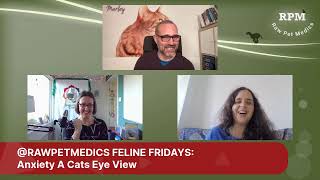
In this live panel hosted by Brendan (Speaker A) with guests Julianne and Amaya, the group explores feline anxiety, especially as it spikes during the Christmas season. They begin by noting how holiday decorations, trees, visitors and altered routines can unsettle cats, and discuss practical environmental strategies such as gradual tree introduction, upside‑down trees, cardboard forts, and creating hide‑aways. The conversation then moves to holistic interventions: herb gardens (valerian, chamomile, rose, calendula), zoopharmacognosy and self‑selection of dried herbs, essential oils, flower essences, and homeopathic remedies. Nutritional approaches are covered, including bone broth, raw meat, tripe, tryptophan, probiotics, spirulina, vitamin B complexes, and the cautious use of CBD oil. They also address behavioural management with ground rules for visitors and children, the importance of communication with household members, and the role of pheromones (Feliway, FeliFriends) and calming sprays. Throughout, the hosts stress a personalized, multi‑modal plan, encourage owners to observe their cats’ preferences, and promote seeking professional help when needed. The session ends with a plug for the upcoming Holistic Cat Conference and a reminder that anxiety is a year‑round issue.
Chapters
It's always the best way to start one of these. Whatever floats your boat.
Talking about dress-up.
Yeah, we've gone from red bedrooms to dark lights to dress-up.
The darker side of Beeline RPM.
Anybody would think this is a nighttime show, though we're missing the wine.
Ah, yes, sadly so. Oh my God.
Oh, I hope you're going to join us for the Christmas party on the 20th.
Is that like, is that an online thing?
Yeah, that's the RPM thing, Tuesday Night Lives.
Oh yeah, of course. Nice.
I didn't know the Christmas either.
It takes me a minute.
Oh Maya, you can't start saying I don't know.
I don't know.
Not into those festivities. Good. Shocking.
I barely follow the real ones.
Oh my gosh. See what I'm doing with people? Hi, Heidi.
Oh yeah, hi. Yeah, so this week we're going to be— this month we're going to be talking about anxiety. So we're going to do it from a cat's-eye view. And I think actually, talking of Christmas, it's really, really appropriate because one of those big changes in many, many households not Amaya's, obviously, is going to be what we do to dress up for Christmas, all of the house trimmings that you've got there. Now, steady, I know what you're thinking, Julianne. I know what you mean. You just can't change yourself, can you? But yeah, just from a point of view of, you know, we bring in this really pungent tree into the household, okay, and expect that our cats are just going to be super cool about the whole thing of Christmas because it's just full of joy and festivities. And actually, we've got to think about that a little bit. And I think it's really good that we maybe just go through some of those things today and deal with anxiety generally. So Julianne, you know, talking about anxiety and feline anxiety, What would you generally share with clients that are dealing with cats anxiety? Are there any books? Are there any— do you have any shortcuts? Or do you have your own little sort of section on your website? What do you do generally as your starter for one?
Wow.
That's the biggest question ever, Brendan.
No, just the meaning of life.
Brilliant. 42. How do you deal with anxiety? Give us one thing. Um, so I think like you said, you know, having, um, you must have a go-to text.
You must have something that you read and thought, oh yeah, that's really where I come from, you know, as a backup cheat sheet.
No, I, no, I, I don't. I, because for me it's like, it's not a one It's not like a read this and you fixed it because it's different for every cat and you've got to find out, you know, where it's coming from. So I know we're going to talk about different ways to support them and, you know, where it comes from, but I think, you know, for me, whoever I'm talking to, whether it's, you know, I'm doing a live again on Monday about anxiety at Christmas, you know, we've got, I've got a masterclass next week, I've got blogs about it, we're doing it now, but it's about knowing your cat and knowing what causes them anxiety, you know, what do you look for and where is it coming from? That's That's what I start when I have the conversations around anxiety. I don't generally point people to something like a book or whatever because it's about having a conversation, because sometimes we're not really aware that the cat has anxiety. So the first port of call is, you know, get, get some help, whether that's watching like us live or doing a bit of research about where anxiety comes from, you know, Googling it and things. It's trying to understand it from, from for me. So I would start to talk to people and say, you know, why do you think your cat's got anxiety? So there are obvious signs— weeing around the house, you know, increased aggression— but actually there are so many other subtle, more subtle symptoms and behaviours that guardians don't always know, you know, are part of anxiety, you know. So I'm gonna, I'm gonna start talking about a sideline of it because that was a very general question. So like, you said about Christmas, You know, let's think about bringing the tree in, whether it's real or plastic, you know, from a cat's perspective, because that's what we're doing today, cat's eye view. There is now this climbable, sparkling, bristling with tinsel, you know, beautiful tree that the cat's like, oh yes, this is my time, you know. And some cats will be great, let's have fun. Max, for example, straight up the tree, I would imagine. We're not having one this year, but others, they're going to be like, what on earth have you brought into my territory? Like, what is that thing that is now in my space that smells completely different, whether it's from the attic or the garden center? And they're gonna be scared, you know. So it's understanding, like, for your cat, what— how are they affected by the tree? So like Amaya, are you—
you—
I know we just mentioned that you're not particularly Christmassy, but are you having a tree? Because you've moved twice, haven't you, recently. So how, how are your cats? Are you having a tree this year?
No, actually, uh, I haven't, uh, put a tree in many, many years. But I did work in animal protection services, and you know, it was— it had a cat cafe. So, um, we put the, the, the tree upside down. Stick to the ceiling. So we put everything, you know, in a different way. And it was really successful because, you know, cats couldn't reach it and nobody noticed. So it didn't cause any particular stress. For me, the tree is something that I think about in different ways, not just you know, having a plastic tree or having a real tree. Both have concerns for me, so it's something that I, I don't like and I don't enjoy that much. For me, it's the biggest party, would say it's New Year's for me. So I don't do many of the stuff regarding to that. But if I have to, if I have to put a tree in my house, what I would do is I always teach my cats to do things slowly instead of bringing like a huge tree the first time. I will start with something small. I would start using that space with something and adapt them slowly with maybe a plant. Maybe you don't have to, you can just have a plant and a plant can cause stress because if you bring like a huge plant out of the blue, then the cat might react the same way as if you brought a Christmas tree. I will think about the decorations, and also you can do decorations with things that the cat can play with. That's what I do. Since I do my toys with wool, I did things that I— well, I still have to hang them because I haven't had the time, but I wanted to hang like small things like small balls of wool, and if they throw it away, I don't care because it's toys and it's for them, right? So you have to think about when you're doing that, that they might get excited by things that you put in the house there for this sport, for this festivities. So that would be my first advice. Think about the materials and how you hang things and how you introduce those things to your cats when, when you're in Christmas time.
Yeah, it's Christmas for us versus Christmas for them, isn't it? You know, sorry, Brendon, go on, what are you gonna say?
Because you know there's just some great little things that you can get that—
yeah, he's been dying to put those up. I'm surprised he managed to wait 10 minutes. He did that as soon as I joined the call.
There's so many things like that that you can just get absolutely for your cats to really enjoy.
And stockings, you know, those are, you know, those are good too. And, you know, there are many things.
Yeah, I mean, the first year we had a Christmas tree with Leo and we moved the sofa down slightly so there was a bigger space, and we left that for a few days, you know. And I'm quite risk-averse, you know, I've said to you all before, I do things quite slowly, you know. Then we bought the tree and we left it for a couple of days to soak up the water, to let the needles, you know, the branches sort of drop, to let Leo get used to it, you know. Then a couple of days later we put the lights on and the decorations. We're— unfortunately, we're not having a tree this year because it sets off his asthma. So the last 2 years when we've had a real tree, he's had more asthma attacks. And then that— and couple that this year with baby Max, who's never seen a tree before. And I just thought, you know, we've had Leo with inappropriate urination around the house, we've got baby Max who's new to a tree, it makes Leo's asthma bad. I'm like, do you know what, for those reasons, like, is it worth it? Like, for me to have a beautiful sparkly tree— and you can see I like my lights, I like— I love sparkle stuff. But actually, this year the cats win because for them it's going to be much more stressful to have one in the house than the joy it would bring me. And I'm going to be worried about them. So, you know, we've got nice, uh, 1980s hanging decorations from the ceiling which, you know, they can look at but can't get to.
Yeah, that's another—
and there is so, um, many things that we can actually do as well for instead of the tree, you know, there are now these wonderful things to do with, you know, you cut fence panels, you know, there's somebody creating this charity thing for giving toys to kids and literally they are going in and just, you know, you get these, when you pay for them, that money goes to charity to give toys to kids that aren't going to get a Christmas and ultimately it just goes in and you end up— you can just decorate them as normal, but they don't have the smell. You know, there's something you can literally just put on decorations, and it's a lot more friendly for the cats. You know, they can use it as a scratching post, you know, all sorts of things like that. So there are options there.
Yeah, yeah, you get— you gave me an idea now. I have loads of boxes from the moving, so I might end up having a cardboard Christmas tree. Christmas tree.
We, we have created a cardboard fort. We've got a fort. That's our— that's my boy's Christmas present this year. We had a massive cardboard box through my delivery, and I, I'll put, I'll put pictures in our chat. I've got— I've cut little holes in it, I've put little shapes in it, so we've got little ones that can poke in and out. There's a cat door to go in through the bottom, so we've got a new play fort. That's our new— that's like, that's our Christmas tree.
I, I might— well, if I have the time, I might Do something. It's like just for the kids, you know.
Yeah, absolutely.
Celebrate Christmas just for the kids.
Brendan, there's a spammer on the chat.
Do you know who it were? I am just, I'm just removing them. Reporting them and removing them.
So we talked a little about anxiety with trees. What about one of the, one of the things that causes me anxiety at Christmas is family, people.
Actually, if you— now that you say so, because we are going to launch in March a course about feline and human anxiety, and the therapist that I'm launching this with, she says now is the time of the year whether you grow up and put some boundaries, because every Christmas is an opportunity to tell your family all whatever you think and grow a little bit, you know, as an adult. And yeah, that's very intense. And the thing is that it's not only just the gatherings, it's also you are buying presents. Sometimes you feel forced to buy presents. That's how, at least in my family, it was like that, you know? You have to buy a present for everyone. You have to do that. You have to cook for a lot of people. You know, we were a huge family. And then the tree. The, the gallery. So now that I have a cat, you know, because, well, I, I didn't at that time, but now that I, now I have a cat, it's like, uh, how many people? 4? That's enough. Yeah.
Okay.
Um, so I'm thinking in, in smaller venues is, is better, uh, just to, you know, keep it, keep the environment cool. And if you have to meet your family, thank— thankfully I don't Everyone is spread around the world now, so it's good. I only meet with friends and have fun with it, and everyone has cats, so it's like the perfect world here. But if you do, if that happens to you, take the time to think about— and that's one of the things I promote— is take the time to think about and talk to your cat about things, you know, just sit around with that and said my God, I have to, I have to do this. You know, I always tell people to do that because it relaxes you and also it makes you like, it creates some communication with your cat. It doesn't matter, you know, you're human and one of the things that I say to people is just express yourself, your emotions, yourself to your cat because otherwise you're expressing it the same way but through energy and not through words. And it's better to put words on it.
And yeah, she's frozen.
Oh, she has— that's, that's what it comes with.
That's how stress comes out. You go and you freeze.
Yeah, yeah, exactly. So that, that would, that would be my recommendation for people because you can have the other things is like, you know, go to therapy and fix it.
But before this therapy piece, like, hopefully they're not that stressed, but there are places for sure. I think you're right. I think talking, communication is the key. So talk to your cat about what's happening so that you can shift your own energy and emotions. But also don't be afraid, everyone, to talk to people that are coming to your house. So I say to my family, 'Please don't ring the doorbell because it, it really upsets Leah.' I was going to swear then and had to consciously not. So he goes shooting out of the door, whereas if they— which is what they do now— they gently tap on the door, or I look for the window to see them coming down, and then they kind of come in the house nice and quietly. They don't go towards the cats and things, you know. So it's about communicating to people and saying, you know, This is what I need you to do when you come to my house. It's my home, it's their space. I need you to honour that, like you would if you went to, you know, grandparents' house or a house that's got children or whatever. You know, you don't let the kids run out the front door. Well, I need you to respect what happens in our house. You know, if you're going to come to my space, this is what me and my boys need. You know, I think it's about having those conversations. Would you do that kind of thing, Brendan?
Yeah, I mean, definitely. Look, the really young kids, you know, coming to visit, uh, you know, that can be sometimes, you know, they just, they don't have pets of their own and all of a sudden it's like that, oh, it's just like a soft toy, you know, it's like, it literally is like these big hands coming towards you and it's just like you can just see the anxiety on your cat as they go back and then it's like Yeah, we're laughing but it's not funny, right, when you see them, the cats like that.
Yeah, absolutely.
So there are some ground rules and I generally set, certainly to the kids, is that, look, you know, please don't approach the cats because that's, you know, the one thing that's super anxious for, or anxiety driving for those situations. Creating lots of hiding spaces.
Yeah.
You know, I sort of I know where my cats love to hide, and that's, you know, giving them that opportunity to be able to escape. And so it can be as simple as, you know, saying to the parents, look, just don't let your kids upstairs. You know, there's a downstairs toilet, just use that, you know, if they need to go to the loo. Just, you know, we've got the cats are a bit anxious with everybody running around, let's, can we just leave them upstairs and, you know, that side of things. So the cats know that they've got an escape place that's not somewhere that they're going to be face to face with, you know, rowdy, rowdy adults by the time it gets to 8 o'clock in the evening with all of the alcohol. But somebody's already written, what, you've had the wine already?
Thanks, ID. Unfortunately not yet.
This is just us not alcohol-free.
Yeah, this is just Christmas crazy.
So yeah, ground rules I think are certainly important. I mean, they are for dogs too, but you know, I think even more so for cats. And you know, if people don't get it, I just say, well, you know, If you want to carry on like that, then don't mind if your child has a slash across the face when they leave because they, you know, and that usually then wakes the adults up to stopping their child doing that.
So you'd hope it wouldn't get to that point, right? So my, like, my niece, she's, she's 8 and she's always in, like you said, straight to the fluffy, you know, fluffy ones. And my dad's cat's much more tolerant. My two, like Leo, not a chance. Like, he is a shadow in our house. Baby Max a little bit better, but I've still had— every time she comes, she's desperate to be with them. And I said to her, sweetheart, you know, that's fine. But for example, once Leo was hiding, so I said, we can, we can go up to the room, you can have a look in the room, I promise you won't see him because he'll be behind the bed. And to Jules, can we look behind the bed? I said, no, sweetheart. I said, because he's nervous and scared and he needs to hide away, and we need to respect that. You know, when you get afraid— and we kind of, you know, gave her a like for like so she could understand, rather than just saying no, it's you know, it was trying to help her understand the emotions that are there. And I think, like you said, Brendan, if the parents don't get it, the kids don't get it, they're going to find out because if you push a cat, they will react. You know, that when we look at another topic, aggression, it is crossing of a boundary. You know, we will do aggression, we will do more behaviour stuff.
Yeah, that was so funny. I just had to share with you guys out there viewing us, you know, it's been a regular thing that, bless Julianne, she's super organized, and then I'll come along and just create a topic. And this morning, this morning I said, oh, what topic are we discussing? Christmas?
I don't know how I'm putting up with them people.
Bless you, bless you.
It helps me to grow and be patient and tolerant and find compassion.
She's managing her own anxiety, that's good.
Anxiety, aggression.
That's a really good point, Amaya, you said about the humans, you know, our anxiety when you're like, the food, like order the food, prep the food, have the people, get the drinks, do the presents, get the cards, sort the tree, get the decks, you know, halftime for school or whatever, holidays, you know, it's like our anxiety just goes up and up and up, right? So regardless of the cats with the tree and the decorations and the people, their home, their environment, just from ourself is going to be heightened, you know.
It is. And also there is one thing that I always discuss with this therapy that I work with. She said the important thing is to understand where's the origin of anxiety. And the origin of anxiety is, you know, not being in your true nature, whatever you should be, right? So whatever you are designed to be. It's not— you are outside your comfort zone where your brain feels safe. And then, so if you think about this, most people don't— at least in Europe, I don't know anywhere, but, uh, well, or in Spain, let's be clear, uh, sometimes you live in an apartment that is so small, or maybe they, you know, you don't feel comfortable in your, in your own home, uh, and you expect your cat to be And sometimes you live in a huge house, but the cat still is not used to be in a house. So we need to understand the anxiety is something normal. I mean, is it something that we made it normal the way we live, the way we decided to have a cat in our house and things like that. So after that, then we have to say, okay, what level of anxiety? How can I address it? How can I? And then start asking the question on, am I happy in this house? Am I doing things to keep myself okay? And then think about also your cat and everything that is around you. Because sometimes you talk about anxiety to people and they go like, well, and I heard this like a few weeks ago, and said, well, the cat has to adapt. And I said, adapt to what? You know, it was like, uh, I mean, I forced the cat to put it to be in my house with me, and I, you know, kind of made it my responsibility. So I don't have to ask him or her anything, you know. I need to understand that they might have— yeah, but then you, you, um, I mean, you don't have the freedom to do whatever you want. She was like that, right? And I was like, uh, yeah, because I made that choice. I made that choice, and it's my problem if it's my choice, right? But it's not the cat's choice. So the cat has not— hasn't had to, um, you know, uh, adapt to my, uh, my choices or my whatever. So I have to think about it. And she was like, oh yeah, you're like, you know, you're those crazy cat ladies, you know, heartbreaking. Yeah. And it was, you know, that I haven't heard that thing for a long time, and that happened like last week, and I was like, my God, still there are still people like this. So yeah, it's something to consider, right? Think about your own anxiety and think about your cat's anxiety, you know, in a, in a, in a space that is not theirs, you know.
Yeah, definitely. I— so, um, sort of things that— so other than changing some of those environmental, uh, elements and talking to the people and sitting down and, and dealing with that, um, what other things are you doing? Are you, uh— because I know, Juliane, you love your colors, you love your zoopharmacognosy, um, What sort of things are you reaching for generally when you start to try and, you know, advise people? Because it's not just about your own home here, this is about, you know, people, you know, what they're using. What generally are you looking at? Are you individualizing things for cats, or are you starting at a sort of like, well, this— if they're anxious, these are the things that generally work? Where are you at?
Me or Amaya?
You, do your best.
Me? So my, yeah, my first port of call is a herb garden, always with anxiety. So yes, you can do more oils and self-selection, like you said, the ZooPharma, but with, you know, any form of anxiety, I would advise people to use a herb garden. So you get a towel or a blanket, you put it in a lovely quiet space of the home, so not near their food, not near their litter tray, and not near a lot of foot traffic, so not like the hallway or the front room, you know, somewhere kind of off off to the side a little and you get a beautiful big pinch, you know, like, I don't know, half a palmful, you know, a good sized amount of a dried herb, so, or flower. So for me it would be like dried valerian root, wonderful for stress and anxiety. Um, then I would say probably chamomile. So like, we all know when we're stressed, you have a cup of chamomile tea, the effect is just the same cat. So I would say valerian, chamomile— let me think of 4. I'd probably go rosebuds. So always use organic. So rose is really nurturing. So if you've got the heightened state, the valerian will help to kind of reduce that, and then the rose will give that emotional support where the fear is coming from with their heart space. And then I would probably say— oh, it's a tough one. I'm looking at my list. I'd probably say— what was that?
No, no, no, just—
what did you say?
Waiting for— no, no, waiting for your, for your last one.
Drum roll, drum roll. My last one would probably be calendula or marigold because it helps to boost self-confidence. It's orange, so it does, as you said, with color, supports the solar— supports the sacral chakra, which is all about individuality and the cat's confidence in themselves. So you put basically a good pile in each corner and you let the cat do what they need to. So some cats will rub and roll around, some cats will just sit near the herbs, some of them will lick or ingest them, and it's about giving them the opportunity to have that coping mechanism. So that's, that's the basis of it. You know, we as humans, we might have a glass of wine, we might go out for a walk in nature, we might go meditate, might watch a film. Our coping mechanisms are different depending on what we're dealing with and where our anxiety is coming from. And with the cat, you know, as you said, Brendan, we've got to have hidey-hole spaces, we've got to have places up high if they're climbers. But herbs and flowers, you know, being that they're dried, they're so safe, they're so natural, but it gives the cat another chance, another chance to deal with their stress levels. And being that it's kind of slightly tucked away means that they can lean into that, that space, that, that opportunity to release those, those anxieties and emotions that are in them. Because it's not just— we don't just stop them having it, right? We've got to help them to, to pass it through almost. Does that make sense? So yeah, so my go-to for everyone would be a herb garden to start with. They're really safe. You don't need to have, you know, previous experience, you know, you, you can get them and put it down, and 9 times out of 10 I've had cats use them, you know. So it is very unusual unless you're looking at a more specific garden like for digestion or something that it's not used, because when a cat is dealing with anxiety or stress— they are a bit different in my opinion— they will go to it because they need more. They need more than what we currently provide, you know, to be able to support themselves.
And how much space do you give them between those plants? Do you tend to sort of like give a corner to each plant? Do you tend to sort of put all plants together and they choose from them? Uh, what's, what's your thoughts there?
So generally I put them— I put one in each corner. So I will put 4 down at once, mostly because if the cat only wants one, if this was the mat, they would sit facing that corner. If they want more, they will position their body in different ways. So like, I've had cats before that will put their root chakra, put their bum towards the valerian root, and they will have their, their throat perhaps near the calendula, you know. But we've got to trust the cat. They— this is another topic, self-selection, you know, zoopharmacognosy. They will— they have the innate capacity to know what they need to heal. We just don't we don't know enough about it, we don't watch them enough, we don't offer it enough, we don't let them do it enough. So I would be putting one in each corner. I don't put more than 4 down. My gardens, because I have the gardens on my website, there's 6 in a packet, but I would only put 4 down because you don't want to overwhelm them and, you know, let them choose.
Yeah, great, great. And Amaya, what's your sort of favorite, um, little additions, you know, that maybe you're using there? The home to calm?
Well, the first thing I do is to have a talk about the environmental, you know, because sometimes you're not aware of what you, you have until you have an issue, right? Maybe your litter box is not in the way where it's supposed to be or isn't the right size. So I go to the basics, basics, totally basics. And then as Juliane said, I will go to the so pharmacognosy. I try different ways. If I, you know, since my consultations are online, usually I go like you say, 4 herbs at a time. But if someone is experienced or maybe with my own cats, what I do is I usually try to gather, we all sit on the floor with a lot of herbs. And then I go like, I like to point out their, curiosity. So I, what I go is like, okay, let's see what it's in there. So, you know, how does it go? Like, let's go. I open up something, I go, what is in there? So let's see. Oh, you know, I, I like to get them excited and curious.
That is something I do too.
Yeah, I work like this. Oh yeah, because when you do this, this sounds like so silly, but when you do this then you have to put them in a carrier and it's the same thing. You just go and say, oh, let's see what is inside. And then you close the door.
Yeah.
And then they're like— So I try to make them a little bit more curious. I like to play with it. And on additions of the plants that you say, I would— I think it's in English, it's an orange blossom. That's what I would add. I would add lavender sometimes. It depends on the type of anxiety. And then mint or angelica root.
Yes.
Yeah, because sometimes when they are too stressed, angelica opens them up and then, you know, allows you to use other things. So that would be— but I also use, well, all of the ones you said I think it's good to have a lot of herbs, as much as you can, and then try and not to get discouraged if the cat doesn't like it at the first, when you start, and then keep trying, keep using it, use it as a time to stress out yourself as well, sit down. I mean, yeah, when you, I mean, if this is an activity you can have with your cat, and have fun with it, right? And this also reduces your anxiety that it's also now helping, you know.
So yeah, I really like those, those, uh, ideas and the plants and the herbs. And I certainly would say, you know, bless little Harry who is now, um, rules the roost. Not so little. And, um, he's so socialized that if anything, it's trying to calm him down. I mean, I just went, oh, what's in here? To him, I Oh my God, he'd have run up my back, jumped over my shoulder and piled in.
Where, Dad, where?
Soil and plants and everything everywhere. So yeah, he's maybe not the most anxious cat ever. But you know, certainly for Spider, she's a little bit more, you know, but she loves, I mean, you know, they have their own individual characters, don't they? So you do have to adapt a little bit to those. And I would certainly say, you know, there's some people asking about, so Emily, you know, things that we can add, you know, into food, and we're going to talk about that in a little bit in supplements, but certainly adding into water, use some of the essences. So the flower essences can be really useful on the homeopathic front, you know, for people that are worried about— they don't know whether they've got the herbs right, and, you know, they get really anxious about that. I think you're really super safe with the herbs that we've mentioned today, um, but I, I think even if you're not sure about those, you'll find that actually there's a number of plants which, you know, you should avoid, and that's really just the lilies and things like that. Yeah, obviously just be careful about those. But I think if you're coming to herbs, and certainly edible herbs, you're going to be pretty safe across the, across the park there. So, you know, if it's, if it's in a pot for you putting in your cooking, you can certainly try some of those things. Around and, you know, see if your cat goes to them and look them up as to why that might be that they're going to take those. So that's another option, okay? Or you just go to Julianne's site and look at all the herbs you can buy for your— so, but I love things like, so you've got the sort of Rescue Remedies are probably the one that's on just about every pharmacy shelf that we use for humans. It's exactly the same one for animals, so you can use that without any problem. Just 3 or 4 drops into a drinking water bowl. Don't make it the only bowl in the house, and again, allowing them to choose it, okay, is really useful. There are Remedies like Aconite can be really useful if you've got the cat that actually freezes, you know, becomes terrified. That's a real Aconite, you know, sort of things. The ones which are restless and sort of rush around, that may be more Phosphorus, those kind of things. The ones that become depressed and just sort of like almost mope because they don't like what's going on, you know, their nature murs. Those are certainly options that you can use in those circumstances. So that's— those are the useful additions. I love the herbs that you've talked about, you know, and certainly valerian I've used a lot. And but sometimes I do find some of them are almost addictive for some cats, you know, they will, you know, almost seek them out. And I've seen quite a few toys. I think the— what's the famous company that makes Kongs? Company of Animals, you know, really have started to, um, you know, pack anything— well, it used to be catnip, but they've started to put valerian in their toys and stuff to almost attract cats to them. Not really to— as a calmer as much as anything, is to get them excited. And I played a video to you guys of Harry with, um, a valerian-infused little wool creature from a very good friend of mine. You can understand He's not an anxious cat, he just thought it was a great thing to play with.
Yeah, yeah, it was a great release of emotions for him. Yeah, great release of energy, it's important. Yeah, good.
And sometimes there's a good point that you make here, because, uh, sometimes when I do, uh, this toy, this toys with a different herd that is not Valerian, and so the cat is not that attracted to, sometimes people are saying, oh, this is it's not working. And I say, uh, hold on, you know, maybe it's not the herb that you had to. So I usually recommend to buy the toys once you tried, uh, self-selection before, so you know, and you know what your cat usually likes, so you can make a better decision. It's not just to have, you know, the valerian. The valerian is the, yeah, the top seller, of course, because people want to, you know, the cat play with their toys. But it's just also to have something that you know, have a herb. Sometimes some people are afraid of, oh, the cat is going to eat it. And despite you tell them that if they have to eat it, it's okay or whatever, some people are concerned about that. So, you know, it's a way to have it in a safe way. And they say, and they are expecting to have this amusement, this toy, this, that, you know, like everybody's selling So it is a good point to make there.
So additions, you know, nutritional additions. Amaya, what's— we'll go the other way around this time, I think. You know, what's— have you come across anything that you feel particularly works well? Are you, you know, things that you advise for cat owners?
Well, I have to say that sadly, nothing that I'm really a fan of or anything. I do have some supplements that I use, but they're, you know, I usually don't use any of those commercial brands that, well, they have like tea extract or this, I don't know how you say this in English now that I'm thinking of the— that's fine— the thing of the, you know, like, um, basically, uh, from the milk, the first, uh, the first— oh, it's the same way. Okay, good, good. Uh, so there, there are several things. Those things never usually worked for me, uh, because, um, maybe they work if you work with other things aside. But I have to say that the, the best one, if you manage to, is to, uh, pieces of meat and meaty bones. That's for me the best thing for anxiety. Or maybe you can get some sticks from a lamb, um, tripe. I think it's lamb tripe. Those are dry And what I do is, it's, I just hold them until they get excited with the biting and playing around with that. And that's for me the best, actually, and the pieces of meat that you can hang outside the bowl, those things are like the best thing to distract them from anything. And then if I have to go deeper because that doesn't work, I usually, go with, there is one product here that it's called Passiflora. I don't know if you have it there, which has valerian, passiflora, and I don't know what else it has, like different, but it's very natural. They do homeopathic remedies usually, but this is not, this is simply the herbs and stuff. I, I use a lot of, uh, uh, well, back flowers as well. And if I have to go even deeper and the food, for example, is not the best that I can find, I will go to tryptophan. Tryptophan works really good for me sometimes, but, you know, it usually is because the diet is not there, right? But that will be my favorite choice.
Yeah, there's certainly a number of those tryptophan options out there from stress and anxiety, from the NutriVet range and VetPro all the way through to, you know, the VetPlus products that you can get, that even Adaptil and The Feliways have actually got a tablet version of a tryptophan, you know, effectively a serotonin precursor, you know, in there, tyrosine, a few things like that that will help some magnesium supplementation in there as well. So they can be useful additions into the food, certainly widely available now, both through your vets and even your pet stores. When you're looking at those sort of things. Certainly of those amino acids being added in. Some people would debate whether it truly is a change in the serotonin that would affect the brain. Others will say, you know, even bone broth, you know, I can't get through very far without mentioning bone broth, you know, because I've just got to hold it up again. I'm not even sponsored by these guys.
Okay.
So, you know, that you can actually add either reconstitute and add warm over their food, you know, but the glycine levels helping to stimulate gut floral change and the connection between gut flora and the mental health is so well known. I mean, it's been known for over 100 years and just trying to actually encourage some of that probiotic, you know, if you've really got an anxious cat who has got GI upset and IBD episodes, there is no greater thing than firstly trying to truly adjust what's going on with the gut flora. Okay. You may see not just a change in their IBD, but a change in their anxiety. Their whole energy that's going on. So I would absolutely back, you know, doing those things and having a look. And I think that's sometimes why some people try and use the colostrums. There's a little bit of an issue of importing into the UK some of those colostrums at the moment, especially from the States. So there's been sort of various ones which have come and gone. So do keep an eye out if you've been used to to ordering them that they may not be available depending on where they're coming in from. Julianne, you know, have you got some useful additions for foods or are you—
yeah, it's funny because when you— I'm glad you went to Maya first because my response is like, oh God, I wouldn't be putting stuff in the food, right, because I— for me, like, it would be trying to look at all of the stuff first, you know, look at their environment, their relationships, their stimulation levels, their mental health, emotional health, you know, and then looking at physical. So nutrition, it is the foundations, right? It is the foundation of good health and well-being. And because of the experience I've had with my own cats, I'm just— I have anxiety about putting stuff into food because, you know, you can turn cats off it and they have a whole different host of problems. But I agree with you, the bone broth is great. My recommendations would be get them off any form of dry food if they're on it, because like you said, you know, we're RPM, or be it Cat Feline Fridays, you know, nutrition is key. So off, off any form of dry food, you know, even if it's just a few little bits of kibble, you know, in the mornings and things, try and replace it with freeze-dried because, you know, putting that into the body the whole host of issues that it brings, but those little bits of sugars, you know, it's going to get the body, you know, reverberating with energy. So if the cat has a tendency for anxiety, that's not going to help them to, to find balance and to feel healthy and well. So when it comes to nutrition and anxiety, it would be get them off dry and replace that with freeze-dried if possible, but on to, you know, high-quality wet, or obviously, as Amaya said, raw you know, and bringing in those bits of play, play and prey in terms of food will boost physical, mental, and emotional health, you know, it will be off the chart. You may need to encourage the cat with your beautiful high-pitched Disney voice to get invested. It may take a go or two to, you know, get them involved because they're cautious and they're going to perhaps be reluctant to begin with. But persevere, you know, make it fun, make it a thing that you do together. And then, as you said, Brendan, I would then be looking at gut biome support. So, you know, is there a probiotic that you can use occasionally or as a, you know, an intermediate boost to support what's going on there? Because as you said, the link is, you know, phenomenally well known. Gut biome support isn't an area that I generally am very specialized in. So, you know, I have one probiotic that we occasionally use, but it's not an area of expertise for me, which is why I think I would look at all the other stuff beforehand. And then if there was still anxiety that couldn't be dealt with, or there was remnants of it affecting the cat that wasn't improved by environment and things like that, I'd then be getting in secondary help, you know. And that's the point to make to people, like, you don't have to figure it all out by yourself, you know. We've got resources and places that we can support you with. But sometimes that, which I'm very fond of, that holistic approach is looking at complementary and allopathic and environmental, you know, what is, what can you do to help them and, you know, try one avenue, try one perspective. But if you can't figure it out yourself, you know, get help from another expert, you know, have a team. We should be having a team of people that support our cats. It's not a just my vet or just my acupuncturist, whatever, you know. I don't just have one way that I keep myself healthy and well, so it should be the same for our fur babies too. Sorry, that felt a bit ranty then.
And when you say, when you say, uh, Brendan, uh, probiotics, because for me it's a little bit more feeding the bacteria that you have. And then for example, what you say, that how they How they feel, if they have constipation or, you know, they have this regular vomit and stuff, you know, that also causes a little bit of anxiety because they are not feeling well. So that's a really good point to make there. And I would go, sometimes I would use a little bit of vitamin B, you know, a complex vitamin B. Pharmacognosy, I would offer spirulina.
Yes.
I thought about that one because that sometimes when they are very anxious, some maybe they won't eat it ever, but then if you have an, you know, like now Christmas time, you know, you can, you can have your spirulina there.
It's liquid actually, so I'd have a green moustache if I did that. It's not for me, it's for Leo. Yeah. Sure, conversation, Amaya, carry on.
And, uh, so what, what would you suggest as a probiotic? Um, because there's, there are many different options, and people, when, when, at least here in Spain, when they think about probiotic, they think about only one, the most common one, and I don't like that.
So, uh, what would you Yeah, so it's really interesting, isn't it? Because I love the idea of postbiotics. I look at that with vitamin Bs and things like that. There's a number of those out there. It's becoming a new phrase that's out. So look out for postbiotics being a thing. But I definitely like prebiotic, you know, adjustment. I still like the idea of things like the, um, PhytoSpore, which are effectively put in some of the, the bacteria that farm friendlies, okay, and sort of outcompete some of the nasties there. But I am finding in a number of cases that you have to almost clear the earth, uh, in order to, to allow those to establish. I don't mean with antibiotics, I'm talking about, you know, using some of the herbs, and we've got to be a wee bit careful with that when you come along, but there's, you know, a number of options which can just— a Trantol is one that I've used before, and it just helps to reduce the bacteria, the bad bacterial numbers that can cause some of those things like the IBD symptoms of, you know, GERD, which is the gastroesophageal reflux, and also the constipation and some gurgling and bloat, you know, that some of these Methanobacterium smithii that are, you know, causing those symptoms, you know, that can actually also lead to levels of anxiety, you can reduce. And it's a combination of peppermint, Wormwood, which is in there. Oh, and Amaya's gone. She didn't like what I was saying, and she probably was trying to look it up. And some chestnut. And those things can be really useful to sort of reduce bacterial numbers. But what Amaya was saying, you know, interestingly talking about the effects thereof, you know, constipation and leading to anxiety is that actually what I sometimes see is that you will get high levels of sympathetic drive outcompeting the parasympathetic normal structure of the gut function. And so if you've got a cat that's super anxious, then you can get disruption of their gut function because the autonomic nervous system is a balance of parasympathetic and sympathetic drive. And if they're constantly being harried by a cat outside, or people coming to visit, or, you know, instability in their environment, that sympathetic drive is always going up and their parasympathetic is being suppressed, and they can end up with all sorts of even physical disease because of that. So It is a balance. I think it's a two-way street. It's not as simple as one leads to the other. And as Amaya was saying, you know, the, the having some of those problems can increase their sympathetic drive, you know, if they've got levels of constipation, etc. But it is something to watch out for both ways. Somebody actually, uh, Bob, you put in about any thoughts on CBD oils. Um, I'm guessing oils not just pure cannabis, for these kitty cats. We are cautious with CBD just because of the liver metabolism. We know the sensitivities, you know, that cats can have in their livers for true drugs like paracetamol and things like that, that actually CBD is very akin in the neurotransmitters and metabolism to gabapentin and, you know, can certainly help in some of these circumstances. However, super cautious if you're going to offer it to cats. It literally is a drop at a time. You're going to need to— don't suddenly go in with, oh, 3, 4 drops. Literally, I would put a drop on a plate and allow them to investigate it. Don't go putting a drop in their gum or anything like that. Now, the one other thing to remember is the liver will take out about 90% of CBD on first passage from the gut into the main part of the bloodstream in normal animals. Okay, so if they've— if you want maximum effect, you may find that you have to apply it to the gum away from food and things like that. So it becomes a little bit more difficult to try and control in cats to get the maximum effect without it being ingested. Okay, yeah, so there are a lot of things around CBD. I think, yeah, it's thoroughly untested. I see lots of vets reaching for gabapentin. I'd probably prefer to go for CBD than gabapentin because now they're able to access it in smaller and smaller doses, but it's still off-label, okay, and it's still something that's experimental in that sense. So if you're going to use it, with extreme care, I would definitely say.
Yeah, I would echo that. And also, you know, you've got to look at the concentrations, you've got to look at the makeup, you've got to look at how pure it is, the potency, you know, my, my thoughts on that would be to go to the original. So I would be getting the hemp essential oil and I would be putting like one drop on a piece of fabric and you see what the cat does. If they need the calming properties, they'll rub and roll around, they'll sit with that piece of fabric. Or you can get the essential oil and put it in a bowl of water, like you said, one drop, dilute it, see what they want to do with it. I, I, you know, I've had people contact me saying I've been putting it in my cat's food, they're now not eating, they're really lethargic. I'm like, no, no, no, it doesn't go in food, you know, of all the self-selection recommendations I would make, you know, CBD for me is, is really high up there. Like you said, Brendan, very cautious. And it's great, it's getting such a good rap for humans and the market has exploded, but there isn't a lot of information and it can be a bit like lavender essential oil, you know, it can be very adulterated. You don't know the purity, the concentration. So I would be going to hemp essential oil and offering it safely on a bit of fabric or diluted in water. That's, that's my kind of risk-adverse way to, to use it.
Amaya, as you said, this is more of a trend for me that— I mean, I mean, it has really good properties and sometimes it helps a lot in, in different and other things. I never use it for anxiety. Because it's already too difficult to administer, too difficult. I mean, there's no point if you're trying to deal with anxiety, create a stressful situation just to put a drop of CBD. That, that would, that for me would be like pointless. You know, there are so many other things that you can do instead of trying this at the beginning. I would go and try to make them feel better in another way. And then, Maybe for other things, CBD, it's amazing, but not for this. Um, so yeah, I'm, I'm, uh, I'm like that. I mean, I'm not very fond for anxiety.
It's a great question though. It's great to be able to talk about it because it's not something we've mentioned through the other lives that we've done. So thank you, Bob, it was a great question.
Yeah, yeah, absolutely. Wow. So I think there's a number of things. Have we missed any key elements. Anything that you'd like to add, Julianne?
Yes, there is one actually. I thought about it earlier, just circling back to Christmas. I mentioned about family and decorations and trees, etc. One thing to say is when it comes to anxiety, you know, cat's eye view at Christmas, don't be alarmed if your cat's eating habits change because you've got people coming to and fro the house, okay? And I say this more more from my own perspective to, you know, release your own anxiety about the cat just haven't eaten yet, you know, because they will eat when they feel safe and able to do so. So as Brendan said, you know, if you've got them, if they've got access to upstairs, it might be you put a bowl in a different place, you know, but you know, if their food station is always downstairs and you've got guests, they may not come in the room to eat. So just be mindful thinking about how you can support them to feel safe and secure with their eating whilst you've got guests in and around the house. And when it comes to Christmas Day morning, if the house is going crazy and the cat's like, what the hell, you know, and goes out for a little bit or hides away for a while, you know, trust that they will eat when they feel safe and able to do so. So have a think about if you need to move where their food is. Once or twice we've put, when Leo's been hiding under a blanket that's kind of draped over the edge of the bed, we've taken a plate of food up and put it one end of that kind of blanket coveredness and he's eaten. So, you know, it's just to kind of bear in mind, we're thinking about you know, the anxiety levels, and we just didn't mention about eating, so I just wanted to share that. Thank you.
I've now got this, this picture in my head of eating habits change and Harry disappearing out of the cat flap, nipping around the neighbours, dragging the Christmas turkey back through his cat flap. Dad, have you seen what they're leaving on their side? Yeah, his, his eating habits suddenly increase. He'll be sat there on Christmas afternoon with a huge belly of stolen turkey.
It was spirulina, Emily and Caitlin, thank you. Yes, yes, sorry. Yes, spirulina.
We got diverted there.
Yeah, no, I can imagine it as well from what you share with us. He's a bit of a bruiser, you know, dragging the turkey back.
Oh bless. So any other questions out there? Anything that you wanted? I think a lot of people want to know a bit more about the spirulina. Are you advising? Because there are different sources of spirulina, so you do need to be a wee bit careful. There are some from the Far East that are using pits in the ground to create their spirulina. Just be cautious because they can be quite high in arsenic levels. So there is that, but there's quite a few places now that are literally growing them in glass tubes across the deserts and areas of Portugal as well, actually. I think I saw an algal farm scenario where they literally have, you know, they just have these glass tubes, you know, almost looks like some sci-fi fencing thing that they've put up, and they're just literally so that they can grow the maximum amount of these algal, including spirulinas, in a sterile farm. And it just sort of like they carry on flowing the waters and nutrients through those farms. So it's, yeah, it's spectacular when you see them. But yeah, there's all sorts of ways. Have a look at the sourcing.
Yeah, that's very important. Yeah, it's very important. And, you know, for me, it would be, if you can, don't wait until the Christmas parties or anything to start working with your cat. Because, you know, despite Christmas is not my favorite one, I do, I am a very social person and I do have people home like lots of times. So when my cat is a little bit afraid of people and what I did is try to start it with one person, but, you know, and another one and try and put a box in a place and try to figure out different hiding spaces, you know, environmental enrichment and work with this continuously until it now is not— actually today I was surprised they installed internet. And he was with the, with the guy, with the, with the tech, and, and he was like— I was like, wow, this is actually paying off, you know.
Excellent.
And that would be my, my advice for this Christmas, uh, do it all year. I mean, don't, don't expect to, to make a change on the Christmas time just like that.
Yeah, yeah, anxiety is an all-year problem. It's not just for Christmas.
Yep.
And for Emily, just before I move on to my one thing that we've missed, so Julianne, what's your favorite brand of spirulina? What are you using? What's in your green little tub at the moment?
I get mine from Caroline Ingram, Wild Health Shop it used to be called, but I think it's just Caroline Ingram now. She is the pioneer of applied zoopharmacognosy, so she is, you know, she's brought it into the homes for animals, so I know that, I know and trust all the products that she has are safe to use and offer with my boys. Yeah, I don't get anything particularly for the boys in terms of self-selection from, from anywhere else really. You know, it's great high quality and I know that it's safe to use.
And I would just reiterate that that's a really good point that actually if you're at all worried that you don't have a good source, there are some great herbalists out there. You can literally go down to the local herbal shop okay, in your local town. And, you know, if you've got a rapport with them, you can ask the question, have they done their due diligence? They usually will have products like spirulina. It's exactly the same for cats as it would be for humans. So it's not going to be that, you know, there's some little feline version out there. You know, literally just go have that conversation, check that they've done the due diligence. If they say, oh, I'm really sorry, no, we just get it in, it's 'What's the cheapest that's available?' Then, you know, that's probably not the conversation you want to be having. You know, you'd leave that product. So I think it's just a case of if they know where it's come from, they know how it's produced, then that's the sort of information you need.
Yeah, I just popped a link in there to Caroline's.
Perfect, thank you.
So Brendan, what's your one takeaway? What's the one thing you wanted to share?
Well, the thing that we've not talked about pheromones. We've not talked about things like Feliway and Feli Friends, you know, we've totally not dealt with those. And loads of people ask about them. And I would say there are changes in how we use those now. And there's also pet remedies, okay, which is a little bit of the valerian and stuff. You've just got to be careful with all of those that you are often infusing the whole house inadvertently And I would say if you can pop, you know, some of the— they have often a spray version which you can then just spray onto a bit of cloth or a bed. And if your cat is attracted to them, great, you know, then you can move on to, you know, being a little bit more fulsome with the approach. But if they just go, I'm not going anywhere near that, or I'm not going in the room with it, Or they pee on it.
Yeah, I was gonna say that.
Please don't plug it in. Okay, it's like, so all of those have a spray, even the Feliway, which just to reiterate, that's the one that if you make an environmental change, so maybe you paint, decorate, something like that, or you are looking at the Christmas tree coming in, things like that, then Feliway certainly can help in those circumstances. If you've got loads of people visiting, okay, maybe even with pets, hopefully not another cat because that's really, really stressful, but, you know, maybe even with pets, then look at FeliFriends, okay? It's now out there. It's really the one that we use or advise if it's cat-on-cat sort of aggression stuff going on. But there is a spray version the visitors can spray their own hands with it, okay, and it has a pheromone in it. As I said before, spray some onto a little bit of a cloth, leave it in a room to see if your cat investigates and how their approach is to it, okay. Now if you're a pure Yorkshireman like me and you want to cut costs, then, felly friends, you can cheat by getting a jay cloth, dampening it, squeeze it out, rub it on your cat, okay, so that it picks up their pheromones, and then you pass that across to your visitor. And, you know, that doesn't have to be super fresh, you know, but you can literally— no, come on, they put it on their hands. Oh my God. Yeah, it's a bit of a body wash.
You shouldn't rub yourself on my cloth.
They're doing blue, you know, it's a little bit further.
Wait for us next year.
Oh my God.
So anyway, yeah, pheromones. So you can just pass those pheromones from your cat on to visitors so that it's a little bit less anxious about that. So just, yeah, just look at that. Those are, you know, we didn't really deal with pheromones in depth, but I think those are useful things to think about. But before we leave, we've got to do a little bit of a plug for what's coming in February. Come on, Julianne.
Yes, tell us all about it. I'm happy to share now. Last month you caught me completely off guard. Yes, so in February, February 25th and 26th in 2023, we have the second Holistic Cat Conference, and I am thrilled to be offering it for a second year. So it's a free event. We will have an option for VIPs, and we've got 9 sensational speakers, 2 of which are on my camera, on my screen here. And basically, I know I was like, it's actually, you're up there and Amaya's that way from me, but yeah, anyway, that's right. Yeah, forward, backwards, um, exit through the back of the room. Um, yeah, so the Holistic Cat Conference, it is about cats, and there is, you know, there are the topics that we're covering are how to have a holistic approach. So we've got vets coming to talk about nutrition, we've got Maya talking about the magic of mushrooms, Brendan's doing homeopathy, we have got, uh, chakra cleansing, we have got Chinese Five Elements, we've got Caroline Ingram coming to talk about, um, cats and essential oils. So we have a whole host of different topics. It's a 2-day event and it's really to help people to have a different perspective. You know, we've said today, and I'm sure we've said it on other sessions, it's never a one-size-fits-all and it's never a one way is the way. You know, every cat is different, and the idea of the conference is to give all of you cat guardians an opportunity to dip your toe in, to experience other modalities, other treatment options, and to be able to give your cat that, you know, holistic and complete approach to their care, their health and well-being. So registration will be opening in January. It hasn't opened just yet, it's going to open in January. And in, uh, later on this month we've got a countdown on the 25th, so there'll be a little bit more information there. So if you don't follow me, uh, Naturally Cats already on Instagram and Facebook, be sure to come and follow me so you get all the updates. And Brendan, when you get a chance, do me a favor and sign your contract and send it back.
You know I'm good for it. So you will see some posts on Raw Pet Medics, uh, so we'll have some links through. Uh, we're gonna do a reverse advent calendar towards the countdown to January opening the booking, so that'll be great, won't it?
Nice. Yes, so Raw Pet Medics are a sponsor, um, and I'm thrilled to be able to partner with them. The other sponsors that we've got are Perform, so the raw cat food brand, and the RFVS, Raw Feeding Veterinary Society. So the sponsorship that we have is because nutrition is key, you know, you, you can't have a healthy cat if you've got poor nutrition. So yeah, it's going to be an epic event, so be sure to keep a lookout for it, peeps. And I'm really excited to be hosting it, and thank you to you two for being part of it as well.
No problem.
I don't know which way it goes.
We're going to create a dance for this. So, so, uh, Kathleen, yes, it's a remote event, all online. Okay, view as you will. Um, I'm sure there's going to be some spectacular offers, so you can keep the videos, and there'll be some, um, stuff that you can do for getting on live and all the rest of it. So, um, watch out for all of the information, more details to come.
For sure.
Yeah, great, brilliant. Thanks, guys. Oh, next one, uh, we've got the 27th of January, I think it was, for next month, because we're having a little—
knows it.
You see, I haven't written it in yet. Did you both reply to me? I think you said yes.
Yes, we did.
I didn't put—
did I? I haven't put the dates in mine.
20— yeah, 27th of Jan. Check it out, Brendan is right. Oh my life. January.
So what's the topic?
What's the topic? Brendan will go rogue, so let's just wait and see.
I'll wait, I'll wait for Julianne to say one thing and then I'll just come up with something totally random.
Yeah, yeah.
Guys, if you can think of a topic and you're watching this, what you should do is just pop it in the comments below this video, which will stay live on Raw Pet Medics. So you can make a comment. We will have a look in the new year and see other things that you want to look at too, because we're going to be carrying on this throughout 2023. So we want some great topics and we want to be informative to all of you out there. So, you know, if you've got any particular things that you want to look at, please do make a comment. Next week I'm back on Tuesday with Nick. Conor's away relaxing in the sunshine, so we're going to be talking about testes and prostates and male sexual health for dogs and cats. I'm going to bring in some cats, you see.
Oh, that's nice.
Yes, you're nice.
Thank you.
So we did a little bit on female neutering last year. I think we wanted to talk a little bit about male neutering, the impact. There is some interesting information out there for cats too, and it's always a compromise, so we'll be talking a little bit about that. There is also the Christmas party if you want to join us for a little bit of a chuckle and a quiz on Tuesday the 20th, I think I want to say. Is, you know, that's going to be join us with a glass of wine on Tuesday evening at 7 BST, which actually probably is not quite so good if you're the other side of the Atlantic because that'll be join us for a glass of wine at lunchtime. So that might be really good for the rest of the day.
But just to let everybody know, it'd be great to see you all. Sorry, Brendan, go on. Yeah, I'm just making a note on the, on our Trello card. So diabetes, we've already got on there, urinary issues, elderly cat care, dental issues. Lovely, thank you, thank you, thank you everybody. I will put it on the list.
Amazing.
Brilliant.
Yeah, yeah, we're seeing, we're seeing the comments. Thank you so much. Yeah, brilliant. So take care and see you all soon.
Thank you for joining us everyone.
Have a beautiful Christmas.
Merry Christmas.
New Year's and stuff.
Merry Christmas indeed.
Bye-bye.










