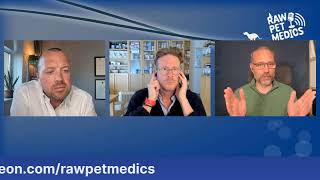
Dr. Nick Thompson, Dr. Conor Brady, and Dr. Brendan Clark break down vitamin D for pets: why dogs make 25,000 IU daily but guidelines only prevent deficiency, how liver and fish oil vary wildly in actual content, and why deficiency links to immune problems, cancer, and heart disease in dogs.
Chapters
Happy days are here again. We are Raw Pet Medics. We have Dr. Conor Brady, we have Dr. Brendan Clark, and my good self, Dr. Nick Thompson. And we are the Raw Pet Medics, and we're going to be talking about vitamin D. And we've just been discussing it for about 8 minutes before, and we've just discovered we've got enough for 8, for 3 whole shows. We're very excited to be on this evening, and Jenny Meredith has beaten Rach Mac.
We just should do a show on that, I think. Oh, Jenny, congrats! Rach, well, good try, good try.
Try again, try harder next time, please. Uh, greetings to all our, our, our Friends in the United States, greetings to everybody who's listening to this on a podcast. Greetings, very many greetings to our Patreon supporters. You can reach us on Patreon on— what is it? Patreon.com/rawpetmedics. Come along, join us. If you can contribute a small amount every month, we put that all together and it helps us with our paying our social media people, paying Pete the podcast guy, um, and for us to get all the infrastructure organized. So thank you very much to—
and thank you for all the feedback about the podcast, you know, available on everything from your iPhones, uh, through to Amazon and Spotify. It's great that you're following us. Thanks for the feedback from our question last week, because do you find it useful. Loads of people are enjoying it whilst out on their dog walks, listening to us, sometimes listening to us again. Thank you for listening to us again and again. And I would just say, you know, what's wrong with you?
Michelle has observed something I'm just after observing, which is, Nick, you're going for the facial hair. I think it suits you, Nick. You look well. It looks well on you.
You like it?
Yeah, I like it.
Joining us.
Yeah, thank you.
I went to a silver wedding anniversary. Can you believe it? One of my friends has been married 25 years. One of the guys, in fact, two of the guys, one of the girls, one of the boys who I was at college with, they've been married for 25 years. And so all the old codgers, there was about 6 of us, all with bad knees except me because I've got plenty of vitamin D, plenty of vitamin D. Interesting. Yeah, they all had bad knees and I was like, yay, I've I've got— but I haven't got bad knees and I've got hair.
Nice, you're all over it, Nick.
I am, I am.
I wish we could say it's all down to raw food because me and Conor are unfortunate.
Sorry guys, sorry I mentioned such a thing.
Yes, I'm sure some of us are richer in our testosterone than others. It's fine.
I, uh, I put up a post there on, um, I put up a post there during the week. I saw a great, uh, bit by Dr. Huberman, do you know that guy? He's the neurobiology professor dude on YouTube and he just gives cracking tips. And he was, one of them was in relation to this vitamin D bit here. He was saying how important it is to walk your dog first thing in the morning, get out there in the first hour of waking up and let the sunlight hit your eyes. So opposed to making vitamin D and everything else, they were saying that the sunlight triggers cells in the eyes and in the hypothalamus in the brain and releases your wake-up signals. For a 16-hour kind of cycle, and melatonin is released and dopamine, and that's your precursor to adrenaline. I never knew dopamine was a precursor to adrenaline.
Pineal gland gets stimulated by that morning sunlight.
This is the pineal gland, which is just here. Wow.
And he says that's why you feel more energetic on a sunny day. So even aside vitamin D. So I was looking at that thinking, my God, is like sunlight is just absolutely amazing. It's amazing. How much we need it and how topical that is for tonight. Because when it comes to vitamin D, it's the thing that we can make ourselves like a little, like a little, what are we, like a little factory for vitamin D. So it must be really, really important if we need to make it. That's what I think. The vitamins that you retain and the nutrients that you can make yourself are, you know, really, really important. And so we make huge amounts of it. Does anybody know how much in international units The UK government recommends you take 400 international units of vitamin D a day. Didn't recommend that during COVID mind you.
Below a certain age. Above a certain age, it goes up.
Oh, good. Oh, now this is good. This is relevant. But at the moment, let's just take this 400 international units to give people an idea of where we are. But guess how much vitamin D you make out walking around, walking your dog in the day? How much vitamin D does your skin make every day on a sunny day?
You need the 2000, 2000 more by a factor of 10.
You make 25,000 international units of vitamin D every day.
So that is very interesting because many of the government recommendations in the UK are not for optimal health. Vitamin C, for example, it's not for optimal health. It is just in order to prevent deficiency disease. So if we look at vitamin C, because people are more familiar with vitamin C than with vitamin D, The recommendation in the UK is about 60 milligrams per day, and that will stop you getting scurvy if you go on for long enough. But most nutritionists worth their salt will be recommending 500 or more. So again, this factor of 10 is coming in. Now, I've just read some stuff which says, uh, however, with regard to dogs, do you know what the recommendation for dogs is?
Gentlemen? Um, oh, I should have had that. No, I don't know, but I'm going to look it up.
Okay, okay. Yeah, yeah, anything, anything, anything. What is the science that dictates how much we recommend to have?
That's a different question. The science behind—
sorry, that was my image of the science that recommendations of what we have is.
Yeah.
Oh yeah, today I think we should dictate that everybody takes a minimum of 800 milligrams, or sorry, international units. There's a difference between milligrams and international units.
125 for dogs, Nick, per 125. Okay, 1,000 kilocalories of food.
I've got a study here that says the reason— oh gosh, no, it's basically— no, no, that's to do with giant dogs, which is a whole other story, and I can't actually find my reference. But oh, here you go. Few studies have investigated vitamin D requirements for dogs and cats, and all these studies were performed in puppies and kittens since the demand for skeletal calcification is higher at this stage of life and growing animals are more sensitive to the effects of vitamin D deficient diets. As there are no studies that investigated vitamin D requirements for adult dogs and cats as well as for breeding females, the recommendations are based on studies of growing animals. So therefore, remarkably, there are no guidelines based on adult dogs and cats for the required intake of vitamin D. I'm not surprised. That is not— isn't that lovely? Well, it's not lovely, it's just— and if you look at the recommendations between the NRC, FEDIAF, and AFCO, there is an 800— there are the difference between the minimum and the maximum is 800. And I looked at another study just here which was talking about feeding dogs. They did a study— hang on, let me grab this for one second. They did a study with 320 dogs testing for serum vitamin D concentrations, and those that were fed commercial diets were between 47 and 100 nanograms per milliliter in the blood. Okay, those on homemade diets were between 9.5 and 129 nanograms per milliliter. The recommended, wherever they get that, I don't know, is about a minimum of 100 nanograms per milliliter. Therefore, of the 320, 292 were fed commercial kibble diets, and none of them reached the baseline.
But it said complete and balanced on the front of the packet when I bought it.
Oh yes, well, that's open to interpretation. Obviously they've absolutely proved that.
Brendan, I'm going to ask you to give us a little lowdown of what vitamin D does. But just to echo on what Nick says about the deficiency in humans, we are all terribly deficient in vitamin D. And it's this— whereabouts you lie on the globe is quite important. Anything above this 35th parallel, which is, you know, really a little bit the bottom of France and up, essentially. But you would expect to be vitamin D deficient in wintertime, even if you walk around in the nip. you just won't get enough sunlight to make enough to stop your vitamin D levels falling from autumn. So it's when you people, a lot of really top epidemiologists would say there isn't cold and flu season, there's a vitamin D deficiency season. And so taking vitamin D supplements is what stops it. It's not that it boosts your vitamin D back up, they're not shown to do that, but they stop you losing your vitamin D. And vitamin D, as Bren's going to start giving us a little bit about what it does and where, you know, but we are all terribly deficient. 70 to 80% of Americans are vitamin D deficient. 90% of all people in care homes because they don't get out and make their own. And what sort of food are you eating? 80% of all hospitalized patients, 96% of all ICU patients. It's just a really common thing that when your immune system is taking a battering, so is your vitamin D. And so you need to supplement harshly. And as we saw with COVID it was one of the things that was working for ICU patients. Brent, can you tell us what is vitamin D? Can you give us like, what is it and what's it do? In dogs?
Well, in dogs, because there's a big difference between in dogs and humans. Humans synthesize it themselves. So therefore, technically, it's not a vitamin. A vitamin is, is an external chemical that you need to ingest in order to be healthy, like vitamin C in humans, for example.
On that, Nick, they, they synthesize it themselves is not quite true. They will convert from D2. But I, my understanding of this, synthesizing yourself is not necessarily the actual body, because we know that bacteria within the gut synthesize the vitamin D.
No, you and I, you and I synthesize vitamin D3 from sunlight on our skin, as you— and, and as you were saying, cattle from a precursor. Okay, so vitamin D is synthesized in the body One way or another.
So my understanding— so you need to go back and check that while I'm talking, because D2 to D3 is the conversion with sunlight. So that's the important bit as far as my understanding. So just check that.
And absorption of D2 from plants is about 4%, so there's not— no, you don't get a lot from plants, plant-based problems. And this is relevant to dogs in that there are there's a lot of dogs who are on vegan dog food, and I'm just thinking, where are they getting D3 from?
Well, they're supplemented. All pet foods, all kibbles are supplemented with D3 cholecalciferol. So that's D3 going into the diet, as Hill's demonstrated terribly recently, which we'll get to later. So they all get D3 in their diet from a conical flask, if you think that's a good thing.
Where's D3? Is that from a plant source, or is that from a— Well, D2 is the plant source one, but D3 they can synthesize it in the lab and just put it from D2 to D3.
Not sure how they make the D3 in the lab, but to put it in, in D3 form, it's converted through an enzyme pathway.
So I think the other thing is that we know that for our carnivores and ourselves, we've got foods which are rich in D3, which is liver. We've got various fermented foods. So bacteria do create D3. So you might find it in certain beans and things like that, D2, but with fermenting with bacteria, it's converted into D3. So there's some really horrible fermented soya bean salad thing, which is— oh, in fact, actually, no, there's another bean. I think it's natto or something like that, which tastes bit like musty old feet. Yeah, it's pretty grim. But that's a vitamin D3 sort of supplement. There are eggs and dairy, again, passed through from the mums, the milking cows, which are particularly if they're fed grass. So if they're out at pasture, and they're fermenting grass because the E. coli bacteria that are known to convert this vitamin from D2 to D3 are particularly prevalent. So these are the non-pathogenic E. coli that are normally found in the gut. So really important to look at there. And I would say that the importance for calcium regulation within the bloodstream what that has for depositing then into the bones. We're going to do a whole other live on K2, which is not the mountain, but it is another vitamin. Unlike K1, which is all thought about with clotting factors, etc., K2 actually co-stimulates the uptake of calcium from the bloodstream into the bones. So it's actually a good supplement if you've got vitamin D3 overdosage, just to try and escape from the hypercalcemia that could ensue. I'm not going to go much further than that. So having fish oils as well. So there's certain fish that are a great source of that. So alongside the essential fatty acids, you know, the omega-3s, you know, fish oils can be great for your D3 uptake. So anything that's from a meat and other animal is a great source of naturally occurring D3. Pork apparently is another one that has a great level of vitamin D3. Obviously lesser hair, especially if it's outdoor reared, is going to be much higher in vitamin D3. Than otherwise you would find. Having it in meat is a great option.
Pork is double pork and pork can contain— there's a massive variation which we'll get to in a while, depending on how the animal's reared and whatnot. But pork can contain twice the amount of vitamin D3 as beef. Lamb can contain— veal, which is— is veal a very young cow?
Yeah, yeah.
Veal is really high. It's twice the amount of pork. Can contain 20 minutes of pork, and lamb can contain the most when it's killed in certain situations. In relation to vitamin D and what it does, Bren was saying about like, you know, maintains blood calcium and phosphates within this narrow range in your blood. And so it's really important for that. So it's important for healthy skeleton and muscle contractions and immune function. It's really important in immune function. Hence, when you drop down in D3, you're more susceptible to coronaviruses and things in wintertime and bugs and colds and whatnot, but also all sorts of immune issues. So vitamin D is really, really important, but it became really famous, or it was rickets really, in the 1600s. They first came up with this kind of name for this soft bone malformation in particularly young kids, but it happens in older adults, osteomalacia. What's that? What's the word?
Osteomalacia.
Thank you.
And so this in the 1600s, but they didn't actually realize what it was until about the early 1900s. So they pinned it on sunlight and whatnot. In the 1600s, but it was particularly prevalent in England in the 1700s and 1800s. This is why when Charles Dickens was writing, uh, Scrooge, uh, you know, what's his name, Tiny Tim— that Tiny Tim was most likely in that situation because it would have been an awful lot of kids around. Do you know why there was lots of rickets around in England in the 1700s and 1800s?
Because they didn't get out of doors very much, not enough sunlight.
Not enough sunlight is correct, but there's a reason. There's a reason not enough sunlight, because factories. That's correct, very good. The Industrial Revolution was kicking off, and so everybody moved from the country into the cities, and it was filthy, and there was so much smog they never got any sun. So the kids were often working indoors, and, uh, they never would have seen the sunlight when they're out. So this would have been very prevalent. In fact, it was called the English disease in the 1700s and 1800s, and it was only until the 1900s that they started pinning it on, oh, a lack of vitamin D. So the rickets and bone issues that Bren was saying, calcium and bone is really, really important to have enough vitamin D in the diet. And people run around then and start trying to supplement with foods, and should I have enough? But if you're eating a healthy, fresh diet that's varied in all these animal ingredients, that raw-fed dogs or cooked, just, you know, lightly cooked, because the more you cook, the more vitamin D you lose, and then you have oodles, oodles and oodles of vitamin D. But dogs can't make it themselves, so it is important in their diet. But the diets that we feed dogs are very high in D3, so it's not something we on this side of the fence are going to be lacking, but in dry pet food, notoriously iffy, which we can come back to in a little while.
But yeah, the thing that I think if we look at big picture, there is this phenomenon that most of us are low in vitamin D. Therefore, all of us, everybody listening, everybody, you know, all of us and our dogs require the vitamin D. And for dogs, it's, you know, the easiest way is grass-fed liver and cod liver oil and fish oil and what have you. The thing is, so everybody knows most of us are too low. The other thing about vitamin D, because it's a fat-soluble vitamin, is that people are scared about hypervitaminosis D. That is too much vitamin because you store it. Okay. So if you took loads of cod liver oil for months and months and years and years, you might get hypervitaminosis D. But there's a study here by Mellanby in 2005, which says, until now, cases of hypervitamin— that's too much vitamin D— are apparently rare and experimentally induced. So in order to get hypervitaminosis D, you've got to do a lot of work in the wrong direction, taking too much hypervitamin D. So don't be too worried about too much D. It is possible, but you've really got to go wrong a lot for a very long time. Be more worried about not enough vitamin D. So you need your grass-fed liver, your cod liver oil, your butter, your egg yolks. That's, that's where you get it from. So even, even the vegetarians, get your butter, get your, get your eggs, not just egg yolks. Eggs come with the albumin, the egg white, and so that's really, really important.
Yeah, yeah. And maybe it's how they deliver the D3 as well, because as with most nutrients, how like conical flask versions of those nutrients, like, you know, this is essentially a steroid, really, D3, isn't it? It's more of a steroid than anything else.
Pre-steroid.
Yeah. And so, you know, it's amazingly complex compound. They find one little bit of it and they can replicate that bit in the lab like they did with vitamin E for a while. And now they've got a little bit more vitamin E, but they don't have the whole compound by a large stretch. And so how you deliver that nutrient, the body does not like it delivered in chemical forms. You know, it's like iodide, which is, you know, every day, selenium iodine. I'm sorry to go on about it all the time, but you know how much the iodine is in your seaweed. It's like, have you ever heard of anybody laid out with iodine from seaweed? The Japanese eat massive, like, multiples of their RDA of iodine every day, and they seem to be extremely healthy as a result of it. If anything, the longevity of these fish and coastal communities is excellent. So like, it's, it's, it's because when it's iodide, it's delivered on its own it really smacks the thyroid and the body doesn't like it. And I bet you that's the same with the D3 studies as well. They're doing tests on dogs in cages using D3 that they formulated. It's just ridiculous. It's not like we fed them huge amounts of something high in D. The only thing that you might feed a lot of, you know, kidney is actually probably a higher source of vitamin D than liver. But when you feed large amounts of liver, it's not so much the vitamin D that's going to be laying out your dog. You'd have to feed furious amounts of liver. It's all the other stuff that comes with liver and copper and selenium. It's a high potent— and yes, vitamin D. But as Nick was saying, it's probably not a whole lot of examples of dogs being supplemented with too much vitamin D. That comes from dry pet food. You know, Hill's Pet Food, 2016, people have already been saying it on the side there, world's biggest recall. Hill's Pet Food is like apparently the top dry pet food because otherwise why would the veterinary industry be recommending it? That factory let 22 million cans of dog food out the door without checking the nutrient content of a single one of them. And so when they say 100% complete and balanced, says who? Some dude filling in an Excel spreadsheet at the front end of the machine. They buy in their vitamin mixes, they pop it into the food, they never check it, they just assume somebody else has. Out the door it goes, 22 million cans, and it happened again. Like, that's that's how careful they are with the vitamin D. They put in large amounts of vitamin D in a cholecalciferol— oh, they put that into the food, but they put in a lot of it because, you know, extrusion cooking destroys 50% of it. But if you don't get that right and a lot of that comes out the other end, you're going to get dogs getting laid out because it will smack you. It's not the right type of vitamin D, as Nick was saying, it's a supplemented vitamin D. So it's happened a few times. Royal Canin killed a few dogs in the late 1990s. There was 25 dogs killed in the 2000s because of too much of this hypervitaminosis. Never. You don't get that from raw dog food companies. They don't kill dogs that way, you know. So yeah, the hypervitaminosis is an interesting one, but not a complete raw dog food issue.
So do you reckon— what do you reckon was behind that mistake? Do you reckon that somebody thought they were putting D2 in that was less absorbed and accidentally put in D3? Or do you think that they just had an error, total error, in what was being put in and they weren't monitoring it? What's your thoughts?
I've heard from an inside source that it was just the guy who was in charge of the vitamin D put in a whole bag into the mixer instead of a tenth of a bag. That's what I've heard, and I'm not going to divulge my sources. Yeah, so it was just, it was just human error. That's, that's it. And, and human error happens all the time. And how do you protect from human error? The answer is you keep on checking the end result before it goes out to the consumer so that you've got, you've got that, that quality control.
Yeah.
So, so the second thing is that, you know, for me as well, that, you know, what Conor was saying about, oh well, it's not absorbed as well as a chemical makeup, I think it's just the fact that all of those products I mentioned earlier will naturally have a lot of the cofactors which help, you know, the body with coping with the vitamin D3. So you'll have K2, included. Okay, I have often vitamin A, omega-3s and things like that, and they'll have the vitamin A that's included in those products, and that actually helps the body—
oh, okay—
moderate how it's used, how it's absorbed, what the end result is as far as the calcium-phosphorus ratios, you know, all of that, what the influences on the other hormones are, like the parathyroid hormone, uh, you know, those are important parts of the pathway.
Yeah, which is another reason to feed food, not, yeah, not, you know, food synthetics like kibble. Okay, food is there for a reason. It's called food, not kibble. And I think that's really, really important. Just before we get too late in the show, guys, I just wanted to break some of the studies that I've seen. And number one is that the presence of vitamin D receptors in human immune cells was discovered. Research on, on their unrelated effects on bone metabolism of vitamin D intensified, and it was discovered that cells in almost all body tissues express vitamin D receptors. As a result of that, that revelation, which I don't think should be too much of a revelation to most of us, It has been shown that vitamin D lack of can be influential in cancer, in congestive heart failure, gastrointestinal disease, infectious disease as per certain viruses that we've been dealing with for the last 3 years. And in a study with hospitalized dogs in a critical condition, it was observed that vitamin D concentrations at the time of diagnosis was a predictor of the mortality rate for dogs with chronic enteropathy, chronic gut disease. So if you go into, if your dog goes into the hospital with bad gut disease and they're low in vitamin D, just as with COVID patients, if they had low vitamin D, their outlook was much more risky than for those who went in with good because they'd been eating liver and cod liver oil and butter and yolk and what have you. And, and in addition to the— so as a result, the cancers that have been associated with poor vitamin D intake include osteosarcoma, squamous cell sarcoma, which you get on kind of tips of your ears and things like that, prostatic epithelial tumor, Anal sac adenoma. Yeah, can you believe it? Your bum is responsive to— bum disease is responsive to lack of vitamin D. Can you believe it? Mammary cancer. How many times have you heard mammary cancer in dogs or women associated with vitamin D? Almost never, but it's there. It's in the literature. Mastocytoma and and the list goes on. So cancer and vitamin D, there's a massive, massive link there. So I think we need to be thinking much more broadly when we think of cancer. We need to be getting more vitamin D into ourselves, especially as it's quite difficult to overdose. I think we all need to be generous with our vitamin D.
John Campbell there on YouTube, guys, check out his video. It's called Vit D and Prostate Cancer. Vit D and Prostate Cancer. And he goes on about vitamin D ever since during about. He was saying, guys, you know, we need to be taking this, but you have to be careful because you couldn't recommend things. And so it was funny that, like, you know, we had oodles, oodles and oodles of really high-quality evidence to show that vitamin D is effective to keep back coronaviruses and whatnot. So it might have been handy, you know. As I said before, in Ireland, when the IRA were making threats to various parts of Britain and saying, we're going to hit Sellafield, we on the East Coast all got free iodine tablets in the post. And so we always, you know, I remember seeing them in the press. We all kept them. We got free iodine tablets post because these things cost nothing to produce. And so what, you know, of all the advice that wasn't said to people, that, that was a real strange one. And now we have Cochrane reviews and whatnot to show that, you know, there was probably a lot of truth to it. But in relation to what Nick was saying there about the cancers, check out that video, Vitamin D and Prostate Cancer. This was a review, a review of the RCTs that we have on vitamin D, but this particular one that came out on prostate cancer, you should have seen the effect it was enormous. For every— now I'm going to butcher the figure, so I'm just going to pick them out of the air— but for every, say, 20— for every 20 micrograms of vitamin D that was included, there was a 10% decrease in prostate cancer in this part. And these are thousands and thousands of people. Like, it was staggering. They said the prostate cancer was really, really high in people of color and Black people in the States. And it was— so you— and the darker your skin, the less kind of vitamin D you're going to make. And so that's a bit of a problem. So you're more likely to be vitamin D deficiency or likely to be hit by respiratory diseases and whatnot. I'm sure there's many other factors in there, grain, all that, of course. But they said as they're adding vitamin D into populations of people, the color of the prostate cancers plummeted. The graph was like that, like it was a staggering 20 minutes of— and then he goes into all the other cancers where vitamin D is pivotal. And then he ends with this enormous study that came out there in the last, whatever, 2 or 3 months on the, on the effect on depression. Did you see the vitamin D study on depression? I shared it on Facebook page after seasonal affective disorder. They've now pinned it down to vitamin D, deficiency in vitamin D, and it is a massive, huge, impressive study to show the more vitamin D you take, the less depressed you are. And so as an antidepressant, it is marvelous. Vitamin D is in everything. It's important for everything. You could Google bloody headaches and you'll find a vitamin D link, but the seasonal affective disorder, very, very interesting. My mum suffers that terribly, as did my dad, you know.
I think that that is fantastic because there's a lot of dogs out there, they it may be difficult to see that they're a bit more depressed or a bit more, I don't know, aggressive or narky or, you know, don't touch me during the winter. But if many dogs are vitamin D deficient and many dogs have behavioral disorders, yeah, it wouldn't be crazy to just think of, you know, as, you know, the top 5 things to do with all behavioral disorders, you know, plenty plenty of omega-3, plenty of raw food, plenty of liver into those, or cod liver oil, into those behavioral dogs. And I would suggest you probably help 20% of that entire population just by looking at the vitamin D, among other things.
Yeah, yeah, interesting. Nobody ever thinks of that, you know. Yeah.
So just to go, because there's been quite a few questions. Okay, come on what is the level of vitamin D that should be in the food, because we've not actually answered that for many of the guys out there. And certainly it doesn't specify D2 or D3 within the FEDIAF guidance.
Oh, naughty, naughty.
And you're serious?
No, it doesn't. It just says vitamin D, so they can add D2 in there. And we do see this when we're monitoring output. And actually it's also really important to ask your raw food company, are they monitoring the output, not just your complete food companies, so that you know what you're giving as to whether you're supplementing or not. Now, international units, okay, rather than nanograms, just for those people that are over in the States because it will upset them if I don't specify, international units per kilogram of dry matter people will assume that this is the optimum levels. It is not. Okay, so for adults, which are a slightly less amount of kilocalories per gram, per 100 grams of dry matter than for puppies, but for adults, the amount is roughly 250 international units per kilogram dry matter of the food. Of food, okay, is what is the minimum levels recommended for puppies in growth. That's 750, so a threefold increase, okay, is the minimum amount. That is not a target, guys, that is a minimum amount, okay. The maximum amount, and this is in international units per kilogram of dry matter of food, okay, so not the dose that you give give your own dog, unless you're giving them a kilogram of dry food, okay, is 30,000 international units.
So that's another example of you can't, you can't really go wrong. So get that vitamin D into them— cod liver oil, grass-fed liver, and what have you. Martina says here, so, so I thought dogs did not absorb vitamin D from sunlight. Martina, you're absolutely right. Humans do it. Brent was speaking earlier about that ruminants do it, maybe not from sunlight, maybe from bacterial degradation of D2 to D3, but dogs don't get it from the sunlight. They can only get it from diet. So plenty of D3 in the diet, guys. Sorry, Brent, I jumped in there.
No, no, absolutely. So the important thing to realize is there is a massive expanse plants that you can supplement into, um, but it must be that they have gone way above a tenfold increase in that bag, okay? Um, because if you look at the minimum levels to the maximum levels, one would assume that it must have been going halfway between, um, the two in order that a tenfold increase has taken them well above the toxic levels. Now, I do know that they use D3 in certain rat poisons. So that's another thing to watch out for, that if your dog is snuffling around rat poison, that they don't come across that. Now, interestingly, they do report that dogs are more resistant to D3 excesses than omnivores as well. So that's another factor that comes into it, but it is still important to monitor the kidneys. Really interesting approach that many people would have to try and deal with that toxicity, such as adding in steroids, adding in diuretics to flush the kidneys for the period of time that they are in that excess of vitamin D, just to try and get rid of all of that calcium as quickly as possible.
But if you think about it, Brent, dogs have been going primarily, you know, if they take down antelope, gazelle, whatever it might be, the first thing they're going to go for is liver. Okay, so dogs have been having acute liver toxicity, acute vitamin D excess for millions of years. I think you've got to give a ridiculous amount of vitamin D for quite a long time to really see significant hypervitaminosis type disease.
I was, I was looking around at the, at the vitamin D content of different beef livers just as a, as a, you know, I don't mean to rag on the Excel spreadsheet kind of approach, but like, you know, the USDA database search database, USDA search database, which is where you can go and just type in your food and it spits out a figure for the amount of vitamin D in the liver in your kitchen in Wicklow, Ireland. And how could they possibly know that? And, you know, so it obviously it depends on where where your cow is, you know, if he's up here or if she's up there or down there, what she's eating, how she was treated. Illness, during illness, your vitamin D plummets. If you're raised in a concentration camp or raised out in the pastures of Devon, I can imagine they're very different kind of vitamin D status. So, but it actually was interesting, the USDA database said there was zero vitamin D in liver for years and years. I haven't since looked at it in the last 3 or 4 years, but for years when you put in liver, it was zero. So when people were formulating raw dog food, they would be looking for where else, like, where they get vitamin D. It's like, but you've got liver and kidney in there. There's huge amounts of it. Perhaps not with stall meat, but studies in Japan found that there was no vitamin D in the liver in some of the beef livers, some of the species of beef liver over Japan. But the differences range from 0.5 to 3.4 micrograms in one study, 8.6 to 7.7 in the other study, 140 2 to 2 into— so like the different, different animals, different times. To say that one little spreadsheet can say that's how much vitamin D is in your liver, the, the figures vary. 13.3, 0.84, 4.4 in Nigeria, 1.9, 22 in an Irish study. There's just the, the contents, the vitamin D contents of liver are just very all over the place. Kidney actually was higher.
And could I say, this is another reason to is your company testing end product? Yeah, I will tell you now, I know from testing end product there can be a 4 to 5 fold difference between what the spreadsheets will say should be the vitamin D content to what the actual vitamin D content is. Wow, that's a 4 to 5 fold difference.
Wow.
Okay, and if you're formulating at home using a spreadsheet, using a formulator of some sort, just be careful. Okay. I think— would you agree, guys, that if you've got good quality grass-fed liver going in there from grass-fed sheep or cattle, you can be certain that there is at least a minimum amount of vitamin D going in?
Yeah, yeah.
I mean, we should all be eating liver if you— as long as you're not veggie. If you're veggie, go for butter and eggs. But if you aren't veggie, please, please, please think about trying to get liver in one way or another. And if you don't like liver per se, pâté is another way of doing it.
Yeah, that's a nice way. I can just—
you know, to get beyond that excess, I mean, you would not be able to survive the amount of liver that you'd have to eat. Yeah, you know, you'd rupture something before you actually got to your excess. Okay, so it's not that you're gonna be able to overeat certain rich foods in vitamin D. Now, I would say that with blood monitoring, okay, it is safe to supplement, definitely. So there is a D3 blood test that you can get for your dog, okay, to monitor their, their levels to see where they're at. And I would definitely say it is possible just to check that they're not in excess in those circumstances.
Okay, yeah, so they've been very rightly says about liver capsules, people like Hunter and Gather, and I'm sure there are more, and unfortunately they don't, um, uh, they don't, um, um, help us in any way financially, unfortunately. Hunter and Gather, if you're watching, we'd be really happy to have you just support us, please do. But, but they do, they do Icelandic lamb's liver in capsule. So if you're one of these people, and there are many out there who just cannot tolerate the thought of eating liver because you were traumatized in primary school or something, then you can have them as a capsule, just as you— when you have other supplements of a morning. And you'll be— your, your brain will be none the wiser, but you will be so much more healthy because you're actually eating some really fantastic liver on a daily basis.
For the, uh, for the US, uh, it's Ancestral Supplements. They're all over Amazon. Uh, they do grass-fed, pasture-fed animals, and they do single organs. They also do mixes, but you'll actually get dried. They were one of the few that were supplying dried pancreas. We could buy them over here, but to ship them in from the US, they're in the UK for a while until Brexit, they're gone again. So Ancestral Supplements are quite prevalent online. They do a nice range of organ meats. Fiona Murray is saying this multiple times, so we have to read it out here for her. So two things. First of all, Fiona was talking about, is there a link between vitamin D deficiency and gut issues and whatnot? And I was just talking to the lads beforehand that, yeah, absolutely. There's a great study there on humans. I'll share it afterwards. I can't say I'm totally up on all that, but I'm interested to learn more. So yes, Fiona, you're spot on. I'll share it on the Facebook page. You can read it later on. But in particular, the second bit you're saying, the reason I'm pushing testing here, Patricia Gethin only fed grass-fed or wild meat. She's— her dogs are the best-fed dogs in the world, and they were all very low in vitamin D when tested, and suspected due to gut issue predisposition. So just a bit of background on that. At the time Patricia was testing her dogs, she was going through a bit of stress with them. The two dogs were at each other, and to the point that it was, you know, she was worried one, there was going to be blood, she was going to come home and one of the dogs would be dead. And so she was, and you know, she did everything she possibly could to find out what that was. So she could have been dealing with a couple of pretty stressed dogs at that point, and vitamin D and stress, no doubt, will probably plummet. So God only knows what was going on with the dogs at the time. But have you heard of vitamin D deficiency, like, in dogs fed Oodles of vitamin D. I suppose if you have the right illness, you're going to be vitamin D deficient. 80% of people in hospital are vitamin D deficient, 96% of people in ICU. The more sick you are, the more you lose.
But also, most humans don't eat enough liver.
Yeah, these dogs were, these dogs were.
But which supplement? Yeah, so was it just fresh supplementation with foods like that that was going on, or was it with actually choosing a supplement? And how Well, was that supplement chosen? Was it a, you know, a synthetic? And was it D2? Was it—
yeah, all I know is that she was feeding a high-quality diet, eggs, really good quality meat.
You can get really cheap vitamin D supplements which do not absorb as well. You've got to make sure it's D3.
Um, so I think what this this counters what we were saying. We were saying that a dog fed a complete raw dog food, a well-rounded diet, for them to be deficient in vitamin D would be very rare. I mean, this, this here's an example that's popped up, as it's going to do, that the dogs were deficient in vitamin D, which I have to say surprises me. I'm like, wow, because they would be getting so much in a diet that Patricia would be feeding them. Like, you couldn't have got a more rounded diet. That woman was incredibly well tuned into what the dogs needed, you know. So it's interesting. I suspect that there was something wrong with the dogs. Maybe that's why they were killing each other.
Because again, gut flora would make a difference to what's going on. And if you've got poor— so some of the fermented foods are supposed to be great, but it's certain fermented foods, and it will be the certain bacteria, certain E. coli, that do that vitamin D conversion. As well as, you know, really interestingly, people assume that mushroom supplementation is great, but a lot of mushroom supplements are actually developed in the dark. They're not necessarily exposed to sunlight. And actually, if you take your mushrooms and you expose them even after picking to sunlight, you can actually increase the vitamin D levels tenfold within the mushroom.
Hey, wow.
Before you give it— so it's always worth considering, even in dried mushrooms, that you can increase the vitamin D3 level by exposure to sunbathing.
Guys, I'm going to stop you there. It's 19:47. Hold that thought. Hold that thought. Let's jump over to Patreon. Oh yeah, do some more stuff.
We're going to talk about eggshells. We're going to talk about calcium stuff as well. And there's a question put to us on Patreon, so we're going to maybe talk about that. Involved in the vitamin D context for absorption.
And I might read out the findings of an interesting study of vitamin D used on a few COVID patients.
If you want to join us, yeah, please come over simply patreon.com/rawpetmedics. For you guys listening on podcast, I hope you're enjoying the conversation and you feel that you want to join us on Patreon too. That would be brilliant. Just to help support us. For all of the rest of you, oh, we've got to announce 20th of June, guys. We've got to start telling them surely about who's coming. So deal. Remember, if you've got questions that you've got, there's going to be a little advert coming up for Karen and her sidekick, little Rodders.
He'd be delighted to hear that.
We love you, we love you, Rodney. Really, we love you.
Then, you know, that's going to be great to see those guys. So, you know, save the date, that's the 20th of June, um, and, uh, we've got them along. So any questions, it would be brilliant to, uh, to hear from you guys, and maybe we can pose some of those questions for you. Otherwise, for the rest of See you over on Patreon shortly, and it'd be great catching up, and see you next week.
Yes, indeed.
See you guys.
Toodle-oo.










