In this informal live stream, Dr. Conor Brady and co‑host Bren discuss cataracts in companion animals. They cover the main risk factors (age, diabetes, genetics, diet), how cataracts develop at the cellular level, and the standard surgical solution (phacoemulsification with intra‑ocular lens implantation) including its cost (~£1,800‑£2,000) and possible complications such as secondary glaucoma. The conversation then shifts to non‑surgical interventions: antioxidant‑rich diets, essential fatty acids, B‑vitamins (especially B2 and B3), vitamin C/E, zinc, lutein and zeaxanthin, and specific nutraceuticals like NAD‑based eye drops (LumenPro), lanosterol, carnosine, and chrysanthemum‑derived diosmetin. They compare nutritional yeast versus brewer’s yeast as B‑vitamin sources and argue that raw‑fed diets may reduce cataract risk. Practical advice is given on photographing cataracts (flash, lighting, red‑eye suppression) and on collecting images via Patreon. The hosts propose a low‑cost trial of a €10 eye‑ointment containing lanosterol, carnosine, and chrysanthemum on a small group of dogs, soliciting submissions from Patreon members. Throughout, there is a mix of technical explanation, personal anecdotes, and light‑hearted banter.
Chapters
Hey guys, we're back. I haven't— back. What I said, Brad, was just to flatter you, is that I didn't realize— I thought, okay, I've been cut off, I'll wait till Brad lets me back in. So I just did. So I'm just, you know, doing something else. And then I'm thinking, hang on there a second, am I live? And I check the Facebook page. I'm thinking, I'm just panicking, going, oh my God, half an hour on camera. Oh, awesome. Yeah, you leave me on my own with— this is not something I can do. I can't do it justice. But anyway, we're back. So listen, where were we there? We were talking about— I can't remember.
Before we go too far into this, that's interesting because it looks like we might be live on YouTube. But there is a problem with BeLive.
No, boo. I'm hating BeLive. I really am.
So not sure why that is. That's almost like the network doesn't like—
well, I'm going to record this on the computer so we can just pop it up on Facebook as a video. Okay.
Yeah.
Um, very annoying. BeLive gives us too much grief. It doesn't need to.
I bet you're on YouTube, so be careful.
Yeah.
Yeah, we know we're not live on Facebook. Thanks, Penny. But we are trying to work out what has happened to the network.
Maybe there's trees down somewhere.
Yes, somebody hates that. Right, let's— I wonder if I can do a quick relaunch of Content. Thanks for bearing with us, Penny. You can shout at some of the others on Facebook that we've moved across.
Please do. I'm gonna record the screen. Lots of people coming in from YouTube there now.
Oh, good. Well, they can see us there. Let's see. We'll try and make sure this is recorded for you guys and split it down into something that's a little bit more manageable. I'm just thinking poor old Judy Morgan's page won't be able to follow us.
It's annoying.
So let's— I'm almost tempted to go live, live.
I have these— I bought these heart-shaped balloons for the kids for the birthdays. And, uh, what's that look like? That was a— that's a love heart balloon. It's supposed to be, but I can't think— I can't think it looks like a scroll. Nice.
I can't stand that noise.
It makes I hate balloons. I hate balloons. They're nice, aren't they? Look, there you go. All the kids' birthdays this week, pure torment. I say that, but I didn't have to do anything. Elaine does absolutely everything. I have to let go of this now. Sorry, Pete. Yeah, a 3-year-old and a 6-year-old tomorrow.
Oh, bless.
Should we just proceed and do it on YouTube? I'm recording the screen here. We'll post it on Facebook and tell us. Yeah, yeah, it will, uh, be live tonight.
Yeah, it should be able to cope.
Let's just run it on YouTube. Yeah, give up, give up, Brad.
Oh, well, there you go, people are coming. So we will carry on. So where have we got to? Yeah, cataracts. We've got to old age changes. We're talking about cataracts, glucose, you know, have a little look at glucose for your pets if their eyes are changing and there is excess drinking. Just get a urine test done because that's one of the biggest causes of cataracts in older age people. So it's really important to— that's more common also, I think, in old dogs too.
For some reason, diabetes is so much more common in cats than dogs. I reckon that's the dog's ability to better handle glucose, can pack away glucose a bit quicker, has a few little tips and tricks. Compared to cats. Do you reckon that's what it is?
Well, we've got a lot more type 2 diabetes known in cats, and actually it's really interesting because the number of our clients increasing raw food feeding and the decreasing levels of diabetes in dogs and cats is just amazing. I don't understand why people haven't, you know, thought about it more. And, you know, we Honestly, what I think we've got two recent cases, both of them kibble-fed. Yeah, that are moving into the tablet forms.
Laurie Wise. Yeah, that's Laurie Wise, is the diabetic cat vet. Okay, so she writes a lot, does a lot of papers, and like one of her papers concludes that a lower carbohydrate diet may be beneficial for cats with diabetes. 'But it remains to be seen if a low carbohydrate diet is of benefit to a healthy cat.' That was the conclusion of one of our studies. And I'm like, my God, I'm not a vet, but for the love of God, how could you say that to an animal that desperately does not want any carbohydrates in its diet, wants to be in a state of perpetual ketosis, and you're feeding them 50% carbs? Madness. Not a single study suggests that cats want carbs in their diet at all, ever. They don't ever select them. At least dogs might select the tiny few here and there, but cats, not at all. So anyway, okay, so that's interesting. So that's the— so you say that it gets cloudy, it gets cloudy with bits and pieces. Why is it getting cloudy? What is— what's it getting cloudy with? Is it— I'm assuming like nasties in the diet, pollution, crap?
As the cells get the wrong level of fluid in there, okay, and you just imagine it's like an onion of of cells is that lens. It's those damaged cells, so it's scar tissue building.
Okay, what is that? Accumulating material of other stuff?
No, so as the cells are effectively dying off and you've got, you know, stroma that's damaged, then, and that's not clear anymore, so you'll get these areas. Now, with those lenses which are firm, there is a danger that they can become detached. and if they tear the very fine hairs that hold the lens in place, then what happens is that the lens can then fall out of that nice mesh and fall forwards into the pupil, and in doing so, obstruct the pupil from being able to help the normal flow of fluid, and you can then get secondary glaucoma. So that's a swelling of the eye, so it can actually be quite serious. To just leave the cataract and hope that it just won't cause any further problems, won't cause any pain, won't cause any other issues. So secondary glaucoma has to be looked at. That can be a consequence of diabetes anyway, just because of the inflammatory change that can occur. And so there are operations at that point which can be to, whilst the cataract is in place, and this is what they often do with people, is they place a very small slit in the bottom of the cornea, place a probe in, and actually melt the lens inside its sac and suck out the lens material.
Okay.
And then put in a false lens in its place to act as a type of focus. There was a time that we used to not put that in and hope that the membrane of the lens would effectively keep that back layer of cells, would keep the vitreous from mixing into the aqueous at front. But it appears that actually the gel part is better having a lens in front of it, and it seems to be just as good for dogs as it is for humans in giving them better sight as well. So they put in these small lenses, and that's really the cataract operation. So phacoemulsification, for those nerds out there. Now, there are some interesting developments in drops which look at antioxidant levels, you know, helping the health and nutrition of the cells, rejuvenation. So some with NAD. So there is a product in the States called LumenPro, and I'd love to hear from anybody in the States if you've tried this on your dogs, which is there when you've got very early steps in the line for cataracts that you can start to apply these drops into the eye. So LumenPro.
What's in it?
So it has a mix of NAD, so that's the nicotinamide adenosine dihydrophosphate, I think, something like that. And then they've also added alongside the NAD. I'm just, um, seeing if I've got that here, uh, something else. And it's not something I've used because it's in the States, not here, but it was something I came across as something that was natural, low risk. They felt it was effective in reversing cataracts. Containing the antioxidants. It's got some proteins in there too, and it's obviously cost-effective. It's not going to cost you anywhere near what it's going to cost as far as an operation.
Yeah, what does the operation cost?
I think currently it's around about £1,800 to £2,000.
Oh, and is there any risk to the dog?
So there is a risk of uveitis, so that's an inflammation following the operation. And remember, these prices may have gone up in recent times. It's been a while since I've had to send a dog for a cataract operation.
So that's a good thing. Good thing.
It is a good thing.
Yeah.
And I would definitely say, you know, first things first, you know, keep up the antioxidants in the system, keep up things like the essential fatty acids, especially the omega-3s. You know, they're all great for healing process. In those circumstances.
Yeah, there's a genetic predisposition for these cataracts in dogs. Why do you think that is? Afghan Hounds, Bichons, Boston Terriers, German Shepherds, Golden Retrievers, Labrador Retrievers, Cocker Spaniels. What do you think is the genetic reason for getting cataracts?
Look, I think there's genetic predisposition Okay. And that can be that the function isn't quite right. And we've talked so much about epigenetics and the effects of the microbiome, the effects of the environment, all of the changes in the chemicals that are exposed to that's extra oxidative stress, the levels of processed foods that they're being challenged with. All of those add to the epigenetic predisposition to cellular damage. And what better place to see that in person than in your eyes? Okay. Because people can look in deeper to those tissues. These are cells in action doing stuff that you really want to make sure. So from retinopathy, so that's an effect on the retina of the eye, all the way through to the lens and the conjunctiva and the cornea. You know, all of those tissues, we can literally see deep into the body as to what's going on. And any damage that's occurring is quite readily available and visible. And the issue is that the dog will— or cat will be affected by that.
Yeah. Does people— uh, iridologists— have you heard of an iridologist?
So that's slightly different because that's looking at damage to the iris. Yeah. And how the iris changes.
Yeah.
Okay. To, they feel, depict underlying biological disease.
Okay.
And so they will say, oh, this looks like a renal pattern, this looks like a liver pattern.
You know, I know a girl, I know a girl, very, very reputable, who couldn't believe that she's ended up doing it. She's like, she's like very, very busy with it. And she says, I'm telling you, like, she uses a lot. And then, um, you know, kind of Chinese medicine stuff would have seen a lot in the eye as well. They would have spent a lot of time. I'm sure there is something to it because of the sheer amount of people that she goes through and helps and that kind of stuff. So it's like things pop up in the eye, you know. Listen, if your bile duct isn't working or your liver's sick, you'll see it in the eyes straight away. If you're hungover, you know. So there's all sorts of, uh, there's also— you can see, you can see it.
Do you go yellow?
Yeah, not yet, not yet. Definitely not January. I haven't done it in 3 weeks. I've got some bits here, okay? So like some of the more, let's just talk about dry food, okay? You're saying dry-fed dogs get it a lot and we know dry-fed dogs are far more prone to inflammation for whatever reason, insert issue. You know, there's just so many things wrong that can cause inflammation in dry-fed dogs and jumping to raw decreases inflammation. So you're saying decreases cataracts. I still thought it was gathering of toxins in the eye. It's going to be hard to shake that. But the two really important B vitamins are B2 and B3 in this process, apparently in cataracts. And there is, I'm sure if you looked at any vitamins important, any of the antioxidants, C and E as well, they're important too. But anyway, let's go with this one. Vitamin B2, riboflavin, and B3 is niacin, are needed to protect glutathione. And it's a really important antioxidant in the eye. And when I was reading these Eye Society places, they were saying that of all of them, vitamin B2 is the most important. And there's a study here by Hoffman Laroche who found that after just 6 months of storage, dry food B1 fell by 57%, B2 fell by 32%. And I'm thinking if you're feeding dry, B12 fell by 34%. In canned dog food, B6 loss was 89% in canned dog food loss. So, you know, it's just another thing to consider that if you're feeding a dry food that may not be very replete with B vitamins, certainly with storage over time, especially if the stress shelf life testing showed that those results are even worse over just 6 weeks. So a nice warm shelf or a hot cargo ship or whatever. So I thought that was kind of interesting. Then I started thinking about food sources for B vitamins, what are the best? And you probably know this already, and I'm sure we talked about it when we mentioned brewer's yeast last time, but my mind always goes to brewer's yeast. And I think brewer's yeast is a great source of B vitamins, but I saw someone did a great article comparing brewer's yeast and nutritional yeast, which is the stuff that, I don't know if you know your nutritional yeast, but if you ever spend time as a vegetarian, you'll know what it is. It's like flakes of deliciousness. Quite tasty, tastes like a light kind of crisp nearly.
But it's not like Marmite, is it? You love it or you hate it.
It might be a little, yeah. Listen, you wouldn't be eating it by the teaspoon, you know? But it's dry flaky stuff, like you almost gonna make porridge out of it, but it's dry and flaky, kind of nutty kind of flavor to it. And people dust their salads with it and make things taste nice. But that nutritional yeast absolutely blows brewer's yeast out of the water when it comes to B vitamins. Listen to the comparison here for whatever unit, I don't know what it was.
Uh, MCG, is it micrograms?
It could be, it doesn't even say that. I'm sure it does say it somewhere below. Is 15 grams of oxalate, a teaspoon. Uh, thiamine, it's got 7 times more thiamine, 9 milligrams instead of 1.2 milligrams in brewer's yeast. 9 milligrams of riboflavin instead of 1.5 in brewer's yeast. 55 milligrams of niacin, only 10 milligrams in brewer's yeast. On and on and on. 9.6 milligrams of B6, only 0.8 in in brewer's yeast. Folate, it's got 7 times more. B12, it's got almost 50 times more. It's just every single nutrient, bar some of the minerals down there. So I just thought if you're looking for B vitamins—
And so tell me again, the B12 in nutritional yeast?
B12 in nutritional yeast is 7.8 micrograms, and the B12 in brewer's yeast is nearly non-existent, 0.3 micrograms. It doesn't exist. I mean, 7.8 micrograms is pretty much nothing. As well. But it's a bit of a genetic processing boost, isn't it? Yeah, yeah, the old yeast.
What's it with the old yeast that it can't produce that B12 unlike bacteria?
That's right, brewer's yeast can't, but it is nutritional yeast, but it's so small that it's nearly irrelevant. But I am surprised that is actually nutritional yeast because it must not be necessary for those levels of organisms to need the levels of B12. Yeah.
The bacteria and all of the organisms beyond that. Yeah. So it's just really interesting that that's— it must have been a developmental change in evolution.
A little quirk. So like, so this B vitamins is interesting. So if I had an older dog, okay, so you're thinking, okay, B vitamins, particularly if I'm a dry-fed dog, I would be offering them nutritional yeast or brewer's yeast on the side, see if he wants it dry or paste form, because sometimes they don't want it dry. But the other low-hanging fruit for these things is vitamin C. Studies show very, very beneficial for eyes. And if you don't have enough vitamin C, you will lose visual acuity and all sorts of stuff. Vitamin E, which is the antioxidant. Bren's talking about antioxidants. Essential fatty acids, which Bren has mentioned already. Zinc, which is really, really important for vitamin A, apparently from the liver, and to do something in the eyes. So, and the last one that we've heard of—
carotenoids. That's the build your vitamin A, and that's for the action in the rods and cones at the back of the eye for the actual part of the retina that detects light. So that's a really important part of the eye processing.
You nailed it, a protective pigment in the eyes. And the other two that we've mentioned now and again are lutein and zeaxanthin. And this is kind of topical because I was— someone came on the page today, they said, oh, dogs don't need plant matter. Look, They don't need plant matter and they definitely take meat any chance they can get. But, you know, we don't have any studies showing dogs don't eat plant matter. We've only got studies showing they eat either a little bit or a bit more. But the two examples I threw out this morning before I noticed this was lutein and zeaxanthin. The only real source of lutein and zeaxanthin, which are two compounds that the eyes are benefited greatly from, you really only get them from plants, particularly lutein only comes from plants. Zeaxanthin you may find a little bit in egg yolk, But aside from that, it's all plant-based as well. So they're two very planty compounds. And so the only place your carnivore, particularly your cats, are going to get lutein is if they are eating eyes. And so that's why things like sardines and little sprats and stuff where you put in eyes and brains are a cool little source of these little compounds. And dogs and cats are particularly sensitive to these compounds. So they don't— they only need a fraction of the CBD we need. So they need it like we do. They've got the same endocannabinoid system. But they're used to harvesting tiny bits of this from the prey. And so we need to eat more of it. We're just, maybe we're just used to eating more of it. But isn't it interesting that lutein and zeaxanthin, that's up the top of the list when it comes to supplements for eyes. So I'd be thinking for older dogs, I'm thinking, right, listen, you're thinking about your B vitamins from nutritional yeast. Is he getting enough vitamin C in his diet? Do raw-fed dogs almost certainly. Vitamin E, which is your wheat germ oil, guys, is fantastic. You just put a drop to the side of the bowl, the dog will eat it, he'll love it. Essential fatty acids. Raw-fed dogs don't need to worry about that, but you can always boost with fish oil. And then zinc, lutein, zeaxanthin, that's your dark greens, your leafy veg. And, you know, tiny little bit of that lightly steamed in the diet might be very beneficial for older dogs. But I have one more, okay? So this is where I wanted to push this new product, and I thought, okay, nothing to do with me, by the way, I just found them, I thought it was cool. I came across this cool study. Brian, have you got that picture of those dogs?
Yeah, indeed. So let's see if we can enlarge that a little bit. Yeah, tell you what, get rid of us.
No need for us. So this is a compound, okay? The compound is called lanosterol. It exists naturally in the skin. And it's, it's the, it's what gives your skin its oiliness. And these amazing scientists, these Chinese scientists, recently enough this is, started messing around with lanosterol, which is like lanolin, and they wanted to see if it helped with eyes. What they kind of accidentally found initially was that it prevents the clumping of proteins and particles in the human eye. They tested it first of all in a petri dish and crystalline clumps is what they say is the fault for these cataracts. And they found that it clumped them together. It got them— what do they say? And indeed, after adding lanosterol to the mix, the protein aggregates dissipated. So that sounds good. Zhang's team suspects that it breaks apart the clumps that are responsible for the cataracts. Buoyed by this result, the team tested whether eye drops of lanosterol would clear up age-related cataracts in dogs over the course of just 6 weeks. A trained examiner then looked at the eye before and after a picture of the eyes. We saw an increase in the lens transparency and also decreased cloudiness of the cataract. So I found the study and I'll share the study later on from the Facebook page, but look at those results. They're pretty— you don't have to be an eye specialist to see. I mean, look at that one in the middle top. I mean, bloody hell, all the middle ones are particularly impressive, and clearly the controls are not changing at all. You use the controls to show that the compound you're adding. So this is a kind of a new addition. So I was thinking, great, lanosterol, this is fantastic. And then I'm thinking, what other cool compounds are out there? And carnosine leapt off the page. So there's a few studies to show that carnosine, which is only found in meat, so vegetarians and vegans don't get any carnosine in their diet at all. So carnosine is great. And there's a couple of studies to show that carnosine is important for eye health. And one more, which is chrysanthemum The mum. What's a tough one?
Chrysanthemum.
Yeah, why not? And so chrysanthemum has been used for eons over in Asia, particularly China. So they're all over this and they knew that this was one for eye health. And recently people started looking into this and they take apart chrysanthemum and they try to find the compound that's most effective from the plant, which is often the ruin of it because it's usually the whole thing is the most effective. Thing, but they're trying to find something they can take apart and sell. And they have this new compound, DIO, they're calling it DIO. And the results of using DIO in lots of different types of issues that result in blindness are impressive. Now, a lot of those could be choose by the people that just found this compound because they've got the patent now for 20 years, whatever. The point is, chrysanthemum, carnosine, and this lanosterol, the last one particularly, lanosterol has the most kind of hope for me. So I just go Googling lanosterol for pets. And I land on a product. I'm nothing to do with this product, guys. Good, good luck to them. Um, did I— I didn't send you that picture, Brent, did I not? Um, uh, oh, here, hang on there a second.
You can send it now and I'll post it.
Yeah, let's see how quick you are. Um, oh yeah, there we go. This is only— this product is only £10. So they could have said— they could have put £40 on that and I would have believed it. So that product is, is only €10 and in my opinion hit these three things. I just happened to be looking for particularly lanosterol, but then I look at carnosine, chrysanthemum, a couple of other bits and pieces. And this very natural looking eye ointment that just says it's for eye health because you have to be careful of the claims you make when you're selling this sort of stuff, has all those bits and pieces. Now, I have no idea where that product came from. It could be from places you don't want to buy products from or whatever. But it just shows that there is products out there like that. And I wonder like if the study shows those sort of benefits, surely if we were to say we pick up 3, by the way guys, again, I have no idea the quality of that product. It just contains all 3 ingredients that I've been talking about 'cause of the studies that are supporting it. So I was thinking surely what I would like to do, Bren, is I would like to buy 4 or 5 of these, okay? And then we will give them out to anybody in Patreon, dogs with cataracts. So we'll plunder Patreon people, this is whatever, this, you know, 500, people there, I'm sure, 1,000 people. So we'll put it out to Patreon first. And if you got— if your dogs have any cataracts, those studies always highlight that it needs to be done early enough. For very late-stage cataracts, you know, you're not touching the sides of it.
But yeah, if your dog already looks like this, yeah, I think that's a little late.
Poor little man, look at that. And so yeah, so I'm thinking let's buy 5 of these. I mean, they're only a tenner, it's so cheap. Buy 5 of these products, we'll find the best version that we can go find 5 dogs with bad cataracts and let's just put them to the test. People can just take photographs.
Is it available in Europe or available in the UK?
It was a euro price on it. So it was actually from a website called Frugo, which I don't like the sound of, frugo.ie. But it's an Irish website with—
It's the.ie that I can't get.
Yeah, never trust them. Don't trust them. Is there any tips for people if we put this out to 5 of the worst cataracts, medium cataract doggies that we have out there. Is there any tips for taking a picture? Like, do you say, like, look at this picture of the dog, how do you do that?
So it's, it's really interesting, isn't it? Because, um, what you've got to do is get an appropriate amount of light going into the front of the eye for you to see the level of reflection and refraction of light.
Now, the difference in those two, these—
so reflection is just light coming back at you off the surface of the eye, any moist area, anything with a light behind it. Refraction is when the light changes direction and creates an opacity because the light is not directly passing back to you from the retina.
Okay.
And so you've got to be careful in this situation that if you've got a lot of diffuse light at the front of the dog, you won't be able to differentiate between nuclear sclerosis and cataract.
Okay.
Whereas if you've got a very focal flash coming from close to the lens of your camera pointing at the dog's eye, that's the one that should pick up if it's a true cataract. You'll get still a lot of blue coming back at you, or you'll get a lot of, you know, you'll go straight through to the retina and you'll get a colored retina coming back at you. So a very green reflection, sometimes very red reflection. And that's, you know, actually the light reflecting off the retina back at you. So that's usually sclerosis. So you need a flash. So you need to darken the room.
Yeah.
You know, maybe even focus on the, you know, where the dog's eye is with a red light so that the camera works a little bit. And so I wouldn't say pitch black because the camera will really, really struggle. Yeah, you need to force the flash on your camera. Okay, and then you need to take that picture and the flash needs to be close to the lens. So with many mobile phones, that's fine because it's right next to the lens. And what you want to try and do is to if your camera allows it, is to force an immediate flash, not to give you the red-eye flash. So you need to turn off red-eye because red-eye does the flash first to close your pupil to stop the red-eye. Okay. So that when you next take the picture, so you won't be able to see the lens because the two flashes immediately allow the closing down of the iris. So you need to have a forced flash that's pretty instantaneous at the time of taking the picture.
Yeah, that's all.
Turn off red-eye.
Yeah. And take a flash photography in dimmed light and hold a treat maybe just on behind the phone. Or like, that dog is clearly staring at something very intently. I mean, even if he can't see, he knows his bloody food there. There's something there that I want. Um, yeah, okay, so that's cool. So look, we could, we could easily harvest a few pictures just to see and get some ideas of some cases out there. So somebody was asking how long would you use this for? Those results that you're looking there from these scientists spent 6 weeks doing that and they were administering it twice a day. So 6 weeks for twice a day, that was pure lanosterol. This product contains lanosterol and a few other bits and pieces. I think NAC is in there as well. But it's definitely got the chrysanthemum and something else. So, you know, I'm excited. Just give it a go. Unless the dog's bumping into things, I'd be giving that a go before I'd have to do major surgery on the dog.
Yeah, absolutely. And wouldn't that be interesting to go alongside the N-acetyl carnitine and the antioxidants and the NAD+ in the Lumen Pro and see which of those two work well?
Oh yeah, we should just run the two products beside each other. Just 5 dogs in each.
We need to be able to get hold of that American product. I wonder how we can do that.
There'll be somebody making that in Europe. Somebody's mimic them straight away. You know, unless any of the compounds are underpaid and someone copies them straight away. You'll see. Yeah, you have somebody in UK probably listening to us tonight ripping it off. Yeah, yeah, we'll take your ripped off merchandise. I'm just balled off that these products— is it like, listen, who knows, maybe it doesn't work, you know, but you know, that thing exists for €10.
Well, the photos seem to say it works, but you know, how many is that? Just 4 cases.
Yeah. And 6. Yeah, but yeah, the, um, yeah, and but yeah, there was also a few others like the chrysanthemum, chrysanthemum studies are the soon possible.
I'd love to follow you around a, um, you know, nursery, a plant store, and see whether you could say all of them.
Why do they make it so difficult? But the compound diosmetin, I like the sound of that. Dial, that's the dial, they say is one of the compounds in, uh, chrysanthemum. From them, and it's doing the job. Protecting an injured retina is where it's strongest. So, uh, cool, loving this, because usually when people talk about eye products, they talk about Eye Bright, Golden Seal, that kind of stuff, but I can't imagine that does anything for cataracts really. It's a specific issue, you know. So, um, that's kind of cool. It's 19:54, Bren. I mean, we don't even have time for Patrick on here. I have to get down to the kids in about 2 minutes. But, uh, anything else left to say about cataracts, do you think?
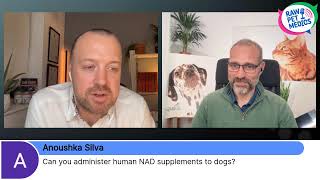
I think so. There's a couple of questions come up on the side. So can we administer human NAD supplements to dogs? Yes, you can. I have done in a few cases. Their metabolic pathways work the same, just you start to waste the product if you go beyond probably a half dose of what's on the label for a human. So I'd just say just You know, don't go overboard with thinking you're going to give them the human dose and a capsule twice daily or anything like that. And so giving them oral medication may be as useful as giving them the eye drops, but there is very little testing, especially on cataracts, other than for the actual eye drops. So do look at LumenPro if you want to know more about that topical. There is a website for the US. And I'd love to hear from you guys if anybody's used it. So cool, have a look.
People want to know where to send these pictures. I haven't thought about that. Do you want to just DM us on Facebook? Would that be easiest? Direct message us the pictures on Facebook? Yeah, we'll break down—
well, I mean, or, or initially, you know what, people are going to be on Patreon, so that's better. We'll be able to message us on that.
That'll keep the quality up. That'll be better. Yeah, let's do that. Just message us on Patreon and send the image there. And Bren's going to go try find that other product in the US or possibly in the EU.
And Caroline Ships is suggesting that— I mean, the other product is a lot more expensive, but I tell you what, £3.50.
Oh, £3.50. Lads, it can't be there for £3.50, is it? I'm getting worried.
The thing that I'm looking at there, it does just talk about dry, itchy eyes. It's not particularly saying cataracts.
No, it's not.
Interesting.
It just found exactly those. The dogs are scaring the life out of me. He jumps in his sleep and he panics. So yeah, but like, I mean, I just typed in lanosterol and those other two ingredients came up straight away in that product. And I was thinking, well, what are the chances that they're reading the exact same thing I am? But if it's there for you, there's a, you know, reassuringly expensive— I mean, there's a reason when you see something with a price tag, it's like €50. 'Oh, that must be very good for me. Oh, I feel great after taking that.' The Lumen Pro is about $50. Yeah, there you go.
'I was blind and now I can see.' You know, but then, you know, to reduce a cataract with a couple of bottles, so $100 worth compared to $2,000 for a cataract operation.
I'm rolling that dice, you know, but I think I'll roll the £3.50 dice first. I love them and all, but come on. Would it work for dry eye in dogs? What's dry eye in dogs? Like, why are your dogs getting dry?
Well, that's an immune-mediated condition, isn't it? So that is the attack of the body on the tear production cells, and therefore you're not producing enough tears. So again, depending on the function of work, there is no reason why it shouldn't. But who knows? I don't think there's been enough testing out there. I think otherwise we'd all be using it, wouldn't we?
Yeah, yeah, that's exactly it. You know, sometimes when things really work, like those, like the bacteria vaccines that Nick was talking about there last week, you know, sometimes, sometimes I think when some things are really effective, like vitamin D, and they're simple and cheap, we don't talk about it for some reason, you know. So I think there is, there's definitely very effective cures out there. It's just trying to find—
thinking a load of eye doctors are going, but I want to keep doing my cataracts.
I love $2,000. What am I going to do if I don't have eyes to work on? Yeah.
I don't want to spend £3.50 on some eye drops for somebody.
I've just made 20p off that, guys.
Got to sell a lot of that to make my money back on a £2,000 loan.
There you go. There you go.
Oh, the suspicion.
It's not my business to keep ophthalmologists in business. Why is there so many big words tonight? Bloody, I'm tired. I was up very early this morning.
Well, Nick's going to be happy that, you know, he didn't have to take care of tonight's fiasco.
Yeah, he'll be happy that we made a Haynes of it at the start as well. Thanks very much for bearing with us, guys. I can see that lots of people came in on YouTube, and we'll post the video. We'll take it from YouTube and we'll post it up on Facebook as well for people that missed it. So thanks very much for that, Bren. You fielded all that. I came very unprepared for that conversation. But if you're on Patreon, guys, again, Send us your cataract pictures and we'll pick a few and we're going to at least run the cheap product. And if we can find this better product or alternative product, we might run a few of them too.
And your wonderful assistant is going to be probably posting on Patreon with a picture of the product and a—
Oh, cool.
Yeah.
Okay. Yeah. This is the product you're talking about. Have you tried it?
No, I think your product.
Oh, my own.
Okay. So that there's a post to reply to and—
Yeah. Okay, cool. Good idea. Let's do that. All right, cool. Thanks, Brian. Appreciate that.
Take care.
Cheers. Cheers all. Take it easy. Bye-bye.










