Dr. Conor Brady, Nick, and Bren break down vitamin E for dogs: two types (tocopherols and tocotrienols), food sources like hemp and sunflower seeds versus synthetic supplements, and why a meta-analysis of 53 trials found slightly higher vitamin E doses linked to increased mortality in dogs.
Chapters
Good evening.
There you are. Hello guys, what's happening?
Hey guys.
So you caught him browsing something else because he was that interested in what we're going to talk about tonight. Thanks, Conor.
I was reading about, reading about AI. I've just been reading about absolutely nothing else for the last 3 weeks, but bloody hell, we just had the last hour and a half of it. As I said, I've got hay fever today. I haven't had hay fever since I was a kid. Uh, so, well, not since I was a kid. Comes now and again, very rarely, but I can feel it in my eyes now and I'm itchy.
So try, uh, homeopathic Euphrasia. Euphrasia, uh, Bright Eye is, is, is, is— I mean, there are many remedies, you have to look it up, but that, that's, that's quite a nice one if it's mainly in your eyes.
Lovely.
I, I've been looking at the AI thing as well. Uh, good evening everybody, by the way. We are going to be talking about vitamin E, we just got a few things to get off our chest first. We're doing it— this is record, so it's actually like middle of Monday afternoon. So it's a bit weird to be doing it, isn't it? Doesn't it feel different doing it live and doing it on pre-record?
Yeah, but Rach, thanks for being there. I know you're on this live, I can see you.
Yeah, you can just see her listening. She's probably walking her dogs going, I think RPM are on. Why do I feel RPM are on? I've forgotten the name of the homeopathic Euphrates.
Euphrates. Yeah. So as regards the AI thing, the best thing that I've come across is a guy called Mo Gawdat. And Conor, you put me onto this guy, and he's— he is all over the internet at the moment. But the really fantastic interview was with Stephen Barrett, Diary of a CEO. Do you know Diary of a CEO? Yeah, that guy. Is amazing.
Yeah.
Anyway, so you've got these two super bright guys in a room having a chat about AI, and it comes down to kind of a— the conclusion— I don't want to ruin it for you— but it's coming whether we like it or not. It is possible it's going to turn into a Terminator-type scenario. That is a possibility. But his conclusion is that we need to be good parents, just as you raise your kids to be polite and know right from wrong and, you know, do all the right stuff. And there's, there's a lot more good people in the world than bad people. So we may well be able to educate AI to do more good than harm. That was the, the sum total. What's, what's your findings, Conor?
So I'm trying to find— I'm trying to do the positive thing, you know, trying to find more positive stuff, because if you go to the negative stuff, YouTube will just keep on giving you, you're doomed, you're doomed. Uh, I think Mo got it, was kind of like he was saying that there's only a tiny window where it might want to kill us, and then after that it'll just be— he goes It'd be like looking— us looking at a tree or an ant and wanting to kill it. We wouldn't want to kill it, but if we wanted to build a data center, we wouldn't ask the trees if we could build it. We would just build it, and they would be inconsequential. Because they— something when it's a billion times smarter, he goes, you can't fathom something being 3 times smarter than a human, but a billion times. He said for every square, it shrinks by a factor of 1,000. So, you know, the, the AI of what it's using now, and then going down to, uh, what's the next stage of computer? Not nano Quantum computing. It's 1,000 times smaller. He says that's not just 1,000 times on the x-axis, 1,000 times on the y-axis and on the z-axis to cube. So he said that means you can get yourself like a billion times smarter and then that computer will rapidly design how to do it tighter than that. So it'll most likely be within years, a few years, like within 5 years, it'll be a billion billion, which is, I assume, getting up near a trillion. So he says like it'd be so incredibly smart that processing power won't be an issue. So how do we move at the speed of light? Well, here's the answer. Here's how he would do it, but he wouldn't be moving us at the speed of light. He'd be moving machines because we can't take it.
Yeah.
So, but I was all this very interesting stuff, but he just said like, you know, get with it because it's happening. And really the only question is, are they going to be good gods? Or, you know, why would they be bad to you? Like, you know, they're just— you're just a Neanderthal. And he says you're— and where he says we're extinct as well. Humans are extinct. He says there's no need for us. And it's— but we will struggle to accept that. But like, any more than the cow or fish does. I mean, it's— I mean, Neanderthals went extinct because they just weren't as smart as us. And that's it. As to become the dominant species. And I thought, oh, anyway guys, happy Tuesday. Sorry, I shouldn't be burdening you with my stuff I was reading over the weekend. Um, but, uh, anyway, sorry I brought us into that. Um, so guys, yeah, you're at a cool thing over the weekend there as well. Nick, do you want to give us a 25-second pitch on why you thought it was great?
Oh, Groundswell. It was, it was, um, it was on Wednesday and Thursday. I went with Fiona Murray and Charlie Lambert, Maudie's lovely husband. Husband, and we were absolutely blown away. We saw presentations from Nicole Masters. I've actually shaken Nicole Masters' hand. She wrote For the Love of Soil, which, if you really want to geek out on soil, and I think you should, then she is just that goddess of soil. She's really— and she's really bright and she's really worldly. If you want to see her just speaking, then Charlie Arnaud about 3 weeks ago did a really, really, really good interview with her. They were on for about 2 hours 20 minutes and they covered everything. And so there's a lot of philosophy in there as well, a lot of swearing as well. So if you're sensitive to that, don't go there. So we met Nicole Masters, we saw another guy who was revolutionizing farming in Sweden. He's a Wiltshire guy. He's gone out to Sweden and he's got 10.5 hectares, which is a pretty small area. And over the last 10 years or so, it is now utterly, utterly productive and making him a fortune because he's, he's, he's growing the soil and he's just demonstrating that you could produce a lot of food and he has chickens and cattle and pigs and what have you, so it is doable.
That's good to hear.
So it's a wonderful thing. If you look on YouTube on Groundswell, you'll probably see some highlights there, and I would say if anybody's even vague— oh, we saw Sally Tobin was there, hello Sally— and if you're even interested, even vaguely, or you know, if you're vaguely interested in regenerative agriculture and, you know, what's going to happen to the planet if the machines don't get us, then it is absolutely for you. I would insist on you guys, you two, coming, and we would have an absolute hoot. The food was to die for, and they had some nice ales as well. And just stupendous. It's the best festival I've been to. I've been to a few festivals in my time and it was the best festival without a doubt, with the most interesting speakers. So yes, there you go.
That was pretty long. Dosing poor Conor up ready for his hay fever and histamine reaction to the ales.
It'll be like, yeah, I'm not sure the ales are going to help my hay fever at all. Any leafy beers just make it so much— I've actually got an on-stage— a sign has come up on my screen there saying on unstable connection. Do you guys have that, or is it just me?
No, it's just you.
No.
Okay, anyway, that's not good.
So Nick's in the middle of Wiltshire with usually satellite connection only. I'm in the very, very northwest tip of Scotland with, you know, the dodgiest sort of Wi-Fi possible.
Conor's at home.
What's going on? I don't know what it is, guys. We are War Pet Medics.
You'll find us on Patreon, patreon.com/rawpetmedics. You'll catch us over there. We do a little bit on the side at the end of each show, and we post a few bits and pieces, and we get your questions out FAQ at the end of each month. But listen, if you can, it's great. It costs you the price of a cup of tea or coffee each month. We really appreciate it if you can. If you can't, not to worry. But tonight we are talking about vitamin E, and I assume we'll get— I mean, Bren, are you going to tell us a little bit about the, the What is vitamin E? And or Nick, looks like Nick's got—
I'm gonna, no, I'm gonna say don't forget the podcast. You can find this episode on YouTube and on all the Acast and Apple.
Yeah, all that.
But you can, you can find the, the podcast so you can take us with you when you walk with dogs as well.
So that's right, spot on. Yeah, so who's going to start us off?
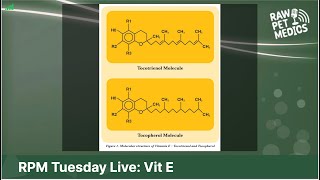
I'll do the very basics. Shall I give the basics? Vitamin E. Okay. Vitamin E, fat-soluble vitamin. And it's fat-soluble. I'm going to show a little picture here. In fact, what I'm going to do just whilst I do this is I'm going to hide these lads because, you know, superfluous at this point in time, but we can still hear them. So we got tocopherols and trienols, which are tocotrienol, sorry, which are both— there are 4 of each which are classed as vitamin E's. So most of us will think of alpha-tocopherol as being the supplement that we will see in the stores, mostly usually in the region of 100 IU, international units, or I think they go up to 400 International units and that sort of area that can range in milligrams. It works out about a third less as the number of— and that's how to work out the milligrams. So take off a third. So 100 IU will be something in the region of 66 milligrams.
Yeah.
There are rats. So that gives you some basics. So because of the carbon structure and those lovely alcohol rings, this is a lipophilic, so it's taken into fats very easily, can work very well on the walls of your cells to try and reduce the oxidation damage that can occur. Really useful for helping our DHA, EPA sort of uptakes as well, taken up in the same sort of lipophilic ways through the intestinal wall. Lots of discussion just before we came on even about the benefits of the different forms, different isomers of vitamin E, and those isomers which are, you know, will be these different, slightly different structures, and the tocotrienols are the ones with the extra 3 double bonds, so the covalent bonds within them. Nick, I think I'm going to leave the next bit to you because you have some interesting information with regards to why that structure might be useful.
Yeah, yeah. Okay. So when you look at the structure of vitamin E and there are over 120 different isomers, okay. And most of the supplements will contain TOPs. 10 or 15 of those. Okay, so we— I have to say, we are slightly unsure as to what to recommend, but I've been doing some research. There's a fantastic researcher called Barry Tan, B-A-R-R-I-E Tan, and he's— he's— if you put Barry Tan into YouTube, you'll— there's lots of— lots— he's done lots of interviews, and he's kind of the god of vitamin E. And he said that if we compare tocopherols— that's the one that we all know about— and the trienols, which is this one that he discovered in the mid-'90s, he says that he thinks that the, uh, the tocotrienols are more compact than the tocopherols. If you imagine a balloon blown up with a piece of string, and there's a weight, a small weight at the bottom of it. That's kind of what— and it's floating in the sea. That's what the tocopherols and tocotrienols look like, okay? They sit in the fatty membrane, and they kind of wander about. But because the tocotrienols are more compact, they're able to actually move around much more effectively. And so he considers it that they are a much more effective antioxidant. That's the big thing about, um, of vitamin E. It's an antioxidant, it's a stabilizer. If you leave a bit of butter out in the, in the sun for a couple of hours, you come back, you can smell that it's gone off. That is oxidation. And aging is an oxidation process as well. But what he does, what he says, is that, um, 1 in 10,000 oxygen molecules— and let's face it, when you take a breath, you're taking in billions of molecules of oxygen— 1 in 10,000 goes rogue and becomes a free radical. Okay, and free radicals are really reactive and really damaging. And so what the body has very cleverly done is it puts these, these, these balloons, these markers which float about within this slightly dynamic bilayer protecting every cell in the body. 38 trillion cells in your body and they've all got this. So it's a really important one and the body uses the vitamin E to scavenge the bad guys so as to not damage. Because he describes it, the cell, as a gated community. Nutrients have got to come in and waste products have got to go out, and that has to be very carefully regulated. And so they're basically the, the policemen of the cell wall, which is really fascinating. And so I'm going to do a bit more work with the trienol story, but it sounds to me like the trienols are safer and more effective, but this is work in progress, so I'm not gonna say too much at this stage. Um, Conor, what have you got?
Yeah, um, you know, I'd be so surprised if, um, if each one of those bits you mentioned— over 100, I'm shocked. I thought it was like, uh, 30, and they had about half the molecule. I think what I took from that was that they're only producing a very small fraction of what vitamin is, this incredibly complicated, you know, all these different bits and pieces to it. And so they pick the bits that they can replicate in the lab and they promote those. They study them very well and they find out what they do and they promote those as really important. So when you look at— so you want mixed tocopherols and tocotrienols in your supplement because assuming the more of that molecule you have, this amazing antioxidant, the better. And so it'll say of the tocotrienols, we have these 4 subgroups: alpha, beta, gamma, whatever. We've got two of the subgroups and that's the— seems to be the most popular one on Amazon at the moment, just as a quick guide, as you know, picking. So I often think, okay, what's missing? And so when people, when they have a look and see, well, how important is like vitamin E, you can only imagine if it's that important, we need a good bit in our diet and the best source is food. And it won't surprise anyone listening that real vitamin E actually, when you supplement with a supplement vitamin E, that's actually quite well absorbed by the body. The body does not like mineral supplements ever. It doesn't like any of the crappy calcium and zinc oxide, magnesium, no matter how well you try to do it. But vitamins, some of them are taken in extremely well, to the point of danger to the body actually. You can over-supplement with vitamin D, it can lay you out. With vitamin E, that's one you don't absorb very well, so the food source is way more potent. And because you're just after a holiday and it has all the extra bits, it's probably way more beneficial. Anyway, here we are with this vitamin E supplement, but when they look at the vitamin E supplements as we have them. It's not a very— it's not a good report card. Overall, this is an enormous study, okay? The title was— I just left the title out because it was horrible, but this is what it was. It was a comprehensive review of 53 RCTs, randomized controlled trials. So they're the top-level studies that we have where you have two groups and you mix and match them, you don't know who's who, and one gets a placebo, one gets vitamin E, and with low risk of bias, including almost a quarter of a million participants. And what they found from dosing these people over 12 years, vitamin E in a dose slightly above the RDA versus placebo, which was 44 studies and 170,000 people, significantly increased mortality. And I was like, what? I had to read that a number of times. You're more likely to die if you take vitamin E supplements slightly more than the RDA. Why is that? That is very strange. Different absorption ability, the fact you're just putting in one part of the molecule, who knows? The body doesn't seem to like it. And a colossal study by the US Preventative Task Force combined every single study citing the benefits or lack thereof of vitamin and mineral supplements— this is just as a whole vitamin and mineral supplements— included 450,000 Americans and found that with the sole exception of reported lower incidence of 2 cancers in men, offered no consistent evidence of benefit for heart disease, cancer, or longevity. In fact, often showed the opposite. I was like, bloody hell, that was— that's a huge— they're huge figures. But for vitamin E, it was one of the poorest. It was like, if you don't take the right dose of vitamin E in the supplements we have at the moment, they are actually counterproductive. And I thought, wow, so it's not just as simple as take as many of this specific part of the antioxidant that they found. So it pushes you more towards, oh, is my dog getting enough from his diet, or what's going on?
What do you think? Do you not find that that is the situation we have with some of these studies where they may have taken the alpha-tocopherol and assumed that that is the archetype vitamin E?
Yeah.
Tested just that within that paper. Yeah. And then they come up with an inconclusive. There was a huge list on one of the doctor websites for We have looked at studies to do with vitamin E and it's shown not to be effective in— and then just listed off a whole raft of things that you would associate, you know, something that's going to reduce oxidation of cells, it's going to reduce inflammation, it's going to help the uptake of and use of fatty acids. And then you think, is that because they've used it in isolation? It's not put in with selenium, it's not being used alongside, you know, the DHA, EPA. Or is it that actually they've just chosen the wrong isomer, that they've created an artificial vitamin E and then tested that and they come up with this, this, this picture?
Yeah, sure.
Guys, when they, when they ask Barry Tan, what supplements do you take? Which is a really good question to the world's leading expert on vitamin E. He says he takes a mixed mineral and vitamin without tocopherols. He takes about 100 milligrams of trienol vitamin E. He takes fish oils. And, and that's essentially the top 3 things that he takes. So that's pretty interesting. He doesn't take tocopherols. Whoa.
Yeah, it's really interesting because, yeah, again, we're talking about supplementing here. You know, minimum levels are easily exceeded in most pet foods, you know, in raw foods just because it's going to naturally be in the tissues, in the artificial foods where they're actually putting in them as an antioxidant anyway. So you're easily going to exceed the minimum levels of, you know, basically around about 4 to 5 units per 100 grams dry matter. You know, it's ridiculously low. There's very little found on insufficiencies. I mean, one of the names around it was the tocopherols was all about the fact that it was about fertility. Yeah, that vitamin for fertility. And it's you know, then going on to looking at its benefits for brain and other tissues of the body and its antioxidant levels. But what we're finding is that there's not really an excess level that's been discussed. You know, there's not a where do you go with the excesses? Because with a lot of the other fat-soluble vitamins, because they're fat-soluble and not easily got rid of, we would find that there'd be lots of issues. I think there's a lot of recycling of the vitamin E within the system. I think there is this really interesting point of at what point is the natural foods going to give us that different approach with all the trienols, the tocotrienols and things like that in there versus an artificial supplement. And then it's really interesting, you know, you talking about his approach to supplementing, you know, and taking those tocotrienols rather than the tocopherols. Yeah, I think I have seen patients that improve with the tocopherols, you know, to help with their skin issues. I've tried it myself where we've been using DHA, EPAs and only got so far with skin improvement and then brought in vitamin E alongside that and seen a massive jump further in their health. Giving them, you know, typically the 100 international unit at least supplement into their food for a 10-kilo dog. And, you know, sort of like, you know, being cautious, but not really seeing that there's been any ill side effects and certainly none reported. But it would be interesting to see if actually we can improve even quicker or even more by actually using some of the tocotrienols instead. Have you found a specific supplement?
I haven't, no. I will, I'll have a look and I'll post it up into Patreon. Yeah, no problem.
Regarding the fat-soluble vitamins A, D, E, and K, they're the fat-soluble fellas. In other words, if you take too much of them, the body holds on to them and it can poison you, whereas the water-soluble vitamins, your body's more keen to pass them out, more able. And so it's very important that we don't have a maximum, particularly in light of the fact that if you just go over your slight recommended dose in humans, it doesn't look great. And so what is the maximum? In regards to like deficiencies, there's not a— like when you look at the deficiencies that dogs are most common in, it's always things like zinc and B vitamins and all sorts of stuff that we know is terribly absorbed or plummets very quickly. But vitamin E passes out of the food very quickly. Authors stored a variety of dry dog foods for 12 months in warm temperatures. They noted that dogs would opt for the dry foods preserved with BHA, which is a nasty preservative, although the food industry might disagree, but they're trying to get it out of the food industry, so that's all you need to know. They would choose products preserved with BHA rather than those produced with mixed tocopherols. So what natural pet foods will say is we don't use BHA, BHT, and it's like, well, how else do you preserve your dry pet food in the warm, sweaty holds of a cargo ship and shipped from wherever it goes to sit in a horrible pet shop because as soon as the fats go rancid, the dog smells the rancid fats and they don't eat it. So they'd rather eat chemically preserved fat, which BHA and BHT are brilliant at. Unfortunately, they give you cancer down the line, but the dogs avoid the rancid fat in favor of those. So what is a natural preservative, and will these companies, knowing vitamin E is not great, use lots of it to preserve, which no doubt happens? There's 2 or 3 there's 2 or 3 diseases that you guys treat all the time. One is pancreatitis. So as the fat rises in the dog, you know, with pancreatitis, you feed too much, usually carbohydrates. If it's nutritionally caused, you feed lots of carbs, you don't burn your fat, fat builds in the blood. And so vitamin E is called upon to sort and deal with all the fat, as Nick was saying. So what happens is with dogs with pancreatitis, they're very prone to a vitamin E deficiency.
Okay, and he's frozen. Oh, lost that. Just give us the last 5 seconds there, Dr.
Conor Brady. But so with dogs with pancreatitis, it's one thing to check is that you may be low in vitamin E. So a small little supplement of vitamin E, we can get to what we might use food-wise in a minute. But so that was— oh, here's another one. In dry pet food storage, Yeah, he's definitely unstable. Am I frozen again?
Yeah, you froze, mate.
I was terrified he was going to freeze in mid-phase.
Yeah, look at the last one, canine atopic dermatitis. 29 dogs with canine atopic dermatitis, 15 given vitamin E, 14 given a placebo, and the ones given the vitamin E had significantly improved canine atopic dermatitis extent and severity index scores just by giving them vitamin E. So there's definitely also higher plasma levels of vitamin E are observed and higher total antioxidant capacity just by giving a little bit of vitamin E to dogs with canine atopic dermatitis. And retinal stuff, there's a few studies in dogs that are very— hunting dogs with retinal degeneration, and they're just being fed table scraps and no vitamin E. So there is some diseases from a deficiency of it So again, it's just hard to know how many dogs, you know, it's tough, but that's the bit I had on that.
Those diseases of inflammation like pancreatitis that actually benefit from increased levels, they're not truly because of a deficiency though, and that's the thing because, you know, if you look at what deficiency should bring, you know, with the infertility, with the sort of mental sluggishness, the skin diseases, I wouldn't say that they're necessarily always obviously going to be primarily because of vitamin E deficiency. I think there's a lot of inflammatory process goes on which predisposes, predisposes you to those diseases and actually supplementing with vitamin E improves the situation rather than it being truly a deficiency. So your recommended daily allowance, I bet daily requirement actually increases rather than actually you becoming deficient.
Yeah, that sounds right.
When we talk to Barry Tan, he says that he will use it for inflammatory disease, which is basically every modern disease. He will use it in for Alzheimer's and cognitive problems, and he is looking at it from a cancer perspective. Because if you think of it, if 38 trillion cells, they need a lot of support. And if every cell in the body needs protection, any disruption to that, if you've got a lot of inflammation anywhere in the body, it's going to utilize a lot of your vitamin E or your trienols or tocopherols. And that's maybe why you, you need that extra, as Bren was saying. So this— it's a fascinating area, and I'm going to be using it a lot more from now on. So this has been a very useful session for me.
I was also thinking, because we talked about vitamin C, you know, a couple of months back, you know, we've done, done these, and some of the benefits and antioxidant effects and the anti-cancer, etc. But the more I look into these individual things. They all have a role to play at various different levels, and actually having a better mix is always a better option than just going, you know what, I've heard RPM talking about vitamin E, I'm going to go out there and just supplement vitamin E. I think you need to start looking at how your whole nutrition for your pet is coming in to, you know, giving a little bit of everything at different points, you know, peaks and troughs, going through all of those so that we're actually getting benefits. And we need to talk also in this session a little bit about the foods that deliver some great levels of vitamin E as well to your pets. Conor, this must be your bread and butter. You know the foods that are going to deliver good levels of vitamin E. I have a few.
Yeah, in relation to what you're saying there, Rita Hogan there is a canine herbalist of some renown in the US, and she always goes mad about not mad, but, you know, the extracts, say, of milk thistle, silymarin, is one of the cool compounds in milk thistle. But she says it's one of hundreds. It could have any untold number of complexities going on. And we find one in the lab that does something to a certain mouse for a certain amount of time. And we say that's the magic thing about milk thistle, but it's a whole complicated structure. And so, yeah, food sources is surely the way to go. Here's the dose of what they recommend for keeping it in America because the AAFCO comes from America who govern dogs. Americans are recommended to take 22 international units of vitamin E per day, whatever that is. They actually say tocopherols. They say 22 international units of tocopherols. Let's just say vitamin E for the sake of the conversation. That's 15 milligrams of vitamin E. That's where humans are. AAFCO say for dogs, who, okay, should be taking 50 international units of vitamin E per day. Now that's an average dog. You've got big dogs and small ones and whatever. We're just going with some ballpark figures. So dogs should be taking—
That's a 10-kilo dog, isn't it?
I don't know what the average is, probably, what, I don't know. Yeah, let's say 10 kilos. Why would a 10-kilo animal need, you know, double the amount of vitamin E than a 65-kilo largely plant eater, you know, plant and meat eater, and here's a carnivore? Because when you look at the food sources for vitamin E, it's— you've got less vitamin E. Very hard for people— am I still coming through?
Can you still hear me?
Oh God, it's so annoying. At least my Zoom recording will be good, actually. So yeah, I'll let Nick, I'll let Pete sort that later, so I'll just keep talking like you are moving on my screen. But so when you look at the food sources of vitamin E, it's hard for me to just to find a lot of vitamin E. It's easy for us because the food sources of vitamin E are invariably things like seeds. Seeds are the best, okay? Seafood and seeds are great sources of vitamin E. And so for example, pumpkin seeds or sunflower seeds— everyone says sunflower seeds, but you could go pumpkin seeds either, it doesn't matter— they give you 35 milligrams of tocopherols per 100 grams. Now that's 8 tablespoons of, uh, of— so you wouldn't want to be trying to top up your dogs if he needs 35 milligrams, a 10 kg you wouldn't want to give them 8 tablespoons of pumpkin seeds, the poor thing. But that is what AAFCO is saying dogs need every day. And actually, an even better source of vitamin E, if you're going after vitamin E for source for your dogs, you would use hemp seeds. Hemp seeds are 55 milligrams, they're the highest, 55 milligrams of vitamin E per 100 grams, which is about 70 international units. So that's quite a lot just in 2 tablespoons. So hemp seeds are very, very effective, but it's a hard way to feed too many of them to your dogs. You can use hemp seed oil, but there's only so much hemp seed oil you want to give to your dog. But when you compare these figures, these figures are 35 and 55 milligrams per 100 grams, or 100 to 150 milligrams of vitamin E per 100 grams of hemp seed oil, which is a huge dose of vitamin E. And when you compare that to meat, 100 grams of grass-fed steak contains 1 milligram of vitamin E and dogs need 33 of them. So he/she needs to eat 3 kilos of meat. The sardines or rabbit is only 2 milligrams per 100 grams of meat. So that's a bigger in— that's a, you know, an intake of a fair whack of sardines and rabbit to meet your minimum kind of standards. But chicken is one of the highest. Now that's probably intensively reared chicken because of what chicken's fed. Chicken is reared on wheat and corn and stuff like that, and that would have more vitamin E in it. So this meat is naturally higher in omega-6 and vitamin E because it's intensively reared. So intensively reared poultry does contain quite a lot of vitamin E, so you'd only need to eat 300 grams of chicken to get your vitamin E. But if your dog was just fed on beef or just fed on lamb or sardines or rabbit, you wouldn't get close to the AAFCO nutrient profile of how much vitamin E a dog needs. So it does come down to the question of, is the AAFCO nutrient profile correct? Because that dose seems extremely high. In fact, only one prey animal comes close. No prey animals— mice, lizards, rats, frogs— all way too low in vitamin E. Great study there if anybody wants it. I've got all the prey animals and nutrient content of prey. They just got the mouse and stuck them in a food processor and just analyze its nutrient content. And so it turns out that the AFGO profile seems extremely high, and it'd be hard for a dog to do it without adding in. So when formulators are making pet food, they have this big vitamin E deficiency because of what AFGO, who are used to dealing with dry pet foods and the horrible crap vitamin E they put in there, which isn't absorbed as well as natural vitamin E— in fact, farm animals and humans can absorb twice the amount of vitamin E from natural food source sources than they can from tocopherols. So I think that the African nutrient profile is way too high, and people— it makes people put in slightly stranger ingredients. Like, you would put in hemp seeds, you know, you put in ground-up hemp seeds, fabulously nutritious, but, you know, just— I did— it wasn't my plan when I was making the raw dog food, but I had to do that to keep somebody happy, you know. So that's the tricky bit. That's the tricky—
I think I'd like to also just come in on that because on my, um, some of where they get the, the actual reports to put into your formulator, that nutritional data is not correct. They are not up to speed with what the levels of certain vitamins and nutrients are within those products. You know, having tested other foods, looking, you know, for the companies that I've worked with there are definite deficiencies that are reported on the formulators. But when you come to look at the end product, they aren't there.
You know, so interesting.
So I think there's two things that you got to look at. One is the fact, again, you're talking about tocopherols, not necessarily the whole vitamin E profile. And two, you're dealing with a formulation from a company that's made up from a load of food formulator people that are producing dry foods and looking at how to preserve their foods and are happy that there is actually a way of artificially preserving their foods by adding vitamin E as an additive to their feed. And of course, they're quite happy that the levels have to be reasonably high to maintain their food from going too rancid. So I would just I would take a breath on that thought process that animals are not sufficient in vitamin E.
I don't think, I don't think they're deficient.
How would, how would those individual animals function if they were deficient in vitamin E?
Yeah, yeah. No, I definitely, I definitely don't think the meat is the problem. I definitely think that what they believe needs to be in the mix is the problem because it's, you know, vampires guarding the blood bags. It's what a dry food manufacturer says food is supposed to look like. What's that got to do? We do.
The thing is, AFCO are in cahoots with the big dry food manufacturers. They all sit around a table, and therefore the dry food manufacturers who know they have to use loads of vitamin E because the fats are going to go rancid because the bags are on the shelf for years and years, I bet they are pushing those up as much as possible in order to justify the fact that their product has got loads of potentially unreliable tocopherols in it.
And we know that's a problem.
It's potentially a problem. So I think that for me, the thing is, let's feed real meat, let's feed nuts, herbs, and seeds. You know, I go on about this NHS— nuts, herbs, and seeds. I think it's really important to, to, to get as much of your nutrients from the food that you feed rather than from supplements. Um, but, uh, and yeah, there you go. I, I did have another thing, but when you were speaking— oh yeah, if I, I imagine if it was regeneratively, uh, fed cattle and sheep and pigs, I would imagine they're going to have a higher vitamin E because all the nourishment coming into them is going to be you know, as good as it can possibly be. So Conor, did you say that pasture-fed meat has only got 1 milligram per kilo?
Yeah, pasture-fed steak, that was, that was in honor of you, Nicholas. So I tried— that was a UK figure, 1 milligram of whatever per 100 grams, compared to chicken, which no doubt is intensively reared, is 9 to 12 milligrams.
Yeah, that kind of makes sense. But the other thing is that I've completely forgotten what I was going to say.
What are they coming into that moment? Because we talked about this last week, Conor, when you were talking about the berry that if it's really challenged, has a much higher level of antioxidants to help itself out. So I'm just wondering, I'm not quite sure it's the necessary— the nutrient value that you're talking about, Nick, as the ease of those animals that are out on pasture, as much as there are ways that that body is adapting to the challenge and making sure it's got enough vitamin E on board to cope with all of the other herbage that may be coming through. You know, just to stick another alternate thought in there is to—
I think it's a great thought because, you know, our our animals, cattle and sheep for example, we know that they have nutrition wisdom. Yeah, Fred Provenza talks about this. They will pick, but if you're picking a certain plant because it's got a lot of polyphenols in it, it's also going to have other elements in it which may have a toxic load. So I completely agree, Brent, that it may not be from the grass itself, but may well be because they are defending themselves from oxidizing principles which are within those herbs that they're getting. Because they're going to be being— if they're pasture-raised as opposed to grass-fed, big difference. Yeah, pasture is many, many different herbs.
At the end of the day, the end of the day, it's actually, you know, we're back to herbivores truly aren't herbivores. Herbivores, they're bacteriovores. They are— the bacteria are producing their nutrients, you know, and those bacteria are feasting on what those animals are taking on board. You know, I think this is a big illusion that, you know, we have a lot of plant-based people believing that the plant-based food is what's feeding the animal. No, actually, you know, for those herbivores out there, but actually it's not. The herbivores are taking on board, you know, ferment material for their bacteria. And it's the bacteria that are producing all of those wonderful nutrients that build their strength, that build their immune system. And you've got to have the ability to ferment that material. And that's great if you're a cow with 4 chambers to do that. It's great if you're a horse with a huge cecum to do that. It's great if you're a rabbit with a huge cecum to do that. If you're a human, yeah, there's, you know, the large bowel can do it to some degree. Okay. But if you're a dog or a cat, there just isn't that chamber that can have time to produce that level of nutrient from that. So we're going off on another track because that's back to plant-based and the weakness of. But I would then come back to, yeah, the challenge to those bacteria from being out there as to how they can produce more vitamins and improve all of that coming through to the end animals.
Yeah, dogs, I suppose, are whole prey eaters as well, and so they're eating the good contents and the little intestines of the smaller animals. And so there surely is a lot with that. I don't know if bacteria produce vitamin E though, do they? Is that not one of the ones that they don't do?
It's all of the volatile fats. Plants and stuff. So where else are those herbivores going to get it? They don't go out oil eating.
Yeah, yeah, yeah. So, uh, I saw a final report there from 2020. Ireland did a report on, uh, the difference between grass-fed and barley-finished, and, uh, there's a nutrient concentrate that they put into cattle. I don't know what it is, but there was 3 different types of cattle. And at the end of it, um, compared to a concentrate-fed beef and the other type, grass-fed beef had a highest concentration of all of everything— sodium, magnesium, um, calcium, manganese, iron, copper, zinc, selenium, vitamin E, cholesterol. So grass-fed came out.
Okay, that's really fantastic. The other thing, um, at Groundswell Festival that I was at last thing, there was a wonderful speaker from the States called, uh, Anna Bickle, B-I-K-L-E, and she's written book called What Your Food Ate, and with her husband David Montgomery. And she put up this wonderful slide of, of, of a diagram of a, of a cow with the rumen and the gut and what have you, and said, this is plant-based food, pointing at the cow. Yeah, because they are plant-based. Yeah, so, um, it just reminded me when you were talking about the, the plant-based thing.
So, uh, yeah, yeah, it's true, you eat the plant-based machine, and that's, that's close to vegan as most people are going to get. There's a big study on grass-fed— I mean, none of this is surprising now— a big study on the antioxidant content of grass-fed beef versus grain-fed beef in the US. Grass-fed beef just dominates on every single thing you can think about. Unfortunately, palatability can struggle sometimes because everybody is getting used to the marbly fatty kind of meat that is animals fed this with these ridiculous, like, you know, grain diets. And so you kind of get used to that. That's tasty. But, you know, that's a different conversation. We were just talking about the nutrient content, the oxidant ability. So yeah, it's interesting. So it just goes— again, the vitamin E thing is a big problem because we're trying to fit in with this. And we, no matter how sensible you try to be by showing them the studies of cattle and humans where we're twice— we absorb twice as much vitamin E from food sources, it doesn't, it doesn't matter because I've had to deal with FEDIAF before, well, with the Department of Agriculture, and they say no, no, it has to look like these AFGO figures. I'm saying, well, it doesn't need to for vitamin, for vitamin E or zinc because you absorb 4 times more zinc from your food. And they're just like, it has to look like that if you want to say complete on your food. It's like, well, then I'm not going to go— well, then you have to say complementary. And people then panic when they buy your product. So it's a tough one for manufacturers to be in, but what we need is Bren to publish those figures. Bren, you need to go and get those figures and compare them to 2 or 3 formulators, you know, and say this is the actual nutrient results of these mixes. This is what the formulator said was going to be in it, and this is what's actually in it. That will be a very well-shared article. We need that.
Could I also then say, you know, you're asking which bacteria produce vitamin E. So basically, yeah, there are a couple out there, including E. coli, which actually can produce 15 micrograms per gram of gamma-tocotrienols.
Oh, and dogs don't mind having a bit of that. Outdoor-reared cats, little bit of E. coli, suddenly it changes how much Vitamin E.
Oh my God, there's Sinica cystus and, uh, what's going to be the A. thaliana, uh, that, um, also will produce, uh, those tuckatrainals.
That's interesting. Wow, people here, people hear E. coli and they panic, but it's not like all of them are, you know, yeah, it's only the toxin-releasing ones which issues. Yeah, 700 different types of E. coli, only a handful, um, tiny, tiny handful are actually ones you don't want, and they're all coming from, yeah, intensively reared cattle, you know.
Same as the salmonellids, there's over 2,000 different types of salmonella, and again, only about a dozen are actually toxic.
And they go, they get— that's mad.
So I think that you will go through each of those nutrients. Let's talk about the ones which are the amine groups, okay, the vitamin groups. And you will find that bacteria will build either the building blocks for them or the actual product for those herbivores to actually use.
Very interesting.
It is, guys. How are we doing for time? Because we could talk about this stuff all day.
Yeah, 5 past 5. I've got a child, I've a child to pick up now down in Crashy poo. So I'm not sure I'm going to be able to do a bit on the side. Are you going to do a bit on the side?
We can do that. We can do that. We'll do that.
Okay.
We'll just put 10 minutes on.
Yeah, no problem.
So thanks, guys, for listening. If you want to listen to a little bit more, then please do follow us over on patreon.com/rawpetmedics and join us over there. We'll be talking a little bit about maybe some of the supplements that are actually out there, what we choose, a little bit more about other thoughts come the summer. And thanks for your time. Hope you've enjoyed this episode and you've had a good chat alongside us whilst we've been talking to ourselves.
Yeah.
Cheers, all.
See you later.
Bye-bye.










