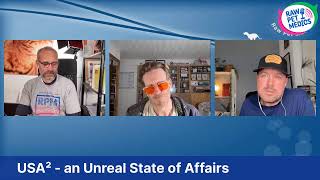
In this conversational podcast episode, the Raw Pet Medics team—Nick Thompson, Dr. Brendan Clark, and Dr. Conor Brady—recap their recent multi‑state tour of the United States. They begin with reflections on the high cost of food and drinks in San Diego and Chicago, noting how American prices felt inflated compared to the UK and Ireland. The itinerary was meant to include talks in San Diego, a conference in Orlando, and a stop in New Orleans, but Hurricane Milton forced a last‑minute cancellation of the Orlando event and a rapid reshuffle of travel plans. The hosts describe their experiences in New Orleans nightlife, a memorable bar on Frenchmen Street, and the vibrant atmosphere of the Feed Real Summit in San Diego. They then detail a four‑state driving tour—Louisiana, Mississippi, Alabama, Florida, and Georgia—highlighting a visit to regenerative farmer Will Harris in Bluffton, GA. Harris’s practices (self‑select mineral licks, dung‑beetle soil aeration, breeding for parasite resistance, high‑density rotational grazing, and compost integration) are discussed in depth, illustrating cutting‑edge regenerative agriculture. The episode also includes anecdotes about forgetting a driver’s licence, car‑rental mishaps, legal limits on alcohol consumption in vehicles, and cultural quirks (pronunciation of “New Orleans,” US vs UK hurricane perception). Throughout, the hosts promote their Patreon, encourage listener questions, and tease future content. The tone is informal, humorous, and enthusiastic, with occasional reflective moments about climate events and the value of regenerative farming.
Chapters
Here we are, back from the United States of America. Greetings, we are the Raw Pet Medics, and, uh, we're going to talk to you about our adventures. And boy, did we have some adventures. I am here with Dr. Brendan Clark and Dr. Conor Brady. I'm Nick Thompson, and you can hear this gloriousness on podcasts, on whichever podcast you choose to mention. You can find us on Patreon, and we really thank all our Patreon supporters. You can go, just go to Patreon and type in Raw Pet Medics, and you can, uh, you can support us there for the cost of a cup of coffee, a mere cup of coffee per month. You can help us keep the lights on and allow us to do all sorts of things that we wouldn't otherwise be able to do to help you, your dogs, and the world.
And if you're really generous, you'll donate— you'll donate the price of a coffee. Oh, well done! Yes, thanks, Conor. Donate the price of a coffee in LAX airport.
Oh yeah, which is about what, $12 or something?
Oh my God, I had the world's most expensive pint in Chicago O'Hare. Um, like, I mean, we do— we go up to Helsinki a good bit, you know, so it's, um, actually what we're used to. Yeah, it was $13.50 and it wasn't even a full pint. You know the way they give you the pint glass but it's like it's short and it's like you can never do that in Ireland. It's like, why did the tide go out? Just, you know, top it up. Uh, so for a short pint, I I paid $13.50 and then I had a tipper. So I spent $15 on a pint in Chicago. I wouldn't let myself have a second one. I'm that mean to myself.
And then because we discovered that Conor managed to forget a certain driving license in LAX, he was sweating over what was going to happen when we landed in New Orleans. So he bought us all around. And what was that, $50 for the 3 pints?
No, we bought—
we had the guilt money.
We had 3 pints and 4 rolls. We had 4 rolls because Eddie was there too. And, uh, so we had 3 pints and 4 rolls for lunch, and the total bill came to $145. $145 for 4 rolls and 3 pints. I mean, I mean, I'll never moan about the prices in Ireland again. I mean, the pints over here can be expensive. You might spend £21 on 3 pints. You'll spend €10 on a roll maximum, and that would want to be a really high quality roll. You're talking about €60 for a decent lunch, 3 pints of bread rolls here, by the way. Yeah. I mean, it was just, oh yeah, that was a fit. And even San Diego, guys, San Diego was very expensive. Everywhere in San Diego was expensive.
I thought it was expensive everywhere, actually. I thought, you know, I thought the cost of living in the States was supposed to be quite low, but they say over the last 4 years or so, it's increased by about 25%.
It feels like that. And everything from the from the meat. But mind you, I do like hanging out in the cheap. I like the dollar, dollar buy kind of supermarkets. I like that stuff. And I like the tatties. And I like going for little tiny little toys and stuff for the kids. So I was hanging around the cheaper supermarkets. And then we went into that enormous off-license on the way to whichever gig. And the prices of the booze actually was quite, quite reasonable for the beers that we bought there. So I think maybe we were just going from tourist spot to tourist spot and getting caught for it. I think that was—
yeah. And San Diego is pretty, pretty shishi. So that would be why the prices are so high there.
Yeah.
That would make sense.
Very cool spot, San Diego. Lovely feel to it, lovely vibe.
Yeah, very much so. So what was your highlight? So, so, uh, I'll just give you an overview of what we did, guys. Okay, so we were meant to go from, uh, San Diego, we were doing some talks there, to— and it was very simple— then we go to New Orleans, then we go to see Will Harris in the southern part of Georgia, and then we were just gonna take a little tootle down to Orlando to see, um, Dr. Judy and do some talks there and have some fun and what have you. Very simple, not too demanding, very simple. But what actually happened is Hurricane Milton came whooshing in from the southeast and meant that they had to cancel the, the, uh, event in Orlando, in Florida, in Orlando. And so we had to go with 2 days' notice. We had to completely rearrange what we were going to do. So we went from New Orleans If you've never been to New Orleans, you must go to New Orleans. And then we went to southern Georgia to see Will Harris. We'll talk to you about that in a second. He's a wonderful man. And then we went to see the wonderful Nikki Kamek at the top of Georgia, uh, and then we went from there to see, uh, the lovely Andrea— can't remember her second name— who runs a really great nautical dome.
Amanda Wilborn.
Amanda Wilborn. Yeah, from Amanda Wilborn, who's very generous and looked after us beautifully. Yeah, she's in Williamsburg in Virginia, which is really beautiful. And then we spent the night there and then we zoomed up to Philadelphia and we picked— we dropped the car at the airport there in Philadelphia. And then Chris came and picked us up and took us to my brother-in-law, Ellie's brother's place, where we linked up with Ellie again. We had a lovely evening. With them. We'll talk to you about that shortly. And then we all— oh no, and then Bren went home with Chris and Conor and I stayed over and then we flew out on the Sunday. It was all a bit of a whistle-stop tour.
Didn't quite go home. No, we went off.
The opposite of going home.
We went then down to the coast. We went to a wonderful place called Ocean City. This was a— so this is actually a mistake, a different Ocean City to the one that Chris thought was quite close Philadelphia, and actually we ended up in Ocean City, Maryland, which is actually home of an ancient car racing game. And we actually turned up on a day where all of the hot rods and everything else were gathering up and down the main strip for some car show. But yeah, it's like the prelude to Grand Theft Auto.
Nice.
So there's cars everywhere. And then So we had a bit of a trip down to see the wild horses down in Northern Virginia, which is on the outside of the estuary. And that was quite an interesting little trip out on a day. And then we drove because we're not tired of driving, drove up to Lancaster, okay, to visit Billy Hope's home and visit some of the farms. We'll talk about that a bit later. And so yeah, only got back on Sunday. So went from one stormy country back into Great Britain that was having a bit of a howler with what did they call this storm that's just blown through?
No idea.
Well, in the UK, it didn't know that we had.
We named it. Yeah.
Really? God, no, no.
Andrew or something.
Storms over here though, you know, a few wheelie bins are fall over. I mean, when the hurricanes hit Florida, like it was a real eye-opener because we were getting messages saying, guys, don't go into Florida, take this very seriously. We were batting it off for 24 hours thinking, well, it can't be that bad because we don't grow up in a land with proper hurricanes. You know, we all remember Hurricane Charlie, a strong wind, and again, picking up your wheelie bin in the morning, bloody wind. And that's about it. That's about all the inconvenience we have over here. But the hurricanes build off the top left of Africa and move across the ocean and the Atlantic. And so they build and build and build. By the time they hit the Gulf, nice warm water, boom, they head inland. And so it was at one stage a Category 5, which is devastating if it hits land at 5, but it dropped to 4. And honestly, I was so naive that by the time I dropped to 3, I thought, let's go, let's do Category 3, who cares?
And like, and diminishing.
Oh yeah, I just thought I was walking around, I was gonna say my hair would be blowing, but that one's stronger.
Okay, you might lose your hat.
Yeah.
So is Cat 3, is that pretty bad? Even Cat 3 is pretty bad.
Cat 3 left 3 million people without power, took the roofs off like tens of thousands of homes. I mean, devastated the center of Florida. And the one previously that hit Georgia, was it Georgia?
North Carolina? No, Helena. Helena.
It was the first time a hurricane had hit them for a long time. They weren't expecting it. Because it's the end of hurricane season and they don't normally hit where it's up a little bit above Florida. And that killed, that killed 260 people or so. And so they just weren't ready for it. Whereas, um, so Florida and the stories you hear from these poor people in Florida, like, it's very real because you're a little bit, um, totally out of— you don't understand what it's like for these people. But they're in zones where some insurance companies will step off and say, look, we can't insure your home because the roof is coming off again next year when the hurricanes hit. And so this can be people that don't have a lot of means that need a home, and they'll move into these areas because they can afford to live there for until the hurricanes hit. And so lack of house insurance is a major problem because who's going to insure it? I don't even know if there is— I assume there is hurricane damage insurance because over here we'd call it an act of God. And, uh, you know, so I'm not sure. I know a lot of people are in an awful situation, but in that part of the world it would be astronomical.
Yeah, because, yeah, you know, every few years you're bound to get—
that's just gone. Yeah, yeah, so it's, it's a very real, very real issue. So, um, but yeah, so, but anyway, look, everybody we know was safe. It was the right thing to do to cancel the gig. So that must have been a lot of stress for the Morgans. I mean, my God, you trying to get something that size, 500 people sitting down, many more than that with trade stands, people floating around, it was a huge amount of stress involved in it. So, uh, difficult, but everything's okay. And that's the real thing. When you see the devastation, it kind of puts everything in perspective. It's like, oh, listen, who gives a shit? Let's move it on to the next time. And, and we'll see them all in May, I think, next year.
May 12th, 13th in Orlando. Okay. Yeah, 12th, 13th. But what, what I did do, so, so with Ruby and, uh, uh, some of the gang there, we gave them one of these amazing t-shirts RPM USA. And what I did, because we were going to give them to Gwen, who is Dr. Judy's daughter, and Dr. Judy, but we didn't see them, so I wrote them a nice note and sent that through. So they should be getting that within the next few days, I hope. So thank you, Dr. Judy, and thank you, Gwen, for looking after us and getting us home. Absolutely amazing. So guys, San Diego, the Feed Real Summit, organized by Ruby and the Feed Real team. What were the highlights for you, Bren?
What was your highlight? Yeah, we're on USA 2, guys. You know, if you want to see the highlights from San Diego, you need to look 2 weeks ago when we did a live direct from New Orleans.
So let's just do a recap just in case. Just in case.
Oh my word. You know, you want us to repeat everything.
So I thought that was USA squared. I was thinking Oh, hang on a minute.
I thought it was USA squared too. Yeah, as in 2-0-0.
Okay, USA times USA.
So, well, okay, quick highlight apart from my and Conor's amazing talks.
What would you say?
Yeah, you were a wonderful top and tail.
Bless you.
I'm not going to say who was who, but yeah, it was bringing the love from the UK across to the USA. I think they really appreciated it. Got lots of feedback on the ground as you guys were speaking. So that was That was great. Obviously it was great to see Rodney and Karen all dressed up in support. I just— yeah, hats off to them. Thank you very much, guys.
Rodney, he sometimes watches. Naughty, naughty Rodney. Thank you.
Background. Just an unbelievable amount of work behind the scenes. You know, you see the talks, you might even see a recording of the talk, but the amount of energy those two put into the talks and to all of the fans that are around them, the signing of books, the, you know, constant photos. Um, I'm not surprised that they were so tired. It was great going for a meal afterwards with them and just, you know, being able to sort of catch up. Um, but it was definitely— you could see, um, it's, uh, it's a massive amount that they put into meeting everybody out there. So I think everybody that does meet them should appreciate just how much They love you all and they want to be up and energetic for you all, but it does take a toll.
So yeah, they do work incredibly hard for the cause, those two. So kudos to you, Karen and Rodney.
But then my real highlights was just the amazing, you know, that's just, you know, the guys we know and what's going on. But I think just the quality of the talks, the amount of information they packed in You know, they were just so enthusiastic, all of the speakers there. And, you know, hats off to the amount that they put into the visual effects, keeping people interested in what they were talking about. You know, it was just great, absolutely great. And not last but not least, you know, for Ruby and her team and just how great they were in the organization of getting everybody to where they should be, enjoying the day. Getting the people on to compare, all the way through to getting some reasonable food, which considering some of the conference food that I've eaten in the past, I think they did really well.
Food was stunning. Well done, you.
And having an outside space to be able to get out into and relax and all of that was just brilliant. So all in all, yeah, I think I've probably named more than just one great thing.
But yeah, yeah, nice one, nice one, Brett. Conor, any highlight? Just off the top of your head.
When you're flying into San Diego at nighttime, it's very impressive. It's just like it's a city like you would see at the start of some sort of movie. And the start of Drive, that's what it felt like. The movie Drive, if you haven't seen it, you should check it out. It's awesome. But yeah, so when I was flying in, I saw it's quite hilly and I saw houses on a hill. And I thought, I'd love to be in one of those houses looking at the airport, having a beer, looking at the airport. And I fly in and I get in a taxi and the taxi goes in a circle and just stops at those houses. And it's like, oh my God, our house was right on a hill. And I get out and I wasn't a taxi. You guys were picking me up, of course. Sorry.
Thanks.
Yeah, sorry.
It was a very memorable journey.
The disguise just fooled him totally. He just didn't know who I was. Good evening, sir.
Yeah, I had to put my bags in the back and everything. It was very, it was very cordial. But, uh, and then, but when we got out there and everyone's on the balcony, and I just love that. I just love meeting up with people. I love meeting up with our gang that we have. And there was a number of us going over there. Fiona was there, and Karen, and Steve, and, um, Ellie, and Chris. And so, like, we had a gang there. I'm sitting in the back. That's my favorite bit. I thought I was talking on Saturday, and I was all built up to do that. But then you guys told me, no, you're talking on Sunday, and that was tricky because jet lag kicks in. Going, going backwards isn't so hard, uh, really, but, um, because you can wait up and go to bed. But anyway, uh, I still was up at 4 o'clock in the morning for 2 or 3 days. I just, for some reason— so on the Saturday, I was about 4 in the morning, so was Nick. And, uh, you go for a walk and you try and use yourself into the conference. But the conference, the whole venue was gorgeous, you know, it was just really cool and laid back. And Ruby was very, very relaxed kind of host. It was very nice. It was just easy for you as a speaker. And as Brent says, it is a lot of work involved in these things because you are on, you know, you're talking to people all day, you're chatting to people, they know you, but you don't know them, you know. So yeah, it's quite a lot. And you're chatting all day and then you go for dinner that night, which I love and I appreciate. But you know, it's quite a lot. So by the time you wake up Sunday again after sleeping for 2 or 3 hours and then up 4 o'clock in the morning and you can be quite pooped. But I think the talks went really well. I think Nick started it and we ended it, and I think that was— it was just a really good, really very well put out show. Ruby wanted to be the very best of those sorts of shows ever done, and honestly it was the best one I've done. And it was lovely to meet Karen and Rodney in the flesh, and there was— they're as nice as you would expect them to be. They are exactly as you'd expect them to be off and on the camera. So I love those guys. I just had great fun with them. And they're all in all a great weekend that was. By the time Monday hit and we left San Diego, I thought it was a very perfect kind of weekend. I thought we'd achieved everything we wanted to do. So, um, it was good. What about you, Nick?
I would say, uh, because I was— because I didn't really know what to expect. Yeah, the venue, you know, because we went in on the Friday and we checked the venue and went and stood on the stage, and there was like this arena of people around and what have you, and and I like a bit of nerves, but when it actually came to it on Saturday morning, I was absolutely shaking like a leaf.
I've got a good photograph of you waiting to go. It was like I was. I was scared too, but it looked like you're about to be shot. Just, you didn't seem, you didn't seem nervous when you went on though, Nick. You didn't. I didn't get that from you really.
Okay.
Right.
Well, that's, that's good. You can't fool all the people all the time.
Yeah.
But what happened, the Turk who is Ruby's partner, Yeah, a wonderful, uh, uh, Turkish guy. And he— we just talked for about half an hour before, before I went on. He was just, he was, you know, organizing things, really, really, you know, a very, uh, kind of analytical and philosophical guy. And so we went deep into kind of Stoic philosophy for about half an hour before, before I went on. So that was A, it was fascinating. Turk, thank you, my friend. That was absolutely wonderful. I look forward to doing it again. And it was a wonderful distraction so that when I went on, I felt slightly less sick, slightly less shaky, and a little bit more in control. So Turk, I owe you forevermore on that one. And I just felt just being there, the vibe was wonderful. Yeah, people from all over the world. There was one of the there was a wonderful guy called Lee Carroll who is a herbalist and, and a medicinal mushroom guru who was most, most impressive. And so talking to him was, was amazing. Rita was there in, in, in all her glory. And so, uh, uh, she was, she was, she was just, she's just great to be around. She's fun and she's cool.
Yeah.
And she's knowledgeable. And so, um, just meeting all those new people and catching up with old people. Rob Kelly from Fairchild was was, was great. Um, so, um, yeah, it was, uh, really great. Susan, uh, Susan Decker, great to see her. She's a nutritionist, big buddy of Karen Becker. So we've got Becker and Decker. Um, and yeah, so, so just, just, just lots of really, really just, just very impressive people in San Diego, and it would have been as impressive in Orlando, I'm sure. I'm very disappointed we didn't get to do it, but I can't imagine how exhausted the three of us would have been had we done both. One week on, you know, one week and then another. I was hoarse for about 3 or 4 days after coming home here.
It takes a bit of recovery, and it does, and that's why we We did not recover because we went from the frying pan. We woke up Monday morning then from San Diego and then we flew to New Orleans to start our driving. Everybody we spoke to in New Orleans, they're like, you're what? You're driving where? We had no idea of the distances that we were about to cover. And this was before the hurricane hit and then sent us driving north. And so we did the entire— I've always wanted to drive that. I've always wanted to do that drive. So how lucky were we that I didn't even have to drive. I just sat in the back of the car and you guys did the driving. I could just sit there.
Oh, before you say anything. So it was really interesting. I hadn't ever realized until I was having a chat up in New Jersey and then sort of I thought, oh, is that right? Okay. So then I double-checked with Billy and hadn't realized that guys, it's actually illegal to open any alcohol in the car. And you can be fined up to $1,000 and a few days in prison.
Oh, the driver would be.
No, no, the passenger drinking gets fined. The driver also gets a fine. So, um, so there were some, yeah, some interesting points where, um, it's good.
I don't think I actually opened any alcohol in the car, but I think, I think maybe once but Dr. Brady on the back, who forgot his license and therefore couldn't drive the car. He was just being chauffeured around like the Queen of Sheba.
Don't say nothing because he won't be allowed back in in May. So just—
oh yeah, I wasn't drinking beer.
None of us did.
And we weren't working, so it's so fortunate that we were just drinking pop. We were, yes, absolutely. So yeah, we landed in New Orleans and a shadow of our former ourselves. And that night we thought we'll just go for a nice meal. We went out for a gorgeous meal, little restaurant right beside the hotel, and it was real cool and the drinks were quite strong. And then we were like, oh, I'm kind of feeling like I don't want to go home yet. And then it's like, okay, we'll just have a quick look on this main street. I think it's called French Street. Frenchman Street. And we got out of the taxi anyway and we went into the very first bar that we came to and it was just a series of numbers like 30, 42 or something. Quite famous place. We didn't know, we just walked in. Everywhere is playing music. You just walk into this dark bar, you get past the bouncers, they want to see your passport for some reason. I mean, I don't look 18, buddy, just let me in. But, uh, so we got in anyway, and, uh, you— this band comes on and it's just the tightest band ever. The kind of, you know, this— you're worried that it's going to be this jazz, you know, highfalutin jazz that you can't even tap your foot to, which I don't like. I really like— I'll leave you tell your own joke, Nick, about your mate with the jazz. But, uh, this band gets on and they're just really cool, great music, some Stevie Wonder tunes, and just really good. So good that your man starts talking and goes, yeah, so this is our drummer from whatever band and he's quite hot shit from whatever, and the saxophonist is a Grammy Award-winning saxophonist. Like, a Grammy Award-winning saxophonist.
Like, he was like the Oscars, guys.
It was so— every single musician, and people come in off the street and hop up and start playing with this. So there'd be two saxophonists playing, the guitarist would change. Like, it was, it was exactly what you thought it would be. And we didn't leave that bar. We walked in and then eventually left it at 3 o'clock in the morning. It was like we We got 10 foot into the actual main street. That's all we got. And it was just, oh, heaven. I could stay there for weeks.
And it was such heaven that as soon as the guy asked, is it anybody's birthday? You know, and then there was somebody, some fan in the audience that said, oh yeah, yeah, might be his.
Yeah.
And Conor's right up the front there. You know, it was his birthday at some point in this year.
Yeah, it was. I got a happy— I thought I might get a free drink out of it, actually. It was just an awkward happy birthday song. So anyway, it was, it was good. But yeah, that was a, that was a great night. We did two nights in New Orleans, didn't we? We went out the second day. We did a lot of walking, saw a lot, uh, walked in on the biggest convention center ever. That's gonna be where RPM are gonna be hitting that stage at some stage, guys. That's the dream. We're gonna do an RPM show in that convention center and we're gonna sell it out.
In New Orleans.
Yeah, God, I want to do it so bad. On the back of the Mississippi, sitting there, and then you go out. Where do we go that night?
That's, um, we went that afternoon, we went to the Spotted Cat. Oh, was it on Magazine Street? Yeah, yeah, on Magazine. So the Spotted Cat, shout out to the Spotted Cat, which is kind of everything you'd expect from a New Orleans, uh, bar. It's kind of wacky. The door wasn't, wasn't, wasn't even, the door wasn't straight. Yeah, uh, there was, there was 6 musicians crammed onto this tiny stage, and, and they were playing the, the double bass and, uh, the keyboards. And there's the woman who's singing was just belting it out. She sounded, sounded like— oh God, I'm just trying to think, um, who's that woman from? Billie Holiday. Yeah, so like really powerful Billie Holiday sort of sound. Couldn't believe it. Absolutely fantastic. You guys stayed outside, but I went inside.
I didn't go inside. I went in initially, we got a round in, and then I went outside, and I didn't go to the back of the bar for about 4 or 5 hours.
I was talking to the old mate Kip. That's what you were doing.
Why was that, Conor? Why didn't you go in?
I was frozen to my seat with how good the music was.
He was getting the vibe for the screen.
Yeah, yeah, too much, too much of the vibe at one stage.
It struck me dumb, but it really was, it was enchanting.
Chanting. And then we went back to the house and chilling out. It was just so nice. So I mean, I could have stayed there for— that is exactly my sort of spot. It's very rare that you get outside Ireland, in the UK, and, and get good bars like that. I mean, you have to kind of be, um— but that city, that knows how to do it. Oh, so good.
Oh, Vicky, Vicky's, um, just, uh, chiding you slightly for not getting the pronunciation of New Orleans.
You can't say that in the UK.
You can't say New Orleans in the UK. Yeah, but I was saying over there in New Orleans. I was—
oh, I was—
yeah, over there. That's okay.
Yeah. Um, so it was great. I, I have— I've got a number of photographs here of one of Nick standing at the top, because Nick was actually— he chose to wear an Irish kilt, uh, at the start of his show. And I want to show you a great image I have of him waiting to get on, just kind of short of backstage. And, uh, so I've got a number of photographs. I'll put them onto Patreon, a few. I'll show you the spotted cat and a few other, uh— nothing too incriminating, fellas. Don't be stressing. Don't go so quiet. See, I'm going to wait there for a moment.
I'm just trying to line up my retaliatory photographs.
Yeah, I was going to say, it could be an escalating war of incriminating photographs.
Yeah, mutually, mutual, mutual destruction we have. Mutual destruction, yes.
Starting quite innocent and ending disastrously.
So what happened after New Orleans?
This is quite amazing. And then, so it was, so we are, is it Tuesday? No, Wednesday morning. Wednesday morning, or was it Tuesday morning? We— Tuesday we went, we, we went, we went along through Alabama, through Florida.
We picked up the car.
It was Wednesday.
Conor wasn't allowed to drive because he forgot his license, you dickhead.
We go for a driving tour in the United States and he forgets his driving license. Can you believe it?
The world's worst hangover is all I can say.
He'd actually, to be fair, he'd actually rented the car.
He paid for the car.
And then we got there and he then fortunately had to get a refund for the said car, having no driving license to hire the car. So we managed to pull off another one. So we went from a huge Chevrolet Suburban, which was like the truck from, yeah, well, enormous Secret Service.
It's what the CIA uses, isn't it?
To, um, we then thought, oh, we'll just go for an SUV, we can cope with that for, you know, a small journey. Um, and we managed to fall on our feet, so we've got a nice big Ford Explorer, um, that, uh, took us handily up north. So we went across 4 states to get to, um, can you name them? Georgia.
So from Louisiana we went Alabama. No, no. Oh, Mississippi. Mississippi, then Alabama. Oh yeah, and a bit of Florida, then up into Georgia. That's right. It was good. It was really good. And it— yeah. And so Will Harris, um, Will Harris is a regenerative, uh, farmer up there in Bluffton. Georgia. Big shout out to— oh, look, there's the hat from White Oak Pastures. Check it out, it really is very, very, very impressive. And so he's one of the top 3. If you think of Gabe Brown, if you're interested in this stuff, check out Gabe Brown, check out Joel Salatin, Joel Salatin, and, um, Will Harris. He's, he's top 3, the Holy Trinity, if you like, of the, the, the one of the top regen farmers in the USA, and he gave us a whole morning of his time. We met for breakfast, he bought us breakfast. We are that lucky that we have been bought breakfast by the great Will Harris. I mean, this guy is big. He's been on Joe Rogan, he has— he's met Alan Savory. It's, you know, it's like Elvis Presley. And he just drove us around his entire farm, telling us about the cattle, telling about, about the buildings, telling us about his family, telling us about the regen. So talking about how he manages the water, how he manages the, the crops and the cropping, and, um, the mineral licks, the self-select mineral licks, which was fascinating.
Self-select mineral licks, why is that interesting?
So, Brent, do you want to—
yeah, so So from a point of view of, they don't, they sow, inter-sow various crops of various grasses. They have huge issues with certain flights of moths which will devastate some of their plant crops in the May time, so they tend to reseed quite frequently. They're reliant on organic matter from the cattle and other animals really dragging, being dragged into the earth and to try and feed that naturally without putting loads of chemicals on. And artificially, they, they will put in certain plants to try and draw up the minerals, but it is quite a sandy sea, ancient seabed soil, so there are relative poor areas of mineralization being brought up into those plants because of the base soil. So what they do is that he takes various individual mineral mixes rather than just a big one-off lick that they get everything in. And then he allows at the water stations these huge plastic barrels that are tilted slightly downwards to stop the rains washing it all out, and they are able to just travel around those barrels and take the minerals that they want out of the 8 barrels I think there are on any one mineral feeding station.
It's too pharmacosey, isn't it? It's the cow knows what she needs. I need a bit more phosphorus, I need a bit more calcium, I need a bit more whatever, the top 6 or 7 or 8. And I've heard of that. I've heard of farmers walking through fields with sacks of minerals and not being harassed by any cattle until they walk through with the inserts mineral sodium, and then the cattle, they'll start really bothering them to get at the sack. Because they know that's what I need at the moment. And when you think about the output from these cows, especially the milking cows, I mean, I can only imagine what those girls would need. Yeah, and his time, I really loved. I thought one of the most magical parts of that 4 hours that he gave us, and he would have given us more time, he really would have, he had an hour or two.
Oh, he was so generous.
He was up for more, wasn't he?
I honestly think he enjoyed it, guys. I honestly, because, you know, I don't think we were too demanding. Like, I think we were having fun. I thought we were, although I sound I tend to think that and overstay my welcome at parties.
You're having such a good time because I'm here, so I'll stay a little bit longer. That's a good policy.
Yeah, you know when they're wheeling you out the door in the wheelbarrow? It's not just a game.
No, no, no. Did I tell you the one about the so-and-so? Yeah, yeah, just get rid of him. Get rid of him.
Let's open that whiskey we got you. We were driving through fields anyway, and we stopped at one of the gates, and he's hopping out of this this Land Rover, and he calls them, and he leans back in the window, and I sit in the back right of the car. So he's leaning in the window and he's talking to me about, uh, talking to us about dung beetles.
He was.
Oh, and then he froze.
No, he was so—
Harris was somewhat more animated than Conor Brady at this stage.
Yeah, yeah.
Say again, say again, Brady, because you got to dung beetles and then you just He said, see those cowpats?
He goes, I love those dung beetles. And he was leaning in the window real cool, just leaning in the window, and he's telling us about dung beetles. And he says, because I don't till the soil and pull from the top and squish it down, because he doesn't want to break up that really vital photo tube and that biome that goes through there and everything else, he doesn't want to do tillage. So, but that land can get quite dry and hard, and you want to get that cowpat down into the soil. So what the dung beetles do is that they burrow downwards into the soil through this hard soil and they leave a little round empty tube. And so not only does the rainwater get down, but it can wash down the manure down into the soil. And then there was more to it, like that was the first bit, and I thought, oh, that's very clever, yeah, that I could see why it's like that. But then it goes on, and then some other animals make a home in that tube, and on and on and on. By the time he's finished talking, I thought, my God, from a home humble dung beetle. That is what most farmers want to kill. They want to kill all the kind of insects and whatnot.
And he said, no, that was also really interesting about the fire ants, because that's the same thing he was talking about, you know, that actually you can take, you know, the fire ant nests, and he doesn't destroy them because actually, you know, although they're a real pain if you stand on the nest and they're, you know, lighting you up with acid sprays and all the rest of it, and that's how much it hurts. But they literally, you know, will go down— I think he said 6 to 10 feet.
Yeah, yeah. To aerate the soil and take minerals down into the soil, but to the tune of 6 foot. Yeah, absolutely amazing.
Crazy. Yeah. And he said about the moths, you mentioned about the moths, so that these plague of moths will sweep through the farm almost every year. And it's extremely tempting to put down the pesticides, moth-killing pesticide. And he used to— he said back in the day, he said, if it was— if I was told I could put on a sack per field, he goes, I would happily do it because I don't want them eating my crops, which just makes sense. But then you kill everything. You don't just kill the moths, you kill the whole thing, that whole system that was— that's based on them. And the birds were supposed to be feasting on them and all that other stuff. But he says, like, last year, he says it was so bad they came along and they did damage. Normally, because he's got so many birds on his farm, the cattle there and the birds are everywhere, the noise of them, because there's so much food. And so normally they will protect you from the moths, but he said there was just such a storm of them last year that, uh, so I just thought those little details are really interesting because the other farms aren't doing what he's doing. So it can, it's even harder for him to manage his farm because plagues of different insects that aren't bothered by things will bother him, and it's, it's so complicated. But I think he's a hell of a guy to have done what he's doing and make it profitable. He's making a real profitable farm, and now he's like growing as much as he can, you know. If he had more space, he would move into it. So it's a— it was a good news story. I felt great coming out of it. I felt like, oh, there's hope, you know. As long as this stuff is getting on the airwaves and regen farming, regenerative farming is being spoken about, that's a— it's a good thing. I felt great coming out of it.
Yeah, and literally that using nose to tail, you know, they're producing their pet treats, you know, from the hide with hair on, you know, and the leathers and everything else from those, using as much as possible, you know, going to, you know, even using some of the other bits to feed their dogs, you know, and though they do compost a lot, so all of their waste material, you know, going into composting, you know, the high nitrogen things he was missing a bit of a trick that he didn't use the compost. Because remember, he was saying they sort of struggled to produce enough veg for their restaurants, all of their guests, and themselves, and have anything left to sell to the general public. And actually, I think he was missing a trick because what they do is they spread that compost straight back out onto the fields, and they could have at least cycled it once through their veggie patch to really take the hungry veg, you know, up a level with their nitrogen levels before they then scrape that out and put that out onto pasture.
And when we're talking about compost here, guys, these, these piles were— they must have been, what, 10, 12 foot tall and, uh, a pile, but this pile was probably about 100 meters long. And there were what, 6, 8 of these 100-meter piles? That's compost. Okay. And that's, that's how he's driving the nutrients back into his soil. It is so impressive. And that as well as the cattle wandering around all this land dropping manure and urine, and then they'll, they'll, they'll, they'll tow all that material into the ground and then move on. He's moving the cattle every day, every single day. So that they will, they'll eat down because he's got quite a high density. And then he'll move them on to another pasture. And I said, how easy is it to, to move them on? And he said, you just click your fingers, open the gate, and they're there. You'll do 600, 800 head in— what did he say, 3 minutes or something?
Yeah, he said it's just literally like opening the floodgates and they just go through like those herds wilderbeest on the plains of Africa.
They know they're going, they're going to a new fresh pasture straight away, so they're totally up for it. So you don't, you don't need to cowboy them at all. A child could do it. You just open the gate, they go through, and you close the gate, and off you go. And you just do the same the next day. So it's quite a low-intensity thing. You do have to move them, you've got to have great fencing, and you've got to have water everywhere and all that sort of stuff.
But once that's set up, you just like Yeah, they do that sort of spoke system, don't they, where they have the water station and the mineral station in the middle, which has access points to the various pastures, and then they sort of move them around that clock face.
Yeah, I think that's an Alan Savory thing, isn't it? Yeah, it's clever.
You hear what he said about the, the parasites? So he said if he, he pulls up close to his girls and he's looking at them, and he said, look, he goes, you won't see a lot of insects on these guys. So I was expecting, you know, these are the cattle, not his goats. Actually, a lot of them are boys. I'm so used to just don't see a boy cattle over in Ireland at all. It's always the Lucas. But anyway, but he pulls them close to these cattle, a lot of them are boys actually. There was hardly any flies on them. So I was expecting them to have, you know, a thick blanket of flies, a lot of birds around and stuff. I thought it was the birds keeping them clean. He said, no, he said, we don't, we pull out, we take away, we turn into meat. The cows that have parasites, he goes, and what we have here are cows that don't have parasites. So it's a thing that you can breed into a population. And I thought, you know, if these animals were out walking around doing their own thing, that's exactly what would happen. You would find a hard time finding a mate when you're covered in flies. It's just much more—
Well, you'd be distracted, wouldn't you?
You'd be distracted by the flies.
It's literally like, you know, there's the people in the world that you take to a nice place like, you know, Georgia, and they get bitten to death by mosquitoes. And then there's the person on the other side of the table that's drinking beer and just ignoring the fact because they're barely getting a red dot. And, you know, and I would say that's exactly what you're experiencing. Those, those people that aren't used to necessarily being in that environment, being bitten to death and those that don't, and there is that different odor that they have.
And you can breed for it, you can breed for fly resistance, that's what they're saying.
Whereas if you're just breeding for a massive cow or, you know, most meat or most milk, you're totally ignoring— and I'll just use pesticides to control the parasites— when actually if you focus on the pesticides bit of it, on the, you know, and you want to get that off your farm out of necessity because you don't have pesticides, all of a sudden within a couple of years or a couple of generations perhaps 3, 4 generations, who knows. But he's only been at it whatever, 20 years? How long has he had it, Nick? What did he say?
20-odd years, I think. And, um, uh, he's a very, very closed, uh, cattle. They don't bring outside cattle in very often at all because they're breeding animals who are perfectly adapted for that little piece of land in the middle of southern Georgia. Okay, how clever is that? It's in the, in the UK they call it hefting. You'll have sheep who are hefted to one side of a mountain and they can survive on that mountain when, when, if you bring foreign sheep in, even of the same breed, they don't do as well on that mountain. Yeah, it's, it's a, it's a, it's a similar, it's a similar process. They are, they are bred to work well with those conditions, with the soil, with the soil types, with the whatever minerals there may be within the soil. Super clever, super logical really, if think of it. And he's doing exactly that in Georgia there, which is just—
and it was great to hear as well that they, as well as that sort of breeding for resistance, that they also were using some of the natural herbs in their environment. So, you know, we were going through some of the pastures that looked quite weedy. They weren't really—
didn't look tidy. They were, yeah, yeah, they were real.
And actually there was some he said, oh no, these herbs are really bitter, they won't eat loads of them, but they will pick from those as they come through. And we talked about, you know, them maybe introducing other herbs just to see if their cattle would preferentially graze those. But just really interesting to see what they were introducing, what their cows would naturally have pick of. Yes, there was some plants in there that would generate great taproots, and that was all about dragging carbon back into the ground as well. Because they chopped them off and let the root rot then in place, you know. So all of that side of things. So yeah, really interesting, um, 4 hours that we spent traveling around in that Jeep. You wouldn't believe it was 4 hours, um, having a great chat.
Um, what a wonderful Southern gentleman he was.
And then we get to his office, and his office is like— he pretty much owns the town now. It's all about the farm now. And his office is in the old courthouse, courthouse. And he says, you know, that's the courthouse, and that's where they would sentence you to death in that courthouse. You see that tree there? He goes, that's where they'd hang you. I was like, what? And he's sitting there and he's got the irons on the wall and he's got— and, uh, and, and, and the, the arrowheads from, you know, passing kind of various kind of Native Indian type stuff, or Native Americans even. Um, so like, like, just to— just— that's just like— he just mentions that on the off. You know, it's just like, oh God, so good. And then began, uh, because we've only a couple of minutes left really before we moved to Patreon, then began the longest drive ever, uh, trying to get north. What I was most surprised about, about leaving that place to get to Nikki's in Georgia— Nikki is a wonderful PhD in Georgia Tech, which is one of the top universities in the US, and she kindly lent us her bedrooms to stay in. And, uh, thanks to her and Brett, they were very, very hospitable. But we know Nikki from back in the day, and she is is going to be the next thing in canine nutrition. She just studies metabolites in urine and whatnot. So very, very interesting. But the drive up through Virginia, 35 miles an hour is the speed limit going through multiple— I mean, it was hard to watch, guys, from the back. It was really, really hard to watch. I mean, how long were we doing 35 miles an hour for? 50 miles?
It was about the last hour, wasn't it?
It was only an hour? Yeah.
And apparently you fell asleep at one point just because you were not having to drive. Cheeky monkey.
And apparently in most, most states, I hope we don't get arrested for this or banned from the USA, but in most states you can go over the speed limit a wee bit. But in Virginia, you do not go 1 mile an hour over the speed limit because they're pretty hot on all that stuff. Yeah. So guys, let's talk about the nautical dog experience with Amanda when we go to Patreon. Just now, and that'll kind of polish off the clinical stuff.
I want to hear about the Amish farmers from Brand as well. Brand new.
Oh, let's do a bit of Amish farmers.
Yeah, we're going to talk about that. That would be great. Well, brilliant. So if you want to join us over on Patreon.com/RAWPetMedics for that price of a pint, especially an American pint, you can. Yeah, it's the American pint, it's the poorest. You can support us. And yeah, we're always looking for entertaining ideas. So please do share if you've got things you want to know. You can use that as a community just to share ideas, share thoughts, ask questions that we can maybe use in future podcasts, etc. And don't forget to listen to us on your favorite podcast station, whether that be Spotify, Amazon, The BBC, I think we can possibly see it. Apple?
You name it. Nick on the BBC, surely.
I'm the only one of you, us three, who would get through.
The more you demand it, the more they've got to play it.
Anyway, they're not going to let a Yorkshireman in, and they're certainly not going to let an Irishman in. Chaps, now come on. It wouldn't be cricket.
You know, so look, it's been great catching up with you guys. Thank you for welcoming me back. Um, uh, we're so grateful for everybody who showed their support while we're out there. Um, and we will see you again next week because it's Q&A, so don't forget to line up your Q&As. And that's where to ask them, over on Patreon especially, but also when you see the post go up after today. So, uh, have a little look at that and ask your questions. We look forward to seeing you all next week. Take care, guys.
Take care, guys.










