About obesity and the "solution" that are offered as "quick fixes"
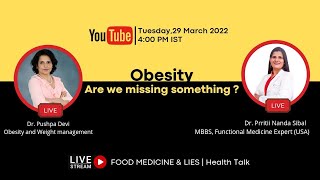
In this episode of the Food Medicine and Life Health Show, Dr. Preeti Nanda Sibal interviews Dr. Pushpa Devi, a physician who struggled with post‑pregnancy weight gain, gestational diabetes and insulin resistance. Dr. Pushpa recounts how conventional advice—calorie counting, restrictive fad diets, and intense exercise—failed to produce lasting results and often worsened cravings and fatigue. She describes her turning point when she adopted a functional‑medicine approach that focuses on identifying root causes such as hormonal imbalances, gut health, and toxin load. Using intermittent fasting, low‑carb/high‑fat Indian and Malaysian recipes, and personalized lifestyle changes, she lost 12 kg in two months, normalized insulin, HbA1c, and lipid profiles, and has maintained her weight ever since. Dr. Pushpa shares patient success stories, including reversal of hypertension, diabetes medication reduction, improved mental health, and a case of restored fertility after modest weight loss. She announces an upcoming masterclass on April 22 where she will teach her protocol, emphasizing sustainable, individualized weight‑loss plans rather than quick‑fix diets. The conversation also touches on societal stigma around obesity, the importance of hormone balance, sleep, and stress management, and ends with a motivational call for viewers to acknowledge weight issues, seek functional‑medicine‑guided mentorship, and view health as an investment.
Chapters
Hi, welcome to a new series of Food Medicine and Life Health Show. Today I have a very inspiring and a very, very sweet doctor, Dr. Pushpa Devi, with me. She is an example in her own self. She gained a lot of weight and look at her today, 27 years of medical practice. And I am sure, like me, many of you could miss out on that and think she's still a college graduate.
If you think you agree with what I am feeling when I'm looking at her on the screen, please give me a thumbs up or a yes in the chat box. Because our topic for today is Dr.
Pushpa is going to share her weight loss theory because In her story, what she talks about is how weight loss is a journey, how weight loss is exciting, how weight loss is not a thing on your head and, you know, you can't do anything good in life with a lot of weight, and most importantly, how you can maintain your weight for life ever after.
Welcome, Dr. Pushpa.
Thank you, Dr. Preeti, and thank you very much for having me on your show.
Thank you. So, Dr. Pushpa, when I spoke to you, you told me that, you know, you had gestational diabetes and you gained a lot of weight. And you shared with me a picture also of yours, which is so hard to believe that both of the pictures are yours. So please share something about how did you become obese.
Okay, so, uh, ever since I was young and even in my teenage years, my weight had never exceeded 52 kgs. And I always believed that, wow, my metabolism is so good and I could eat anything but not gain weight. So unfortunately, I first started to have these weight issues after my first childbirth. You know, after childbirth, it's normal for us to gain weight And so I assumed that it was just normal and hoped that whatever I had gained will eventually go away after the pregnancy fat comes down. So again, I didn't really pay attention to the weight gain. And so over time, the weight just slowly and gradually kept increasing. And the same thing happened after my second and my third childbirth when the weight just kept piling. Eventually, I reached about 72 kgs which was 20 kgs above my pre-pregnancy weight. So at that time, although there were many times I contemplated to do something to lose weight, but you know, life stresses at that time, such as working, you know, you're a young parent of 3 young kids, made it tough for me to prioritise my own health. And I think this is the same scenario a lot of ladies go through today. It is so normal that we young ladies, we ladies, especially young parents, young mothers, you know, they're so busy with their their families, their home, and their work that they forget to take care of themselves. So you keep gaining weight and this starts a vicious cycle where people just lose control of their health. And the more weight you gain, the more you think it is more difficult to lose weight. And when you try to lose and you do not succeed, you tend to believe that this thought that yes, it's very difficult to lose weight and you just tend to give up after some time. And like you mentioned earlier, during my third pregnancy, I had gestational diabetes, and a few months after delivery, a routine blood test done showed that I had insulin resistance. So I knew that I was at a higher risk of becoming a diabetic, as my late dad was a diabetic. So this was the, the point, this was the turning point in me, and that is when it hit me hard. I had enough of excuses. I had to do something. So I made up my mind on that day that I'm not going to let myself to progress into becoming a diabetic. I had to stop this vicious cycle and take control of my health.
Wow. Yeah, I will come to what you did to take control of your health. But you know what, one, I think you are right. Most of the women post-pregnancy gain weight. And most of the women keep postponing taking care of their own selves because they think that let the child first grow up. We have a job, we have a young child, we have so much of things to do at home that we are not able to do it. And you know, I also gained weight. And as you know, I have a very good sense of humor. When I was not able to lose weight, in my almirah I put a quote, you know. And what that quote said, that quote said I don't know what happens, but at night some fairy tale comes and stitches my clothes tight.
Because every 3-4 months I wear very fitted suits and all, right? And every 3-4 months the suits didn't used to fit me, you know. I used to actually have to squeeze or I had to change. And I thought I feel so bad about it, so I put this thought there. And, uh, you can imagine my plight then, right?
Exactly.
So, Dr. Pushpa, you are trying to say that it is not those fairy little tails who come and stitch our clothes tight, right? You are trying to tell us that we actually gain weight and we blow up, and that's the reason clothes get tighter.
Yes, exactly.
Okay, so if that's the reason, then what is it that you did?
To take control of your health and lose weight?
Okay, so see, just like, oh, all right, see, all the while I have, as a doctor, I have been advising my patients that they need to lose weight, you know, when they are diabetic, when they have diabetes, when they have hypertension, and they are obese or overweight. We keep on telling them, but I never have given them a constructive plan on how to lose weight successfully. So I realized it was just so easy to tell people to lose weight. And, um, back then as a doctor, you know, my medical training back in the '90s barely paid any attention to nutrition and the equally thorny question of how one should approach weight loss. So the most we could advise was eat less, cut calories, and move more. So using the same advice I gave to my patients I started to do calorie counting and I did lose a few kgs of weight, but either it easily piled on again or plateaued after losing a few kgs. So, uh, then the other thing is, Dr.
Pushpa, yes, so sorry, I really wanted to say this here. I believe that counting calories is the biggest fad of, you know, weight loss industry.
Yes, calories from broccoli and calories from chocolate or cookies would have been same, then imagine how happy people who are on their weight loss journey could have been, right?
But despite the fact, despite this fact, all of us know that calorie from broccoli is different and from chocolate or cookies is different. We still believe in the fact that calorie counting is important for weight loss.
Yes, right.
And I'm so happy to know that, you know, you also experienced the same thing, that, uh, you were counting calories, you were eating less, but you were not losing weight, or you were losing very little to just gain it back.
Yes.
So then what did you do, Dr. Pushpa?
Yeah, and then I tried going on restrictive diets, you know, such as low carb, low fat, high protein diets such as the Atkins, which again led me to always feel hungry and angry and subsequently led to more cravings. And of course, then the weight piled up again. So then I realized that most of these fad diets or restrictive diets were not sustainable for long term. Even for my patients who went through these diets, they gradually piled on after going back on their normal eating habits. So like you mentioned, nowadays this calorie in calorie out equation is actually outdated, and from what I read is 95% failure rate. Okay, and then there were these diet plans which tell you that you should keep eating small quantities throughout the day, but now again research shows that if you eat 6 or 7 times a day, there is higher production of insulin, and insulin being a fat Storing hormone makes you to store more fat and we don't want that to happen. Then there were meal replacements which I also tried. Another way, again, it uses the calorie counting concept and that again causes boredom and craving. So that didn't work too. When you know that dieting is not helping, you try to go a little overboard with exercise hoping that if the food part wasn't working, maybe if I really go all out and do the exercise that will help me to lose weight. But either you are too exhausted to do anything the next 2 days, or you start to avoid exercise. And again, today we know that this kind of strenuous exercise don't help you lose weight, but it can actually be a barrier to weight loss.
I am so happy that you are live with me today, Dr. Pushpa, because you know, any PCOD girl who comes to me because her doctor has told her to lose weight First thing I tell her is stop exercising. Do only walking or a little dancing, nothing more than 40-45 minutes. Yeah, because what happens is when you exercise and your cortisol is low— cortisol is another fat-storing hormone—
that goes for a toss.
The testosterone levels go higher, and instead of improving your health, it actually puts you deep down in those ditches and you are worse than what you were before.
Yeah, true, right?
Oh, thank you. I, and I really understand what you are saying. So then where did you find success, Dr. Bushpa?
Uh, yeah, then a few years ago I was introduced to functional medicine. So for our few, for our viewers who may not know about functional medicine, is actually a scientific evidence-based approach that focus on identifying and addressing the root causes of disease. So, using this functional medicine perspective, I not only lost 12 kgs in 2 months, it healed my gut, I gained my energy, my confidence, it helped me to reverse aging up to a certain point, and most importantly, reverse my insulin resistance. And the best aspect is today I'm able to maintain my weight ever since. Even though I can eat whatever I want. Of course, I do that with moderation. Likewise, my blood parameters such as my serum insulin, my HbA1c, my lipid profile has improved tremendously. So most importantly is I think it's not for us to look at short-term fixes which are not going to be sustainable, but to improve our relationship with food so that it's a lifelong learning and change. I think that's what functional medicine has taught me.
Wow, that's very interesting, Dr. Pushpa, because I agree that since the time I have started studying functional medicine and healing my patients through functional medicine approach, the whole game has changed. I don't have to give them diet plans. I actually give them the dos and don'ts, explain to them what will help them, what will not, and the results are so phenomenal. And sometimes I feel We've not done anything. How have we lost weight?
Or how have we anti-aged?
So thanks for bringing that up. But Dr. Pushpa, that brings me to another question, you know, which I'm sure my viewers would also want to know. Any recipes which you think were a part of your weekly eating plan while you were managing your insulin resistance?
Uh, yes. So I, I did try a few things. Initially, I think the intermittent fasting helped me a lot. So yeah, I also looked through a lot of recipes in— because we at home, we eat more of Indian food. So I looked through a lot of recipes from India which were low-carb recipes but high-fat, you know, high-fat type of diets. And that helped me a lot to prepare at home. And of course, we have our own Malaysian dishes and all. So I think learning a lot through the web, learning a lot through other doctors, that also helped me a lot to try to change my diet.
Okay, perfect. So what is now— what is it that now you want to do, Dr. Pushpa? What are you passionate about? Sorry viewers, I think Dr. Pushpa's internet has some problem. Technology is like this, right? Um, it is important, but it does leave you at times hanging in the air. Till the time Dr. Pushpa comes, I would like to add something on weight loss. You know, uh, of course weight is a parameter which only tells us that something within our body is not right. It could be toxins in our body, it could be imbalance in hormones— thyroid, insulin, cortisol, or sex hormones. It could be, you know, our metabolism not working well. It could be our diet. And sometimes, friends, even if you're not sleeping well, that could also impact your weight. So as Dr. Pushpa said, in functional medicine we find the cause of the problem. Knowing why you have gained weight and correcting that cause, whether it's insulin resistance or adrenal fatigue or hypothyroidism is the key to sustained weight loss. And of course, whichever hormone we want to balance, science now tells us what are the foods which we should be eating for that, what are the foods which we need to avoid, what are the nutrients which we need to have in good number and good amount for that organ to be functioning well and our whole body to be functioning well. So Find the cause and then make a strategy on how you can lose weight, and I can promise you will be successful. You will not keep on, you know, doing this journey to and fro the way Dr. Pushpa and many others happen to do.
Wow, and we have Dr. Pushpa back with us. No worries, Dr. Pushpa, thank you very much.
In between, what I talked about was about various reasons why we gain weight and why working on the cause is important to have sustainable weight loss.
So welcome back, Dr. Pushpa.
And I was asking you, when, you know, your net went off, what is it that now motivates you and what is it that you are wanting to do today for the community, for the people, and for your personal satisfaction?
Uh, yes, Dr. Preeti. I think most importantly, um, from, um, what I have done and how I have touched my clients. So using this functional medicine, uh, way, I have actually successfully used this protocol with many of my clients to help them lose weight, feel better, reverse various chronic illnesses Most importantly is to get them off medications. For example, diabetic and hypertensive medicines. I think most importantly is again, I have managed to touch and change the lives of many. Some who were lonely or depressed because of their weight problem. Some who had to live with constant harsh comments from family, friends, and relatives. Those with food cravings, sleep apnea, those who had PCOS like you mentioned earlier, and infertility issues. I even had one girl who was married and couldn't conceive for 8 years, and just by going on this program and losing about 7 kgs, she actually got pregnant before she even completed the program.
Wow, wow.
Yeah, this is the joy I gained from doing this, and that's the reason why I'm so passionate about weight loss.
Are there any programs you are planning to launch in the coming days, Dr. Pushpa?
Yes, I will be having a master class on the 22nd of April, uh, next month, and, uh, that's when I'm going to introduce my program to everyone, everyone. And I hope everyone can come and join, learn something about that, and eventually join this weight loss program because it definitely will be a life-changing experience.
Dr. Pushpa, when you say life-changing, how was your life when you were obese, and how is it now when you're looking so young, so fresh, so energetic, very slim, trim? Uh, could you just take us through that journey of Dr. Pushpa then and Dr. Pushpa now?
Okay, see, um, of course, when you, you, uh, gain weight, the first thing is you start having, um, uh, really have a lack of self- confidence, self-esteem, that affected me to some degree. And of course, like you mentioned, you couldn't fit into the pre-pregnancy clothes. And even when you get a new wardrobe full of clothes, it just didn't really help because I really never liked my flabby arms and the large abdominal girth. And I ended up wearing a large— I mean, sorry, big baggy clothes to cover my body. And I look perpetually pregnant 360 65 days. And that was so embarrassing. Like, you know, patients used to come in and innocently, even though innocently they were asked, you know, even though I was not pregnant, they were asking me like, how many months are you pregnant, doc? So that was very embarrassing, you know. And at the same time, I dreaded to attend social functions because I didn't feel like dressing up, you know. And people will pass comments like, why have you put on a lot of weight? And why don't you do something to lose your weight? 'You are a doctor, you are supposed to know, you're supposed to be advising people how to lose weight,' and so on. But coming to think of that, what they were saying was not wrong, but at the same time, it's not that I wasn't doing anything. So again, I can relate this to a lot of my patients who go through the same thing. You know, the other thing is many of our patients, obese or overweight, they tend to feel stigmatized in our society. And even we as medical professionals, we have some time or other been guilty of stigmatizing someone who is obese. And, you know, people tend to judge someone who is obese as someone who doesn't care about himself or herself or has made no effort to lose weight. But that's again not true. Many people try, but as long as you are not doing it in the right way, you, you don't lose weight, you know. And this leads to further frustration until one just gives up. And like yesterday, I was just reading an article that our present Miss Universe, uh, Miss Hanra Sandhu. She was trolled after she went on this Lakme Fashion Week for looking like she had put on some weight. And you know, people made comments calling her like a moti, which is actually very sad because you don't know how much that hurts someone, not only the beauty queen but others who are out there having issues with their, with their weight. So, uh, yeah, I think that's what I wanted to say.
And how do you feel now, Dr. Pushpa?
Now definitely, um, I'm a different person. My self-esteem is good, I'm very confident, and I'm very happy because I think that I'm taking very good care of my health just by helping change my diet, you know, my exercise, my lifestyle.
Wow. And I hear the promise in you that, you know, anybody who goes through your program also will see this change, not only in their weight but also in their mental health, the way they think about themselves, the way they talk about themselves, and you know, the, the way they actually feel about themselves.
Yes, exactly, Dr. Preeti.
Great. Dr. Pushpa, do you have any message for the viewers?
Uh, yes, definitely. I think the most important thing is for us to acknowledge that we have a problem with our weight and to act immediately. We should not keep avoiding the issue of weight, and we shouldn't be shy or afraid to ask for help or to do something about our weight. And if you have joined a program before and which didn't work, it doesn't mean that you will fail another program because not all programs are the same. Similarly, not two people are the same, and what works for one person may not work for another. And it's best to get a mentor or a coach to help you, especially someone who uses the functional medicine approach, like in India, Dr. Preeti. So, and because when you use a functional medicine approach, you write your own program like you have mentioned, the food you enjoy, the type of exercise you enjoy. And so the weight loss is enjoyable, and that only then is sustainable. And of course, the final message I want to say is your health is an investment. It's not an expense, and you are the only person responsible for your weight. And get help. And our body is amazing, and let's love it before it's too late.
Thank you, Dr. Pushpa, for such a wonderful message. And you know what, I can relate to it because I was 87 kgs at one point of time, and I lost with great difficulty the way you were just saying. And now I always balance my hormones And the moment they go upside down on their own journey, I get to gain weight again. So I definitely relate to your thing, and your message is very crisp and clear, and I'm sure all the viewers will follow it. And let's make a healthy world together. Thank you very much for being here, Dr. Pushpa.
Thank you very much.
Thank you, thank you.
Bye-bye.
More from Dr


Understanding Chronic Acidity: A Holistic Approach to Better Digestive Health 🌿


BHRT - transformational health journey if a 42 year old women #BHRT #HormoneBalance




Transform Your Health Naturally with Functional Medicine | Dr. Priti Nanda’s Success Story


hypothyroidism and ozone therapy - talk at Ozone Conference by Dr Priti Nanda Sibal
