Cancer - Management and Prevention | Dr Priti Nanda Sibal | Dr Sakeena Harmsen | #cancer
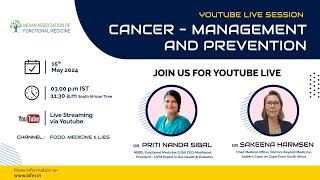
In this interview Dr. Priti Nanda Sibal hosts Dr. Sakina Harmsen to discuss a functional‑medicine, terrain‑focused strategy for cancer prevention and management. Dr. Harmsen describes her journey from conventional medicine to global humanitarian work, which led her to seek natural, low‑toxicity protocols. She identifies three primary observations in cancer patients: chronic dehydration, profound loneliness/social isolation, and a toxic internal terrain driven by poor gut health, oxidative stress, and metabolic dysfunction. The conversation details how re‑hydration with electrolyte‑rich, whole‑salt water restores cellular ion exchange, improves blood viscosity, and enhances oxygen delivery. Earthing, nasal breathing, and structured breathing are presented as methods to improve electrical balance and oxygenation. Nutrition is emphasized through plant‑based keto, intermittent fasting (16‑hour fast ending by 3‑4 pm), circadian‑aligned meal timing, and vegetable juicing that supplies enzymes and micronutrients while avoiding heavy metals via lemon acidification. The role of gut microbiome restoration is covered via short‑term liquid fasting, gradual fiber re‑introduction, and fermented vegetables, with attention to avoiding contaminated dairy and animal products. Dr. Harmsen critiques conventional supplementation, favoring whole‑food juices and specific oils (olive, coconut, castor) over isolated pills. She introduces Immunoclean, a 12‑herb Ayurvedic formulation designed to oxygenate mitochondria, reduce pathogenic fermentation, and support immune function through oral, enema, trans‑dermal, and inhalation routes. Additional topics include the importance of addressing loneliness, reducing environmental toxins, using structured alkaline water (with caution), and employing whole‑salt (Celtic/Himalayan) to aid cellular hydration. The interview concludes with consensus that a holistic, terrain‑first approach—hydration, psychosocial support, gut health, oxygenation, and mindful nutrition—forms the foundation for cancer‑free living.
Chapters
Hi, welcome Dr. Sakina.
Good day to you, Dr. Preeti. Thank you so much for this opportunity.
Thank you, and I'm so, so, so thankful to you to be here. And, uh, you know, I'm really looking forward to the knowledge you're going to share with us. So for people who are seeing Dr. Sakina for the first time, I met Dr. Sakina, I think about 3-4 months back. Dr. Sakina, during your travel to Delhi?
That's right, yes, in February.
Right. And after, you know, being into functional medicine for 9 years and just talking about the upstream stuff, I was quite happy to listen to what Dr. Sakina had to say, and especially the simple ways and hacks they use to balance the gut terrain in such a way that diseases like cancer are managed, you know, I would say beautifully. That's the word which comes to my mind right now. Thank you, Dr. Mahesh, for joining us, um, and we are looking forward to your questions. I won't take, you know, more time. Over to you, Dr. Sakina. I want to understand from you, Dr. Sakina, that how did you get into this? Um, and when it comes to cancer, what are your 3 key observations which you see in your patients? And when you balance them or eradicate them, you find results.
Okay, wonderful. Thank you. So So this started many years ago after my initial qualifications where I was slightly disillusioned in that we are limited in our healing rather than chemical distribution as doctors. So the healing part of our work seemed a little bit out of balance with just distributing pills rather than actually addressing the causes of disease in the first place. So I carried on after that to continue researching, went to Europe and Germany and from there to Mexico, to alternative cancer clinics where I met from young to old children with cancer, people that have been through a lot of conventional treatments and struggling and suffering. So my passion developed from there to find solutions that work, considering that we see such a low rate of success under the conventional programs often. So our work then went into researching and finding the answers in places where people are already utilizing more natural rather than more toxic protocols. And from there, I came back to South Africa when I joined Doctors Across Borders And we continue to work in Africa and in poor countries. We went to India, we went to— we were in Afghanistan, we worked very difficult environments in Africa. And we look for solutions that are applicable in every culture because an Eastern problem is not necessarily an African problem, although there are similarities between why our bodies are going through the stress strain that it is going through. So from there on, what we have come to see, and an interesting observation apart from what we can call the causes of cancer— there are a myriad of things that cause cancer. So toxicity and the poison that we are exposed to, lots of medications and antibiotics, even in our foods these days, lots of stress, and in the fight and flight state, the body doesn't necessarily do the healing and digestion as it should. So in order to then get people to be in a better state, we are— we, we looked at fundamentals that come across the board, every continent, same things. And although cancer has very specific properties, and metabolically we look at the metabolic cause for that, we found that dehydration is the number one of course, as our cellular, intra, extracellular terrain is highly affected by the recycling metabolic processes in our body where waste byproducts from that regeneration process is also not dealt with efficiently. Dehydration, people are not hydrating effectively with electrolyte-rich fluids as a number one thing. And the number two thing is loneliness. People lose drive for life due to this extreme loneliness. So when we talk about cancer properties, the actual properties like it loves glucose, it loves acid environment, it loves to have no oxygen around it that can actually work against it. Those properties on one side, but on the other side, we have actually come to realize the effect of effective with hydration as well as dealing with the excess loneliness that so many people on our planet are actually also experiencing.
Very beautifully, Dr. Sakina. You have, you know, brought about things which we generally ignore and want to brush under the carpet. Yeah, I strongly believe that, you know, proper hydration is the beginning of healing. Yeah, and the way I look at it and tell my patients about this is that in a family, if you are about 4 members or 8 members staying in one house, how is the energy of the house if you're not talking to each other? Yeah, and that's what happens between yourselves inside your body if you are not hydrated properly. Because it's the ion exchange which is like communication from cell to cell, and if that is broken, the whole energy of the system is broken and everybody goes haywire. And, uh, so I really liked when you said that that's the number one cause. Can you elaborate a little more on dehydration, Dr. Sakina, before I come to loneliness? Because that's even more powerful. But a little more about how dehydration— what mechanisms get affected and how it ultimately is the main cause you've seen for cancer.
So what happens under dehydrated conditions, even just if you look at our blood cells, when they dehydrate, they don't have a buffer around the membrane that keeps them from clumping together. So when they clump together, if I have 10 little blood cells that are clumped in a little group, The water and the oxygen uptake is going to be around the whole clump instead of around each individual cell. Thus, the oxygen carrying capacity of the cells go down under dehydrated state. Over and above the fact that under dehydration we have that electrolyte balance that goes out, which then affects how our brain delivers electricity and energy down into the system, the spinal column, and the delivery of our nervous system. So under dehydrated conditions, the blood gases and our own body gases with oxygen and carbon dioxide and nitrogen, the balance is going out under dehydrated condition and has an uptake nutrient chain and delivery or low delivery oxygen change. And when there's less oxygen, how our cells metabolize energy, how they metabolize glucose, how the mitochondria functions to keep the energy of the cell going, goes down, after which, and within which environment. Now I've got a cell here with less oxygen that is, um, serving it, and with its gases coming out of the metabolic process within the cell, that waste sitting outside of the cell, which and drinks and pees and poos just like we do as a whole. That waste sits around the cell causing also metabolic adaptation due to the fact that now it's sitting in its own sewage. And when you understand that in the environment, everybody talks about epigenetics and the effect of the terrain, and they think it's the terrain only outside of ourselves, but it's also the terrain inside of ourselves and in and around the cells. And it starts like Hippocrates said, and I'm glad that you mentioned it as one of your focal points of addressing health, is what is happening in the gut, because it's a highway between the mouth and the rectum that's 9 meters long through which food will pass over a period of time depending on what is sitting in it. And that waste is also coming into our bodies from the permeability that is allowed through a gut lining. Whilst we are low on fluids to get the waste out. And so the body and the blood and all our organs sacrifice their own waters, making a cell's, um, terrain smaller and smaller to do its actual metabolic processes in, because it has evacuated its own fluid to get waste out. And then also our blood gets thicker by nature of that sacrifice of its own fluids. Now I have blood pressures going up, I have cognitive function changing, I have metabolic changes, I have mood changes, I have a whole load of things that come as a load of toxicity goes up due to dehydration. And so as we rehydrate more effectively, and it's not just about drinking copious amounts of water, it's about drinking water that can get into the cell So when we go into hospital, we'll get Stein water into the vein, but people are told not to drink any or eat salt because salt reaches the blood cell and raises the blood pressure according to some studies. And that is because we are not eating whole salts, we're eating sodium chloride, we're eating salt that contains aluminum and free-flowing agents. So that salt is not a good salt. If you have a whole salt, something like Celtic salt, something like Himalayan salt, a crystal of the Himalayan salt into your drinking water before you drink it, or on your tongue before you drink it, will actually facilitate that the water gets inside the cell. People with edema have too low levels of whole salt to actually get water into the cell. So by putting electrolyte-rich fluid in, we get the water into the cells and we provide a medium. We are 70% water. A medium through which our electricity system electrolytes can actually work.
Great, Dr. Sakina. So, Dr. Sakina, you've already mentioned some salts which you recommend, you know, and which you suggest that people should take. And I agree with you, the white salt which we are getting today, plain sodium chloride, it does not have the other minerals, and our body needs all the minerals. And of course, everybody knows that we are 70% water. So the smart thing is first to set the water right in our bodies to be healthy. What are the other things which you think can help in balancing this ionic balance inside our body? Means, I strongly believe that earthing and all also play a role in this.
You, you believe in— sorry, the, the, the line broke up. You believe in earthing?
Earthing?
Absolutely, absolutely. It's a fundamental in our programs as well. We are electricity systems, so our houses are earthed because of that current running through it. So as electrical systems ourselves, with plastic or rubber under our feet, we do not get that earthing or discharge of buildup of electrons in the system that have been becoming a free radical. So in terms of that earthing, that you touch a tree that is in the ground, whether you take your shoes off and you stand barefoot outside on the ground or on the grass, that is an important part of our program anyway as well.
Right. So what other things, Dr. Sakina, we can do to improve the balance in our system?
So in terms of our load of toxicity that comes as a consequence of what we're putting into ourselves these days, it plays a huge role. So we can't just say, go and breathe better, which is one of the great things. And if I can just talk about breathing, because it is on what we have as a 5-track plan. We've got a 5-track plan and so let's deal with these things in a more systematic way. But I just want to mention track 2 of the 5-track plan speaks specifically of breathing. And what we do not realize is if we breathe through our mouths, we do not have certain things happening for how that oxygen is then filtered, how the oxygen is moisturized, how the oxygen is warmed, how oxygen actually is pressurized, which happens when we breathe through our noses. However, if we breathe in and out through our noses, we have, like with hyperbaric oxygen chambers, the pressure under which oxygen comes in. Even when we are training, if we are training and we inhaling through our nose, exhaling through our nose, those, even though initially it's a bit more tough, we are getting a much better oxygen delivery into the cells. Remember, Otto Warburg actually said many, many years ago that cancer is also, as a metabolic process, also a disease that comes from oxygen deficiency. It can't thrive in an oxygen-rich environment. So our oxygen delivery when our bodies are dehydrated is going down because the blood is clumping and not carrying as much oxygen as it should. But now by rehydrating with electrolytes and breathing better, we are already getting a better delivery of oxygen back into the body. Apart from that, we do have to look at what we are eating and what's decaying inside of us because of this 9-meter tube and how it decays what we've eaten, especially if we combine foods that are high in sugar, like carbohydrates and sugars in itself, all these sodas, things that we are also still consuming. Combine that with flesh in terms of what we've eaten and we have a putrefaction that is happening internally in our gut and that waste byproducts going into our interstitial fluids and into our blood is adding to the burden. So nutrition matters as much as those who have had conventional training do not know about nutrition. It is a big aspect. That's why Hippocrates said it starts in the gut in terms of disease. And if we are eating food that is full of pesticides, herbicides, and fungicides and antibiotics, it kills a 2-kilogram brain of bacteria that is communicating through the spinal column with the gut-brain axis. And that death then in the gut is adding to the burden internally. And our body's intelligent response to that acidity inflow that comes into the blood is to alkalize it minerals, minerals from our bones, minerals from our pancreas, and bicarb that is released from the pancreas, the gut lining, and the kidneys in order to neutralize the acids. But in the process of that, we have tissue that becomes calcified and lumps and bumps forming because of our intelligent, divinely intelligent response from our bodies in terms of dealing with this acid load that keeps on coming out of the putrefaction instead of efficient digestion. So how people eat, what time people eat matters. If we could have our meals as our main meals, a breakfast and a lunch, and very light meals at night, that metabolic changeover in a rhythm that runs with the circadian rhythm of the planet, where the daytime carries the load for digestion and nighttime carries the load for body healing, not digestion, also has fantastic results by nature of shifting how we eat. But I do have— I must mention it, Dr. Preeti, and I was in India, I was absolutely horrified and amazed that the Indian population eats almost— it's, uh, everybody eats their main meal between 10 and 12 PM at night, which is frightening because that's already our beauty sleep and regeneration time between 10 and 2 in the morning. So if we are eating at that time, there's no body regeneration and attention to the degree we require under the load we're exposed to. Because in all of that, there's still now Wi-Fi and electromagnetic fields that we're exposed to. So a lot of things add on to why the system internally becomes under duress.
Right, Dr. Sakina. So that's very— you are very right. And that's very unfortunate that a lot of us, we actually feel dinner is the main meal we do with our families. And if we are eating out, then of course it is after 9 PM, and therefore a lot of us tend to eat late. But of course, people who are now becoming aware, we finish our dinner at 6:30 PM. Most of us watching now also would be doing the same. And you've rightly said the best way to live life, or a cancer-free life, is to live with the circadian rhythm. Yeah, and, uh, I personally feel the amount of emphasis we should be giving on circadian rhythm— we are not even at 10% right now. We really don't understand how it affects every, every, everything about the way our cells function. And also nutrition is a big, big thing. Dr. Sakina, I will want you to elaborate a little on what are the foods— so you have spoken about the concepts, but are there any foods you think which, if we incorporate in our daily schedule, they help the body stay alkaline?
Absolutely. If I may mention, yeah, um, in terms of digestion, everything that I eat is gonna go some form of acidification. When we eat protein, our protein and our minerals like our ions and our magnesiums require an acid environment for nutritional uptake to be optimal and for bonds, amino acids that make up a protein, to be broken. In today's society, a lot of misconception is out there in terms of how digestion works. People are suppressing stomach acid from 4 acid-forming cause of, for example, heartburn, which comes as a consequence not of high acid in the stomach. It's low acid in the stomach when the food comes in, which forces the system to actually go through a putrefaction and a fermentation in the small intestine and then in the colon, which is an acid-forming process, whether it's a vegetable or not or a protein or not. So there's an acid formation in terms of what we eat, regardless of what we eat. It's just less acid forming. It's raw and it's vegetable than if it is a piece of a hind leg of an animal. So understanding the complexity of breaking down complex protein from animal protein, in our experience, a full, a plant-based whole food diet is the most effective way to get rid of cancer in our experience, because the protein— we are protein machines. We don't need to eat animals to make proteins in our bodies, although it is unfortunate that the, the system likes to sell it that way. But if you look at all the animals that most people eat, they only eat greens, and that's strong muscles, strong bones, um, uh, far— small, big, tall, all sorts of forms. And what they eat is dark green. And out of the dark greens, we get a phenomenal amount of good nutrients that our bodies are being built out of and alkalizing from dark greens, for example. So in our program, we give a lot of vegetable juicing, vegetable juicing, because in terms of cancer loving sugar, you don't want sugar spikes. Diabetes is like a pre-cancer condition because the body is already struggling to, to handle the sugars that are coming from processed foods as well as carbohydrates, for example. And then we have incorrect combinations of foods as well, then that creates a sitting still because one needs acids and one needs alkaline environment, and there's no hand in the stomach so nothing can be taken out, um, to separate it. So if I eat flesh, for example, with carbohydrate, there is often a slowdown of digestion. And anybody eating flesh, if they know that it actually takes up to 5 days to process the animal in you. That piece of flesh passing through the intestinal tract and then in the colon up to 72 hours. Add to that a bacterium that is not in a good balance because of eating flesh and being exposed to antibiotics and poisons in our food and the sprays, so that the condition of the gut flora affect so many things. And it is your specialty here in terms of things you've spoken of. But if we can get that condition of gut in a better condition by nature of what we put in, there's less rotting if we eat only vegetables. Putrefaction of flesh is the way that the system actually breaks down the flesh if the acids in the stomach were not there. And the load of alkalizing that is required after acid-forming food have been eaten is tremendous. So that is why there becomes a challenge. So in terms of the foods that we eat, they're all there to encourage how the body regenerates, easy to digest. So that's why when people have conditions like cancer or any other lifestyle conditions, we encourage the consumption of vegetable juices just because the gut is not working as it should optimally anyway.
We get—
need to get nutrients in because nutritional deficiency is one of the reasons why there is adaptation internally. So by getting nutrients in easy through, through veggie juices that don't have to be— they don't have to be awful. In fact, they must be so that you can actually love them and have them. That's part of our life. It's a way of life. Have a vegetable juice in the morning, some carrots, some greens, some— if there is— we don't juice fruit, but if it's a green apple, it's a sour apple, but put an apple in, a bit of olive oil, lots of lemon, and that in itself gives nourishment and nutrition that bypasses a digestive tract that doesn't work. For example, a day on diet under our program starts with some hot water with a bit of lemon and pinch of salt or the Himalayan salt so that we can just rehydrate a digestive tract that has been fasting for the night after rest. And then we put in the net fluids. Rehydration under our program requires the sipping of water over the hour, every hour at least a glass of water so that we can get at least 2 liters of water with electrolytes back into the body. But we can't down 2 liters liters in one sitting because it's like a waterfall and the body doesn't really do the proper uptake when you get that fast. So we go for a slower drinking of water and hydration whilst we also help with the food. Remember, stomach acid is also a water composition. So even that, if there's not enough stomach or water to make the stomach acid, then we also have deficiency in protection as if immune response to what we're putting into our bodies, whether there's parasites on it, whether there's bacteria on it, etc. So in terms of that, in addition to hydration and juicing, we add the foods that are easier to digest in people who have challenges in their gut. And we have found that in cancer cases, up to 100% of people who are diagnosed with cancer actually have a high dysautonomia. So again, if you're eating late at night— sorry, I'm not talking about the food yet, I'm just mentioning this because it's quite fascinating— if we're eating late at night with solids sitting in the stomach when we go to bed, and now you turn sideways and the solids are still here for the next 4 to 8 to 10 hours, it pushes the little sphincter into the esophagus open because it's still sitting there automatically, because that lining of the stomach is now pushing the valve open. Starts to stay open, now I start feeling heartburn and all sorts of other things. And things like a hiatus hernia can actually be fixed by drinking a glass of water and standing on the step and just jumping off. And the water that's filling the bag of the stomach pulls the lining of the stomach back out through the hiatus hernia, and we can overcome the issue. But then also we've got to stop eating solids, those heavy foods, at night. So that that lining doesn't go through the same issue again, pushed upward as they lie down. In terms of food, raw food is very healing in fighting cancer because we need enzymes to break down tumors, hammers and chisels. That is what is issued from our organs, especially from our pancreas. Diabetes type 2 is an enzyme deficiency in the pancreas. It means the hammers and chisels that break apart what we've eaten is less. So when I have cancer, my enzyme load is less. And most people only eat cooked food, very little raw food. Even in the raw, a lot of fruit perhaps without its seeds, which are great for fighting cancer. If we were to eat an apple and you eat the seeds inside the apple with it, fantastic. Just like some people speak of, um, what is that other— apricot seeds. It's not about buying apricot seeds, it's buying the apricot and opening the eating the apricot as well as the seed. That way we actually would be a much healthier society if you were actually just eating the whole fruit with its seed as well, because of the nitriles that's in the, um, seed, which is a very bitter compound. Apricot seeds, vitamin E17, laetrol, which is cancer protocol in some of the Mexican clinics, is specifically what's in every fruit seed. So papaya, which is a fantastic cancer-fighting fruit, when you eat its seed with it. So if I cut my papaya, or I'm not sure what you call it in India, and you take about a tablespoon of the seed and crush it under a, a glass or in a mortar and pestle, that bitter seed is on one side cancer-fighting, but it's on the other side also parasite-reducing. Another unattended issue in a great part of our society these days. So I call it, if somebody has cancer and they have been used to eating cooked food, it's not about just introducing raw food because gut lining is not used to that on the inside, and it's very fast when it's raw and it causes a bit of inflammation and irritation by nature of what's in the gut. So first start with what is familiar in a diet take out the foods that are cancer-causing and adding to the burden, go from a sugar-rich diet to a no-sugar diet. We exclude sugar, we exclude dairy, we exclude meat for at least the first 28 days of our program so that we can give chance for this meat and the cleaning process. And in addition to that, we cut down on the fruit even. For the first 6 weeks because you want to starve a cancer cell, which— cancer cells love sugar. They take up up to 15 times more sugar than a normal cell. That's why when you go for a scan, they inject glucose in the blood and the scan reflects there where the cancer cells are responding to the glucose. So often I hear that some of the oncologists say it doesn't matter if you eat sugar these days, because in any event, what you eat is going to be converted to glucose. So we want to, rather than eating the glucose, we want to go for the ketone type of food. So fats, but whole fats like avocados and your, your nuts and seeds, that the body can then burn to energy. To use ketones rather than glucose for energy is also another way to shrink a tumor and shrink a cancer because we're starving Yeah, we're starving it of its foods. And then if somebody is used to a 100% cooked food diet, the juicing is an easy way to bypass getting some raw in. And then we introduce a 10% increase in raw over a period of several weeks so that the gut can adjust and form new bacteria that will digest this new diet that I shift to. There's an understanding to have. You can't just cold turkey from one to the other and expect not to have any bloating or indigestion consequent to eating something new that you've eaten for a while. So there's a shift that takes place in helping your body get used to a new way until we can get someone on almost an 80% raw diet so that there's a lot of enzymes that can be consumed to get the body to have availability for breaking down tumors.
Perfect. Dr. Sakina, uh, there are two questions and I will take them now because they will make sense here. What about the alkaline water? Does it help? Do you recommend it?
So in terms of alkaline water, um, the unfortunate thing is that a lot of people just rush out and get sodium bicarb and sodium bicarb in their water. Uh, it's not the ideal way of drinking it because, um, sodium bicarb in water, if I take that and I just I just take straw and I inhale and exhale through the straw into that water, within my first 2 breaths, that water's acidic already. That means that the bicarbonate is not bound in a structured form in the water, so it just dissipates immediately under exposure to carbon dioxide. So for me, if you have a system that does the alkaline water, that makes it, structures the water for you, that is usable. At the same time, if I'm gonna eat a meal now, I want to add a little a little bit of acid, if I can say it like that, to my water so that I can form hydrochloric acid. Hydro, water, chloric, salt, acid, lemon. So that when I eat my meal, there's going to be a better nutritional uptake because my digestion started correctly. But to drink alkaline water, by all means, one can do it as long as you do not just do it before a meal because then the meal digestion is affected negatively. If it is a protein-rich meal, I'm not mean protein-rich from animal protein. Again, we do not do animal protein in our diets. I've been vegan for 12 years. I don't think I'm deficient. So in terms of that protein, we replace all flesh with legumes. That's why Indian population would actually be the healthiest population. Legumes plus grains are a complete protein and it's easier on digestion. So if I'm eating my legumes, whether it's beans, whether it's lentils, chickpeas, whatever— there's so many types in India. I'm so jealous, if I can say that, of all the different choices one has in India. Uh, even in that though, I have to mention everything is sprayed these days. Everything's sprayed, even the rice. So even in the— it's not just about fixing or changing your diet. Even in the preparation of the food, we soak our grains, we soak our legumes, whether it's overnight or 4 to 6 hours depending on the type of legume. And then we wash it and then we go and put it into a pot and we wash it again after 20 minutes after it's been boiling. So that oil doesn't go straight into my veggies and my rice or my meal that comes with with it. Even the rice, it gets soaked, it gets washed, it gets par-cooked for 10 minutes and washed again so that we can reduce the load of toxicity coming in. Because nobody's going to grow all their own food anyways, we don't know what's on it. We clean it up and facilitate how our bodies can handle it better. Perfect.
Dr. Sakina, alkaline water through Kangen machine, that water which You know, people use this Kangen machine for alkaline water. Any comments on that?
Yes, there are many systems these days that are great, but where do you get the water? What water are you using? So now I'm getting water that has been filtered potentially. But in terms of that, if we look at ozonated water, water that has gone through reverse osmosis, which is dead water, it's called dead water. I call it hungry water. So in terms of that water, it will immediately, when it comes back into your body, will come and take minerals to rectify its own structure. And you pee out in a complete structure, you've got sweated out its mineralized structure. So those options of the machines that they use to put— make your water more alkaline and then also to structure it, if it has done a filtration as well, it's one thing that I would still add to that, to put intention over my water, to put gratitude over my water, because we are still drinking the society around us. There's memory water. There's something is in the water because of the sewage system that comes back into my tap. Um, and the DNA memory is not taken out by any filtration system. So even intention can have a great change on our water. And even if I use a beautiful little system that can give me alkaline water, I would still put intention and gratitude as well.
Yes, thank you, Dr. Sakina, for bringing that. I think that's very important. Dr. Sakina, another question we have here is juicing with greens, won't that add heavy metal load even more?
So juicing with greens, I don't personally just do a green juice. It's very harsh on the gut lining, and, um, it depends on the condition of the client. And if it's an early stage cancer or or any lifestyle condition or a late-stage cancer, the capacity to take in dark greens is not always at the beginning of a program that easy because of the condition of lining of the gut. When we have greens, I'll have 3, 4 to 6 leaves of spinach, for example, with a few leaves of kale. But then I add softening foods such as beetroot, such as carrots, such as cabbage, such as a green apple, and then lemon. Lemon is necessary when you, when you juice anything that contains the metals, the magnesium, the zinc, the iron, in order to chelate it out of the plant. So if we don't put an acid like a lemon to the plant and don't put an oil to get that nutrient through the cell membrane, we are going to have irritation and inflammation often. Happen in gut lining as a consequence of how the gut lining is necessarily well lined with the mucus, um, in terms of that dehydration level again. So we do not— if people do a wheatgrass juice, it's a small juice, it's not a large glass. I'll drink a 250ml glass of juice every single day. Well, I do, and I have many years. Um, and when somebody new comes in, well, we'll go for the colors from the rainbow and add in the softly and gently and increase it as you go. Remember, the green is also the bitter. Our bodies are too sweet. And when we put in more bitter nutrients, automatically we have reactions because not only because it's never just a single— it's not the one thing. Everything is holding hands. So my gut lining is irritated, my gut flora is not right. I have all sorts of other things adding to the burden. I'm dehydrated, I'm stressed. So various things need to be combined in the process. Of being holistic health, um, affiliated.
Great, Dr. Satina. Another question we have is what functional supplements can be very helpful in various cancer diseases? Any top 5 choices you can mention?
I'm not your favorite person in that sense. We don't do supplementation. We are all about oil. If you want to supplement, you can supplement with whole oils— olives, olive oil, coconut oil, They are great in terms of the things that we feel people should take. Rush out to get supplements, but supplements are never a whole thing. If I rush out to get your vitamin C, you don't have the other vitamins for uptake or efficient uptake. And now a little pill must fix a whole body. In addition to the fact, if I take the supplements, I can do a blood reading and I'll have some of my markers up nutritional deficiencies coming up because now it's in the blood. It doesn't mean it gets into the cell. So for us, that juice is my supplement. That's where I'm going to get my nutrients, my vitamins, my minerals more effectively because it comes as a whole with all the other minerals and vitamins required for uptake. So in terms of supplements, and there's also— it's a huge market, it's a huge business, it's politics, it's business. So we, in terms of supplements, we don't rush off the supplements.
Okay, but then you use Immunoclean, Dr. Sakina. What is your concept around that? Immunoclean is a supplement.
I, I know because it gets registered as a food supplement, uh, because it complements, but it's not a nourishment. Right? It's an Ayurvedic composition. It has 12 herbs. And so it's— for South Africa, it falls under the classification of a herbal complementary medicine. And in India, we also can classify it as an Ayurvedic medicine. But in terms of the testing that was done on it, in principles of it, it's almost homeopathic as well, because you take 1 or 2 or 3 drops to take orally. And how it worked activates the immune system. It becomes the immune system. It facilitates an internal terrain that gets cleaner by nature of the herbal stimulation. Centella asiatica for the brain. So the landia, which has been tested extensively around the world— so the landia frutescens, for example, is a wonderful cancer-fighting component. All our herbs are bitter herbs. So as well, people can see Bitter is what we are deficient in in diet these days. So the bitter herbs are all very specifically chosen to support specific functions of each organ in our bodies— thyroid function, kidney function, liver function, digestive juices stimulation so that we can digest a little bit better, brain function. So all of the herbs in there are to support what your body is already in terms of 4 liters of blood on an adult woman that needs to be cleaned and recycled, and 5 liters in a male adult body. That process of cleansing happens through a variety of ways, and we support it again with hydration. We drink the drops with electrolyte-rich water, so we deal with the dehydration whilst we are supplying an oxygenation that is delivered through the water. When your body absorbs oxygen from the lungs, the blood carrier, but I only have 4 liters of blood. Now when I can put the oxygen in this form at oxidation rate of the blood and of my own cells, it's not like peroxide, which oxygenates at higher rate, which can cause, um, the explosion is bigger on an ozone oxygen than it is on a hydrogen peroxide oxygen, which is higher than when you breathe. Oxygen. So Immunoclean is designed to give you oxygen at the rate that you do need, and it's delivered through the water. So when I drink it, now I don't rely on my blood anymore, and the— it's permeable and transferable through my own body tissue waters whilst I'm supporting the organs to get that metabolism of the immune system handled more effectively, because the herbs are to stimulate that evacuation.
Dr. Sakina, um, there's this question here. Dr. Sakina, your approach to killing the microbes inside the cancerous cells instead of killing the cancer cells themselves is very unique. Can you speak about that and then how Immunoclean helps you in that?
So Immunoclean is a mitochondrial stimulator. In other words, when my cell doesn't generate energy through mitochondria anymore because the mitochondria can't get get the oxygen in because the nature around the cell— so the cell doesn't get oxygen delivered inside it anymore because the terrain in which it finds itself is no longer optimal. So now the cell starts to generate energy through fermentation. That fermentation process is what we call cancer. The fact is that the oxygen delivery cannot reach the mitochondria anymore, and that is why cancer is a metabolic disease in terms of that mitochondria energy generation. So glucose gets fermented, you still generate the ATP, ADP at very high energy output, low, low output in terms of non-oxygenated glucose metabolism. So with Immunocaline, we get that internal mitochondria to restart Because we're delivering oxygen via the water, and because it now can enter the cell via water, and mitochondria can start again, thus reversing the cancerous behavior of the cell. It's just due to the terrain and the metabolism requirement for the cell. So that is what we do in terms of our process, Immunoclean, which isn't consumed orally. We do Immunoclean orally, we do enemas with it in saline water, we go through the skin transdermally, we spray wounds with it because its wound healing capacity when we clean and we stimulate repair, it's much faster when you do a multiple multidimensional approach. If I drink something, I can only take so much. then you don't want anymore. So if I apply it, I steam with it into my lungs. Lung cancer is the number one cancer globally, and the reason for that, which I— if I may just mention it, is not just only what we are inhaling from the outside, it's also what's coming out of our bodies. We expel 70% of our waste through exhalation. We expel 3% of our waste through poo. We expel 7% of our waste pee. We expel 20% of our waste through our skins, and people are not sweating, they're not raising body temperatures. We use saunas and things like that to get the waste out through the skin. And then we have 70% of waste that goes out through the lungs. So when we have conditions like cancer, not only of the lung, when you steam, you actually clean up that terrain, which is also compromised by nature of our own bodies' evacuation pathways, which are in most cases with cancer blocked. Our evacuation— it's congestion. Yeah, a tumor is already our body's, um, intelligent response to get something out of circulation so that we are protected, we can function, we can live life, and that, that lump or bump becomes so big that it becomes a problem, obviously. But it is still body's divine intelligence to deal with something and get it out of the way whilst blood's flowing and carrying on and serving the rest of the system.
Perfect. What about intermittent fasting? Uh, do you recommend that? And also your stand on keto approach?
Yes, absolutely. Well, our keto approach is actually also a plant-based keto, not just, um, like the animal protein diet. But in terms of fasting, 16-hour fasting is fantastic. There's a gentleman that came to that same event where we were, a gentleman from China, or China, from the East, and he said, eat less, live longer. Simple rule. Oh, it's so beautiful. I love it. Live longer. So in terms of that, for us, we, for example, have our last, our afternoon meal by 3 o'clock in the day and 4 o'clock It's done, and we fast until the next day at 10. So there's a long fasting, lots of liquids, lots of liquids all the rest of that time. But a good 16-hour fast is a great way to give gut resting. Lots of unfortunate directions for people with diabetes, for example, they are told, okay, you've got to eat 6 meals or eat every 2 hours. It causes a lot of putrefaction and rotting in the gut. Gut because the process is not finished before next food comes, and then a lot of food sits and putrefies. So, uh, we do not agree with those principles.
Yeah, I also don't, and I strongly feel it's like calorie in is equal to calorie out. You need to maintain that. And then eating more meals— these both are, I think, the biggest myths today which we need to challenge and correct. So another question, Dr. Sakina, we have here for you whether Immunoclean aims to reduce lipopolysaccharides or bacterial fermentation byproducts.
So when you understand that fermentation in the gut and in our bodies take place as a consequence of the terrain that everything is in, so Immunoclean as an oxygenator will oxygenate at the rate pH that is pathogenic and opportunistic. It is not programmed to oxygenate your own body cells, so your friendly bacterium is left just fine, which is between the 6.5-7 pH that our fermentation-friendly bacterium takes place. But when I have a bacterial load, Immunoclean will deal with that bacterial, viral, fungal fungal infections that we have, because your immune system, which is 70% of our gut flora, gut flora that defends us against what has come in. So when we have that corrected, the immune body's responses to deal with the infection is much more effective. But if you have none of that, of course I have putrefaction and I have rotting and I deficient system, whether it's due to disease or lifestyle. When I take Immunoclean, it replaces my immune system because it cleans the terrain. When it's less toxic, it's less burdened by opportunistic organisms that ferment and putrefy and make more acids again. By nature of a cleaner terrain, we have lower loads of infection. So that is why it is also successful there. Polysaccharides, the reason why our bodies are loaded is again because of metabolism and enzyme deficiency. We're not giving body enzymes with ImmunoClean, but because we're cleaning the terrain and we're eating our foods or our juices that give the enzymes back, we actually deal with those latent areas. Perfect.
I think we have one more question, Dr. Sakina, which is how the microbiome is restored, as most of the cancer patients we find really bad dysbiosis through diet and fermented foods.
Absolutely. So when, when you start with a diet that is different to what you're used to, you're going to get bloating and indigestion and all sorts of discomforts. And that just adds to a burden that already is there. So we do an initial 2-day liquid fasting just so that the body can expel some of what is still stuck in this digestive tract whilst we are also— the hydration, reline that gut lining, which is replaced every 4 days, 4 to 5 days. Our whole gut lining, which is as big as a tennis court, is regenerated. The reason why we have long-standing gut problems is because of what people keep on putting into it and what is coming out of our bodies. So in terms of recorrecting the gut flora, more fiber in the food is not the first day's diet, because if I have putrefied flesh, there is impact in my colon. Then I eat fiber, which is now going to be a boom that comes to loosen some of that stuff that's on the sides of the colon, for example. Releasing a lot of microbes and bacteria that aren't necessarily friendly probiotics, then that creates havoc and inflammation. So by fasting and going on a soup, broth, veggie juices, hydration waters and teas for 2 days, it gives us a chance to lower the burden of opportunistic organisms in the gut whilst then we start reintroducing friendly bacterium with fibrous-rich foods, whether it's cooked or raw, depending on the scenario, the case of the individual, and add to that fermented foods. So fermented foods, we used to believe that yogurt was great for us. In today's society, we unfortunately don't find it that way anymore because the animals, especially here in South Africa, are injected with growth hormones and antibiotics. And it changes again as it comes into the human body. And we don't use plant, uh, animal protein anyway. So we go for fermented vegetables such as sauerkraut. Kimchi is a bit spicy for people who have gut issues, so then we just take the spice out. But it's fermented vegetables. And then of course your raw fruits when you start reintroducing fruit and raw foods will give lots of building materials and food— garlic, ginger, all of these beautiful food sources that can help to structure and reform our friendly bacterium and rebuild our immune system.
Great. So now, thank you, Dr. Sakina, for sharing your insights. And they were, you know, I think, very holistic. And just before I say bye-bye, I think there's a request that I will sum it up So, um, the basic premise which Dr. Sakina has shared today is that, you know, cause of cancer— when we look at root cause, we need to start from hydration, from correcting how lonely the person is feeling today and giving them emotional support. Well begun is half done, and therefore having good acid in your stomach is very, very important for the complicated digestive process in our body to go Diabetes is a precancerous situation, and once you become diabetic or insulin resistant, your body is already telling you that you are on your way forward. That's the time you need to become careful and make sure that your body is getting the right nutrition in the right way. And you know, you can bring balance back in your life and start working on the terrain. To add further, um, uh, you know, Dr. Sakina also said that intermittent fasting is very critical and she really loves it. 16 hours fast, especially starting from 4 or 6 PM in the evening rather than eating very late in the morning, is a better way to do it. And Dr. Sakina, if you want to add anything, please let me know.
There.
And then moving forward, of course, they use keto and they use plant-based keto. Which I've been using for last 7 years, and I realized that to do keto and to get into ketosis, it is not important that you are a non-vegetarian. Even if you are a vegetarian, you can do keto diets and you can achieve ketosis. And getting your body to work on ketone as energy is a great phenomenal way of switching that switch on and off. Of course, mitochondrial health plays a huge role And to improve your mitochondrial health, the first basic rule is to improve your oxygenation. Now, how do you improve your oxygenation? I think that's a, in itself, a very, very, very huge topic. Breathing, you know, your proper breathing, your grounding, uh, even what you think. And also the Immunoclean product, which, uh, you know, Dr. Sakina and team uses It's a natural herbal product, the way we use other herbal supplements, ashwagandhas and all. It's a very powerful mix of ions. And the second one is a mix of 12 herbs which actually helps you bring your terrain back in form. To that, uh, you know, I think Dr. Sakin also mentioned that parasites are playing a big havoc in our health today, and they are really distorting our gut terrain. And to get rid of the parasites, yes, we have a lot of huge allopathy protocols, but what works gently, softly, and for a longer time is when we do it through food. The simplest tip and trick is, you know, using seeds of papaya when you eat—
have papaya.
And similarly, there are a lot of other ways that you can do that. Of course, using seeds of fruits along with fruits is very, very important. Antioxidant. And, um, I realized this power when I started telling people that you should have the lemon rind with the lemon whenever you have it, because it is 5 times more powerful in antioxidants than what your lemon juice is. Of course, adding lemon juice to all your green juices is very vital. And also, green juicing, when you do, you don't have to take big glasses full of juice in the You need to start with small 50ml shots in the beginning. Add lemon water to it. Add soothing products to it, like, you know, beetroot and carrots in addition to all the greens you do. Increase the number of greens as you go every week. And go slow and be consistent, I think, is the rule of changing the gut terrain. Uh, right, uh, Dr. Sakina?
Absolutely, absolutely. There's one more thing that I want to mention about the parasites because that's a whole topic on its own as well. Yeah, I know a lot of research is coming out to say that we have maybe missed— that there was an Egyptian parasitologist who has got 40 years of, um, research in parasitology that has said only about 2 years ago that somebody asked him about parasites and cancer The fact that a tumor and tissue of a tumor in comparison to a parasite nest is— if you look at the cells, it's exact, it's exactly the same thing. So we use a variety of ways to break down lumps and bumps, and there's a fantastic product called castor oil that can be used topically, and we use it internally. Topically, if there's, for example, a cancer in the breast, a lump in the breast, cysts, the boxes of parasites that the body has encapsulated, like a slug or a snail that the body is encapsulated and closed up because it can't carry it out, they can't break it down, are already enzyme deficient. However, now I have my castor oil— sorry, you say castor oil in India— if I have a castor oil and I put it onto a, a little flannel and I can put that inside my bra with a linen saved, even work with a plastic over it so that it doesn't mess on my clothing. There's one lady that we worked with, she had no other means. She had no means to treat herself except with castor oil. And she would use that and put the castor oil flannel inside the bra on the lump for a year, day and night, and the lumps went away. So there are other ways that we can help our bodies to break down those lumps and bumps. And we have wonderful methods that are still staying natural that we can support the process with.
Thank you, Dr. Sakina, for sharing your valuable information. If we get any more questions, the team will be in touch with you and we will request your answers. Thank you, audience, for joining us, and please share your questions. I know, uh, in functional medicine we do a lot of supplementation, which is vital, which important, and I believe in that too. But I think we need to, uh, you know, start from this base premises, and then whatever is needed can definitely be added. At the end of the day, health is about being in balance— being in balance physically, mentally, spiritually, emotionally, right? And Whatever can help whatever client, I think we can use all of that and achieve our results. Thank you, Dr. Sakina.
May I, may I add one more thing? Sorry for interjecting because of the supplements, and I know it's a tender topic. I just want to say in terms of the supplements are no substitute for the real thing. Therefore, if somebody is taking supplements, we encourage them to take the supplements with a veggie juice. Because with the veggies you get all the other minerals and the vitamins. Now suddenly uptake is much more effective.
No, so Dr. Sakina, in functional medicine practice, I know what we're doing in India, all our health coaches and doctors, diet is the basic premise. The first thing everybody does is take off gluten, dairy, soya, eggs, you know, and processed foods and sugar. Then everybody works on the breathing and the lifestyle and the circadian rhythm. And after that, if people are deficient, you know, in these and B12s and magnesiums and zinc, and we know that the gut is not in a state to absorb and digest from food, then one side we add good food and the second side we add supplements so that the machine starts rolling. And over the few weeks and months, we taper off the supplements and food continues. And that's how health is achieved, right? And I'm sure that's, um, you would agree that that's the way to go forward. And unless you're doing diet and basic lifestyle, nothing else can work. Um, and I'm sure everybody's in agreement with all of us. Thank you everybody for doing wonderful work. Thank you for being here. Here, and I will look forward to getting a lot of questions from you for Dr. Sakina. And Dr. Sakina, thank you for being here, and we will— I will send you questions and your answers will be really appreciated, and I will see you soon.
Wonderful. Thank you again for the opportunity and your audience for, for also coming in to hear us. Stay blessed.
Thank you. Thank you. Thank you.
Bye-bye. Thank you very much. Bye-bye now. Bye.
More from Dr


Understanding Chronic Acidity: A Holistic Approach to Better Digestive Health 🌿


BHRT - transformational health journey if a 42 year old women #BHRT #HormoneBalance




Transform Your Health Naturally with Functional Medicine | Dr. Priti Nanda’s Success Story


hypothyroidism and ozone therapy - talk at Ozone Conference by Dr Priti Nanda Sibal
