Chemical Causes of Diabetes: From an Environmental Medicine Perspective
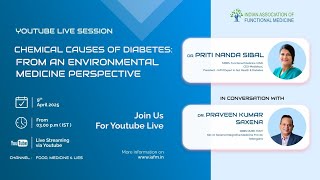
In this YouTube interview, host Dr. Preeti converses with Dr. Praveen Saxena, a radiologist and environmental medicine practitioner, about the rising diabetes epidemic in India and the role of environmental chemicals. Dr. Saxena recounts clinical observations from the 1990s to present, noting a surge in fatty liver and pre‑diabetes despite patients following conventional lifestyle advice. He outlines a broad spectrum of toxicants—endocrine‑disrupting chemicals (EDCs) such as BPA and phthalates, persistent organic pollutants (dioxins, PCBs), heavy metals (mercury, arsenic, cadmium, lead, aluminum), and micro‑plastics—that accumulate in air, water, food, and consumer products. The discussion delves into mechanistic pathways: heavy metals can break insulin’s disulfide bridges and impair receptor function, while EDCs mimic hormones, promoting insulin resistance and beta‑cell apoptosis. Dr. Saxena emphasizes magnesium deficiency as a central factor, explaining how toxic metals displace magnesium in enzymatic processes, leading to mitochondrial dysfunction and cardiovascular risk. He proposes a multi‑modal detox strategy—dilution of exposure, improving excretory pathways (skin sweating via infrared sauna, liver support), magnesium repletion (IV or transdermal preferred over oral), chelation, and dietary changes (reducing processed foods, avoiding contaminated water, limiting high‑glycemic meals at night). Functional‑medicine tools such as gut microbiome assessment, SIBO testing, and personalized labs (fasting insulin, intracellular magnesium) are highlighted through patient anecdotes. The conversation ends with a public‑health call to reduce environmental toxin load, improve awareness, and integrate these insights into clinical practice to prevent the projected rise of diabetes from 33% to potentially 66% of the population.
Chapters
Hello everyone, thanks for joining us, and thank you, Dr. Praveen, for agreeing to be here and agreeing to share your knowledge. The amount of work you do in terms of keeping yourself updated—
thanks, thanks a lot, Preeti, because the people like you who starts giving questions, and we are definitely indebted, and particularly to this society called IAFM You people are doing a great work. Kind of honored to be here, Dr. Preeti.
Thank you, Dr. Praveen. So Dr. Praveen is a medical graduate and a radiologist from Osmania Medical College, Hyderabad, working in the field of environmental medicine, right? And Dr. Praveen, environmental medicine He is a proud member of the Global Coalition for Autism Research Institute USA and an advisor to Akhil Autism and an advisor to LEADCON 2017 India, as well as the founder of the Universal Health Organization. Today in this episode, I've requested Dr. Praveen to share his immense knowledge on how chemical causes are the reason for making 33%+ people diabetic today from the environmental perspective. Science, guys, 33%+ to mazaak, right? Youngsters who are becoming diabetic, and interestingly Even 10 years back when I started Dr. Praveen working on diabetes because I reversed my own diabetes, right, it was much, much, much simpler to reverse diabetes than what it is today. And I would love to hear from you what are your insights on this and why this change has happened and what is it that we need to now be doing that this 33% doesn't become 66% in the next few years. Over to you, Dr. Praveen. You can share your presentation.
Yeah, yeah, again, thanks a lot, uh, Dr. Preeti, and, uh, it's always, uh, good to be here. I just, uh, the thing is, I am— I can always tell you what exactly I'm going to, uh, work it out here because I was one of the pay— one of the doctors who belong to, uh, I'm quite senior in the sense we passed in 1990. And from there itself, during that time, I see most of my parents, my relatives, and all that, they were not very happy with that only allopathic approach. I belong from a family where we have a lot of things on music, and at the same time they say, okay, you need to learn homeopathy also. So I said, okay, this is not my cup of tea. Once I joined my medical college. But I can tell you, nowadays I see a lot of people telling that same story. I am not alcoholic, I don't smoke, I try to be very careful with what the kind of oils I'm using, I'm exercising daily. And this sort of people are on for a— basically they are being treated by doctors like us. Come into the club of diabetes and, okay, we are also one of them, and join the club. So I always try to look at the kind of— the numbers are really, really astounding. We need to know why. See, I try to compare 30 years back. Yeah, 30 years back is some time, but this is Then that particular moment, I'm talking about '95, we completed graduation in '90 and did my radiology later that, and I used to do a lot of ultrasounds and all that. We never picked up that fatty livers on normal ultrasonography. And whenever used to have this something called fatty liver on the ultrasound, we used to tell, okay, uh, you have some problems with your fat intake, uh, try to correct your things and that will, it will help you. Um, but over a period of time we realized, we started following up that cases, and all of them, they were having something called the pre-diabetic. They were having fatty liver at the period. Uh, pretty— I am taking around circles because I see a lot of people having, uh, something like they are not happy, uh, because of their health issues, and they start looking at some answers, some weight person says, okay, I will reverse your diabetes in one day. Somebody says you do this kind of things, and people are becoming guinea pigs because of this. They want to— at this kind of thing, they want to see. I have a very good— I can tell you, most of the people are on the higher side, very intelligent people. The person gets into something like CKD and his glucose goes down and he says, my diabetes is cured, Doc Sir. So the thing is, it's really an important thing, particularly from an Indian perspective. We are the largest democracy and we cannot afford people having ill health because of these stupid reasons. So I'll try to share my presentation here, and this is one thing which we always try. Um, I'll, uh, okay, uh, so we were— one second, I, I'm just uploading the file.
Uh, yes, you've said two things which I want to re-emphasize. One, please join the club, guys. We don't have to join the club of being a diabetic. We have to join the club of being energetic and being in peak wellness.
I am now— now I am so confident, I want to take up the people who are non-diabetic and start researching on them why he has not become a diabetic. It, it's something like that now, because this is so rampant.
And second, Dr. Praveen, what you said, I always say— see, I did my MBA from IIM Lucknow and then used to sit in medical conferences, and everywhere there used to be one line Heart health capital, heart disease capital, diabetic capital. And I used to, you know, hold like this on my chair because I used to feel so angry, so annoyed, I can't tell you. The simple thing is that we cannot become the economic power till we make sure that our youngsters are healthy, our parents are healthy, and we are healthy. So if for nothing else, guys, I think it is extremely important if we want to be— get the recognition we deserve globally, if we want to be that economic power, if we want to be the country which people look up to. First and the most important thing is we need to make sure that we are not the capital for diabetics, not the capital for cancer, not the capital for heart health. And most of it today is coming from what Dr. Praveen is going to share with us right now.
Yeah, I think, I think because we, we are good actually, we will, we definitely crack good IIT marks and all. We try to work with the entire, uh, this one, but, uh, getting first in all disease patterns is really, it's not acceptable. Uh, I'm just, uh, it may take some more time. I'm, I will slate, uh, share Uh, this is one thing I'm trying to share it.
Uh, yes, shared it and it is here.
Yeah, yeah, yeah, yeah. So I'll just, uh, go. I think I, I'll try to work it out. Basically my introduction is basically I'm a radiologist. I started working on something, concepts called, as you rightly said, autism and all that. But at the same time, when I did my medicine, during the first year of MBBS, I was, uh, I was started doing something like cardiology postings. Why? My dad was having some heart problems, so he was put in the ICU, and my mom used to be in the night duties she used to perform, and I used to go— I used to do the nights actually. My mom was there. So I see a lot of mortality there, and I really realized what is this going on. So something has to be done. As you rightly said, we are not sitting ducks, and we are— we should not get ourselves as guinea pigs. Why I'm telling this chemical cause of diabetes is everyone we tell, Hyderabad, we are all keep, we talk very jovial, we are a— means you have become turned diabetic or not. That's the kind of thing. My goal is to keep your diet environmental toxin-free as possible and prevent the disease and remove the risk from the disease. From— if you remove DIS from disease, it becomes ease. So that is— that should be our focus. So the question, uh, the kind of thing is diabetes may be a natural physiologic response to a collective high toxic load. Um, it can be because of overeating, reduced exercise, environmental toxins. I will try to focus more on this environmental toxins. What the thing what you breathe through air food as well as water, right? Uh, the solution to pollution is definitely— it is called, uh, we have worked on this environmental— this one, it's called dilution. We see, I'm also putting on weight, I'm having something like higher resistance now, but still what I can tell you, when your body gets toxic, soluble, fat-soluble, water-soluble, they tries to, uh, evade the, uh, this one, toxins, from damaging the other organs. That's the reason they start accumulating fat around this one. So this is, this is a standard, uh, solution for pollution is dilution. And what are the things which we are dealing with is, uh, definitely some things like organochlorines, dioxins, PCBs, uh, so many things. We can always, uh, I can go on and on. So, uh, what happens if I tell an overweight person Okay, Baba, you have got— you have to reduce 10% of your weight to see that, uh, to see that you get into proper this one. But somewhere, once they start losing the weight, uh, the all the toxins, they start getting out, and you get into it. Uh, functional medicine— hats off to this particular concept of functional medicine. The history is important as well as physical exam. I don't have to do everything. I, I need to look at the markers. You have got acanthosis nigricans. I know he has a pre-diabetic kind of thing. So many things which we have learned in functional medicine. So we started raising our concerns about what is this rising autism, diabetes, and all that. We are able to go to the policymakers, and yes, there are still things are there, a lot of hurdles. Coming to chemical cause of diabetes, we have devised— I can always work it out on 3-4 things here. The 3-4 things are basically mercury, inorganic arsenic, cadmium, bisphenols, POP, pesticides, and all that, as well as phthalates. We'll go and look into what is this thing called, why this doctor is always on this thing called EDCs. EDC is endocrine disruptor chemicals which are mimics. They mimic something like hormones. It can be— so we have— we are talking about a lot of mimicry happening here. It's called molecular mimicry. There are something called xenoestrogens which are causing a big— and yes, you see very commonly tin bottles, we see very commonly fruits which have got— we tell, okay, this is the imported foods, fruits we have got, but But I can tell you, everything is— you are paying a price for that. So what do you do to avoid them? You can always work out all that. I can, uh, this share, I can all these things. But the most important things, PCBs, DDT. DDT is one thing which was banned, but now the DDT is still found in the breast milk. Heavy metals, I have been working a lot, as well as the plastics and all that. The endo. Now we have to raise a different level of things. We have to work on Dr. Preeti, and I know you have, you have such a good social, this one. So I want doctors with social responsibility should start talking about how to— the way we started talking about no smoking, There used to be like that. Now people have to understand what is this plastic. It's the most toughest thing to remove from the earth. And the thing is, it has issues like anything. I'll again go back 30 years back, what we had, what we now have, we have got. We have the change, the things which I believe there's a school of thought, the way we started consuming water. Now we consume the water not in the glass bottle. We try to consume in the plastic water bottle, microplastics, they leach, right? Apart from that, the water what we consume is getting from— not from the surface, you get from the groundwater. Groundwater is 100, 500 feet deep, and it has got heavy levels of heavy metals. So now, I have never seen 35 years back any big Borewells is the thing. Now we see that is every flats and all that we see borewells. We had never seen something like air fresheners and all that, that kind of time. We have never seen that kind of what shampoos which have got high levels of phthalates. So this is a big kind of thing which I think it has to be taken up by the public. It is not just the doctor's job. You have to start looking at why the things are getting so— see, this particular thing, you are seeing a lady who is pregnant and she's smelling that particular thing. It could be really poison for the kid. And these are the phthalates which are found everywhere. I can always— we tried working, Dr. Preeti, we tried working on fridge. I used to tell my patients to 'Give me a picture of what are the contents you have in the fridge.' So now we should ask them what are the other surroundings also. We should take the screenshot because once we see what is the thing is there in that fridge, we can always tell you what is the kind of metabolic things they are up to. Yeah, it makes a kind of thing. We are— we started collecting this fridge shots. Good work by one of the Dr. Rangan Chatterjee. And plastics are there everywhere. So this common, uh, this hormone-recepting or disrupting compounds is the one which we need to work it out. I'll give a simplest example, formaldehyde, and how it is, uh, percolated throughout. You go to any shopping mall, try to work on something called garment shop and all that, and after 20-30 minutes you don't even walk for you feel so exhausted and you feel so tired, and invariably you need to go to some, uh, you need to go, you go for some snacks and all that. This is because of the outgassing of that formaldehyde. Formaldehyde is sprayed heavily to make the cloth. Usually it is used by this industry. It looks like a fresh, uh, this particular stuff. So this human exposure is quite, quite significant. And where we are, we are not even leaving everything, even on fruits also we are trying to put some sprays and all that. It's really a kind of thing. So I'll come to one particular thing which was authentic, which is called Vietnam study, Vietnam veteran study. And there were a group, two groups of people who fought in Vietnam War. Some of the group called— were using Ranch handlers. Ranch was an explosive, and with that there was a thing called dioxin was emitted. And the people who didn't use this particular Agent Orange, they didn't get into rabies. Other people got into that. Dioxin is the most horrible stuff now, next to BPA. Next to phthalates. Phthalates is one thing we know everywhere it is percolated. Even the tooth, what we are— you have that particular stuff, you put some plastic, that's also phthalates. Yeah. So BPA concentration was measured in a lot of conditions. The significant part was in the diabetes and coronary heart disease. It's quite high. You need to learn something from there. POP, I'll not go for it, but I can always tell you, if you are doing something in your home trying to put a varnish paint, also trying to see that your furniture gets rebranded, you're refurbishing that. Be careful because this is going to cause big issues with you. The people who doesn't know about beds and all that, you have got Skarnaland mattress, everything is good on paper, it looks good, but it keeps on outgassing something like PBDEs, and that is for an 8-hour thing, usually for 8 hours. And you are, you are in for problems there. And, uh, like that, environmental leak, I have already told you about this particular, uh, dioxin. We need to understand something about the periodic table. Uh, I am trying to put up, Dr. Preeti, one thing called magnesium. Magnesium has got a 12 valency, uh, it's called atomic weight. And, uh, this is one thing which is, uh, at the nidus If you understand what is magnesium, then you can understand the whole thing. There are some heavy metals down the lane which are heavy in the sense transitional metals and all that. So everything is something like biological mimicry. You have got lead in the same, this one with magnesium and calcium, and you have got— so there are so many metals which are playing havoc now. The most important in particular India is lead and aluminum is the one important thing. I'll show you why this mercury is causing, how it is causing that diabetes. You have to go back to insulin molecules. You have got what you see, the yellow thing here, these are called the disulfide bridges. You have a short arm of insulin and you have a long arm. These two are connected by these disulfide bridges. See, this disulfide bridges will be easily knocked off by something heavy metals like mercury sulfide. It catches, uh, it tries to— so mercury, cadmium, aluminum, particularly arsenic. So this insulin molecules are directly assaulted, so as the insulin receptor site. And this is the one thing which is one of the Basic reasons you get into low— this is the reason for the present pandemic. Already 2006, American Chemical Society established showing that methylmercury has got something to do with the pancreatic cell apoptosis. So we don't have to, uh, do more studies and all that. Already it's there on this one. So it is blocking that transsulfuration process. So apart from that, we have something like arsenic, lead, and all that. More or less, they go with the same kind of thing. Cadmium is important because I know about this cadmium here. We are in Andhra Pradesh. We have paddy. Paddy is rice. We are all rice eaters. And paddy is grown in the fields which has got— they use superphosphate fertilizer. This superphosphate fertilizer is rich in cadmium. Rice, one more thing. Rice, you, after you take out the rice bran and all that, you try to work in the mills, rice mills. They use something like alloxan to make the right rice more white. Alloxan kills beta cells of pancreas. And, uh, yes, your mercury or metals can be there in your, uh, tap water also. Tap water is, is a dangerous product. I don't think we have to be— we cannot go without telling that the foods which are soaked in water are prone to lose their zinc content. And you have got aluminum sulfate. We need to be careful about how we start. Here again, a food for thought I'll give Dr. Preeti. We started cooking rice in— I'm talking about rice now. Rice, we started— oh, there is a convenience, the kind of convenience— we started using pressure cookers. Once we started using pressure cookers, all that, uh, before that, I'm talking 35 years back when pressure cookers were not there, the people used to make the rice in an open vessel, throw off the water, excess water, which invariably had starch. It is not just starch, it's other things also. So you— it is imperative to throw that out. The glycemic index also come down, as well as any contaminants are there goes off. Contaminants are usually— I'm talking about alloxan and all these heavy metals. So nowadays what we have to do, we have forget all the things. We will just put that kind of thing and OCD. Okay, we are taking everything inside, and that's one of the biggest reasons what I believe Everyone is meeting one rare. Arsenic in water may cause diabetes. It has been proved in American Medical Association, uh, journal. And yes, low levels, they studied up to 8 to 10 micro— uh, 10 micrograms per deciliter. Uh, it's, uh, yeah, it's up that level. And they showed this was— you have got a lot of industrial chemicals causing that. You have got, uh plastic chemicals. I don't— I have already told, but this paper, Michigan paper, uh, they said, uh, arsenic and diabetes at about 10 micrograms, and, uh, there was a correlation with diabetes, kidney disease, and cerebrovascular, uh, this is—
also there is a correlation, Dr. Praveen, between arsenic and breast cancer.
Yeah, yeah, yeah, definitely. Aluminium, you're absolutely right. So I think you are— you have to start looking at this way. If you are heavy, it's not just— and you are sick and tired and you age prematurely, you need to look at what is having— what is your heavy metal content also. So I think I'm repeating this. Yes, one thing I want to make it very clear here is about this particular stuff. This arsenic thing was used in poultry to to increase the muscle mass of chicken. I am very sure when I am talking about something like in 1980s, we never used to have broiler chicken. We used to have only country chicken. Broiler chicken was a big thing and it used to be a— it was not easily available. Now everything is broiler chicken. Broiler chickens are being fed with this growth stimulant called Roxarsone. Which is used in the poultry feeds, and there is arsenic into that. Two big things, Doc. I think arsenic as well as exposure to diabetes. You have got a Sweden case, you have got a Bangladesh case. Sweden was the smelters, it's called, basically it's called glass people who make the glass. They were at increased risk because of this arsenic component. I was talking to you about Alexon studies Okay, good and bad fats. I think, Ashwini, you people talk in a very good way. I don't have to add anything there, but I can tell you this picture. What happens is that you have got a blood sugar, it's there in the extracellular glucose. In the cell is a normal thing because of the permeability of the cell membrane. And once you have got saturated fats, in the sense trans fats, this permeability of the cell membrane is lost. So the inward entry into the glucose is an issue, as so as the mitochondrial issue. So this is, uh, whatever is we are trying to work it out. A policeman's approach doesn't look good, or the stagnated public, uh, crowd. You are, uh, you are living at this place and telling, okay, you block the other place. This is not the answer. We, we are not interested in just showing the glucose HbA1c normal. The thing is there should be proper uptake into the glucose cell and there should be proper mitochondrial, this one, and the person should be healthy. Muscle uptake should be good. I'll just give you a small, this one, about what is this muscle uptake, what is this fat uptake this doctor is talking. Sweeteners, aspartame and all that, never go for this. This is a one thing which is already causing big issues. GM foods, we keep telling everyone not to go for that. Monsanto's food, try to be careful about what is this genetically modified foods are there. Soft drink, again, it's a big issue. That's the reason we started taking the pictures, asking the patient to give the picture, because invariably you pick up in my fridge also I'll be having some Coke or soda or something like that. So, but I— this is what we need to work Already it is proved bisphenol in plastic causing 1,300% increase in fat cells. So this is a quite dangerous phenomena, and it has been proved that this is what causing this. Phthalates are found in so many things. I don't want to bore off in that particular thing. I'd like to give an interesting thing I was told about, uh, diabetics In kids, what we are seeing, this, this is called insulin-resistant diabetics. You have to start looking into why this phenomena is happening. There are so many things which is causing phthalates and all that. It is crossing the placenta, not just after that, it is causing children with anti-androgen effects. It can easily measure, but, uh, we don't have to take all the things By clinical methods, try to check the distance, anogenital distance. And if the anogenital distance is the issue, we are sure we are dealing with this kind of things. And, uh, yes, these kids, they get into problems. They'll have hypospadias, they'll have so many other things and all that. Uh, chromium deficiency was known, doctor. You know, all of you are working on that. A word of caution about chromium deficiency, because chromium is found in trivalent as well as exuberant form. Trivalent form is good for your diabetes, whereas the exuberant cross form is going to make you cancer. So you need to be careful. It is all— I think this word is repeating. Whenever your body notices that sugar is elevated, sign that you have got more than you need, so the insulin comes into picture, tries to take away and store it in glycogen. So the glycogen stores in your liver and muscle don't— won't last for throughout. And, uh, it's so that from there it goes into the saturated fat. Insulin, we know it's anabolic hormone. We can always improve our muscles with insulin, but it stores magnesium also, excess nutrients also. So if your cells become resistant to insulin, you cannot store magnesium. You start low peeing it off in the urine. That's the reason people start going for loo every time. And intracellular magnesium is one thing which is absolutely depleted in most of the people now. So that is one thing which is causing a rise in BP, rise in other things.
Extremely important for the overall balance in the body, Dr. Praveen.
Exactly. Because what happens is that as a clinician, I'd like to check only serum magnesium is 1.3, 1.4, it's fine. No, it is not like that. Intracellular magnesium is a different entity at all. And if you keep your intracellular magnesium, you are not going to get into some kind of stupid cardiac arrest, the kind of stuff now what is being. So I have a question, Dr. Preeti. This is a— this should be a kind of— they, they should get some food for thought because a lot of my patients also told— we are going to see that Why this heart attack happens only in the middle of the night, early in the morning? Most of the corporate hospitals who are having an emergency, they're busy that time. Morning times, afternoon times, they are not busy. The reason is your carbohydrate meal. You have to tell our people, kid, don't take that heavy carbohydrate meal in the night. That will save you a heart attack.
But that's all what we all do generally.
Exactly.
Tell your patients don't do that and they say that's the only time we eat as a family.
No, no, but they need to get smart because what happens is that it is really causing high insulin surges and this high insulin surges, this causes a lot of spasm in the arteries. Even if you have not any blocks also and you have got a big spasm, you are out for a problem, you are out into a big issue. So this is what has to be done. Somewhere I believe that the higher the insulin, the bigger the damage. Now we are checking something like markers for sudden cardiac death. The markers are usually HDL levels are low, insulin levels are very high. If somebody is having fasting insulin levels above 30, you need to be careful because you are in for a problem. So try to keep your fasting insulin levels below 10 or 7. That's, I think, IFM also promotes that. Yes, exactly. So, uh, these fat cells, when they become resistant, uh, so what, uh, what happens is they retains, uh, action of insulin on your fat is there is an issue there. To store that fat, it takes sugar. So resistance goes up and up like that. Your liver starts having fatty liver. So your fatty liver, for us We thought it is because it is downregulated. It's a vicious cycle with your cholesterol, with your cholesterol, with your insulin levels, and your toxins, which is making the fatty liver. It's endemic. And all these things, unless I picked on a paper which showed, yeah, this is quite— everything is fine, but high levels of insulin in the blood causing this particular thing. You can just— one second. And this is— yeah, uh, this is done by Dr. Cruz into a femoral artery of a dog. I have done a lot of peripheral artery diseases cases. Usually I don't get normal diabetes. Uh, whenever there is a complication of diabetes like a peripheral artery disease, cardiac, cardiovascular, or some other things, we come into picture. So we used to do that hypobaric and all that, but somewhere This is a big thing for us. Dr. Cruz, in his early 70s, he injected in the femoral artery, one femoral artery, insulin, and it almost occluded within 3 months. The contralateral side, which was not injected, was quite clear. So nowadays I see people having 70-100 fasting insulin, and those are the people they have Whenever we have a vascular disease, the fact that high levels of insulin causes blood to clot too readily and causes the conversion of macrophages into foam cells, and they accumulate as the fatty deposits— no rocket science. We don't have to blame only cholesterol, cholesterol, and all that. It's insulin, it's the sugar, which is the most dangerous product on Earth now. It is— once we talk about sugar, we talk about insulin, We have to talk about plastic also. Then we need to talk about arsenic, we need to talk about other things. It is not the other way around. We are just trying to see that, okay, there's accumulation of fat, and right, accumulation of fat is a protective mechanism by the body. Just by reducing, increasing atorvastatin from 20 to 80, or people are using 160 also, it is— I think it is— you are killing the patient. Maybe that is my kind of thing. So, or 25 years before, I had already said I would not have said before also, but any chronic disease is toxicity. Uh, one important thing I just want to show you, Dr. Preeti, then you'll understand. This called magnesium with a 24 atomic weight, 12 atomic number is 12. Magnesium is found crucial for health in the lot of— it's used in more than 300 enzymatic reactions. We see magnesium depletion resulting in this picture. A normal person going out for a walk, he, he has a cardiac arrhythmia. Arrhythmia is because of this low magnesium in the—
I had a patient, Dr. Praveen, who was being treated for cardiac arrhythmias. Put him on magnesium. Over the year, year and a half, He had no arrhythmias.
Perfect, perfect. Because what happens is normal, and I was surprised what is happening. But that is it.
You move forward, Dr. Praveen. I want to really tell viewers also that the way you have explained how insulin and insulin resistance is the cause of fatty liver, for heart health problems, it is so important for everybody to know because As you said, most of the patients, when I check insulin, who come to me, their insulin now is 40, 50, 70, PP is 500, 800, 1200. And interesting is, Dr. Praveen, they have no clue why I am talking about this. In fact, some of them come and say, you wasted our money, why did you do all these tests? Our doctor did not say to do these tests. And I am so grateful to you that you have covered this so beautifully. Anybody who listens to this will understand why it is important and why it must be done.
Exactly, I'm coming to that. We used to think that I am getting my green leafy vegetables and I'm, I'm having a good magnesium. No, you're not. The deplete— groundwater now is depleted of magnesium totally. And instead of that, we are getting something like heavy metals into that particular thing. So you need to be very careful. Magnesium is the important stuff. Magnesium can do a lot of stuff, uh, things like this, uh, marginal deficiency. It can— see, people having some muscle cramps and they think that it's a magnesium deficiency. We as a doctor, I used to think first of, uh, even if somebody comes to me, if you think, then I used to think it is like sodium, potassium is correct. I based on that magnesium totally.
As a, as a talks about it, we have talked about it, but nobody talks about magnesium.
We need to talk this among the public now because this is such a useful, um, uh, mineral and it is causing so many problems. And you can, once you keep that particular things is correct, you don't have to really bother about that. Uh, you people having spasms, people having a lump in the throat, so many factors. So why I am telling this particular stuff is magnesium. Magnesium in turn is a— magnesium is a good mineral. Good people are being sidelined by the bad people, the people who are powerful lobby, like mercury, aluminum, and your lead. They are basically some gundas or dadas, and they come into the mitochondrial cytochrome, uh, this one, and they displace this magnesium at all because they have the same valency. They say, this is my seat, and this all things goes for a screeching halt. And this is the basis of why we are talking about heavy metals and heavy metals. I did some, uh, wanted to show you some cases as you requested. This was a case of a gangrene, um, of 4th and 5th, uh, uh, foot. Patient was a smoker. Whatever is it, I— my angiography showed there's an erratic blood flow downstream. Peripheral Doppler I did myself, and I showed there is a less of velocity. Even the popliteal— till popliteal it was normal. Anterior tibial and, uh, dorsalis tibial There is no flow out there. So we started doing something called magnesium. We tried removing lead toxins from here. This was again correlated with CT angiogram and we started doing this particular stuff, added some things called ozone. And this was the picture within 3 to 4 months. All this microangiopathy was gone. Even the bone had, which had issues, some osteoporosis and this one. There was something like, uh, bone also had an effect. After this therapy of doing it, taking out lead and supplementing magnesium, it corrected everything. Likewise, there were some multiple cases. So this is one thing which, uh, I believe is, uh, I think, uh, Dr. Preeti, I have done my presentation.
Thank you, Dr. Praveen. I just lost my connect with time. Because it was so nice, I was glued to the screen and my ears were only listening what you were saying. Um, thank you for bringing this out. I really like the policeman approach. Now, so Dr. Praveen, how do you think people can remember this and not let this get out of their system after today's talk?
Because we have some doctors also which we are very interesting, functional medicine doctors, and I'm sure all of them are looking into all these nitty-gritties. But if we can always add on some things, because everything is— see, I'm not a very— everything is not into one particular thing. So I feel that we have to look at this when it comes to diabetes. I have not gone for a one controversial thing which I would like to tell here, uh, is, uh, we are— infantile diabetes, we have correlations with giving some vaccines, something like Haemophilus influenzae, something like hepatitis B vaccine, and that is resulting in insulin-dependent diabetes. That is one thing. Another, um, another contentious and all that is, uh, again, uh, you have got But you need to look back. You cannot just say, look at that as a doctor, okay, I'm just treating diabetes. You try to see— is— I'm happy with all functional medicine doctors here because you have to see the microbiome. You already— you people are doing that. You have to see the other things also. What is hypogonadism? What is the low testosterone levels are causing this middle-aged people getting into all diabetics? You need to look at all the perspectives. Don't close your mind. Try to work on innate immunity, all things. Try to see what is the correlation with COVID This is a big thing now. Pre-COVID and post-COVID is like AD and BC for us because the kind of patients what we are getting, almost all patients are with that stupid jab. They are into their lymphocyte count has changed. It has gone totally. Your monocytes are on the high, lymphocytes goes sometimes below 15 or it goes above 35. Both are— both things are a cause of problem. And, uh, we— if we are not able to correct that logistics, uh, whatever we do, we will be just doing some— okay, today is the— okay, this is fine, I'll add, um, this also, I'll try to add in 'You try and come on, I will give you insulin.' Insulin? Baba, like, look at that. What is his fasting levels? If his fasting levels are already high, why do you want to give him more insulin? You are going to kill the patient. At least he will be— definitely he will go to a vascular surgeon after that.
Dr. Praveen, what you just said, I'm reminded of a girl, 22 years old. She came to me about 3 weeks back. Her doctor had said that she is moving towards 1.5. Type 1.5 diabetic, right? Parents were extremely stressed out, and one of the health coaches, functional medicine coaches, only referred her to me and said, Dr. Preeti is the person you can go to because this is risky. I saw her monocytes, lymphocytes, eosinophils, everything, and you won't believe, started working on her gut health, SIBO, C. fo, parasites. 3 weeks down the lane, her sugar levels are between 80 and 120.
Super.
Means gut can be so powerful if you can diagnose right, and if you can just tell yourself that diabetes just doesn't mean food you are eating and your pancreas. Beyond that, you need to look at, and, uh, the things can really change. And similarly for heavy metals, of course I've learned from you quite a bit, but I see mercury and aluminum and lead. And the moment start working on it, it really— the patient starts moving in the right direction. But having said that, as I said in the beginning, it is not that all diabetics can be healed properly or it can be reversed for everybody. In some cases, the journey can be long because, as you showed, the level of toxin is so, so, so high. That it is going to take lot many cycles to get us where we want us to reach. But, uh, beautifully shown. And Dr. Praveen, I have a question for you. Hello, Dr. Saxena. Thanks for shedding light on the chemical causes of type 2 diabetes. My question is how to dilute the toxins and reduce the load.
Uh, I think this is why I tried, uh, emphasizing a lot on magnesium. There are some good minerals and there are some heavy metals. The balance, it goes out of balance. The higher the heavy metals, the lower the magnesium and all that. So we can always see there is a— we can just increase the magnesium levels. Usually doesn't support with oral administration. We try to go with the IVs or transdermal. Mayer's protocol is one of the magnesium protocol only. So you, you try to balance that. At the same time, we can always fix up something called methionine. Methionine is one thing which is— the higher the methionine, the higher the toxic load you can bear. Most of the people who has got disease, they have low methionine. I'm just talking about a reserve. Your vehicle having less reserve, you are in for immediate problems. So the same thing happens here. The other stuff what we can be done is taking out these heavy metals in a peaceful way, because it is difficult to excrete this with a normal kind of things. Whatever fasting you are doing, whatever purging you are doing, this is a stubborn things. It really holds tight to your soft tissues. And it gets embedded into the bone. All heavy metal toxicities have one thing common, which is lower levels of vitamin D. Just by giving vitamin D is not going to solve. You need to slowly start mobilizing these heavy metals through some reasons. The first thing what I try to tell is try to improvise on your excreting capabilities. Excreting capabilities, hepatobiliary system, If we can improve that, that makes a big difference. You can, because your liver is the most overworked organ, try to give support to that particular stuff. Try to see that your skin starts breathing. Skin starts breathing, I mean, your skin should start sweating, something like that. The people who sweat more, they are healthy. The people who don't sweat more are not healthy. I, Dr. Preeti, I can always tell you there's a difference of, uh, things now. I am talking about 30 years back. Somebody used to come with the shoes and he used to, uh, throw— he used to remove his shoes outside. And if he was coming after removing the shoes with that mojai, what we call socks, the whole room used to sing. We used to think, why you have come? We used to tell him, go and remove your socks. Now, we— does it happen we are not able to actively excrete things at all?
Interestingly, what I've seen is that when I start, people tell me that we don't sweat at all. And I tell them, take 10 FIR, far infrared sauna session. After that, we will talk. After 10 or 15 sessions, they start sweating even inside the sauna. If I don't tell them you won't sweat, they feel as if there was no heat only, because our body is just not detoxifying. Very, very beautifully put, Dr. Praveen.
Very beautiful. So that is the one more concept. You try to see that your skin breathes. You are, you are trying to do, uh, your fatty liver has to be corrected. I'm very sure I have challenged— it's not challenge, but I have seen people who are, who are masters in hepatologists and all that, they say you cannot treat fatty liver. But just by what you said, what you said, doing a sauna and doing this kind of things, trying to use some niacin, trying to use some good stuff, your fatty liver is getting normal.
So once you Even fibrosis cases, we are getting such good response.
Exactly, exactly. So try to use all the modalities. Keep your detoxing skills. I'll tell you, your body— uh, I— if I want to tell you about detoxification in a nutshell, uh, imagine your, your body is like a tub. You have a tub where you used to immerse water and used to lie down there. Still, uh, because of now people doesn't have. In the tub, we have got on the right side, you have got some tabs. On the left side, you have got some tabs, and you have some drains also. So your health is like a bathtub. All toxins are coming from the left side, all clean water is coming from the right side. Just imagine. And what happens is that with these toxins, it is getting overloaded, and there is a spillage. The drains which are there, you have got 4 drains. One is your skin, one another one is your kidney, uh, you pass from pee. Other thing is your, uh, poops. The fourth one is your lungs, and that is blocked, you are in a problem. So try to cut down, pour the normal right water, don't pour the bad water into that particular thing. Keep your detoxes clean. It will be a good— you will not get into any chronic diseases as far as I understand.
Dr. Praveen, you just said one thing before I take the next question. You said something like oral magnesium does not work as well as IV magnesium in form of—
yeah, yeah.
Second, you also said that there are ways to remove toxins, but what I understand is again we have oral medicines as well as IVs. So your opinion on this for both?
Oh, the thing is, I'll take up first magnesium basically, because what happens is that when you have a big— when you are into a disease state and you have got a real problem, you have got arrhythmias and all that, you cannot depend on 15 days oral medicine to get to that level. You don't have that 15 days. So try to work on something like IV parenteral, number one, most easy thing. Yes, magnesium, transdermal magnesium works wonderfully. I can always vouch for that. Transdermal magnesium has to be taken in a big way. Oral tablets are there, but it's more of a marketing gimmick, I think, because most of it is passed out. The more you take it, it passes through the, uh, your poops. Uh, the other one is Regarding heavy metal toxicity treatment with the chelation drugs, chelation drugs are easy, but there is a lot of natural chelators also are there. Start looking at that also. Do mix and kind of both. Um, again, when we talk about a person who is diseased, who is having a fatty liver, so already liver is overworking. By giving orally, uh, it goes from the first pass, it goes into the liver only. I don't want my liver to suffer unnecessarily. Even if it's a good stuff, It is going there and it is getting into something, converted into some other thing. So I try to see that as far as possible, I try to see that, ask them to swallow, or ask them to see that chew it. Sublingual medicine is better than the oral medicine. So I'm not a big fan of orally. IVs, they do phenomenally well. Yes, on a longer run, if I want to keep someone, you can always do some oral stuff. Because this ethylene EDTA, what we use orally, that pKa value is very low, and the absorption is— it's as good as not taking it, actually.
Also, what I have seen is that with IVs, it does multiple other things, like it breaks the biofilms, and that's where the healing starts at a very different level.
Yes, absolutely, absolutely, absolutely. And you need to support the body. The thing is, you remove the obstacles and and support the body, the body starts healing by itself. That's kind of the beauty of that human body.
Great, thank you, Dr. Praveen. I have last question for you before I let you go, though we've extended our talk today, but it was phenomenal, phenomenal, phenomenal. What is the top cause of insulin resistance? Energy toxicity, environmental toxicity, stress, or genetics?
What was the question like?
What is the top cause of insulin resistance?
Uh, the thing is, top cause of insulin resistance is— I tried to show on that kind of picture, uh, because that was, uh, I have given you two, uh, arms of insulin, which is disulfide bridges. And, uh, there is a— even the insulin receptors have got something like pyruvate kinase. So most of the people who has got pyruvate kinase, it has also got sulfides. And, uh, we are firm belief in the sense it's, uh, it is not just the lead or arsenic, it can be, uh, there are other things also which are called endocrine disruptors. Bisphenol A as well as the salads has to do a big thing. The— I, I believe I want to give 4 answers. I cannot tell only one is an issue. There are a spectrum of cases like it happened in something like Blackfoot disease of Taiwan. What happened was in Blackfoot disease of Taiwan, this was way back in 1977. The people who started having black foots and all of them were diabetic, turned diabetic. And it was found that the people who were taking from a well in Taiwan, that so only those people who were consuming that water, they had that black foot. So then it was tested, arsenic was way beyond. In that case, it was only arsenic. That's the thing. In, uh, I know, uh, Bengal and Andhra Pradesh and all that, arsenic in Hyderabad also, it's quite high. I don't know about the other kind of stuff.
Yes, the north side, lead, aluminum, very, very high. Even we have a lot of fluoride here, because of which iodine is going down because it gets replaced. So thank you for bringing this awareness, Dr. Praveen. Thank you everybody for joining. Thank you very much. And do write to us about what more you would want to learn, and I will catch hold of doctors like Dr. Praveen and get you all the information.
Thank you, thank you, thank you, Dr. Preeti. It was splendid. You are always a tough examiner, I think.
Thank you, Dr. Praveen. Thank you, you are a smart one. Bye-bye.
More from Dr


Understanding Chronic Acidity: A Holistic Approach to Better Digestive Health 🌿


BHRT - transformational health journey if a 42 year old women #BHRT #HormoneBalance




Transform Your Health Naturally with Functional Medicine | Dr. Priti Nanda’s Success Story


hypothyroidism and ozone therapy - talk at Ozone Conference by Dr Priti Nanda Sibal
