Choosing Protein Supplements the Right Way |
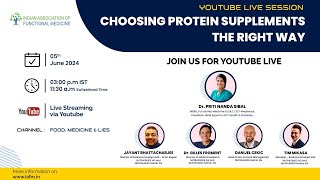
Dr. Priti Nanda Sibal and NutraSwiss experts discuss choosing protein supplements wisely, comparing whey, casein, soy, and pea. Their whey product comes from grass-fed Alpine cows, contains 0.9g lactose per serving, and undergoes batch-wise testing for microbes and heavy metals.
Chapters
Hello and good afternoon, everybody. Good to have you here. And today we are going to talk about a very, very important thing. I know in functional medicine we talk a lot about micronutrients, we talk a lot about toxins, we talk a lot about hormones. But we all know that macronutrients play a huge, huge, huge role in how healthy we feel. And one of the most important macronutrients, which is in the middle of a lot of controversy, at least in India, is protein. Because of that controversy, I thought, let's hear it from the horse's mouth. Why You know, protein is important. And what are the factors we should take into account to choose the right protein for ourselves? Of course, we will share a step-by-step guide, uh, to choose your protein wisely just after this YouTube Live in the description. So rest assured that a lot of content you will get in written form also. But I will want all of you, Geeky, Shivaram, and all others who have joined us to actually ask your questions here and let's get answers.
So before—
without wasting any time, I will want to introduce Jayant, who is the founder and head of Delhi operations and overall NutraSpace, which is the producer for organic protein. Uh, over to you, Jayant.
Thank you, Preeti ji, and a very, uh, you know, warm greeting to everybody that's part of the Indian Association of Functional Medicine, all your listeners and viewers. It's a very warm and nice and sunny day here in Switzerland, in Biatenberg, at our headquarters at NutraSwiss. Uh, you have a window there, you can see it's a direct view of the Jungfrau Mountain. And as you can see, the title there is Nutracis Protein Meadows. This is where, you know, the cows graze from which our protein comes. Therefore, you know, I don't think I have to say too much when it comes to this because obviously the source that you're getting your protein from is not even arguably but definitively the best in the world. Now, having said that, let me just say couple of quick words about Nutra-Swiss. But before I go into that, let me introduce my colleagues. I have, you know, my friend Daniel Cecik. He's at our factory in Saanen, where we have a world-class production center, you know, in our joint venture with Narin. So we have Nutra-Swiss Narin, where all these wonderful products get made, and Daniel is heading that show there. I have my young friend here, Tim Mikasa. He will fill us in with the research and, and the info on all these stuff that we need. So we're all set to go and let you know how this works. As Preeti ji just mentioned, you know, NutraSwitch has a very, very popular booklet that possibly has hundreds of thousands of views around the world at this point in time, which will be then posted in the description below for this. It's called a step-by-step guidebook to choosing the best protein supplement. This we will make available. This pretty much gives you everything that you need to know. Now, uh, let me, let me say NutraSwiss is— NutraSwiss Switzerland is one of Switzerland's largest, oldest, best-known 360-degree wellness companies. Why do we say 360-degree wellness? Because we are not just a company that makes health supplements. No, we do that as well, but we are also involved, and, and we take a lot of pride in the other activities that are connected with wellness that we are involved in. So we have 5-star resorts, uh, we have genetic therapies, uh, you know, we have, uh, we have Clinic NutraSwiss where we do all kinds of therapies for wellness that we put together. So there's a whole lot of things that are happening together as we grow. We are no stranger to India, you know, we have been in India for over 2 and a half years now, and we have worked very closely with some of the leading corporate hospital chains in India. We've worked with the best nutritionists in India. We work with Apollo Hospitals. We've worked with a whole host of other people, and our products have been well accepted in India for for over 2 years now. I take a lot of pride in letting you know that we have over 10 products which are currently on sale in India. In Switzerland, we have many more. In Switzerland, we have over 40. In India, currently, with all approvals, whether they be from, you know, FSSAI or the drug authorities concerned or whoever is involved, these products have been selling very well in India. And our protein, by the way, is the largest selling protein for most corporate hospitals these days, and it's also gaining traction with a whole host of nutritionists across India.
I will want to just add a word here, Jian. Thank you for sharing that. I've been using your protein and it is giving good results.
Thank you, Preeti.
I will echo you on that. Perfect. So, yeah, Gian, I would want to understand from you, what are the different types of protein? Or maybe Tim can, whoever wants to answer. And why do you think whey protein is the way to go for fitness people or for health enthusiasts?
Perfect. I will hand you over to my young friend here, Tim. But before I do that, I always add a caveat because, you know, our attempt here at NutraSwiss is not to really sell you our products. So I I would start by saying if you had a choice, your choice for protein should be whole food, something that comes with the fibers, with the vitamins, you know, with the carbs and everything all put together. However, in this day and age, it's not always possible to get all your macro and micronutrients from one possible source given the, you know, depletion of the topsoil, environment, contaminants, etc., etc. Therefore, the requirement and the need of a wholesome, you know, protein supplement like this. So I let my friend Tim take over here and deal with the stats and the technicals here. Tim, step up.
Yes, so as Jane said, there are many different protein sources, especially from whole foods, but I believe your question is in particular for health supplements. So for health supplements, the most popular sources would certainly be whey protein, which is what we are selling under Protein Magic. There is casein protein, and there are various plant-based protein sources. The most common one is soy protein and pea protein among the plant-based sources. There are a few others also. Whey protein is considered to be the best because of the high bioavailability. The body can very efficiently absorb the— yeah, can very efficiently absorb whey protein much better than especially plant-based sources. The bioavailability of whey protein is 3 to 4 times higher than most plant-based sources. Whey protein is also fast absorbing. This is why it's very popular in the fitness community. Now, a lot of, a lot of people who go to the gym and work out have their famous post-workout shake to supply the body with a fast absorbing protein, and whey protein is by far the fastest absorbing one. So these are the main two highlights for whey protein. And the third one I would say is that it has a complete amino acid profile. Not all proteins, especially plant-based proteins, come with a complete amino acid profile. Which is a big bonus for whey protein.
So Tim, thanks for sharing this. Can you share a little more in detail when you talk about complete amino acid profile? What is missing in pea protein or what is missing in soya protein? And when you said that whey is the best, yes, majority of people use it, but could you elaborate a little more on difference between whey and casein protein also?
Surely, surely. So whey and casein protein are both sourced from milk, usually from cow milk, of course. So they both come into the same category. They're not plant-based protein sources. The difference between casein and whey protein is basically how fast they absorb. Whey protein is the fast absorption protein, and casein is the slower absorption protein. For the fitness community or fitness enthusiasts, they tend to prefer whey protein, but that is not saying that casein is inferior. It just has a different goal. I would agree that for people who work out, especially in a post-workout shake, whey protein is the best choice. For the general public who's looking at overall health, a mix of both of these protein sources is very recommended. If you get your main source from whey protein, but you can also add in a little bit of casein, that is, that is perfect. You know, combining these two would give you the best of both worlds, so to speak.
If I may add here, can you just look at this one? Yeah, if I may just add here, you know, uh, I know there are camps and there are camps. So now you have hardcore guys who will tell you casein, milk, gluten, never, never. On the other hand, there'll be people who swear by whey, right? Now, as we know, I mean, casein, definitely for people who have lactose intolerance of any kind, it would be a factor. Obviously, I wouldn't want to take milk, and that's where I believe we score either way with whey. Because, for example, Protein Magic, you know, as Tim would have mentioned or will mention in due course, has about 0 point— am I right, Tim? 0.9 grams of of lactose only per serving. And even for people affected by lactose intolerance, they can go up to 10 grams of lactose. This will not affect them. So this is pretty much the lowest possible protein, lowest possible quantity of lactose in a protein available in the global market. Incidentally, what we are selling in India is exactly what we sell in Switzerland, what we sell globally, and this is the best possible protein you could have. But just one more quick word, if I may add here. When Preeti ji asked whether it's whey or casein, what are the differences? Of course, I mean, we are bio-individuals, you know, every individual, every human being is different, and that's where you have to possibly look at who you are, what you are, the status on your gut, the situation, how you absorb, when you absorb, at what time of the day you absorb, and that's where your nutritionist and the entire family, Preeti ji's family at the Indian Association of Functional Medicine. These are people who would be able to guide you and tell you how these things really work. But before we move further, may I just hand over— hand you over to my friend, colleague Daniel here to say, because an integral part of the protein that we produce, which we call pretty much the best protein in the world, which is now in India, production and the values associated in the processes and the protocol associated with the production here in Switzerland is very important. That is where I think you know, there's nobody better than Daniel to elaborate on this. Incidentally, one more input, Preeti ji, for you. Like many of our competitors, you know, we had the opportunity of producing these proteins in India. We could have sourced the powder and the whey from Switzerland. We could have easily had a contract factory in India like many of our peers and competitors do and produced it there. We chose not to, even though commercially we pay much more in terms of customs duty and others, and the end product becomes far more expensive in the Indian market. But we didn't compromise on that for a very good reason, and Daniel will tell you why. Over to you, Daniel.
Thank you, Jayant. Our company has existed for 70 years, so there's a lot of knowledge experience, and why can we keep the high quality. I mean, we are FSSC certified. This is the highest food safety standard existing, and all our raw materials are controlled internally and externally, and every batch that we produce gets controlled, same thing, internally in the laboratory and in an external laboratory. And only if all these laboratories approve the quality, then it gets sold to customers. And so what we combine is the experience from 70 years, but as well the modern standards that we have to meet. And I think this qualifies us as a producer of the protein product being sold not only in India, not only in Switzerland, but in many, many countries in Europe, in Africa, in Asia as well.
Thank you, Daniel. Thank you so much. In fact, if I may just— permission— take one more second here. Is that okay?
Yeah, yeah, please.
I, you know, uh, I, I just before I handed over this, uh, portion to Daniel, I would just like to bring to, uh, the attention of your viewers that By and large, across the spectrum of nutritionists and, you know, functional medicine doctors across the world, and we interact with many, many people, we have data pretty much collated and collected and assorted across regions. We have a lot of data available with us, and this is something that we propose to share as we go along. We'll post some of it in the description below. But the important point that we would like to make is We have found by polling hundreds of nutritionists across the world, and we asked them one very simple question: if you had a choice and you had a company and you were given all that you needed to produce the best protein powder or the best protein source in the world, what would you choose and how would you go about it? This is something that we did, you know, with, with a lot of you know, how would I put it, sincerity in trying to be objective. And, and we polled doctors across the world, nutritionists across the world, dietitians across the world, and the answer we got was very straightforward and clear. Up to 85% of these well-known dietitians and doctors said to us very clearly, for them, the number one source of protein, if they had a choice, would be whey protein from cows that are fed organic grass without flavoring agents, as far as possible without sweeteners and agents and preservatives and the rest of it. Now, the point I'm trying to make here is this: most companies in the world that produce protein powders do not do so at their own works or factories, because if you are a global company, you need to optimize your production by locating production centers in, in your target country. So what, what really happens is you, you use contracted facilities and you source the, the main ingredient from across the world, wherever it is. Just to let your, uh, because you— I believe your audience is global. I believe your listeners and your viewers are, uh, are members of the Indian Association of Functional Medicine. So they would need to know the 3 principal sources for whey protein across the world, divided is the Chinese source, and then you have the Japanese source, and then you have the Swiss source. And just to give you, for your reference, a price point— I'm coming— there's a reason I give this. The landed cost of Chinese whey-sourced whey protein is about ₹2,000 or ₹2,500 landed in India, just pure whey without packaging or anything, adding anything else. Similarly for Japanese, which is much higher in quality, it's about 9,500. For Swiss whey protein, grass-fed cows from happy Alpine cows, as we call them, it's about 12,800, 13,000 rupees. And this, and this price points happen for a reason, and the reason is very clear. And that's what you see in that, in that window over there. You are getting the best possible source. So what I'm sharing here is data from a poll across the world. And as I said, about 80% of the people said this is what they would do. Does this mean that whey protein is the best? Well, depends who you are. It could be the best for you, but I would not be the one to stand here and say it's the best for everybody. That's the decision that you have to make, and you take into account advice given by, you know, people like Preeti ji who can guide you and her team.
Thank you, Jayant. And when you took over from me, I was wanting to tell Daniel that, Daniel, this is a big question from everybody who uses protein is, that whether it is tested for safety and quality. So thank you for sharing this, that yes, you have very stringent controls internally, externally, and you have the highest levels of quality standards which you have been maintaining for last 70 years.
Exactly.
Thank you very much. And Thank you.
It's not marketing.
That's the fact.
Yeah, but, but Preeti ji, I mean, it's— I, I will tell you this, just if I may, with your permission. We have been in India for 2 years.
Yeah.
And, and, and, and I take a lot of pride in saying that, you know, as I said, uh, we are one of the largest selling protein powders, imported protein powders, at Apollo, across Apollo. All right, it's a huge impact that we have. And we had the good fortune of getting a lot of testimonials and feedback because these were basically doctors across the board. Because whatever disorder you have, obviously, you know, without protein, you're not getting anywhere because nutrition is such an important part. And we have been ourselves surprised at the level of acceptance that we've had. I think we scored very highly because One of the biggest sources of our sales is people who are on dialysis, for example, where this whey protein scores very highly because of the absorbability. Similarly, my friend Tim here will tell you straight away in terms of the protein content that you get per serving in our protein as compared to others. Would you like to elaborate on that?
I have some questions for Tim.
Sure, please, please.
Thank you. Tim, does the protein contain any artificial additives, sweeteners, or preservatives?
Uh, yeah, so we have reduced the amount of artificial additives to an absolute minimum. We're doing this one by giving real vanilla flavor with real vanilla beans as the source of flavor. I've never seen another company or brand do this. As far as I have seen across the board, we're the only company that gives real vanilla flavor. Everybody else is giving artificial vanilla flavor. This makes a huge difference in terms of both quality as well as taste. Vanilla is the second most expensive raw material in the world after saffron, so that is why most companies choose an artificial vanilla flavoring over a natural one, which we are using. But, you know, it makes all the difference.
And we add vanilla seeds. Correct.
Real vanilla seeds. Correct. The only artificial ingredient that is in our protein is sucralose, which is the best calorie-free sweetener available on the market. We're not using, for example, aspartame or something like this. These would be very harmful and cancer-causing sweeteners. We're using sucralose. We're losing a small amount, but of course this is important because we want to have a low calorie count and we don't want to add sugar to the protein.
This is sucralose, just change the gut microbiome. Now there are studies to say that So sucralose is also not as safe as we used to think it is.
Absolutely, one has to be careful with these ingredients. But, you know, we have a protein powder and we must make sure that the protein is as pure as possible. We cannot afford to add sugar in a protein supplement. That would be counterproductive.
So, yeah, so Rahul has this comment to make. Checked ingredients of NutraSwiss, it does contain artificial sweetener. Also it has sucralose. Not sure how it is different from the other brands.
Well, again, just to reiterate, the difference is we use natural flavor, real vanilla seeds, not artificial flavor, and we don't use aspartame. We use sucralose, which is much higher in quality as a sweetener.
A quick, quick thing here, uh, by the way, we have just one flavor and that is vanilla flavor. And we, as I said, we do that for a reason. We people ask us, don't you have chocolate? Don't you have this? Don't you have that? The problem is that everybody is using emulsifying— see, the problem with this powder or most whey powders, it must kind of mix well. Most people use emulsifying agents, they use all kinds of other stuff to give you a smoothie kind of feel. Now we could have compromised on that, we don't do it. So as Tim said, we're the only people that don't use preservatives, we don't use other flavoring agents, we don't use coloring agents. It's just this wee bit, and that also by industry standards, the lowest possible amount, because we had to do this to make it kind of palatable to our diabetic patients. That's the reason. But by industry standards, this is—
another question, yeah, another question Sivan Bhandari has is, does NutraSwiss protein come in unflavored version too? If not, why? Also, is the milk coming from free-range cows, as could not see this on the website?
Okay, so We have Protein Magic and it's vanilla flavored. At this point in time, we have this. Of course, it's theoretically possible always that, you know, we could have an unflavored version as well. It's possible, but obviously, you know, this is a decision that does not get made in vacuum. There are market dynamics involved here, so we have to work with that, obviously. But to answer categorically to your The question here, our milk or the source of our whey comes from what you see in that window. Not only free-ranging, these are happy Alpine cows. That's a technical term for cows that roam free. There are no antibiotics, no injections, no herding them. They're just sitting there enjoying the pure air, water, and grass. That's our source. That's why we are different.
Wonderful. Tim, I think this question you will have to take. One is Nitya wants to know what about people with dairy intolerance, can they still have whey protein? Though Jayant has mentioned it in brief, but if you can elaborate on that, whether lactose intolerant patients can take your whey protein or any whey protein with whatever.
It's a very simple question. Yes, they can. Of course, people think because whey protein comes from milk it's connected to lactose. However, that's not really the case because the whole point of whey protein is extracting only the protein from the milk, which means the lactose and the fat content of the milk have been removed. One serving of our protein contains 0.9 grams of lactose, which is practically nothing. You know, the average person, even that is lactose intolerant, the average lactose intolerant person can take up to 10 to 20 grams of lactose without noticing any discomfort whatsoever. So 0.9 grams of lactose is, practically speaking, nothing. And yes, therefore it is very safe for lactose intolerant people.
Sivaram wants to know that, you know, he says, I'm told if we supplement, we need to take the isolates.
Yeah, happy to answer that also. Our protein is whey concentrate. There's a minor difference between whey concentrate and whey isolate. Whey isolate is even more isolated or concentrated than whey concentrate, which means the protein content is even slightly higher than in the whey concentrate. I would argue for the normal person, this makes no difference whatsoever because the product is much more expensive, more processed, which is not a good thing, of course. And the increase in protein content is very minimal. I would say this makes a difference for bodybuilders who might even do this professionally and are preparing for a bodybuilding show. Where every gram counts, for 99% of the population, an isolate is not needed at all.
In fact, if I may add, the process of, of getting it to an isolate stage as compared to the concentrate is itself a harmful process because it's a very complicated process. You have to add a lot of other stuff which basically defeats the purpose of the exercise. This is our view, and you can check this out. There's a lot of this stuff available on the internet. Everywhere. You can, you can check it out for yourself.
So Geeky was saying, I am giving regular adult dose of Protein Magic to my PCOD patients, pre-surgery and post-surgery patients, and women with anemia and heavy bleeding. How much dose of Protein Magic I can give to patients with high uric acid levels?
You want to take this or should I take it?
Um, well, I would say that the normal, normal serving size for protein works for everybody really, which is 30 grams per day. But this has to be decided on an individual level because the purpose of a protein supplement is to get to the target amount of protein, which is different for everybody. Of course, a small woman might use much less protein per day than an athlete who is 2 meters tall. So this has to be decided on an individual level by the doctor based on the individual protein requirements of the patient.
As you know, I mean, the protein requirement generally across genders globally is, as they tell you, somewhere between 0.8 grams per body weight kg or 1 gram per body weight kg. So this would translate to about, give or take, 80 to 100 grams per day depending on your age, life cycle, health, and so forth. Now, if you have a patient that's bleeding or not well. Obviously, a supplement is always a supplement. This supplements your regular protein intake. It can't be the only source of protein. So here, the nutritionist or the doctor concerned plays a key role because he or she has the firsthand access. She understands the patient, knows the patient. What we can tell you is that we have about 20 grams per serving—
22 even here—
22 grams, 22 grams of real protein per serving, and then you have to take it from there.
So, Geeky, I would want to add here that for uric acid patients, one, start low, go slow. Second, whatever protein you want to give to the patient, give it to in the first half, not in the second half. And if you have any particular case, I will be happy to discuss it with you after this YouTube Live. You can just send me a message and we can speak. Thank you. So Prime King has this question: is your protein tested for mold?
Daniel, maybe that's for you.
Yes, definitely. Each and every batch gets tested microbiologically so that it's not only the specifications that we rely on, but as well the, the actual finished product that gets tested. And it's really every batch. It's not only every 10th batch that we test, every batch that's being produced.
And Daniel, you test it particularly for mold also?
Yes, we do.
Perfect, thank you.
In fact, Priti ji, if I may add here, as a foreign brand, when we import our goods into India, we are, we are by law required to submit our microbiology test for each batch, each sample that we are sending there. Unlike the Indian counterparts, once they are producing inside India, they don't do it automatically. They may do it for themselves, but here we have to—
what a good opportunity.
Yes, yes. So this is a huge selling point for me because I'm mandatorily required to submit this data to the government of India, whereas somebody that produces in India, while he may be carrying out this test internally— this I don't wish to comment on— but he is not required to mandatorily submit this So I would be far more careful in what I do.
And I want to repeat that it's not our laboratory doing these tests. It's an external independent laboratory. So there is no way that we could tweak or change anything to our advantage. It's an external independent laboratory proving the quality.
Thank you, Daniel. And we just—
maybe one more point to add here. Even the Indian customs draw a sample and send it to their laboratory. So I think it is not unreasonable to say that our imported protein from Switzerland might be the most tested product on the market.
So Shweta Jain wants to know, I use Barbell Nutrition raw protein because they have clean labels, price is also more or less the same. Why should I recommend NutraSwiss? Please guide me.
Take this. Yeah, well, I mean, I don't want to, you know, comment on any brands in particular in a negative way whatsoever. Um, I would like to highlight the benefits of Protein Magic, which again, I have to repeat myself, there's no other brand that uses real vanilla seeds as a flavor. Um, they will use artificial sweetener, and I believe we're the only protein in the market that sources the milk or the whey protein from grass-fed cows in Switzerland. And I think that because of these two points, we can recommend Protein Magic. Again, I don't want to badmouth other brands in particular, and there are too many, so I don't know the label of Barbell Nutrition by heart.
Also, by the way, if I may just add, since the listener who asked this question also mentioned the price point, as I said, you know, we've had this going on for 2 years now, and we've been saying that our product is basically the most price efficient in terms of the, the purest protein available at per rupee. And this is a claim we've made, and this is something that we can justify, but that would require a longer discussion at some point.
Yeah, but before I take up the next question, I really want to thank the participants because a lot of good discussion is happening in the chat box. Thank you, guys. And thank you for being present because it helps everybody. Some comments are coming that maybe instead of sucralose, you could consider using stevia, monk fruit, or erythritol. They could be much better than sucralose. Anything you want to say on this, Tim or Daniel?
I think Daniel would be the best person to answer that question.
Um, out of experience, we can say that whichever ingredient we choose, there are always pros and cons. We have customers who say we want it as natural as possible, and that's sugar. There's nothing as natural as sugar. But there are many people who say I don't want to have sugar. Stevia, which is considered by some people as natural— that's right, technically it's not natural anymore because the process is, it's so heavily processed that it's not even available organic, for example, because they say a processed product like stevia cannot be called organic. So this is why, yes, there are alternatives, and every alternative has pros and cons. In this case, we chose sucralose because it is calorie-free, and even if there are some voices who say we don't like it, It's proven and it's an experienced ingredient.
Yeah, so Daniel, but recently a lot of data and research is coming saying sucralose changes the gut microbiome. And as functional medicine practitioners, what we are seeing in our practices, I would not be wrong if I say 70% of people today are suffering from digestive health issues.
Yes.
What would be your preferred, um, go with?
We could go with, if not stevia, erythritol.
Yes.
Or we could go with just unflavored brand and people could add their fruits or whatever they want on their own.
I think this is an interesting topic where we, NutraSweets and Narine, have to involve customers and then to listen to what they want. I mean, we brought this idea or this, this solution. I'm not saying that we couldn't improve by listening to customers who say if the, the majority is for erythritol, we should do it.
Thank you, thank you for being open, because right now what I see, these are all your customers and their patients are your customers.
Yes, no, we thank— I mean, this is a wonderfully interactive session, and, uh, it's a session like this that serves both ways, you know.
We, we take a lot because going forward, you know, functional medicine I see is future healthcare, right? And functional medicine doctors and coaches are going to be more and more important and more and more heard too when it will come to health and fitness. And we all strongly feel as a community that we have better options than sucralose, or maybe nothing. But thank you, Daniel, this is very nice to hear it. At least you are open. And if you get a feedback that no, sucralose is okay, then we would do more research at our end. But currently I know that we have a lot of data which does not support sucralose as the additive now. A year back we were doing it, but now it is different.
We can actually discuss this internally and maybe, you know, give you some data from our side as well.
Yes, perfect. So we have another question. I have lost the flow of questions, just give me a minute. Yeah, unflavored and unsweetened, we have discussed. Okay, so now people want to know that there are tons of protein supplements. Could you tell us something about the labels? What— how should we read a protein label? What labels should we consider while buying a protein supplement, like approved by FDA or any other organization? Tim or Daniel?
Yeah, I'm happy to take that question. I would say the most important— there are many, many important factors when reading the label. The most important factor is to look at the protein content and the content of other macronutrients like carbohydrates and fat. The problem is that many so-called protein supplements have more carbohydrates and/or more sugar content than actual protein. So calling it a protein supplement is fraud. I would really use that word. Um, so in my view, that is the most important thing, to make sure that there are no fillers like maltodextrin or vegetable oils in the protein supplement, which don't belong there at all. Yeah, the first thing is to ensure that you're buying a pure protein supplement. From there, you go to the next step and you look at the quality of the protein. Are they using natural flavors, are they certified, are they manufactured, where are they manufacturing. So this is the chain of, of, um, of thought that you should follow when choosing your protein supplement in the most basic manner. Of course, I could list 100 factors, but these are the 2 most important ones.
What you can add here is, of course, the source. Now you have the standard sources we discussed in the beginning. You could, you could have, uh, you know, peas or soy sources, or you could have whey. It's something that also that you, you should be looking at. Because as Preeti ji would tell you, or practitioners of functional medicine would tell you, depending on where you are in terms of health, soya source or a pea source may not be as efficient, biologically speaking, or from a gut perspective, as whey. So you must take that also into account for sure.
And so for practically speaking, and I mean, of course we love Protein Magic, but without saying you have to buy our brand, I would recommend to to customers to choose a whey protein and a pure whey protein. If you have this covered, you're good to go. And then once you have that basis covered, it's between comparing the source of the whey protein. But as long as you have these two things covered, you're already in a— you have gone in a very good direction, and you've cut out most of the bad products which contain tons of fillers and maltodextrin and vegetable oils, which are really harmful.
In fact, quickly, just one more second, with Priti Ji's permission, you know, to answer this question without naming brands, you have brands available which call themselves protein this or protein that, but the actual content of protein in 100 grams would be less than 18% or 18 grams or even less. Yeah, it's crazy. You must look at that.
Yeah, it's mostly sugar and fats which they use as fillers, and they have a tiny amount of protein, and then they call it protein supplement. Is really not right.
Also, now we are seeing that labeling is not done correctly.
Yes.
So is there a way that we can check whether this label is done correctly or not? Daniel, maybe you could help us with this.
What is on the label comes from our specifications. The specifications, um, the product specification is, uh, like a very strict protocol what goes inside there. There's no interpretation, there's no marketing inside it. So what's on the label, that's what our scientists define that this must go on the, on the label. So there is nothing that we could—
that is, that is perfectly all right, Daniel. What we are trying to know is that we have a lot of brands in the market Right, in April there was a lot of news around this that people had found that protein companies were not giving the right information on the label.
Yes, I see.
I think here, in that case, what are the type of quality accreditations we should check where we can be a little more sure that no, this label would be correct? Any good agencies?
I think it's impossible when reading a label to distinguish between false and right ones. I think there is no obvious signs, but I think here I would like to mention our reputation. Since 70 years we've been doing what we've been doing. There are people. Like, we are not an unknown company with unknown people. We have faces. You can check our faces, our names on the internet, and we cannot risk any, like, reputation with wrong label.
We get it. Thank you. Yeah, uh, we have this question from Dr. Ashwini.
Can I just add one point here? When you're talking about label in a broader sense, you must understand that the labels are not defined by us in a larger context. For example, in India, a whey protein is a food, and the label content, design, structure, what is in it, is defined by the FSSAI. So what— for a product like ours, I mean, I would like to of course give you much more information. I could do that if I wanted to, but the law does not allow me. Maybe this, this is something that you have to jointly address and approach with the FSSAI in India as well.
One more point from my side. I think generally speaking, it would be fair to say that imported products are safer because they are much more tested. The process of going through the Indian customs is very strict, and products manufactured in India don't go through that process. So broadly speaking, your chances of the label being accurate are for sure more or higher when the product is imported because of the additional security measures that are taken by Additionally, we have the FDA, we have the GMP, we have all the other stuff.
We have to go through the Indian customs process. We have— we are tested against an Indian laboratory after going through Switzerland. Then the FSSAI enters for every batch that goes into India. At the airport stage itself, the FSSAI enters the scene. They extract jars from each sample. These are sent to the Indian labs. Each claim on our label is tested. Therefore, in fact, there's a study which Preeti ji mentioned. It was carried out in April by a lot of reputed doctors. In fact, this study actually says that you're better off at this point in time buying an imported protein powder because of less contaminants, heavy metals, and stuff like this, which are far better checked in a scenario like this, right?
Are your protein tested for heavy metals also?
Daniel?
Yes, there are no heavy metals allowed in none of the ingredients.
So Dr. Ashwini wants to know, without any preservatives, how long will be the shelf life of your protein?
Uh, Daniel, I think it's 3 years.
It's, um, I don't know it by heart, but it's approximately 3 years.
For 3 years.
And you don't have any preservatives in your protein?
No, no, we don't have preservatives in our protein. Absolutely not. And I can say this, I think we're the only people who don't have it. Please correct me if I'm wrong. And our product, of course, lasts about 3 years. This is what we say. It could— it— look, technically we say 3 years from a legal perspective. Of course it could last longer, but I'm allowed to Second is Dr.
Ashwini wants to know that are your cows hybrid cows?
No, our cows are regular Swiss cows that have been here for generations. Now of course I would not sit here and say that, you know, I mean this is genetically pure or make a statement like that. But what I can tell you is these are traditional cows, these are Swiss cows, these are happy cows. And this is a breed that has been producing the best possible milk that we've had. In fact, by the way, I'd just like to say here, as you are aware, Preeti ji, we have a— I'll just digress here for exactly 5 seconds with your permission. I know you may not allow me, so I'm going to just ram in quickly. We have collagen, and Daniel here can elaborate. You know, our collagen, by the way, we're introducing these collagen sachets, and there again, the best source is from cow for collagen. And we have a method and mechanism which tracks and identifies every cow. It's not random stuff sourced from here and there, everywhere, and mashed and mixed for your benefit. No. Daniel, please, if you can add something here for the collagen.
We try to improve whenever possible. We will never get perfection, but we, we move towards perfection. And for collagen, what, what Jayant said, we found a partner where we can really declare not only the name of the farmer but the name of the cow as well. So it can really be sourced back to the very end. And this is something that it's not always available for every raw material or ingredient, but whenever possible, we will take this step towards perfection. But we will never reach perfection because we need the challenge of improving. Improvement.
Thank you. So Manjari wants to know, can you outline the major conditions in which protein should not be given as a supplement?
I think all three of us could take this in steps, but I could— I can begin. Actually, I would add a caveat by saying the best person to answer that question would be Preeti ji and her team or functional medicine doctors. However, as I said in the beginning, Obviously, a supplement is a supplement. This supplements your food. A, this should never be the only source of protein that you have. That'll go way off. I mean, protein without fiber at some point is going to be difficult and possibly damage your kidneys and other stuff as well. There's a lot of research available on that. Obviously, people with— because we deal with hospitals at the corporate level, we know obviously people with renal disorders or other disorders need to be very careful. They need to to check with their, you know, healthcare advisors or doctors, etc. Definitely there are conditions where proteins have to be avoided, but then again, I have to add, those are the precise conditions where our product scores, because those are conditions where the body finds it difficult to process protein, break it into amino acids, prepare collagen, etc., etc. That's where whey protein scores. So I would not give a direct answer, but I've given you the factors that go into it, and I would end by saying talk to the expert, Preeti ji.
Thank you, but this helps. And yes, you're right, you started off by saying that in Apollo Hospital, a lot of people with kidney disease are given your protein, and that's where we need to be careful about giving protein. Severe liver diseases like hepatic encephalopathy, we need to be careful. Phenylketonuria, maple syrup disease, we have to be careful about giving protein. So Udit Satsangi is saying, is your selling point your price or quality? You have to choose only one. This is something you should answer.
Okay, this is a full toss. To use cricket terminology, this is a full toss given straight to me and I, you know, I have to take this one. Sorry guys. Enjoy. Okay, well, obviously we take quality anytime, any day, anywhere, any place. All right, however, having said that, obviously our price is— as I, as I mentioned to you, if you were to import whey powder, the best brand from Switzerland, anywhere, per kilo, it would be 11,000, 12,000, 13,000. We are selling you 500 grams, half a kilo, of the best Swiss whey protein powder produced in Switzerland, certified by, by all, all relevant agencies in Switzerland, the double-check, cross-check in India by the FSSAI and all agencies involved for just ₹3,999. So while quality is the number one pick that we have, is the only concern you have, your pocket goes easy on this, be sure about it.
So Rahul has shared some useful information. Daniel, maybe you can make a note of it. Monk fruit is being used by some brands such as NaturalTain or The Whole Truth. So maybe you can have a look at those brands and then consider, you know, whatever decision you want to take. Now, Jambu Basna wants to know, can we use protein powder in IBS, irritable bowel syndrome? I can answer that. Yeah, you want to say?
I can add my two bits. As you wish.
No, no, I feel you can definitely give it jambu and your patient will benefit. But Dr. Ashwini has an important question here: what protects your protein from decay if you are not using any preservatives?
Daniel, would you like to take that?
That's mainly the packaging. If you look at the packaging, um, this kind of packaging, um, has been sold millions and millions of times by us because it protects from sunlight, from air, from humidity, and this is why it's well protected. Once it's opened, then of course it needs to be consumed in a short period of time, but the packaging helps us preserving the product.
In fact, if I may add here again, Preeti ji, you may be aware and your listeners are aware, we've had thousands upon thousands of requests from users and customers and doctors and nutritionists telling us, why don't you, for example, you know, attach a scooper or a spoon with this? A lot of people do that, and we had to tell them that we can't do it because, you know, in such a situation, A, we don't want any of our goods to come in contact with plastic. In any way, because there is microplastic leaching at a very basic level, and we wish to avoid that. And as Daniel said, the material we use, the packaging technology we use is really best in class, and this is what keeps it absolutely, you know, good at all times without preservatives. Thank you, Daniel.
And Daniel, it would be lovely if you can share some information which I can share with everybody after this on packaging and how actually it keeps your material good for 3 years without a preservative. I would myself want to, you know, read a little more about this.
Gladly.
Thank you. So now I know we have overshot the time, but we will take 2 more questions because this had to end at 3:40 and we are already at 3:55. Are those cows free-range cows? Bhavita wants to know, and I think the answer is Yes, Jyant has already—
You can see them on this window here. There are 3 of them actually roaming a little below. You can see, spot 2 of them. I mean, if this is not free-ranging and happy cows, what is?
Right. Okay, so Jyant, now is an important question we have. Can we have a direct line, email coordinates to the gentleman in the black t-shirt?
Anytime, I'm at your disposal.
I can share your email here in the YouTube so that people can connect with you directly.
Absolutely, always.
And Jyant, I can share your direct number, is that fine?
Yes, I have a number, obviously, yes.
You can share your email ID and number which you will want me to share. I will share that with you once Jyant sends me his coordinates. But I like— this is in good mood today. Very direct questions. The guy in black tea, can I get hold of him? Yes, you can. How quickly should we consume this protein once we have opened the box? Daniel, I think this is— this would be for you.
Um, there is no general answer to, to this because it— I would I would say in Switzerland in winter when we have dry air, take your time. In India where you have perhaps higher humidity, I mean, once you start consuming it, it will be consumed after, let's say, maximum 1 month, and that's no problem at all. Keep it in the shelf as dry as possible, and then you consume it Slowly, within a month, and it'll be okay.
Great. No, Anjali, the shelf life is in the closed bottle. After opening, it will depend on the temperature, as Daniel just mentioned. So after opening, we will have to finish it within some weeks, months. That's it, right? Perfect. I'm just checking if I've missed any question. Yeah, people want to know that this protein is, uh, okay. Pranava Krishna wants to know, Dr. Preeti, how beneficial or different is an Indian milk protein compared to Swiss one? So, Tim, will you want to answer?
Yeah, sure, you go ahead.
Okay. You want to start off? Should I start? All right, so, uh, you know, there's been a lot of debate on this, and basically the variants— you know, you, you have— when you talk about milk, essentially we're talking about casein, and then you have A2 casein and the variant, the mutated version, you have A1. Generally, people go around saying that A2 is better, and the ghee cow or the Indian variety of cow is basically A2. But what happens is, in the case of whey protein, this debate is perhaps, uh, how do I put it, avoided skillfully because in whey protein most of the casein is removed. So it's just whey. So you've actually removed the protein that could be a problem for people. So, uh, you may have A2 or A1, uh, but at the end of the day, whey is whey, and you've dealt with it. Tim, you want to add something to it?
Yeah, basically it is not really— the difference comes in them, in the manufacturing facilities and how they, how strongly they uphold the quality standards. So we know that we are doing it the best, and maybe other people don't do it as well as we do.
And never, I never want to lose a chance here, let me add, every time this leaves Switzerland, there are 17 agencies involved in checking and certifying. After this reaches India, there are another 5 or 6 which, which goes through this drill. You are safest with this.
I have two quick questions now because it's already 4. Does protein supplementing reduce muscle mass loss?
Reduce muscle? Yeah.
Oh, reduce the loss.
Yes, absolutely, absolutely, absolutely.
That is, that is why whey protein is so beneficial, because of course protein, the macronutrient, is very, very important. It's the most important for, for muscle building or for the prevention of muscle loss. but just as important are the essential amino acids. And whey protein is pretty much the only source which has all essential amino acids. Essential means the body does not produce them on its own. Essential means you have to consume it through your food. And, uh, yeah, so that's the main benefit of protein, is helping you to build muscle.
Can it be taken by children? Any age groups before which this should not be given to children?
Well, it's like this. Legally, of course, in our declarations and precautions that we have to state, we say that, you know, try and not give it to children below the age of 5. FSSAI mandates this.
Perfect, and that helps. And the last question is, what is the PDCAAS score of this protein?
Can you want to take that?
That's the amino acids.
Yes. The amino acids. Uh, we, we could actually post this for you in the description.
I mean, the content or the score?
Score. So I will check.
The AA score is like the different, uh, different, um, amino acids.
We can post this later in the description.
Again, as a general answer, whey protein has the highest amino acid content of all protein sources and one of the only sources that has a full amino acid profile in the first place. There's a short answer.
Yeah, but I will wait for the number.
Of course, those we have to post.
We will post the picture of him and me at the gym so you know that there is no muscle loss.
And Rashid, as soon as I hear, I will post it in the group. And last question, Priya wants to know, can it be taken by senior persons aged 80 above?
It should be, actually. We highly recommend it.
Highly recommend it.
Because senior people have a risk of muscle loss. So it's especially recommended for senior people to supplement protein.
Perfect, thank you very much. And it's a WHO, uh, WHO standard? That's what Rashid wants to know.
Absolutely. Not only that, it's much, much more. It's Swiss standard. Our factory is FDA certified, is GMO, ISO, the works. Whatever you can name it, nobody can do it better.
I like that as the ending statement. Whatever you can name it, nobody can do it better. But thank you very much for such active participation. I love my team here, and if you have any more questions, share them with Renuka, and Renuka will get answers and share it back with you. Thank you, Jen, Tim, Daniel, for your precious time, and I am sure this has helped us know a little more Um, okay, so Anjali has something here. It contains Acesulfame K. I'm sure that's not good for children.
Uh, the topic of the sweetener, I, I, I really want to take up this, this topic and continue on this topic to evaluate how better could we do, or what, what's the, the expectation of our customers.
The background of this discussion is natural sweetener is sugar, which is not good also. So there is no perfect solution one way or the other.
So maybe, maybe yes, I think the best option is, is an unflavored or unsweetened pure whey. This could—
that's one. Second, monk fruit is a good option, especially when we are looking— when we are so, so, so very confident about the quality of our protein then just adding this will not make too much sense. So maybe Daniel, check on those two brands which Rahul has shared and—
but Preeti ji, I can tell you this. I've checked this out. I had occasion to deal with this question earlier, so I'll just take it quickly for your benefit. Look, monk fruit is not a bad idea. The question is, are you to be using concentrate essence? Because emulsifying it, once you add an agent for sweetening in whatever way, whether it's monk fruit or artificial sweetener, It has to emulsify and be a smooth mix, and this is where people start using chemical alternatives.
The best is unflavored and don't add anything.
Bingo, bingo.
And then people can add what they want, and they can add a lot of natural stuff. But thank you very much. It was a pleasure, you know, learning more about protein, and this is one topic which can go endless. Daniel, thanks for your presence. I think You really gave us a lot of trust.
Thank you very much.
Right, which is very, very important in terms of this. Tim, I will wait for your answers, and pleasure meeting you here. Thank you everybody for joining. Have a great day.
Thank you guys.
Thank you.
Bye.
More from Dr


Understanding Chronic Acidity: A Holistic Approach to Better Digestive Health 🌿


BHRT - transformational health journey if a 42 year old women #BHRT #HormoneBalance




Transform Your Health Naturally with Functional Medicine | Dr. Priti Nanda’s Success Story


hypothyroidism and ozone therapy - talk at Ozone Conference by Dr Priti Nanda Sibal
