Diabetes Missing Link | Dr Prritii Nanda Sibal | Dr Stefanus Synman
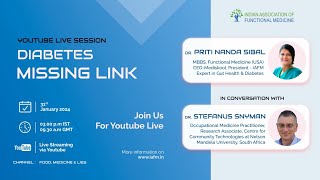
Dr. Stefanus Synman and Dr. Priti Nanda Sibal explain how to reverse type-2 diabetes by addressing insulin resistance through diet, stress reduction, and lifestyle changes rather than medication alone. A businessman's HbA1c dropped from 14 to normal in weeks; a wheelchair-bound patient walked on the beach. They argue refined carbs and seed oils, not fat, drive the disease.
Chapters
Good afternoon, Dr. Steffnes, and thank you for being here.
Thanks, thanks. Thank you.
I'm so honored to have you here, Dr. Steffnes. I remember my colleague, my classmate from medical college, Gurpreet Benipal, introduced me to you, I think, in 2019 or 20.
20. It was 20.
20, yes. And he said that, Preeti, Dr. Steffanus is doing an amazing work in diabetes and he has a program, 5 for Life, and why don't you both collaborate or do something together or see what you can also do because you are also doing the same work, right? And from there to 2024, I don't know where 4 years have gone. But it was very nice to have you as a speaker in our Indian Association of Functional Medicine conference. And today, as a sequel to your talk, right, I am very excited to learn from you how you came into this space and why you are so focused on working for insulin resistance.
I came into this space Uh, it's about 6, 7 years ago. For many years, for many years, I was a mainstream doctor. You know, you mean, it's actually a very, very easy job. You know, it's, it's, it's either there's something chemically wrong, so I write the script. If that's not working, I write more stuff on the piece of paper. If that's not working, I up the medication. If that's not working, well, perhaps you must cut out something. And if that's not working, then, well, there's something wrong here, let's refer you to the psychologist. Yeah, so, so I was sitting the one day, I had this pain going down my arm and short of breath, and I thought, well, not a good sign. So I went to my physician friend and I sat there, did the ECG, he did everything, all the examinations, and then he took out his prescription pad, and he wrote, well, let's start with a blood pressure medication, with an angina medication, with the metformin for that, for your diabetes that he just diagnosed, the cholesterol, the depression medication, and for the anxiety. And I just walked out of his room and I realized this is not going to work. I've done this for 25 years. This game is not working. And for years, a friend of mine, a colleague, Frank, Doc Frank, he told me I must take responsibility for my own life. You know, I'm a busy doctor, I don't practice what I preach. And that evening I phoned Frank. I said, Frank, tell me again, how do you reverse diabetes? You've told me a few times, but I wasn't interested because what you told me was not what I was taught by the experts in medical school. 'But whatever they taught us is not working.' So he explained to me the story. The next day I was sitting in a clinic and a guy walked in with a little walker. You know, he's 50 years old with a little walker that old men walk in, shuffling. You know, sat down next to me and he had a file this thick that he put on the table. They said, can you please complete my disability form for the last time? I said, well, I didn't know the guy at all. I was my first day actually in that clinic. And I said, well, what for? He said, no, I have diabetes and they gave me 6 months to to live. So, and every 6 months you must have this disability form completed. So I told Ashley, Ashley, and I mean, it's 14 doctors, he's on 16, 17 different medications, and he's sick. 150, 60, 70 kilograms, I can't remember exactly. I told them, "Actually, I think we can do something, but I'm not sure. I was diagnosed with diabetes yesterday, and a friend of mine told me how to reverse this. But I first want to study your file." They only gave me 10 minutes to complete this piece of paper. "I need 2 hours with you. Come back tomorrow." 'But before we go, can we pray together? You know, there must be hope.' So we prayed, and he left. The next day he came back, and he told me— and he burst out in tears because his pain in his legs are so severe from the diabetes— and he told me He tried to commit suicide the previous year. He injected nearly 500 units of insulin and it did nothing. Okay, he was so resistant. I told him, actually, I'm so glad you've tried this. Why? I said, well, because if it was just your diabetes and I must admit you to hospital, within 3 days the insurance will tell me 'Your sugar is now under control, you must go home.' 'Now it's a psychiatric condition, I can admit you for 3 weeks and we can reverse your diabetes.' Okay, so I admitted him to the clinic, the psychiatric clinic, and, uh, I wrote down the things, you know, no carbohydrates, high fat, low fat, high you know, the diet and all the supplements. The kitchen refused, the chef and the dietitian refused that we take him off carbs because he must eat 6 meals a day. You know, that typical diabetic crap that dietitians usually tell you. And we can't give him, you know, a high-fat diet, he will get a heart attack. So I got into the kitchen, and I made the food for my patient. Wow! With him, with him, you can imagine the ramifications of that, but let's not go there. 3 days later, for the first time in 20 years, he was off his insulin. But he came into that clinic with a walker, severe pain, 2 and a half weeks later, he was running with my kids on the beach because I sort of had it, you know, I have this thing, I can't see somebody in this little cubicles in a psychiatric clinic. So I said, let's go and sit outside. And then I put in my car and go to the beach and we, you know, have our ward round there. Um, and I usually take my kids along because kids are tonic for sick people. Oh yes, so anyway, 2, 3 weeks later he was walking around, uh, and well, he reversed his diabetes. Uh, the thing is, he took control. He took control. He decided, you know, you can't rely on doctors and medications. And I, for me, I mean, we did this journey together. I told him I'm not sure if this will work. I'm trying it myself. And I'm— so yeah, that was this, that was this. Well, it's a long answer to your where did it start, but that was my— phenomenal story.
Phenomenal. I really loved every word of it. And I know now that because the way it started, you've never looked back since then.
Yeah, then people started to come to us, uh, and I think it's because we have a holistic approach. It's not just diet, it's not just supplements, it, it's the biological. Yes, you must look after your cells and your biology, that's important to help your body to recover, but you do need the right way of thinking. You do need your spiritual connection. You do need your faith. You need community. You need love. You need to have fun. To reverse type 2, reverse diabetes, I mean, diabetes, just, just think about the food they prescribe to diabetics. You know, pull off the dietitians, pull off the skin, just steam it. It's so boring. Nobody can eat it.
And I also—
you must have fun, you must laugh, laughter, you must meditate.
Yeah, exactly. So I always say diabetic diet is not any special diet, it's the diet every human being should eat.
Exactly, exactly.
Yes. And having said this, Dr. Stephanus, you're reminding me of a patient. A patient came to me with HbA1c 14. 42 years age, rich businessman, and he said, I've not been able to have health insurance for the last 2 years because my HbA1c does not come down. We started working from 450 fasting sugar. In 2 weeks, it came down to 200 fasting sugar. Wow, that's how powerful the body is. And just little— I did not do any admission. I only gave my guidelines and some supplements and some drips, right? Omega-3 and vitamin C, all nutrition. And he said, I've never seen this happening before in my life. So this is really phenomenal. But the challenge what I see, Dr. Stefanos, and you would also be seeing is that one, there are a lot of myths around diabetes. But second challenge, which is even a bigger challenge, is that people have decided to agree to the fact that diabetes is not reversible. This is genetic. I can't, I don't have this much of time. I don't have money. I don't have these taste buds. 'Where I will be able to eat what Dr. Preeti or Dr. Stephanus or other, you know, doctors will recommend,' right? So yeah, do you also see these challenges? And if yes, do you have a story to share where you can, you know, motivate people and tell them that the truth is far away than what they are thinking and what story they are telling to the mind?
Yeah, I'm thinking of Liz. Liz, her husband is an astrologist. Okay, so he's looking at the stars. Scientist, brilliant scientist. And he actually enrolled her into our program. Against her own will. Okay, now she didn't— I mean, she has diabetes for life. Why is her husband now looking at this? Okay, and so she was very skeptical. In the first meeting we've had, a group meeting, she was quiet and she actually told us, I'm very skeptical about this. Anyway, she She started to follow our instructions. Um, we give it in bite sizes. So I realize, you know, often people with diabetes, they are tired, they have brain fog, they've tried everything. I say everybody coming over my path should get an honorary PhD in diets because they've tried all the diets. They've they've seen all the doctors, and they have long lists of medications. So they can tell me everything about it. So, so Liz, in a period of 2 months, her— and she was on insulin and on Forjica. Okay. So she She— blood sugar came down, but we told her from the start, remember, we're not focusing, we're not managing blood sugar. Remember, diabetes is a symptom, it's not a disease. It's a symptom of insulin resistance, like fatty liver is a symptom of insulin resistance, and obesity, and high blood pressure, and the depression, and the dementia. It's all symptoms of this of another disease. So, so, so by just treating the symptom of diabetes, I'm not solving the problem. By just giving you medication to lower blood sugar is not going to take the disease of insulin resistance away. I must focus on that. So she adhered, and it's just amazing. 2 months later, she went and she was in the best diabetic clinic probably in Africa. Okay. So the top professors was running that clinic. So she will come in that clinic. When you go to the clinic, they will, you will get in, they'll do your bloods. You see the nurse, you'll see the dietitian, you'll see the coach. And then lastly, you'll see the endocrinologist or the diabetologist. And then the blood results will be there already. And he looked at her and he said, uh, I told you not to increase your medication without me giving you permission. It's very dangerous. She said, no, I didn't. He said, well, your HbA1c is normal for the first time in 20 years, and you have normal blood sugar, and your insulin levels are Nearly normal. She said, no, to be honest, I'm on no medication. I'm off all my medications. She said, no, this is impossible. She said, I reversed my diabetes. He said, it's impossible. She said, well, then I'm a miracle. If it's impossible, then I'm a miracle. There's a lot of them out there. And she told them, I mean, she told him what this was all about. But sadly, you know, we, you in our profession, we get something like cognitive dissonance, uh, where if, if it's not within my comfort zone— I said there's nothing, there isn't something like an expert. An expert is only an expert in the stuff that he's reading. So if you're only reading how to give insulin and the newest drugs to diabetics, your expertise is just in that drug. But if you don't read about insulin resistance or vitamin D and K2 and the holistic reversal of a condition, if you— then you're not an expert. So the thing that the endocrinologist is the top of the food chain when it comes to diabetes is nonsense. They're top of the food chain when it comes to insulin and specific drugs. That's about all it is. Um, you need all the various professions and the expertise. Yeah, so that was Liz's— that's Liz's story. And today She is actually working for us. She is, um, helping. She's alongside. She's an along— she's an alongsider. So she helps people and encourages them as a life coach to take responsibility for their own health, to say, I'm not going to trust a doctor or anybody else. She's helping them that they take ownership and say, I'm gonna do this myself. If I don't take responsibility of pill won't do it, a wife won't do it, nobody else will do it. You have to take responsibility, otherwise you'll be in that prison forever.
Exactly. So I think this is so beautiful, that you will be in that prison forever if you don't take responsibility.
Yeah, the, the— you, you can open the gate and you can leave, or you can stay in that prison. That's your choice.
That's your choice. And you know, when you were talking about Liz, I won't name the patient, but I was reminded of my patient who came to me, and first 2 days when we changed her diet and lifestyle, she felt so restless that she sent a message to me, is this normal? And I had a big smile on my face. I said, see how much insulin resistance you have. And after a week, 9 days to be precise, she sends a message saying, I didn't know I had brain fog, doc, but I'm feeling so much better mentally and in my body that I know that I was brain fogged before.
Right, you're so used— you are so used to the brain fog that you can't see.
So you think that you're normal. You don't even know how a breathing brain can look and feel, or, you know, Make what things that can make you do?
I'm thinking about, I'm thinking about Loazi now. So, so he was about 150, 160 kilograms, okay? He wasn't able to do a day's work. He was always tired. Young kids, not even in school yet, okay? So he got onto our program and his physician who wrote the diabetic guidelines, uh, or contributed to that, was very angry that he actually joined, joined this. Um, and well, he reversed his diabetes. He lost 50, 60 kilograms already. But where he was, wasn't able to do a thing, he's now, he's now, last year he did his, he's now busy with his master's degree. He's now— he's working full day and, and he's doing postgraduate studies. He's full of energy. It's a total, total new person. Just that mental clarity where he wasn't able to do a day's job, now he's doing his MBA. That's for me, that's just the amazing thing. But just eating correctly, you can change your whole— your whole—
that's what we call transformation. Yeah, you are a new person, you are a new you, and I really love that your present thing. I think that stuck with me here visually, and I hope it stuck with others, you know, also. Great. Uh, Dr. Stephanus, another thing where, you know, which I've heard a lot is that fat is not good, it can lead to heart attacks. Anything you will want to say on that?
Yeah, sorry, let me just— the interesting thing is, if fat was so dangerous, Priti, right, I shouldn't be here because the Eskimos must have died out 100,000 years ago. And the Khoi people, the— where the— in the cradle of mankind here in South Africa, we know for a period of 160,000 years that we come back in the caves where they lived. They lived off protein and fat. They didn't die out. What changed in the human diet the past 100 years? It's all the 50, 60 years, the refined carbs and all the seed oils. 60, 70 years ago, there wasn't something like sunflower oil.
Exactly.
Now everything is made in sunflower oil. Okay, so fat won't give you a heart attack. Fat in the presence of a lot of unhealthy carbohydrates contribute obviously to that.
Exactly.
If you think the average Koi person over a period of 160,000 years, that's our ancestors, the average amount of sugar they got from their food was half a teaspoon to 1 teaspoon a day. My average Koi patient now gets 120 teaspoons of sugar in their diet. If you think that one potato breaks down to 8 teaspoons of sugar, one cup of rice to 10 teaspoons of sugar, a slice of bread between 7 and 9 teaspoons of sugar, apple juice is between 8 and 10 teaspoons of sugar. We're not talking about all the soft drinks. So, so, so, so we know we were not made to consume 250 times more sugar What will happen if you feed a cow meat? The cow will die. What will happen if you feed a lion just grass? The lion will die. And what will happen if you feed a human being 90% carbohydrates, like the Western diet today? Yeah, it's because we won't We won't die because, you know what, we have a pill to help you. So it's a— okay, so we give you the food to make you sick, and now we have pills, and that's keeping the economy going. I mean, you can't make money with healthy people, can you?
You can't, you can't. I agree with you. I'll tell you what, yesterday I was in a gynae conference, right? And, um, a very, very senior gynae. So they were talking about insulin being the number one, uh, recommendation for gestational diabetes, right? And metformin being number two in the new guidelines. Okay, just keep listening, right? And then some of the gynae started opposing it. They said if metformin can handle it, why should we give insulin? Yeah, and this discussion was going when a very senior gynecologist stood up and said, this is all pharma. Now the insulin lobby is stronger, right? Yeah. So I agree that some of the medicines we have are life-saving. I agree that they have a huge role to play in emergencies, in acute cases, right? But imagine gestational diabetes and we are debating insulin or metformin, and I feel I don't think even 1% of gestational diabetes would need that if we can only help them balance their diet, their, you know, spiritual aspect, their stress and sleep. And take care of the nutritional deficiencies.
Correct. I mean, if, if the underlying disease is a resistance to insulin because your body is not— your body is not reacting to the insulin because of high blood sugar levels and high insulin levels, you get resistant to the insulin. So, you know, if you have a— I always tell patients, if you have a peanut allergy, if you're allergic to peanuts And your doctor tell you, you know, I, I, I know what I'm gonna do. I'm gonna inject you peanut butter.
This is exactly that.
This is what we're doing. You're allergic to insulin, you're resistant to the insulin, and now you're injecting you with insulin. That doesn't make sense. We're making you more resistant.
And imagine in gestational diabetic women, now a new life is going to start and this is where we are starting it. Yeah, it is, it is extremely, extremely sad. But coming back to the fact that of course I get it that fat is good, but even after this discussion that, you know, we were never meant to be eating so much of carbs. Yeah, there are some people who still are very scared of fat. I think what 50 years of, you know, communication has done to them. For these scared people, do you want to give them any hack or any suggestion on how they can start and test for themselves whether it is helping them or not, and then Once they will gain confidence, then they will move forward, then more confidence, then, you know.
Yeah, you know, it's— it is difficult. I mean, in the beginning, I remember when I talked about Ashley there in the psychiatric clinic, when I had to make him his own food and everybody was watching him, he's gonna die now of a heart attack. I was just making nice food. Okay, um, and even for a year or two, three after that, I was— every time I tell a patient it's okay to eat fat, or if I stop a cholesterol pill, I was always sure, what if I'm wrong? What if the insulin model is not correct? What if the mainstream theory that you are ill because you eat fat and you don't exercise— I mean, that's what they tell us, hey? You are sick because you eat fat and you don't exercise.
Exactly.
But, but we know that's a fabricated story, uh, and that even the initial studies that was actually funded by, by the sugar industry, um, and Ethel Keys should actually be, you know, it was genocide, the unethical stuff he did, how many lives his, his research cost the world. But, um, so that, that was on Ethel Keys's research, who said that fat is dangerous. And that was then taken by the big food industry to American Congress, the McGovern Commission in 1977. Adopted the new American dietary guidelines which say fat is dangerous for the first time in 160— over a million years, how long? Okay, so, so now, now fat was out. Okay, and so now we changed our diet to be 80%, 90% carbs. So what I usually tell, tell patients is I actually don't tell them go high fat. I, I just tell them we have to go low carb because you're allergic to carbs. If you're allergic to sugar or you have a carbohydrate intolerance or you're pre-diabetic, uh, or insulin resistance, it's all the same thing. So, so I just said let's go down the carbs, but you— and build a new relationship with food. Okay, and I give them recipes, and the recipes is just nice healthy fats. It's later on that I will tell them, okay, you actually— if, if, if you can't have carbs as your fuel because you're allergic to the carbs, I must give you another fuel to burn on. Carbohydrates— the fuel of carbohydrates is newspaper. You're burning on newspaper, you know, have a bar— you're having a barbecue with newspaper. You're fueling your fire with newspaper. That's burning on carbs. You're hungry every 2-3 hours, and the whole yard is a mess. Can you imagine your yard if you must have a barbecue with newspaper? You can't even clean that. That's, that's why carbs causes inflammation, and that's the driver of the whole process, is It's your whole body inside is full of burnt newspaper. Fat is like burning on jet fuel. It's like burning on coal or hardwood. It's clean. I always say, if you take a car, if you burn on carbs, if that's your primary fuel, the exhaust is dripping oil on the garage floor. It's just a mess. If you burn on fuel, that exhaust is white. You know, you can go for a sprint and you can go for far because you burn, you burn for long and you feel so much better. And the residue or the, the ash, the rubbish in your body after— because if you burn, there's always ash and rubbish— is, is little.
Exactly. So you decide then what you want to do. Yeah, very, very, very beautifully put, Dr. Steffnes. And one thing you just said, exercise more and less fat. So less fat you've spoken about. What is your take on exercise for diabetic patients? Okay, especially post-COVID, in the post-COVID scenario?
Okay, um, well, we, we do know that Exercise doesn't contribute so much to weight loss as what people would like to think. I mean, you get people running marathons and you see they're still 20-30 kilograms overweight. Um, so the importance of exercise for a diabetic is you just want a little bit of exercise for two reasons. The one is You want to increase your metabolic rate because then you'll burn more fat during the course of the day. So it's more important in the morning, first thing, just to walk around the block or one flight of stairs than late in the afternoon to do 20 minutes of cardio. Because if I, if I do a little bit of exercise in the morning, it increases my metabolic rate and it will stay there for the rest of the day. So just Okay, so, so that's important. The other important thing with your exercises, the type of exercises, is to focus on exercise that will reduce inflammation. Simple exercise you can do in a chair, okay? Vagus nerve exercises that will help to reduce the inflammation in the vagus nerve. And meditation also links to that.
Um, and that's where my next question comes. Vagus nerve is my favorite. And you know, you won't believe, Dr. Steffness, we've been talking already for 30 minutes. Okay, not even started, right? But okay, let me take this last question. Is vagus nerve and what you call in your program spiritual angle. What is it that you think, what role it has for diabetics in their diabetes reversal, and what has been the smartest thing you've found to help these people?
Okay, if I can think of one patient at the past week, she did everything right but the blood sugars were still around 20— well, inside, in the, in the other units, in the 20-25. So that's very high, that's about 400-500 in your your units. And I think so, I can't do the switching in my head so quickly. But anyway, her blood sugar is extremely high, and she was fasting, she was doing a lot of stuff. And then she said, okay, but she wasn't able to reduce the stress, to get calm, so she went to a spa. Where she had time to meditate, where she was just on a water fast for 4 days. Her blood sugars are now normal. The importance of just connecting, whatever religion you are— she was a Christian, so for her it's just to pray, to meditate, just to, to realize who I am in the bigger scheme of things. The whole world doesn't have to be on my shoulders, okay? There's— I'm, I'm there to serve, um, I'm not there to control. I'm to say— and, and just that was the key that just I mean, you— we did everything. That was the one— that was the one thing that was still missing.
So I'll tell you, this, this really reminds me of my today morning's patient. He's been to about 10 doctors, just 40 years old, and everywhere he says, doctor has failed me, right? So I had given him, him some tests to do, and today morning when I was looking at his test, his fasting cortisol was at 47, when the average value, you know, we want to maintain between 13, 14, 15. That's where we want it to be, right? Imagine. So I said, see, you are stuck like this. No doctor will be able to help you unless you help us help you. Because this is one place where who am I, what is my purpose, why I am fighting, with whom I am fighting, why I am fighting with my own self. So here I said I won't do diet first. I don't want to do anything. You figure out a way because he can't even do deep breathing because he can't, because he's always sympathetic active. Right, I said you figure out 8 small 2-minute, 1-minute video clips which will make you laugh in a way that your eyes water. Because I have no other way to break this lock.
Yeah, yeah, one, one belly laugh a day will do it.
Yeah, exactly. So I said once you do this for one week We repeat your test so you can't cheat me, right? Because otherwise they would say I've done it and I don't know what he has done, right? And then we will talk about what diet and what supplements and what more to be done. I know a lot more to be done, but why you are just going in circles again and again and you are losing trust is nobody is opening you or unhooking you from that nail where you have fixed your own self. Mm-hmm. Autoimmunity, he's hypertensive, he's had one angioplasty, and all of that because of insulin resistance. But that because of what? Because of that one male when you are hooked and you are not just taking yourself out, right? Yeah. So I think, and that's the reason I think your spiritual thing really connected And what you said, know who I am and I'm here to serve and not control, it sounds simple, but I think it is the most powerful thing which can help you regain your health.
Yeah, I think this is That unforgiveness, to be able to forgive that bitterness, often the bitterness.
Dr. Steffanus, the moment you decide that you will serve, the whole perspective changes. You will not get angry only. Forgiveness will come later. Because when you serve, then you don't mind when your boss or your Almighty tells you something which you don't like. That's right, right. So I, I mean, I really love this word which you used, serve, because, you know, I at least reiterate and keep telling myself— so, Dr. Stephanus, I've just launched, um, very, very powerful diabetes reversal program by the name of Crush Sugar. Ditch heart attack, avoid memory loss, and stay medicine-free for life, right? Thank you. And why did I launch this was because the last 4 months I was thinking, how can I serve my community better? Right? And though I work a lot on gut health, I work on mental health, I work on a lot of other problems because functional medicine is actually— we don't name the disease, we work from inside out, right? But what came to me was that post-COVID, 1 in 3 people are diabetic, whether they know it or they don't. I don't— you know, we know that that's a fact. If I have to, as a medical professional, serve my community, there is nothing better than giving them a toolbox of things which they can do to unhook all the nails which are making them diabetic. And I think— and that's the reason that serve really touched me, you know, here, here, and everywhere. Because I think the day I started thinking that, everything changed. I don't have to forgive a patient who doesn't listen to me. I don't have to forgive a patient who, you know, thinks that I don't know anything and he knows everything. Somebody who drops out of the program in between. Somebody who decides that no, the payment doesn't— should not be made. Or anything. Now everything has become just one statement with no meaning and no energy. Because I think this serve word is extremely, extremely, extremely powerful.
Yeah.
Thank you for bringing them up, Dr. Stephanus. I never knew that this could be such a touching conversation.
Thanks for the opportunity.
Thank you very much. I wish— we all wish, you know, lots of success to your program, Fired for Life. Thank you, and we will keep hoping to see you here in our Indian community more often.
Thank you so much, Preeti, and God bless. Have a wonderful day.
Thank you, thank you, thank you very much.
Okay, okay.
More from Dr


Understanding Chronic Acidity: A Holistic Approach to Better Digestive Health 🌿


BHRT - transformational health journey if a 42 year old women #BHRT #HormoneBalance




Transform Your Health Naturally with Functional Medicine | Dr. Priti Nanda’s Success Story


hypothyroidism and ozone therapy - talk at Ozone Conference by Dr Priti Nanda Sibal
