Diabetes Unpacked With Dr Robert Cywes
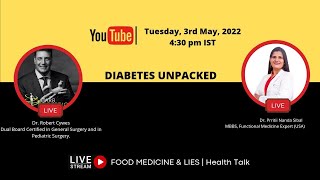
In this 55‑minute interview on the Food, Medicine, and Life channel, host Dr. Priti Nanda Sibal talks with Dr. Robert Cywes, a bariatric surgeon and creator of the "Carb Addiction Doc" program. Dr. Cywes argues that the current medical approach to type 2 diabetes and obesity is fundamentally flawed because it treats symptoms rather than the root cause. He posits that chronic insulin resistance, driven by a pervasive addiction to refined carbohydrates and sugar, is the single underlying disease that manifests as diabetes, obesity, PCOS, hypertension, cardiovascular disease, cancer, dementia, and many other conditions. He critiques the conventional reliance on A1c thresholds, lipid‑heart hypotheses, and medication‑first strategies, calling them “failed” and “business‑driven.” Key points include: - Insulin resistance is the core pathology; the body’s response to chronic carbohydrate excess creates a cascade of metabolic disorders. - Carbohydrates function like a drug; the relationship to them is an addiction that fulfills emotional needs rather than nutritional ones. - Standard diagnostics often omit fasting insulin, C‑peptide, and oral glucose tolerance tests; continuous glucose monitoring (CGM) is advocated for real‑time biofeedback. - Behavioral interventions focus on quantifying total carbohydrate intake, tracking frequency (often every 15‑20 min), and asking “why am I eating this now?” to expose emotional triggers. - Dr. Cywes outlines five effort‑based pillars for emotional regulation: physical activity, creative arts, spirituality/meditation, empathetic human connection, and healthy sexuality, plus the concept of “bridges” (non‑caloric moments like coffee) to replace compulsive snacking. - He frames diabetes as a substance‑abuse problem, using analogies to alcoholism and abusive relationships to motivate lifestyle change. - Pharmacologic tools (GLP‑1 agonists, metformin) and bariatric surgery are described as adjuncts, not primary cures; the goal is to reduce insulin resistance and eventually wean patients off medication. - Cultural and societal forces—historical reliance on grain‑based diets, modern food industry, and the loss of self‑care—drive chronic carb consumption worldwide. - Technology (CGM, biofeedback) and patient empowerment are presented as essential for achieving remission. The conversation ends with a powerful call for patients to recognize their relationship with sugar and to make a conscious, stepwise decision to “leave” the abusive partner that is diabetes.
Chapters
Hi, welcome to the next show of Food, Medicine, and Life channel. We have a very eminent guest today, and why I call him eminent is because we all know that our mind plays a huge role in the way we treat our diseases. But Dr. Rob here, he talks about that and helps you manage your mind before you manage your disease. He's been into this practice for 23 years, and thankfully he's honored us by coming on our channel and sharing information and actually unpacking diabetes for us. Welcome, Dr.
Rob. Thank you, Dr. Nanda. It's great to be here. I'm honored that, uh, we're having this discussion, and I'm also excited to be talking to a group of people who are not roadblocking what we're talking about, but are leaning forward and, and wanting to understand a variety of different approaches. So often, uh, physicians are defensive of an erroneous way of practicing. And I love the fact, as we talked about this earlier, that you've got a group of people who are interested in how better to help their clients and patients rather than to entrench them in old failed practices. Because that's really what this is about, is that our current management, our current standard management of diabetes, of blood sugar, of obesity is failed. There's an epidemic that we are not able to treat adequately, and that is very concerning. In fact, one of my type 1 diabetics here in the US has the statement that the natural enemy of a type 1 diabetic is their endocrinologist, and that is a very concerning statement. But this is somebody who where the endocrinologist was happy with an A1c below 7. Our target A1c is 5.2, and within 2 years of working with us, this person's A1c is 4.7. Now, they're a type 1 diabetic, but really, because we don't understand the way that diabetes happens, whether it's 1 or 2, our treatment methodology has been erroneous for about 50 years or so, and we need to transform that. And there are better ways to, to treat diabetes to the point of remission.
So nice, Dr. Rob, and I really like the word old which you used because I think healthcare is the only space where we are taking so much time to catch on to the new advancements or the new talks. The whole spectrum of disease has changed But we have not changed the way we treat our patients.
You're absolutely right. And I think we've lost the concept of curiosity. And certainly I think the US is a little bit different to India, but not that much in that because medicine is becoming more and more of a business rather than an empathetic provider situation, we no longer cater to our patients' needs We have the patients cater to our recipes and our formulas and our protocols and our best practice standard guidelines, and if those are incorrect, we are in all kinds of trouble. And we really don't treat patients as individuals and help them to explore not what they have to do to get better, but why they got into trouble in the first place. And that's the big distinction in our practice methodology. If you don't address the root cause Treating the effect has no value. Diabetes is not a problem. Diabetes is a consequence. And if you don't treat the underlying problem, why they got diabetes in the first place, if you understand that it is reversible to remission, you're just going to modify an endpoint problem, not the starting root cause. And that's what we'll talk about today.
Great. Dr. Rob, I know you are a bariatric surgeon.
Well, that's how I started out. I am a surgeon. I'm actually a pediatric and general surgeon. And so I try to minimize that in talks like this, that yes, I do that as an endpoint challenge. However, that is only there for people who, as an adjunct to people who are doing what they do. And the less often I have to do that surgical side of things because patients are being successful, the better. We only use it really in our practice as a rescue approach. But my background is more with the liver hepatology and liver biology, liver pathophysiology, which is where my understanding of sugar metabolism comes from.
Oh, great. I was actually with Nova Specialty Surgeries, a surgical chain, and knowing surgeons that closely, I was quite curious to know that, you know, how come being a surgeon you started believing in this Y approach and actually guiding your patients correctly.
Well, it's a very easy thing to walk back on. 98% of diets fail. They all work. They all work for a while. But ultimately, if you talk to those people 2, 3, 5 years down the road, they're back to where they started from. A very, very low percentage are. And the word that we have to work with, the most important word, is the word sustainability. Let's say we're going to live to 100. You subtract your current age from 100. That's how long this diet should be working for, not just for a few minutes to lose some weight or to treat diabetes. Bariatric surgery is just the most powerful form of diet. It is excellent for caloric reduction, so it treats the effect of a disease if it is obesity. And together with that caloric reduction, you have a transient impact on illnesses that are caused by excess. However, if the person then doesn't partner with that surgery and address the lifestyle that caused the problem in the first place, nothing is effectively going to work. And whether you use medication, whether you use counseling, whether you use surgery, it's all tools in our toolkit, because ultimately the enemy is your blood glucose or your body weight. Those are the two enemies we're dealing with, and then all the other illnesses that are products not of obesity or diabetes, but are products of insulin resistance, because that's the holy grail. The disease that we need to treat is a single disease called insulin resistance.
Insulin resistance.
How it expresses itself is a different story, but all the endpoints, whether it's polycystic ovarian syndrome, the incidence of breast and colon cancer, dementia, diabetes, peripheral neuropathy, arrhythmias, cardiovascular disease, obesity, All of those are the consequence of one phenomenon called insulin resistance. And until we understand and help the public to understand that concept and treat all those other diseases individually, that's problematic. Yes, of course, if you come in with hypertension— and there is no such thing as essential hypertension, or it's a tiny fraction. What we call essential hypertension is actually carbophilic hypertension. So we have to treat the hypertension with medication for a while, but as you then treat the patient's lifestyle and help them to change why their blood pressure is high, and they monitor that blood pressure, which is an important concept, as their pressure improves, you can then deprescribe. And as long as they are no longer doing the things that created the hypertension in the first place, they can be— they can put that hypertension into remission. But we've got to understand that partnership between what we throw at patients and what we help them to do for themselves. And more and more healthcare has become therapeutic, where, oh, this is a problem, here's a pill for it. Oh, your LDL is high, here's a statin. Um, you know, oh, your blood pressure is high, here's a pill for it. And you're condemned to that medication for the rest of your life, and all it's doing is slowing down the inevitable progression of disease. Once you educate people about insulin resistance and how their contribution to causing it, they can then choose whether or not it's important for them to address that relationship. And if they do, most of those diseases can go into remission.
Perfect. And very surprising, Dr. Rob, is that at least in India, a lot of doctors don't check insulin in diabetic patients. In PCOD patients, gynecs do check their fasting insulin, but in diabetics I rarely find a patient with fasting insulin and PP insulin levels.
Right. And you have to know that, you know, the things that we really need to know to mind. And I think certainly if in the US and I'm not certain it's in India, India's got that high proportion of diabetics more so I think than most places in the world. But in the US, our healthcare system has been hijacked by lipidology, by the lipid-heart hypothesis of harm. And the reality is lipids— and I'll say this categorically— lipids do not cause harm. Exactly. Lipids do not cause harm. They are the consequence of insulin resistance. And but lipids are just FedEx trucks. They're just transport molecules. Lipoproteins are transport molecules for fat around the body. From one place to another. And depending on what the direction of that traffic is and what generates that traffic, that's where the harm comes from. So lipid heart— the lipid heart hypothesis is what's dominant here in the US. So everybody's getting lipid fractions and NMRs, and they're looking at LDL ratio and HDL, and those are important as markers of disease, but treating a marker doesn't fix the problem. And the problem, as you said, is how your body responds to chronically, chronically elevated levels of carbohydrates in your diet. And that we call insulin resistance. And in order to know how your body responds, we have to know C-peptide, we have to know insulin production capacity, we have to know A1C, we have to know blood sugars and blood sugars on a continuum. We'll get back into that. And then the final piece is every now and then an oral glucose tolerance test is a very useful test as well to see how your body responds to a load of sugar. But ultimately, those are diagnostic criteria. Most Indians are dealing with insulin resistance and type 2 diabetes, and there really is no difference between the two. I really don't like the word type 2 because it is a threshold diagnosis. So if you've got an A1c of 6.5 or a certain blood sugar, you now you've got type 2 diabetes. But if you're just on the inside of that, if you're a 6.4, oh, you're pre-diabetic, be care— no, a normal A1c is 5.2. Now this is US percentages, I'm not sure what percentage—
5.4 is what we look at as normal.
And 5.4 or 5.2, ultimately that is way lower than being below 7, which is satisfactory to most endocrinologists. But really the, the, the endpoint is this: the premise of diabetes is at that point that your elevated, your chronically elevated blood sugar is no longer a contributor to vascular inflammation or vascular harm. That's ultimately what diabetes treatment is about. If you can exclude vascular inflammation by virtue of sugar, that's really the goal. And you know what's interesting is nicotine has a very similar effect on vascular endothelium. So that's why the disease profiles are not dissimilar in terms of cardiovascular plaque development, atherogenic plaque development. But way back in the smoking era, we blamed fat for clogging our arteries, and that's where the lipid hypothesis perseverated. It was never fat, it was nicotine, and it's still not fat. Now it's sugar.
Thanks, Dr. Rob, for bringing that up. So in such a concise way. What I see here is you've written Carb Addiction Doc, right?
So Carb Addiction Doc is kind of a trade name that I use for my— we've got a small presence on the internet. We're on— we've got a YouTube channel which— where we drop videos on a regular basis. I'm on Instagram and I'm on Facebook. But it really is to connect. You see, we can talk about what promulgates diabetes and how to reverse it. However, The question is, why is— yes, Indians have a genetic predisposition to become diabetic earlier in the evolution of, of a disease process. We talked about this earlier. Some of the South Sea Islanders have— we've got prevalences of 60% of— I can't remember the name of the islands, about 10,000 people on this island. It's the highest incidence of obesity in the world. It's over 60% of the population is severely obese, BMI over 30, but the, the incidence of diabetes is very, very low. So the, the genetics there comes down primarily to insulin production capacity, and we'll talk about that in a little bit. However, none of that matters whether you're obesogenic or diabetogenic, doesn't matter if you don't consume sugar and starch. And the question then is, why are we eating sugar and starch in abundance for the first time ever. And there are a variety of reasons. And I think the, the one that the defenders or a lot of our patient population defend themselves on, oh, it's our cultural thing, it's cultural. And you know what? That is absolutely true. It was a cultural pressure of survival under conditions of starvation and of food insecurity and food inadequacy. That made a grain-based or a, a grain or a rice-based diet a foundational secure source of caloric nutrition, but it's very, very poor in nutrient provision. And over the last 50 to 100 years, certainly led by the US, but more even in India and in my home country of South Africa, abundance has become the problem, and the human genome is not capable of dealing with excess. It is very well adapted to scarcity. That's what, what has made us successful as a species by being omnivores. But, uh, because we can eat, we can survive on pretty much anything. However, in an era of abundance and ubiquitous availability, we have overwhelmed those. So the drive was always How do I secure food so we can go into insulin resistance in the, in the autumn or the fall to be able to load up for winter when fruit was abundant? But now fruit, for example, is abundant throughout the year, so we're eating it all the time. So we remain in a state of insulin resistance that should have been a transient seasonal period where we use insulin resistance to gain some weight to survive winter. Now we're perpetually insulin resistant, and over time the body breaks down. So we have to understand that cultural— to lean on our culture as the rationale for eating this way is erroneous. And there is not a single culture out there that is not carbohydrate-based in terms of its success.
Right, Dr. Rob. Another thing which I see a lot of us say is we don't feel satisfied if we don't have a chapati or a rice or a grain on our plate.
Right.
Right. We feel that's, that's not our kind of diet.
Right. And I think the— so there's a cultural— it's been normalized by culture and promoted heavily by industry. But, you know, the rice, the papadum, whatever it may be, that has been there for 100+ years or 1,000 years is not the problem. The problem is the layers on top of that. Of all the other things that we consume. And there has been a shift, two major shifts have happened, which are not cultural, they're universal in the world. The first shift is a radical reduction in self-care methodology. Our, our productivity, our pressure on productivity has increased dramatically. And in the internet era, we are on 24/7. So that has come at the sacrifice of self-care, of emotional self-care. So which, because a healthy emotion management system takes effort and time, whereas we have become an instant gratification society where we're looking for emotional resolution instantaneously, alcohol, nicotine, heroin, opioids, and the most ubiquitously available, most toxic drug that human beings use everywhere on this earth is a drug called sugar and starch carbohydrates. So we've shifted away from using sugar and starch primarily for its survival nutritional basis, to now using it more and more and more for its emotion management basis. As you know, if you look at this over here, I've got it even on my coffee cup, a snack is always, always, always an emotional event. And, you know, if you're working in the fields, uh, um, uh, as a laborer, you're gonna eat twice a day, and there's gonna be a long period of time when you're not eating. If you're sitting at a computer, you've got your candy or your sweets or your chocolates or, uh, what— and you're sitting there doing this like a smoker smokes. Nobody smokes 20 cigarettes at one time. You space them out. A cigarette here, cigarette there. By the end of the day, it's 20. So we sit there nibbling on our stuff, we're eating all the time because the mind needs those little mind cleansing moments. So now instead of having maybe one or two episodic rises of insulin through the day and then living the rest of our lives, the rest of our days under the influence of glucagon. You see, the misnomer also is that glucagon is the healthy energy supplying hormone in humans, not insulin. Insulin should only be functional once or twice a day to cope with what we've eaten. But if you're eating continuously or you're eating massive amounts of sugar and starch, now insulin becomes your dominant hormone and you don't get the glucagon phase. And insulin is causing cholesterol production in the liver. It's— but it's— the problem is not the cholesterol. The problem is the continuous consumption of those little, little bits of sugar. And let's face it, most people are not snacking on lettuce or broccoli. We're snacking on processed sugar and starch. And therein lies the problem. So we have shifted away from a world where we primarily eat for the nutritional value of food toward a world where we are primarily eating and drinking in a pattern and a substance for the endorphin value as a surrogate for a healthy effort-based emotion management system. So the root cause of diabetes, type 2 diabetes, is as a dysfunctional emotional coping strategy to fill the void of the absence of an effort-based emotion management system. And that is affecting every society in the world.
I really like what you just said. Our dysfunctional emotional capability or capacity. Nobody else is talking about this. Any reasons why?
Well, I think it's, it's pretty darn obvious, but the problem is this, and, and let me do a parallel equation. Is alcoholism a hydration problem? No, no, nobody would— even though alcohol is a liquid that we drink And if you drink a lot of beer, you could probably hydrate yourself. Nobody equates alcoholism with a hydration problem. We drink water and other substances for hydration. We drink the sole purpose of alcohol for pleasure, right? It's based for pleasure, to get a buzz. But for pleasure, it's fine. But if you're drinking it because you're stressed, because you're anxious, because you're depressed, because you're angry, because you're sad, because you're frustrated, because you're bored— in other words, if alcohol becomes your primary mechanism of handling the entire spectrum of emotional tension, then that relationship becomes chronic, excessive, and toxic. That's, that's addiction. Everybody understands that very simply. And nobody tells an alcoholic what they should drink. We, as long as the alcoholic doesn't drink alcohol, they're fine. What they do drink doesn't matter. In an identical parallel, diabetes, type 2 diabetes and obesity have been hijacked as being nutrition problems. They're not.
They're not.
Type 2 diabetes has nothing to do with nutrition. It has to do with substance abuse in parallel to alcoholism. The food that we eat for nutrition, that the human body has to eat for nutrition, like water, will never ever make us fat or diabetic. We do not get fat from, from leafy vegetables, from that kind of thing. It's the, it's the starches. Now, the vegetables obviously all contain carbohydrates. But remember, alcohol is not a problem. It's a person's relationship with alcohol that is. Carbohydrates are not a problem. We've survived on them forever. It's a person's relationship with them that is the problem. However, additionally, the treatment of a substance abuse problem type 2 diabetes, obesity has been hijacked by people, by a group of people telling us what we should be eating. And that's like, that's like treating an alcoholic by telling them, oh, you should drink water, you should drink coffee. Okay, it's ludicrous. Okay, and then fighting over which one— no, you treat an alcoholic with a psychologist saying, don't drink alcohol, and here's why you drank it, and then find other ways to deal with your emotional needs. And if we treat type 2 diabetics the same way, say, look, the sugar and starch is fine, that naan, that rice, that papadum, that's absolutely fine, not an issue. But why are you eating it right now? Why? You've just had dinner. Why are you sitting there eating something? And I promise you, that's not lettuce that they're eating. That's going to be— because you're eating it for this. And helping people to understand that this is a substance abuse problem. And that obesity and type 2 diabetes are not diseases, they're lifestyles.
Exactly.
Because the entire universe of that person, by the time you have an A1C above 6.5 as a type 2, that didn't just start yesterday. That wasn't just one extra tub of ice cream. That is a whole way of life where you are thinking of it, right? And unless we help people to understand that and bring the psychologists in, or we physicians take on a role that is more psychological than nutritional. Yes, we have to teach people what they should eat, but there's such a wide variety. I mean, here in the US, we've got a huge carnivore movement. Well, in India, we've got Muslims, we've got vegetarians, we've got people that don't eat beef. Those are all fine. There's no reason why we cannot cater to anybody with any diet, because no human being needs to have a diet based on sugar and starch.
Right.
So, you know, that's really— that's the reality of the misconception of where we are approaching this from a diet perspective, not a substance abuse perspective.
So, Dr. Rob, I really think this is very, very powerful. Uh, just the fact when you say that it's substance abuse, I'm sure the patient, the client starts thinking And, uh, and the moment the client starts thinking, as you said, it's a lifestyle, the chances that they will change their lifestyle become much higher, right?
And you know, because it's a— listen, the reason we eat carbohydrates is they're wonderful. They make us feel great, and you want to eat more the moment you've eaten a little bit. And they don't interfere with our cerebral function very much. You know You know, if you shoot up heroin, you're dysfunctional for the rest of the day. If you get drunk, you're dysfunctional for the rest of the day. If you're smoking or eating sugar and starch, you can be working here. It actually helps you to focus a little bit more.
Exactly.
So, so there are—
at least for that little time.
Of course, of course. But once the, once the mountain of harm, as you perceive it, becomes greater than the benefit then you begin to change. The problem is that most doctors still belittle the harm because we don't connect it directly to sugar and starch. You know, in the 1950s, certainly here in the US, we believed that smoking was absolutely fine. So we told people that, you know, your cough is not smoking, your lung cancer didn't come. So it fostered the relationship with smoking, even though people intuitively knew 'Hey, the smoking is probably not a good idea. My doctor said it was fine.' And until we take a leadership role against carbohydrates as a cause for diabetes, as the exclusive cause for diabetes type 2 with our genetics, we're really not going to bring individuals to the fold because the government— there's too many opposing factors. If they're making money from the sale, from the taxes and the sale of these sugar products, They're not really going to change that. We still sell cigarettes in the US.
And why would they make an effort to change if people are wanting to harm their own self?
You're absolutely right. I'll give you a very interesting Indian juxtaposition between India and the US. Nothing to do with diabetes, but over the last 5 to 7 years, do you know what vaping is? Electronic cigarettes.
Right.
Okay, nicotine, electronic cigarettes. What do you think here in Florida, what do you think the incidence is of high school children vaping on a regular basis?
70%.
It's about 65 to 70%, probably about 65%. Okay, it is, and that's brand new. So in the last 5 to 7 years, a lot of these kids with mental health issues are using nicotine in the form of vaping as a way to find that instant gratification. India did an incredibly proactive thing. I think it was 2014 or 2015. It might have been more, more recent than that. They banned the sale of electronic cigarettes. And yes, you still have people using it, but you look at high schools and that kind of thing, there are very, very few kids using electronic cigarettes. And yet in the US, where there is no regulation, zero regulation in effect. These kids are using it in ridiculous amounts. And it's not about vaping. It is an exposure of how desperate these kids are for mental health restitution, for healthier emotion management strategies. And if we are in our school system feeding these kids tons of sugar and starch, why should they not also adopt carbohydrates as a way of life? And if you're doing that in India, those kids are becoming insulin resistant at a very young age, in age group at a very, very young age. But as we said earlier on, the pediatricians are not looking at insulin levels. They're not looking at, at A1C levels. They don't understand that the time to intervene is before someone has lost their feet or their kidneys or whatever else it is, right?
Very interesting. Dr. Rob, you have used again and again this term emotional support or emotional strategy or dysfunctional. What is it that you do with your clients in your program which you have seen really working well for them?
Yeah, I think the first connection is that number one, sugar and starch is not necessary for human survival. So we've got to understand that it is a drug, not a nutrition non-nutritional element. And the starting point— so before we change anything, the simple thing that we have our patients ask themselves is 3 questions. Number 1, don't eat or drink anything unless you absolutely know what the total carbohydrate content is. So you can educate yourself about how— because most people are oblivious to how much sugar and starch they eat. So if I say to a type 2 diabetic Okay, what is healthier for you, an apple or a donut? They'll always say the apple, and then their answer is, oh, it's natural sugar. Well, when you Google it, when you understand what the sugar content is, the apple has twice as much sugar as the donut. It's exactly the same sugar. It's glucose and fructose. So there's no such thing as natural sugar. It's a 6-carbon structure. So, but the perception is that the apple is healthier. Now, if you're a skinny, healthy, normal, non-diabetic person, The apple has health benefits to it, the donut doesn't. But if you're already a type 2 diabetic and you check your blood sugars, the blood sugar profile is— it's worse with the apple than it is with a donut. So what we have to educate patients with is that what they believe to be healthy, if they already have diabetes or obesity, is not healthy for them. Doesn't matter what the dietitian says is healthy. The second part is, if they look at that, the average type 2 diabetic— and India is going to be no different— over 70% of the total caloric consumption is in the form of sugar and starch.
Yes.
And if we can get by with zero sugar and starch consumption and survive, then that 70% is a huge burden. And it's really just to clarify the that this is the problem, because we have to have fat, we have to have protein in our diet as macronutrients. But the liver is very capable of producing sugar, so therefore we don't need it, even though we need it in our bloodstream. Then the next question I ask them is, okay, every— when you identify that you're eating some sugar and starch, ask yourself, why am I eating this right now? Why am I eating this right now? I'm eating this. Why am I putting it on rice? I'm eating a hamburger, why do I have a piece of bread on either side? It makes it convenient as a vehicle to put in my mouth. The rice, the naan, the papadum are vehicles to put food into your mouth. But you can, again, it's a slight cultural change. But if you can eat with a knife and fork, you can eat that same, or a spoon, you can eat that same food without necessarily using your hands. Now, there might be some cultural conflict there. But at the same time, those are vehicles. The starches are vehicles to put food in our face. They're like wrapping for the food, and we can find other wrapping or use a knife and fork to eat that. And if your culture is more important than you dying in pieces from diabetes, I can't help you, okay? But if you look at the frequency— so the first thing is the total carbohydrate content. The second is How often does your brain desire this? And it usually is about every 15 to 20 minutes. You see, throughout this talk, I'm sipping on this. This is coffee. Now, I used to be 300 pounds. When I was fat, this would have been a Coke or M&M's. Because what it is, that's— I'm not drinking. That's a mind cleansing moment for me. That's a moment of distraction so my brain can relax, so it can refocus. And we have to educate people that You have to have that moment, but a snack contains calories, and this I call a bridge. It doesn't do me caloric harm. It serves the purpose of the emotion management, but it doesn't cause me harm. So once you've quantified how much you're eating and how often your brain desires that, then ask yourself, why am I doing this right now? Am I eating this right now because my selenium levels are low? Or because of some nutritional biologic thing, and the answer is absolutely not true. And then the final statement along that, look at when you get hungry. We use the word hunger to justify eating, but if an alcoholic says, oh, I'm thirsty, I need a drink, it doesn't mean they need hydration. And when a smoker says, I need a cigarette, What they're saying is, I'm having a little emotional tension I need relief from. A cigarette delivers me my nicotine. In the modern era, when we say we're hungry, it almost always is an expression of emotional need, not nutritional need. And, and so hunger has become, I need a cigarette. But if we can plan our meals ahead of time, if we can get back to a routine, if you look at back at the peasant folks who are eating maybe twice a day. And, you know, one of the things we've just come through for the Muslim folks is Ramadan, and they eat early morning and they eat early evening, and diabetes is never better in the Indian Muslim population than it is in the month of Ramadan, right? Because of that, just that intermittent fasting. So even if you're not— don't want to even start with sugar and starch, Start by the frequency of that caloric consumption so that you can begin to cycle from insulin to glucagon. But if you're eating all the time now, you're insulin dominant all the time.
You will never be able to do it.
Right.
So, Dr. Rob, one thing you shared in between was this bridge, which is your coffee, which you are sipping through the talk, right? So this is a bridge because now you're not taking your M&M's or your cookies or your chips or whatever processed food you would have otherwise had. Any other emotional tools which you have seen work with your patients? Because one thing I have, you know, when I'm listening to you, what is actually going in my mind again and again is my client will say this. They say, I can't resist it. I feel an urge which is so strong that I can't do anything about it. Yes, after eating I might feel bad, right?
And, and that's addiction, you know. The heroin addict never ever considers turning blue and dying as they're heating up powder and injecting it in their veins. The decision to eat that stuff, once you understand addiction, is no different. It is a compulsion. I understand that, and it's the ubiquitous availability. So, uh, the starting point is to get rid of the processed carbohydrates in your diet, because if they are there— if I had M&M's on my desk, I can assure you And you're gonna be— I lost my weight 23 years ago, but I can assure you, if it's there, I'm going to eat it. I can also assure you there's no way on God's earth it'll ever be there, because I recognize that my relationship with it is broken. But here's the thing, I don't have to remove them. I have chosen. So addiction management is always about choice. That person that you describe has chosen to give herself easy access to her drug of choice. You know, smokers always got their cigarettes close at hand. The diabetic or the fat person always has their carbohydrates easy at hand. So distance is one of your best protection mechanisms. The— when it comes to emotion management, the bridge is just one piece of it. But there are two other things that we do for emotion management. The first one is preemptive, which is putting emotional money in the bank before the start of your day. So you can spend that money when life throws you curveballs. So if you can establish an emotion management ritual as the starting point of your day— breakfast is the least important meal of the day. I agree with you. Yes, there is something called the dawn phenomenon where cortisol gives you breakfast from your liver. There's a surge in blood sugar in the morning. You're, you're basically— your liver and cortisol is saying, hey, you're waking up, here, have some sugar. Have some energy. You don't need to add sugar energy to your— now you can have a cup of coffee. If you really want to eat something, that's fine. But you don't need to eat something. However, breakfast is also a wonderful opportunity to do some, to put some emotional money in the bank, to do some mind cleansing before your day starts. So if you get into a ritual, it might be a small, small moment of meditation. I love to watch the sunrise. And that's my little zone-out thing. I take my dog for a walk every morning at 5 o'clock this morning, we were out seeing the moon. And so you can arrange your life to put effort into something that reduces emotional— now, what are the 4 effort-based pillars? Actually, there may be 5: physical activity, not exercise, physical activity, taking my dog for a walk, wonderful endorphin activator. But because there's a time component, it also allows my subconscious to show me issues that I'm dealing with that I've repressed. And I can process difficult issues that are causing irritation or frustration for me. So I become a more effective human being if I provide meditative time for myself. When you eat some M&Ms, it gives you instant gratification. But you take those tough issues and you hoard them in your brain. I'll deal with you later. It's called psychological hoarding. Going for a walk, even a 5-minute walk, doesn't have to be long or far, opens up that meditative space so you can connect with and deal with emotionally traumatic or difficult issues or plan ahead. So physical activity is one. You can do that in the morning. The creative arts. You can listen to music. You can draw, you can sing, you can go out in the yard and do some gardening. It doesn't matter. But the creative arts are a wonderful effort-based emotion management system. You can do some sewing. Even when a person gets dressed, and they spend some time painting their face, or not so much me, but getting really nicely dressed. I mean, there's nothing more pretty than a beautiful sari that makes you feel great. When you put it on. And I know I see— I'm a Bollywood fan. So I see— forgive me. But I see how beautifully people dress, they may put some jewelry on, that is part of self-care. Because you say, hey, I feel beautiful, I look beautiful. And it's part of emotion management. The third one is spirituality, or meditation. And I think India is probably the land of meditation. But spirituality is also that, and it doesn't just have to be a book or an institution. It can just be a connection with a higher power where I'm checking in, I need some guidance. It's again, a meditative moment. And the fourth thing, and I think this is what we've lost, is something called empathetic human connection, where we trust somebody implicitly that they will not be judgmental or critical of us, but then we have to take the risk of being vulnerable in that space. And we're not able to be vulnerable, we keep that inside, it festers. And then we need some ice cream on the way to work to make us calm down, or some Starbucks sugar-based coffee to calm out to start our day. Or we put 4 spoons of sugar in our tea that we're drinking. That's— you might as well go outside and smoke a cigarette if you're going to do that. Okay, because it's there for the— so, and then the fifth one is, say, is healthy sexuality. So those are the 5 endorphin, effort-based endorphin aspects. And if you look at most type 2 diabetics, if you ask them, what do you do for fun? It's cobwebs, because what they do for fun is snacking and sugar and starch.
So what I've also seen, Dr. Rob, is that if you get up in the morning and cook because you are wanting to cook, that's also a very meditative and a nice relaxing process.
Absolutely. Cooking is a creative art. And here's the key thing about the creative arts or any of the effort-based things. The outcome doesn't matter. The outcome does not matter. What matters is the relaxation. The world dissolves around you when you're cooking. And if you can be proud of what you're cooking, irrespective of how it turned out, that in little increments builds up self-esteem, self-confidence, and self-respect. And when our sense of self is strong, We can self-validate. We don't need drugs that we consume to make us feel good.
Right. And second, what I've seen is, which is very, very simple to do, is start your day with some gratitude.
That's exactly what it is. Yes.
Absolutely. Which everybody can do. Meditation might sound a little difficult, but gratitude doesn't. And when you start it in the morning right, whole day, even difficult situations, you know, you are able to cope with them much better than the days you have not started with gratitude.
Well, right. And the word gratitude really means, or at least in order to feel gratitude, you have to self-reflect and self-reflect in an empowering, positive way. And that really— for meditation is not sitting in the lotus position for an hour. It is a moment of empowering introspective self-reflection. And you say, you know what, yeah, this is what I'm grateful for. And that gratitude is not outcome-based. It's based upon whatever small thing in your life you can see as a positive thing. Because what we've become is a nation or a world of awfulization. We awfulize everything. The word awful, A-W-F-U-L. We live in a world where we magnify awfulism. You think about these internet things that go crazy about people, and, and I think India is a home for that, where somebody says a fake thing on the internet and everybody spreads the story and everybody's in panic. You know, it's, uh, we live in a world of daily panic, and that's what the internet brings to us. And we don't find those moments of positivity, of empowerment, which are self-enriching. And that's what gratitude is. You're absolutely right. However you want to couch that The juxtaposition is to have self-care. However, simultaneously, you also need to recognize the negative, toxic, harmful effect that the drug of carbohydrates has on you. And when you're feeling good about yourself, it is much easier to defend against their presence. From a position of positivity, strength, and empowerment, it is much easier to say no thank you to something. Or to make a difficult change. If you're emotionally disturbed, you're not going to get rid of the— oh, your best friend, because you're leaning on your best friend. And sugar and starch is a diabetic's best friend, right?
I definitely agree with that. And Dr. Rob, the whole perspective with which you are seeing the diabetes management, or what you call as diabetes being unpacked, is amazing because one, it makes things very simple. You don't have to tell them what they should eat, what they should not eat, right? You only have to tell them that, you know, carbs and sugar, what's that their position in their life?
Well, I think, I think the other thing, so we've looked at, okay, you looking at what the carbohydrate content is. One of the things that I just think is a travesty, and I think India is becoming a huge tech country, uh, certainly the US is a big tech country, and yet We inhibit the use of tech in healthcare, which is ludicrous. We've got all this wonderful, very inexpensive, so powerful biofeedback technology, but because of insurances and things like that, we've restricted this. And one of the most wonderful technological things that I can't practice without— here it is right here, there's one on my desk. That, that's called a CGM, a continuous glucose monitor, or CBG. But this is a device you put on your arm or your tummy, and it tells you what your blood sugar is every 5 minutes, and it tells you your average blood sugars and the biofeedback. So for example, if I'm exhausted, or if I get angry, or if I go for a long run, my blood sugar goes up. Okay, why is that happening? If I eat some ice cream, or if I eat some rice, why is my blood sugar going up? and that biofeedback then says, okay, if I don't eat that, and now my blood sugar is at 200 or 300 in US terms, maybe my blood sugar is at 7 or 8. Okay, that wasn't good, and now I've got to use medication to bring it down. But if I don't eat this thing, then I don't have the rise. So we need that biofeedback because I think the challenge with what we call the glycemic index way of treating diabetes is what people do is they look at what they're about to eat and then treat the— by some mathematical formula, what they think that is going to do to their blood sugar, which is like— that would be like saying you have to drink 3 shots of whiskey and then take this medication that reduces the alcohol in your bloodstream. That is crazy because carbohydrates are toxic at ingestion. When they go into your body, they're toxic in the intestinal tract, they're toxic in the blood vascular space, in the interstitial space, and the intracellular space. So, you know, it's telling someone to, to eat some carbohydrates and go for a run to burn off the calories. That would be the same as telling someone, okay, after you smoke 3 cigarettes, go for a run and breathe out the nicotine. It doesn't work that way.
It doesn't work.
The only thing that matters in type 2 diabetes is your blood sugar. It doesn't matter how or why it got up there. And if your blood sugar is elevated and stays elevated, it is damaging your blood vessels and it will kill you. And the problem with diabetes— and I hate this phrase, but I love this phrase— it's going to kill you in pieces. Your toes are going to go, your kidneys are going to go, your eyes are going to go, your brain is going to go. And eventually, after you—
memory—
memory— after you've destroyed all those organs, then eventually you die. So it's called dying in pieces. And if you want to reverse that, and you can reverse it to remission, what we have to do is know what our blood sugar is, know what's contributing to it. And if we empower people with that, the biofeedback of that is going to actually help people to help themselves without even a doctor saying you must do this.
It's very powerful, Dr. Rob. I've started using this continuous glucose monitoring with in all my patients now, even in pre-diabetics, even in patients who have abdominal obesity, PCOD. And it is marvelous.
Well, let me tell you, let me just stop you for a second. You just said something that's a red flag for me. Pre-diabetes. There is no such thing, right? We physicians arbitrarily decided to cause diabetes, call something diabetes at a hemoglobin A1c of 6.5. Okay. In the United States, if you're driving down the road and you've been drinking, if you get stopped at a roadblock and your blood alcohol level is 0.08, you go to jail. But if it's 0.07, you don't go to jail, but it doesn't mean you're sober to drive. So this whole concept of pre-diabetes— oh, I'm fine, I'm just pre-diabetic, I just gotta watch— that's garbage. Your body is being damaged continuously by this disease. Now, one other thing is that PCOS and diabetes, like obesity and diabetes, are polar opposites. They are both caused by chronic excessive carbohydrate consumption. But one of the things about the Indian— mostly I'm going to generalize a little bit— but Indian genetics is that typically Indians have a very low upper limit of insulin production. It's called insulin production capacity. You look at some of my Samoan patients, they'll come in with fasting insulins, and nobody checks fasting insulin. We should be, but they'll come in with fasting insulins of 100. The highest I've ever seen is 117 as a 12-hour fasted insulin. Okay, can you imagine injecting 117 units of insulin to somebody? And now, the guy was enormous, but he wasn't diabetic. So when you cannot produce a high threshold of insulin and you have insulin resistance. What's insulin resistance? The tsunami of sugar into your cells has been so enormous that the cells have been— are beginning to be damaged by this high level of intracellular sugar. So the way they do that is they downregulate and they block the receptor. Basically what they do is they shut the front door and change the lock and throw the key away, so they prevent sugar from going into the cell. Now, with higher amounts of insulin, you can overwhelm that and still keep your blood sugar low. But then those cells, particularly the liver and the fat cells, will convert that to fat. So you become enormous, but you spare diabetes. If, however, you have a low level of insulin production, now your cells become resistant and you can't produce more insulin. So the blood sugar rises. You can't get it into your cells. There'll be some liver clearance, but it won't be adequate. Because the liver doesn't need insulin. The fat cells need insulin. So what happens is your blood sugar then rises. You don't become enormous, but you become diabetic because that's how glycosylated hemoglobin is how we measure diabetes. So it really comes down to insulin production capacity, and that's genetically oriented. And so therefore, PCOS is obesogenic. It's based on testosterone and a variety of other things. Whereas type 2 diabetes, gestational diabetes, and type 2 diabetes are more on the lower insulin production side. And that is devastating to pregnant mothers, a 7-fold increase in fetal loss if you have gestational diabetes, and it comes from sugar. So, I mean, the ramifications of this are enormous. You know, in the US, for example, we've seen autism spectrum rates go from 1 in 15,000 in 1970 to 1 in 44 last year, or 2019. And the primary issue there is these babies are in glycosis all the time, they're sugar-bathed all the time, and the human brain needs ketones and fat to develop. Not all the time, but if you've got high blood sugar all the time, you're not using the ketogenic pathways from the liver, so you don't have substrate. And the problem with that lack of fat and too much sugar is the human— the corpus callosum, the white matter, doesn't develop normally. It's not a genetic problem, it's a substrate provision problem. So we can talk endlessly about these diseases, but that's what we're doing to our society. But as physicians, what we have to understand that the problem is an elevated blood sugar, period. Doesn't matter how it gets up. So as physicians, the way we treat our diabetics is to, first of all, have our patients have a monitor so that they know what it is. Because if you're going to ask your patients to stick their fingers, it's very unpleasant. They're just not going to do it, right? And therefore, you know, it's like the, the phrase I use is, um, if you drive a car, can you imagine what it would be like driving a car without a speedometer? Well, that's like trying to manage blood sugar without knowing what your blood sugar is. It's ludicrous. And the technology is readily available.
And very reasonably priced, very easy to use.
But the problem is we physicians don't believe it's necessary because we're using glycemic index mathematics to pre-dose insulin or to pre-dose medication. So the goal there is to educate patients about what they can change behaviorally to bring their blood sugars down. And then what we need to do is to add insulin or add medications, and we can go through some of the medications. We, for example, are using a lot of GLP-1 agonists. Um, which are, uh, your Ozempics, your Victozas, which trigger the maximum amount of insulin production. So we really maximize that insulin production, but also it's got a huge appetite suppressant effect. So the effect is not just through— it's 3 effects. It increases insulin, but you're already producing insulin max. It suppresses appetite, so you're not eating as often or as much. And also it reduces hepatic release of reduces glycogenolysis so that the liver doesn't contribute to an already raised blood sugar. So I love the GLP-1 agonists and the metformin, but the other ones, the SGLT2s, I try not to use. They are— they can be problematic, especially if you're trying to get into ketosis. And we've touched a lot of things, but ultimately what you want to do is treat the diabetes aggressively to bring the blood sugar down from all cause. And you may need to go up on the dosing to overcome insulin resistance, because insulin resistance is a gradient problem. Once the gradient flattens and even is upside down, now the cells are saying, hey, I need energy. They recruit insulin receptors, and then within the course of that first year or two, you can bring down insulin and actually get people off insulin. But the key is managing insulin resistance, which is the disparity between the blood sugar and the intracellular sugar. And bringing that gradient down and aggressively bringing the blood sugar down, it doesn't matter why the sugar is up, right?
And we are going to have a balanced level sugar, correct?
You want an up gradient or a level gradient into the cells, predominantly the muscles, which is where the GLUT4 receptors are, the major insulin receptors. So, uh, and then that's where physical activity also comes in, because if you create a, uh, a need for glycogen in the muscles by going for a walk a couple of times a day, there's a place for your— for insulin to put the sugar. If you're a bump on a log sitting in front of a computer all day doing this, there's nowhere for that energy to be stored.
Right. So, Dr. Rob, it's been very interesting talking to you, and it's almost now been 55 minutes.
Still, right?
I told you, no, no, but all of this has been amazing, very useful. And I'm sure like me, other people will also use it in their practice and help more and more clients.
Your last message to diabetics: the most important thing is understand your relationship with sugar and decide whether or not you want to kill your best friend because your best friend is busy killing you.
Right. Thank you. This is so powerful. And I also say something which is similar but not like this. I say diabetes is like a love affair. You decide till when you want to be into that love affair.
Let me take it one more step. The other, the other phrase— and it's a nasty phrase, but it's a real phrase most people can connect— um, diabetes is like being married to a spouse, an abusive spouse you really love. You love him or you love her, they provide for you, but every day they're beating you up. And at what point do you get a restraining order and move out of that house, no matter how much you love them, because of the harm they're doing? Every day we see people who are the victims of spousal abuse who end up dying because they couldn't leave. Every day we see people dying of diabetes because they couldn't quit the sugar. Every individual has to make that decision, and it is our goal as physicians to highlight the, the harm versus the benefit and create a safe stepwise passage away from that. Because if you suddenly move out of a house where everything is in that house, you've got nothing. So if you suddenly stop eating sugar, you've got nothing. But if you do it slowly and progressively, it is manageable. But you have to make that decision, and a stepwise approach is the way to go. So I compare it to an abusive relationship.
Very beautifully said. I think it could not have been said in better terms, and I'm sure everybody understands this.
Well, thank you very much.
Thank you, Dr. Rob. Thank you for your time. Thank you for sharing your knowledge, and thank you for giving us a new insight and the way forward to work with diabetics. Good luck.
Good luck with everybody. I love, I love the approach here that people are intrigued in a different way of doing things. Thank you.
Thank you. Thank you, Dr. Rob. Thank you very much.
More from Dr


Understanding Chronic Acidity: A Holistic Approach to Better Digestive Health 🌿


BHRT - transformational health journey if a 42 year old women #BHRT #HormoneBalance




Transform Your Health Naturally with Functional Medicine | Dr. Priti Nanda’s Success Story


hypothyroidism and ozone therapy - talk at Ozone Conference by Dr Priti Nanda Sibal
