HEALTH BENEFITES OF COHERENT WATER | Dr Priti Nanda Sibal | Dr Eric Laarakker
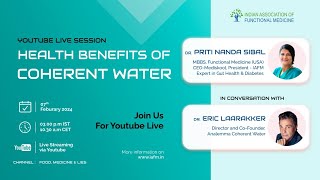
In this YouTube Live interview, Dr. Priti Nanda Sibal talks with Dr. Eric Laarakker about the concept of coherent or structured water, specifically the Somarca Analema system they have developed. Dr. Laarakker explains how his background in veterinary medicine and alternative therapies led him to investigate water’s role as a ‘missing link’ in health, inspired by biophoton research of Fritz‑Popp. They describe the discovery that altering water structure dramatically increases biophoton emission in plants and, by extension, may affect human cells. Over 12‑15 years of laboratory work resulted in a stable coherent water produced with a crystal and wand, which retains its structure for days. The interview covers biological effects observed in human and animal studies: reductions in glycan age (making the body appear 1‑12 years younger), a 28 % increase in cellular ATP, a 50‑83 % improvement in gut microbiome dysbiosis indices, and enhanced microbiome diversity in soil. Practical usage advice is given – drinking 1‑1.5 L per day, preferably on an empty stomach, but the amount can vary with climate and individual needs; the water remains coherent for weeks if stored properly. Comparisons are made with reverse‑osmosis (RO) and alkaline (Kangen) water, emphasizing that those systems lack coherence and may require remineralisation. Patient anecdotes highlight taste differences, increased thirst, detoxification, heightened consciousness, and better response to acupuncture and homeopathy. Dr. Laarakker cautions that coherent water is not a cure‑all, especially for serious neurological conditions, and stresses a holistic approach. He outlines ongoing and future research plans, including microbiome, ATP, NAD, and potential clinical trials on neurological diseases.
Chapters
Thank you. Hi, good afternoon, Eric, and welcome to this YouTube Live today on such an important topic, water.
Thank you so much for having me over here. Thank you.
Thank you. So Eric, um, as you were just telling me, you know, few seconds before we went live, that, um, water was one of the missing links.
Yes.
Which you found about almost 2 decades, 15 years to 17 years back. Share your experience about how did you find this as a missing link, and how do you think this— now this piece, once set right, can help people live healthy?
Okay, I will, I will try to explain, um, the— well, how we came up to it. Actually, I'm 30 years ago, I, uh, finished my school as a vet. And, uh, veterinarian. And, uh, but you know, I couldn't deal with only the regular medicine. So I, I did a lot of schools on acupuncture, homeopathy, uh, herbal medicine, and a lot of other things which you can find over there, which is very, very beneficial and very helpful. And, but I, I'm always curious to start doing a lot of research, but what is, you know, the missing link between a lot of, uh, of those, uh, different ways to look at a body. And so 17 years ago, we started our laboratory to do research. And first we digged in how was the best way to do research. And we stumbled up the, the work of, of, uh, famous Dr. Fritz Popp, Professor Fritz Popp, sorry. And, uh, who invented that the light is being emitted out of cells. So you can measure the light which is inside of your body, inside of a tomato, whatever, and that says something about your health. And then we were trying to, okay, what if we change different parameters? How can we achieve the biggest, uh, uh, change in positive way in biophoton emittance? So light emitting out of, and for the first, we started off with tomatoes. And then we found that actually water plays a key role in that whole system. And by just changing the structure of water, you could see that, you know, that sometimes even at 80% more biophoton emission, so more light emitting out of the cells of a tomato, uh, but just by changing the structure. And so we thought, well, This could be very well a missing link. And since our body is 99% molecule-wise water, yes, it's 70% in mass, but if you would count the molecules, it's 99%. So we are, our body is just water, if you know what I mean, for the biggest part. So water must be a very important ingredient. And then we start digging into the research of water. And the funny thing is nobody understands water. It's a very strange substance. We look at it, we think we need it, you know, just for hydration, but there's a lot more to it. I mean, actually, we found that water is a broadband absorber for almost all electromagnetic frequencies. I mean, it's just the other way there on the internet. There's a lot to find. Uh, and we live on this planet because we have an atmosphere which contains water in a vapor kind of way, and it absorbs about 70% of the incoming harmful radiation. So we must be a broadband absorber for all electromagnetic radiation. And since almost all the diseases, at least chronic diseases, you know, are informational disease. So we started to look at water as a radio, if you know what I mean, which receives certain information. And it does something with it. And the better the radio is, the more pure the information is. So then we start looking at all kind of different types of water, and, uh, uh, different types of water give different results. So we were not satisfied, and then we starting to develop our own tools, our own water, which took over 5, 6 years to develop it for different perspectives. Until we came to the water, the, the Somarca Analema water, which we have now. And, uh, the, the biggest achievement, I think, it was to make it stable, because the issue with water is if you harmonize it, structure it, whatever how you want to call it, make it coherent, it usually falls back into the, uh, um, in You know, in, in the chaotic state, soon after you made it, it take an hour. It can take a couple of minutes. It can take maximum of 1.5 days, but then it falls back. So after we, uh, managed to do that, then we started to do tests on human beings, on animals, and see, you know, uh, what happens over there. And, uh, so I mean, this is now I'm talking about 12 years of doing research. And we started off with glycan age. That's a way to look at how, well, actually these are sugar molecules attached to proteins. And the main antibody proteins for the human immune system is immune globulins. And then you see that they have the anti-inflammatory, pro-inflammatory, that it balanced, changed so that into the pro-inflammatory or sorry, the anti-inflammatory, so that you have less low-grade infections in your body. And we found out that when people drink it only after 2 months, drink it for 1.5 liters without changing anything, that actually the body became biologically 1 to 12 years younger only after drinking uh, that, that water. Wow.
So yeah, sorry, I have a question here. Sorry. So when you say drinking 1 to 1.5 liters of water, the body became younger. What time do you recommend that people should drink this water? How long they should keep the crystal in water before that?
Sorry, your question is how much of the water you drink?
And what time?
Uh, well, to be honest, I first maybe have to say something else. I, I think we need less water if we drink coherent water.
Yes.
And that's an important thing because we need a lot of water because we waste a lot of water, uh, and, uh, because the water is not efficient. If you study animals and human beings who live in a desert, Actually, they use plants and plants can structure water also. So when you get the, the water out of plants, it's far more effective than when you drink like from a tap, which is not effective at all. And, um, what we found out actually last year, we did a research in plants that they need less, far less water, maybe 40, 50% less water if you give them structured water. So this whole story, of course, it depends on where you live. I mean, we live in a cold climate over here with a lot of, of rain. So you need a little bit less water, of course, than when you live in India, when it's dry, et cetera, et cetera. So there's, to me, there's not like an average. You should know your own body, how much you need by looking at, you know, your pee, looking what comes out and if it's not too dark, et cetera, et cetera. But you'll find out. That if you, I mean, all the water to answer also the other question, uh, all the water I drink is coherent water. So when I have a chance, I drink it. And over time I found out that I'm starting to use less and less water because it's a lot more efficient. Uh, I usually start off in the morning. Uh, I have one weakness. I love coffee. So, uh, um, but then I try to drink a glass of water. And, uh, uh, uh, so the best time is to me, whenever you feel thirsty, whenever your body needs the water. And it's not for everybody the same, but you have to— but a lot of people also don't know their body. They don't feel that they need to drink. So that's why always tell people, please look when you go to the toilet, what comes out, what color it has. If it becomes too dark, then you know you didn't drink enough. So you have to find, you know, the average. I'm traveling a lot. When I go to Tanzania or something like that, I need more water than I need over here. So I don't like to, you know, put it on fixed, uh, amount what you need to drink.
Yes. So Eric, I agree with what you said. But I want to understand, for the patient's benefit and people who are listening to us, is there a difference when we drink this water early morning, empty stomach, or alone, or when we drink it with our meals?
Yes, the, the, the— I think so, um, because the best time to start off is in the morning on an empty stomach.
Right.
Because the, the, uh, as everybody knows, when you wake up, uh, the, your bladder is going to work. Your kidneys is going to, they're starting to work when you sleep, you know, they're working less hard. And, uh, um, you recently found also there is a kind of substance which rules exactly, you know, from out of your brain whenever you wake up that you have to go to the toilet. So that is actually the best time. To drink a glass of water. Actually, that's what I do when I wake up immediately. I have it next to my bed. I drink one glass of water before I start off.
Yeah. So next question, Eric, which comes is that when do you use this crystal? Immediately when you are about to drink this water, or you use it in a jug and/or in a glass bottle and then use that water in the next few hours?
Uh, it doesn't matter. I mean, the water I use in the morning has been made coherent the day before. And that's, that's because it keeps its stability. We did tests with water we created with a wand, 8 months old, and we fed it to the, the plants and did our photon research and all the other research. And we did many research on the microbiome, ATP studies, et cetera. And we found it doesn't make any difference. So. It is stable. So it's not like you have to wake up, make the water, go back and drink it, you know? No, you can leave it over there, leave it in a jug in your fridge or whatever you want to keep it. And I mean, the, the, um, I sometimes drink water which has been like a week old or so in the fridge. Doesn't matter. It will keep its stability.
Great. Now the second question, Eric, with lot of, you know, clients ask is, how is this different from the RO water and the Kangen water, the alkaline water?
It's a completely different story. Both of them haven't got anything to do with coherent water. To start off with the Kangen water, Kangen water actually, you know, gives you a higher pH, more alkaline water. And, uh, there are many different opinions about it.
Yeah.
If it's good, yes or no. And I only can give you my opinion, uh, about that. First of all, it's not coherent. Yes. So doesn't give the benefits of coherence. It gives you maybe the benefits of that it's more alkaline. And sometimes that's beneficial, you know, maybe after a disease or, you know, when you have to detox or whatever. But not on a continuous base.
I love you for this, Eric.
Thank you.
No, because there are so many controversial things, but this is the concept I support strongly, that it's not for everyone. No. And now it's not for all the time because—
no, no, no—
a big problem we are having is low acid production in the stomach.
Yes. Yes.
And I have met so many people who are on Kangen water. Somebody, you know, makes them install it and then they keep drinking water throughout the day at 9 pH. Nobody has either told them or they have not heard it that in the morning you take 9 pH and then you set your pH at 7.35, and then that's what you take throughout the day.
Yep.
Yes, and I think that— and of course I agree with you that people who have cancer or people who have some chronic diseases where we know that, you know, it's very acidic and they need alkaline water, of course there it will benefit. But, uh, current water is completely different. And, uh, till the time I knew a way to make current water, right, I used to take a lot of omega-3 and give all my clients a lot of omega-3s because the concept is that as we grow old, and especially in the environment we are living today, our cells lose their flexibility.
Yes.
And that is also one reason why we are generally dehydrated. If we look at our hemograms, most of the patients, when we see the report, we will see that they are dehydrated. And despite the fact that they're drinking a lot of water, 3 liters, 4 liters.
Yes, yes, yes, it's not beneficial.
Exactly. And I have seen that there it makes a huge impact. In fact, as I was sharing with you, I started the day I came to know about your crystal, I started using it. I've broken one few weeks back and I'm really missing my Somarka water, so I'm going to order one today. And because I really feel the change, the skin starts glowing, you feel more energetic, and scientifically it gives me a lot of support. So thank you for that. What is your take on RO water, Eric?
Sorry, your take on RO water, uh, reverse osmosis water? Um, first I think I need to explain, neither Kangen neither uh, uh, Somarca Analema water, uh, takes out the, the toxins or bacterias. Yeah. You have to keep that in mind. It structures the water. So the, uh, um, the information of toxins becomes less, but I wouldn't drink it with arsenicum in it. You know, if you know what I mean, with arsenic in it, because I mean, you will, uh, toxify yourself. So we are not on that end. And neither is Kangen. RO is a beautiful way to get all the toxins and the bacteria, viruses, fungi, everything out of that.
Yes.
But there is a but, and the but is that, uh, it also is depleted out of minerals.
Yes.
Which is very, very, very important. So I'm not against Kangen, uh, sorry, not against the, the, the RO systems. Uh, especially if you live in countries where you have dirty water, but you have to keep in mind that you have to, uh, uh, uh, remineralize it afterwards. Otherwise it starts dehydrating your body. It goes into your, into your stomach and actually it draws minerals out of your system because, you know, it wants to become water, likes to become a little bit salty, if you know what I mean.
Right.
So there are many— we actually, if we're out of the US, a lot of people use RO and we always have this, these questions. And I say, well, it's one of the best way to get, uh, everything out of it. But keep in mind the minerals, you have to remineralize it and it's still not coherent. So if you want to use it, You know, you have to make a 3-step, if you know what I mean. Yeah. First do the RO, remineralize it, and then make it coherent, and then drink it, and then drink it. Or the other way around is that a lot of people have an inbuilt system like in the US in-house, and we have now this whole house called Analemma, which you can build in your house. So you can build it in your house at least 3 meters away from the RO system. and then the water will be coherent through the whole RO system and keeps this coherence. And then you only have to resalt it again, remineralize it again.
Yeah, no, but thanks, Eric, for sharing this information in such a beautiful way. Eric, can you share some transformational stories of your patients when they came to you and what changes, you know, they felt after they started using coherent water?
Yeah. Uh, of course it's, uh, not everybody reacts the same. Not everybody is the same, luckily enough. And, uh, that's why we should approach in a holistic way our patients, because everybody is in need of something, whatever. So the, the, the, um, uh, the first thing what people always notice is the taste difference.
Yeah.
Uh, and, and when they start drinking it, They want more in the beginning because it's, you know, it's a thicker, it's a different taste, a different mouthfeel. And they, in the beginning, they long for more to keep on drinking a lot of water. So your body starts detoxifying. You have more, have to go more to the toilet usually. And, uh, but it, it's like a slow system. It's not like, you know, you drink the water and everything is healed. I mean, then it would be a wonder water and well, this in a certain way, but it, you know, it, it takes time. Then mostly people see that their mind is changing. And that's a funny thing because, uh, we consider it as conscious water. If you know me, you know what I mean? If you go back what I said before, actually water, I consider water as a bio-quantum computer, as a radio which achieves information and all the information is there in the quantum field. Whatever how you want to look at it, it's over there. So if you have a pure radio, you attract more, you know, good information. And actually it's very beneficial. And that's one of the first things you're gonna notice, your consciousness changes. And I mean, I saw many people who were like, you know, in our country, eating loads of meat and stuff like that, and you start eating meat less and less and less and start thinking more about life after death, whatever, you know, start, you know, getting more conscious.
This is why when people do their colon hydrotherapy, yeah, yeah, people come back because gut microbiome has a huge impact on your mental health, your thoughts and everything.
Exactly. Yes. And, and that we did also, like, we did a beautiful, uh, study on the microbiome. The microbiome are the, you know, the, the, the bacterias, uh, fungi, whatever you have in your gut. And as you know, uh, well, they found over 1,200 different species and the more differentiation you have in there, the more healthy you are. And we did a, a big research on that, uh, uh, 2 years ago here in the Netherlands. And the scary thing was that of, out of all the 60 people, nobody had a good gut health. Nobody when we started off. And, but the good thing is, is that we saw almost 83% more, uh, a better dysbiosis index, uh, in, in the gut and almost 25% improvement, uh, but 50% worsening with normal water. So altogether we came up to the 50% improvement of the pathogen bacteria index. So less pathogen, more good ones in your gut after drinking 2, 3 months of water. So it changes on the informational level. It started changing on your microbiome level. And the, the better, of course, you know everything about it. If your microbiome, it's the key for our, for everything in your gut, everything. It doesn't matter almost which disease you're gonna name and brain diseases, et cetera, et cetera. A lot of diabetes you have in India. Microbiome, you know, plays a key role, uh, in with a lot of other things, of course, but they are very, very important. The, the—
is at the center stage of all chronic diseases.
Exactly. So we saw a beautiful, uh, you know, increase in the microbiome index over there. And also we saw the same in the soil. So we could improve the microbiome in the soil. And actually all the good bacteria we need, they come out of the soil. So, uh, uh, how exactly, we don't know, but the, the good ones, they love that water and they start growing from it. So on all different levels, even, uh, we could see that we had a 28% rise in ATP levels.
Oh, wow.
In 60 days drinking the water. So that means, well, there's a little bit complicated maybe for, uh, uh, listeners who don't know much about it, but you have mitochondria in every cell, 500 to 2,000 mitochondria. And actually they give you the energy, all the glucose, et cetera, has been, uh, uh, uh, you know, they needed as food and they produce ATP. And this ATP actually is your food. Every, almost every chronic disease.
So I think this is equal to 28% more energetic when you drink this water.
Yes.
For a person, right?
Yes. Yes. So also those, uh, the, the, those guys, you know, the mitochondria, they love the water, but it's not so strange. If you look at the research a couple of years ago, actually it was already 20 years ago, there was this famous biologist, McGillis, and she already said, well, actually mitochondria are bacteria. So I consider them, to be honest, as part of your microbiome.
Exactly.
So also they love it. So on every aspect, you know, it has its power and it's so easy to do. It's so easy to use. So I'm not saying it cures everything. But it, and of course not, I mean, but the, the, it helps you as a very nice basic, you know, to improve your health. And even other, we found out that people who drink the water better react like on acupuncture, better react on homeopathic medicine.
And yeah, sorry, what I was wanting to say when you said that it's a radio Right, that's one side of it, or maybe when it's outside. But I also feel that water is the communicator. All the bacteria in your body, you have to communicate to each other because it's a society. You know, I generally say whatever you see outside with your open eyes, everything is present in the similar way inside, but you have to close your eyes to have a look at it.
Yep. Yes. And, and, and as you know, even more than that, because what we see with our open eyes is just between the 400 and 800 nanometers somewhere over there. But it's only a very, very, very small part. I did saw research and actually they said that our eyes only can see 0.005% of what is out there.
Exactly. So imagine how much is inside and that community has to communicate with each other so that they can stay happy. And I think for that, water plays the most important role.
Yes, I agree.
Also, when we look at our reports, at least in my practice, I know till the time I have electrolytes in balance, I will— I am not able to fix anything else. So electrolytes is one of the separate key pillars of my, you know, overhauling process or anti-aging or, you know, treating chronic diseases process. And, uh, it all comes because, you know, water is so very critical. Unless that is set right, um, I don't think we can move forward at all.
I agree.
Which is, yeah, so to have happy people inside, we better have good water inside.
Yes, that's after— well, of course, that's, that's the basic. I mean, uh, I even did some research, like, in, uh, the Blue Zones. You know, Blue Zones are areas where people become like 100 years old without issues.
Documentary which has been released on Netflix.
Yeah, yes. But the only thing that they miss is water. Because the, the, the, the, what we found out is, like, I did a couple of years research in Saline, that all the people over there drink from the same well. There is something special about that well. They use that.
No, but Eric, also because, um, you know I also, you know, had a lot of interest in water in the last 5, 6, 7 years. And till in that journey of 5, 6, 7 years, when I explored everything, it really used to actually get on my head that what is the solution I can offer in the current state. And that is the time when I was doing my research, I realized well water is the best water we could drink. Right. And in India, there was this culture of having wells in every village, and people used to drink water from those wells. That was the best. But now that thing is not available at all. Yeah. And yeah, and now the water—
and even besides of that, in our country, they found out that you know, glyphosate and all these toxins, the poison, actually they're already over 100 meters deep under the soil.
Yeah, so water has all that. So today when we do Legoscan or heavy metal testing for our patients, I am yet to see a patient who has decent level of heavy metal which can keep him— keep them healthy. So that's another important thing, and I think water plays a huge role there. We are seeing a lot of iodine deficiency in India these days.
Yeah.
And, uh, and that's the reason hypothyroidism is increasing at such a fast pace. And again, water has a huge role because our water is getting depleted of those things. And, uh, so, but if we can structure the water, if we can decrease its need and improve its efficiency— exactly, you know, using this crystal, I think, um, it's a great solution. Everybody should try it. I have two questions for you, Eric. This Healing MND India, they want to know, current water and neurological diseases, how is that connected? And have you seen any patients who had neurological disease feeling better after using current water?
You say neurological diseases?
Yeah, neurological. Oh.
Let's, I'm very careful. Yeah. Uh, I'm very, very careful always to make promises, et cetera. But if you go back to the, uh, I mean, your brain uses the most ATP. Yeah. So if we theoretically, uh, if you have a rise in ATP levels in your brain, it should be very healthy for your brain. We did a lot of brain research with the qEEG. And, uh, uh, immediately after drinking the water, you saw positive changes in the brain, becomes more harmonic, et cetera, et cetera. Immediately it's like, you know, it goes down and I think it goes through the nerves, vagus communication with your brain. Immediately starts recognizing it and it harmonizes your brainwaves. Why I'm very— so it does something. 100%, but I'm very, very careful, uh, over there because when you have a neurological disease, I'm not gonna promise by drinking the water, the issues will be gone because a lot of things which are damaged are very hard. As you know, don't need to tell you that, you know, it's very hard to restore, uh, damaged nervous system takes a long time, et cetera.
Also, I think only one thing cannot give you full solution, but saying that will this contribute a little in helping you move your patient in the right direction?
Yes, I, I, I would dare to say that. And of course, I mean, neurological disease is a big, huge area to cover. I mean, yeah, I mean, we see, for example, a lot in, in our country We see many, uh, animals and, and, and human beings with Lyme disease.
You know, in India also now we have Lyme disease in a lot of cases.
It's becoming a huge issue. And when that's, you know, in your brain, well, only by drinking the water will not help enough. You need to do other stuff, you know, to go there. So I'm always very careful. You know, there are too many Uh, uh, things you can buy which promise wonders, and I'm always careful because, I mean, everything has its part in it, but sure, it's beneficial.
Yes, very well received, Eric. Eric, I think we have upshot the time, but I have last question for you. How many times one should drink Somarka and Alema water?
How many times? Always.
Always.
Of course, listen, listen, I'm not— as much as you can. I found out myself when I have to go out for dinner in the evening and even, you know, serve nice water on the table, I don't like to drink it. Then when I come back home, I start drinking it because my body wants Analema water. It's used to it. My body is spoiled. And in, in that way, and at least I would recommend 3 glasses a day, at least. And, but if you have your wand, why not use it? And I mean, you can use it in all liquids, huh? You can use it in your tea and don't boil it, of course, with that other lemon wand because it's going to explode. Actually, my wife did.
Okay.
So I, I have that experience and she thought it was lazy. And so she put it in a water cooker and didn't work out. And, uh, but you can do it like before you make the tea.
Yeah.
Then boil the water, pour it and quickly, you know, do like 3, 4 times, uh, uh, do, do your tea. Uh, you can do it actually in any liquid. You can make any liquid coherent. So I would recommend at least 2 or 3 glasses a day, but as much as possible.
Perfect. Thank you, Eric. If we will have more questions, we will write to you, and I'm sure you will reply. There's one more question, Eric. Um, oh, somebody wants to know, have you done clinical trials on this, and would you be interested in doing more? I think we can take this. Yeah. Will you want to answer this question?
Clinical trials on what?
On benefits of, uh, Sumarqa water in neurological diseases.
Uh, I'm always interested because the, the, our issue is that we keep on doing our research and research. That's actually a lot, you know, a huge difference from most other water devices. Is that we almost spend all our money in research. We're gonna start another microbiome study again because we are not satisfied with this, uh, with the, the, because we want to make it publishable. This ATP study is going to be published. We're going to do research in NMN, uh, sorry, in NAD levels, in et cetera, et cetera. We just finished off a beautiful research, like in a huge, uh, on, on cows and everything. So we keep on doing so. Everything which is there, it could be interesting for us to study. We are always open to it when we love to do it.
Thank you, Eric, one, for doing such an amazing work and giving us such a beautiful solution. And thank you.
You're welcome. Thank you for having me over here.
Thank you very much. And pleasure to speak to you. I think I am hoping that more and more people would use Samarka. Because this is such an easy way of making your water coherent. We can't be lazier than that if we don't do this, right?
Yes.
Great. Thank you.
Thank you. Thank you so much.
Thank you.
More from Dr


Understanding Chronic Acidity: A Holistic Approach to Better Digestive Health 🌿


BHRT - transformational health journey if a 42 year old women #BHRT #HormoneBalance




Transform Your Health Naturally with Functional Medicine | Dr. Priti Nanda’s Success Story


hypothyroidism and ozone therapy - talk at Ozone Conference by Dr Priti Nanda Sibal
