Holistic Approach to Treating Autism
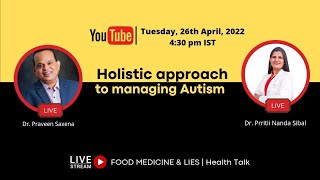
Dr. Praveen Saxena, a radiologist turned functional medicine practitioner, outlines his protocol for autism: eliminate gluten, dairy, and refined sugar; test for heavy metals; reduce Wi-Fi and fluorescent lighting; use infrared saunas and red-light therapy. He emphasizes epigenetic factors and environmental toxins over genetics alone.
Chapters
Welcome to the next session of Food, Medicine, and Life channel. I am extremely happy to have Dr. Praveen Saxena with us today. Welcome, Dr. Praveen.
Well, thanks, Dr. Priti, for inviting me.
Thank you. Thank you, Dr. Praveen. So Dr. Praveen is a radiologist. By degree, and he will share with us how he came into functional medicine and the great work he's doing today, especially with the autistic children. Dr. Praveen has a clinic in Hyderabad, and in fact, not one, he has 3 clinics now. And, uh, he helps people with autism, with cancer, with autoimmune disorders. And just now he was sharing with me how he uses EMF and other technologies to shift the energy within the body and heal the patients. So let's hear from Dr. Praveen. Welcome, Dr. Praveen. And Dr. Praveen, I would really want to start with knowing, after doing radiology, which is number one in medicine, you know, anybody who can get a radiology seat is always jumping because that's the best department you can go into. How come after a few years of practicing radiology you came into functional medicine?
Again, I can tell you it is only about radiology because I used to do a lot of interventions in radiology, interventions where usually like ultrasound-guided interventions. I used to treat some people like with amoebic liver abscess and the people having something like pleural effusions and trying to do some biopsy or fine needle aspiration. And we had— we thought, let us not keep this patient for 3 days in a hospital. Instead of that, we will keep— we will ask them to come on an elective day, and within 2 to 3 hours, we ask them to go out and go to the home. So this is the concept we thought that is going to save much time and money for the patient. And somehow I was always on this one trying to do some kind of things, and I started doing some ultrasound-guided interventions. The first case I did was an ablation of a hepatoma, and I can tell you that hepatoma was less than 3 centimeters and it was a unifocal one into this one. It was way back, 15 years back. So those people, they told me, okay, there is something like— I was always a— I was used to connect with the people, and they used to tell, we can— can we do this particular one? Doctor family had a hepatoma, and he said, okay, can we try something? Because that patient was given some days or weeks to live. Then we said, okay, alpha-fetoprotein was more than 5,000 or 8,000, something like that. And then I, I wore the hat of an interventional radiologist with it. See, we tried to use a very thin 21-23 size needle, and we used to take that, uh, and I— it was so easy. I started doing percutaneous ethanol ablation for this particular patient, and the results were too good. And every month I used to do that for— we went for at least, uh, 8 8 to 12 months we did it, and it was a— during the second week, second month itself, we were able to see the decrease in AFBs and all. And it gave me a lot of encouragement, and that's how I entered into Integrity Oncology, number one. And yes, I had some personal challenge in the sense, in the year 2000, I was told my son was having a disease called autism. And they were not very clear. They said it is something like pervasive developmental disorder or something like that, but between the lines they were clear— they were not clear. They said, okay, you need evaluation, this, there's no treatment for autism and all. So I said, okay, let me look into what is it. And I started, because one thing I was very keen was autism as a thing. Whatever I'm dealing with. This was not congenital. It was— it came after 1 year because I knew my child, and he had a regression after 12 months, 12 to 15 months. Something went off and he— we lost, in a sense, the spark was lost. He was into social isolation. You call him number of times, he never used to— it was a challenge for me as a radiologist And I always have an inclination, uh, yes, I— you are right, actually, all the top rankers and all that. I was one of the, uh, thing. But for me, I— the challenge was always, uh, what is the cause? I had done so many pyrexia of unknown case origin cases, and we used to pick up something— renal abscess or liver abscess or some smallest thing. And these people used to come to us after finishing off everything. They used to be bombarded with all things, and we used to pick up that small abscess and we used to drain that. And the kind of— I was always used to look at if there is a fever, there has to be some focus somewhere. And so I thought, this autism, what is the kind of— what is the kind of intrinsic problem he has got? Because he has not just— we were very responsible parents. Most of the autism was told, yes, it is non-responsive parents, a refrigerated mother. So, but I could see there was nothing of that sort. So I started looking at, trying to look at answers, and that was my always— I used to look at answers for provide how I can provide simple solutions for complex problems. Was my— always I was on the lookout for that. So started interacting with people around. There was something called Autism Research Institute was there at the time, and we connected with them. And I had to— they were, they were very good doctors, and they were very good human beings, and they were, they were ready to extend their support and the help actually, because I had to literally depend on sitting here, and on the other side they were— so we started working on some area. I felt this is something like some atrogenic problem, and we— and I tried working on some areas, trying to take up challenges. I have my families of doctors, and they said, what is this you are doing? No, no, this is— you cannot take, uh, for giving that steroid also for some time. For my son, and they started questioning, why do you want to experiment with this? So I said, okay, let me experiment, because once the other people have given up, they said nothing can be done for this kid. So, so the egos are quite high, Dr. Preeti, and but I can always tell you, it taught me to how to become a good human being first. Autism taught me a lot of stuff. Autism helped me trying to look beyond what is the realms of what is a doctor as well as a parent. So I could see a lot of stories like that from other corners. Then we started, okay, let me do some one by one. So this is all how I started this integrative medicine, and I believe we need that combined effort rather than just only focusing on one particular thing. Because I was not a big fan of behavioral therapy, speech therapy, and all that, because I was always looking for answers, and it was not my cup of tea to wait for 2 years or 4 years down the line to see improvements and all. So I had a literal fight with a lot of mainstream doctors also, and they spoke— I was like, I was told to take something like anti— I said, no, no, why should I take this? This doesn't have anything. The narrative came was, no, no, he may get the autism fits sometime later, so need to start now, sir. So I said, okay, till how long I need to take? They said lifelong. So I said, no, this is not the answer. You can— you have to is just trying to push the tip of the iceberg and make it immersive. It's not the answer, actually. And so it was a long journey, Dr. Poojya.
Dr. Praveen, I have heard this story before, but today when you were sharing, I could sense a lot of emotions as if you were back in 2000 and that whole turmoil which lot of us are facing these days. You know, whenever any such diagnosis comes in our family, among our family members, or loved ones. And when we allopathic doctors go to allopathy doctors, and the answer is, take this lifelong, nothing else you can do about it. You know, you can cry, you can feel sorry, but if you are innovative, if you are good, if your mind is really working, your mind questions, why has it happened and what can I do to correct it? Right, and I definitely see—
the thing is, you need to look back and look at what might have gone wrong. And, uh, so I was, I was confident, number one, yes, let us— there has to be some cause and effect relation, always is there. So, uh, like that, we started, uh, picking up some threads and, uh, trying to look at, uh, it's like a— it's like an entangled, uh, mesh. So you had to remove one by one things, and then you are there. My— I am very happy. My son is going to— he has completed his graduation of hotel management and he's going to get recruited soon.
Exactly. So Dr. Praveen, just what you just said now clearly tells me that—
not, not just one more thing I'd like to relate here, because I, I'm trying to give a energy. I'm trying to tell the people, okay, this is something which you can always achieve. Because I was— I will tell you about the narrative of how genetics were told. I was told that, yes, you have got first son, the second chances of second kid getting into autism is very high, to the tune of 70% or something like that. And, uh, to my, uh, surprise, in the sense I was— I spent some few restless nights trying to work on autism, what to do if my— because my 7 years down the lane after my first kid diagnosed, we are having a second child. And during that pregnancy, I had everyone in my family was telling, yeah, what is the risk you are doing and all that. Then I started telling I did my homework a lot and I said, okay, let me work on this. And I created a benchmark in the sense I tried working on pre-pregnancy methods, what has to be worked out during pregnancy and post-pregnancy. We followed it diligently, and with that, my second son now has got admission into MBBS first year. He is into Visakhapatnam Medical College. That's why I want to tell you is there are some more than 45 or 50 parents who followed my advice. I gave them this paper, I said, okay, let us work on this particular thing. And I'm— I wanted to prove this thing that autism is genetic is wrong. It may be epigenetic things may be there, but if we are able to remove that factors and all of them have a healthy child And it was somehow, uh, the— when I see, when I see, saw in Seattle and Colorado, the second kid, third kid also has been having that issues. It was really difficult. Now I am dealing with the case with from patients from Bihar. First kid has got, second kid also has got. So this is really, really kind of this one. And the narrative from the mainstream medicine is no, this is not Familiar. And, uh, how come? How come? You tell me. I have seen a lot of— I have seen not just here, Dr. Preeti, I've seen in US also, achievers, the people who have gone to the biggest level after IITs and all that, and their kids having autism, their kids having this learning disability and all that. What do you mean by telling that they have got genetic traits and all that? These people where way beyond, they are very good intellectuals and they got their kids are autistic. Does it mean that they have, uh, they also have some autistic traits and all that? Uh, it was, it, uh, it was hard to digest actually. And I tried to— I have worked with more than 1,000+ families with autism and I am able to give them some good ideas and how Most of them now, they are doing well. But I can tell you, it is not familiar. The way the thing was, a thing called, uh, this— all the kids are injured, injured with the vaccine, MMR or multi or pentavalent or some vaccines and all that. I can always prove that point. And so all the studies which were done, all the studies, they were done on the priority that this, this, uh, to prove it is not vaccine-induced. They just wanted to prove that. So what is the next kind of thing to prove that it is genetic? There are some 200 genes that are identified, but hardly it matters. We have so much, uh, you know about— you do functional medicine, you, you run into oncology also. You have BRCA genes, 9,700 types of the BRCA kind of thing. We can isolate only one or two. And if even if the BRCA gene is positive, we can make the patient— person need to not getting into breast cancer by doing our functional medicine message. So the same thing I'm just trying to work on this autism front.
Dr. Praveen, before I ask my next question, I definitely want to compliment you on the passion with which you have worked on this subject. And the positivity your sentences are bringing around people, because I agree, I also see autism kids and I've been able to get some very good results in those children. But you know, in the beginning it's so difficult when you tell the parent that do this and you will see the benefit. The parent says no, my mainstream doctor has said there is no chance. Do behavioral therapy? And there is no need to change anything.
That's right, defeating process. There is a kind of thing because I was told, okay, no, you don't do any experimentation with the kid because nothing is going to work. And when you start with that, because whatever cases we have done, Dr. Preeti, you are aware we have done so many, uh, different cases. And the somehow, as an ardent student, as a big I used to look into what is the cause of dilated cardiomyopathy. First point is idiopathic. What is the cause of thyroiditis? Idiopathic. Now, idiopathic, this because they were not able to identify that it is the mercury, it is a kind, this kind of things which are, it is the pesticides, it is your glyphosate. So many things are now, but I now, I believe doctors like us are going to have a bigger challenge Because the kind of— there are so many elephants. It's not just one elephant in the room, there are so many elephants. We are not able to see. And I really, sometimes I pity these people, of people with— we are being guided by whatever the kind of somebody gives us the list of paper, the, the way it has happened in COVID, you know. So why you should— why I should follow? I'll give a smallest example, doctor. When my second kid, uh, when Mona was pregnant, and during pregnancy it was told to go for a, um, something like, uh, tetanus toxoid vaccine. So my gynecologist— I was working in that hospital as a radiologist very good hospital. You have got operation theaters where super twin steel chambers. And I said, okay, I was, I was a very— always I used to pose different difficult questions to this, all my other group people. I said, what are the chances of tetanus neonatal? She says, no, no, it has to be taken. It's an age-old tradition without TT injection. TT. I told, madam, do you know what is the amount of 25 micrograms of mercury is there in the, uh, TT injection. TT. So she says, so what? It is giving a protection. I said, okay, uh, what are the chances of getting tetanus neonatarum in your hospital? She says, my all thing is aseptic. We have a— we maintain very good thing. I said, then I don't want that. If my child is going to be born in a case where there is a pakka hospital, very remote place, he may need— because tetanus, this is being directed 50 years back. That time there were no— people used to work in their home and all that, in that mitty and all. So that is a valid thing, you use tetanus toxoid then. So like that, there are so many things which have been followed since years, nobody wants to question. We had questioned about injection DPT. I was telling injection DPT is banned in 1986 in US. You must meet Barbara Lou Fisher. She's such an amazing lady. She wrote a book called Shot in the Dark, and her kid was almost gone. She had convulsions and all that, almost death, or in that kind of thing. It was an encephalopathy happened because of the DPT vaccine. Cellular pertussis. The pertussis was a cellular one. So after '86, 1986, whole of USA, they stopped giving a DPT. Instead, they gave DTaP. DTaP is a cellular form of pertussis. With that, you don't get something like convulsions and encephalopathy. And you know, here the same thing continues and continues. We have to— it is, it is really a difficult thing. As a radiologist, Dr. Preeti, as a radiologist, I have— I used to go to that hospital. I, I used to work in a pediatric hospital. I used to visit the NICUs and all that. We used to do CT scans. We have done neurosonograms and all that. And we have seen people, children suffering from encephalopathy because of the DPT. And the word was being put across in the hospital that you are not going to talk anything about vaccine. Um, I am a very open guy. I had seen MRI, patient comes with the fits, MRI is normal, other things are normal, then the cause is only this DPT is causing that. 875, 1 in 875 is the association of convulsions in DPT injection. So what I mean to say is one in which is huge, quite high, huge. And most of the patients who get this convulsions, they are put on lifelong therapy for this convulsions.
Exactly. So Dr. Praveen, why I really like the area you are in and why, you know, I really wanted to host you today is because it's not only the child's life, it is the parent's life too.
Whole thing goes upside down actually. Exactly.
When, you know, the birth of your child has added new energy in your house and you've just started enjoying that and some diagnosis like this comes.
Yeah, it is a— it's a great— it is— I— we have seen a lot of families broken with that. It's not easy to have that.
Exactly. I've also seen, and which is very surprising, you know, their divorce is happening because one partner tells the other that it's because of you, it's because of you, blame game happens.
And hey, Dr. Preeti, I can tell you, I have been talking with these people. I try to take the info. I take the mother having a dental amalgam. I don't even tell them this dental amalgam has caused you a problem, because immediately we can see the reactions among that. I don't even tell hypothyroid mothers have got the tendency to get into that, because what happens is that we are— so, but now we are concerned. We, we have identified a subset of population who are having subclinical hypothyroidism also, they give rise to birth to the kids who are susceptible to autism if we don't do our homework properly. So it's a big challenge actually. All medical community should stand up. I'm sure all this— I'm really happy what a fantastic guy like Ashwini Garg is doing because I used to think that I'm only one talking about that. I'm really happy that Ashwini and all that, we are on the same page and we can really do some service to the society by—
Exactly. Yeah, no, that's very important, Dr. Praveen. Dr. Praveen, before I go forward, I have a request to make. Will it be possible for you to share that sheet so that I can attach this in the YouTube comment section? And people who already have one child with autism diagnostic can follow the same guidelines?
Yes, yes. There are 3 pages only. Pre—
perfect.
Before pregnancy, you need to follow this. During pregnancy. And third, I'll give you that. Share that paper. I can—
perfect. So I'll add it on the YouTube. So for all the viewers, you will have—
you should. That's it. That is a kind of— it will be a great kind of contribution. Maybe it went for Pune. There were a lot of parents from Pune. And, uh, this was before lockdown, 2018 or 2019. This was— most of the parents use that paper actually. I, I— great.
Yeah, because when you have done it on so many, then I don't want to do it again. I will request your help to get it and do it.
And I'm really so happy my son, second son, got into medicine. So I do— I want to tell you, I want to tell the world that, okay, we are not autistic family or something like that. Right.
And in fact, yeah, and in fact your elder son is also normal now, right? Because you did all the right things.
Yeah, he's going to get a job in— he has completed his master, he has done his hotel management 4-year course. Wow, God has been kind on me, right?
But I think a lot of parents, Dr. Praveen, try to do something but are not able to, and You are very blessed that you did not leave where you saw that there is dark everywhere. You still found that ray of hope and went on moving.
It's all because of people like you and who are my well-wishers, I could do that. Only thing is I'm— I was only a kind of— I do one thing at a time, but autism, it took me nearly 10-15 years. I did my MBBS for 5 years, I did my radiology for 3 years, But autism took me 8-10 years. It was not an easy track actually.
No, functional medicine overall is not easy because it goes into the roots of your thing and it actually helps you change your genes also.
Yeah, what I'm looking nowadays is people— I was telling one doctor today, psoriasis patient, it's easy to change religion than change the diet actually.
Right, but diet is so critical because it's a messenger Right, no more, only calories.
I can tell you, I was— I told my wife, you know, this looks like he was 5 years old that time. I said there must be something with that, we should stop taking wheat and milk. I am convinced, I don't want to get convinced anywhere. Then she started weeping, she says, what, milk and wheat only he takes? He takes only bread or milk, there is no other thing. So I can understand.
So Dr. Praveen, you know, I work a lot with gut health patients and I make them do elimination diet.
Yes.
So I think almost 1000+ people have done elimination diet under my guidance in the last 1.5 years.
Perfect.
And you know what I've seen is if somebody comes and tells you, can I keep eating this, rest all I can avoid, you already know that person is allergic to that. And there is science behind that, you know, which you must know, is that it activates the opioid triggers. And what cocaine does to your body, the food with which you are allergic to does the same thing.
Exactly, exactly. All this, all that.
So now I'm working with some celiacs.
Okay.
And for them, leaving gluten is so difficult in the beginning because they start getting Herx reaction.
Yes.
So you have to make them first decrease it by 20%, then 40%, then 80%, and gradually, you know, help them wean it off.
I can tell you, it has helped so much. Autism has helped so much for my practice. See, I try to— any nasty case also, I tell them, okay, you stop taking gluten, you stop taking this particular stuff, and it helps a lot. Why do I do— I am— I sometimes pity this other so-called super specialist They are not aware about this or what? They keep doing scopies and scopies and scopies and nothing, nothing comes.
Dr. Praveen, the moment you are off this life, your phone is going to be ringing a lot.
I'm ready to face the consequences, but I somehow believe that if there is an elephant in the room, you should see it. You know, it is a Logical thing.
Yeah, I agree, Doctor. Dr. Praveen, we have few questions. I'll take those and then I will continue on what is it that you advise, you know, for autism and how— what is your approach to autism. But before that, I'll take this question. What is your advice to parents whose children are autistic?
Uh, the thing is, it's a— I can always tell you, you people are number one blessed Take it this way, and God has chosen you because you are capable of carrying these kids. And I can always tell you that involving with autism, it will make you more responsible human beings. You will understand what is their kind of— take some breaks sometimes, and there you need not be totally overwhelmed with the subject and all that. Try to follow a simple— any— I tell everyone to go to even in US, anywhere, go to an integrative or functional medicine doctor. He will take care of you. And I can always tell you, don't get overwhelmed with the knowledge what is being circulated in the WhatsApp and all that. Because if for a person like me who was always— I used to love my books only, and it took me so many years to understand what is autism. For a non-medical person, it's not easy to understand everything at one go. And there is no ready-made khichdi here. No treatment is something like— it is not like anti-tuberculous treatment. At ATT, we gave a combination of 4. Chalo bhai, lelo, you do whatever you like after that for 9 months. It is not like this. It has to be dealt with personal doctor. Uh, you— it's a personalized medicine. At the same time, I encourage people particularly mothers and parents, not fathers and mothers, try to not go by the way the society treats you. Because I have seen my people only telling, so the thing is your blood boils, you know, and you will be demotivated. And try be meeting very people who are positive only. Don't get into that skepticism. What is this? Don't try to move a lot. Don't stop that, that place. Or my kid is there, let me go. Don't go to the parties and all that. So wherever we have gone, we have taken our kid along with that. If the society doesn't accept, it is their fault. Let them, let them come into terms with that. And yes, you put your conditions and all that. Yes, it is. I think parenting autism is something you are— you— I think you are— maybe I'd say it's an easy thing, but you— at the— I have seen a lot of patients who got their health got better just by cutting that stupid wheat.
Exactly, exactly. And anything more you can do is positive. Yes, anything more you can do is positive. For the last 25 years, I don't take sugar.
In my tea also. And I— if I— someone gives me a cup of tea with sugar and all that, I feel like vomiting.
No, I feel like vomiting after that. If sometimes, you know, I'm not able to say no, right? And Dr. Praveen, I am a typical Punjabi who used— who used to love her tea and coffee with 2 teaspoons of sugar instead of 1.
I have given up 25 years back. I read something about sugar, nasty ways of sugar. When I was reading all this, I said, okay, I'm not going to. Then the counter question is my sister tells, I don't want to wait till diabetes comes, right?
Exactly what was in my mind. You've, you know, triggered that. A lot of clients who come to me, when you tell them about functional medicine and what all they want, they will have to do, especially changing diet. Which is very difficult. They prefer to go to Ayurveda, to homeopathy, stick to allopathy, but they don't come back to you or any other FM doctor. What is your viewpoint on this, and will you want to suggest something to these patients, to these parents?
The thing is, as a clinician, you always have big egos, actually. If someone comes to me after so many things, I feel that, okay, I'm the best doctor, and I try to take up things in a this one. I suggest every parent or something like that, the person who talks about, okay, we'll do, uh, what happens here is that he may be doing in a good intention, but the repercussions are going to happen later. Uh, you have to, uh, most of the homeopathy, Ayurvedic, they are definitely, they are good, but when we are talking about something like autism which is a multi-system disorder, and it was not dealt by anyone before. This has come only after 1942. There were no cases of autism reported. Now there is a kind of epidemic. So if we are— if we don't know this, let us try to figure out in a collective way. I use sometimes homeopathy also for my patients, but I tell them, okay, You don't compromise on your microbiome, don't compromise on your detoxing skills. That's a very essential part. You have to have that. Uh, parents are always— I have seen a lot of parents, uh, there is always— there is a— they want to go for that quick fix. And exactly, yeah, there is a quick fix. They say, all right, we'll do within 21 days. If somebody is able to do that within 21 days, it's very good. Only thing is, till now, you have to— there are no shortcuts for treating autism. It requires minimum of 6 months to 1 year, and it is hard work. And not just by the doctor, it has to be borne by the parents also. And even the family also suffers. I have seen, I have got a patient right now, and the child, his sister also, elder sister, she says she doesn't touch any sweet She doesn't touch any— the whole family doesn't keep anything inside their fridge. So it is a— in fact, it is a good thing for all the family. But you have to— you should be— you have to be ready with this one. You quick fixes normally you get, then repercussions will be problematic later, will be a problem.
Also, Dr. Praveen, I'm seeing that when people are trying Ayurveda these days lead is increasing in their system. Do you have any opinion on that?
100%. It is actually what happened was when I was in US, for our Ayurvedic chanprash was brought into much disrepute. And I have seen my father's elder brother, uh, he used to take chanprash like this. And I can always correlate that later because I had dealt— I had treated him for peripheral vascular disease. There was a huge calcification of the all arteries and all that. He used to go for one amputation of one finger to another finger. And now retrospectively, I think because of the chain crush and all that lead, he got that peripheral vascular disease. I, I can always tell you one thing, there is the Ayurveda has got good concepts, but in this era of money-making or whatever is it, you cannot have that Chyentraj bottle being ₹200. If you get a pure Chyentraj, it should be very costly ones. If you want to sell within that ₹200, you have to add literally lead into that. That's the reason we all in US, we got a disrepute. Ayurvedic, even our rice, Indian rice, people are scared to take because it has got it was shown to have arsenic and cadmium impact.
Exactly. And, and Dr. Praveen, I use oligoscan for testing heavy metals, and there is hardly a client who comes and does not have excess heavy metal these days.
Oligoscan is such a beautiful thing, Dr. Preeti. I even— I will test. I'll be having high levels of mercury. We do have— we all of us have got And we need to work on it. Exactly. We are not getting into something like Alzheimer's and all that.
Yesterday I saw an aunt who is suffering from Alzheimer's, and reading in books and seeing somebody, it's so different. That any day we can do something early on is really the need of the day today.
I think we are going to get increasing numbers of Alzheimer's post this COVID jabs and all that, and we have to be ready with this.
All right, so there is this another question. Yeah, Dr. Praveen, there is another question here. Is there a detox you can suggest for parents to help detoxify the body from vaccine-related toxins?
Exactly. Vaccine-related toxins are usually aluminum, mercury, and we are working on usually these two particular stuffs. And parents should work it out, try to use a lot of coriander and whatever is available, kind of which foods which are available, try to use that. I suggest very simple things for— but when we are dealing with autism, we have, we have to be more careful about, because there is a— we cannot afford to do a steering business there. We— what happens with that, if properly detox is not done, there is going to be redistribution. It comes out from one place and it gets into the other system, which is not an ideal situation. And that is where this— all this chelation and all that has come into— if it is not done properly, it is— we get a lot of reactions and all that. You may get long-term kidney problems and all. So we need to look at 10 years down the lane. Immediately, answers are not very— this one, yes, detox is one thing which I believe has to be an integral part of any autism treatment. What I mean to say is, I'll give a small example. Detox is like if your car is— you have got a crash, in the sense you have a dent on the car, you need to do a denting and you need to do painting also. You need to do both the things. You just can't— similarly, you had— we work on—
it is a very beautiful example, Dr. Praveen. Generally what we do, we do the denting when it comes to our body's detox, and we don't do the painting. So the detoxificant is already creating havoc in another place within our body only.
You need to see, remove that soft tissues also. That's the most important thing.
Yeah, great. So I hope Arvind got his answer. Dr. Praveen, what is your protocol for autism children?
Autism children, basically, uh, I am working on some things like, uh, started cleaning the— clean the environment, number one. Now I tell clean the environment. The, the most important thing what I tell is Uh, it's a, it's a kind of major thing. The, the people who are coming to us, they are not ready to switch off their Wi-Fi. I say you need to switch off the Wi-Fi, and they should not use something like fluorescent lights in the home, right? Another, another thing is try to keep away all the cleansers and all that, air fresheners and all, and you are not using your any kind of fragrances and all that. You— it has to be fragrances-free. Mother and father, both has to, uh, kind of— they need to work on that. This is clean the environment. Then we tell that not to use any much of electrical gadgets across the bed of the children, and even the bed should be We— I suggest cotton beds for everyone, not the foam beds. There is a thing called PVDEs which keep on causing a problem. And other stuff is when you whitewash your walls, you see that your walls basically are lead-free and cadmium-free. Most of the— now you need to pay some price for that, but you'll get—
but it's available.
It's available now. It was not available, and people are not aware before about that. That are the things. And we tell about trying to work on the hygiene part a lot. Hygiene part is trying not to use the children diapers and all that, because that you should always try to switch on to the— people try to use this. All dioxins are there in the, in diapers, which can cause problems. And I can go on and on. Only thing is, yes, I'm not very happy looking at the products what is being sold across. So I believe that it has to be in a proper way, or right, you start from your bedroom, come back to the kitchen later. In the kitchen, no pressure cookers, and try to see that you don't use Um, this microwave oven— microwave oven is a big no-no. Big, big nuisance. Yeah, even cell phones, whatever you are doing, try to see that they are not always in an on mode. Try to remove Bluetooth from that, try to remove all this Wi-Fi and use the phone like that. I had seen, uh, somehow it, uh, it is a— somehow I can always— I need to connect with People who doesn't understand that the child who is greeted, a newborn child is greeted with a cell phone here, and he is being given cell phone and said, 'Arey, Nana Gosu, Nana is in something Delhi,' and he cries at the— so this is something which is very, very ridiculous, and the child should not be given a cell phone. I was telling the other day, maybe I was telling some other doctor also, I have one in my house in front of me, 3 BHK. Another one child is there and the parents are so happy. One-year child talks up, our kid is— I was really shocked. I said, why do you want to give him this particular stuff? But things are not good. This kind of screen time, 50 years later or 40 years later, he is going to get into Alzheimer's. If he starts using computer, cell phone like this now. So it is better the child gets a small— I think we parents also, they are not aware. I think they are not aware about— they feel that it is a big—
this one also, Dr. Praveen, the advertising industry and the way we are working. For example, to do this YouTube Live, both of us are sitting in the Wi-Fi zone. And unless, you know, we are really aware, we won't switch it off immediately. So making that balance is not easy in the current environment also, I think. Dr. Praveen, hi viewers. I think in this very interesting conversation, Dr. Praveen's Wi-Fi is having some problem, but we will have him back soon. Just wait for a minute. Till then, if you have any questions, please post. I have loved this conversation with Dr. Praveen, and I'm sure you would also have loved it. Learned a lot from it. And if you have anybody, you know, who you think can benefit from this, please share it with them so that we can help autism children live a normal life. We all know during COVID times autism incidence has increased, autoimmunity has increased, and it has become all the more important that we become aware of how to manage this condition. Just give me a minute, I will just see what is happening. Let's wait for 2 more minutes. So, Arvind, yes, in autism I have at least in my practice seen this biases contributes a lot. There is science to show that there is gut dysbiosis in autistic children, and once corrected, it really helps in getting the child back, and we see a lot of improvement in his symptoms, his or her symptoms.
I— The number you're calling is currently switched off.
So I think his number is also switched off. Something has So friends, um, I think there is some issue, network issue, at Dr. Praveen's side. So till we wait, I would want to add Few more things about management of autism when it comes to functional medicine approach. Infrared saunas, red light therapy do help in these cases. A lot of these children are seen to be dehydrated, so correct way of drinking water, especially if you can include sun-charged water in your life. It can really help. We all know this Mosito study which says that water has energy and the crystals are formed in the shape and way the energy which we give to this water. Sun-charged water is very, very positive for our and our children's health. So if you can take a glass bottle, take 1-liter glass bottle, fill it with water, keep it in sunlight for 4 hours, say from 6 AM to 10 AM. Or 7 AM to 11 AM, and then bring it inside, and that's the water you drink. This alone will help you feel better. And, um, sorry guys, I think something major has happened because Dr. Praveen is not able to join back. I hope you enjoyed whatever we spoke, and I will have him back once again to talk about what he does in his practice for autism children, because I for sure know that he uses chelation to take out heavy metals, which he was talking about, and he has seen promising results doing all of that. Thank you, all the best, stay healthy, stay happy, and it was nice to have you with us.
More from Dr


Understanding Chronic Acidity: A Holistic Approach to Better Digestive Health 🌿


BHRT - transformational health journey if a 42 year old women #BHRT #HormoneBalance




Transform Your Health Naturally with Functional Medicine | Dr. Priti Nanda’s Success Story


hypothyroidism and ozone therapy - talk at Ozone Conference by Dr Priti Nanda Sibal
