Hypo & Hyper-Thyroid: Emerging Science & Management Tips
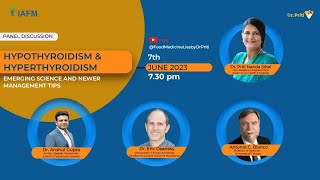
Four thyroid experts discuss why levothyroxine alone doesn't work for everyone and when to add T3 or combination therapy. They cover which tests matter most (free T3, free T4, antibodies), how diet and adrenal health affect thyroid function, and why Hashimoto's cases are rising.
Chapters
Hi, good evening everybody, and thank you for joining us. We all know company's growth depends on the decisions the CEO and the strategic board members take, right? And when I came into functional medicine of almost 7 years back, one of my first talks with leaders in thyroid medicine told me that thyroid is our body's CEO. So it is very, very important that our thyroid works optimally so that we feel good, happy, and our body works in perfect state, right? And today we are going to talk about what are the nuisances, what are the problems which people are facing with thyroid. And how can we manage or optimize the functioning of thyroid to live healthy and happy, right? So just to say here, you know, today itself I had a 27-year-old girl from US visiting India, and she said, I have been gaining weight like this over days if I'm not very, very careful. And I've been trying to tell my doctor for the last 4 years that my thyroid is not optimum, but whenever my doctor gets my reports, the doctor says, no, your thyroid is okay and you don't need anything, right? And when I got a test done, I put her on bioidentical thyroid immediately. Now, how did we look into the reports and what do we do? We will be talking about all this today. I want to welcome Dr. Bianco, Dr. Sankhi, and Dr. Anshul Gupta to this show. Dr. Bianco is the professor of medicine at University of Chicago. Antonio Bianco is a physician scientist and a writer working in the thyroid field. He obtained his MD and PhD in human physiology in São Paulo, Brazil, and later immigrated to the U.S. And he maintains an NIH-funded laboratory there. His research career has focused on how T3 initiates or terminates critical biological steps while maintaining relatively stable plasma levels. Bianco was elected and served as president of the American Thyroid Association in 2016. Dr. Bianco, please share with us how you got into this. What is your story and what is it that drives you to actually focus on thyroid, which you do?
Thank you. Thank you very much. It's a pleasure to be in your show, uh, uh, and with my colleagues, Dr. Gupta and Dr. Asanki. Thank you very much. So I started as a medical school working in the Department of Physiology, and it so happened that my mentor at that time, he was working in the thyroid field. So I, I fell in love with the thyroid, and this happened about 45 years ago, and I never stopped. I, uh, some point 25 years ago, I moved to the U.S. from Brazil, uh, and established my laboratory, uh, and since then I've been, uh, doing research on thyroid hormone metabolism action, uh, and maybe about 10 years ago I became much more interested in the clinical aspects of this research and, and to the understanding how are we doing in terms of treating patients with hypothyroidism. Are we restoring thyroid hormone homeostasis or not? And so that has been my most recent focus of my research. Thank you.
Thank you. Great. So another speaker we have is Dr. Sanki. Chiropractor, clinical nutritionist, and a certified functional medicine practitioner. Uh, Dr. Asanke, just to, you know, share something on the sidelines, before I came into functional medicine, I think chiropractor practice in U.S. inspired and motivated me to leave my allopathy practice and move this side. And, uh, I am really in awe of what you guys do And I'm so happy that in India also now we have, I think, 20+ chiropractors, and the number is increasing every month. Uh, so thank you for being there in that space for so, so, so many years. Of course, the topic of interest for Dr. Sankhi is reducing antibody in Graves' disease. A lot of us, when a patient of hyperthyroidism or Graves' disease comes to us, we tell them, go to your endo. Because we want to be safe, and this is an area not talked about too much. So Dr. Usanki is a chiropractor, clinical nutritionist with over 20 years of health and wellness experience, and has been helping people with thyroid and autoimmune thyroid conditions since 2009. He is also an author of the book titled Natural Treatment Solutions for Hypothyroidism and Graves' Disease. And Hashimoto's triggers. Wow. And is the host of the Save My Thyroid podcast. Dr. Sankhi was personally diagnosed in 2008 with Graves' disease and after taking a natural treatment approach has been in remission since 2009. Wow, this is such amazing news for so, so, so many patients. After seeing how well natural treatment methods helped with this condition, He began using these natural thyroid treatment protocols to help others with different types of thyroid and autoimmune conditions. Dr. Sanki, thanks for being here, and please share details about your story. How were you diagnosed? What happened? And of course, I understand that when you healed yourself and came into remission, there was no looking back, and there was no way you could have done anything else. Over to you, Dr. Zanki.
Yeah, you're right. Well, thanks. Thanks, Dr. Priti, for having me here. And yes, so up until 2008, I just had a regular chiropractic practice. And then, as you mentioned, I was diagnosed with, with Graves' disease. I started developing— I mean, it's a, it's a long story, so I won't get into great detail, but I was dieting, detoxifying. So I was actually losing weight and And I didn't realize eventually that was— initially that probably was due to the dieting and detoxifying, but eventually it was the hyperthyroidism that was taking over. And, you know, I didn't know until I was walking around in a Sam's Club, which is a big retail store they have. I don't think they have in India Sam's Club.
I don't know.
Do they have Sam's Club in India?
No, we don't.
It's, uh, I don't know if they have Costco there, but anyway, it's a big big, big retail place. And I took my blood pressure. They had one of those automated blood pressure machines. And, and my blood pressure was fine, but my resting heart rate was elevated. I thought maybe it wasn't because I wasn't fully resting. I was walking around. But then I started to put the pieces together. I was losing weight. I had an increased appetite. And then I started realizing that, noticing heart palpitations. And in addition to the resting heart rate being increased, and so I went to a primary care doctor, got diagnosed with hyperthyroidism. And again, being a chiropractor, I can't say I had a lot of knowledge when it came to hyperthyroidism. But I will say that when I was taking my continuing education credits up until then, I always took nutrition courses for my CE credits, and I took a couple of functional endocrinology courses up until then. So I, Even though I wasn't too familiar with hyperthyroidism, I still knew enough that I wanted to avoid the conventional medical treatment and at least attempt to address it naturally. And eventually I went to an endocrinologist and she's the one that diagnosed me officially with Graves' disease. Yeah, so I avoided the medication. I took herbs to manage my symptoms and did a lot of things from a diet and lifestyle standpoint. Of course, nutritional supplements and was able to get into remission. And that was— yeah, that was 2009. So as of recording this, 2014 years ago almost. And, you know, I realized that there's not a lot of practitioners that help people with hyperthyroidism. So even though I also wrote a book on Hashimoto's, as you mentioned, Hashimoto's Triggers, most of my patients have hyperthyroidism with a lot of those people having Graves' disease. And reason A lot of people see me as just— again, there's not a lot of practitioners out there, but then of course my own story with hyperthyroidism as well.
But an amazing space, Dr. Sankhi, and very inspiring story you have. So I will come back to this later and ask you more. And we have Dr. Anshul Gupta with us. So welcome, Dr. Anshul, and thanks for being here. And also thank you very much for connecting us with Dr. Bianca and Dr. Sankhi and helping create this panel. And sharing this information. So Dr. Anshul, I think all IFM members and people in India know him as the hypothyroid, Hashimoto's, you know, thyroiditis king, I would say. Because any case which is stuck, I think if he's not going to Dr. Anshul right now, should start consulting or taking his opinion on this. Uh, Dr. Anshul has also written a great book which, uh, you know, I really enjoyed reading. And, uh, it's always nice to be working with him. Um, so Dr. Anshul, over to you, because I know people know you here. Why did you particularly choose thyroid for yourself? You're good at so many things. I know I discussed cases with you, and I know you can do Parkinson's and Alzheimer's and diabetes and everything. So why particularly thyroid for you?
Thank you for— thank you, Dr. Preeti, for inviting me over here and for that elaborate introduction. So I really appreciate, you know, your kind words. And there is no way that I know everything. It's just kind of, you know, a humble beginning for me of sharing whatever information that I'm gathering over the course of years. So the thyroid actually came into me, you know, like, because I was having my own health struggles, you know. I'm— so by training, I'm a family physician. I was practicing like in rural Virginia As a regular physician, I started having a lot of issues with weight gain, brain fog, tiredness, gut problems. Could not figure out what was going on with me for a long amount of time with a lot of investigations like endoscopies, colonoscopies, ultrasounds, blood work, all those things. So then I— that's where I found functional medicine, and I implemented a root cause approach, found my root causes, and then by a stepwise approach by lifestyle and supplements, I could get it better. So then that was very powerful, that within a few months I could completely transform my health. So that prompted me to share this with obviously a lot of other people, and I wanted to do research in this field. So an opportunity came to work actually at the Cleveland Clinic. They had a functional medicine department. They wanted to do research on functional medicine model of care. So I got an opportunity to work over there, learn from Dr. Mark Hyman, Dr. Patrick Hanaway, and all those people. But over there, actually, I started seeing all these clients, you know, which are all middle-aged females, had similar health issues as mine— weight gain, brain fog, tiredness, gut issues. And one thing was common: they all had either Hashimoto's disease or thyroid problems. They were all taking medicine but still not getting better. And even in functional medicine, what I realized was that, you know, like, a lot of people were just kind of trying to treat, like, with replacing the levothyroxine or the synthetic hormone with a natural hormone. Beyond that, a lot of people were not doing much. So I started researching into Hashimoto's disease, particularly how we can make it better. Is there a way that we can actually reverse it by getting those antibodies back to normal? So that got me interested into it. I researched it a lot, kind of made my protocol as the 3-step protocol, implemented a lot of people over there and in my prior practice too, and saw phenomenal results. A lot of people, almost everybody obviously got an improvement in the quality of life. Their symptoms improved. Plus, you know, obviously their antibody levels, you know, like improved significantly. So that kind of prompted me to kind of go into this field and share this knowledge and help people kind of world over. So that's what I do now.
Great, thank you, Dr. Anshul. And you know what surprised me in the beginning was I had this lady from Punjab, the area where I come from, and she was trying to conceive, and I was not doing infertility cases then. But I saw her reports and her TPO level was 3,000. I just managed her gut, put her on elimination diet, and 4 weeks later she had conceived and her TPO levels had come down to 91, 92, something like that.
That's amazing.
Yeah, and that actually inspired me that, you know, simple things but just in awareness it— you can change somebody's life. In this case, she had had 2 failed IVFs, right? So, and since then, I think 5, 6 years, a lot of such cases have come, and a lot of cases have also come where I'm stuck, and I'm looking forward to learning from you all so that I can help those patients. So moving over, Dr. Bianco, generally in allopathy medicine We were taught, and even today what we do is we use levothyroxine and that's it. You have thyroid, nobody will even check antibodies to a large extent, right? Like in diabetes, we don't check insulin. In this, we will not check antibodies. So why T4 medicine or levothyroxine is not enough alone? What is your view on this?
Well, so, so levothyroxine is, uh, it, it works very well for a huge number of patients. Number one, I mean, we know that there are, at least in the U.S., there's about maybe 20, 25 million patients with hypothyroidism. If all of these patients had problems, the, our offices will be flooding with patients. So that's not the case. So most patients do well on levothyroxine. And, uh, you know, until years ago, maybe 5, 10 years ago, those patients that did not do so well on levothyroxine, that remained symptomatic even though they were being properly treated, they would go to the doctor and the doctor would say, well, you know what, I can't help you because your TSH is normal, because that's what the a main goal of the treatment is to normalize serum TSH levels. And patients will be moving from one doctor to the other until they, you know, up to 10, 15 times they will move. And then until they find a doctor that— or maybe they get used to the symptoms. I mean, the resolution was never very, very good. So What changed in that is that in the last maybe 10 years, the idea that levothyroxine is not effective 100% for 100% of the patients became very clear and it started to be accepted by the medical societies, professionals in general. Now we really understand. Yeah, in fact, there are, there is a group of patients, the size of which we are not very clear. It's large, probably between 10 and 20%. You know, when I published my book, I wrote between 10 and 20%, and doctors tell me now probably it's less than 10%. Patients tell me it's more than 20%. So depending on the perspective that you have, there is such a group of patients for whom levothyroxine is not 100% effective. So I think that that's a major thing that we all realize that the patients are very grateful, even though it started 50 years ago. And so for those, the idea is what is causing these residual symptoms? Why are these patients not fully satisfied? As it turns out, T4, the hormone in levothyroxine, is not an active molecule. T4 doesn't do much. T4 doesn't resolve symptoms by itself. Our body needs to convert T4 to T3. T3 is the hormone that's really active. And so when we treat patients with levothyroxine, we rely on the body's ability to convert T4 to T3 at a rate that is acceptable, at a rate that's going to resolve the symptoms. And most patients can do that. Some patients do it poorly. They are not capable as, as they should be to produce, to normalize serum T3 levels. And it is a fact that about 15% of the patients that are treated with levothyroxine have normal TSH levels, they have T3 levels that are below the normal range. And that for me is, it's eye-opening because if the T3 is the hormone that resolves the symptoms and our treatment does not normalize T3 levels, what did we expect, right? Now there's a lot of studies. The connection between low T3 and the symptoms is not very clear. However, for me, it's so obvious that, uh, we, we need to fix T3. And let me just say that the connection is not very clear because you know what, we don't even measure T3. We are not— we are told not to measure T3 levels. We are told to measure free T4 and TSH levels, uh, as if these two hormones had anything to do with biological activity of the thyroid hormone. They don't. So I think that while we don't understand everything, and perhaps, uh, and, and I believe the antibodies could be involved, uh, in this residual symptoms, I think there's evidence to that. But the low-hanging fruit that we have today is the low T3 levels, and I think we should make an effort to normalize these T3 levels to restore thyroid hormonal homeostasis.
Dr. Bianco, from what you said, you know, I've been waiting to ask this question. Is— do you know of, you know, a certain system which we can create in our mind from which we can know whether this patient will be benefited from levothyroxine and this patient should be put on bioidentical? And why I ask this is because at least in India The cost of levothyroxine versus the cost of bioidentical is 100 times.
So what, what is bioidentical? Is it desiccated thyroid extract?
T4 and T3. Yeah.
Okay, got it.
Combination.
So we don't have that. Uh, we are working hard, not only my group but other groups are working hard to, uh, develop a method through which we could tell a patient before trying levothyroxine, you will probably benefit. There's some genetic changes that could be markers. There are certain polymorphisms in, in enzymes involved in thyroid hormone metabolism, but, uh, results so far have been a little bit, uh controversial, and we need more studies, right?
Because, you know, one thing which I have seen in my practice, Dr. Bianco, is that people who don't have antibodies generally would do well with normal levothyroxine, which is available at the chemist, right? That's one. But I have seen that some patients, when I had put them on a combination of T4, T3, their symptoms aggravated. And, uh, that's a mystery I'm trying to solve. I can only know whether the symptoms will get aggravated after I've given them that compounded thyroid, right? And but before that, I have no way to know whether, you know, this patient should I give compounded thyroid, this patient I can only give levothyroxine.
You're not alone. We are the, the everywhere in the world, uh, that there's If you want to find out the effectiveness of levothyroxine versus combination therapy, you need to do a trial.
Great, uh, thank you. So that I'm not alone, but still I think a lot of research is needed on this because it can really help patients if we can know which one will benefit which patient.
Absolutely, I agree with you.
Dr. Osanki, Dr. Anshul, will you want to add something on this question?
I think like I totally agree that, you know, like, uh, this is something which is very new to the medical fraternity of adding the T3 hormone treatments. And I think everybody is still figuring out what is the best way of using T3, because as you suggested that, you know, not every patient improves. Some people actually do get worse. So like, you know, a patient of mine, you know, she was put on again by a natural practitioner on very high doses of T3 medicine. And then she was just not getting better. And then like finally actually we weaned her off T3 medicine and boom, like she's actually doing much better. So she was already taking like, you know, a combination T4 and T3, and plus she was given a high dose of T3. So again, a lot of things are happening in the world and a lot of practitioners are not completely trained. And I think so there is a value of adding T3 in a lot of our clients, but again, we need to know the best way of doing it.
Yeah, no, because actually I learned it the first time a very hard way. I changed my mom's medicine, levothyroxine, to compounded thyroid, and a week later she was in such miserable shape that I can't tell you. We had to get her back on levothyroxine, and, and that's when she settled. And I was like— and since then I have seen many patients like that, and therefore I was very curious to know if we can do something about it. But great. So we have something to work on. Dr. Bianco, my next question for you was what you said, TSH is not enough. Well, you elaborate a little on this.
I mean, I think that's a, that's a good point. So I do believe that TSH is a very good test for the diagnosis of hypothyroidism. And I know a lot of my colleagues do not agree with that. Uh, you know, assuming that the patient has a healthy pituitary gland, uh, there's no reason why the TSH should not inform how the thyroid function is, is working. So what happens is that, uh, a lot of drugs can affect TSH secretion. Steroids can affect TSH secretion. Amiodarone can affect TSH secretion. Retinoic acid can affect TSH secretion. So if we just take the TSH value in isolation and we don't understand what's happening with that patient, we, we might not take a full advantage of the method. The other thing we see frequently is patients trying to lose weight they cut down on calories, and that also disrupts TSH regulation. So I do believe that for the diagnosis of hypothyroidism, we need to look at all of these things. And if none of these things exist, I would trust the TSH levels. There, there's a rare condition, as you know, secondary hypothyroidism This is not, uh, maybe less than 5% of the cases of hypothyroidism, maybe even less. It's not very common. A lot of patients tell me, oh, I have secondary, I have central hypothyroidism. Well, I mean, unless there's an epidemic of central hypothyroidism that I'm not aware of, I think these other factors— drugs, caloric intake might confuse a little bit the utilization of the TSH as a diagnostic tool for hypothyroidism. Now, when we talk about treatment of hypothyroidism, now, now let's say we have a patient that has been established, has hypothyroidism, and I'm going to treat with levothyroxine. The TSH is really not a very good tool because what happens is that by giving levothyroxine, we can normalize TSH levels, but we are not normalizing the T3 levels. So there will always be a relative deficiency of T3 because there's a relative excess of T4 and a, a little bit of deficiency of T3 in everybody, all patients. Now, in 15% of the patients, the T3 levels are below the normal range, even though TSH is normal. So I do believe in the management, management of patients with hypothyroidism. You need to look at TSH, T3, and T4, and before all that, how the patient is feeling, the symptoms. So we have to— doctors need to integrate all of this symptoms, TSH, T3, and T4, and, uh, and try to do the best possible with the replacement therapy. Now, I think that Dr. Gupta mentioned something which I think is really interesting. Doctors normally don't look at the TPO levels when we are treating patients with Hashimoto's, and, you know, and there's not a good reason why we don't look at TPO levels. I think that We are learning that there are conditions in which TPO levels are really important, like pregnancy, the outcome of pregnancy, outcome of fertility treatments. And I think that maybe there's much more in this field that we have to be looking for.
Great. Dr. Bianco, we have a question from Dr. Ashwini Garg. He wants to know what are the long-term side effects, if any, of giving thyroid hormones longevity?
On longevity? So I mean, if a patient is hypothyroid, the patient needs to be treated with thyroid hormones. I mean, until the day that that patient dies, uh, we should not treat someone that doesn't have hypothyroidism. So I would not suggest that. But, uh, the critical thing is the dose of levothyroxine or any other replacement therapy that you're using There are studies showing that as we get older, we need less thyroid hormone. So normally your TSH will start going up. We believe the TSH, the upper limit of normal of TSH, will increase 1 point by, by, for each decade of life. So it will be the upper limit of normal will be about 5 when you're 50, 6 when you're 60, 7 when you're 70, and so forth and so on. So then when we replace thyroid hormone in a patient that is 78 years old, I don't want to bring that TSH back to 1 or 0.5, even though it's within the normal range. I will tolerate a slightly elevated TSH as you get older, as the patients get older. But again, symptoms TSH, T3, and T4.
Great. So, Dr. Bianco, why I think this question came from Dr. Ashwini was that there are now studies, uh, showing that mitochondrial function plays a huge role when it comes to hypothyroidism, and that can be another way of correcting hypothyroidism in some patients. Like, we all know that adrenals make a huge impact I know while doing my fellowship, I think one of the things which stayed with me when I was doing it from A4M was that for first 6 weeks, treat the adrenals first before you start managing the thyroid. Of course, right? And this is not a small thing because it changes the way patient's body responds and reacts. If we keep this one thing in mind, at least I have seen in my practice, this has helped my patients so much. And in fact, this has helped me so much, so I never forget this. So your thoughts on both, actually, on the adrenal fatigue part and also on the mitochondrial health. Does these two things impact hypothyroidism or thyroid functioning? And should these be taken into account? And if yes, how?
Well, obviously, if the patient has adrenal insufficiency that has to be dealt with absolutely and should be treated before treatment of hypothyroidism, because otherwise we're triggering a crisis. We don't want to do that. But I am not— I'll have to defer to my colleagues. I'm not an expert on adrenal fatigue. I will not be able to, to address properly your question. Now, as far as mitochondrial health, that's Yes, thyroid hormone is the life of the mitochondria. With, you know, as you— hypothyroid individuals have lower levels of mitochondria. We know that because either studies in animals, that's what you observe. If you look in the microscope, you're going to see less mitochondria if you're taking tissues from a hypothyroid animal. But even studies done in humans with muscle biopsies also found the same thing. So as you replace thyroid hormone to individuals that have hypothyroidism, those levels of mitochondria are going to go up again, are going to be restored. The question is, are we restoring it fully? Because what does restore mitochondrial levels is T3 and not T4. So I, you know, it would be my guess if you're not normalizing T3 levels you're not normalizing anything that's downstream of T3. And mitochondria is one of the elements that downstream of T3. Another element is cholesterol. We just, you know, in the last 5 or 7 years, we realized that patients that are treated with levothyroxine and have normal TSH, they have a slightly elevated cholesterol. I mean, that doesn't make sense. Are we not normalizing TSH? Why not normal? You know, I learned that if you normalize TSH, your cholesterol should be normal again, and it's not. And I, and I, I was really interested on this and say so and thought, well, what's going on? So the first thing is, are these patients taking statins or not? So as it turns out, if you're taking levothyroxine, and we did the study both in US and in Brazil, the likelihood that you're going to be on statin is double. So what happens is we as endocrinologists, we treat patients with hypothyroidism with levothyroxine, the cholesterol doesn't come down, so we start those patients on statin medication. And so the association of levothyroxine and statin is huge, and, uh, it's, it's, uh, it's, uh, for me it suggests that indeed those T3 levels that are not fully normalized are not bringing back the cholesterol to normal. And does it happen in the mitochondria? Maybe it does, probably does. We just don't have a good marker. I don't have a good marker.
But very interesting. And thanks for sharing this information because, um, at least for me, I learned, uh, this for the first time that, uh, you know, the studies which actually show this, because now there are a lot of studies which are saying that mitochondrial function should be improved to help people with hypothyroidism. Uh, Dr. Bianco, we had another question from Dr. Vijay Mohan Kohli. He wants to know what can be the reason for very low TSH with normal free T3 and free T4 levels and normal antibodies, and patient is not on thyroid medications.
Yeah, well, uh, I think this very low Within the normal range, or I'm assuming it's below the normal range?
Below the normal range.
Well, I mean, that's a condition known as subclinical hyperthyroidism, right? So you have a patient that has normal T4, normal free T4, normal T3, and the TSH is low. Uh, so, uh, in, in, if, if I see a patient like that, I'm gonna think, well, there's something happening in the thyroid. There's such a small excess of thyroid hormone in the circulation that I'm still not detecting as I measure these hormones in the circulation, but the TSH is already detecting. So this happens frequently when there's a small nodule that becomes autonomous. So I would do a thyroid ultrasound to see if there's a nodule then, which is followed by a scan with the radioactive tracer, so you can see if there's a hyperfunctioning nodule that could explain that situation. The other thing is patients might have a very mild subacute thyroiditis, and the levels— and I've seen that patients that have normal levels of T3 and T4, but the TSH is really low. And I assume it's a subacute thyroiditis because as we follow, and after 3 months, 4 months, that TSH went back to normal again. So it would be a silent thyroiditis. I think that we always should look for something that's happening in the thyroid. Patients with central hypothyroidism do not have a very low TSH level. So when you have a patient with suppressed TSH, don't think it's, uh, it's central hypothyroidism because that's not what it is. A very low TSH is always associated with a thyroid that is working more than it should be working, either through thyroiditis that's releasing a lot of hormone. You're not just a little bit, or some autonomous nodule that's working, or maybe it's just a Graves' disease that's really in the beginning of its phase, and it's— there's some degree of excess of thyroid hormone. So you really need to look at it.
And we will come to Graves' disease with Dr. Sankhi in just a few minutes. I think I have 2, 3 more questions for you, Dr. Bianco.
Okay.
Alvi Patel is asking, isn't TPO antibody not a specific one? It just says we have inflammation.
No, the antibody is very specific. It's directed against the thyroid peroxidase, so that which is a very specific antigen in the thyroid. It reflects the existence of lymphocytes that recognize that antigen as foreign, that they don't recognize that antigen and start producing antibodies against it.
Great, thank you. Shagun wants to know which are the best supplements to optimize free T3 levels.
Supplements? Yeah, like nutritional supplements?
Yes.
I would not know that. All I can tell you is that if you stop eating calories, your T3 levels will go down. So in general, uh, the caloric intake has a—
that's a huge thing, Dr. Bianco—
positive correlation between T3 levels and caloric intake. The more calories you intake, the higher the T3 levels. But the opposite is also true. The lower that your caloric intake, your T3 levels will go down. Uh, some very old studies suggest that more than calories is the carbohydrate content in the diet that can activate conversion of T4 to T3. That's a little bit, you know, it's not gonna— I don't think it, it's gonna help anyone eating a lot of calories if they are interested in losing weight just to increase the T3. It's— I think it's going to be counterproductive. But, uh, I would not know anything about that Yeah, but Dr.
Bianco, here I would want to add, at least that's what I do, and I think Dr. Gupta and Dr. Sanki can also say what they do. I generally do not recommend keto diets for patients who are in adrenal stress or hypothyroidism, um, because I feel that, you know, some carbohydrate should be a part of their diet in these cases. I don't know, Dr. Anshul, do you have any take on this? And Dr. Sanki, what's your take on this when it comes to diet for hypothyroid and keto?
Oh, so from my side, yeah, I mean, um, I— so it has been shown in several research studies that fasting definitely kind of, you know, lowers your thyroid hormone levels because thyroid is a metabolic hormone, right? So longer fasts are definitely going to reduce that thyroid hormone levels in the body. So, you know, a lot of people are doing these longer fasts like 3 or 4 days, or even sometimes intermittent fasting too. So there is only a very short window of fasting that could be useful in some thyroid patients, but otherwise I generally try to have them avoid longer fasts. Now beyond that, you know, so keto diets can work in some people because, you know, like if you're taking the right calories. But again, not a lot of people it works because the people that works with us have multiple conditions going on in their body. And as you were talking about mitochondria, you know, keto diets does suggest that they can actually, actually improve mitochondrial functioning. That's the reason a lot of people on keto diet feels a lot of energy, feels their mental capacity improving, because all those ketones do support, you know, brain functioning. So I think for a short amount of time it might be useful. Long, long ways, it might not be the best diet for all the thyroid patients. And that's where I think there is no no one particular diet that I think we have all identified that will be good for each and every client of ours. And that's where that personalization is very important.
Now, I wanted to bring this up today because today one of the, uh, patients who visited me said, you can scold me, but I am on keto and I will continue to be on keto for next 5 weeks because I need to lose weight. And, and then what do you do? So I thought, you know, maybe I need to check whether I was advising her right or wrong. Dr. Sanki, anything you would want to say here on keto diets and thyroid patients? And should this be the diet to go to if you are thyroid, hypothyroid or hyper?
Yeah, well, as Dr. Anshul mentioned, yeah, I definitely don't think there's a perfect diet for everyone. Now with hyperthyroidism, in most cases, ketogenic would not be a good fit as far as like really restricting the carbohydrates. But even I agree with— for those with hypothyroidism, including Hashimoto's thyroiditis, I think it could be a bit extreme, not just from a thyroid perspective, but from adrenal perspective too. If their adrenal isn't— adrenals aren't optimal, then, then I usually like to do things to support the adrenals, optimize the adrenals. I mean, I can't say I'm very familiar with ketogenic, carnivore diets, you know, as well. But yeah, those are not typically ones that I recommend to my patients, not only with hyperthyroidism but with Hashimoto's. I will say, as far as intermittent fasting goes, I think once someone's in a healthier state— I mean, I do intermittent fasting. Again, I would not have done it when I was dealing with Graves' disease, and I lost 42 pounds when I was dealing with hyperthyroidism and you're saying with Hashimoto's, of course it's a different story because most people are gaining weight. But yeah, you know, still I think it also comes down to their overall state of health and the state of their adrenals. And in most cases, I think doing like 12, 14 hours is okay, but getting into like a 16:8 fast or even, you know, some people do like 18 hours. Yeah, I think that's a bit extreme.
Exactly. Great, thank you. This was really helpful. Great. So, uh, Dr. Bianco, I think we have 2 questions for you. One, Dr. Praveen Saxena— and thank you, Dr. Praveen, for being here. Uh, Dr. Praveen wants to know thyroid supplementation and mercury toxicity. What's your take on that?
In where?
Mercury toxicity.
High mercury. I, I don't know anything about that. I'm sorry, mercury toxicity.
Yeah, so, um, in India somehow unfortunately the incidence of us finding heavy metal in patients is increasing right, left, and center, maybe because of the water supply and the environment we live in. And, uh, of course there are studies which connect hypothyroidism, especially Hashimoto's, with mercury toxicity. Uh, so Dr. Anshul, will you want to say something on this?
Yeah, I mean, so mercury, obviously heavy— we know that heavy metals has been a big issue, you know, like with thyroid conditions, you know, especially like, you know, we have seen lead and mercury because there is kind of an affinity of thyroid tissues for heavy metals. So a lot of times we do see that thyroid or thyroid gland is so fragile, so it can get affected. And I think it's world over that we do see mercury, not potentially like toxicity as such, but like higher amount of mercury levels in particular bodies. Because obviously, like, you know, a lot of people have these amalgam fillings, you know, which they still have it. And sometimes the mercury can come from the fish. What is also interesting is that we do see fish oil supplements, you know, which are not properly made, can also be high in mercury levels. And obviously people listening to different online forums and researching, they take a huge amount of fish oil supplements. and that can lead to this mercury toxicity too.
And that too, the cheapest one.
Yes, you know, that's obviously the, the case. You know, everybody wants to get the cheapest supplements, or, you know, like, supplements are available easily to them, and sometimes that can backfire and they might have these toxins involved in them.
Great, thank you.
Thank you for— because I didn't know that. Thank you.
Great, Dr. Sanki. Anything you will want to say on mercury toxicity and thyroid, you know, could be Graves or Hashimoto's, whatever?
Well, I mean, I agree with, uh, Dr. Gupta. I mean, you know, we— I see a lot of people who have mercury amalgams, and that could be a common cause, or large sources of fish. So I think the number one thing is to try to minimize exposure. If someone's eating swordfish on a regular basis or even a lot of tuna, you could get— I mean, I wouldn't say always with swordfish mercury toxicity. I mean, eating tuna a few times a month, even a few times a week, I don't know if you would really call it toxicity, but you could have higher levels. And there's that argument. I mean, obviously mercury, you don't want really any mercury, but when it comes to the— when it comes to silver fillings, it's even more controversial just because in a perfect world, we wouldn't have gotten, you know, I mean, I personally don't have the mercury amalgams, but I have had them and I got them removed by biological dentist. And, you know, but some people can't afford to get them removed, especially if they have like 6, 7, 8 of those fillings. And as Dr. Gupta says, in some cases they can be trigger along with other heavy metals. We're picking on mercury here, but there's, you know, there's lead, there's aluminum. So we want to really, it really, the big thing is coming down to minimizing our exposure, you know, to these metals. And then they mentioned supplementation, so as far as supplementation, I mean, I won't get into great detail, but just doing things to increase glutathione could greatly help, you know, whether it's taking something like N-acetylcysteine, NAC, or even a liposomal glutathione. I mean, there are other things too, but that's something that I won't say is safe and 100%. Some people don't do well with NAC, with the NAC, but, but a lot of people can tolerate it. And, and again, NAC, very cost effective too.
Yes, very cost effective and pretty valuable here. Thank you. Um, so I think this is the question, Dr. Usanki, I will ask you and move on to hypothyroidism from there. What's the role of iodine in Hashimoto's thyroiditis?
Yeah, well, iodine is important for the production of thyroid hormone. But when it comes to thyroid autoimmunity, it could— it could— when it comes to Hashimoto's, it could be a potential trigger. It's funny, I wrote— there's a chapter in my book, Hashimoto's Triggers, that focuses on iodine. And In the past, I used to be gung-ho on iodine.
What—
I mean, things have changed over the years. When I was dealing with Graves' back in 2008, everything was— well, I won't say everything, but a lot of, a lot of the information out there was pro-iodine for both Graves' and Hashimoto's. So if you have— whether you have Graves', Hashimoto's, take larger doses of iodine. And even the conferences I mentioned, my continuing education credits, they would still— the presenters would talk about large doses of iodine And I can't— and I have experience taking large doses of iodine and in my— and everybody's different. So I would be very cautious when it comes to supplementing separately with iodine even though iodine is important for formation of thyroid hormone. We got to remember that Hashimoto's is more of an immune system condition so that's typically not related to thyroid I mean, it's an iodine deficiency, and I've seen cases, and I don't know what Dr. Gupta could, as well as Dr. Bianco, can, you know, give their experiences, but sometimes it could exacerbate the autoimmune response and make someone worse. And the thing is, we don't know, we don't know how someone's going to respond. Someone could do a urinary iodine test, but even if they're deficient, they still might not do well with supplementing with iodine. I will say I'm not too concerned about iodine in a multivitamin. I mean, they're, they're like people that go to the other extreme, like they think everybody with Hashimoto's should completely avoid iodine or, you know, keep it less than 200 micrograms including food sources. I'm conservative, but if someone's taking a multivitamin with iodine and they're eating some foods, as long as they're not eating crazy high amounts, like if they're eating a lot of kelp and seaweed, that might be a different story. But if they're eating just foods like eggs that have some iodine, some seafood, and just again, not crazy high amounts. And let's say they are taking a multivitamin. In most cases, people will do okay, at least what I see. But it's really the separate iodine supplementation in a number of people that seems to cause problems.
Dr. Anshul, what is your take on this?
Yeah, same thing. So we, uh, again, I looked at a lot of research, and research kind of do suggest that for Hashimoto's clients specifically, that too much of iodine is bad and too little bit is bad. So, and then kind of we are living in this world where, you know, like getting too little bit of iodine is kind of very rare. So again, I'm a very big proponent of using like food sources of iodine as much as possible. I don't put my clients on exclusive iodine supplements I think that is too much. Again, you know, as, uh, Dr. Osansky mentioned, if they're taking some iodine supplementation in a multivitamin or here and there, that is okay. But I think a lot of people, you know, are smearing their body with like Lugol's iodine, or they are like, you know, taking huge amounts of iodine supplementations. I think definitely that's not a good thing, especially for Hashimoto's clients. I've not seen any benefit with it. Uh, in any of my clients doing huge amounts of iodine.
Dr. Bianco?
Well, an excess of iodine can cause hypothyroidism. Uh, it will— the thyroid will just reduce its activity, uh, when you are exposed to an excess of iodine for a long period of time. So an excess of iodine is not good. Uh, in Japan, for example, because of their food that they eat, so much from the sea, the seafood, they have an increased iodine intake which is above 500 micrograms per day, between 500 and 1,000. And that— and they do have increased incidence of Hashimoto's disease as well, so that people believe that the excess of iodine, the relative excess of iodine in their diet may be causing those, uh, the increased, uh, cases of Hashimoto's in Japan. So it— in most of the Western world, uh, has gotten rid of iodine deficiency. Uh, so I think that— I'm not sure. I, I do believe in India this has been resolved by and large. I'm not sure, I don't have the statistics, but I can tell you that in the U.S. it's assumed that this has been resolved. But it, it has been identified recently that pregnant women may be at risk in the U.S. for iron deficiency because we are at the threshold, non-pregnant individuals. But when you become pregnant, you are your need, your daily requirements for iodine go up. And so there are studies showing that maybe 20, 25, 30%, depending on the area, depending on the socioeconomic background of the patient, there will be iodine deficiency. So that's why it's so important that during pregnancy, women start on vitamin supplements that contain iodine for that pregnancy to have a, you know, a healthy thyroid for the baby and for the mother. Now, that's what I know about iodine. I would, in my practice, I would not recommend taking iodine for Hashimoto's or other thyroid condition.
Great, thank you. Uh, so Dr. Osanki, difference between hyperthyroidism and hypothyroidism for some of the patients who are listening here, and what are the tests you commonly use to confirm your diagnosis of Graves' disease?
Yeah, so with, um, so hyperthyroidism and hypothyroidism. So hypothyroidism, you're going to have low thyroid hormone levels And then Dr. Bianco was talking about thyroid stimulating hormone or TSH, so typically gonna have elevated thyroid stimulating hormone, elevated TSH with hypothyroidism, whereas with hyperthyroidism, we are seeing the opposite, low TSH and elevated thyroid hormone levels. So everything is— think of it as everything being sped up with hyperthyroidism, you get that increased metabolism, and with hypothyroidism, you get the opposite. So with hypothyroidism, we commonly see symptoms such as weight gain, a coldness, fatigue, whereas with Graves'— or constipation also. With Graves' disease, you have the heart palpitations, the increased resting heart rate, sometimes loose stools, diarrhea, insomnia, and tremors. I'm trying to think of the ones I had. I mean, I had that increased resting heart rate, I had, you know, again, I had the palpitations, I had some tremors, I had some looser stools. Again, definitely lost weight. I mentioned I lost approximately 42 pounds. And so again, definitely the symptoms are different, even though there could be— sometimes the symptoms don't always correlate, meaning that sometimes with hyperthyroidism you'll get people gaining weight and not losing weight. Now, it could be because they're taking anti-thyroid medication, which slows everything down. That's one, one possibility. But sometimes even if they're not taking anti-thyroid medication, they can gain weight for other reasons. Similar with hypothyroidism, usually you're gaining weight, but if someone's losing weight, then you're probably going to look at like, does the person have like an absorption problem? But, and also I should mention that most people with hypo or hyper, it's autoimmune. So the majority of people with hypothyroidism have Hashimoto's. And the same thing with hyperthyroidism, most people will have Graves' disease. And then as far as testing goes, so besides, you know, I just mentioned the thyroid panel with again hypothyroid, high TSH, low thyroid hormones, so low free T3, low free T4, and then with hyper it's the opposite, you get typically not just a low TSH but a depressed TSH, undetectable TSH, and elevated thyroid hormone levels. And then as far as the antibodies go to diagnose Graves' versus Hashimoto's, so Hashimoto's, we were talking about the TPO antibodies, those thyroid peroxidase antibodies, but I'm not sure if those other— the thyroglobulin antibodies were mentioned, which are another antibody associated with Hashimoto's. With Graves', you got TSH receptor antibodies, the antibodies bind to or attack the TSH receptor, which results in the excess production of thyroid hormone. And the most common TSH receptor antibody are thyroid stimulating immunoglobulins. And what's interesting is, according to the research— and I do see this a lot of my patients as well, backing up the research— approximately anywhere from like 60 to 80% of Graves' patients also have TPO antibodies. So over time, eventually they can become hypo if You know, if things aren't done to address the autoimmune component, if they have both those TSI as well as elevated TPO antibodies, and then some people have all three. I've seen people that have all three of those antibodies I just mentioned, but typically, I mean, I don't personally diagnose since I'm not a medical doctor, but when someone goes to an endocrinologist and if they have hyperthyroidism in the presence of those TSI, thyroid stimulating immunoglobulins, or TSH receptor antibodies, TRAB. Sometimes it depends on the lab, but that is typically diagnostic of Graves'. And Dr. Bianco mentioned before the uptake test. Some endocrinologists, some endocrinologists also use the uptake test, not just for nodules. I mean, they'll use that a lot to differentiate between a cold nodule and a hot nodule, but also if the uptake is high in the presence of hyperthyroidism, they'll use that as a diagnostic tool. Although if someone has elevated TSI, then really that by itself is diagnostic. And then I should also mention a lot of people with Graves' disease have what's called thyroid eye disease, where they're presenting—
That was my next question, yes.
Yeah, yeah, so that's also pretty common where, you know, at least I'd say 50% you know, have some form of thyroid disease, most of it mild, but some people get severe where they get severe eye bulging pain. Some people get double vision and some cases it could be quite debilitating.
Ah, so thank you, Dr. Osanki. Dr. Osanki, you mentioned that, you know, Graves' disease and Hashimoto's both are autoimmune conditions.
Correct.
Can we go ahead and think the treatment for both should be same?
There's definitely a lot of overlap. I mean, the big difference between someone with Graves' that, you know, that I work with compared to someone with Hashimoto's is obviously the symptom management. If someone has Hashimoto's, if they have lower thyroid hormone levels, as we've been discussing, thyroid hormone replacement is typically given. Whereas if someone has hyperthyroidism from a conventional medical standpoint, They'll usually be given anti-thyroid drugs such as methimazole that block the production of thyroid hormone. Many times they'll be given beta blockers also such as propranolol, which could lower the heart rate, and also some beta blockers such as propranolol will affect the conversion of T4 to T3. So symptom management is extremely different with hyper and hypo. From an autoimmune component standpoint, there is a lot of overlap. You're trying to do things to clean up the diet, eliminate food triggers such as gluten, and doing things to reduce someone's toxic burden and, and reduce their stress levels. So regardless of whether one has Graves', Hashimoto's, you want to address all those things, do things to heal the gut. Most of the immune system cells are in the gut, so if someone has an unhealthy gut, regardless of whether they have Graves' or Hashimoto's, you want to optimize their gut health. So So yeah, in that respect, there definitely is a lot of overlap.
Is there any specific diet recommendations which you follow for your hyperthyroidism or Graves' disease patients? Other than elimination diet, of course, eliminating gluten, dairy, eggs, soya, sugar, processed foods. In addition to this, is there anything else in diet you want your patients or clients to be careful about?
Yeah, I mean, I do like the autoimmune protocol. I don't think it's a good fit for everyone, but like for the autoimmune protocol essentially serves as an elimination diet. So you're eliminating those common allergens, but then you're also avoiding other categories of foods like nightshades, which a lot of people find problematic. You know, it also eliminates eggs, which it depends. Some people do really well with eggs. And that's usually one of the first foods I'll reintroduce if someone's eating eggs, just because they're so nutrient-dense. Yeah, and, and it depends. I mean, some people I'll start on a regular paleo diet and not an autoimmune paleo diet because I realize an AIP diet, autoimmune protocol, very restrictive. So it does depend on the person. It's a challenge because if someone is not as strict and then they're not improving, then we could look and say, well, are they— is the problem with eggs or is the problem with with egg— I'm not— with nightshades, or even sometimes nuts and seeds being a little bit too harsh on the gut. But then if someone— in some cases, the diet will stress out the person. So if— which isn't a good thing— if someone is restricting too many foods, then it could really be, um, in some cases harmful to the person's recovery. So it really does depend on the person. So I can't say I have 100% of people follow autoimmune protocol. But when I do, it's essentially because it does serve as that elimination diet. And then when they're on it for a period of time, then of course we start reintroducing foods because the goal isn't to be on that type of diet long term.
Great. So, Dr. Sankit, this is a very, very— what would I say? I shouldn't say difficult, but yes. I don't have answer to this is why aren't there a lot of functional medicine doctors who want to work with hyperthyroid patients?
Yeah, I think a few reasons. One, I think a number of doctors get intimidated when someone either walks into their office or these days a lot of practitioners are working remotely, but either way, when someone presents with elevated resting heart rate and palpitations and And, and some of these people have gone into a thyroid storm, and then they're still looking to do things naturally. It's— I mean, it's, it could be scary. And I get— again, I, I sometimes get nervous working with people, but I guess not as— I have my own experience, and I know these people need my help. And as long as they're managing the symptoms, like when I dealt with hyperthyroidism, I took herbs to manage my symptoms, but some people do need to take the medication, and if someone is taking the herbs and they're not working, they need to realize that you don't want uncontrolled hyperthyroidism. Not only can it put stress on the heart, but it could decrease bone density. So, and for— again, these are reasons why I think a lot of functional medicine practitioners are nervous about working with hyperthyroidism, and another reason there are a lot more people with Hashimoto's. It's a much more common condition, so they see that and, you know, they see the condition more and so they're more familiar with Hashimoto's. And again, I won't say it's easy to manage. I mean, not everybody— some people, as we discussed here, they do struggle with thyroid hormone replacements, but typically they're not worried, they're not concerned about going into a thyroid storm or having arrhythmias because the resting heart rate is too high. So I think it's— they feel more comfortable working with people with hypothyroidism, Hashimoto's, And again, the main reason I feel comfortable working with those with hyperthyroidism and Graves' is just because my experience. If I didn't have Graves', I'm sure I probably would not be working with those with hyperthyroidism either.
Yeah. Thanks for giving such an honest answer. And I think I really agree with what all you've said. You have mentioned twice today that you lose— you use some herbs, you did it for yourself and now you do it for your patients. With lot of benefit. Which are these herbs which you use for your hyperthyroidism patients?
Yeah, there's a few natural agents. So the— so one of the herbs I took was called bugleweed, and bugleweed is not one of the more popular herbs because it is more specific for hyperthyroidism and just has anti-thyroid properties. And it worked really well for me.
I—
it had— it works well for a lot of people, but there are, I would say, probably like 25-30% of people don't do well. It's not that they don't do well with the bugleweed, but it just isn't effective. So they need to look into other options. But I took bugleweed. Then there's motherwort, which works more on the cardiovascular system. And even L-carnitine. L-carnitine, which could be given to those with Hashimoto's— like, it's not just for hyperthyroidism, but in larger doses, the research shows that taking like between 2,000 and 4,000 milligrams of L-carnitine daily can help lower thyroid hormone levels. So when I dealt with Graves', I wasn't familiar with the benefits of L-carnitine, so I didn't take it. But as I learned about it, that's also something that I use. And then there's lemon balm. Lemon balm is an herb that has some calming effects, and that's something I give at times. So yeah, I would say those are probably the, the top 4— the bugleweed, motherwort, L-carnitine, as well as the lemon balm, things to do to help manage a person's symptoms. Obviously, they're not doing anything to address the cause of the problem, but just trying to keep the person safe while we address, address the cause of the person's— on the cause, the root cause of the person's hyperthyroidism.
Thank you, Dr. Osanki. Dr. Osanki, we have some questions for you. Shagun wants to know, goitrogens should be eliminated in hypothyroidism, should they also be eliminated in hyperthyroidism?
Yeah, well, I don't necessarily agree that they should be. Well, it depends on what they mean by goitrogen. So many people think cruciferous vegetables are considered to be goitrogenic. So broccoli, kale, cauliflower. And so goitrogens, I don't agree that everybody with hypothyroidism, everybody with Hashimoto's should avoid those foods. I usually encourage people to eat those foods. I mean, there's the concern with goitrogens is they inhibit thyroid hormone production, but maybe if someone's eating 5 cups of raw kale or raw broccoli per day, maybe that will cause a problem. But I will say this, so it's interesting that someone asked this question because, you know, I've worked over the years with pregnant women with hyperthyroidism. I mean, that's not— most of my patients aren't pregnant, but I've worked with a good number of people who are women who are pregnant, and they— a lot of them don't want to take the medication, understandably. And really, herbs such as bugleweed, they're contraindicated during pregnancy just because we don't know the effects it would have on the baby. So in the past, I have tried having these women eat larger amounts of cruciferous vegetables, hoping that the goitrogenic effects will lower the thyroid hormone levels. And to be honest, it was not effective. So That's another reason why I'm not really concerned about it really like suppressing thyroid hormone production in those with Hashimoto's, because I intentionally tried to do that in people with hyperthyroidism to see if they could avoid taking the medication, but it didn't work. So, um, so yeah, if anything, if it did work, you probably would want to take it with hyperthyroidism because to have it lower the thyroid hormone levels. But yeah, so I would say both Hashimoto's— both hypo and hyperthyroidism, I do recommend cruciferous vegetables as far as the goitrogen.
I personally recommend them in my practice also because I also keep in mind that for women health, for liver health, all of this plays a very important role. So taking out such an important group of vegetables from your eating plan, and that too when it's not showing any results, is not a great idea. Great, thanks for sharing that. So there is another question Manisha Rana is asking. What can be the reason between high free T3, low free T4, and high TSH?
So high T, um, hot— so high free T3, yeah, it sounds like thyroid hormone resistance. I mean, when it's odd with the low T4 a little bit, and maybe the other doctors could, um give their input. But when someone has high, like, high free T3, high TSH, there's like— some might be familiar with insulin resistance, when you have too much insulin but it's not going into the cell. So there is thyroid hormone resistance when you have too much thyroid hormone and it's also not getting into the cell. And typically, but a lot of times we'll see the high T4, like, if we see free T3 and free T4 high and the high TSH, that's like a sign of thyroid hormone resistance. A low T4 That's interesting to have low T4, high free T3, and high TSH. I'll be interested to hear what Dr. Gupta and Dr. Bianco have to say.
Yes, so Dr. Anshul, what is your take on this?
Repeat the labs. That's the first thing people need to do, you know, like labs, you know, are great, but it's always important whenever you are getting these odd labs. Obviously they're taking a, you know, like just a T3 supplementation. So again, like what I see is that a lot of people are taking supplementation over the counter, and they can have medicines added to them, and they are not aware of these things. So always let people say that, okay, if they are, they're taking any supplements, stop them, repeat the lab work to see where it is and see what levels come back.
Great. Dr. Bianco, your take on this case?
I agree completely. The supplements, uh, I have had many patients taking supplements that they don't even know there's thyroid hormone there. There's, you know, if they're taking T3, that will give you those kinds of labs. Also, I think biotin is very common these days, and biotin affects measurements of thyroid hormones. And, and depending on the assay that the laboratory is running, it will affect differently. So I think that Stop anything with biotin for at least 2 or 3 days and stop supplements, and especially supplements that, uh, they don't tell you what's in there, and there's, you know, it's just not there. So you should stop to make sure that there's no T3.
Sorry, I have a question here. If the supplement would have T3, shouldn't it actually decrease your TSH?
Yeah, I thought that was the increased T3, low TSH, and low T4.
No, high TSH, high free T3, high TSH, and low T4.
Right, a high T3 should suppress the TSH. Absolutely. You can't— I mean, it's going to be— I think that Dr. Osansky was correct thinking that that it could be a sign of a resistance to thyroid hormone, a TRH beta resistance. But again, the low free T4, it's misleading.
Exactly, it's misleading.
I would go, you know, biotin is a— it's a likelihood here.
Yes, great. Um, thank you. So, uh, Dr. Osanki, there's another question, not hypothyroidism, but still I would want your help in answering this. High prolactin levels with hypothyroidism, what should be the approach for management? Dr. Vijay Mohan wants to know.
Yeah, with high prolactin, assuming, um, the one— if it's a woman and they're not pregnant, if they're not, you know, breastfeeding, then yeah, we want to make sure that there's— I mean, it could mean— I mean, sometimes it could be like an adenoma, pituitary adenoma. That would be more extreme case. But there is some evidence, actually. It's been a number of years, but I wrote an article on my website talking about high prolactin levels, and it actually— there is some evidence just with autoimmunity, just like the, the correlation even and without being— without nursing, without an adenoma. So that, that could be just that direct relationship. And I remember just looking at some agents that could help like support it, like Vitex, chaste tree sometimes could, could help to lower that prolactin. Again, that would be in a woman. I don't know if that would be effective with a male. But, but yeah, with autoimmunity, that could be just a finding just because it's related to the autoimmune components. I don't want to freak anybody else— freak anybody out and think that they have an adenoma.
Yeah, but Dr. Sankhi, you know, I don't know. I think I've had a busy OPD today because I've had some very interesting questions. So there was this girl today who had come for infertility, and she had high prolactin and hypothyroidism. But her TPO, TSH, and all antibodies were within range. Um, yeah, so if it is not any other autoimmunity, which should be ruled out in her case or in such cases?
Well, I mean, if she just had TPO, you want to look at those thyroid globulin antibodies to make sure that none of the three— all three were checked, all antibodies Yeah, I mean, there's always a chance for false anti— false negative antibodies, but assuming they were true negatives and she didn't have an autoimmune component, yeah, I'm not sure. I mean, you know, like, I would look into, you know, supporting maybe pituitary, like there's, you know, like hypothalamic-pituitary, like either the HPA axis or HPT axis. So Could be.
She had some issue with the adrenals, so I think, um, yeah, I mean, sometimes I guess the thing is, you know, I don't always chase blood tests.
Like, I don't want to give like always a specific supplement. Oh, we have like high prolactin, let's, you know, even though I mentioned like Chastree and all that because that's what a lot of people are looking for. But a lot of times, like, we just, when it, when anything that's related to, you know, the, the hypothalamic-pituitary communication A lot of times just supporting the adrenals and supporting the thyroid and balancing that HPT axis could help. And then if that doesn't help, that's when we might need to look into other things.
Right. Dr. Anshul, your take on this prolactin and hypothyroidism?
Yeah, again, similar thing, you know, like I think, you know, we are— the saying in my situation is that the more tests you do, the you are going to find something which is out of the range. So why are we ordering prolactin levels in a normal person when there is no absolute need for doing it? You know, that's the first question. And you know, yes, obviously ruling out if there is any adenoma, there is any cancerous lesions. Beyond that, you know, again, I don't believe in just rebalancing prolactin and going after them for any unnecessary reason. Obviously, once you measure it, it is always nice to keep an eye on it if it is increasing or not. If it is not increasing, Then again, working on the autoimmunity, working on the HPA axis, working on the overall inflammation parameters is what I generally do. Because I see, you know, like a lot of false positives, or like, I will not say false positive, a lot of people having high prolactin levels and I don't know what to mean with them.
No, but prolactin, for example, for this patient whom I did today, she came for infertility, right? So I did it, but prolactin is a very naughty hormone. Different days, different timing, you do it and you will get very, very different values. Use. Uh, but yes, there are some patients like the one I'm sharing about, you know, the reports today where this happens. And I strongly feel that adrenals could be a part, and once that is managed, I think her levels could get better. Uh, Dr. Bianco, your take on this? And also if you can say something about low estrogen levels and thyroid hormone secretion.
Okay, let me first talk about the prolactin. So patients with hypothyroidism that are not being treated, okay, they are hypothyroid, their prolactin is going to go up, right? This is because TRH stimulates prolactin, and so prolactin will go up. So if, if you have a case of overt hypothyroidism, very intense, patients might present galactorrhea as well. Just because the prolactin is elevated. So when you treat these patients with replacement therapy, the prolactin should go back to normal because TRH should go back to normal as well. So finding an elevated prolactin level in someone that has been— is being treated for hypothyroidism is unusual. But as you mentioned, prolactin is very sensitive to stress, for example. So I always ask the patients, did you rest for 30 minutes? Did you get to the clinic and sat down and waited for 30 minutes before you got the prolactin, the blood drawn? Because believe it or not, that might increase slightly the prolactin levels. Now, uh, if there was no stress involved, if prolactin is elevated, depending on the levels, if it's greatly elevated or mildly elevated, that makes a difference. Now, I would repeat it. If after repeating, the prolactin remains elevated, I would do imaging studies because it could be an adenoma leading to hypersecretion of prolactin. So, I mean, I think— and there's a work, a lab work to be done for those patients. Now, what's the other question was?
Estrogen.
Estrogen replacement therapy.
Yeah, and thyroid. What is the link? Well, I mean, is there a relation between low estrogen levels and thyroid hormone secretion?
Uh, you know, thyroid hormones in the circulation are affected by estrogen because estrogen stimulates the synthesis of those proteins that bind to thyroid hormone like TBG. And so, uh, when you are taking estrogen or, you know, oral contraceptive, for example, that contains estrogen, TBG levels will go up your thyroid hormone levels will go up. But, and that's why we always focus on free thyroid hormone levels, especially the free T4, because you, you know, total T4 is easily affected by estrogen levels. Uh, now also during pregnancy, the increase in estrogen, uh, results in accelerated clearance of iodine. So that's another reason for why pregnant women would be at risk for developing iodine deficiency, because they're losing more iodine in the urine as well. Now, uh, I think the, the biggest, uh, issue with estrogen, it has to do with the menopausal syndrome, because the symptoms of menopausal, perimenopausal, and postmenopausal syndrome are indistinguishable, in my opinion, from symptoms of hypothyroidism. You know, dry skin, falling hair, memory doesn't work, I gain weight— all of those symptoms that can be attributed to menopause and can also be attributed to hypothyroidism. So when a patient with hypothyroidism is getting close to perimenopause or menopause, I mean, we should always ask ourselves, where are these symptoms coming from? Is this because the ovaries are failing or because the hypothyroidism that was controlled before now is no longer controlled? So we should keep that in mind. I think that's a huge confounding factor for hypothyroidism, is the menopausal syndrome.
Thank you, Dr. Bianco. Thank you. Dr. Anshul, Dr. Anshul. Yep, great. Dr. Anshul, there is a lot of controversy about gluten and Hashimoto's. A lot of patients keep asking, do we have to leave gluten lifelong, and should we leave gluten lifelong? What is your take on this?
So again, the problem is that the research, right? You know, we do have research suggesting that gluten can trigger a lot of autoimmune conditions, including Hashimoto's disease, right? Now, and then we don't have a perfect test to check for who, you know, should be avoiding gluten or not. We do have these food sensitivity tests, but those are not perfect, you know, like every test out there, you know, has some advantages, but there is no perfect test to check for it. Obviously, if a person has a celiac disease, then there is no question, then he or she should be avoiding gluten. But beyond that, What typically I recommend doing, people, if they have Hashimoto's disease, is to go on a gluten-free diet at least for 4 to 6 weeks. That kind of gives their body a break and at least see how they feel on it. If they're feeling better, if everything is doing good, then they can try reintroduction and see how the body does. From what I have seen, majority of my clients who do have really bad Hashimoto's disease— and for me, the really bad is who have antibody levels of TPO more than 500 Those people do not do very well with gluten diets. So whenever they try to introduce gluten, their antibody levels do go up high, or they feel worse with having some gut-related symptoms or things. So I don't tell people that they have to be in a lifelong gluten-free diet. They can always try to see, kind of doing an experiment on their own body of how they're feeling. But I do recommend initially going on a gluten-free diet for a minimum of 4 to 6 weeks and see how they feel.
Feel about it.
Great. So, Dr. Anshul, in the last 5 years, I think I call myself an elimination diet expert because I have helped almost, if not more, about 5,000 people do elimination diet. And my thing is very simple. I do this in groups, and after 1 week, I insist that they introduce gluten because if they will feel bad They will not try gluten for at least 6 months from there, right? And if they, if they don't feel bad, they don't get symptoms, it's worthwhile. And I have seen some amazing results with elimination diet. And of course, I will not be able to say that everybody benefited by getting off gluten. I think there is a good group of patients who, when they introduced gluten, they did not have symptoms. Back. So I, um, it's not 100% that you should stay off gluten for life, but yes, you take 4 to 6 weeks and then you can leave it to them. Uh, you know, when I started doing this, I always remembered, uh, when— so I have 2 sons, and when my younger one was very, very naughty— in fact, he's very naughty now also— he used to go near the gas and always wanted to put his finger in the hot water. So one day I say— I told my husband, I said, let us try and let him do it once, then he will not do it ever again. And I never had to, you know, stop him from putting that finger in the water. So that's what happens when people who should not be taking gluten, if initially we can tell them avoid it for 3 weeks or 4 weeks and then you can introduce it, I think it helps us and it helps the patient a lot. To find out whether gluten works for them or not. But having said this, Dr. Anshul, conventional medicine is overly reliant on suppressive treatments. They don't, uh, you know, go on the root cause, and they don't work on the autoimmune part of the disease. Um, and you are a conventional doctor, so what is your take in this? And anything you would want to tell Dr. Who are still not into functional medicine, what is your take on this?
Yeah, so I mean, absolutely. So first of all, like, people need to understand that hypothyroidism, the number one cause right now is Hashimoto's disease. A lot of people, unfortunately, because they're not getting the complete testing done, they don't— they're not aware that that is the case. A lot of people still think, even conventional doctors, that then now still hypothyroidism is because of low iodine. Obviously there might be pockets which might be true, but majority of, you know, like the places, it's a Hashimoto's disease. Now if you're just using a replacement therapy of levothyroxine or even a combination therapy, we are not doing anything for the underlying autoimmune processes. And that's where my research was like, you know, important of what we can do, because in conventional medicine there is no medicine right now that can lower the antibodies or even get the antibodies back to to zero. According to them, it is going to keep on going up, and one day finally, or when your thyroid burns out, then the antibodies might go away. But then by doing a protocol, we certainly see those antibodies going down and obviously coming back to normal at a lot of times. So work— unless you work on the root cause, we cannot save the thyroid. It is going to get destroyed. So I do believe very strongly that working on the root cause approach not only improves the thyroid health, but also improves patients' health by improving their symptoms, and also at the same time safeguards the thyroid. So there is no reason not to do that, right? So that's what, you know, I believe into there.
And Dr. Anshul, do you also agree with me that in practice now cases of Hashimoto's have increased, uh, quite a lot in the last decade or so, and therefore, uh, this is the right time where we start looking at the root causes and have in mind that Hashimoto's is becoming common and it needs a different approach.
Yeah, I mean, the research is very clear about it, that the incidence of Hashimoto's disease worldwide is increasing at a very, very rapid rate. Again, we don't know the exact reason for it, you know, because obviously the research is still lacking. But at least we know, we come to the conclusion that the reason of Hashimoto's disease is an interplay between your genetic makeup and the environment around you. That's what at least now we know. We are studying some of the environmental factors, but, you know, obviously the research is very slow and it might take us again a decade before we know the complete reasoning behind it. But our environment is changing very, very rapid rate, so we have to kind of pick, you know, like, you know, from small research studies which do so that what kind of environmental factors are playing a role. And that's where I did by kind of a hit and trial method of applying it on my patients and as well as well as researching on it, figured out all those environmental factors which play a role. And that's where we have to implement that. If you don't do it, then again, patients don't get better, especially Hashimoto's disease. A lot of times the medicines do not improve their symptoms, you know. And again, depending on what symptoms they have, and again, different research studies show that between 40 to 60% of patients with Hashimoto's disease, even though they are on the right treatment, even though they're lab values, which is obviously the TSH might be normal, still will have residual symptoms. So it's kind of a big number, you know, like, you know, that people are not feeling good. And that's the major reason I feel is there underlying causes which are kind of playing an important role.
And Dr. Anshul, here, do you think that there is some relationship between imbalance in gut microbiome and the development of Hashimoto's?
Oh, absolutely. Yeah, again, you know, like, the gut microbiome is so fascinating in the last decade that, you know, so much research is coming on. I think before, like, you know, we were all fascinated by our genetic makeup and our gene micro— like, you know, the whole genetic makeup. Once we decoded that, we thought like, you know, we will have an aha moment that we will know each and every answer. Unfortunately, that did not happen. And I think the same thing is happening with the gut microbiome. We know it is important. We are waiting for like, you know, a complete gut microbiome analysis that will tell us everything about about it. But I don't think we are going to ever reach that point. But it's very clear that the gut microbiome plays so much important role in inflammation, or like, you know, brain health, our thyroid health, our autoimmune health, you know. Because literally, like, if you look at that, we have more DNA in our body which is foreign to us, you know, than our own DNA. Because there are trillions of bacteria which is living in this gut, which all have this genetic makeup, you know, which contributing to our own, uh, working of our body. So, um, I think the research do suggest several role in autoimmune conditions, uh, which, you know, like the gut microbiome and associated. We don't have a single bacteria which, yes, we can pinpoint that will lead to Hashimoto's, but I think the overall gut microbiome do play an important role.
Great. Uh, Dr. Anshul, what is the role of fermented foods in managing Hashimoto's?
Well, awesome. You know, like, you know, fermented foods, you know, have all these good bacteria. And the good part is that I think all of the culture around the world were using fermented foods, knowing or unknowingly, you know, like, you know, for centuries now. So it doesn't matter which place you go, east or west. And I think the— they are great way of giving the good bacteria that our gut needs. Which obviously helps us to kind of improve the immunity and improve Hashimoto's disease. So that is the case. Now again, a lot of people— the, the number one fermented food world over which is being consumed is yogurts. Now the problem is that the modern dairy, you know, like, you know, the way it is processed, we know that it can have high, like, estrogens, like, you know, phytoestrogens which are added to it, or, you know, it can have, you know, like, a lot of inflammatory compounds. So I'm not a big fan of introducing, like, you know, just plain yogurts as a main source of fermented foods. Now we have good options of dairy-free yogurts available world over, and people can actually make them at home also. So I think those are better options. And obviously choosing, you know, a non-yogurt option as a fermented food, you know, is what my preference would be.
So any preference you have? For example, for H. pylori patients, my first preference is Sauerkraut. So any preference you have for your Hashimoto's patients, Dr. Anshul?
No, I give them a free hand. I said, you know, just go with whatever agrees with you. I'm a very generous person with my clients because I don't want to— their life is already miserable, you know, don't want to make your life more miserable.
I think I have a tip here which if you want you can use is I tell them that open a capsule of a spore-based probiotic and add it when you set your yogurt. And it actually helps the bacteria which you want to grow. And I have seen some good results by using this simple trick.
So that's great. That's definitely— we like to try to use it and see how that works.
Yeah. So I do it for my own self also, for my family members. So I thought this was the right time. So do you think small intestinal bowel overgrowth, Dr. Anshul, uh, somehow impacts your thyroid and is one of the causes of Hashimoto's? Do you see it in your practice?
Yeah, a lot of times. You know, SIBO, I think, is getting again very common, which is a small intestinal bacterial overgrowth. Again, you know, like, you know, this is a recent diagnosis which even now the conventional medicine recognizes it. You know, I think 20 years ago there was nothing like SIBO, and we had no idea what was going on. We will just label it as an IBS. But I think recently now, you know, like, we are knowing that is a condition of SIBO. Obviously the testing is available, so that is a good thing. In SIBO, various things happen because of all this bad bacteria which is overgrowing. It actually interferes with the absorption of a lot of nutrients from the food. We already know that. And thyroid hormone synthesis is requiring a lot of different vitamins and minerals, as well as a conversion of T4 to T3 also. Like magnesium, zinc, selenium, you know, even your vitamin D, even, you know, like, uh, your omega-3s, all of those things. So we do see that people who have SIBO, their absorption is affected. So that's first thing which, you know, which kind of, you know, leads to Hashimoto's disease. The second thing is that, you know, like, anytime in SIBO, overgrowth of bad bacteria also cause putrefaction of these short-chain fatty acids. And that putrefaction of short-chain fatty acids again also leads to inflammation going on in the gut and again kind of destroys some of the gut immunity and can again negatively impact the good bacteria which is present over there, which again obviously indirectly affects, you know, like the inflammation in the body as well as inflammation in the thyroid. So it's very common. We know that one of the major symptoms of almost 60 to 70% people with thyroid disorders will have some gut-related symptoms, either diarrhea, either constipation, either bloating, you know, or alternating, like, you know, abdominal pain and things. So definitely, like, you know, gut plays an important role and, you know, is associated with Hashimoto's disease very closely.
Great, thank you, Dr. Anshul. Dr. Anshul, Dr. Ashwini has a question for you. Situations where we have to be careful about fermented foods in patients with autoimmunity, like fungal infections.
What's your opinion? Yeah, so first of all, obviously in SIBO, right, you know, we do see that, you know, uh, people with SIBO, if they do get like, you know, regular probiotics or if they take fermented foods, their symptoms are going to get worse because, you know, like they can definitely feed the wrong bacteria over there. So that's the condition that we are like concerned about. And then along with SIBO, there is another condition called SIFO, which is the small intestinal fungal overgrowth. So again, fermented foods, you know, especially dairy and things can feed, you know, like the fungal overgrowth or doesn't help it to heal it. Because again, you know, it is not good for that. So in those cases, again, probiotics or the fermented foods are not our first choice. Then certainly we don't want to use them unless we get the SIBO cleared or the SIFO cleared. Then only we use like, you know, more fermented food, you know, or like, you know, any kind of probiotics in those situations, unless they are spore-based probiotic, as you said. Those are definitely on the safer side for for those conditions.
Great. Dr. Bianco, do you have some say on this fermented foods in autoimmune cases where there is fungal infections?
I'm sorry, I don't. I'm not an expert on that area.
Okay, great. Dr. Osanki, will you want to say something on this?
So whether someone would like a Candida overgrowth or SIFO can eat fermented foods?
Yeah.
Yeah, I know there's some that say with like Candida overgrowth to avoid the fermented foods. I definitely would recommend to avoid the sugars or to minimize sugars, especially refined sugars with something like Candida overgrowth. But with both Candida overgrowth and fungal overgrowth, I can't say I typically recommend them to not eat fermented foods. What I would advise them to do is listen to their body. So Dr. Gupta mentioned about the bloating, gas sometimes with like SIBO and SIFO. And I mean, there are people with SIFO— I mean, well, both SIBO and SIBO who can tolerate a small amount of fermented foods. So it's not across the board. It really depends on the person. But again, I would say listen to your body. If you're eating fermented foods and you're getting bloating, yeah, definitely don't continue eating them. But overall they have some great health benefits.
So we've been here for almost 1 hour and 40 minutes, I think now, and it's been really good discussion. I have some more questions here which I will throw up and I will request whosoever wants to answer. Please show your interest so that you can, you know, you all can go back to work. I know Dr. Bianco has a meeting in another 20 minutes, and this can continue, you know, I think forever. This is such an interesting topic. I never knew that, you know, we could just be touching the iceberg in this much time. Thanks, Dr. Anshul, for putting this all together for us. So Nidhi Varma wants to know, if my Hashimoto symptoms are gone 'But my TSH is high, antibodies are high. Does it mean it's in remission? I'm off gluten, sugar, dairy, processed food for last 6 months.' And anybody who can answer, please show your interest and answer.
I mean, the question is that, you know, if their antibody levels are high, the TSH are high, then what do they mean that their Hashimoto's is gone? So that's the confusing piece. Maybe they are saying that the symptoms are better That's what they mean about here. So your antibodies are high, if your TSH is high, then definitely means your thyroid is still not in the best shape. So you definitely need to work on it more. Diet definitely is one of the piece of the puzzle as we spoke about, but there are definitely other pieces that you might be missing, and I think that's where people need to be focusing on. And again, a lot of people actually— again, the message out here is we are not against medications. That's the message that, you know, is very clear. Like as Dr. Bianco mentioned, a lot of people do need medicines. And, you know, we are not saying that don't take the medicines. We are saying look beyond the medicine. So medicines are not your enemy. Medicines are not causing your Hashimoto's. There are other things which are causing it. And some people, a lot of people will need medicines. So don't shy away from them in using it. Just be aware that there are other things you can do along with the medicines that can improve your situation.
Dr. Anshul, I really like this coming up because otherwise, you know, we would have missed something very important. When we treat SIBO, SIFO, what is your take on use of antibiotics or antifungal for our patients in those cases? Dr. Anshul, Dr. Sankhi, Dr. Bianco, you know, your opinion on this please.
So SIBO, you know, like we have very clear-cut protocols, whether, whether those are using like, you prescription medications. But the good part is that there was a study done from Johns Hopkins GI department, and they compared, you know, like the traditional prescription medications with the herbal protocols, and they saw very similar results in improvement with it. So again, like, I always have apprehensions using the prescription medications because the problem is that the protocol is very small— just 2 weeks of rifaximin or combination of rifaximin with neomycin. I always see that the SIBO recurs back, you know, with such a small protocol. So generally, my, uh, favorable thing is going towards herbal protocols which are a little bit longer, because SIBO is just not about overgrowth of bacteria. For me, it is that why that overgrowth happened. So improving on the gut microbiome, improving the gut immunity, reducing the inflammation, giving all those tools to the gut so that the gut, like, you know, the bad bacteria again doesn't come back. So my preference is to do that. But obviously, like, you know, there are people who will benefit from prescription medications also, and they can certainly do it.
Yeah. And what I have seen, Dr. Anshul, in my practice at least, is that depending on their lifestyle, their current state of, you know, their whole thing, you need to decide whether they need immediate result or a slow result. And I think combining both sometimes works beautifully for, you know, a lot of patients. Dr. Sankhi, what is your take on this? Do you use prescription medicines also, or only the herbal route?
Yeah, well, I can't— I don't have prescribing rights, so I definitely don't use the prescription. So my approach for SIBO and SIFO is always to recommend an herbal approach. Which usually is effective. It could take some time. But if it doesn't work, I'm definitely not opposed to referring them out to a practitioner who would recommend something like Rifaximin, or, you know, like Dr. Gupta mentioned, if they have like methane dominant, they might need the Rifaximin and something like neomycin. So it really depends on the person. I— what I've learned with SIBO and SIFO is Everybody's different. There are some people that do better. I mean, that's the case with everybody, of course. But with the treatments, some people do really well on the herbs. Other people, they're more effective with the medication. Then there's something called the elemental diet that could also benefit people, but it's usually for more, I would say, more severe cases of SIBO, mainly because most people don't want to follow a liquid diet for a few weeks.
Where you have done everything and nothing has worked, then Elemental Diet can be your go-to. Yes. Dr. Bianco, do you want to add something here?
No, thank you. I'm learning a lot, actually.
Thank you. So this is, I think, a question for you, Dr. Bianco. How important do you think checking reverse T3 level is in cases of Hashimoto's?
All right, so, uh, for— not for the diagnosis, I hope. Uh, yes. So, uh, you know, reverse T3 is that hormone that nobody paid attention. It was discovered in the '70s, and, uh, you know, if you ask any endocrinologist, they will say, well, forget about it. I mean, it's really not relevant. And by and large, that's how I feel as well. Now, reverse T3 does tell you something, uh, which we just recently, uh, learned. So if you have a high reverse T3, uh, in an otherwise healthy person, that means you're— one of the deiodinase pathways is not working very well is the type 1 deiodinase. We in fact discovered two families that had a genetic mutation in the type 1 deiodinase, and the only reason we discovered those two families is because their reverse T3 levels were high, and because reverse T3 is cleared from the circulation through the D1 pathway. So that put me to think. And some patients will say, well, that's a good thing. I mean, we already discovered what you just discovered, you know, exactly that we discovered 50 years ago, that if you're treating someone with levothyroxine and you do have a relative excess of reverse T3, that means your D1 pathway is probably not working very well. And if it's not working very well, it means you're not making as much T3 as you should be making. So looking at the T3 to reverse T3 ratio might be helpful when you're treating someone with levothyroxine to assess the D1 pathway. Now, I think we— what's the evidence of that? Evidence is that in animals, in mice, works like that, and in these two families that we discovered that have a D1 mutation. Now we do need to do like a comprehensive clinical study before I can recommend, or I can say for sure, oh yes, you just do this and that's what you conclude. No, we can't— at this moment I cannot say that. However, the scientific background and some limited clinical experience with these two 2 families tell me that the T3 to reverse T3 ratio might be helpful to assess the D1 pathway in patients being treated with levothyroxine.
Thank you, Dr. Bianco. And I think this is the last question I will take. I am hoping I have not missed anything, but if I have, please, my apologies for that. Um, the question is, if antibodies Anti-TPO, anti-TG are high, but T3, T4, TSH are all within range. TSH is 4.5, little elevated. Will it be classified as Hashimoto's or not? Prolactin is also elevated.
Uh, I think it— the presence of the antibodies are telling you— it's telling you something, right? It's telling you that the thyroid is under attack. Those antibodies are trying to destroy the thyroid. Uh, your TSH is already 4.5, so it's in the upper limit of normal. Now, do we have symptoms or we don't have symptoms? Now, uh, because, uh, if you don't have symptoms, then I would just say, you know, come back in 6 months and let's see if— how is the destruction going on, uh, probably this is an, uh, you know, it's gonna get worse with time. So you're— I expect that in 6 months your TSH is going to be now off the normal range, and probably you do have hypothyroidism. We could start treating. Now, if you already have symptoms and with the TSH of 4.5 with positive antibodies Probably I would not wait 6 months. I will repeat this test 3 months. I would also ask for a thyroid ultrasound because the thyroid ultrasound can tell you how the thyroid— do you have a normal thyroid, normal size thyroid, or you have an atrophic thyroid? Do you have a— the texture of the thyroid, is it normal or is it patchy? So it tells you if you know, if it's patchy and you have a small thyroid and your TSH is already slightly elevated and the body's— the antibodies are positive, so it's pretty clear a picture is being painted showing that you will evolve into hypothyroidism very soon. So I would just repeat the TSH shortly, maybe a month or two and possibly start treatment.
Great, thank you, Dr. Bianco. Dr. Osanki, sorry, one question for you. My thyroid profiles are normal, my anti-TPO is 290, and I have slight eye bulging diagnosed as Graves' disease. Can it be controlled only through diet, or is medication needed? This is Jerry McCall-Lacquion.
Wait, so TPO antibodies are elevated, 290, eye bulging, and then did they say thyroid? I see it over here. So thyroid profile is normal, anti-TPO is 290. Well, I mean, medication probably won't be given if the thyroid profile— if like, if the thyroid panel is normal, they're not going to give like they're not going to give like anti-thyroid medication if the thyroid panel is normal. Now, as far as for the antibodies, they're also not going to give, you know, medication for the antibodies. So the question for the eye bulging, like, this person may, you know, sounds like they might have thyroid eye disease. And sometimes, sometimes someone could have subclinical Graves', where again the thyroid panel is normal but the Again, the antibody is elevated. I don't know if they tested the TSI. I thought we're stimulating immunoglobulins, but yeah, it is, it is possible that diet and lifestyle can manage this, or sometimes we need to dig deeper. We spoke about heavy metals. There's infection sometimes, so it might not just be diet and lifestyle, but even if diet and lifestyle isn't sufficient, that doesn't mean that the person will need to take medications. So either way, Since the good news is the eye bulging is slight, when someone has like moderate to severe thyroid eye disease, then conventional medicine is— I won't say always necessary, but more likely. And here in this case, this scenario where it's mild, I would say that it's reasonable to try to address it through diet and lifestyle, maybe work with a functional medicine practitioner. And especially if diet and lifestyle doesn't work, by itself to dig a little bit deeper.
Great, thank you, Dr. Sankhi. And Dr. Anshul, any tips on postpartum hypothyroidism, which is generally said to be self-limiting, but anything you want to share that, you know, people should do during that time?
So again, first of all, checking for Hashimoto's disease because that's a very important time. And, you know, we do— a lot of females do get diagnosed with Hashimoto's thrombosis. So checking those antibody levels, see where they are, is important. Now again, with postpartum issues, you know, like how far they are out, because if they're breastfeeding, that kind of limits what they can do. Because a lot of herbal and supplements, we have to make sure that, you know, they are on the safer zone, because, you know, that, you know, your baby is like dependent on you. Beyond that, obviously, like working on your diet and lifestyle changes are very important because it's kind of a stressful moment, you know, having a new on, you know, with you. So I think working on that and then keep checking those levels. And if you need the medicines for short-term basis, you might, but checking those antibody levels will be also be important. And the more you work on your lifestyle, that will be great. Once you're done with the breastfeeding, then I think introducing supplements will be fine because then we know that they are safer, you know, like they are not— that you're not giving it to your baby.
Thank you everybody. I'm sure you also want to go off now and start your work. Thank you very much. I think this has been one of the most exciting, uh, discussions we've had. We've covered all the length and breadth of thyroid, and I know we have just touched the iceberg. I'm going to come back to you, Dr. Bianco and Dr. Sankhi, requesting more time from you sometime in future. Thank you, Dr. Anshul. You are always here to support us. You will hear more from me very soon. Thank you, everybody, for joining us.
Thank you.
Okay, bye-bye.
Thank you. Thank you.
More from Dr


Understanding Chronic Acidity: A Holistic Approach to Better Digestive Health 🌿


BHRT - transformational health journey if a 42 year old women #BHRT #HormoneBalance




Transform Your Health Naturally with Functional Medicine | Dr. Priti Nanda’s Success Story


hypothyroidism and ozone therapy - talk at Ozone Conference by Dr Priti Nanda Sibal
