🎯 Is Your DOCTOR Keeping You SICK? - A Book by Dr Lenny Da Costa | Dr. Priti Nanda Sibal
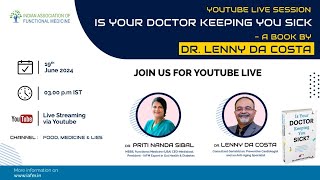
In a live YouTube interview, Dr. Priti Nanda Sibal hosts Dr. Lenny Da Costa, a geriatrician, preventive cardiologist and functional‑medicine practitioner, to discuss his book Is Your Doctor Keeping You Sick?. Dr. Da Costa explains why he wrote the book – to empower patients with the knowledge to question conventional medical advice and to adopt functional‑medicine and anti‑aging strategies. He critiques routine laboratory interpretation (e.g., fasting insulin, lipoprotein(a)), argues that many standard tests miss underlying physiology, and urges clinicians to order targeted markers. The conversation covers the role of supplements, the paradox of food as medicine versus food as poison, the importance of high‑quality fats and oils (ghee, cold‑pressed coconut, mustard, caution about commercial olive oil), and the five pillars of health (nutrition, hormone balance, detoxification, exercise, stress management). Dr. Da Costa describes hormone balancing, the true function of cholesterol, and why statins may accelerate ageing. Heavy‑metal exposure, chelation therapy, and the dangers of modern dairy and seed‑oil anti‑nutrients are also discussed. Throughout, the hosts stress patient‑centred empowerment – becoming the “CEO of one’s own health” – and encourage viewers to read the book and apply its functional‑medicine principles for disease prevention and healthy ageing.
Chapters
Do this in English.
Okay. Hi, welcome audience, and I'm very, very, very excited and thrilled to have Dr. Lenny on this live show today. Thank you, Dr. Lenny, for being here.
Great to be here, Dr. Preeti. Awesome, always awesome to chat with you.
Thank you. Uh, so Dr. Lenny Da Costa is a consultant geriatrician, preventive cardiologist, works on anti-aging principles, and uses functional medicine as his major tool. Dr. Da Costa is a member of a number of medical organizations and is currently the president of the Society for Regenerative Aesthetic and Anti-Aging Medicine India. And he's also the president of the Indian Society for the Study of Metal Toxicology and Chelation Therapy. I have not met a more passionate teacher than Dr. Lenny till date.
Thank you.
He loves teaching, and anybody who has learned anything from him would vouch, you know, with me on this, that he really gets so involved. He has this I think I can sense that feeling of giving and creating more people who can do the practice which he is doing. Thank you, Dr. Lenny, for teaching me and teaching so many more doctors to help more and more patients. Over the last 18 years, Dr. Lenny has helped more than 25,000 patients, and he has a clinic in Goa, in Mumbai, And he travels a lot and, you know, sees patients in Delhi and in Pune and few other places also. And today Dr. Lenny is here for a very, very, very specific reason. Dr. Lenny published a book, Is Your Doctor Keeping You Sick? I honestly felt that it will be Thank you, Dr. Lenny. I honestly felt that I would not do my work of sharing information and taking relevant, important information so that India can be a healthy country and the world can be a healthy country if we don't hear from Dr. Lenny. What is this book about? What motivated him to actually invest so many hours in writing this book? And what is it that he aims to achieve with this book. My very simple aim of today's discussion is whatever Dr. Lenny shares today motivates and inspires you to order this book on Amazon today, read it, share your reviews, and spread it to more and more and more people, because I think this is where Health in 2024 and henceforth in the coming years begins. Welcome, Dr. Lenny, and my first question to you is, how did this book come into being? What happened? Like this.
So, uh, there were 2, 3, 2, 3 things that happened when I decided on a book. One was, uh, every patient used to ask me, hey, hey, Doc, what's, what's this functional medicine all about? What is this anti-aging medicine? Uh, and, uh, you spend a lot of time telling people and explaining to them that there are concepts in medicine that actually work in a particular way, and you could get better health by doing things a little differently because It's not some mumbo-jumbo. It is not some witchcraft. It is— there is a lot of literature on it in modern medicine itself that these things do have to be corrected, and this is how disease shapes up. And so at every point, people had their own thoughts. They— there was a lot of confusion. Even today, you— I mean, I see a lot of heart patients. Just today, I, I got late coming on the show. Because I had 3 new cases that walked in absolutely confused about what they are supposed to do. Every cardiologist has given them a different idea. So at the end of the day, I said, why should that confusion be there in the mind of a patient? Why is it that all this power and all this knowledge should sit only in the hands of a doctor? Why shouldn't the patient be an informed patient to understand what's the problem that's affecting them and how is it that they can solve Do they have options other than what their doctor is telling them? So these are some of the questions that came to me, to my mind, when I decided to write this book. So this book basically is nothing but a comprehensive guide, and I've written it, it's my subheading, it's a comprehensive guide on how functional medicine and lifestyle changes can prevent chronic disease and keep you healthy. So that was the whole purpose on writing this book, is keeping the audience, whoever reads it Healthy. Now, there are lots of questions asked when it first came out, but I had sorted out many of those controversies in the first page itself. So the title itself, people ask me why the title, Is Your Doctor Keeping You Sick? And so my only purpose of writing this book and the title this way is that I wanted doctors to pick it up and read it. Because when they read it, even if one of them would use some of the concepts here, many of their patients would become better. So for me, it was more about the patient rather than selling the book, and therefore the title of the book as well.
Preeti, thank you, Dr. Lenny. And that's my reason of actually going to every little page and thing you've written in this book so that audience can also hear it from your mouth. So, Dr. Lenny, what I understand is you are saying here is that the starting point is the reports, the way the reports are interpreted today.
Correct. Yes.
Could you elaborate a little more how interpretation of reports by conventional doctors is different than what you are wanting to share in this book?
Okay, so let me explain a couple of things to you on what we do first as reports. One of the things that we ask you, let's say, is I'll give you 2 or 3 very specific tests that we ask for. One is obviously your lipoprotein(a), and the second one I'm going to talk to you about is Fasting insulin. Now again, coming back to the title of the book, Is Your Doctor Keeping You Sick? This also came from this one aspect that I used to see in my practice day in and day out. Large portions of my practice from 2004 onwards has been cardiodiabetic. That means people who have had heart disease and people who have got, uh, diabetes. And The one thing that I saw from every doctor is the first thing they give you when you're a diabetic is they give you a secretagogue. What is a secretagogue? It is increasing the insulin in your body. That's what most public thinks. I've got diabetes, my insulin is less, so I have to be given more insulin. But you have not even checked whether this patient has enough adequate insulin and is that patient insulin resistant? So a simple test like fasting insulin is never done before we start putting patients on medications. Even today, GPs do it, family physicians do it. They just put a patient on a glimepiride because it's the cheapest and it is— and it controls your sugar. Sugar comes down. So what, what happens beyond? Nobody looks at what's going to happen in the long run. Uh, the second one is Lipo-A. I'll give you another simple example. Every Cardiac patient is put on a statin. Now, a statin is actually bad or contraindicated for people with high Lp(a). What is Lp(a)? Lp(a) is a marker that tells you, hey, this patient is going to keep getting plaques whatever you do unless you lower the, the, the Lp(a). Lp(a) is 30 times more atherogenic than oxidized LDL, not normal LDL. We look at all the cholesterol levels, we never look at the, at the oxidized cholesterol. Of course, nobody does it in this country. It's done only in, in the US at the moment. Nobody does particle size. But if, if these things were done, you can narrow down on understanding what is it that's affecting your patient. We do generalized tests and we decide, okay, this is what we need to do. We try to fit, uh, the same size for everybody, and that's why people are suffering. I mean, people are suffering from heart disease. You do bypass surgeries, you do any kind of treatments, people do suffer. They come back with the same problem. Why? Why should they? If you— if this is a lifestyle disorder Modify the lifestyle. Yeah, God, have, have some, have some sense in doing that. It is common sense. You can't do the same thing the same way every time and expect a different result. And every patient is given that, and most of them come back. So nobody is looking at what is basically the problem in a patient's body. How does that body function? What is, what is wrong physiologically? And how can you correct that physiology? I mean, if we had to do that work, we as doctors are paid to do that, by the way. And we don't do it. We just follow certain, certain, certain recommendations put out by, again, groups of doctors. Whether they have ulterior motive or not, it's not for me to say. But as a doctor, it is my responsibility to know whether those, those guidelines that are given to me are going to be beneficial for my patient or not. When we don't do this, we are abdicating our responsibility, and that is not right. And that is the reason why I say it starts with understanding what your physiology is. And before you do that, before you understand that, please don't write or take medications without understanding why you are taking these medications or why you are giving them, even if it is supplements.
Great. So, um, Dr. Lenny, you've rightly said, I a lot of times wonder that For PCOD girls, gynecs now do fasting insulin. Yeah, but unfortunately for hypertensives, for diabetic patients, they don't do fasting insulin even now. They don't, right? And it is so— it's such a sorry state, I would say, because that one test can make a huge difference in diabetics and hypertensives and fatty liver and depression cases. In obesity cases, and so many more diseases. So thank you for putting that up so beautifully, Dr. Lenny. There's another thing you've mentioned in this book, which is right tests not being done in conventional medicine.
Correct.
Just like you explained Lipo-A Right. Do you think there is a reason? Is it just that they don't know about it, or do you think there is some reason that they are not doing it intentionally, unintentionally?
So I, I don't cast aspersions. Even in the book, I don't cast aspersions on anybody as to why they're not doing it. But certainly, I think every doctor wouldn't want to do a test where he doesn't have a solution for So let us say your Lp(a) is high, you don't know how to bring it down. What are you going to tell your patient? I don't know how this comes down. When you tell the patient that you are bad, this is high. So obviously the reason why people don't do the tests even though they are there is because they don't know what to do with it. Honestly, Preeti, I'll tell you, I'm a part of the Research Society of Diabetes. I was the chairman in the Goa Goa branch of theirs last— for the last year. I just, I just finished on 1st April. Uh, I was just going through some of their data which is coming out now. First paper has been published on a molecule they are working on today because they have understood how atherogenic lipoprotein is. And that paper I happened to read, and it— then that, and that, and that, uh, molecule is still not approved. It's still in Phase 2 and Phase 3 trials. Okay, first molecule, the first paper I'm reading on lipoprotein, it's not that modern medicine doesn't know about it, it's just that it doesn't talk about it because it doesn't know what to do with it. Same thing with homocysteine. Why, why don't people pick up homocysteine? Because they don't know what to do with it. If they give folic acid, homocysteine goes up because folic acid is not the answer to homocysteine. Folate is the answer to homocysteine, but the Problem is that a modern medicine doctor has not been taught nutrition at the biochemical level, or we study biochemistry in the first year and forget about it. I decided to just pursue it a little more and understand what it can do to, to my— and help me, how it can help me in my practice. I think other doctors should do the same. This is not some mumbo-jumbo, like I say, it's very commonsensical work.
And Dr. Lenny does a lot of courses, so if any doctor wants to do it It's easily available now. Education is available, and he's a great teacher. Dr. Lenny, the next thing in the book which you have spoken about, and which I think every day my patients come and say that to me, is supplements. Whenever they take our prescription to their doctor, obviously their allopathy doctor they trust more, who is still into conventional medicine practice, right? The doctor says, no, no, stop everything. And you have covered this very, very beautifully in your book. Could you elaborate why this happens? And do you think this is the way to go and this is helpful for the patients?
Okay, so, uh, one of the things I, I explained— so there's a little bit of background to this. One of the things you need to understand, and, and it's put in the book as well, is The way to restore good health has got 5 pillars to it. One is— the first one is nutrition. We eat a lot, but we are malnourished, and I'll come to how and why. Uh, balancing of hormones is the second. Detoxification, because we have so much of toxic stuff going in our food chain that we are permanently toxic with what we eat, with the air that we breathe, and the water that we drink. Then you have no exercise, so your body has to be a little strong and you need to work out a little bit. But at the end of the day, your body is the one that has been given for your survival. And if you say that you don't need its use, then the body starts slowly degenerating. So you need a little bit of exercise to keep that body taking care of itself, because at the end of the day, the body takes care of you. No, you can't take care of it. And, and so you need to only ensure that you do what you're supposed to do. And finally, you need to keep that mind calm. So coming to the first, first main pillar, and that's your nutrition. I always say you are what you eat, and, and this statement has been made by everyone whoever has something to say on nutrition. But today we eat so much and yet we are malnourished. Why do I say this? And therein comes why we need our supplements. Let's look at a very simple fact. Third standard geography. When we used to— when we were in the third standard, we were taught that the rivers originated from the hills or the mountains, and they came down to the plains and they recharge the plains. Recharge the plains with what? With minerals. So that the whatever we grew on the main plains would— the plants would take those minerals and absorb them and use them. And that is the mineral support, and that's the vitamin support that we get from the plants that, that grow in the plains. Now what have we done in, in all that, all our modernization and want for power? We have gone and dammed those rivers. When you dam those rivers, everything that comes from the source is sitting in those dams. It doesn't recharge the soil. So what your grandfather ate from the same field and what I'm eating, even though it's local, does not have the same nutritive content. And when you don't have that much of nutritive content, where are you going to get it from? Let's take the second example. You are eating the best fruits from across the world. The fruits get their nutrition or, or all their vitamins and minerals when the fruit is basically ripening. That means you can't pluck it before it is ripe. What do we do? We pluck fruits raw, we ship it across the oceans, and then when they come here, we put light or chemicals— sometimes it is worse— to ripen them. Where is the nutrition in those fruits? Other than you getting fructose and getting a little bit of sugar high, you're not getting anything more. And that adds to your high fructose, which causes, uh, your liver function problems, that non-alcoholic liver disease. But if you had to have a local fruit, even if it has got less, you have far more nutrition in there, which we don't do. And so when you don't get this nutrition in the food that you eat, how else do you get it? You need to take tablets, you need to take capsules, you need to take extracts so that you get what you need to get in your body. and then the body absorbs what it needs to absorb and uses it. What it doesn't need, it will throw out. And so you have to let the body do what it does best. So when you look at, at even supplements, you need to use natural kind of supplements. What I mean by natural supplements— supplements that occur naturally in, in, in, in, in, uh, plants can be Yeah, if they occur in plants and all that. Something is wrong with my— yeah, so that is what happens. And therefore you need to generally have supplements 24/7 or supplement your food with that. Can I shift, or should I shift on my phone?
No, it's fine, Dr. Lenny. We are not seeing any—
somehow my thing is not recharging. I don't know what's happening. Okay, let's carry on till we go on.
Okay, so Dr. Lenny, this is one part of the question you have answered. Yeah, the second part is still pending. Why does this happen that when the supplement prescription lands with a conventional medicine doctor who has not upgraded his knowledge? Yeah, they immediately say no, no, stop everything else, you will die. Means I have had some patients come back to me and even give me this statement that our doctor has said you will die if you continue with these supplements.
And you are— that's nonsense.
That's very beautiful.
Yeah, that's nonsense. That's, that's because he or she doesn't know what they're talking about, right?
So I think what you have in your book written very beautifully is that this is because of their own fear. They don't know what supplements, right? And because of their fear, they actually tell the patients not to take it, in fact, and become a roadblock in their patient's recovery, I would say.
Yes, yes, that's a fact.
Great.
That's a fact. Yeah.
Dr. Lenny, next you're talking about aging and chronic disease. The way functional medicine looks at it. What are your thoughts on aging, and what is it in this book you are trying to share with the audience on aging and chronic disease? How is it— how— which lens do you want us to look at it? Sorry guys, I think Dr. Lenny's laptop was not charging. He will be back in a minute, so please stay with us. And till then, uh, let me talk about few things which Dr. Lenny has touched. Uh, you know, there was a recent study which shared that spinach 30 years back had 3 times more nutrition, simply, you know, nutrition like magnesium in it, than what it has today. And on the other side, we now have data and studies, and, you know, common sense also tells us that because of the stressful environment in which we are living in, right, the absorption has decreased. So one side, you are getting less nutrition. Second side, the absorption of nutrition from that food in your body is declining. The sum total is, despite the fact we are eating so much, we are becoming malnourished, right? And I always talk about nutrition as, you know, the wheel of a cycle or a car. In a cycle wheel, we have multiple spokes. If all those spokes are not fitted well, you will not be able to ride the cycle at the speed you want to, right? These spokes are the vitamins and the minerals which our body requires to function. Like Dr. Lenny said, I can't take care of my body, my body is the one who needs to take care of me, right? And I think no other words you know, could have summed it more beautifully than this line. Dr. Lenny is back. Great, happy to have you back, Dr. Lenny.
Yeah, tell me, can you hear me?
Yes, we can hear you. And Dr. Lenny, your thoughts on aging and chronic diseases?
So when you look at aging per se, What is aging? First, what is aging? Aging is when your body stops functioning the way you want. So today we are looking at a 40-year-old going to live to be 80. At 40, he's a hypertensive. Is that aging? Why not? Why isn't it aging? It's premature aging. For the next, for the next, uh 40 years of your life, which is a major part of your life. How would you not— how would you live a normal life just taking medications? So the idea is you live as long as you live with the right kind of nutrition, with the proper sleep, with your body being able to do what it does without troubling you and without causing any kind of degenerative diseases in your body. What happens when you exercise regularly, sleep well, eat right, detoxify, manage your hormones well, is that your body age— even though your chronological age is 60, your body age might be 40. That's possible today, and that's what we have been doing when we say anti-aging or, or stopping your chronic degenerative disorders, or what functional medicine aims at doing. But what has— what, what we end up doing a number of times with most of the patients is, because the patients come late to us, that is when the problem starts. They come when they are absolutely sick. And when you are sick, the first thing you need to do is sort out the issues that you have because of your— because of your problems that you have, the disease that you have. Let's say you've got diabetes. I can't possibly shift you to good health without first trying to get your diabetes controlled or then reversed. Or if you have got heart disease, I can't get you to a normal physiological workload on your body if I don't first handle your heart. But if we had to do this from the age of 30, 35 and check ourselves instead of doing some routine bullshit tests that we do which tells us nothing, if we had to do the right kind of tests and see for ourselves whether we are having problems moving forward, whether this chronic degeneration can set in much before we go— we actually get sick. And that's possible, Dr. Preeti. Today you can actually predict a patient who's going to get diabetes in the next 2 to 5 years. You can predict somebody who's going to get heart disease in 2 to 5 years, and you can prevent that. That is anti-aging. Preventing disease is anti-aging. Preventing the fact that you are not, uh, saying that this is a part of, you know, aging, or because I'm 50 now I'll get hypertension and accept it— that's being stupid. That's, that's like saying, hey, listen, the car is coming on the road, I might as well say I'm standing anyway in the middle, I can't walk, let the car run over me. That's being stupid. You have to make an effort to ensure that you live your life at the best way possible, in the most healthy way possible.
Great. So Dr. Lenny, on this I want to share something. When we— you just said that, you know, we can know 2 to 5 years, or even maybe before that, that a person might become a diabetic soon, right?
Yeah.
When we tell this to our patients, and when that the patient goes to a conventional medicine doctor Patient comes back, at least they come back to me and say, Doc, you, you were just scaring us. Our doctor has said nothing is wrong with you. You do what you're doing and be fine.
So that's, that's the reason why I wrote the book, Is Your Doctor Keeping You Sick?
So I don't know then what to do. What did they say to that patient?
Yeah, no. So I tell my patients something like this: you go to a doctor when you get sick. You don't go to a doctor when you're not sick. So don't go and— the doctor is, the doctor is capable and, and very well trained to take care of you when you are sick. So go to him when you're sick. You don't want to get sick, go to somebody who's helping you to have not to get sick. How can you go to somebody who's helping you only when you get sick to ask him whether you are— how can I not get sick? Is he going to tell you don't get sick so that I, uh, so that he doesn't have any more patients to come by? If he was going to tell you how to not get sick, he wouldn't have become a doctor. His job is to treat sick people. Why would he tell you not to get sick? So it's like, you know, going to a cobbler and asking him how to cook a, uh, a biryani. I mean, that is the problem that that, that exists over here. That is what patients don't understand. It's only when you put this analogy towards them they understand.
Exactly, Dr. Lenny, and you've said it so beautifully. So what with your statement I have interpreted is, and I want to tell all the viewers, is onus is not on the doctor. We need to become the CEO of our own health. We need to understand our health the way we understand our bank balance.
Absolutely.
And we need to make right choices of if we are sick, we go to a doctor who treats sick people. And when we are not sick and we are, you know, healthy and we want to stay healthy, then we go to a doctor who makes sure that we don't fall sick.
Absolutely.
Great. Another very, very interesting thing, Dr. Lenny, you've written in your book, and Though I knew it, but every time I read it, something happens, you know. I get those goosebumps. Rakul, Andy is thinking which is this thing which, you know, Preeti is getting goosebumps on. There are a lot of them, but this one is really key, and I'm sure viewers will love it. So I will want you to elaborate a little more on this. And what is this is we all know food is medicine. But we generally forget or miss that food is today poison also. Yes, you have said it so beautifully. So can you elaborate for the viewers on food is medicine and food is poison? What is it? One, what do you mean by this? And second, what is it that they can do so that food is medicine for them?
Okay, so the unfortunate part is today, uh, I, I put it in various ways, but I think the most, uh, easiest way to understand is what we get, uh, in the form of food today. So let's, let's understand, uh, the basic vegetables, okay? And I'll elaborate this by telling you a story that happened with a patient of mine in Surat. This was about 10 years ago, or maybe 12 years ago. I used to visit Surat those days, and I had this elderly-looking gentleman, very distinguished, walked into me and he said, Doc, you know what, I've been told that I have got a triple vessel disease. He says, I don't smoke, I don't drink, I don't eat non-veg, I'm a pure Jain, so I eat only vegetarian, I eat only vegetables. I'm a vegetarian, I'm a pure Jain, and I don't even eat, uh, food that grows under the ground. So why is it that I got this disease? And so I turn on, and he says, I walk every day, I exercise every day. For him, walk was an exercise. For me, walk is not an exercise in any way, right? So I turned out and told him, I said— and when he told me, he says, I'm a vegetarian— I said, God help you, because, because you're a vegetarian, you've gotten sick. Now, is that something against vegetarianism? No. You need to understand a little beyond that. You're free to eat what you want, but you need to understand what is coming in that food for you. Today we are growing a lot of our vegetables on commercial farms. When we put our fertilizers and, and, and, uh, and pesticides on top of them, a plant absorbs all of it like it absorbs the nutrients from the soil. Now when you absorb all of this, where does it go? It gets into your body. This is not supposed to get into your body. Now here your food becomes your poison because it is these heavy metals and other toxic stuff that gets into your body that harms you. This food could have been, been medicine for you, but it isn't because If you really want to do great medicine from the food, you have to eat food rich in minerals, but you're not getting that. You're getting food rich in toxins. That's why food can become a poison for you. Let's look at red meats. People talk about red meats being bad. How do we make red meats bad? By making the animals that from where we get our red meats eat the wrong food. So in the West, you have something known as CAFO, which I've explained in the book. What is the meaning of CAFO? These are commercial operations that they do. So as to fatten those animals, they, instead of feeding them, uh, normal herbivorous stuff like veggies and things like that, they are given corn to eat. So the entire EPA/DHA, uh, sorry, omega-3, omega-6 ratio in their, in their, in their body changes, and their muscle changes to a more inflammatory thing. So while A grass-fed animal becomes good for you. A commercially done, uh, red web, uh, animal becomes bad for you. So red meat itself can be good as well as bad depending on where it originates. Vegetables organically grown can be, or can be medicine for you, whereas when you're getting them from your commercial mandis, it's— it can be poison for you. Chicken today, the chicken that you get in the market is no chicken at all. You should not be eating the chicken at all. Why? Because it's full of, full of, uh, hormones. What you should be eating is free-range chicken, which is good for you, which, which is basically, uh, can help you a lot. And it's like medicine for you. You get your protein supplementation from that, so many other things from there. If you are a pure vegan vegetarian, you need to get fruits that grow from organic sources, because otherwise you are going to be completely bereft of good nutrition. Absolutely. Absolutely. So food is your poison as well because of the source that you get it in. And finally, today we are eating— let's look at wheat. What, what wheat are we eating today? The wheat was also eaten prior, maybe 50, 60, 70 years ago, or maybe 100 years ago. Then it didn't affect us as much as it's affecting us today. Why is it affecting us today? Because the wheat that we are eating today is chemically modified in '60s. Now it has affected all the varieties of wheat across the world. And so that becomes a poison for us. Uh, the other thing I always tell my patients today is, guys, all of us drive cars. Maybe we have a petrol car. We can't take it to the, to the station, and I mean the gas station, and put diesel in it, can we? But we have absolutely no qualms about doing it with our body. We were hunter-gatherers. We used to eat foraged food, hunted food. We have suddenly become grain eaters 10,000 years ago. Why wouldn't our bodies start firing back at you? So food can be good for you, it can be medicine for you when you eat it right and you get it sourced from the right sources. It can be bad for you, it can be a poison for you depending on where your source of food is, especially when it comes from commercial sources, especially when it is processed, especially when you have, uh, too much of toxic stuff getting into your food chain.
Great. Um, thank you, Dr. Lenny. Dr. Lenny, you have also spoken about fats. A lot of myths about fat. And why I'm bringing this up so early in our conversation is because today itself a patient had booked a consultation, and then when he went on my site and saw Cyclic Keto is the book I've written, right, he canceled his consultation because he said I am very scared of fat, and then Dr. Preeti will tell me to have fat, right? And he is a diabetic, and that's— that was what he has booked his consultation for. So I thought, let me hear it from a horse's mouth, you know. Uh, one of the very first few doctors who started practicing functional medicine, and, uh, you know, you've covered it in your book very beautifully. So what are your thoughts on use of fat? And what oils do you recommend that people use?
Okay, so the first thing you need to understand about fat is you don't have fat, some of the most important vitamins in your body don't get absorbed. Please understand this. Vitamin D, vitamin D is a prohormone. Without vitamin D, you are going to get sick. You are going to have diabetes, you are going to have your immune system going haywire. In fact, during COVID vitamin D was one of the biggest supplements that we used to kind of save patients from dying. And you know that, Dr. Preeti. But if you don't have enough fat in your food, it's not going to get absorbed. So there was a doctor, I mean, who wrote about going completely fat-free, and that's when he realized that it doesn't work. Uh, and, uh, yes, you may get some benefit because the fat that you get around you is bad, but you need to have good fat. And ideally, the day you just reduce the amount of carbs that you eat, you should have fat to replace it. So what happens when you eat carbs, which is glucose that you— that our body needs, our brain needs it, our body needs it for energy, It is like a dirty carburetor that you get. It's a carburetor-based engine, you know. It's that combustion engine which creates a lot of dirt around it, a lot of toxic waste around it. Whereas the moment you switch to a kind of a high-fat diet, your entire body switches to being an electric machine with no dirt around it. And the, and the amount of energy that you get is pretty high. You'd never— if you are on a high-fat diet, you will never, never, never get cerebral degeneration. You will never get Alzheimer's or Parkinson's. This is one thing that you can be guaranteed. Thank you. You can be guaranteed about this one. Now, how do you eat fat? So the best— we live in India, and I think I have to first talk about what is available to us locally. Traditionally, we make the best ghee, homemade ghee. Homemade ghee is the best thing that you can have for yourself. It takes care of your gut, it takes care of a whole lot of the fat requirement that you have. And if you notice, a good old eating, even if you had to have the dal and all that, people used to throw a lot of good homemade ghee on top of it. Why? Dal has protein. You add ghee to it, you feel full, you don't want to eat too much of rice or roti. That would keep them very healthy. Every old person— I still remember my a diabetologist friend of mine, years ago when he came and my dad was alive and he was— he came to see my dad for some other thing. We were having lunch at home and he said, my grandfather, my father and my grandfather are telling me that you will die before we, even though we eat a lot of ghee and you, you are so healthy with all the new oils that you are eating. That gentleman actually did pass away before his father passed away. So these are facts for you, and this is anecdotal, but I'm just telling you. Now, what are the good oils that you eat? One, of course, is homemade tea. The other is local cold-pressed oils. Uh, the best, of course, is— because I live on the West Coast, I know what the benefits of coconut oil are. So you can have pure coconut oil, which is cold-pressed. And for those who love to drink it and put it in their coffee to increase their, their energy levels, please use virgin coconut oil. It's beautiful. It doesn't harm you. You can eat as much of it as possible. For the others who don't like the taste of coconut, they may not get it. Let's say you are in North India, you get beautiful cold-pressed mustard oil which can be used. You use any local cold-pressed oil. The only problem with these oils is they are dirty looking. And so when they're dirty looking, people don't like them. They like the nice shiny ones. But all that shines is not gold, and all that shines is not good as well. And so My request to every patient of mine: when you go to the supermarket, if you pick up any of those oils on the supermarket shelf, you're going to kill yourself with it. So get locally pressed coconut oil, locally pressed oils. And the way you know whether the fat is good for you, the oil is good for you— take the oil that you buy, put it in a big container, a wide-mouthed container, and put it in the fridge. If it hardens Eat it. If it doesn't harden, throw it out. That's the best way to know whether the oil is good for you or not. The olive oil in this country— everybody has turned to olive oil. Please understand something, and this is what I tell every patient who asks me this: how many countries in the, in the world grow olives that make olive oil? What is the land mass of those countries? The land mass is smaller than our state of Maharashtra.
Dr. Lenny, we had lost you in between. We have lost Dr. Lenny at a very, very, very vital point. I think oils make a huge difference. I also want to add here that, you know, homemade desi ghee, which Dr. Lenny was talking about, it's an excellent probiotic. After we do colon hydrotherapy for patients, one thing which they are forced to have is desi ghee on that day and the next day. So choosing your oils right is a sure shot and a smart way of staying healthy and not falling sick. Right, I think Dr. Lenny is back. Dr. Lenny, you are muted. Thank you. And we can't see you. Anybody, if you have any questions, till the time Dr. Lenny is joining, maybe I can take your questions if you have any. And please don't log out because more interesting stuff is yet to come. I think he has written such a beautiful book which, you know, is power-packed with the things which you will feel really goosebumps in your stomach when you will get to know it. And you will also make some very, very vital, important decisions for your health. So just be a little patient. And yes, if you have any questions, please post them. I will answer them for you for a while. How many of you actually think that it is possible to not fall sick? Hi, Renu, how are you doing? Renu, it is very personalized. Your body actually tells you how much fat you can eat. Welcome back, Dr. Lenny.
Yeah, yeah, sorry about this today because I'm, I'm My system doesn't seem to be giving proper, uh, support to me today. Anyway, uh, so I was telling you about olive oil. Let me finish that one tip on olive oil. So if you are, if you are not in a position to grow that much of olives to supply for the whole world, where is the olive oil that we are getting? And at the cost of being, uh, am I there?
Yeah, yeah, I agree with that.
I say it very often, is 90% of the olive oil that we get in this country is questionable. A friend of mine did tell me that he used to export the largest amount of palm oil from Malaysia to India because they would then put an olive oil essence and make it olive oil in India. I'm sorry, but that is some of the things that we are hearing. How true it is, how factual it is, I don't know. I don't think any of us should take the risk in actually using that olive oil at all.
Great. Yes, Dr. Lenny, there is a question from Amit Jain. Is RO water depleting nutrients from our body?
Absolutely not. This is another crappy thing that people tell you. RO water gets rid of some of the some of the, uh, some of the, what do you call it, the heavy metals that you have in your water. And so it detoxifies your water and gives you proper, good, clean drinking water.
Great. Uh, Dr. Lenny, the another thing you've covered very beautifully in your book is hormone balancing. But even before I tell you to talk about hormones, what I want you also to address is The moment you tell people that you need hormone balancing, they get scared and worried. Yes, right. And then when I tell them that people have been taking thyroid for, you know, from the time they become hypothyroid till the day they die, and that's also a hormone, and people are like, oh, I didn't think of that as a hormone, right? So a little about hormones and then why hormone balancing is such an important topic that you have covered it as a separate chapter in your book.
Yeah, so, uh, like you said, as far as thyroid is concerned, a lot of us don't even understand a lot about thyroid. Okay, a little in that thyroid part of it, uh, we all look at it, and all of us doctors look at TSH and tell you whether you are hypothyroid or not. That is the worst way to do it. That's when you are really, really sick because your thyroid hormone is not working. The earliest thing you have to look at is very many other tests like FT3, which will tell you whether your thyroid is functional. And it is— even though its levels are normal, is it functional? We don't look at it at all, but, but it's something that you need to look at. Now, why hormones are so important? What are hormones? Hormones are simply the chemical trans— uh, substances that actually control a lot of what your body does. And so if your hormones start declining, you are going to get old fast. And it's that simple. It's that simple. So you don't want to get old fast. Ensure that your hormones are balanced. So if you're— let's look at thyroid. If your thyroid starts going down, you are going to get old faster. Why? Because you're not in a position to do the work that you would have done normally. Your body is not in a position to do the thing that it's supposed to have done normally. Let's look at insulin going down. You become a diabetic, right? So as your hormones— your testosterone starts going down, you get heart disease, you get, uh, you start losing your skeletal strength. And so that confidence of a male goes down. In females, when their estrogen and progesterone start going down, you start getting all the chronic degenerative disorders including hypertension, heart disease, diabetes, which normally if your hormones were good, your body would not have gone through. You are protected. So the moment you start— your hormones start declining at 35, 40, you start getting exposed to this. You balance it out properly, your mood is great. You are feeling good, you can do what you want to do, and you don't have disease. What more do you want, right?
And Dr. Lenny, what I generally tell these people is whatever your body is making naturally is a clear sign that your body needs it for proper functioning.
Yeah, because when there's no insulin, we give insulin.
When there's no time, your job is fine to find a good source And a good doctor. Yes, because that becomes very important, especially because of so many products available in the market.
Absolutely.
Great. Uh, Dr. Lenny, another thing which I think people are not aware of, and you have covered in your book remarkably well, is cholesterol.
Oh yeah, so cholesterol It's something that I talk about quite a bit to every patient of mine because one of the stupidest tests that all of us do is what the cholesterol lipid profile that we do. It is one of the stupidest. It shows— it tells you nothing, and they think it tells you everything, right? It tells you nothing. Now, to understand cholesterol, you need to understand that first and foremost, cholesterol is made in your liver. The liver doesn't make anything for you which is harmful. It is made there to regenerate you. Why to regenerate you? Every cell in your body has got a cell wall. The cell wall has got cholesterol in it. If the cell is damaged, it has to repair itself. What will it repair itself with? With cholesterol. So when the liver makes that cholesterol, it has to transport it in water. Now cholesterol is fat. It has to transport it in a water medium, which is blood, to a place where it is required to be used to repair your body. So it goes on a truck, and that truck is called LDL. So it's just a transport medium. Your lipoprotein, little LDL, low-density lipoprotein, is just a truck to take your cholesterol to the site. It will not enter the site unless there is a signal that the cell needs it to repair itself. Then it goes there. If it is not used, it then shifts on to another truck, and this shifting is done in the presence of phosphatidylcholine. And, and once it is shifted on to another truck, that truck brings it back to the liver. That is HDL, basically a transport lipoprotein that brings it back to the liver. And in the liver, this cholesterol then gets converted to bile acid, bile salts, and most importantly, Dr. Preeti, it gets converted to important sex hormones.
Exactly.
So the day you start taking anti-cholesterol medications, you are actually paying your doctor and your pharmacy to prescribe a drug that will make you old fast.
Cholesterol is not the culprit, which will also make you diabetic, which, which will also impact your mental health.
Yes, it does.
Just by managing Yeah, just by managing LDL, HDL, and triglycerides in young children, I've helped so many people who had anxiety issues.
Absolutely. So now what you need to do basically is ensure that your LDL does not get oxidized. How do you do this? By removing— reducing the oxidative stress in the body. You reduce the toxic levels of all the toxic metals in your body. You reduce the oxidative stress that you normally would do going out and, and, and, you know, being in areas which is highly polluted, which are getting a lot of toxic stress. Cut that out, and then, then you will see that your LDL doesn't get oxidized. Food provides only 20%. So cutting down— they're saying that the food is responsible for your high cholesterol. No. If your LDL is required, it will go up irrespective—
exactly, yeah.
So, Dr. Lenny, what gets converted into cholesterol? The food that gets converted into cholesterol is nothing but your carbohydrates. It is not the fats, for God's sake. And everybody thinks, I stop fat, I stop non-veg, my cholesterol will go down. Bullshit. You stop your wheat, you stop your rice, your cholesterol may come down, your triglycerides may come down. But if your body requires the LDL, the liver will make the LDL any which way.
Because your digestion— Dr. Lenny, sorry, improve your digestion and your all cholesterol parameters will improve.
Absolutely, absolutely. Because you will never have— see, if your body is functioning in sync, why will the liver make extra cholesterol? And then one thing that I always tell people, I said, if you're— let's say your LDL is high, your total cholesterol is high, but your HDL is also high, don't touch that cholesterol level.
Exactly.
There's a body repair going on because your HDL also is high, so the mechanism is working. But if your HDL is low and the LDL is high, now know that the LDL is getting oxidized. Reduce the oxidative stress.
Perfect. And Dr. Lenny, I think for more people will have to read this book because this has so much vital information. I will share with all of you the link. But before we allow Dr. Lenny to log out, his favorite topic which we have not touched— chelation and heavy metals. What is the havoc they are creating in today's health scenario? And why is this something which everybody should look into if we want to live healthy?
Yeah, so Dr. Preeti, like I said right at the beginning, one of the things that gets into your food is heavy metals. And whether we like it or not, if you are in Delhi, you stand outside on the road for, for 10 minutes, you don't need more than that, you would have, you would have got cadmium that comes in from 2 cigarettes 2 cigarettes that you smoke. So you may be a non-smoker, but you are, you are, you are with cadmium in you. What does cadmium do? It actually causes both hypothyroidism and diabetes.
Exactly.
And, and it is— and it causes strokes and heart disease. We have lead in our food, we have lead on our walls, everything gets into us. We had leaded petrol, air was full of it. We still have those problems that are happening because the air is polluted. Polluted. All of this gets into your body. Now, many people ask me, but Doc, my brother and I live in the same house, we have the same food, we have the same air. Why doesn't he have heart disease? Why do I have heart disease? Now, for this, I need to go a little beyond and tell you that every body, every cell— sorry, every human body is made a little differently. We have a little— we have a different genetic makeup for everyone, including two identical twins. Now, Some of us may have SNPs, or single nucleotide polymorphism, which is basically a, a, a gene that has kind of mutated, uh, which will show certain disease in certain people and may not show in another person. But this gene will not work on its own. It needs what is called an epigenetic factor. And what is that epigenetic factor? It is your environment. And what is the environment? It's all these toxic metals that are getting in. So some people, in the— when those toxic metals get in, will show disease faster than another person. So you can't compare yourself to the other. So the one sure thing you need to do for yourself is to reduce all the toxic metals in your body. Why? Because the toxic metals stop your normal biochemical reactions from happening, and that's what makes you sick. It goes and sits in areas where your normal minerals will sit and knocks it off. Like for example, T4 conversion to T3 doesn't happen, but your T4 is high, your TSH is high, your endocrinologist says, hey, nothing is wrong with you, why is this doctor asking you to— saying that your thyroid is not working properly? It's because of the heavy metals, it's not working properly. Detoxify yourself, you'll start losing weight. One of the first signs that you're putting on weight is your metabolism is sluggish. Your metabolism is sluggish because you have got toxic heavy metals in your body, and you need to look at that very, very, very seriously. So chelation is the only way. I mean, that's a no-brainer. How do you remove metals from any part, whether it's your body or for anything? It is by way of chelation. You just remove the chelation, you remove the heavy metal out, let the body heal itself. It does its job. It knows how to do the job. All you need to do is get the trash out, and chelation does that.
Definitely, Dr. Lenny. I did it for myself, and I have been able to, you know, stop my hypothyroid medicine from 150 mcg and now to no medicine after chelation. So I now from experience can say that yes, it is very, very powerful. Everybody should do it, and thank you for training me on that. Thank you.
Pleasure, Doc. Pleasure.
Thank you, Dr. Lenny. 2-3 quick questions we have before I say bye. Uh, is the quality of milk available today affect hormones? Sorry, is the quality of milk available today affect our hormones?
So first and foremost, I don't, uh, ask— allow any of my patients to have any milk. Good, right? The milk— first, why would you drink milk of another animal? Cow milk is meant for the calf. The cow himself or herself doesn't drink it. It's meant for the calf, the young one of a cow. So you should not be having any dairy. That is one. Secondly, today a cow gives milk, 25-30 liters of milk. That's not humanly possible. I mean, that's not possible for a cow as well because naturally they would give about 4 to 6 liters maximum. And so if they're giving so much, it is because there are a lot of hormones and that are put in there which get into you. So as a woman, as a young kid, especially young girl, you get what is called as misoestrogens when you're not supposed to get them. This is probably one of the reasons why there is a large quantity, a large number of PCOD cases that we see in age groups of 15, 16, 17, 18, very early in life. And that is where you need to be careful about having milk. And finally, milk gives you nothing. It gives you no nutrition. It leaches your calcium. It doesn't give you calcium. People come and say, where am I calcium coming from if I stop this? The— this—
exactly, exactly.
You don't need milk. Milk leaches your calcium. It reduces the amount of calcium that you have.
Great. The next question we have is, what about anti-nutrients from cold-pressed seed oils? Sorry, what about anti-nutrients from cold-pressed seed oils? From cold-pressed seed oils?
Uh, so if you're using seed oils, first and foremost, they have to be cold-pressed. I don't have a problem if you have them. I don't have an issue if you have them, but I don't know how effective they are when it comes to detoxification.
Yeah, they are not effective, and better avoid them if you are on any health journey.
Yeah, so I wouldn't— I don't normally advise them, so I, I wouldn't, uh, I wouldn't comment too much on that.
Perfect. Thank you, Dr. Lenny, for your time today and for sharing so generously what you've in the book. But let me tell all the viewers, we have not even covered 1% of what Dr. Lenny has shared in the book, from keto to modified keto to whether you should eat fish or not and why full whole egg and not only the egg white, and so many other things. So click on the link which we will share very soon, order your copy, and share your reviews. And before I end, Dr. Sibia from Lydiana has shared a study which I was also wanting to share it, which has recently come. Even newborns in Delhi and Gurgaon are smoking 15 to 20 cigarettes a day due to pollution, says Dr. Arvind Kumar from AIIMS.
I rest my case.
15 to 20 for newborns. So, Dr. Lenny, we have actually advanced a lot.
Yeah, yeah, we do. People are now looking, sitting up and looking at what we were saying for the last 20 years.
Exactly. And thank you for this book. Thank you for your time today. Thank you for being a mentor and teacher to so many doctors like myself. And pleasure to have you on this show.
Thank you, Preeti, for hosting me. My apologies that my tech kept affecting me. It normally doesn't happen, but I don't know what's wrong with my system today. My my apologies. We had to log in and log out twice. So sorry.
Thank you.
Thanks. Thanks for hosting me, and see you soon.
Yes, see you soon. Thank you.
More from Dr


Understanding Chronic Acidity: A Holistic Approach to Better Digestive Health 🌿


BHRT - transformational health journey if a 42 year old women #BHRT #HormoneBalance




Transform Your Health Naturally with Functional Medicine | Dr. Priti Nanda’s Success Story


hypothyroidism and ozone therapy - talk at Ozone Conference by Dr Priti Nanda Sibal
