No "IF" No "But" ONLY GUT - GUTSY Punjab - Happy Punjab
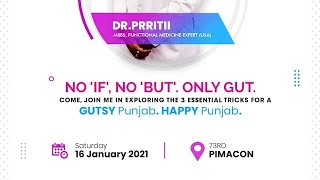
Dr. Preeti Nanda Sibal explains how gut health shapes mood, immunity, and hormone balance, and how dysbiosis drives diabetes, autoimmune disease, and mental health disorders. She outlines the 5R framework to restore gut bacteria: Remove, Replace, Repair, Repopulate, Reinoculate. Simple habits like chewing and stress management rebuild microbial diversity.
Chapters
Hi, very, very good afternoon to the chilly cold day. And the topic which I am going to talk today is Gatsi Punjab, Healthy Punjab, right? So what does that actually mean? Gutsy Punjab, Healthy Punjab. Basically what it means is that if our guts are healthy, we will be healthy and happy. So what is gut? But before I tell you about that, let me tell you something about myself. I'm Dr. Preeti, health and fitness wellness freak. I practice functional medicine and I'm an alumni of prestigious Medical College Amritsar, and I am Lucknow graduate and a certified executive coach. Why have I chosen this topic today? Simple reason I have chosen this topic today is that I run lot of programs which are group programs and one-to-one programs where We change lifestyle and help people reverse their diseases like diabetes, hypertension, adrenal fatigue, gut problems, obesity, and help women balance their hormones in our Become a Superwoman program, or boost immunity. And one thing which I find very, very common in all these programs is that Gut. If we can heal the gut, that is the gastrointestinal system, that is from our mouth to our anus, if this system is working fine, then all these diseases get reversed and we live a healthy and happy life. And that's the reason my topic today is Gutsy Punjab, Happy Punjab. So let's see some of the facts which I think The more I read them, the more I'll understand them, the more prominent they become. So no if, no but, only gut. Gut is our second brain and it controls our brain also, and therefore I actually mean it, no if, no but. Only gut. If our gut microbiota is healthy, what is it a sign of? It's a sign of a healthy life. And how many of us listening to me right now want a healthy life? Say yes in the comment section if you want to be healthy. I want to be healthy, so I have my yes there. Look at this, some million people and the type of crowd we see. Yes, but look at our gut, 5 trillion microbiome in one human body. So you can now multiply and see this image is, you know, how big the microbiome is currently present in this image. Wow, right? I actually keep saying wow every time I learn a new thing about my body. And I think that's the beauty of being a doctor, and that's the beauty of working in the space of lifestyle, where really new truths keep unfolding every day because everybody is different. And therefore everybody behaves differently. Exactly, that's what we see. There is no one recipe or no one key to the lifestyle log of every human being, huh? Which basic rules— but that is not what I call your personalized lifestyle. We all know our genetics are different, and likewise, our lifestyles which we should live are different, and we have to customize it. And in my practice, what I've done is I have actually defined it in a form of a dress. So you create your own dress which suits your situation at this point of time, which suits what is your age, what is the type of people you're living at, how— what are your responsibilities, and accordingly you design your dress. Can you visualize something? Is something coming to your mind? Yes, something is coming to my mind. My dresses were different when I was a child. My dresses were different when I was in college. My dresses are different now. My dress is different when I'm in the hospital. My dress is different when I'm at home. And therefore, the lifestyles have to keep changing. And what do we always have to remember? We always have to remember that we have 5 trillion microbiomes. So, hamare itne guest hai mein ghar mein, aur in sab guest ko ham ko happy rakna hai agar ham happy rena toh. Yes, I am sure you can now relate to some situations, some weddings, some birthday parties, birth of a new one in the house, and lot of such things. Where you know how you have to keep balancing your ifs and buts so that everybody who comes to your house stays happy and goes back happy, right? So this scientist and a doctor, Dennis Burkitt, once said America is a constipated nation. But he went ahead and said if you pass small stools You have to have large hospitals. And doctors and friends, I promise you, we are passing small stools these days, and that is the reason we require larger hospitals now. Now, this is a very busy slide, and I'm sure you would think, what is it all about? I will take you through some very, very important points from this slide. If you look at this normal physiology, this is the first half where it is physiological programming and energy, which is defined by the microbiome of your gut. How many of you want to feel energetic? Me, right? I think everybody does. And interestingly, our genome or microbiota starts developing the day a zygote is made. Most of the microbiome passes from the mother to the baby, and microbiota to infant signaling happens during delivery, during breastfeeding, and through epigenetics. And adult signaling also happens through these three same parameters. What happens after this? We get exposed to antibiotics, dietary changes, drugs, disease, injury, surgery, and stress. And of course, our immune system gets compromised. Endocannabinoids change, hormones change, bile acids change, short-chain fatty acids, which are so, so, so very critical to our health, decrease at times. Biogenic amines and xenometabolites, all these are influenced. And they affect the composition and activity of our body. And this leads to abnormal microbial development, leading to dysbiosis, resulting in disease—H. pylori infection. And this further leads to worsening of the vagus nerve. And we all know what is vagus nerve. It is our gut and brain connection, right? And this connection is what keeps our parasympathetic and sympathetic tone in balance. And all this is affected by our gut microbiome. This is a slide by J.K. Nicholson published in a journal in 2012, and I acknowledge his work because I think This one picture summarizes it all, from how we start and where do we land up in our life, especially when it comes to gut health and lifestyle diseases. Friends, this is all— not all. Arizona State University, Dr. D.O. Wook Kang, he studied that autistic children have Prevotella, Coprococcus, and Venelocci less than what they should have. And the moment you increase these strains in their gut, their symptoms of autism starts decreasing and kids start behaving much more normal, like a normal child. Wow, this really motivates me to change my lifestyle and change my gut microbiome. I am sure you know these facts. But at the cost of repetition, I want to repeat them. Almost twice as many women suffer from digestive health issues on a weekly basis compared to men. And I think this is the reason why almost 3— 67% or maybe 80% women have autoimmune diseases and men do not have autoimmune diseases. 62% of people worldwide suffer from digestive complaints such as constipation, indigestion, or diarrhea at least once per year. 95% of serotonin, a major mood enhancer— we all know it, we all want it, and we all love it— is produced in our gut. And 70% of our immune system is in our gut, and therefore it is important that we have a healthy gut. And that's the reason my topic for today is gutsy Punjab and hence happy Punjab. So let's see what happens if our guts are unhealthy, or if we have taken antibiotics, or stress in our lives. These are the normal tight junctions. We've been reading about them for years. Pathogens come and they create these gaps which we call leaky gut, and I think we studied it as intestinal permeability. This results in all these pathogens getting into our bloodstreams, and our body starts to scream, somebody has attacked me, somebody has attacked me, and the army becomes active and starts to act against your own body cells. And that is how finally, you know, autoimmune diseases happen. That inflammation happens, nutrient malabsorption happens. Why are most of us deficient in B12 these days? I think a lot can go back to leaky gut or intestinal permeability. Autoimmunity, it leads to food intolerance. It leads to blood-brain barrier. It leads to systemic inflammation. And we know the reasons, but let me repeat them: stress, toxins, food particles, drugs, pathogens, and organ malfunction. And this slide, which is a beautiful slide, and I love seeing it again and again, is credit to Dr. Josh Axe, who is doing amazing work in gut health, brain health. So what all leaky gut leads to? Sinus and mouth infections, frequent colds, food sensitivities, adrenal fatigue, rheumatoid arthritis, fibromyalgia, headaches, depression, anxiety, ADHD. Skin may— acne, eczema, rosacea, psoriasis. Thyroid, Hashimoto's, hypothyroidism, and Graves' disease. And colon, constipation, diarrhea, IBD, Crohn's. And I can go on and on, but this is just to give you an idea how much we can impact if we can actually take care of our gut health. How do we take care of our gut health? I know I don't have that much of time, but still I wanted to share this because this is what I use. This is what is very effective. 5R program: remove, replace, repair, repopulate, reinoculate. And this slide actually tells us lots of ways by which we can do it, but I will just move on. And I will want to ask you, I'm so sad— gut feelings. How many of you have felt this? I actually feel this a lot of times. Actually feel this, and the moment I eat a type of food, I start feeling better again, right? And that is what shows us again and again that gut and brain are connected. Gut-brain connection is so, so, so powerful that our ancestors, our Ayurvedic practitioners, all have believed in this. And now presently, allopathy also believes in it, and functional medicine, we actually work a lot on it. Microbial diversity and relative abundance is very important here. From brain to microbiota are neurotransmitters, neuromuscular control of peristalsis, fight or flight or stress response, for example cortisol, and secretion of mucus. They are impacted. And from gut to brain, what is impacted? Vagus nerve activation, Neuropeptides and neurotransmitters, leptin and serotonin. So how hungry you will feel and how happy you will stay is what gut tells your brain. Wow, lovely! Immune signaling, barrier integrity signaling, and zonulin test can be done to find how well is our barrier. And I find it in my practice a lot of times that zonulin levels are increased and people have intestinal permeability And once they know the, you know, that they have it with the proof, they are actually ready to work on it. And short-chain fatty acids, especially butyrate, which is very, very important for our brain health. So friends, you just heard that 95% of serotonin is made in the gut, and we all know it. But also important to know is 50% of dopamine is made in our gut. Wow. So all reward, motivation, pleasure, euphoria, everything is gut. Bacillus species, they produce dopamine. And that is the reason, you know, Bacillus coagulans, which is a probiotic, once used, actually can help people make more dopamine, stay more happy, stay more motivated. Lovely. So mood, memory processing, sleep, and cognition— all these depend on your gut health. All these depend on your gut health. So this is a very, very cute cartoon character which I really like, Glass Bird by Glass Bird. You know, if you are what you eat, I would rather be thin like a French fry than round like a head of lettuce. Please, friends, have a laugh, heal your gut, and then decide what is your choice. 3 secrets to gut health which I want to leave you with today are: talk less when you are eating, chew more, 32 times every bite. If you chew, you will eat less but you will get more nourishment. Be kind to yourself. It is very, very important to have a proper digestion. Digest your emotions. Don't be very angry, don't be stressed, just let it pass by. Everything will be well. This is by Katie Schmidt, but I believe in this strongly. So I want to end this by just saying, keep your microbiome happy and you will be happy. And let's make everybody happy. I have a giveaway for all of you. If you want to know which are the foods which give which prebiotics and which are the foods which give which probiotics, do send me a WhatsApp on my number or write an email to me, and I will share you a list of how food can become our medicine, food can become a very, very easy way of changing our lifestyle and reversing our diseases. And our lifestyle can make us happy and healthy. I wish that we have a healthy Punjab and a happy Punjab. And thank you very much for your patient hearing. I am looking forward to hearing from you and All the best, happy 2021, healthy 2021, and thanks for this opportunity given to me to share my inputs on lifestyle at PEMA Con. Thank you everybody. Thanks.
More from Dr


Understanding Chronic Acidity: A Holistic Approach to Better Digestive Health 🌿


BHRT - transformational health journey if a 42 year old women #BHRT #HormoneBalance




Transform Your Health Naturally with Functional Medicine | Dr. Priti Nanda’s Success Story


hypothyroidism and ozone therapy - talk at Ozone Conference by Dr Priti Nanda Sibal
