Nutrition & stress 2-way street
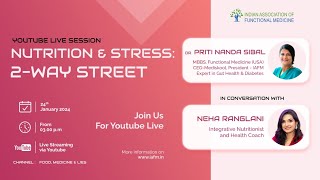
In this conversational YouTube interview, Dr. Priti Nanda Sibal hosts functional‑medicine practitioner Neha Ranglani to explore the bidirectional relationship between nutrition, stress, and overall health. The dialogue begins with Neha’s observations from a recent trip to Japan, where she highlights three cultural pillars—respect for all things, collective silence, and disciplined routines—and links them to stress reduction. The conversation then shifts to the importance of circadian rhythm, regular sleep‑wake cycles, and morning sunlight as foundational pillars for hormonal balance. A detailed case study of an overweight PCOS client illustrates how resetting daily routines, replacing intense gym workouts with gentle movement, incorporating parasympathetic‑activating practices (yoga, breathwork, hobby classes), and targeted supplementation (vitamin D, B‑complex, omega‑3) led to weight loss, resolution of acne and hirsutism, regular periods, and improved life outcomes. The hosts critique the common prescription of high‑intensity exercise and indiscriminate intermittent fasting for women with hormonal imbalances, emphasizing individualized testing (cortisol, insulin, DHEA, gut health) and a more restorative approach to activity. They discuss the prevalence of burnout among working adults, the misconception that self‑care is selfish, and the cascade of hormonal dysregulation that follows chronic stress. Finally, they outline practical ways to assess neurotransmitter health (gut symptoms, anxiety, brain fog, mood, energy) and provide actionable lifestyle and supplement recommendations—protein‑rich foods, adequate hydration, quality sleep, sunlight exposure, breathwork, and specific nutrients (vitamin D, B‑complex, magnesium, omega‑3)—to restore neurotransmitter balance. Throughout, the tone remains conversational, supportive, and motivational, aiming to empower listeners to adopt sustainable, integrative health habits.
Chapters
It's fun. Thank you.
Hi, my YouTube viewers! Welcome everybody, and I'm extremely happy to see all of you here. So I have Neha Ranglani with me today, and you can see by looking at her face that she has worked a lot on her health, and the sweetness, the nice smile she is, you know, sharing with all of us makes my cortisol levels go down. Thank you, Neha, for that.
Thank you, Dr. Preeti. No one's introduced me in such a sweet way as you have done.
So I was speaking to Neha just before we came live, and what came to me was that She is a learner. Neha believes in walking the talk and practicing whatever she preaches, right? I have a good description of her here, but I'm not going to read that because you have already read that, and I don't believe in duplication. Thank you. Right, thank you. And but I will give all the time to Neha today to share what is it that in her practice she has learned which has made her patients shift from here to here. I call them FLB moments, which means wow, I have cracked it, right? And the topic today we have is stress and nutrition, a two-way street. Right, so welcome Neha, thanks for your time.
Thank you so much, Dr. Preeti. It was really— it's really fun, it's pleasure. I love the way you're talking already, so I'm sure we're going to have a great chat and we're going to have some great moments today.
Thank you. So let me ask, you know, my first question is, you just said you were speaking in Japan last year. Yes, yeah. And Japan, I think that ikigai is so, so, so, so very popular, right? And there are so many things which are similar to what our Indian tradition teaches us. Yes. What are those 3 things which you learned there during that conference which you think we all can benefit from?
Absolutely. I think overall what I learned from Japan and the way people live over there is the way they respect everything that they do. It's not only people, it's even the non-living things that they respect. So I'll share a story. I went for a tea-making ceremony. It's a very popular thing in Japan where it's, it's very auspicious and it's very ceremonial. They usually have it on celebrations and on big days. And I was just looking at the lady, I was in awe The way she was dealing with her tools while making the tea, she was paying gratitude to every tool while she was using it. And I realized the, you know, the, the reason for the success of Japan and for what it is as a country is how respectful they are towards people, towards things, towards everything that they do. It's, you know, how you do one thing is how you do everything. That's what I learned over there. That was the first thing. I think the second thing I learned over there is silence. It was really something that shook me. I was coming from India. You're in a place where you're sitting in a public train, in a local train, and nobody's talking to each other. Everyone is silent. Everyone is doing their thing, either reading a book, or they are listening to music, or they are doing something that is, you know, that is something that's fulfilling their soul. And I'm like, if I was in an Indian train right now, my ears would have been dead. But here it was beautiful. I was like, they all are sitting there, like, so, and thousands of people in the train, but it's silent. And I'm like, okay, so silence is important. And we Of course community is important, but being silent and doing things for yourself is also important. That's one also— one of the ways you lower your stress levels because you go inward, right? And I think the third thing I learned over there is discipline. They are highly disciplined, like they're so disciplined people. They just make sure that everything is done in a certain way. In fact, too much to that extent that the way they walk on the escalator, the way the way they, you know, just on the road, the way they are, they are just so disciplined. And I feel that's the reason for their success. So these are the 3 things I learned from the people of Japan for sure. And I think that was beautiful.
Great. So, and I think Indian tradition also teaches us all these 3 things.
Yes, absolutely.
And I would want to add here that respecting everybody is second level. I believe so. I've been into gratitude, and you know, everybody's spiritual today in its own way, and I'm also taking my little baby steps on that path. And what I've realized is, first, respecting the soul which is within you is the most important thing. And unless we do this, we can never do the second part of respecting other living and non-living beings.
Absolutely.
And when you respect yourself, you love yourself. And when you love yourself, you hug yourself. And when you hug yourself, I think a lot of what we are going to talk about is taken care of.
Absolutely. I think the divine within you has to be respected first before the divine around you has to be respected. So that's very rightly said. That's beautiful.
Thank you. Silence. So yesterday I was speaking to somebody and He gave me a different perspective of silence, and you brought it up today, so I think universe wants me to remember it and not forget it, right? Yeah, that's how I think, you know, life, you know, moves on. He said, what do you think, is silence only not speaking?
Silence is of the mind first, then of the speech.
Silence means you are balanced, calm, shant here. And you know what, I did a silence retreat for 3 days at Sri Sri Ravi Shankar. No, at Rama Mission, Rishikesh.
I did the 3 days at Sri Sri in Bangalore in December.
So yeah, I'm in Delhi, so Rishikesh is the nearest to us. Anybody wants to go to a retreat? Just let me know. We can organize that. But having said that, that first silence 3-day retreat was full of turmoil for me. Yeah, so many thoughts, so many experiences which I had left unsolved within myself, they came out and I solved them. On the 4th day morning, I was a different person. And I can tell you, Neha, I actually was a different person.
I believe you when you say that because I've experienced it myself. You become hollow and empty. There's nothing in it.
But first day I was crying, second day I was crying, third day I was a little sober, but fourth day I was fresh. And after that, I've done it once more. People who know me would find it very difficult to believe Dr. Preeti in silence, right? And that was then a very empowering thing. And third, you said discipline, extremely important. And I think I connect discipline with circadian rhythm.
Oh, same.
And thank you for agreeing on that, because circadian rhythm is something which we have forgotten. Yeah, which we are missing. And I think that's where you have to start. So I remember I did a 5 AM course once, right? Because as Neha is a learner, I'm also a learner. I was telling somebody last week that the more I learn, the more patients I see, the more I grow, more I feel I don't know anything and I have the need and curiosity to know more.
Same.
So I can go to anybody and say, hello, do you have 5 minutes? Can you teach me a little of this? Right? And I think this has helped me, um, in the last 30 years of my professional career. And going forward, if I continue this, it will help me. You know, one very powerful thing she told me, she said, if you have to get up at 5 AM, you have to think about sleeping at 9 PM. And I think that's exactly what circadian rhythm means to me.
Yeah, yeah.
So thank you for bringing this such a powerful three-pronged approach, right? Yeah, all of us can follow. And, um, you know, a lot about stress and nutrition can be solved there.
Yes, absolutely.
Thank you. So now coming to this Can you share with us your most difficult client which you have worked with in terms of bringing her stress levels to normal so that you could help her absorption, elimination, assimilation improve, you know, help her gain health?
Right, so I had a client who was pretty overweight and she had PCOS. So I see a lot of PCOS women these days, especially in the last 5-6 years. It's really increased. And she had a stressful job, like she had a good 12-hour job, you know how a corporate job is. Wasn't getting married, had all the symptoms of PCOS which was bogging her down mentally, physically, emotionally. So A, looking out for boys in arranged marriage, not getting married, and be not feeling confident in your own skin. So there was no way she was, uh, you know, able to energetically be what she wanted to manifest in her life. And of course, stress levels were high with the job, with her PCOS, with the way her body was, you know, showing up all the symptoms— all acne, hirsutism. It was really bad, all angry acne, and you know, it was just so painful. So she didn't know where to start from. When she came to me, of course we all look at food first thing, but now as a functional medicine practitioner and an integrative health coach, I do not see food as the first thing. Of course food is important, I change the way they eat, but there are so many more things which you need to put in perspective before the food even does anything good to you in the body, right? So of course I, I, I, I spoke to her, asked her many questions, and realized that her stress levels were really high mentally, emotionally, physically because of, because of PCOS. So we started working on small things first. First, for me, for every client, is setting up the routine. What time you wake up to what time you sleep, I need to set your routine between those hours. So helping them, you know, set up the routine from the time you wake up. Of course, if they wake up very late, then helping them to, you know, pre-pone their waking up time and their sleeping time. But that's a process, doesn't happen overnight. But the first step is wherever they are, meet them there, and then start with whatever they are doing and small tweaks that we could do. So she was— she had never meditated, she had never done any sort of yoga, pranayama. Yes, whenever she had the chance, 3 or 4 times a week, she would go and do intense workouts. And I told her, I said, this is what is killing you even more. Your stress levels are so high mentally, emotionally, and physically. You're adding more stress by doing that crazy workout. Though, you know how it is, the whole, uh, the whole weight loss culture is like exercise more, do it intense, that's how you lose weight, burn the calories. And I've been somebody who never looks at numbers. For me, it's numbers— sorry, I don't know, what are you talking about? Out. Never had calculators, never done that. So, um, I just started small. I said, first, stop your workout. Just stop it cold turkey. She said, Neha, how will I lose weight? I said, have you lost any weight till now that you feel, um, that workout is going to do anything better to you, any better to you right now? She said, okay, I'll trust you and I'll go ahead. I said, first of all, stop intense workouts. Find a yoga class for yourself till you find a yoga class, which will take a week till you figure out what time is. Just go for brisk walking in nature. Go into the garden, just walk at your own pace. Don't even count your steps, nothing. Just walk and listen to something positive in your ears. So she said, yeah, okay, sure, I can do that. This is very doable because she was doing everything very intense, and for her this is like, are you sure that's all I have to do? I said, yeah, that's all you have to do. And then slowly, steadily, week on week, I started adding more, um, you know, um, parasympathetic nervous activating activities like vagal nerve activating activities. So, um, asked her to join a hobby class. She said, I love singing, but I don't. So I said, see, once a week if you can do it. So she got an online teacher, she got that. And then I told her, just take your focus away from PCOS right now and put into the routine and activities that you have to do. Got her into meditating, pranayams, breathing breaks, ultradian rhythm breaks, taking every 1 hour, 1.5 hour, taking that 5-10 minute break to reflect, to rejuvenate, to refuel. And in 6 months she had lost about 15 kgs. Her acne literally— acne disappeared in 2 months only because the inflammation started going down initially. And her hirsutism got better and she got her periods in 6 months, and which she had not got for like many months, and it was very erratic. And she was like, I don't believe this, how did this happen? And literally after a year she found the right match. That was, that was the thing for me. I'm like, oh my God, I literally had tears in my eyes. I'm like, I can't believe this. Like, you know, once you just start doing the right thing and you, you achieve, the body will adapt, and energetically you become a match to manifesting the right things in life.
Oh yes. And when you were saying this, you know, I was smiling. You know why? I sometimes feel all these gym owners are going to kill me one day. Because I have two sons, right? And when I came into functional medicine about 8 years back, I thought, now I'm going to become a mother-in-law, I must know what the girls of today do, eat, you know, and what they feel. So I started working only with PCOS girls then, and first 3 months I realized the worst mistake these girls do is take a gym membership.
Yeah, why this happens?
Because gymming increases their cortisol, increases their testosterone, which leads further to hirsutism, increases their cortisol. There's no chance of weight loss then. Absolutely. And the moment you tell them don't exercise, they feel so guilty and paranoid, and they do a lot of self-guilt exercises then.
Yeah, first of all, they doubt your credibility because they're like, yeah, are you even a nutritionist, health coach, whatever? How are you asking me to stop working out against the norm.
Exactly. I found a way out. I do their testing very regular, very particularly. I check their fasting cortisol, fasting insulin, PP insulin, DHEAS, their gut health.
So I—
yes, so we will be able to tell them this is it.
Yes.
So to correct this You have to change this.
Yes, right.
And this is so beautiful, so phenomenal. And what you said, you know, in nature, that one word.
Yeah, because treadmill— I didn't want her to do treadmill. I didn't want them like, no, just go in a park, sit over there.
Clearly are showing that you can decrease your cortisol level by 3 points by just spending time in nature. Look at green. 3 minutes a day. Yeah, 5 minutes a day. Is that difficult? I can just turn my neck like this and look at my green plants outside. Yeah, yeah. And if that is so powerful in helping me bring my cortisol down, then, um, I think we should do more of that.
Absolutely. I am, I'm definitely not in the favor of women doing intense workouts all through the month, even if you don't have hormonal imbalances, because we are so different from men. Our menstrual cycle makes us so different. Every few days we are having different hormones which are at play, and our body needs different treatment at those times. And I had made a video on my Instagram regarding this, and I had trainers who were trolling me. And like, you know how these gym trainers are, they're like, you know, what, what rubbish! So you mean, oh, in the last 15 days women should not do weight training? I was like, no, I don't say they shouldn't. I said they should do something that's more restorative. Even if you're doing weights, reduce the intensity, reduce the frequency, do something that's more, you know, that's more flowing for the body, because because that's what the body needs when progesterone has to go up, and it has— it needs support. When you're doing intense workout, it's stress, and that robs away the progesterone. But it's very difficult to explain people who don't understand this. And you know how the culture is on social media— they just believe what is out there. Nobody understands when you talk a little offbeat and actually making sense and giving them the right information. They're like, they start doubting the right information because, you know, it's the herd mentality. Everybody's following one direction.
Right, I am happy about this, that people like you are there talking about this, creating awareness. Because I see the situation, what it was 8 years back. Yeah, today it's significantly changed. Look at the Indian Association of Functional Medicine conference. Yeah, this time we have 1000+ registrations, which is like, wow, this wave is catching up.
It's lovely. That's what we need. We need that.
Exactly. So, Neha, coming to my next question, which I think is connected to this experience which you've shared, is do you see a lot of people with burnout? And what is it that people should know so that they can, you know, diagnose themselves that they are having this burnout and come to a functional medicine coach or a practitioner earlier than later?
Right. I see in fact burnout in most of the people because today the kind of people I'm seeing, very few of them are homemakers. Even they have a lot of stress, but most of them are working individuals. They are young girls, they are men who are working through the day and not taking enough breaks, not really focusing on self-care. They don't even know what self-care is, and most people find self-care very selfish, you know. They're like, oh, how can I take off 1 hour for myself and not give it to my work or not give it to my child or not give it to whatever responsibility they have. So burnout is very common, and most people don't even know they are burnt out. And over and above of that, what I'm saying, most people are taking gym memberships and doing intense workouts, doing— when I look into their diet charts, they are, they're just barely eating. Oh, and intermittent fasting, they're just hopping onto the intermittent fasting trend without realizing that it is damaging them. Thank you very much.
I'm looking at them, I'm like, okay, you're eating at 6 in the evening, and then next day you're eating at 12.
I said, what? No, we waking up at 7, why are you not eating till 12? I'm doing IF. I'm like, you know what, your IF is causing problem. You need to eat within 1 hour of waking up. You already have cortisol imbalances. And, you know, of course, doing the tests, understanding what their deficiencies are— D3, B12, homocysteine methylation is not happening properly— so how is anything going to be in place? So, you know, helping them with supplements. But getting them the entire routine, telling them that, boss, this is burning you out. This is— your majority of your symptoms are coming because of excess cortisol. Your stress levels are high. But they're like, no, but I'm not so stressed out. I'm okay. I said, you're not mentally, but you're physically worked out. You're burdened. You're doing so many things at a time and you're not giving yourself downtime. You're not giving rest to your body, to your mind, to your system to recover. To restore, to do all of that. And that's when they realize, they're like, okay, and then they start feeling better and the thyroid levels get better, the autoimmune gets better, the PCOS gets better. So basically when people are talking about different conditions and saying, I can do it, I can do it, the cause of everything is the same. Once you touch one thing, you're literally— it's an umbrella, it's an umbrella. You're just touching one thing and all the factors below it are taken care of, you know, all your diseases.
Yeah, so very interestingly, you know, a lot of cases I see there are so many gut infections or the heavy metal load is so high that the body is stressed. Yeah, but because we are under that, you know, accelerator, right, personality, and we burn out. And unfortunately, what I'm seeing, at least in my practice, is 13 years 14 years. They come to me with cortisol of 8, 9. I have young women with DHEA of 25, 35. And you know, now there are studies to support the way we have for insulin resistance, where they say if you have insulin resistance today, 10 years you will be a diabetic or a hypertensive or both, and 20, 30 years you will have some cancer. Similarly, there are studies to clearly show that if your DIS is low, few years from here on, autoimmunity is on its way.
Absolutely.
How about that early diagnosis, you know, and then working on your burnout and everything? Yeah, yeah, it's amazing. But I really love you for this, Neha.
Thank you.
Intermittent fasting. I'm like, stop it. I am like Please guys, if your cortisol is high, it's okay. But these days we don't see high, we see low cortisol. Yeah, you've done it.
Fatigued. Your adrenal fatigue is done. You're done and dusted.
Now you cannot do fasting of more than 10 hours. Yeah, you cannot.
So I've had clients where I've put them off intermittent fasting and that's when they've lost weight, got their periods, and conceived. And they're like I'm like, now you see, please stop following everything that's on the internet. Because it's okay, it's good, I'm not saying it's wrong, but it's— you need to do it under guidance. Is it good for you is the question.
Yeah, it's exactly same as when we say, you know, that never treat thyroid till you have set the adrenal glands. Absolutely.
And the adrenal gland, yeah.
Your first 6 weeks has to be on adrenals. Yeah, and then thyroid.
Absolutely.
To do H. pylori treatment, your first 3 weeks have to be on your adrenals and then H. pylori treatment. Yes, and that's the reason in 5R protocol the first is not remove, the first is reset. Yeah, right. So it's huge. And in fact, the more patients I'm seeing, the more I'm realizing that This is preventive medicine, and if you need long-term effects, if you want to enjoy long-term health, then there is no shortcut to it.
That's so true, right?
You just start it right. But I still love you for this, Neha, because I know of so many people who only do intermittent fasting, and you go to a lunch meeting and they say This is my first meal, and I say I can't do my first meal.
I can't do it. I need to eat in an hour after waking up. I'm hungry.
I had adrenal fatigue about 5 years back, and it was bad. And therefore, I think very few people talk about adrenal fatigue, but I am one which talks about it with a whole book.
Yeah, yeah, of course, because I've been there.
I've lived it. I've cried a lot of times because of that, and I have made wrong decisions because of that. And now when I'm out of it, I know the type of decisions I'm making and that— know the way I'm feeling. And then— and I know the love I feel for my own self now.
Of course, of course.
It is—
it's a beautiful process. Yeah, yeah. You know what I tell— you know what I tell my clients is, guys, health is more addictive than an unhealthy lifestyle. You haven't tasted health. The minute you taste health, you will be an addict to health, like to doing healthy things. You will be an addict to feel healthy because nothing tastes as good as feeling good feels, clearly. And, you know, and that's—
man, there is a very simple thing I always tell people. Imagine there is this, uh, window here which has a glass pane, right? Now, if it has all the dust on it, you are used to it. You will never notice it also. But suppose if somebody cleans it one day and then somebody puts dust on it, and you will immediately come and say, oh, this is so dirty, why don't you clean it? Yeah, that's what you feel when you start making little, little changes and balancing your, you know, getting into the circadian rhythm, balancing your cortisol, insulin, thyroid, and stuff like that, and taking it forward. Neha, thanks for sharing this. This is powerful. But you spoke during the I Am Fame conference about the neurotransmitters. Yes, yes. Can you give 6 questions or 9 questions to the audience saying what is it that they should note or notice in themselves so that they know that their neurotransmitters are going awry and they should work on it? And then what are the few things which they can do get relief and what are the few things they can do to get long-term sustainable relief?
Right, so of course we have different types of neurotransmitters which work during states of stress, during states of calmness, happiness, anxiety. We have different emotions and different neurotransmitters play a different role in our brain and also in our gut, right? So first thing first, let me give them 5 questions which they can actually check in with themselves. Do you have any gut issues such as IBS where you are not— where you're either constipated or you have diarrhea? That clearly shows that somewhere the serotonin is not doing well. The second question is, are you always anxious apart from your life situations? I also want to know, is there something that makes you anxious at the drop of the hat? Say, just like if you have to do something small, you have to reach somewhere, or if you have to be present somewhere or maybe present yourself somewhere, does that give you anxiety? Do small things make you anxious? That means that your neurotransmitters are not doing well. Do you feel that you have a brain fog? You can't focus well, you can't concentrate on your work well, then clearly neurotransmitter is off. Do you feel sad? Do you feel lack of confidence very easily? Because again, that comes from your neurotransmitters. Of course, it's your situations also, but when your neurotransmitters are not doing well, you'll always be in the low state. And of course, do you, um, do you feel lack of energy and zest in general in life? Like, there is no zest, there is no happiness. Even to important situations where you should be happy, you're numb, you don't feel anything. Now, if that's happening, then These are the things that will tell you if anything is off here, your neurotransmitters are not working well. So of course there are different ways in which you can improve your neurotransmitters. So we have a lot of ways, but first thing first is what you eat. Now, a healthy diet, it cannot be traded for anything else because what you eat is what gives rise and helps in production of neurotransmitters. So you need to eat protein-rich foods which have amino acids such as tryptophan, it has tyrosine, and that's very important for your serotonin and for your dopamine. Production. So you, you basically, you need to eat banana, oats, nuts, seeds, pulses. All of these foods have that kind of amino acids that help you. Then of course you have to make sure that you're drinking enough water, you're sleeping well. If you're not sleeping well, you cannot restore your neurotransmitters, because for everything to regenerate and repair in the body, you need to sleep. It's like your car engine. If you're not shutting it and your car is getting spoiled, you cannot repair a car in a running condition. You have to shut it, let it cool down, and then the repair work can happen. The same thing is with your body. So for the neurotransmitter reproduction, regeneration, and restoration, you need to sleep so that the body can do what it has to do without you interfering with it. Of course, regular exercise— when you're exercising, you're producing the happy hormones, you're improving serotonin levels, you're improving your dopamine, you're improving all the— you're increasing the production of this. Stress management, meditation, breathing. So every morning that you wake up sit on your bed before you get out of your bed and just do maybe 10 rounds of Anulom Vilom. I'm just giving you something that you can do instantly tomorrow morning as you wake up, and that itself will calm you and get you into a, into a zone where you'll, you'll go through the day but with a lot of ease and a lot of calmness and happiness. Because you need to make sure that, you know, you're always checking in with yourself and lowering your cortisol levels, because excess cortisol robs away your neurotransmitters. It stops neurotransmitter production and interferes with its function. So deep breathing, yoga, mindfulness, meditation— all of that works. The most important thing that you need to do tomorrow morning if you need your serotonin and your dopamine to be high is sunlight exposure. Get up, get out, and see the sun. I don't know why we are so afraid of the sun today. Why are we running away from it? Because we feel cancer, ojaga, ye ojaga, bo ojaga. Guys, there's a pineal gland in your brain which activates only when you look at the sun, and that's where your circadian rhythm comes in place and it says, okay, abhi din hai, toh abhi mujhe cortisol produce karna hai. And just because of that timing, at night your body produces melatonin at the right time, and that's how the sleep-wake cycle gets in place. So get up, get out, and see the sun. Be in the sun. Very important, stop or have a limit to your caffeine intake. Do not be so mindless about it and just be on autopilot caffeine intake throughout the day. It disrupts your neurotransmitter balance, and you can have a cup or two, but don't overdo it because that's really something that will give you a lot of high initially and then low, and disrupts the production of your serotonin and dopamine and all the happy hormones, uh, happy neurotransmitters. Then of course sugar and processed foods. And very important, one thing is that you have to take the right kind of supplements. So if your vitamin D is low, you will not be able to produce your neurotransmitters, the ones that make you happy, that reduce anxiety, that take away your sadness, that give you that zest for life. You will not be able to produce it. So vitamin D is very important. B vitamins are very important, just because, like I said, serotonin is actually 95% produced in your gut, okay? And serotonin is the happy hormone, is the feel-good neurotransmitter, right? So for that production, you need tryptophan. But for tryptophan to work, you need B3, B6. You need the B vitamins to work. Your B12 is important. Your folate is important. So for your neurotransmitters, take a good quality B complex supplement. Take a good quality vitamin D supplement, but make sure you add some magnesium before that, because otherwise you— your bones will suffer. You need to make sure that you're having omega-3. Now, if you're— if you're not a vegan, you can do the fish oil, but find a good quality fish oil supplement. Or if you're vegan, then you can do the algae ones. But make sure you get the DHA, you get the EPA, because that takes care of your nerve health, your brain cells, and supports your cognitive function. So I think these are few things that you can start doing instantly— the sunlight, the morning meditation or breathwork, taking some good quality supplements, and exercise. I think even if you add these 4 instantly, you start feeling better from tomorrow itself.
Thank you, Neha. And I want to add to this before we leave you and allow you to decide what is that one thing you will want to change from tomorrow morning, is whatever Neha has said, the way I interpret is if you're feeling sad, if you are not feeling up to the mark, if you are having negative self-talk, if you are low, if you are not able to make sense Don't blame yourself. Balance your hormones, balance your neurotransmitters. It's not you who's creating the problem, it's these imbalanced hormones and neurotransmitters. And see a new you.
Yeah, I would like to add one thing here. It's not them directly, but it's their lifestyle and habits indirectly causing that. And once they improve the way they live, the way they eat, and the way they take care of themselves they will correct that. Isn't that true?
Uh, it's a chicken and egg. Yes. Yeah, actually, I believe as human beings we all have the right to stay healthy. Yes. And we have to have our personalized plans. If you can stick to the circadian rhythm 100%, good, you have to do less. But if you can't, then do something extra. But make sure that all your reports are balanced, your neurotransmitters are in sync, and your hormones are balanced. Yeah, yeah. So that's my way of life because I'm slightly pretty naughty.
No, no, absolutely. You need to live life, you need to enjoy.
I know.
I feel, yeah, self-awareness and self—
so interesting, Neha, is what are we thinking? Either ways, you will not crave for junk food.
That's true.
So automatically things will settle. So I am saying whatever you can do easily, start there.
Not that—
yes, at the end everything is going to happen. You're going, you're going to get up in the morning on time, you're going to sleep early, you're going to do everything what Neha has suggested, and you are going to feel happy and young. And before I leave, I want to tell you, sleep also is the time when your body secretes growth hormone. Yes, which is the key to your anti-aging and to longevity. So anybody who doesn't want to grow old, I think that can be one good reason for them to sleep early, right?
Yes, beauty sleep said for a reason, right?
Exactly. Great. Thank you, Neha, for sharing such valuable inputs.
Thank you, Dr. Preeti. It was amazing.
Yes, and I don't know where 30 minutes went by. I think we've already, you know, exceeded our time of 30 minutes. But thank you very much. Keep doing the good work. And yes, and we will keep bringing you back on the channel. If there are any questions I have, we will send them to you.
Sure.
Thank you, guys. Please thank you everyone and have fun.
Yeah, bye-bye. Thank you. Bye, Dr. Preeti.
Bye.
Thank you.
Thank you. Neha, bye-bye.
More from Dr


Understanding Chronic Acidity: A Holistic Approach to Better Digestive Health 🌿


BHRT - transformational health journey if a 42 year old women #BHRT #HormoneBalance




Transform Your Health Naturally with Functional Medicine | Dr. Priti Nanda’s Success Story


hypothyroidism and ozone therapy - talk at Ozone Conference by Dr Priti Nanda Sibal
