Panel Discussion: Step-by-Step Approach for Managing Children with Autism
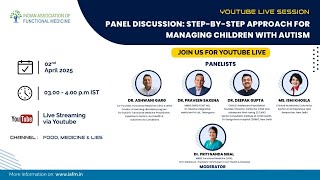
In this moderated YouTube panel, Dr. Priti Nanda Sibal convenes four experts—Dr. Praveen Saxena, Dr. Deepak Biswas, Dr. Ishi, and Dr. Ashwini—to examine the sharp rise in autism prevalence (1 in 36 children in the U.S., 1 in 59 in India) and to propose actionable steps for prevention and management. The discussion opens with Dr. Saxena recounting historical incidence data and linking the surge to vaccine preservatives (thiomersal, mercury, aluminum) and the delayed removal of these agents in developing countries. The panel collectively identifies a broad “toxic load” encompassing vaccines, processed food additives, pesticides (glyphosate), electromagnetic radiation, and environmental pollutants as major drivers. They argue that genetics play a minor role, emphasizing epigenetic triggers such as leaky gut, dysbiosis, and chronic inflammation. Dr. Ishi details the gut‑brain axis, highlighting gluten, wheat modifications, and zonulin‑mediated leaky gut as central mechanisms, while Dr. Biswas stresses pre‑conception, prenatal, and post‑natal lifestyle interventions (diet, stress reduction, microbiome support, detoxification). Therapeutic modalities discussed include chelation, oral and IV detox, ozone therapy, infrared sauna, hyperbaric oxygen, probiotics, and targeted nutrition. The panel repeatedly calls for a paradigm shift: re‑classifying autism as a multi‑system medical disorder, improving awareness among parents and clinicians, leveraging social media, publishing Indian‑specific research, and engaging professional bodies (IAP, AIP) and celebrities to disseminate messages. Socio‑economic observations suggest lower autism rates in rural, less‑toxic environments, underscoring the need for epidemiological studies. The conversation concludes with a consensus that coordinated education, policy advocacy, and data‑driven research are essential to curb the rising incidence.
Chapters
Hello, welcome to this beautiful panel here. And we've already shared the introduction, and I don't want to waste any time introducing who all are here. I think you will hear from them when they speak. But why we are here together, that is one thing I want to say. 1 in 127 children were found to be in ASD spectrum in 2020. 1, and now CDC USA is— it's 1 in 36, 1 in 59 in India. The whole world is looking towards India to create policies for this one particular disease, and the reason is very simple. The pace at which autism is increasing in India is much, much faster than any other country in the world today. So let's understand from all these panel experts why is this happening, and more importantly, what can parents do right so that we, one, help autistic children grow up well and enjoy life and do everything what they want to do, and also how can we decrease the incidence of autism in the coming years, starting here now. So my first question is to Dr. Praveen, because I think he comes with a great experience of doing it himself. 20, 25 years back, he was gifted with an amazing child, but he was autistic, and he has done this journey, and now he is the brightest star I've seen. He's doing so well. So Dr. Praveen, please share your experience and also share why do you think the incidence is increasing so much and why are we still closing our eyes and not doing anything in the right direction so that every year we can report lesser and lesser and lesser number of cases.
Uh, thanks Dr. Preeti for doing such a wonderful thing. And, uh, yes, everyone wants answers now. We just can't just go with the normal, this one. Uh, there are few things which I just want to give you a background from things how it started, because this is that— this has been on the record. Uh, the incidence of autism in 1989 in California was 1 in 4,000. 4,000 kids, 1 autistic was there. So what happened was, uh, in 1993, again, um, the incidence of— that shot to 1 127 in California. Um, so the thing is, they opposed that 1993, uh, this one, it's a heavy incidence of autism. The people like us, a lot of doctors, they started looking into why things have gone so bad. Um, so the— I— there is a committee called IOM, American, and AAP, American Academy of Pediatrics. And there was another government, uh, something like IOM was there. They came with a— in— it was in, uh, 2— uh, sorry, it was in 1998 or 1999. They came up with a directive at WHO. They came with the directive that the thing probably what was, uh, issue might be because of prayer of autism is introducing Hepatitis B shot at birth, which started in California in year 1991. Uh, I remember myself taking hepatitis B shot when I was a house surgeon in 1990. I passed, it was a new thing, SmithKline Beecham, uh, that machine, that thing was came. And as a doctors who are going to practice and all the paramedics, uh, in Usmania General Hospital, uh, we were forcibly given, uh, to the outgoing doctors, everyone has to take a thing. And that too, we had a government medical college and we paid from our stipend fee for that particular stuff. That's a different issue. But 1991, every child was greeted with hepatitis B vaccine. And in 1991, '99, IOM, WHO, and AAP, uh, felt there is a plausible connection of hepatitis B administration increase in autism. Why? Because there was something like thiomersal, which is added as a preservative in the, uh, Hep B vaccine. So mercury. So they came up with a directive that we will phase out this particular stuff, and it will be, uh, mercury has to be taken out thoroughly. In a country like US, it took almost year 2007 to US became mercury-free. There was an act called HR— Mercury-Free HR Act, which was in 2007. So the thing is, on the contrary, what happened? WHO and AAP and this one, they said this will hold for only US and Europe nations, it will not hold for developing countries. So all the things was dumped into the third world countries. We are still third world country. I, I'm— I, I want to see that we get out of that bracket very soon. But then, uh, we were surprised. We had a district in Hyderabad, uh, near Hyderabad, which was Anantapur, which was a place called Sathya Sai Baba's place, and the whole district was given free kind of vaccine. Uh, I'm, I'm very sure the Gates Foundation has given that vaccine because that samples were resting at that place and it was so sent here. Uh, why I am giving this particular thing is when they have done that, they must have done it for third world countries also. And the other mistake what they did was instead of mercury as a preservative, they started adding aluminum into that. Right, so the thing goes like this, uh, I'm very sure, uh, on, uh, the work of Dr. David Guerre, Dr. Andrew Wakefield. There are a lot of, uh, there's so many things, uh, we have— I was in touch with, uh, RFK Jr., and we have now Asim Malhotra also is talking on our, uh, this one. He is also, uh, Peter Bakula These are the people who said, no, enough is enough. There is something. I'll tell you about RFK Jr. His grandson was having a diagnosis of autism, and he did some— we have huge expectations with him now. So here, what happens? You start a policy in the whole of the US, everywhere you implement it, and a country like India, we are still having mercury in the vaccines unless we ask for a mercury-free vaccine. We are not going to get that. We need to pay a premium for getting a mercury-free vaccine. All the vaccines are DPT, all the vaccines tetanus toxoid. You have got, um, all pentavalent vaccines, and you have— these are the things, hepatitis B shots, these are all containing mercury. And this is one of the big things. And that time, uh, it was shown clearly That addition of mercury, which was in the form of thiomersal, uh, started in some way back in Eli Lilly. They started in way back in 1940s and all that. So the 1940s, that now they admit there was a mistake by adding that particular stuff. So, uh, kind of thing is, I, I being— I happen to have a kid who was diagnosed autism, and, uh, it was— I, I did, uh, checked it late. In '96 born, I'm— until the year 2000, I was in a state of denial. I said, okay, no, no, it's not— unless I came to a paper called Sally Barnard's paper, Autism and All Forms of Mercury Toxicity. I was absolutely blown out, uh, try, try connecting with people, and that started my journey and, uh, work diligently on removing this particular things, try to work on all these things. Yes, um, there are a lot of, uh, things which have— which will be added by Deepak as well as Ashwini. And yes, this is the toxicity issue. I see this as a toxicity issue. There is an environmental hazard which is causing autism. Now that the things are more, uh, a kind of problem— we have got Wi-Fi, we have got stupid— so many things have come up. And it's really, uh, I don't see India will become a leader in, uh, uh— we are, we are good at producing IITs, getting good marks in IIT, and all that, uh, but not in autism and all that. Yeah, I do. I tell you, I have people coming all the way from US, our Telugu people who usually come to— from US, they come to Hyderabad. And I, I had seen them, all are achievers, Dr. Preeti. Uh, there no one is something like a, uh, any dysfunctional person. And everyone, mother and father, are smart people. They have gone out of the way And they started living there. And now taking this at genetics, it is not digestible.
Great. So Dr. Praveen, thank you. Two important points you have brought up, and I think very, very important for all the parents and the health coaches and the doctors who are here right now. One, toxic load and immunization, very important. That we set it right, clean it up, because that's creating a hazard with our children who are the most precious thing we have in our lives, right? And second important thing you said, that generally people say it's more genetic than anything else, but you have just said that genes have almost no role or almost minimal role to play in this disease.
I can always create something and all that on the paper. There's so many work and all that. We have always some genetic polymorphisms. That doesn't mean we are going to have that. Uh, see, there are a lot of, there are a lot of people who have, who have myopic, and, uh, there are a lot of people who have got propensity to cancer. You have got a BRCA gene, and at only 97% of the BRCA genes only 3% they manifest. So there are something like epigenetics, environmental factors triggering that kind of thing. So environment plays a trigger here. What trigger? Any kind of MMR vaccine, or I have seen more than MMR vaccine, I have seen this pentavalent and hexavalent causing immediate results. Results in the sense you can make anyone, uh, whose child is normally going, and you give 3-4 vaccines at one go on, uh, with his bad luck, he will definitely turn into Spectrum.
Great, thank you, Dr. Deepak. Thanks for being here. And sorry, yeah, and Dr. Deepak, in your practice, what do you think is the main reason why autism incidence is increasing so much? And what is that one message you want to you know, give to the children of autistic— parents of autistic children, which you think can be a game changer?
I wish it could have been so simple to be a game changer, but yes, I can move towards the positive side. I, I, I, I take it forward from what Dr. Praveen Saxena was talking about. Yes, definitely toxins has been one of the I, we believe, we believe, a lot of people may not believe, but we believe that toxins have been one of the major reasons. Then we also believe whatever the chemicals and preservatives and processed food which is coming up in different, different ways and entering the body is also one of the reasons. Also, what is what he said, that now electromagnetic radiations, electromagnetic radiations and frequencies, they are also, uh, one of the major reasons.
So all this have I think we have lost Dr. Deepak for a while. So till Dr. Deepak joins back, um, Dr. Ishi— no, I think he's coming back. He was Okay, by the time Dr. Deepak comes back, Dr. Ishi, just what Dr. Deepak was saying, maybe that is what we can take up and hear from you what you think. Preservatives in food, yes, um, causing the increased incidence of autism in India, and what is your take on how we can mitigate the effects of this so that our children can be healthy?
Yes, this is an important subject where there are multiple players, and when you talk about diet and food— so first of all, I just like to say that it takes genetics, it takes a leaky gut, and it takes an environmental trigger. So Dr. Praveen just mentioned the environmental trigger being the, the, the mercury and the aluminum in our vaccines, and the heavy load of multiple vaccines also adding to it. And ultimately what each one of these are doing, whether it is the vaccines or whether it is anything else in the food or toxins, it is the leaky gut which is the primary, you know, pathway through which this develops into a problem. And why some people have it, why some people don't develop it, I guess is a combination of this triology. And the leaky gut itself If you look at the leaky gut, uh, genesis, why this happens, it is the primary trigger is a disturbed microbiome which is impacted by food first, more than anything else. Other factors definitely contribute. And in, in the dietary aspect, as we see it today after the 1960s where modern wheat was changed chromosomally whatever they want to call it, GM or non-GM, it has had immunogenic impact and it has triggered inflammation and a leaky gut among the population. And we are seeing the impact. What is important is when I'm talking about the leaky gut and wheat being one of the primary culprits, there are other culprits, there are other, you know, contributors. But if I have to focus on one very important one in this conversation, both in terms of management of the condition as well as prevention, it is the, you know, the pathways are also very clear. I'm not going to get into the mechanics of what happens in and how this sort of pans out in, but it certainly creates inflammation, and inflammation is going to be the trigger for the rest of the the cause of the disease. And I, I think, um, the, the focus has to be therefore in removing the primary— elimination of the primary trigger and rebuilding a microbiome and addressing the nutritional deficiencies which arise out of the fact that the gut has got compromised. And we, we are seeing all of that. We are seeing vitamin D deficiency, 12, you're saying whatever we test for is typically compromised. And having said that, uh, when I'm talking about the gut and the leaky gut, it may or may not be always the case that the child is going to have digestive symptoms. They are very strongly correlated, you know, in autism we do see that, but it may not always be the case. So a lot of people say that, you know, my child doesn't have digestive problems, he's not constipated, he's absolutely fine. So That is another aspect which needs to be communicated. And apart from that, I think like Dr. Deepak was talking about the ultra-processed food, the preservatives, the pesticides, all of these are added, you know, contributing factors, extra sugar, and, you know, and the radiation, etc., which all of which we are seeing the impact of. So, um, I feel the only way one can understand this is how do we treat the future generation, the kids. Because if we have a mother who's passing on antibodies, or, you know, if the wheat is evoking an immune response, these antibodies are crossing over the placental barrier and reaching the child even before he's born. And, you know, the exposure— so this child who is at risk and the exposure to the other triggers, like Dr. Saxena talked about the vaccine will be, you know, manifested in some form or the other. So we are doing— we are also seeing ADHD, we are seeing other, you know, other problems also growing. We are seeing congenital, you know, issues with thyroid, with even juvenile diabetes. So all this entire spectrum is increasing. So it's not just autism which is growing. And I think I feel what we need to focus— I personally feel is Because I am a mother-in-law, I'm a, you know, I see, I'm a parent, I've seen a lot of all this, that the guidelines have to be communicated for the pregnant mother. You know, these, uh, who should be going on a gluten-free diet or a grain-selected diet or with probiotics. And, you know, we don't even have probiotics in the Did we lose you, Dr.
Ishi? I think we've lost Ishi for a while, but one thing which Ishi said, and I definitely in the patients I see or the autistic children I see, I also see that, that when you talk about gut health to the parents, quite a few of them would say, no, no, no, no, my child doesn't have any gut health symptoms. And then you have to dig deeper and deeper and deeper into the history, and then you will reach a space where they will say, oh, he did not like when we used to give him milk, or yes, he did not like the chapati and he, you know, preferred to have rice. So I think Yes, on the— at the outside, if you just ask that the child has symptoms, you will see in majority of these children they will not be able to pinpoint what symptoms. But if you dig deeper, you will see that, you know, intuitively our bodies know what we want and what we don't. But we keep insisting, no, no, milk is good for you. No, no, you need to have a roti or chapati. But I think we should be more sensitive to this coming generation because They know what they are liking, they are just not able to express itself. So, um, coming back to Dr. Deepak— Dr. Deepak, when you got logged out, we took that opportunity to ask Ishi about the preservatives in food and how to manage that. So coming back to your question again, other than the preservatives, what do you think is causing this increase in incidence? And also, if not a game changer like this, But what is it that can help us decrease the incidence of autism in the—
what she was talking about, that if we can educate the pregnant moms, and if we can educate the pregnant moms so that they can have a healthy diet from in pregnancy, and once the child is born, how can we be as much as away and from these toxins and provide As— because, you know, I don't know how to say that we can provide a toxin-free world in this— living in this world today, you know, where pollutions have toxins, immunization has toxins, the food has toxins, chemical processed food is there. So my only, my only humble submission to the parents out there, that as mother, what— please, what, what all things you can do in your pregnancy, even before conceiving? Because whenever the parents ask me about this question, that they already have a child with spectrum and what they should do for the next child. So I tell them, before conceiving, what are things can you do before you go into pregnancy, and what all steps you can take during pregnancy, whether it's a food, whether it's your lifestyle, whether it's exercise, whether the sleeping pattern, whether it's your, uh, you know, whether it's your, the, you know, cleaning up your kitchen, or whether it's your, uh, your mobile phone radiations and this thing. So I tell them it is not one thing, it's a cumulative effect. So do follow all these things, and if you follow that, you will see results. That's what— and we have enough evidence. If we search for the articles, we can support all these one by one. It's there, though they may not be the mainstream articles, but there are enough articles as which published in good impact factor journals.
So now people can't say that no, this is not the mainstream. I think it is coming in the mainstream journals, so it is the mainstream.
Absolutely.
So it is, it is not—
it is before conceiving also, after conceiving, and after delivery. All these have to be taken care steps. Then, then only, then only I'm sure you will be able to cut down the load. Then only I'm sure the figures will not increase. It's not just only one magic figure, magic key we have.
So Dr. Deepak, for viewers here, I had done one session on YouTube Live with Dr. Praveen, I think 2 years back. In which, in the description, Dr. Praveen was so nice that he shared a list of things he wanted mothers to follow, or parents to follow, I should say. Remember, Dr. Praveen, you shared that list with me? What all things?
Because what happened— then I'll give a background. What happened was we were treating autistic kids, and most of the parents were reluctant to go for a second pregnancy because they were afraid the likelihood of chances of is more than 60-70. So in for looking for doing that particular thing, we gave 3 papers: one pre-conception, steps to be taken before conception, steps during pregnancy, and steps after pregnancy. I've been, uh, I, I, I was giving a talk in fertility hospital about infertility cases. We do some hyperbaric oxygen for that. So I was telling them, you do such a good thing, and I have seen a lot of kids who are maybe after IUI and all that, after very difficulty, they are also getting into some things like not, not just autism, they get into ADHD or asthma or allergies. So maybe a gynecologist have to look After, what is this pediatrician going to give? Uh, I hope there's no pediatrician here, but the pediatricians has to be careful. Uh, you cannot just, uh, really what happens is that the whole fabric is being torn here. So by following that particular 3 paper pages, Dr. Preeti, um, we have around more than 100 parents telling that our second son is normal. It was mostly from Pune and some places. So how to prevent that autism, that was my focus.
I think Dr. Now, Dr. Preeti, internet is—
yeah, turn off Dr. Preeti. So you can start with here.
Yes. So So sir, what I see at least in my practice, a lot of these children, they already have autoimmune issues. Their ANA is quite high, their NTCC— but this is two antibodies I test— their ESR is quite high. Most of them, ESR is 36, 50, etc. So quite an infection load in the body. So that tells me that their immune system is compromised, plus it is in a state of autoimmunity, a lot of inflammation. And we know for a fact that vaccines would trigger such a response. Yes, there's enough data.
I'll just— sorry for interjection— I'll just add one particular thing which one of my teacher taught me. Look at the monocytes. If the monocytes are more than 5, uh, your immune system is working overtime. He was telling that exactly.
And if your MDP is more than 7, which is monocyte, basophils, and eosinophils together, please go deeper into the CBC and check if why your immune system is working more than it needs to. Because at some point of time, that exhaustion limit will come, the threshold will, uh, you know, be there, and we will have more diseases or symptoms than we are having right now. Great. So Dr. Ashwini, coming back to your thing, if you find inflammation high in all these children Any other observations you have in these children and what can be done so that that doesn't happen? But before that, Dr. Ashwini, I have a question for Dr. Deepak, right? Yes, it is right. We all keep telling and saying that mothers should take care of this, mothers should take care of this, mothers should take care of this. And I agree with you on that, though as a woman I think, I think that the responsibility should be shared. Fathers should also be more responsible about their health, right? Honestly, but having said this, I— and I also strongly say that when a couple is trying to conceive, both of them should work on their health 9 months before they plan to even conceive. And when I say both, remember, microbiome is shared. In Indian culture, especially as Indians, we know it the best. Simple reason was that this microbiome comes share, but when we do handshake, we will share everybody's microbiome and we will put our immune systems in stress. At least I think it that way. Now, Dr. Deepak, coming back to this question about mothers, you know, doing pre-list during the pregnancy list and the post list, do you think stress during pregnancy, before pregnancy, and post-pregnancy somewhere affects the health of the child? And do you think that is where men should be trained during this time and told to do something differently, um, to, you know, help our kids to be healthy?
They are What I can always say, the men should always support their wives. There's nothing, uh, no second choice. And absolutely, pregnancy is a very demanding time, and pregnancy is a time when a lot of, lot of changes are happening emotionally and physically, a lot of things. So my, my only humble submission is that, that men— it's not only the issue of autism, it's, it's that they should take care of the, of their spouse. And we all, we always know the happy mothers always give happy babies. We know that, and we have enough studies to that. And we have seen enough studies not only on autism, that if the mothers are unhappy during this pregnancy, if they're stressed out, that the children who are born, you know, at the age of 3 years, 5 years, 7 years, 9 years, they have a lot of behavioral problems. So we, we have enough evidence to that. So my thing is that yes, the husband should support their spouse, uh, their wives as much as possible. I know it can be difficult, but yet that's one thing. And, and, uh, and, and that, that, that should be, that should be not only, uh, just be in the pregnancy, even after delivery, you know, during the postpartum and during the initial years when they need more support, you know, the, the spouse should support each other in a more healthy way.
Thank you, Dr. Deepak, because I think in a lot of discussions we keep talking about what moms should do But I think spouse also has this additional responsibility during that, you know, during that phase of 1.5-2 years, because every thought is also a food. And I think in today's times, toxic thoughts are also playing a big role in the way we digest food, in the way whether we have leaky gut or not. And maybe Ishi can add something on this. Um, how thoughts impact and cause leaky gut, or can be the cause of leaky gut?
All I can say is that yes, stress is a very clear inflammatory, uh, you know, trigger, and through various mechanisms including cortisol. And I think anything which is going to cause inflammation is going to cause a leaky, disturbed microbiome. And I think essentially what we are, you know, what we have to be, you know, just going back to if our traditional wisdom, the chesa an vesa man. And I think if we were, there was a term used before we started, the game changer. So in my opinion, the game changer is really the grain changer. And apart from that, of course, all the other things are extremely critical. I know the views of the other panelists, Dr. Praveen especially spoke about vaccines, and I'm absolutely sure that these are very important conversations which need to be brought out. And also talking about pregnancy as a time when the mother's— or the third trimester, the mother's microbiome is almost like an IBD patient. It's like an inflammatory bowel disease. So it becomes— it shifts negatively by, you know, physiological changes that happen. So giving support to the mother through probiotics, through fermented foods, through avoidance of the harmful foods, and defining what are the so-called harmful foods. Because, you know, if the mother is one of those at-risk mothers for developing any of these problems, if they have autoimmunity in the family, if they have metabolic problems like diabetes or obesity, then these mothers should also be, you know, the foods which are so-called good, like milk is dairy, is a so-called good pregnancy. Whole grains and pangeries and dalias are good foods, but they may obviously need to be redefined. So what is good and what is bad needs to be reevaluated, and these messages must go down and percolate to levels where it becomes meaningful for us.
Thank you, Ishi, for saying this. Dr. Praveen, you were wanting to add something.
Uh, nothing, nothing. Basically what happens is we are— when we talk about all these pesticides, when you talk about things, the agricultural practices, uh, something was added, uh, very recently which is called GMO. Foods and all that. We know about Monsanto. Uh, the thing what was tried that time, this is again a new latest onset phenomena, maybe 15-20 years back. And there is a thing called glyphosate which is added as a weed killer. Yeah, this is glyphosate. Glyphosate has got the propensity to create your leaky gut. Glyphosate is one of the big reasons why we are getting into leaky gut. Uh, Dr. Preeti and Dr. Ashwini, we are working with a lot of autoimmune cases. The common thing in any autistic, uh, all autoimmune cases what we are seeing is the leaky gut. Leaky gut is not the cause. Leaky gut is the result of the, this, uh, so stupid glyphosate, arsenic, mercury, lead, and all that. That's the kind of take we have, because we, uh, with the— you need to deep dive. There is a thing called zonulin deficiency occurs there. And somewhere this antibiotics also coming to a picture. Antibiotics, antibiotics which can get into your system by milk and milk products and by non-veg, uh, this particular thing, um, because this, uh, whatever we are feeding this day, um, the buffaloes and all that to We are— cow, cow milk has got now a lot of antibiotics. And if we take that cow milk and we try to take the chicken out, or whatever is it, because there is an injection was of antibiotics is done on that, or to this cattle, and this causes— this is a vicious cycle. I think that we need to, uh, Dr. Preeti, next time you are going to call an agriculture professor also.
Exactly. So I used to publish an article with ICAR, Agriculture Society of India. So I worked a lot with all of those. And when you were speaking this, I was—
yeah, so you are one step ahead of all of us.
Not exactly.
Yeah, these are—
yeah, I just wanted to add to what Dr. Praveen was saying very rightly, that this— these changes which happened in the '60s— I refer to the change in the wheat which was basically to make it high yielding to address the famine at that time. Not only was it designed to be high yielding, but it also was designed to become pesticide resistant. So this particular variety— normally when you add pesticides to a plant, it also destroys or damages the plant to some extent, but this does not happen with the modern varieties. And therefore indiscriminate use of glyphosate happened with this, you know, with this change and, you know, there was nothing happening to the plant. So these have been unfortunate changes in our agricultural practices which we partly can explain, you know, the form— the early onset of the, you know, diseases that we are seeing and be it autism or be it anything, we are seeing it much, much earlier.
Exactly. Thank you, Ishi. So now coming to the main reason why this was done. We all agree here, and I think many who are listening to us also, that high time, high time we hit the road now, because the incidence is increasing to such an extent that 1 in 32 or 36 children is no joke. We've been an observer for a very long time, but now if we want to be a doer, want to be a doer not in our little spaces. I know all of you are working in our little spaces, and I'm also doing my bit. But if we need to come together as a community, Dr. Ashwini, I would want to know from you what is that one change which we should make and how. And then this question is for everybody, but I want to start with Dr. Ashwini, the youngest here, right?
So I think the first thing, we should change the perspective of how we look at autism. We should not just call it a behavioral disorder. It's a multi-system disorder. The gut is involved, the immune system is all involved, liver is involved, thyroid is involved, brain is involved, hormones are involved. It's a multi-system disorder. We just have to redefine first. It's a medical issue, it has to be taken seriously. We cannot just— because they have a label of autism, they get a pain, they get GI issue, they get fever just because autism, we hardly do anything about it. So if we start fixing their body We start treating their body, we can pull that child out of the problem.
Dr. Ashwini, then why aren't we doing it if it is so simple? Means when you were saying it, I thought this is so dandy, means everybody should be doing this. So why do you think we are not doing this?
It's a multi-system disorder. Everybody see, a lot of the doctor— every doctor's— if GI doctor is only looking at stomach or, you know, intestines, and Lever doctor is only looking at liver. Brain doctor is only looking at brain. You know, we, we need to look at the whole body.
And how will we make that happen? Because from 1 in 4,000 cases, we are at 1 in 36 cases today.
Yeah.
So what, what do you think? How will we make it happen? Or how can we make it happen? Because otherwise it will be 1 in 2 or 1 in 3. The way— see, when I was in medical college Dr. Praveen, Dr. Deepak, you know, we used to actually tell our friends that if a PCOD girl comes, call us because we want to see how that girl looks like, right? And today we don't have to say that. Everybody who enters the clinic, you know, out of 2, at least 1 will have PCOD.
Oh yeah, yeah, yeah.
So do we wait— want to wait for that time and still not do anything, or What is it that we have to do, Dr. Ashwini? Because whatever you are saying, it looks very simple to me, but I don't think 1 in 4,000, say 1 in 36, it's a, it's a, it's a sea change, means it's unbelievable. So why are we not doing what we need to do?
I think a lack of awareness, even at the parent end.
Create awareness. Everybody's talking, everybody's doing it? We have social media today.
That's a very important— why don't you use social media? You should use social media for messaging.
That's what I'm saying. And you know why I'm asking Dr. Ashwini is because I think he knows the answer. Dr. Deepak, yes, but Dr. Ashwini, I'm going to come back to you on this.
Yeah, see what Dr. Ashwini is saying. Yes, what Dr. Ashwini is saying is— I think I am just stretching that point. Yes, one is that we need to change the perspective, and how the perspective will change? By awareness and education. But that awareness and education just cannot be only limited to social media. We have to change the perspective of medical fraternity also.
Absolutely.
Exactly, Dr. Deepak. This is what I was wanting Ashwini to say.
Thank you very much. I think Dr. Praveen will totally agree with me, and being a parent also, that I think what is important is that, that, that you're even— and he being a doctor, when he finished in '90s and then he took himself the hepatitis injection, he was not aware of it. And when he went through the journey himself, a few years, he was in denial. So important is that a lot of people in denial And my medical— I have so many pediatricians whose kids are under my care. I have so many doctors whose children are under my care, grandsons are under my care. The only thing is that if— and when— and the perspective has to change from starting, that yes, autism has behavioral component, but autism has a medical component also, is a multi-systematic also. It has a genetic part also, but yes, environmental factors trigger it. And when that environmental triggers it, we can change on the environmental factor, and then the child can be— child can be saved. So all these things can be there, unless otherwise we'll have the same situation the way we have a PCOD and PCOS.
Exactly. And another one more point, and we forgot about depression.
What?
Sorry, everything, everything along with the education to the medical fraternity Strong messages on the social media. What is also important is that, like what we are doing today, so we have to have a talk where multidisciplinary people come in to join, where pediatricians also are there. I'm saying involve all your colleagues, tell them. And there was a time when we were not talking about the issues. There's a time now we are talking about it. People are talking about gut-brain axis now openly. Pediatricians are talking about gut-brain axis. She will agree with me. People are talking about gut reactions.
You know, 5 days back I thought that we need to do this panel discussion, and you know what triggered it? Yeah, I practice in Gurugram, and 5-6 days back I met 3 parents in different scenarios, and everybody was just going to the speech center, to the, you know, allopathic thing, and they had not changed even the gluten in their child's diet. And one more thing, it was so painful, Dr. Deepak. It was so painful. And see, they are all good, they are well-to-do people, right?
Because I know still so many therapists who believes into it, who believes that all these factors are important. And there's so many therapists who are so against this. Don't do it, don't do it.
That is true.
When we are able to create that awareness, when we are able to create that awareness— I work with so many therapists I work with so many people, I tell them that yes, I keep on— so along with the social media platforms, also important is the research work. We need to come out with the data, more and more data. Exactly. It is important, social media is important, but the research work is coming up. And Ishi will totally agree with me, and as being a part actively with Celiac Society also, the research work, the papers which will come up, that will substantiate Yes, it is. Otherwise people will keep on questioning, Mark, it's not FDA approved, it is not this, it is not that, we don't have any data. And the things will go on, numbers will keep on increasing, and people will say only one thing, it's because of early diagnosis and awareness.
That's all, right? So Dr. Deepak, thank you very much for summing it up. So 3 things you have said, and I'm going to come back to Dr. Ashwini again, and then Dr. Praveen, you, but Dr. Ashwini again. First, doctors have to be trained, have to be taught, have to be brought into this space of awareness. I came in this space of awareness one day, Dr. Deepak came one day, Dr. Praveen, Dr. Ashwini, Ishi. But we need many zeros in front of this if we need to change the situation. I have a classmate, Gurpreet. I'm from Amritsar Medical College, 1989 batch. So Gurpreet's son was diagnosed with autism few years back. And he left everything in India and went to Canada because he thought that maybe there the situation will be better, the environment will be better, the science is ahead or whatever. And now he is very, very strongly associated with ICF. And in Punjab, he's working a lot on setting up autism center, which was inaugurated I think last year in Mohali. And today also they are doing an event there. But I think so many more such initiatives with government involved, which medical doctors involved, they have to be done so that we reach where we want to. One. Second, of course, social media can play a huge thing. But for social media also, I think at least my patients, they don't want to come on social media and say that, you know, their child is autistic. Somehow there is that fear of being judged or something like that. Right, and it takes a lot of courage to do that. And thanks to Dr. Praveen, who started about this 20 years back. Actually, thanks, Dr. Praveen, because it's not easy, right? So social media then becomes difficult at times because again another set of awareness has to be created so parents can come out and speak about it. And publishing— I worked with a severe— in Indian Journal of Clinical Practice. So of 10 years of good experience into publishing, and you know what, I had a boss, American boss, William Curtis, who we used to call Bill. So we started publishing journals for the first time. We got journals on the Springer platform and got them PubMed indexed. So I was responsible for that during my journey there, and which I give a lot of pat on my back because now Indian content is there online. But one thing Bill said which still has not changed to a large extent, I want to say it here so that we all can accept it, and then only we will change it if we accept it. You know, we went— we used to go to academies like ISI and Association of Surgeons of India and all, and I used to tell him I want to publish this journal on Springer platform. He used to look at the journal, open it up, and say, read the name of the author. I used to read the name of the author and then he used to say match the bibliography. All the references used to be from the time when that author was doing his post-graduation. Unfortunately, I think we doctors— and please don't mind it, and I hope this has changed in the last 10 years since I left publishing— but we doctors go read journals only when we are doing our PhDs or our postgraduations. Most of the doctors here in India don't have access to one of the best journals, and because these journals are pricey, we don't go and we, you know, rely more on the PubMed Central journals which are free. So I think that's another space which needs to be filled up so that we know what is happening in research. And of course If some groups can be created where we can together publish data, because see, our gut microbiome is different, our emotional bandwidth is different, our spiritual journey is different. We can't rely on the articles and the studies which are published internationally. I've been saying this since 2006. I came into publishing in 2002, but I think because Dr. Deepak has said it, I can't resist it. I really want Indian doctors and nutritionists and psychologists to please come together, create a pool of data, and start publishing. Starting can be difficult, but we can definitely do it. At Indian Association of Functional Medicine, we will be happy to help you guys if you need any type of help in writing articles, any type of help in analyzing data. Um, this is something I've been doing, saying to Dr. Ashwini that I want to do this. So Dr. Deepak, you, your friends, Ishi, Dr. Praveen, if you need any help from that side, from the publishing point of view side, we'll be happy to help you. But yes, strongly, data, data, data, because data has to come. It has to be published in good impact factor journals. It has to be shared in medical conferences. And we have to, you know, associate with Association of Pediatricians, AIP, and all, and get this there first before even we think of taking it forward. But this number is the last number we see, the lowest one. Now we should have 1 in 500 people, 1 in 700 children, 1 in 1,000 children going forward in data who are affected with autism. Dr.
Praveen, uh, sorry, I think the, the main common denominator what you have spelled is pulling up the data. Uh, we have been working with this chelation therapy also for pulling up the data. We, you know about Lenny and our work, what we are working on that, and it's a very good idea, uh, to have that because our people, our pediatricians, are not going to look at our names Even if we are giving a talk in AEM and DANN conference and all that, it doesn't matter to them. What they want is the true data there. And it's a high time, it's a high time most of the pediatricians— if some, if you are working with any pediatricians, grandson and all that, involve that man. However, try to reach out to— we will reach out to— yeah, we will reach out to IAP and all that, and we'll try to give a kind of a proper presentation Because something— we are not only blaming vaccines, there are a lot of things. You have got something like antimicrobials in the soil, you have air pollution, which Delhi air pollution has done so big kind of— it was in the news and all that for so long. But these are the things which we need to take these people also into confidence and start working hand in hand. Because what is happening is they are, they are scared now. Most of the petitions, they are scared because they are thinking that we are going to blame them for that vaccine. It's not like that. We are not going to sue them. Indian— there was a Hannah Pulling case which happened in US, that was different. We don't have that kind of resources and all that. We want to see the— see that the next generation gets saved. We need to work on that.
Yeah, Dr. Praveen, when you said about chelation, we do oral chelation in autistic children whom I treat.
I do IVs also. I do IVs also, right?
But I do IVs for adults, for autistic children. But even with oral chelation, the results are really nice with, of course, your ozone and infrared sauna, which is again a very, very good detox thing, and HBOT. It can really make a difference. Dr. Ashwini, coming back to you, why is the situation not changing and what is it that we need to do? We've heated up the discussion quite a bit so that you can say out what you want to.
I think it's a treatable problem to a greater extent, maybe 80%, maybe 70%, 60%, whatever we can achieve, we should not let it go. I think Dr. Deepak and Dr. Parveen Saxena at least start an online course to train more doctors like us. What they have learned over and they have gathered the pearls of the clinical practice, they should get a course so that we all can learn. And probably many doctors will be willing. I mean, they, you know, online is a good way to teach, train new doctors. And I think it is, can be a good way to have at least new doctors can learn the ways of—
great.
Ishi, Is she—
um, what do you think you do today so that next year when you have this discussion, um, you know, we can pat our backs and clap for everybody who's a part of this awareness?
That, that would be a fabulous situation, and I hope your words come true. But I have a question on the data angle. Um, when we are talking in this group, we are agreeing on the fact that there is an association of MMR or vaccines with autism unanimously. But when I started searching, I have got not even a single paper which is there to support this.
The post-marketing data is not even collected, right?
I mean, this is something which I needed to support when I wrote my book 4G, Code to Good Health, Gut Girth, Gluten and Glucose. And I could not get one paper which supported the fact that there was an association. All of them said no association.
There were retractions of the paper. People have done some work and they did come to the right.
Exactly. So my point is that even if we are here, we have a muscle We have vaccine companies, pharma companies there, right there with equally opposing power, and their forces are to be reckoned with. They are not just— so I have that just one comment when you said publish. And secondly, I have a question on the, which I'm not aware, there's a question on the socioeconomic presentation, the distribution in terms of autism. Is there any preferential socioeconomic strata?
Dr. Deepak, can I request your answer on this?
I work with all the strata and I work with multiple various parts of the country. Though I have not worked in the hardcore village, but I have a lot of population coming from different aspects. I know, I'd still— again, again, again, it's from the clinical experience and can be a bias also. But definitely, unless we have a comparative study— but yes, there's some articles also which says the living people living in village, people who are playing on the mud, people who are playing with the— exposed to those, those benefits of the earth and, uh, and the, and the, and the mud, and where there are more natural deliveries and more, uh, less toxins and more, less, uh, things are there. So that is one hypothesis, is that that could be— that's why we don't have much autism in that rural or the village side of autism.
We don't have.
So that makes a very strong point in the epidemiological studies to present this, that, you know, there is something that we are doing with—
yeah, we need to have more science data, then only we can prove it off. But yes, when I see sitting in Delhi, when I talk to my staff, when I do the free OPDs, when I go to the Bhuvaneshwar or Calcutta or Imphal or Lucknow, where I have my peripheral autism clinic, and, and, and I see that from where they are coming up. I was interacting with people from Imphal when I went there. Before the riots were there, and I was talking to them that why I'm getting only children in Imphal from Imphal, why I'm not getting from the inside mountain areas of this thing. Then they told me in Imphal also it has come from last 20 years only. So also I have indirect evidence, but I— we need to have a direct conclusive evidence before we present to the scientific fraternity, otherwise fraternity always questions you. But yes, I believe there's a lot of factors in that culture which tends to mitigate that, which tends to buffer that, what we have exposed in the rural, in the urban or suburban cities.
Right, thank you, Dr. Biswas.
That would be really very useful if we can you know, make a study where we have an epidemiological study to support the—
they are very small, one or two studies. If you will, if you search, they're very small, one or two, two, three, few studies from that, that rural thing is there, but not very prominent studies.
Yeah, yeah. So that just shows that the genetic component is only one part of it and a small part of it, and what we are doing with our practices is is very important. And here I would just again highlight the fact that the first 1,000 days we keep talking about as the most critical of, you know, window of opportunity to intervene. And, but I would say it is beyond first 1,000 days. Parents, like you rightly said, should be aware of their diets and their health status. And we also need to maybe also, you know, in the population that we are talking about, do more testing on leaky gut. Tests are there now, there are barrier panel tests. I've just got mine done to get parents to do those tests and then take the informed decisions on their diet. And, you know, if zonulin is elevated, clearly that patient mother should not be on a gluten diet during pregnancy and should not be fed those, you know, atta ki panjiri and atta ki ladoo. And some of the traditional practices actually are very, very sound. If you look at the post-delivery time and the, you know, the preparations which are given are with good fat, flaxseeds, with the ghee, which is again good for the, you know, for the leaky gut, and some gums which are those gonds, you know, we talk about the the gond katira. And the gond, there are many forms of gonds which actually help to bind the leaky gut. So those traditional practices I think should be relooked at. We should revive them and study them more and bring them in rather than saying, oh, this is old-fashioned and this is going to make the woman fatter and there's no need for ghee and etc., etc. So I think the conversations should begin early and are, you know, the diet for during pregnancy, according to me, needs to be redefined very, very strongly.
Great. Thank you, Ishi. And you've asked some lovely questions. I think it gives us a lot of work, and we all, I think, take the responsibility and have the responsibility of doing whatever we can. But I think we can't delay this any further. Already 1 in 36 children, if that's the incidence we have reached, we need to act fast. We need to take support from our doctor friends. In fact, they say that world is looking towards us for, you know, making policies for autism and how to decrease its course. And therefore, it becomes very important that something is done urgently. Dr. Praveen, before we logout, anything you want to say.
Maybe this is perfect for words of this one, Deepak. I 100% agree with you. Uh, some, some things are there which we are absolutely— we, uh, talk about something called innate immunity. Uh, you have what— what I see usually is the acquired immunity is much weaker. We have witnessed during this COVID also, uh, the people who are being on the passive So what I believe is the person who comes from a rural background had a good connect with the mud and all that, and definitely they have got a good T-cell mediated immunity. And this is definitely a big— this one, because most of the city people who are living in their own cubicles and all that, they are not— they are scared of opening their windows, leave about playing the kid in the mud and all. And we are worried about a small infection. If the child has got fever for 99 degrees for 1 hour, the parents are getting out of this one. They want immediate— they want to see that the fever is arrested immediately. They would like to go for any extent, whereas the kind of There are two things which I definitely like to tell you. One, uh, in simple words, see, there is a thing called, uh, terrain. Uh, you, if your biological terrain is good, you'll not get— you should not get worried with the external factors and all that. You have to build up your biological terrain. Even if the fever comes, it's a biological mechanism by which your body is trying to train your immunity to work. So nowadays we don't even train, actually. That's a, that's a hard reality. And maybe, uh, Dr. Preeti, good work. And this kind of things has to be taken up in a more way. Tell us how we can work it out, because, uh, coming on this one is not a— but I'm sure there are a lot of like-minded doctors who are purely on some— so this one, they were looking from the other side. They used to totally different vaccines. Now they are telling, oh, there might be a possibility, there must be something like that. So, um, I think, uh, in the interest of the community, uh, in the sense we cannot, uh, we cannot afford— because autism treatment is very costly, uh, not just costly, it breaks the families. We have seen the unnumber of cases, uh, so, uh, this our country as a whole cannot afford it. And in This is a kind of, uh, this is slowly evolving into a big issue.
I, I'm with you. Last week I had an ophthalmologist, a gold medalist, visiting me. She was about to go out, she had cleared all her exams and everything, and her son was diagnosed autistic. Since last 6 months, she was going to every possible doctor whom, where she thought that she could get health, and somebody referred her to me. And you know, she had quit her work for the last 6 months, not doing anything. She didn't know where to go. And you know how it hurts when you are a doctor and still you are struggling to find an answer to it.
And I think the thing is, the thing is society. Yeah, yeah, the society, her own in-laws or somewhere else would be always cursing them, telling that, okay, That is what the society is doing.
That, yeah, so it taught me emotionally so much. And every time this happens and it goes at the next level, let's do something together. I think, uh, 3 points I've written. Dr. Deepak, uh, I will come back to you. Dr. Praveen, you, Ishi, and how we can reach out to the pediatricians, IAP, and, uh, see if we can do something there, because I think then we can reach out to more more and more number of people. At least the first step is getting rid of the resistance which we get when we tell people to stop gluten, right, Ishi?
100%. I have to share this with you. Uh, uh, somebody in the family was having trouble with sugars during pregnancy, and I told her to go off gluten and dairy for some time till she settles down. And the gynecologist, you know, the words she used are still, you know, they are in my head. And I shudder to think about what the impact it must have had on the lady. She said, you want to kill your child by not giving milk? You want to kill your baby?
I mean, exactly. No, no, no. And she came and she shouted at home.
Yeah.
Yeah, it becomes extremely difficult. So I think we need to go out a little more from our offices. And, uh, thank you everybody for being here. Thank you for the participants who joined. Please share it with as many people as you can. Share it with your patients, with your friends.
And yes, Dr. Deepak, one last point. I think time will come then when very soon, if we have all this in place, we'll involve celebrities who will vouch for it and who will speak openly. And that is the time the masses will start believing into it. That is the time we will be able to have better healthy lifestyle. We'll be able to have less toxic world, and we'll be able to have the figures will not further increase of autism. That's what I want to say.
I totally agree.
I believe our words create, right? So Dr. Deepak and everybody, I strongly believe in gratitude, and I strongly believe We create our world with our words. So you have said it, it's created now, and it's gonna happen.
Thank you.
And may I just add one more thing which you can use without a cost today? Sister Shivani has said it in one of her— like, we had an event and she said, and she has a narration of experience in the family with what she's changed, and it's Life transforming experience. Sunil Shetty has brought out a reel in which his diet, if you have seen that, is very clearly saying I don't eat gluten. And then the other one was, um, John Abraham on national television, Times Network. He said very clearly and openly said I don't eat gluten. So maybe you can just draw those little snippets.
And a lot of other celebrities are talking about gluten. But autism, I think nobody is still talking about it.
The connection. Oh yes, yes, absolutely, absolutely.
And I'm sure that will happen, Dr. Deepak. You have said it, it's been created.
Thank you very much, and thank you for the opportunity.
Thank you very much. I hope you enjoyed the discussion, and you were a lovely—
you were a lovely moderator.
Thank you. Thank you very much. It comes all from my heart. Thanks a ton. Bye-bye.
Thanks, thanks, thanks, team.
Thank you.
More from Dr


Understanding Chronic Acidity: A Holistic Approach to Better Digestive Health 🌿


BHRT - transformational health journey if a 42 year old women #BHRT #HormoneBalance




Transform Your Health Naturally with Functional Medicine | Dr. Priti Nanda’s Success Story


hypothyroidism and ozone therapy - talk at Ozone Conference by Dr Priti Nanda Sibal
