🎯 Panel Discussion: Unmasking the Silent Killers: What Are We Missing Behind Sudden Young Deaths?
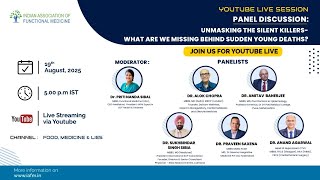
In this YouTube panel, moderated by Dr. Priti Nanda Sibal, clinicians and researchers (Dr. Alok, Dr. Praveen, Prof. Amitava, Dr. Anand, Dr. Sibia) examine the alarming rise in sudden cardiac deaths among adults under 40. They identify multiple, often hidden, contributors: silent insulin resistance and metabolic dysfunction; lifestyle factors such as poor sleep, chronic inflammation, sedentary habits, unhealthy diets, vaping, smoking, alcohol, cocaine, and substance use; post‑COVID myocarditis and possible vaccine‑related adverse events; environmental toxins (lead, arsenic, cadmium, air‑pollution, heavy‑metal exposure). The discussion distinguishes “plumbing” (coronary blockages) from “electric” (arrhythmic) mechanisms, emphasizing that many deaths stem from electrical instability rather than overt atherosclerosis. Diagnostic innovations highlighted include heart‑rate variability (HRV) via smartphones, cardiovascular cartography, CT coronary angiography, cardiac MRI, and microvascular assessment tools. The panel stresses early detection through simple blood work (CBC, CRP, D‑dimer, lipid panels), risk‑scoring questionnaires, and targeted imaging. Treatment ideas range from lifestyle re‑programming (circadian‑aligned eating, sleep hygiene, stress reduction, meditation) to microvascular therapies (extracorporeal shock‑wave micro‑vascularization, ECP) and conventional revascularization for macrovascular disease. Policy recommendations call for robust adverse‑event monitoring, public awareness campaigns, mandatory CPR/AED training, and environmental regulation. The overall message is urgent yet hopeful: with better screening, lifestyle change, and systemic support, many young deaths can be prevented.
Chapters
Okay, let's get on.
Hello everybody and thank you for being here today. Now this is one of the most, most, most important panel discussion which you are going to have. The important thing is that who's and who's in cardiology space, in functional medicine space, as scientists and epidemiologists are here to share with you what you don't know till now and what can help you stay healthy and most importantly avoid these young deaths because of heart problems today. I'm sure everybody is shocked, surprised, and feeling very helpless because every day we are hearing that somebody has crashed down without any prior problem which they had. So I will start with Dr. Alok. And Dr. Alok, what do you think is the reason that so many young deaths are happening?
See, we have now realized that heart attacks in young people are increasing. Even the ages are under 40, and even the 20 to 30 age group. And we have realized that 1 in 5 attacks are patients under 40 years, and increasing by 2% yearly. Now they face the same risk as adults, and even a second attack is very possible. So all of them will also get an early diabetes, and that's 2.4 times more likely to have a heart attack because, you know, sugars and blood vessels will all cause a problem, atherosclerosis will cause a problem, etc., etc. So it's also because of that there's more further attacks, high cholesterol, high blood pressure. So this is linked, you know, with the unnoticed metabolic dysfunction. It is not the high— please understand, it is not the high-intensity workout, neither is it the treadmill. The key is not to avoid exercise, but the key is to detect and address the silent risk factors before it becomes fatal. And the real culprit lies somewhere else— a silent insulin resistance, which means insulin is released after a meal.
It works to, of course, reduce the, uh, and prevent the Just, I want people to know, you said this is not about high-intensity exercise. This is about— let me finish, right?
Let me finish this, then we'll talk again. Yes, the idea is that prolonged chronic inflammation, you know, is not a great lifestyle. So at these ages, they want to do much more than what they can do. Poor sleep, consequent recovery, nutritional deficient diets, all that. In other words, that body is already a ticking time bomb. So that a sudden high workout may just light the fuse, and early detection therefore is very crucial. More chances of hypertension, which causes a rising incidence of blood pressure, which makes the heart muscle thicker, blocks the blood vessel, and hence increases the heart attacks. Then comes overweight, obesity. Carrying extra weight is even, even worse. Even the, even the, you know, healthy people can get more comorbidities— blood pressure, diabetes, and hyperlipidemia. Then comes smoking. Smoking cigarettes— bad. Vaping is directly proportional to the number of cigarettes, and one pack a day doubles the risk. Vaping is as bad, if not more, and increased blood pressure and heart attacks occurs, and is about 30 to 40% more likely to have a heart attack. Then comes substance abuse, which leads to very frequent things like marijuana, which boosts the heart rate, raises your heart attack risk.
Cocaine—
cocaine impacts heart directly, raises the blood pressure, increases the heart rate, and tightens the arteries. So a large number of heart attacks are preventable by changing the risk factors, improving the lifestyle, and taking the correct medications. And we are here to support anything as long as they are willing to talk to us. It is very easy for us to all put our facts together and make them understand, because it's very, very bad to hear this. You know, people at this age are dying. Yeah, that's it.
So, Dr. Alok, you just said that smoking, vaping, cocaine are directly linked to heart problems. Yeah, but what we are seeing is that post-COVID, the incidence of these young deaths because of heart problem has really increased. Agreed, right? So do you think smoking, vaping has also increased, or there is some other connection why we are seeing such a steep increase? Is the media talking about it more? Yeah, something has changed post-COVID in our bodies wherein our body's ability to handle situations has decreased or declined.
You see, the thing is that because they are doing too many things, because they want to actually make too much money and then relax. And because of that, they need the effect of vaping and smoking and alcohol to make them happy. That's the problem. You know, somewhere down the line, we have to tell them what to do and what not to do, because there's enough time. They want to finish off at 30 and put their feet up and enjoy their life. It doesn't work that way, right?
Dr. Praveen, what is your take on this post-COVID Has smoking incidence, vaping incidence increased, or post-COVID because of some other factor the incidence has increased? Dr. Praveen, you are muted.
Uh, I'll go according to the stats here and what are the results, what you are seeing, what is happening with the people who are having a heart attack. The, the, the agony is people used to get heart attack, they used to go to the hospital, and by the time they used to get revived, they used to have a CPR and all that. But, uh, this now, the kind of incident what we are saying is by the time they are reaching the hospital, they are gone. Uh, so something is really wrong. Uh, we had a case study in the sense we had our neighbor who had a problem, and we were able to, by the time he went to the hospital, hospital, there was a blood test was done, uh, and that blood test revealed high levels of WBC count, lymphocytes were higher, there was a CRP which was higher. We didn't do D-dimer, but after taking the blood, by the time we were planning to post him for an angioplasty, everything gone off. So what I'm trying to put across is let us go in with a scientific bent of mind In— I'm a radiologist. I had seen what exactly is myocarditis. It is not easily picked up on any of the modalities. You need something like MRI to pick up a myocarditis. So we have certainly seen— my take will be like there is something which is— the foresight has been— there is something in the heart which is causing that ventricular fibrillation or atrial fibrillation, and, uh, that is the electrical cause which is happening here. It's not the block which are, uh, more now. It is that they are dying because of the electrical issue. Electrical means again ventricular fibrillation and all that. So my take will be the people who are susceptible, who have got higher CRP, who has got D-dimer which is higher These people should be screened out thoroughly, and they will be— they should be properly taken. Because what happened is we have number of studies now. We had showed how this— I can always show my PPTs— how this mRNA vaccine can cause heart disease. You have got multiple— this spike protein 133 MIR expression is higher in people who had long COVID as well as were injected. So the question is, is it the only the infected people got, or is it the long COVID? But there is a percentage, or there is a long list of people who are on the verge of a disaster. This is impending disaster. And as a responsible doctor, as a physician, for social responsibility, all of us has to come up and take a kind of thing, screen of people. What is so big in that? We have to screen out for high cholesterol level. High cholesterol doesn't mean anything now. And screen out with something like coronary CT angiography. Try to look at the— what is the inflammation levels the patient has got, and you can always make a thing which is very amenable.
Dr. Praveen, you have brought up very, very beautiful points, but the one which I like the best is simple test CBC. We all do a hemogram. Your lymphocyte levels, high or low, can tell you whether it's active COVID or it is long-term COVID. Going into those details is exceptionally important. And now we have enough studies to state that yes, they can impact the heart health. And of course, Dr. Alok has already said that I think the way we live and what we aspire has also changed. So moving forward, um, so what do you think Is there any impact of vaccination, and is it in any way— some noise from one person, I don't know from whom. Wherever the noise is coming, if we can mute it, that would be great. We still have it from somewhere. Right, back to Professor Amitava. Professor Amitava, what's your take on this? Why are we having so many young deaths, and are they anyway connected to whatever has happened in the last 5-6 years?
Yeah, thank you, Dr. Preeti. Actually, as an epidemiologist, we see the patterns, large data patterns, which can be missed by a clinician. Because let us say, I mean, as per the vaccine, from the statistics in the Senate hearings also, the serious adverse events are 1 in 800. 1 in 800 is too little for a clinician to catch. Clinician may see 800 patients, 799 no ill effects of vaccine. One he or she sees, it will be passed off as coincidental. So it's very— clinicians, individual practice may not come across. So that perception is there, vaccines are very safe. But if you take 1 in 800 in a population like India, if you have given it to 100 crore people, you will be having the side effects, serious side effects, to the tune of 10 to 20 lakhs. That's a big amount at a population level. Russian roulette, whom it will hit, and it is much higher than the baseline sudden deaths. That's why we are getting much higher than the baseline sudden deaths. And another thing, all these risk factors are well known— diabetes, smoking, hypertension— they are well known, and they take almost a decade or two decades to have an impact. If I start smoking today, if a youth of 20 years, 18 years has started smoking, even if he or she is a heavy smoker, he wouldn't get a heart attack in 2 or 3 years within this pandemic period. He or she may get it after— I mean, the population pattern. So here's something which is very unusual from the population pattern. And we had published a column, myself and Dr. Bhaskar Ravan from IIT Bombay, we had published a column on this sudden death in 2022, 3 years ago. Bhaskar Raman was monitoring as a data scientist the statistics and a large pattern. And I will just give the figures from that data, the salient features, that since early 2021, after the rollout, rollout of the intervention, there was a sixfold increase in heart attacks in Mumbai. Mumbai. Then we also examined the global patterns. England, Wales, and Australia deaths increased in 2021 and 2022, and the most market, uh, rise was among the 15 to 44 years young people. There was a 31% increase in deaths. That is right. And in Australia, Australia data is very illustrative. Because Australia had hardly any COVID because they had very strict lockdown. But after the mass rollout of the vaccination, the sudden death increased by 17.2% of heart events in the young people. So had it been long COVID, they, they shouldn't have had because they hardly had any COVID because of very strong— the tennis player was also not allowed to enter, so they had such strict here. So these are the very illustrative, and there were certain social circles, there some platforms, local circle, they did some rough and dirty, quick and dirty assessment. They found that 51% of respondents in Delhi, they knew more than 1 or 2 persons who had a sudden death. Even I also come across people who are just sudden death or sudden strokes and heart attacks, strokes and cancer. Out of this, 62% were having 2 doses of the vaccine. 11% are single and 8% unvaccinated. Of course, this is not a very clean study, but we require better studies. Then from the USA insurance data and other compilation from USA, the book by Edward Dowd, Cause Unknown: Epidemic of Sudden Deaths, in 2021 and '22, it reported 84% increase in sudden death in 25 to 44 years. When the— they were mandatory, vaccine mandates were mandatory for employment. So the working class, there was an 84% increase. This is very unusual. This cannot be attributed to the conventional risk factors which were always there. And within 2 years it takes, you know, there's a latent period for chronic disease. So something is very, very amiss. And for that, we could have— we boast of a digital platform. We had everyone on the COVIN platform. We have got people who are vaccinated, people who have been continuously monitoring the adverse events in the vaccinated compared with the unvaccinated. Then only we would have got a clear picture. So I think we require further investigations, we require unbiased studies, because we do not have a proper adverse events monitoring system. We don't have an adverse— and we pushed it out very fast, like we are running a super fast train with on old tracks. We don't have the tracks, we have run a train. What has happened has happened. We cannot go back in time, but this should be an education for subsequent— whenever we plan a program, first we have a good monitoring system, very good, robust reporting of any suspected adverse events, properly investigated. And now the most concerning is the— in the Senate hearing about a month back, Peter McCullough, the cardiologist, leading cardiologist, he gave— he cited autopsy studies where they found in the young people 74% of sudden deaths have been attributed to myocarditis caused by the vaccine, established by autopsy study, 74%. So these are quite concerning figures. And the Covishield has been withdrawn subsequently, which was used in India. It had more adverse events on the young population. That's why it was suspended in European countries. In USA, the Covishield or AstraZeneca did not get licensed because during the trial only there were adverse events of clots. So unfortunately, we had a younger population, and most—
I understand that there is a lot of data on that. My next question is, that has happened, what you just said, what has happened has happened. Now today, what is your one tip for people, young people between 20 to 40 years of age group What can they do so that, you know, we don't lose more people the way we have been losing in the last few months and years?
Whatever they can control now, the risk factors which is within the— within the— which they can control. Like, they should, uh, sedentary— they should not be very sedentary because one bad effect of the lockdowns had been that people have got a habit of doing everything from home. Not only working from home, they will order food at home. They will just watch the movies on OTT. They just don't step out of the house.
Perfect. So your tip, Professor Amitava, is that become active, don't be sedentary. That's the first thing they need to do. Dr. Anand, I understand that you do a lot of work with young people and you have this very strong passion on Save the Young Hearts. What is it that you would want to tell people? What should they do now? So that we all can stay healthy?
See, my take— first of all, thank you very much for inviting me for this, uh, online conclave. Whatever has happened, whether you blame it on COVID, COVID vaccine, whatever, there's so many reasons we can go on and on. But what is in my hand? What can I do? I divide it into two things. One is ahaar and vihaar. Ahaar is what we eat through mouth. Am I audible?
Yes, you are. We lost you. You were on ahaar. What we eat.
Yeah, so how we, how we live. So most of our— we will not go into the details of what we eat, how we eat. It's up to the people to understand. So most important thing in today's youth is their unregulated lifestyle. They eat when they like, they sleep when they like, they exercise when they like, they don't exercise when they like. So my simple takeaway is, you know, have a gap of 3 hours before your sleep and dinner. And in Bihar, early morning exposure to sunlight— get up before the sun is up, you give your darshan to the Sun Maharaj, have a yoga, pranayama, meditation, start the day with that. And most important thing is sleep early, because you know, Dr. Praveen also knows about it, and everybody knows that melatonin hormone is secreted between 10 PM and midnight. So this is one very, very important thing which our young youth, and including ourselves, that we need to go to bed preferably at 9:30 or 9:45 so that we sleep by 10 o'clock. So this late sleeping, late getting up, it is, it is a major, major thing. You know, in COVID time, I had a very prophetic statement. I said, you sleep better in your home early and get up, otherwise you'll have to go and occupy a hospital bed. So, you know, we can go on and on, but lifestyle modification, whatever you talk, whether diet, sleeping early, and most important thing is, you know, our happy demeanor. All of us are stressed nowadays. Doctors are stressed, patients are stressed, everybody is asking for—
I don't think it is really possible in today's lifestyle and life. But yes, thank you. I will go over to Dr. Sibia. Dr. Sibia, welcome. Dr. Sibia, what is seeing in— what are you seeing in your practice and how are you managing those cases?
Uh, first of all, what we have already discussed, I'd just like to add a little bit about that. And that little bit is that when you're talking about COVID uh, I suffered from COVID I was in the ICU, I was on the ventilator, and I developed COVID myocarditis. Okay. The myocarditis can be caused by most of the viral infections, and COVID is one of the viruses. So what it causes is microscarring. This microscarring affects our electrophysiology, and that disturbs our sensitivity of the myocardium, and there the re-entrant circle starts. And once this starts, your heart rate starts going up because the circuit, the electric current, is again going back. And the heart rate starts going faster and faster and faster till we go to the stage of ventricular tachycardia. The heart is full of blood, it is still trying to pump, it is not able to pump out. And ultimately what happens is the sudden cardiac deaths. This is one of the things. The other is that sudden cardiac death is not a plumber's problem. Most of the tests we are doing are to study the plumbing problems, right? It is not a clogged pipe. It is a circuit breaker problem, electrician problem. So unless we go into the— our whole line of thinking so far has been, uh, the plumbing issue. We are not concentrated as much as is required in the electrician part. Whenever we have a problem, like, uh, I, I always tell, uh, everywhere that like the car, like the scooter We have got our body also has the two systems. One is the fuel system, the other is the electric system. When the fuel system gives problem, the car will start, stop, start, stop. In the old scooter days, we would turn the scooter on one side, put it again, start it, go some distance and again start. That is engine. We have problem with SP start. And if the electric problem is there, The spark plug problem is there, the wire to the spark plug is not there, there will be a sudden stopping of the vehicle and it will not move. See, similarly, if it is the fuel problem, circulatory problem, then it is going to be angina, repeated angina and all that. And if it is an electric problem, it is a sudden cardiac death.
Beautiful way of explaining this, Dr. Sibia. Thank you very much. Dr. Sibia, how can somebody check how is the electricity function of the body going on?
Uh, there's a very good test, but before I come to that test, I'd like to tell you one thing— how that test developed. Uh, there's equipment known as CCV, cardiovascular cardiography. I was discussing with Dr. Anand in my first talk with him. In that, most of the research was done on the data collected from engineering students because the brain behind it, Dr. Rajavijayakumar, he's an engineer. He's a biomedical engineer. And when I started doing cardiovascular cartography in 2000, it did not have this feature. What happened is that After a few weeks, in the next few years after this research was done, I think 4 engineering students had sudden cardiac deaths. Oh, Dr. came to know of it. He went back, collected all the data, and after collecting the data, he analyzed it, and then he came to the conclusion that it was an electric problem. You are the cardiovascular catheter is studying the electrical impedance, the turbulence, and a lot of other things. And this is what we are now studying— interbeat interval and deep early and delayed after depolarization. So with this, it is a prediction towards the chance of having arrhythmia, the chance of having sudden cardiac death. So I think this is one thing which, uh, there must be other—
Yeah, yeah. Once you assess or get to know that there is some electrification problem in the body, right, what are few things which you will do? And yes, then Dr. Praveen, you can ask your question.
Uh, in this, I'll add one more thing.
That electric—
that this is what I've just told you, just one part of it. And the other very important part, which we can do much more, is the sympathetic overdrive.
Very important.
So we need to study the sympathetic and parasympathetic overdrive. We are doing it every single patient that we are treating. We are doing this.
And how are you doing it, Dr. Sibia?
We are doing with cardiovascular cartography, right? And we have seen that those patients who have a sympathetic overdrive, they are the patients who are not recovering with stent, they are not recovering with the bypass, they are not recovering what we are doing. They are recovering with meditation. So I think we need to be very clear that what we are dealing with whether we are dealing with a plumbing problem or electric problem, or we are dealing with some other problem which is causing the sympathetic overdrive. Perfect.
Dr. Praveen, you were wanting to ask something to Dr. Sibia.
Not that, I just wanted to add, because Dr. Sibia has always summed up so beautifully. I have a suggestion in the sense everyone is carrying a phone these days, and why, what the best we can do for this Gen Z population and the people who are always on the word go is do a simple thing called HRV, which is called heart rate variability. And I think everyone can have access with that, all the smartphones. I think that can be a very good game changer. We can always predict what's going to happen to someone, and if we spend only 1 minute, I just wanted to add that.
Thing.
Very important thing, Dr. Praveen. I think HRV can be a game changer, definitely. Also, secondly, when Dr. Siddhya was saying that, you know, heart rate increase matters, I, as you all know, work a lot on gut health, and I see high heart rate in a lot of patients with gut health issues. And those are the patients who get— feel pain at night and they are rushed to the hospital. There is ECG and all are done and they are all normal. So I think that's another area where we need to work on. And of course, that is again connected with sympathetic overdrive, which Dr. Sibi has already mentioned. Dr. Alok, Dr. Alok, you're muted. Yes, uh, Dr. Alok, what are the type of patients you are getting in your clinic and what is your protocol or how are you helping that, helping them, you know, so that At least whatever we can do to preserve them, we do it.
Well, you know, I normally start with talking about the body clock because most people are not aware of it. I mean, all of you know what is the body clock. So I have, you know, first talked to them about it so that, you know, it gives you a complete picture of what to do, what time to wake up, what time to do barefoot grounding, what time to do prayer, what time to first meal. Exercise, you know. So I always start like that, and then I start picking up on their problems. And by then, you know, they're already so worked up that, you know, what, you know, nobody knew it. Then the second thing I ask is to eat in an 8-hour window, and at no point should they be eating more than twice. Because—
sorry, let me rephrase my question. What I want to know from you is, and what my audience also want to know is When a patient comes to you, young patient with whatever symptoms— what are the most common symptoms you are seeing with which patients are coming? What are the— how you proceed with them?
So that's what I'm saying exactly, that I first talk to them about the body clock and then I pick it— pick up one by one. At what time should you eat?
What symptoms do they present to you with?
Well, that's—
it's too— this is a very, you know, broad question.
1, 2, 3. Well, see why I'm asking you this, Dr. Aloke, so people will not ignore those symptoms.
No, no, symptoms, symptoms. First of all, I mean, people are starting from idiots to the best. There are people who have understood what is right and wrong, and there's some people who will tell, no, we can't do this. Why can't you do this? You know, this is a very common thing, by the way, that we try to tell them that how to eat, what to eat, how to start your meal, which should be your biggest meal. And then, then I come into their illnesses, you know, one by one, depending on the illness. So the question is right, but you know, it's a very long answer because each person— I mean, there's so many varied people that we see that basically—
No, so Dr. Alok, what I want to ask is That do you see in— like, I in my practice see a lot of times important symptoms get ignored. Patients keep sitting at home thinking it's acidity and doing some Indian home remedy.
Yeah, exactly what I'm saying, that ultimately they, they do something wrong. So I take them off and explain it to them. Some understand, some don't. So it's a, it's a very large, you know, question.
I, I get it. Dr. Praveen, what is your take on this young heart deaths? And other than the HRV which you have brought up, what is it that you will want everybody to know first of all? Because when they will know, then only they will implement.
The things are— symptoms are so insidious. Uh, it is basically people come with fatigue. They will just tell after the lunch or something like that, heavy meal They feel quite fullness, bloated and all that. Most of the youngsters, they at the end of the day, they crash basically. Crash in the sense, I'm just talking about why they still work for 8-10 hours and by that, after that, they just go up. The symptoms are very, very indolent. They may have, they may not have palpitations, they may have breathlessness on exertion. But what the subtype, what we are talking about, the people who are more prone from sudden cardiac death, they look— seem— they look quite normal. Uh, only thing, they may be having something like fatty liver and other things and all that. And, uh, yes, uh, I try to emphasize on people asking them what is their, uh, family history. They have some things and all that. For those kind of people and who are having some issues, I would certainly ask them to take that software, HRV is an app from Philips, that is a very simplest thing and they can always monitor themselves. They should refrain from using a gym when their heart rate is high. They need not get into a gym or a strenuous activity. So small precautions what we can do. And again, as you have all emphasized on that, ultra-processed food, refined oil, and all that, uh, it is definitely taking a big, uh— we need to educate everyone that it is not just, uh, that we— in our childhood, we thought smoking is the biggest evil. Now I feel sugar is the biggest villain. So somehow, uh, things are changing, and as doctors, we have the kind of We need to educate first people and then we can always look at the society.
Great. Yes, Dr. Alok.
Sleep apnea. Sleep apnea. Now sleep apnea is a very common—
How did you guess that, Dr. Alok? I was about to ask this to all of you. Have you seen any connection between sleep apnea and the sudden heart attack? Thank you very much for Being so intuitive.
First of all, snoring and loudness, it comes the same way, hand in hand. So you will see someone lying, the first thing to not do is to lie and sleep on your back. Choking, gasping, daylight, you know, even in the daytime, fatigue, sleepiness. They wake up with modern morning headaches. They can't concentrate anywhere. They make errors in their workplace. Their moods go bad, depression. And then, you know, I've often seen people just driving, knocking them off, accidents, and that leads to sudden death. And by the way, men are more likely to get it, so you are okay.
Why do you say, Dr. Alok, men are more likely to get it?
I can't help it, that's the way it is. Okay. Genetics also works like that. Our lifestyle works like that. Sedatives, smoking, alcohol, all that. All this must be taken into account because I see so many people, you know, you can hear them around the clock across the road. And most— I've seen people driving and knocking off. So this is very important.
I did that once about 30 years back. I was driving from Noida to Delhi and I knocked off and hit my car on the road.
But, uh, you are the only person who can keep on talking till kingdom come. How can you sleep?
Great.
Dr. Anand, do you see any difference between a 20-30 year old patient who comes to you and a 50-60 year old patient comes to you when it comes to their symptoms or the outcome you can expect?
See, the, the— what I'll tell you is, I am a bypass surgeon. I do coronary artery bypass surgery. So very, very clear difference. A patient above 50, patient above 50, I can find some graftable vessels. Patient below 40, they have got aggressive coronary artery disease. So Sometimes this is not explained by the risk factors, because a 50-year-old person must have been diabetic for 20 years, but a 40-year-old person might be a diabetic for all, or just 10 years. So there is much more to the young coronary artery disease than the traditional risk factors. So this is a very intriguing thing. Yes, COVID, COVID, COVID COVID vaccine, because all the thing COVID and COVID vaccine were a thrombogenic state. So I think the whole inflammatory process combined with sedentary lifestyle, increasing stress, this is causing aggressive atherosclerosis, endothelial dysfunction, and aggressive coronary artery disease. So that's an answer to your question that young patients are having very aggressive coronary artery disease.
Yes, thank you, Dr. Anand, for bringing that up. Anybody who here who thinks that there are genetics and epigenetic things also which need to be taken into account? Yes, Dr. Praveen.
Uh, we started working on levels of arsenic in water, levels of lead in water, uh, same way with, uh, in the lead and arsenic in the food or food chain. And there was a prospective study done as well as there was a Taiwan study which showed linear— there is a kind of, uh, you have a higher, more than 8 to 10 micrograms of arsenic and you have more predisposition for atherosclerosis. And this was taken up, uh, about that. Um, we now, we as a public health, as a country We see we are in a kind of state of— I can always tell you, you try to do an angiography for any 30 or 40-year-old, you are bound to get some or the other block. People are having— we started using something like coronary imaging, uh, sorry, mass carotid intimal thickness, and you see it's quite prevalent. Now the question is, uh, most of the people who are not smokers, who are vegetarians, who are not diabetic why the hell they are into this particular problem. So I think Dr. Amitabh can share his, uh, this one. Uh, we have been told in the US also, no, Indian population has got— you eat rice and your cadmium levels are high, and that's the reason you are into so many things. Uh, there has to be some, uh, we have to take up in a big policy matter, need to work out why this lead toxicity all this arsenic in the water. This is what I was trying to— you don't have to take, uh, you live in this, uh, world, in this part of the world where air pollution is quite high. We used to think about air pollution only causing lung issues. It was not just the lung issues. I can always tell you, if a small particulate matter can enter from the lungs into the bloodstream causing that atherogenic, uh, this one. So I think there are huge repercussions here.
Do you do heavy metal testing in your patients, and what— how do you do it? And then, uh, are you able to even decrease the concentration or the, you know, or how much heavy metal your patient has? And what is the outcome you get with this?
Exactly, Dr. Preeti. We have, uh, now we are dealing with a lot of coronary calcification cases vascular calcification. And we, to our surprise, uh, there was already case studies were done before in on the other side of the world. But whatever we are doing in here, we are finding high levels of lead. And, uh, something like people with diabetic neuropathy, um, they have some thing called arsenic. Uh, so, uh, we took a— the kind of labs which give the results here are slightly not we don't match with this one because American Academy of Cardiology says anything above 2 of lead in the blood is a problem. So we have a number of cases here. Almost every case who comes for us for a cardiac, for a hyper— or whatever things we do, something like chelation therapy, and the moment that we check the blood, we are documenting that. And here I'm not treating his hypertension and all that. I'm trying to reduce the lead content I'm trying to reduce the toxicity. By reducing that, uh, the things that arteries are becoming more flexible, uh, this is the way out. We believe, uh, in a country like India, because we can't, uh, yes, we have very great good doctors like Anand and all that, but everybody cannot go through a knife. Um, almost, right?
We can prevent the knife. That's always a better idea, Dr. Praveen.
Perfect.
Yeah, and Dr. Praveen, I also know that you, uh, you know, check heavy metal for young children also, autistic children and all. And that's becoming a big thing today, which is leading to health problems for us, not only heart health but other problems also.
We have, we have the markers. As a clinical clinician, we try to look into the things, we try to see nails and we have low zinc, we know that there is something happening there. So we try to test for the heavy metals, mercury and other things. That is for the kids and all that. But I can tell you, ADHD, autism, again there is a thing called lead toxicity.
Uh, I'm, I'm sure that's a very different topic and we will bring you on that.
I can tell you, if you people can come to Hyderabad, I can treat you with a biryani. Biryani also has got lead.
I agree with you, Dr. Praveen. Great. Dr. Sibia, if you have to give one tip to the policymakers and the young youth of today, what will be those tips for— tips be? And I want all of you to answer. I will come to all of you one by one.
Uh, just looking on a few points. On this. Uh, before that, I'd like to add one thing. We are talking about what Dr. Praveen said about the heart rate variability. Uh, there's a very nice, non-expensive, uh, smart ring by Gabi that is giving this information. Not only giving this information, I think it also gives you a warning that this is happening. And not only a warning to you, it will also give a warning to your relations, or whoever you want, who want, you want should get the information through internet. So if a person having a sudden cardiac arrest, uh, maybe this ring will inform your nearest and dearest person that you are having a problem. So I think variables like that may be able to help in future. But one main thing which I'll say about the policy is awareness. There has to be a proper campaign and awareness created. In that, I'll say, uh, the basic screening is concerned, uh, ECG, blood pressure, blood sugar. But more important than that, I think, is what, uh, our next generation of doctors is missing. That is family history and case history. I mean, that is very important. Then, uh, when a person is going to the gym, proper warm-up and cool-down routine is essential. Even that is very important as far as the sudden cardiac death is concerned. Then another very important— I don't know if it's prevalent other places But, uh, the quality of the supplements in the gym, they also have to be looked after because they are also a source of causing this neutral value of sudden cardiac death. Uh, that's important. Of rest and rehydration, we have already discussed. And I think the most important thing is that, uh, cardioresuscitation Training for everyone, not just a doctor. It is required for every single citizen of the country. And the availability of automatic external defibrillators should be much more prevalent as it is in many other countries. Uh, in fact, uh, unfortunately, most of our even clinics don't have it, right?
No, no, what I wanted to say was that in a lot of our patients don't realize that myocarditis is not just a heart condition. It's also always caused by bacterial infection, fungus infection, parasites, and even Coxsackievirus. Even people don't realize that this— what's to do with the heart? A lot of people, like young people, you know, they're fighting around, and a large trauma to the chest can also give a heart You know, people forget about these two, three things.
I agree, Dr. Alok. I work with a lot of patients from Dubai and all, and it used to be a constant feature, them calling me, sending me messages at night between 2-3 AM because they had rushed to the hospital because of some, you know, anxiety and pain, and it was not related to heart but gut. And similarly, vice versa also happens. So very right, all parts of the body are well connected. You can't ignore one and focus on the other. Professor Amitabh, what will be your one tip to the youth and one tip to the policymakers?
We are having a lot of social anarchy, social changes, like there is no childhood now. So the stress is there from the childhood level. After school, we used to be very carefree. Now they run for coaching classes. They have concern about admission in school, then in college, then in PG. And so there is no end to it. And then that follows through, tracks into the career path also. So that has to be taken easy. I mean, some policymakers should make— think very seriously about it. I see all around neighbors, their children are not playing. If they are in the playground, their mothers call them, do your homework. Then they go for coaching. Even in holidays, they are going to coaching classes. This unhealthy competition is killing our children. It has robbed people, children, of their childhood. So they develop into very stressed, and then they overindulge in food. Food is also a part of relieving stress. It's not only drugs. They have a then craving for sweet. This is also related to stress and so many things. And then they are not using their— I mean, they are using automobiles, motorized transport. We are having a traffic congestion in all the big cities. That is giving rise to air pollution and all those toxins which Dr. Saxena is talking always. So you are, you are not doing physical activity, and as a double whammy, you are getting the toxins in the air. So if you have a cycle paths, there are no cycle paths, if there are no pavements, you, you cannot walk, you will get killed in a traffic accident if you walk. If you cycle, you will get killed. So you will kill either way whether you do physical activity. It is not enabling enabling environment. I mean, you have to make the policy because Japanese, they make the cars and sell it in India, and they have public transport there. All the developed countries, they are using public transport, and the cars are getting pulled up without proper roads. Like, we don't have an adverse events system and we have all the vaccines. We are having all the cars without roads and without traffic control. So it requires a major political— and no political party is thinking, any political party is thinking on those lines. It's a tough task.
I feel, Professor Amitava, one more thing. Agriculture and health have to be in sync. I often these days feel that, you know, um, I think that that has to be looked into because unless we look at our agricultural policies, I don't think we can keep anybody healthy.
We are going for genetic modified food and other things, so we are going in the wrong direction. We are going for fortified rice which has got no evidence. So we are interfering a lot of technology which are being used unchecked, unmonitored. So they are— we are going there.
Your one tip for the youth of today?
Youth of today is to take it easy, not to go for unhealthy competition. Take it easy. And I mean, it's difficult. They will say it's not possible. I will—
our parents will not—
I have been a teacher also.
I tell that both I agree with you.
Some of them are on the brink of self-destruction. There are people who came to me, I cannot talk, I cannot talk to my parents, I talk to you when I was a professor. And it's very, very, you know, very, very difficult because they are under so much stress. I mean, it— the parents also have to— I mean, they are also in the rat race. I mean, they are rat race.
I think they are also confused. Kids are also confused.
Totally.
We are in a total—
we are chaos, actually. Social chaos we are passing through, right?
Dr. Alok, what is your— you muted, Dr. Alok. And though I love your smile, but I want to hear you too, right? Dr. Alok, what is your one tip to policymakers and more importantly, one tip to youngsters?
See, honestly, I don't spend a lot of time in policymakers because they don't listen to us. That's one thing, you know. That is a very serious matter, and everybody is on their own thing. That, you know, one party is doing something else, another is doing something else. Someone like Rahul Gandhi, idiot, you know, everybody's on that game.
I know, on their own thing.
You need a very strong person I think Modi, whatever we people may say or not, has been one of the people who has actually taken everything right. All over the world he has gone. So he has actually worked on a manner, and policy matters are gradually— okay, he has that little issue about the Muslim man thing, but, uh, you know, otherwise I think he's done a damn good job.
Yeah, but what is then your one tip to the young people, especially men? Because you've already said they are more prone to this, so that they can avoid their sudden heart attacks? One very concrete—
I think you can sum it up in two words: lifestyle. And then this lifestyle, we have to elaborate on and explain to each other what does it mean, because people don't know the real meaning of lifestyle.
I've been getting one question recently from, you know, a few of my patients LP little a, if that is high, does it in any way tell you that you are at a higher risk than other people?
You see, the answer is yes and no, because, you know, heredity is not something that you can change. So whether it's high or low, it doesn't matter. Now, the big pharma people have come up with so many maps, you know, which they say that they could do that. Obviously it's bullshit. You cannot change it. You cannot change it. So whether it's high or low, you can't do anything about it. I mean, this is my view about it. I don't know if someone else has more ideas about it. I don't think so.
You had said before when we started the conversation that inflammation is playing a huge role in this. So do you think knowing your markers like hs-CRP, D-dimer, homocysteine, LDH, these would be helpful? And if we keep them in range, We will— we should be able to avoid some cases at least.
I think cancer markers should be talked about more because the number of cancer markers are huge. And, you know, when cancer at early stage, stage 1, is 100% changeable, we all know that. But because cancer markers are not clearly understood by people and the starting point of the cancer is always missed, which is why people die, though it is very easy.
My question was, all these inflammatory markers for these heart attacks and, you know, sudden deaths because of heart problem— do inflammatory markers have any significance?
Yes, of course, absolutely. All the markers, that's how we are managing it.
Perfect. So for everybody who is listening, I mean, you're saying this is—
yeah.
Monocytes. Nobody talks about monocytes, you know, giving a very big answer that something is basically wrong. And then now a new thing has come, you know, but strictly between us, this— what is his name?
Juhal.
What is it? He said that nobody should be— everybody should be doing OMAD. OMAD means one meal a day. Now, okay, one meal a day is good for a certain period of time, but have you looked at his face?
He's looking like, you know, scientifically, Dr. Alok, so diet is my very strong focus.
But, you know, I, I have, I have started a program which is called NOMAD. Which is called nearly one meal a day. And I've created a protocol for this, that yes, when you need one meal a day, call it— it's not just an OMAD, nearly OMAD. And that really works, right?
But Dr. Alok, here I have a very different perspective. For women doing all these type of OMAD diets, or even keto at times, is not really good because if their bodies are already stressed, this puts them in more stress.
That's what I'm saying.
High or low cortisol, with abnormal thyroid, with lot of inflammation, OMAD might not be the way to go.
No, no, what I mean is that OMAD, if you have to do something, it's like— yeah, no, yes. And also, we all know that once in a week, once in 10 days, we do, you know, not eat anything and eat once. And during that time, I tell all my patients to have bone broth. So you're having bone broth around the clock, and then your blast meals. That covers up everything.
Exactly, perfect. So Dr. Praveen, I've kept you specifically in the end, right? Because I thought what everybody else would not cover, you will be able to cover. So your one tip for the policy makers and your one tip for the youth of today.
So I, I think I'll start with the youth of today because youth of the today is is really, uh, wild. And I keep telling them, they say it is a form. I said, don't get into that. Uh, one thing that it can help youth of India is digital detox at least twice in a week. Make sure they are not supposed to test their cell phone, uh, because it's a tough thing. And if you are continuously, you are on the Wi-Fi or you are too continually wired, you are in for a lot of problems. Because we are, as Dr. Sibi also was talking about, we are having a problem with electrical, this particular stuff. So, uh, youth of the problem. And, uh, normally youth of the, uh, youth of India doesn't come to me. It's the old people who are generally, uh, age group of 50, 60 plus only comes to me. So I tell them to, uh, there are two mantras I give them. I think it's noteworthy. I tell them don't eat, means don't eat stress. Usually people, once they go to a hospital from other hospital, they are horribly stressed out. They, you know, they take as a whole, this one, with this. The other thing which I tell is to avoid air condition as well as the food and water pollution. I think these are the two things, uh, you try to work out. Avoid pollution, avoid stress. I think that's the best particular thing. Yes, policymakers, they have to work really, they have to work it out why people are— they have to set the markers, what is required for the optimum levels of that. Because we had been seeing now, it's a kind of— in a country like India, when we have a vitamin D deficiency like anything, something is wrong. There is something like a toxicity of glyphosate which is hampering the levels of vitamin D. So we need to come up with the proper things. Yes, as rightly said, Dr. Amita, Dr. Sibya, sir, I know Dr. Amitabh has a big reach to the policymakers, and certainly these are a few of the things. Start with the little things first. Try to advertise sugar is the biggest evil. When you are talking about tobacco kills, start writing sugar kills. That will make a big difference.
Sugar is the biggest addiction, Dr. Praveen. That's what I say. Yes, Dr. Alok.
No, no, I am fully agreeing with this. So I think this is it, you know. I'll just carry on with everything. What we are doing is very good. By the way, it's a very interesting biohack someone told me. They said that when your shadow is less than half your height, when your shadow is less than half your height, that's the time when your vitamin D is getting in the most. Interesting biohack.
Very nice. Yes, very nice. So I will have to— so there are a few questions. Deepak wants to know, I am treadmill positive, no symptoms. Should I do anything? My age is 71 years.
What does the question say, ma'am?
Dr. Anand, I am treadmill positive. 71 years of age and no symptoms. What do I do?
He has to go fall back to the basics. He has to look into his vitamin D status, uh, try to see that is he, uh, having a, uh, pre-diabetic, uh, is he having fatty liver. And at the same time, if he has got a, uh, this TMT which is positive, he should go for a coronary angiography at least. CTI.
Will you recommend something else for him?
Yes, I think the first thing which we need to realize, uh, assess is whether this patient, a person, uh, has a macrovascular disease or a microvascular disease or a combination of the two. And, uh, if this test is— can be done non-invasively, then that is the best. We have a very system, again, cardiovascular cartography When we do it, once we do the basal and see the blood flow, then we give a single tablet of sorbitrate, and after 5 minutes we repeat it and see the changes. So we are able to assess whether the patient has got macrovascular, microvascular, or both. So based on this, we should move ahead, uh, what next can be done, right?
Dr. Anand, do you want to add anything on this?
No, once the TMT is positive, especially according to our cardiology science, we definitely advise angiography. And I would like to work with Dr. Sibia because he's, he's speaking a lot about microvascular disease, which we don't normally actually cater to in the modern cardiology. So yeah, so I see the thing is, uh, one, one thing I want to give, uh This thing is how to save the young heart is first prevention, early detection, identifying the high-risk people and work with them. So it's a proper program.
And how do you identify, Dr. Anand?
See, we have an inter-heart risk score on our website. Uh, it's a very simple 15 questionnaire which takes all the risk factors in the lifestyle it grades into mild, moderate, and high risk. So, uh, so the people who are in moderate and high risk, those people we would like to work with.
Renuka, please take this link from Dr. Anand and share it in the YouTube description so that people can use it. And, um, yes, can I add one thing?
Yes, doctor. Macro and vessel— when we talk about macrovascular and microvascular and combination Uh, there's only— what I have read, uh, it is only around 5 to 10% to have a purely macrovascular. Most of them are having macro plus micro. So whatever we do, we— whatever treatment we may do, at 90% of the people, patients require something to be done for the microcirculation as well.
And what are the options? What, what can be done for microcirculation, Dr. Sibia?
Uh, for microcirculation, we can do the ESMR, extracorporeal shock wave microvascularization. Uh, ECP can be done, and, uh, even dilation therapies should be able to help because most of the patients have got the calcification in the arteries. It may be visible, it may not be visible. The small blood vessels, the capillaries, they are more likely to be affected by the calcification as compared to the large ones. So a little bit of calcium deposits over there will block the capillaries, rather much more than that in a big blood vessel will have no effect at all.
It will not. Perfect. So I think this is a perfect note to say bye-bye.
One last one, one last one. You know, one, one word I would like to remove is called pre-diabetic. You know, pre-diabetic is like— very often I tell my patients that they said, no, pre-diabetic. I said, pre-diabetic is like saying I'm slightly pregnant. So we have to remove this word.
Perfect.
Thank you very much.
All right, I'd like to end this one with— I can always tell you, uh, how to improve your vagal tone as well as endothelium is by just singing few lines, even if you're a bathroom singer.
Thank you everybody for being here.
Thank you for amazing work, and let's be healthy and let's be happy. Thank you, thank you everyone.
Thank you.
More from Dr


Understanding Chronic Acidity: A Holistic Approach to Better Digestive Health 🌿


BHRT - transformational health journey if a 42 year old women #BHRT #HormoneBalance




Transform Your Health Naturally with Functional Medicine | Dr. Priti Nanda’s Success Story


hypothyroidism and ozone therapy - talk at Ozone Conference by Dr Priti Nanda Sibal
