Physical Activity - Art Of Living by Dr Priti with Dr Ravikumar Modali
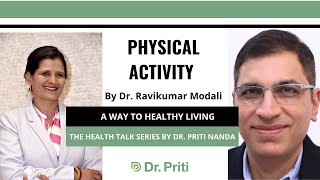
In this YouTube interview hosted by Dr. Priti Nanda Sibal on the "Food, Medicine, and Lies" channel, Dr. Ravi Modali, a lifestyle‑certified physician with over three decades of experience, discusses how physical activity should be viewed as a daily way of life rather than a separate, intimidating exercise regimen. The conversation begins with the confusion many patients face about exercise and its perceived limited role in health. Dr. Modali introduces four hierarchical levels of daily activity—sleep, resting activity (sitting), active way of life (light walking, standing, chores), and peak performance (intense sport or training)—and explains how each level impacts the body’s wear‑and‑tear, recovery, and overall balance. He highlights the health hazards of prolonged, meaningless sitting, offering simple break strategies (e.g., 2‑minute micro‑breaks, standing desks). For the general population, he recommends at least 30 minutes of moderate‑to‑vigorous activity on five days a week, emphasizing regularity over occasional long sessions, and suggests mixing aerobic, anaerobic, yoga, tai‑chi, or other modalities to support neuro‑vascular and autonomic balance. The dialogue also covers how movement influences the sympathetic‑parasympathetic nervous system, posture, and overall balance, introducing a practical “30‑second stand‑straight” challenge that can be progressed to eyes‑closed or uneven‑surface tests. Dr. Modali shares a structured self‑assessment questionnaire that captures posture, sitting time, activity frequency, intensity, duration, symptom tracking, and food‑movement pairing, designed to guide individuals and clinicians alike. Safety cautions for older adults and the importance of professional guidance are underscored. The interview concludes with a call for viewers to submit short video clips of their challenges, reinforcing the message that small, consistent changes lead to significant health benefits.
Chapters
Welcome, Dr. Ravi, to our next channel of Food, Medicine, and Lies. So, Dr. Ravi, as you know, I started Food, Medicine, and Lies channel during COVID times, and the reason why I did it was that there was a lot of information in the market, online, offline, And people were getting confused. So I thought how good this is an idea, you know, to get experts on the channel and help people find out what they read on Google and WhatsApp and what is the real truth behind it. So welcome, Dr. Ravi.
Absolutely, yeah.
Thank you. So welcome, Dr. Ravi, to our channel. And Dr. Ravi is a lifestyle certified physician He is an MBBS from Mumbai College, and he brings with himself more than 3 decades of experience. So please welcome Dr. Ravi, and the topic for today is Physical Activity: A Way of Life, right? And I'm sure, Dr. Ravi, everybody is now curious to hear what is it that we are going to share in this topic, Physical Activity: A Way of Life. So, Dr. Ravi, when you proposed this topic, what was in your mind?
Well, I think lifestyle medicine, as you rightly said, Dr. Preeti, it's a daily thing. Each and every day we live our lifestyle. We want to be the best, and rightly you pointed out that, yeah, it's COVID times. People have become very sensitive to the way health is behaving, the lifestyle, what to do, what not to do. So yeah, absolutely fair, and thanks for beginning these sessions. You are doing a lot of help to people.
Thank you, Dr. Ravi. Thank you, thank you. So Dr. Ravi, what happens, you know, whenever patients come to me in the clinic, they start by saying, "Doctor, I'm not able to exercise so much," or, "Doctor, I'm exercising for 2 hours, but I'm still not losing weight." or I'm feeling tired, right? And I have been trying to tell them that exercise is just 20% of the lifestyle, right? And now more than ever, it is time for people to know that exercise can be your friend or enemy depending on how you use it. So can you put some light on this fact that how exercise and our daily activities, they need to be looked differently and how health and fitness need to be looked differently.
Perfect. I think very nice opening question, what common people have. I think when the term exercise is used, it already begins to tire anybody who thinks about it. Exercise is something which is outside in, Somebody is telling, somebody is doing, let me try to match. But when you look at daily activities, it looks like, oh yes, daily I've been doing this. So can I do a little better? You know, what would it be? And then, you know, is there a guidance? Is there a way out? I think that's where the lifestyle medicine practice comes into play. It's about how in the routine way of life, what are happening good to you and you're happy with it? What are not happening good to you and you want to do something around it? I think that's the foundation of how it's another people-centric thing, physical activity, and not really exercise from the beginning. Wow.
And I think this is from where people have now started saying that sitting is the new smoking.
Absolutely. Yeah. And I think there is a reason for that. I think if I tell 2-3 terms, I think it starts becoming clearer to the people who are listening. One is rest.
Right.
One is just sitting without any reason.
Right.
The other is our work compels us to sit, but we need to take breaks if you're conscious around that.
Right.
You know, so compulsive sitting and a meaningless sitting. So between these, now people can play, you know, their choices. I'm sure when people listen to this already, they're thinking of, you know, I can do that little thing. I can take small breaks, 2-minute break when I'm sitting for more than half an hour time. Or my workplace, you know, can I choose a standing place at least half of the day? And these are the simple things, you know, where it, the nice breathing happens.
So Dr. Ravi, I'm very happy to hear this. You know why? Because I think this ad came, walk when you talk, many years back. Remember? Somehow I was going through this phase of life that time when I was working 16 hours a day in a corporate profile, traveling in flights. Sitting in meetings and, you know, suffering from diabetes, hypothyroidism, cervical, migraine, and I can go on and on. And this ad came, and somehow there is a groove in my mind which has been made now. If you call me right now and I pick up the phone, the second thing I do is I get up from the chair and start walking. Wow, thank you. So, and I think that helps me because if I'm on the phone for about 2 hours a day I am walking slowly or fast, that is, I, I don't define that, but I'm right. So time to Dr. Ravi. But Dr. Ravi, when you say that exercise can be our enemy, right, uh, can you put some more light onto it? Because I think that's one big mind or belief system which We have to clarify before people start appreciating the importance of daily activities in their life.
Absolutely fair point. So let me put it this way. There are 4 levels of activity what all of us do every day.
Yes.
The basic thing is sleep. You know, the entire body is relaxed. The next level is resting activity, you're sitting and doing something.
Right.
One level higher is active way of life— walking, standing, or whatever, jogging, you know, not really straining yourself.
Right.
And the fourth one is the peak performance, where, you know, the highest level of activity what you're doing each day.
Right.
So typically, maybe for a homemaker, it could be maybe the certain activity, the domestic chores, that it takes a lot of intensive activity out of them. There could be someone fitness freak who says, you know, I do half an hour of aerobic activity, I run every day and I try to compete, you know, maximize my time. Somebody would say, that is my peak level of activity, right? If it is sportsman type of personalities, they do 6 hours of intense activity type of a thing just to maintain their level of fitness. So these are the levels where, you know, again, I'm just repeating to make it simple. Sleep, resting activity, active way of life, and peak performance.
Right.
So within these, I think in the peak performance, the wear and tear is very high. It commands rest in between, you know, the peak performances. And of course, hydration, nourishment. I think you're the master around that, how to maintain the nutrition and, you know, the physical fitness, not to stress the body systems, but to keep the peak performance and the matching health. What is needed to maintain peak performance. The other extreme is sleep, where body has an automatic healing system, natural healing system. So you sleep nicely for 6 hours to 8 hours, the body recovers from the wear and tear. You know, so that's where I think the balancing for each level is important to keep exercises out of being an enemy and making exercise a friend by using the physical activity route and improving on. The performance.
Perfect. So Dr. Ravi, one thing when you were sharing this came to my mind was everybody wants to be at their peak performance, right? The word in itself is very tempting. We have a lot of coaches who train people to stay at their peak performance, right? And you rightly mentioned that, you know, there are these Bollywood stars and Hollywood stars who spend 5 to 6 hours working out But then the remaining hours, 18 hours or, you know, 20 hours, they spend taking care of their nourishment, their supplementation, their sleep, their hygiene, all of that stuff, right? So they are still able to make a balance. What is an ideal balance you will recommend for people? For a normal person who is working 8 hours a day in a sitting job, Right, what will be your guidelines to that person?
Absolutely. I think, yeah, you gave some cues about 8-hour sitting job. It gives the objective specifics, but I will give 2 inputs. One is the population-based understanding where it's, it's a little more prescriptive in the sense people have benefited out of that, and hence you can try. The second aspect, which is the most important, is Every person has a choice they can prefer and they have their way out. And that's where when I use a coaching method of lifestyle training, that's where it comes in. So when people own it up, do it, it works. But let me give you the perspective, population-based first. It is recommended that minimum 30 minutes of moderate to aggressive physical activity, if it is done, then people are able to maintain their health and fitness levels. Maintain is the term. If you want to improve your fitness, then you have to stretch a little more beyond 30 minutes. Yeah. And also there is also a point where a minimum of 5 days in a week, regularity becomes important more than actually doing in one go. Regularly, if you're doing it, then the body is getting entrained, muscles are getting trained, joints, the body systems, blood circulation, hormonal systems get adjusted. And that is the time when actually people are improving on something, either reducing the weight or improving on the muscular performance or the fitness. So regularity is another. And the third aspect is the type of activity.
Yes.
Now, in the type of activity, aerobic is one, anaerobic is another. Just balancing the neurovascular system, you know, just how we are able to balance ourselves is also an act like what yoga teaches us. You know, so there are varieties of activities what people can choose or get prescribed for their health conditions. So that is what is prescribed. From the personal choice point of view, you know, it begins with what did I do yesterday? How was my experience when I was sitting for 8 hours? Did I feel any backache after 4 hours? What was the time when the backache began? Or I could sit 8 hours completely, you know, without any issue, you know, and I was happy. So then personally, there'll be varieties of these things. So from that point of view, either what is the simple thing change what people can bring in to either reduce the symptom due to excess sitting, or what— how will I maintain my physical activity to improve whatever goal I have? Now clearly, excess sitting will take people to obesity. There are no two ways. So either proactive and want to do something proactively without having any symptoms or any conditions and improve their fitness levels by either adopting 30 minutes of severe activity in a day, maybe gymming, so that muscles are fit, and then that sitting time is more relaxing to the body and mind is able to concentrate more, you know, definitely that type of a balanced activity which becomes a personalized solution.
Yeah, so Dr. Ravi, thank you for this, but you know, you said something which has me hooked on it completely. That was balancing. So can you elaborate a bit more on that? Because I personally feel life is all about balancing. Excess of anything can actually make you fall down.
Absolutely.
So yes, so something more on what you meant when you said that, you know, exercise helps you balance, and is it parasympathetic and sympathetic nervous system which gets balanced, right? Is it your muscles which build and helps you maintain your balance and a better posture, right?
Absolutely, yeah. So fantastic. I think you have your term, I have my term which says excesses are as harmful as deficiencies.
Oh yes.
And hence optimization is the only way ahead for anybody. So from that point of view, I think you brought out the correct points. There are nervous systems. One is what we consciously do, and there is a subconscious nervous system, which is the parasympathetic and the sympathetic nervous system. And also, I think the area where you have mastered neurohormonal balance, how our hormones are aligned with the neurotransmitter, almost every second we are living that, you know, how We feel that balance. So these are the technical terms which essentially we use as doctors in practice. But let me give a very simple way how people can check their balance, and it connects to every part, every system of our body. Now it's a wellness challenge. Now whenever we say physical activity, I like throwing up challenges. So this is the type of— I have started walking, Avi. So it is like this, in a very simple way, for any age group, in a simple way, it can begin with a 30-second challenge. People just need to try stand straight, right? Stand straight, you know, and try to stand straight for 30 seconds, right? And when I say stand straight, all posture-related disorders or whatever changes, they should try to align which means try to straighten the body. And typically, you stand against a wall, you see, you know, 3 points touching— the head, back, and the base, and maybe the foot, the toe, or the foot behind. So 4 points touching, which you try to maintain without using the wall for 30 seconds or 60 seconds, 90 seconds challenge. It begins with that basic thing. Okay, now where systems come into play. People can try standing with their eyes closed and ensure that the body doesn't sway. So they are feeling from within whether I'm able to stand straight or any sways are there, I sense it from within and try to balance that. That's where an autonomic nervous system comes in, right? Yes, people will stretch their challenge and try to Do it on an uneven surface. Okay, say maybe standing on a stone which is not flat, and it should be— I mean, you should not be taking any risk of falling down. Stone has to be firm, stiff. Only it should not be flat. Maybe it's a curve or something. Oh, not that surface. You try to stand there and maybe on your— just on your foot or just on your toes and try to stabilize yourself. And again, take a challenge. 30 seconds, 60 seconds, can you stretch? Now these are the ways how it builds on a challenge, you know, little by little, and it actually ensures the entire body is working as one whole system and to make you possible to hold your balance for as long as possible. So I think that's the first insight I want to share.
Perfect, and I am going to float this channel with this video and I will be waiting for people to send their pics and messages there.
Oh yes, 30-second clips or 90-second clips.
Exactly, exactly, right.
So, but one caution I again wanted to highlight that people should not take risks. Typically, elder people can try this, but it is strongly suggested that ensure safety first. You know, maybe there should not be any sharp objects around and keep a chair in front of you So that, you know, whenever you're feeling unstable, first your hand will go and hold the chair. So please don't take risks. We are doctors. We are very sensitive about taking precautions before you try anything different. So with that caution, yeah, and you do challenge yourself and raise your potential to the highest at whatever age.
Yes, very right. And what do you have to say, Dr. Ravi, about posture?
Okay, so posture is a basic thing what comes first. Before recommending any exercise or activity, the first thing what has to be seen is posture, whether people have the natural posture which they are endowed by birth. In lifestyle, in life, many things happen. Our body shape changes, we put up weight on some part of the body, bones tend to compensate for that. So many changes happen during life, but it is possible to reverse all of these. Either by physical— I think yoga has done a great, good job, and yoga masters are brilliant around that. But as doctors, we have learned anatomy, physiology. Yeah, so if you're just in anatomy and physiology, I think we are able to check as doctors whether either yoga or tai chi or whatever methods, whether they are working good for an individual or no.
Exactly.
Posture control, typically maternity, after delivery, bone changes for the lady and how it comes back to the normal. Bone strength has to come back to normal, the joints have to come back to its tone, and the muscles which actually hold the joints firmly, equally they have to be built on. So these are the perspectives when, you know, the simple thing when we say a posture challenge, stand straight with your eyes closed for how long, these are the observations what typically we see. And that's why I think rightly what you suggested Telemedicine is on nowadays in COVID times, so people cannot travel to doctors, but they should not miss out on treatment. So as you are pointing out, clips— recording your clips and sharing it to the doctors, typically lifestyle physicians or a functional expert like you— we are able to observe, you know, what all things can be balanced, and the recommendations become so easy and absolutely workable for people.
Exactly. And I think small, small changes can lead to big results.
Absolutely. Start small but aim big.
Yes, right. For example, you know, in Hindi we say, boond boond karkay ghar aap bari jata hai.
Yes, helpful.
But the important thing is that the ghar aap, that the matka, has to be kept below the tap. So the right positioning, right guidance is very important. Otherwise, you will keep doing yoga or your exercise, and instead of improving, maybe you are deteriorating day after day just because the positioning is not right or your mentor is not right. So I think very rightly you've put it, Dr. Avi, that if there is a problem, reaching out to expert is what one should not shy away from. And now it has become much easier than before. So, Dr. Avi, Do you have any questionnaire or something like that which people can do on their own, right? We can leave it in the checklist box below the video and understand where they stand. So for example, you know, I am doing a lot of immunity webinars these days. One of it is coming very soon on 18th of July again. So what I've done is I've made a small immunity checklist. So that first people get to know whether they need to work on their immunity or not. You know, there would be few people who are just doing right things for their lifetime, so they don't have to worry about their immunity, right? But there are others who think they are fit, but their immunity is just imbalanced in a way or an extent that they really need to take action.
Absolutely. That's so nice of you.
Yeah, and very simple is, you know, I tell people, if you've ever had yo-yo weight, yeah, your immunity is not right. Please do not ignore it. Now is the time to focus on it. Yeah, so in that perspective, for physical health, do you have something like that? And I am sure you have.
Absolutely, I do have. I do have, very happy to share. I think lifestyle medicine is something we have learned from people, about observing people, how they have lived. Only we have applied the medical side of mind of how the non-medicinal approaches will work. So happy to give it back. So I have a form. Now I'll tell you the structure of the form, what it is. Now physical movement, I think everybody can relate. I think immunity, still it's tough for people to know, they depend on a doctor. But this form is such that setup, as people will enter it, they will start getting ideas. So I have physical movement in which it begins with posture and how they can check themselves, you know, the amount of time what they're spending in sitting, amount of the time what they're spending in standing, or, you know, some activities. And I have classified into different sections, like balance is one section, stretching activities another section, yoga, tai chi is another section. And then it goes to even competitive sports and adventure.
Okay.
You know, maybe in a week, how many times I do, or they can also put in annually once if it is as frequent. So they can be creative around entering. I have given specific sections which are important. One is the number of days in a week.
Okay.
You know, people can enter for each level of activity, how many times they are doing in a week. Then intensity. Light, moderate, or intense. Then it is about when they do an activity, how long they're able to do— 30 minutes, 60 minutes— and did they challenge themselves to stretch their performance, improve their performance. So that's the structure, it's there. So which means the proforma itself is going to give ideas even without taking any paid consultations, the solutions they can build. Only thing is when they want to be methodical They want to have, you know, some goal-oriented thing. They want to achieve something safely, securely. I would recommend to please consider consultation where things will be much better. They will not take so much risks. Otherwise, you might be taking risks just by stretching yourself. Injuries will happen and then you need to consult a doctor versus in lifestyle. If you use lifestyle physician early on, it's about methodically everything. So progressively you're only improving your health without taking risks. And I have another part. I've also included food along with it because food and exercise go together. So I have a checklist around food which people can think. And the most important part which people would have— would not have got anywhere else is about the effects and affects. With these activities, there will be people who experience some conditions, or if they have some condition, those conditions have to improve.
Right.
I have a section where they can express either that the activity is improving day by day, or it could be they're feeling fatigue day by day. Symptom has come, they are feeling pain in the chest, or they are feeling giddiness. You know, they can note down those symptoms. If they are having some diseases, they can note down the diseases and they can mention about that, you know, how the lab parameters or whatever they pay, they be monitoring around there. Yeah. And also for, uh, people who are working in corporates or working in office, I have mentioned one interesting activities of daily living. Okay, interesting activities of daily living, which means maybe software engineer, the most interesting activity for them in the daily living is sitting and working on the system, right? That needs to be balanced. So they can't compromise on this excess sitting. But what are the small changes what can be done to make that interesting activity more interesting? So there is help available there too. The type of food they consume, the type of activity what they can put in between while they are working and after work and before work what they can do. There is a methodical way of modulating. And the second aspect is the vital activities of daily living. Necessarily those activities needs to be done. Sleep is important every day. Having a bath is important every day. Interesting activities. I think people can play with it, and yeah, medical guidance is just a follow-up for them.
Perfect. So this sounds very interesting, Dr. Ravi. In fact, I am waiting for this questionnaire, and I will fill it. I'll be the first one to fill it, and then if I need guidance, I'm gonna connect with you. Right, but it's been a pleasure talking to you, Dr. Ravi, and, and somehow, despite the fact that, you know, in my obesity and diabetes reversal programs, exercise plays an important role, and I do work on aerobic, anaerobic, yoga, tai chi, but something has shifted within me today, and I am sure it would be when the viewers will hear us And we are going to share with you whatever responses we get on the challenge. Thanks for being with us, and it was a real pleasure talking to you and understanding exercise, physical fitness, posture, balance in such a methodical and organized way.
Pleasure was mine too. I think you were a great moderator and you brought out the goodness out of me. Lifestyle is all about fun, so yeah. Let as many people enjoy in whatever ways they can understand and reach it out. We are always there to help.
Thank you, Dr. Ravi. Thank you.
Bye-bye. Have a great day. Bye. Bye.
More from Dr


Understanding Chronic Acidity: A Holistic Approach to Better Digestive Health 🌿


BHRT - transformational health journey if a 42 year old women #BHRT #HormoneBalance




Transform Your Health Naturally with Functional Medicine | Dr. Priti Nanda’s Success Story


hypothyroidism and ozone therapy - talk at Ozone Conference by Dr Priti Nanda Sibal
