Practical eating Tips for Diabetics with Muscle Wasting & Weight Loss
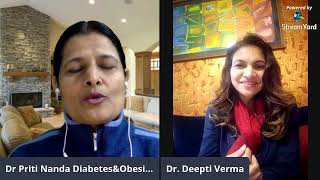
Dr. Deepti Varma explains why diabetics lose muscle and weight, and how to fix it. Evening weight training plus adequate protein (tofu, paneer, legumes, eggs) rebuilds muscle. Fasting glucose can be higher than post-meal glucose because of liver metabolism, not pancreatic failure.
Chapters
Welcome, friends, of Food, Medicine, and Life. So today, today, and that is, and that is practical, practical dieting tips for diabetics. Who are losing weight and are not able to gain weight. So we have with us Dr. Deepti Varma. Dr. Deepti Varma, welcome Deepti! Hi, welcome Deepti!
Hi, Dr. Preeti, I hope you're doing well.
Yes, so Deepti heads the beauty head at VLCT. And without wasting much time, I am going to start asking some questions. So, Deepti, we are 70, we have 1 million diabetics.
Yeah, unfortunately, right?
Right. Yes, yes. So, so, and in a lot of them, I find, I find, is higher than the higher than the PP. Anything you can suggest?
Well, there are lots of things because I actually— yes, I mean, why don't you give the introduction and then we can carry on and I can answer your questions, right?
So, right, so this is the hardest diet because I find in my mind to control. Out of 77 million 1/3 are falling in this group, right? And that is the reason I have Deepti here to share her knowledge with us and help 1/3 of the Indian diabetic. So Deepti, what is it that you do in the evening? Yeah, so that the breakdown which happens— which happens—
well, there are lots of things. I mean, there's something like fasting blood sugar and there's something like a postprandial blood sugar. So we all know that. So at times it does happen that fasting blood sugar goes higher than the PP because the fasting blood sugar gets handled by the liver, whereas the postprandial one gets handled by the pancreas. So there is a difference in the metabolic activity. So actually, the blood sugar level depends upon many factors. It is not just about food and eating. There are other factors also, like the exercise regime that the person follows on a daily basis. And besides that, also the metabolic response to the foods consumed. So that, and of course the type and the quantity of the diet consumed, which is very important. People focus so much on the quality of the diets, yes, but Even the portion, the amount of food that we have, you know, that also makes a major difference to the blood sugar profile. So yeah, when it happens that the postprandial blood sugar becomes lower than the fasting blood sugar, it has— it is something to do with, you know, the exercise regime and also the amount of the complex carbohydrate that people have. So what I would recommend for these people is like in the evening time to actually go in for some good physical activity to do with muscular workouts. That is something to do with weights and weight training. And for people who are not able to do this, can also go in for the yoga. So that also works really well because that of sorts can be said to be a muscle, you know, muscle strengthening workout, or, or kind of something that exerts pressure on the muscles. Yeah, so these are the two things, of course. And after evening, it is very important not to consume a very high amount of simple carbohydrates. So has to be a lot of fiber and fibrous foods, and especially something that is to do with the probiotics. That really works well towards the evening. So yeah, these are the 3 key things I would recommend a person to do. And of course, needless to even say that they should avoid all the processed foods like bread, biscuits, uh, rusk, and carbonated beverages and things like these. Yeah. So these are the 4 key points I would suggest to them.
Thank you. Thank you, Deepti. So for some reason, so I'm going to keep my question very short. All right, what are the special probiotics you will recommend?
Uh, the special probiotic I would recommend are of course yogurt, which is so important and which has so much to do with Uh, you know, like in Indian cuisine. So yeah, buttermilk and yogurt is something because it has been researched that the lactobacillus has a huge impact as a role play in management of diabetes type 2, and these days even type 1, as per the researchers which are recommended. Because, um, you know, like having these probiotics have a direct impact and a correlation with the adiposity in the humans. So yeah, that's something. So yeah, of course, curd. Second would be sauerkraut that can be made at home with the cabbage, and it's like a little fermentation of the cabbage. And the third thing, very important, are the fermented products. And in Indian cuisine, of course, we have so many food products which are made after fermentation, like idli, dosa batters, and something which is kept overnight. And anything which has yeast in it also is a very, very good probiotic. And besides probiotic, it is very important to consume even the prebiotics. You know, there's something called prebiotics, which of course goes into the intestine and it makes those gut microbiome. So that is also considered to be very important. So yeah, bananas are very good. I mean, unlike people think— people think that bananas are like a villain to a diabetic, whereas it is not like that. I mean, bananas are the foods which are low glycemic index. They have a glycemic index of just about 50. So it becomes very important for people to have bananas. It's a very, very good prebiotic and strengthens the gut microbiome. And of course, besides that, it is onion and garlic in, in whatever forms people can consume, as much as raw if possible. And of course, the cabbage, cauliflower, and the broccoli as vegetables, and the citrus fruits, which are considered to be very good prebiotics. So this is a very normal range of the foods which are available all around us. So yeah, this is what I would recommend.
Wow, thanks, Dipti. Thanks, Dipti. Deepthi, these patients also—
yeah, yes, they do.
So your suggestion or suggestion on what will we do to improve upon the muscle?
Okay, so very important thing for the diabetics is to have a good quality protein. So generally, diabetes and cardiovascular disorders are very closely correlated. I'm sure we all know about it. So we don't normally recommend the animal protein to diabetics. I mean, because also because of the cholesterol levels, you know, intake which should be low in a diabetic. So hence, you know, we would like to give them something which is a good quality vegetarian protein. So in that comes tofu, which is very, very good. I mean, which is made from soya bean, which is also called soya bean paneer or whatever. So yeah, that's considered to be very good quality protein. And besides that, the milk protein of course can be taken in the form of chhena or the cottage cheese which is made at home. I mean, we would not recommend the paneer that we get from outside from the market because that's very rich in carbohydrates and arrowroot, which is a simple carbohydrate. So the paneer which is made at home, you know, if we have to curdle the milk and we have to make it at home, so that is a cottage cheese which, which we recommend. And also there are the sattu, I mean, which is called superfood in today's time, which is considered to be a very good quality protein also in terms of bran chain amino acids, which is a range of, you know, it contains plethora of the amino acids, and especially the branched-chain amino acids, which are considered to be very important in muscle building, okay, which are valine, leucine, and isoleucine. So out of all the amino acids, these three are called branched-chain amino acid. We must have heard about it, you know, because people who gym regularly, they consume BCAAs as a supplement. Here we are giving them sattu, which is very rich in BCAAs naturally. So yes, that actually strengthens the muscle building, and it would be very, very, uh, good for a diabetic. And also helps in the insulin, lowering the insulin levels as well as the blood sugar levels. So yeah, these 3 are the primary foods. And of course, if somebody is an ovo-vegetarian, then they can consume eggs because eggs are also supposed to contain all the 9 essential amino acids. So it has a very good amino acid profile, so very rich in protein. And besides that, of course, the cereals and pulses and the legumes which are there should be considered, and, you know, the intake should be done on a regular basis. So yeah, these are the foods that I would recommend in terms of protein. The other things is a good workout. So diabetics have to do actually some kind of a weight training and a muscle strengthening workout because just intake of protein is not going to build the muscles. When we work out or put pressure on certain muscles or the parts of the body like abdomen or arms or wherever we would need the muscle strengthening from, we would notice that, um, you know, you, you start putting on lean weight on that area. So that's also because the testosterone hormone and the human growth hormone, they rush to the area which is being pressured by the weight, and wherein then protein would come and synthesize muscles on that area. So very important to work out, which is number 2. Okay, number 3 is always work out in the morning, especially when you're doing the muscle strengthening and the weight training. Of course, you can do a bit of it in the evening also, but morning workout is always better because we are on a very high metabolism in the morning times. So everything that happens like 10x speed, you know, when we do it in the morning hours. So that of course very important. Then the amount of water that we consume. So just to let you know that our muscles are 75% water. So that means that it is just 1/4 of the muscle ingredient, which is the solid ingredient, and 3/4 of it is water. So if you do not consume water, it would be difficulty in making the muscle mass optimally. So that's another thing. And the next very important thing is the rest. So just remember, one very important aspect is that we synthesize muscle mass only when the body is at rest, not when we are working out. Okay, so reserve those couple of days as the rest days, work out for the 5 days. And the last but not the least, the fat that we consume also contributes to the synthesis of the muscle mass, but it has to be a good fat like polyunsaturated fatty acids and monounsaturated fatty acids. And of course not trans fat so much. So yes, fat consumption is also very important, but obviously the person is a diabetic, so we would not recommend the person to consume fat in very amounts. It has to be in the optimal amounts of about 4 to 5 teaspoons per day. So that's what normally we recommend, but a good healthy refined oil fat. Yeah, that's what— so these are the 5 points I would recommend for the diabetics, you know, to synthesize the muscle mass.
Wow, wow, wow. So my voice is— my voice is equal.
It's not equaling to us. It's very, very sweet to us.
Thank you, Dipti. So Dipti, this patient side is very difficult to increase weight. Increase weight.
Okay.
And because of this, what happens? Because of this, what happens is they stop exercising. Exercising.
Yeah. Oh well, exercising is going to make them gain weight instead because the muscle mass is way more heavier and dense compared to the fat mass, right?
So this you've already addressed.
Yeah.
Anything else? Anything else? You will want to add weight.
They can add weight. Okay, so weight is what? Body. Body is made up of bones, muscles, fat, and water. Okay, these are the only 4 things that can make the body weight. So of course the bones has to be mineralized. One has to be very good in amount of the calcium intake that we consume, and especially vitamin D3. And these days we see that most of us have got the deficiency of vitamin D3. So that contributes to a lot of weight loss also because your bones are getting more porous and they're getting, uh, you know, like, uh, demineralized. So that weight also goes down. So that's number one. Of course, water intake has to be very good. And then the fat weight has to increase also because there is always some amount of fat that should always be there as a reserve energy resource in the body. So that is also very, very important. So consuming a good amount of fat and not be very scared that we are going to become fat. If somebody is losing weight, I'm talking only about them. So here I'm not talking about people people who are already obese, because, you know, obesity also contributes to diabetes or insulin resistance. So yeah, if somebody has been losing weight drastically and are going below their ideal body weight, it is only for these, you know, only for those patients. So yes, a good amount of fat would be required. Good amount means again 5 to 6 teaspoons, not more than that. But a healthy fat would be recommended, otherwise the impact is going to be just the opposite. And a good quality protein, as I mentioned, in every meal. Especially after a good workout in the morning, one should always consume a good amount of, you know, like a good protein, something to do with sattu or something to do with egg or something to do with paneer, you know, that kind of, or a sattu kachila or something like that has to be made. Besan kachila can also be used, but then along with lots of vegetables, because along with protein we need to actually also give a lot of fiber. Only then it gives you the maximum impact. So yeah, these are the things I would recommend. And a good workout, of course, as I always already mentioned.
Beautiful. Beautiful. And you know, we have limited time, 15 minutes.
Okay.
As we had discussed.
Yeah.
And I'm quite hopeful that it will be very useful for people.
Right.
And diabetics who are losing weight, these changes. Yeah, they will come back to us. We have started gaining more and more.
I hope so. I'm sure if people actually follow diligently— what, otherwise you're always there to help them. So now they can go back to you.
It matters. It matters. Thank you for your time, for your Sunday evening.
Thank you so much. It was my pleasure always to be with you and of course your patients and friends. Thank you, thank you, thank you so much, and wish you all a very happy new year and a very, very, uh, warm, warm time. Right now it's very, very cold in the North India, so, so right, have fun, take care of your health. And, um, well, as Hippocrates always says, let food be thy medicine and medicine be thy food. So we've actually made a big circle, you know, in the last 150 years and come back again to the point where again we can say that let food be thy medicine and medicine be thy food, because food and the lifestyle that we all follow and practice is of utmost importance, especially when it comes to diabetes, since India is called the diabetic capital of the world, unfortunately. And this is the single most unresolved challenge we all have been facing of late. So let's fight this menace of diabetes together, and please stay healthy and happy. And thank you so much, Dr. Preeti. Always a pleasure to be with you.
Thank you. Thank you very much.
Bye.
More from Dr


Understanding Chronic Acidity: A Holistic Approach to Better Digestive Health 🌿


BHRT - transformational health journey if a 42 year old women #BHRT #HormoneBalance




Transform Your Health Naturally with Functional Medicine | Dr. Priti Nanda’s Success Story


hypothyroidism and ozone therapy - talk at Ozone Conference by Dr Priti Nanda Sibal
