Sleep Well to Keep Well: Cannabinoid Medicine for Insomnia | Dr Priti Nanda Sibal | Dr. Bhanu
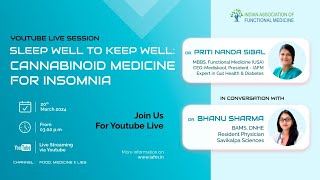
Dr. Priti Nanda Sibal and Dr. Bhanu discuss using CBD and THC to treat insomnia and other conditions. Cannabis contains over 160 active cannabinoids; CBD reduces anxiety while THC helps with sleep onset, and they work better together. The key is starting with low doses, going slow, and taking periodic breaks to avoid tolerance.
Chapters
Hi, welcome everybody and thanks for being a part of this. Dr. Bhanu, I'm very, very happy to have you here.
Thank you so much, Dr. Preeti. Thank you so much for having me here. Thank you.
And you know why I wanted to do this session with you? Whenever we prescribe CBD oil to our patients they have a lot of questions and the first response they give is, do you have any other option available?
Yeah, this is something which— yeah, this is something which we really need to change the mindset of the people. And mindset can only be, you know, incorporated once there is more of awareness. People need to understand this is a herb And if we— and not a single substance in this universe is there which has no medicinal properties. In fact, we eat chapati or drink water also in a wrong manner, then they can also create a lot of side effects into our body. Then this is something which has been medicinal, part of prescription of doctors over the years. And I mean, people need to be a little more aware, maybe via us, maybe because of the— I mean, the healthcare professional has to bring lot of effort to bring that awareness. And they actually have to teach the people that you have to unlearn many things that they have learned over the years. The preconceived notion has to be removed. So option— what?
Yeah, why do you say that people should take CBD oil?
Actually, see, this is a herb and it has more than 160 active compounds into it. They are known as cannabinoids, right? So now people have, uh, over the years they have actually associated this cannabis or the CBD oil, um, with this thing like euphoria or the high feeling, right? So this is something which they knew about it, but the fact is not this. It has more than hundreds of the cannabinoids which work and has a lot of therapeutic benefits. So it is a THC which has intoxicating effect, which can give you that high, right? But then you have another compound, another cannabinoid, which is known as CBD, which has many, many medicinal properties into it. And in fact, when we talk about the THC also, yeah, in a higher quantity and in a larger dosage, it has that euphoria or the high-creating impact. But then again, it also has its beneficial properties. The therapeutic properties are there, like THC will bring you the onset of the sleep, THC will help you— it is— it has anti-nausea properties, antispastic properties. So that is why we always say awareness is much important. It has a lot of beneficial properties also. Together they work in a synergistic manner to bring benefits, right?
So if you can elaborate the indications for CBD, then for THC, and then combination.
Yeah, so CBD basically has lot of therapeutic benefits that I have already mentioned. One is it is antioxidant. Second, it is anti-anxiety, which actually people are really battling. Again, that's a painkiller, will help you in maintaining the sleep. And we know Sleep. If you're not sleeping properly, I mean, you're inviting a lot of diseases into your system. That is all about the CBD. But when we talk about THC, uh, in trace, when you take it, especially when in the form of the medicine, then it is anti-nauseatic, it is antispastic, and of course it improves the onset of the sleep, right?
What are the side effects people can experience with plain CBD or CBD and DHEA together?
See, actually, um, I don't see it as a side effect. Whenever you incorporate or you start with some kind of medicine, it will definitely— it is meant to bring some kind of change into your body, right? If we— I mean, I always give an example to my patient. When you just, you know, try to arrange your wardrobe, at one point of time you will find it more chaotic. More unorganized, but then slightly and gradually it will bring and, you know, uh, it will become a clear and a clutter-free wardrobe, right? So when we talk about this, initially people might feel little drowsiness, people might feel a little bit of dryness in their throat. This is all what generally we see. And at times we see that the people say that, yes, we, um, little bit of the palpitation could, could they, could experience it. But this is something which is very rare. The majorly which people actually come back to us is that we feel a little bit of drowsiness initially when they started off. So this is something which they experience, but after, when they continue with their medicine, after 5 or 7 days, it just pass away. So that's a temporary thing to happen.
Great. So Dr. Manu, are there any patients, anything in patient's history which tells you that this patient should not be given CBD or THC combination?
Yeah, definitely. This is something which a healthcare professional, and in fact the patient, should also take care of. This one, the schizophrenia patients, right?
They shouldn't—
maybe they, they are not the schizophrenic, but then, uh, if they— it runs in the family history. One. Second thing is that it is not about that the patient, uh, who all are heart patients, it is contraindicated for them. But yes, if they have, they should really notify this to the doctor so that the dosage could be, uh, could be advised in that particular manner, right?
Any other things in history? Any other thing? Any other type of patients who should stay away from this?
I think generally the heart patient should be careful about it, and to schizophrenic, it's a big no. Right.
When you say heart patients, can you elaborate a little?
Yeah, that's the coronary, and especially when the people are there with the pacemakers.
Great.
And also the people— because, uh, this particular herb has a tendency of lowering down the blood pressures, so people who have a tendency of a very low blood pressure, they should notify this to the doctor. I'm not saying it's a big no for them, But yes, they should look at that. Yeah, please tell me.
No, I said you have to be careful in these patients, and I really want to—
perfectly, perfectly. Because that's why we always say it has to— I mean, I always say to my patient, what do you mean by over-the-counter medicine? Everything, everything should be, uh, should be consumed under the supervision of, of a doctor.
Anything—
what I mean, see, in fact, we talk about the neem also, we talk about the moringa also. They all are antioxidant in itself they are medicinal properties. But what is right for you, what is that, what is the correct indication where you have to stop it, this is only the doctor who is, you know, uh, better going to judge and explain it for you. So now when it comes to the cannabis also, it is absolutely safe. There are few contraindications, but then if you notify, what is the harm in taking or starting any medicine in the supervision of physician?
Right. So, Dr. Banu, you know, in last few years cannabis has really come on the prescription of doctors, right? In India, this is something which was used many, many, many years back and we have a huge history of benefiting from this. Yeah, I want to know your opinion on some very basic conditions where this is pretty First is sleep.
That's my favorite topic because, you know, uh, yeah, because in Ayurveda we always say that the sleep is the one pillar, major pillar. How important the diet is to you, it is equal— I mean, it's a second diet for your mind and your soul. It renews you, right? So at times what happens is when we, uh, when we start prescribing the medication to the people in terms of pain in terms of migraine, for the dysmenorrhea, we always see that the pain, the anxiety, and whatever the other ailments for which we are prescribing, ultimately that problem is debilitating, or, you know, it is disturbing their sleep. And when you are not able to sleep properly, in— it is actually bi-directional. If you're not able to sleep properly, you will experience more of pain. And because of the pain, if you are not sleeping, I mean At the end of the day, both of them are bidirectional. So what I see is that when people sleep well, especially the cancer patients are able to sleep well, the anxiety people are able to sleep well, so the healing goes faster. So in terms of sleep and in terms of anxiety, it is definitely helping people in a very good manner. And you know, when I always treat my Parkinson's patient Parkinson's patient, a lot of stiffness is there in the body, and then they say to me, ma'am, that's what people say to us because the stiffness and the rigidity that they have in the body. If we are able to help those people out, if they are able to sleep proper, I think my bit of part is done, right?
So which stage or phase of sleep does this go on?
Actually, uh, majorly, you know, sleep is— we have, you know, broken down it into the various stages. But yes, it is actually working on the entire sleep architecture. We have seen that's majorly the third stage, that the deep sleep stage, it is really working well. And once you have that stage done, I mean, you wake up very restful because the major part why you need a sleep Because you, you know, your body repairs yourself, it heals yourself, actually it renews you, right? So that part is done in the stage 3, the delta waves. When you meditate, what happens? The delta waves are— so basically the entire renew, the need of the sleep is attained by getting that third stage of sleep. So it is working there.
Right. And what is the dose which you generally see very effective in people who are not able to—
this is a tricky question because every individual is different. I may be, you know, I may be happy with one chapati, but I mean, you may require two chapatis. So I mean, so I— for that, I always say every individual is different. The individual may have, uh, you know, uh, could be, could have various kind of diseases, various kind of ailments, various kind of symptoms associated with them. So according to that, we assess properly, we take proper history of the patient, and then we decide the dose. If you are into the pain and anxiety, then of course you may, you may require some other dose. But if you are not able to sleep properly because of the PTSD, the nightmares that you have, In that case, you require some other dosage. So that's why it's not an over-the-counter and you need a physician always. So the dosage will always be, uh, decided by us. But yes, we always say, uh, the titration is the key here. We start with the lower dosage and then we actually ask people, uh, yes, it's not a marathon run. That's what we say. It's not a marathon.
So let your body adjust.
Yeah, right.
And because once you start at certain dose and you have side effects, your confidence in the new therapy goes down. Correct, correct. But when you start low and go slow, slowly and gradually your body adapts. You see minor changes. Your confidence improves, and hence the result you get also improves.
Absolutely, absolutely. This is something, and you know, post-COVID era, what we have learned— we have learned, I think, don't— I mean, stop quick fix, uh, quick fixing the things. Address the root cause. Thank you. Because people reach nowhere. That's why, you know, when people take the popping pills and sleeping pills they're taking, At one point of time, they always come back to us and then they say, no, it's not working for me now. I, it's— I think I have to increase the dose, or maybe the same doses work. I mean, I'm only able to sleep for 2 or 3 hours. So the quick fixes has to, you know, stop somewhere, and the people really need to understand this. This way they are not going to reach anywhere.
Dr. Bhanu, fibromyalgia. A lot of people have fibromyalgia.
Yes.
What is your take of use of cannabis?
It has a tremendous improvement because fibromyalgia is something, from my perspective, how the number of the patients I see, it is not just the physical but the mental aspect also. It is contributing to them. So basically it is helping those people in getting out of it. But then again, people have to be patient, and it really— because it is the compounds present into it works on the inflammation that's constantly going into their bodies.
So in how long do you see good results in fibromyalgia cases, and what is generally happening in your experience?
Uh, it wasn't much clear. The question wasn't much clear to me. Maybe the length of the treatment one has to take it. Yeah, all right. So again, um, you have to start taking the medication and gradually you start— people start seeing some kind of improvement based on how chronic the ailment is. Then we generally see people tend to see some kind of improvement, let's say, in the 15 days or 20 days of span. You don't expect something, you know, overnight. No, but yes, and then gradually the body— the medicine will go into the system and will start working on the inflammation, the pain part of the body. And then gradually we start tapering off their whatever the medications they are on. So assessing how the medicine is working on the system, assessing how the patient is showing us improvement, Then, I mean, the patient has to be regular at least for 3 months, but then again, the chronicity of the ailment that one has to— and how the patient is responding to the treatment— that will decide the length of the treatment. But yes, we do ask patients to give a gap for the tolerance, cannabis to break the tolerance of the medicine.
Can you elaborate a little more on this, uh, the tolerance part? Yes.
Yeah, see, whenever patient take the medicine, of course at one point of the time people can actually, you know, uh, feel like, you know, okay, I'm becoming dependent or the medicine is not working on me. So at that point of time, we always ask people to give a gap or a break of 3 or 7 days and then we start it again.
Okay. And generally the patients, you know, they're not— they're scared of this because they say it is addictive. And they will have to be on this for life.
So, uh, of course there are a lot of researches which says that it is less, um, you know, addictive, even to caffeine also is less addictive than, uh, than nicotine, opioids, and alcohol. But I always ask people, uh, it is less addictive than your mobile phones. Right. In fact, the researchers hasn't shown this, that it is addictive.
So then, supposing a fibromyalgia patient feels better in about 3 or 6 months, is the patient able to stop the medicine completely?
Yes and no, both. And why? So see, what exactly is the cause? If you are adhering— because it's all about, about the, um, holistic way of treating the patient. It is the diet which contributes to it, is the ongoing inflammation, it is the ongoing mental health If you are just able to break that entire thing by the lifestyle modification, then we can actually help the patient coming out of the medicine. But if it is ongoing thing is going on, people are not following what we are actually, uh, you know, uh, asking or suggesting them, then they have— can have to go on some kind of maintenance dosage.
And, uh, can you suggest, um, sorry, maintenance dose. Can you give a little more details on how do you plan maintenance dose and how does your chart look like for how long?
So generally what we ask, uh, we take the entire history and we actually assess the patient and whatever the medication the patient is on on and what are the comorbidities the patient has. So according to that, we decide the dosage for the patient. We start with the minimum dosage and then we take it and we ask the patient to increase— I mean, the titration, we always ask the patient. And then we check what diet, what is the sleeping pattern, what are the diet they are taking. And this is how we take the treatment forward. And of course, we ask the people to follow strict follow-ups. It's not like that, you know, today you start a medication and then you go on with the medication. This doesn't happen, um, you know, and this shouldn't be done also. Maybe that's whether the patient is taking medicine from a dietitian, maybe, maybe any kind of the treatment they are taking, but this should strictly— patient should understand this. Like, see, when you are repairing a wall, I explain it to my patients like this, when you are repairing a wall and some kind of deposition is there, you will just scrape it out, right? But if you keep on scraping it out, at one point of time you will end up making a hole there. The overcorrection happens. So you have to understand, somewhere the medicine has to be, you know, has to be stopped, one, and somewhere you have to go on a maintenance doses also, because there are diseases which are curable, but then there are diseases where you have to maintain with the same medicine.
Perfect. Dr. Banu, anything you will want to share with the audience? Anything about cannabis which can increase their confidence, use it on their own self or with their patients?
So one thing, uh, that— see, it is not only just that the sleep it is helping you out. People generally think a lot has been, uh, you know, people are actually, uh, taking this medicine for the depression, anxiety, it is tremendously helping them out. But there are other areas also wherein it is very, very effective. Like, uh, see, when we talk about a good sleep, it is actually helping you out. So think about it, if you're sleeping well, the ongoing inflammation, you are able to break it, right? It is very effective in the terms of the migraine. It is very effective in managing the complications of the diabetes, like neuropathy, right? Then we talk about the obesity. It's a— when people take this medication, people say our appetite has gone on a very higher scale, so it will put on my weight. But this is where the major role of a doctor and the awareness and the understanding of this beautiful herbs come into the picture. The same medicine has the other, you know, active compounds into it which will just improve the feeding behavior of the patient. And we have seen that the ongoing inflammation, once comes down, Diabetes is not only about the 120 mg/dL which is showing in your blood reports. It's actually the obesity, it is the poor sleep you have, the ongoing inflammation, everything is contributing to it. So it is actually working on the root cause, and this has been seen a lot in the— I mean, there was a research done on the rodents, I mean the mice, it was done, and then it was seen that it really works there well. The obese rats were actually able to shed off the weight. So if your appetite is going on high, I mean, don't worry about it because the other compounds will take care of the, uh, you know, waist circumference that you have. And then it works very good on your appetite. Think about the people, I mean, uh, who are not able to eat properly. Appetite is something which people say, so what if you're not eating properly? But think about the people who are on the dining tables and they're not able to eat anything. They feel nauseated because of their mental health. Think about the people who are cancer patients and they're not even able to complete their treatments. It's not just the managing of the pain by the cannabis medicine, but I have seen people dying of hunger when they are into the cancer. I, I do remember one of my patients who took the discharge from Sabdarjang Hospital and straight she came into my clinic and she said the doctors are— she was at third stage of cancer, she was in the third stage of the ovarian cancer. And then she came to me and she said, I want to eat roti, Dr. Bhanu. And I really, I mean, I wish I could know you about this medicine prior so I could have, I mean, would have helped her out. Think about the people who are battling with the irritable bowel syndrome because they are not able to, they are not able to socialize, they are not able to, or the professional and the personal, everything is hitting them. So there are the various areas, and when your mental health is not doing well, it is actually deteriorating everything— your gut health, your joint pain, unexplained pains that you have in your body. Think about the endometriosis. I mean, this medicine has the ability to work on various places, but you have to under— I mean, people have to understand this. It is not cure for everything, but it does work at various It does support in, you know, reversing a lot of conditions.
And in my practice, I have seen this as a very, very, very good adjuvant therapy to whatever else I'm doing on the root cause base.
Yeah, of course, the anti-nausea properties. People are not eating, eating properly. I mean, the pain that they have they, their caregivers are not able to sleep for, for days and days.
In postmenopausal women, sleep is a big problem. I see this being a very, very important—
not just this, but the postmenopausal depression. I think it is a boon for— I mean, it's a blessing for them. Perfect.
So what you're trying to say, Dr. Banu, is more and more people should use it? I have used it myself and I can say that yes, if used properly, it is pretty good addition to our whole things which we use in functional medicine.
Yeah, correct. So what I'm trying to say is whatever you have learned and whatever the patients and the users have the preconceived notions, I mean, uh, they should actually, uh, they should actually unlearn all those things And we are there to educate them, and we are there to help them out. We— I mean, and when we talk about, uh, what actually the patient should look into it, the one thing which is very important thing is, uh, they should— when they think of just buying or starting a treatment, they should look at the brand. And one thing which should— they should actually, uh, look into it is the ingredients. One thing that they should actually look into it is that the third label, third-party label, right? Because they will check the ingredients, they will check the contamination part, they will check the potency part. And one important thing which I always ask my patient is whatever is visible everywhere doesn't suggest that it is good. So look for the best brand, right?
So Dr. Bhanu, there is a question. Can we know more about specific details regarding insomnia?
Sorry, regarding insomnia, uh, I mean the medicine, or I mean the question isn't much clear to me.
Can we know more about specific details regarding insomnia?
Yeah, so when we talk about the insomnia, inability to sleep, one, right? And I always— I mean, my understanding to this is it is, it is a symptom of some— in itself it's a disease, but then again it is a symptom So many, you're not able to sleep because of the various underlying causes. And third thing is though, it is self-created problem, the casual behavior that we have. So what if we are sleeping 12 in the night? So what if you are getting up 9 in the morning? And this actually, when this casual behavior goes on, goes on, and then you end up with the problems like insomnia. So not just, you know, the latency, I mean, you're not able to sleep properly, but if you're waking several times in the night then also your disturbed sleep, the tachynine, which we call it as— that's all about the insomnia.
And Solomon, you can connect with me later if you have any more questions. Thank you, Dr. Manu, for being here. And, uh, if we get any questions, we will be in touch with you.
Sure. Thank you so much, Dr.
Thank you. Thank you.
More from Dr


Understanding Chronic Acidity: A Holistic Approach to Better Digestive Health 🌿


BHRT - transformational health journey if a 42 year old women #BHRT #HormoneBalance




Transform Your Health Naturally with Functional Medicine | Dr. Priti Nanda’s Success Story


hypothyroidism and ozone therapy - talk at Ozone Conference by Dr Priti Nanda Sibal
