🎯 Testosterone Truths: Hype, Hope, or Hormone Magic?
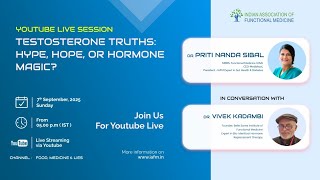
Dr. Vivek Kadambi explains how low testosterone mimics burnout and fatigue in successful 40-60 year olds, and why symptom-first diagnosis matters more than lab numbers alone. He prefers transdermal cream over injections and pellets, and stresses that hormone therapy works best alongside stress management and nutrition, not as a standalone fix.
Chapters
Hello, good evening and welcome everybody. And today's topic is very interesting and it is not about theory today, it's about practical use and how you can live a healthier and a wealthier life. Because if you are healthy, then only you can be wealthy. And to tell us how you can do this, I have today with us here Dr. Vivek Kadambi. You know, people know him as the Testo Man, as the Progesterone Man, and he's the one who started BHRT in India many, many years ago. I think from everybody's side, I must say thanks to Dr. Vivek for creating the whole infrastructure so that we are able to do BHRT today in India. Thank you very much.
Thank you, Preeti. For having me.
Thank you.
Go ahead.
Yeah, so Dr. Vivek, generally what I see, you know, is that a lot of people today come very wired and tired despite whatever you do. Do you by any chance think that low testosterone could be the hidden reason why so many, especially successful people, feel drained and stuck despite achieving so much in life?
Yeah, so Priti, I presume when you mean— when you meant people, you meant men.
Yeah.
So yeah, and when you said that successful people, you mean people who are successful in the, uh, in the way in which society looks at success, both in terms of achievement, uh, career-wise and money, both these. So let's, let's say that, okay, let's take this sector of people who are quote-unquote successful and also that they are in their 40s or 50s. Okay, we are not talking about young people.
Yes.
So yes, if you look at the what we actually call as the middle-aged men, uh, you will definitely find, and I agree with you, that more and more men who are successful, who are, you know, successful career-wise and also financially, they are the ones that seem to come up with symptoms which are— if you did, you mention any of the symptoms, or should I say symptoms suggested?
Yes.
So let's take tired, fatigue, and the person feels that, you know, I don't have the same kind of drive, or I can't do the same kind of, you know, let's say, the things that I could do before. We're not talking about person, we're just talking about, let's say, the career-wise, or in able to perform. Uh, well, one reason for that is probably what we call as a burnout syndrome, that anybody who's extremely, uh, pushy, extremely active in their younger days of their life, and probably that's why they became successful, they burn out. And we will come to the burnout with testosterone, but testosterone is not the only thing that burns out. But because today's topic is testosterone, let me say that testosterone burnout among others, you know, adrenal hormones and others. And that gives rise to a set of— yeah, and gives rise to a certain set of symptoms which they can't understand but has its base in hormones, probably the testosterone. So from there we can take it, right?
So, uh, you agree with me that yes, you know, that is one of the reasons why people feel very stressed out? So, um, if someone is at the top of their game, okay, that has low testosterone, all right, they don't know it that they have low testosterone. What's the first thing they will notice in their performance? Not only just health, but overall performance in every space of life, right?
So, um, well, judging from the kind of, I call them patients or clients that come to me, which eventually we need to give them testosterone replacement. There is a large group that comes because they are not able to explain why they are not that energetic as they were before. That's one group. I'm not talking about the group that comes directly saying that, you know, my sexual drive has gone down, I need testosterone libido. That's one group. But we are particularly talking about the group that you spoke about. I'm also not talking about, uh, that group that comes, uh, that, you know, they want to get into fitness and they feel that they are not developing enough muscles, their six-packs are not coming, and they also would like to take testosterone. I'm taking that group that you started the discussion with, uh, let's say corporate for sake of understanding. Could be not non-corporate also. Corporate executives that are extremely, uh, successful. Okay, all in quotes. So they are the ones that, uh, may not realize. And hence, uh, the only way to, to sort of diagnose this is, number one, they should reach out to a practitioner, hopefully a functional medicine practitioner, and then the symptoms particularly when the symptoms are of— it could be cognitive function, it could be a lack, physical lack of energy, lack of motivation. There are some symptoms which are very subtle, and usually it is the spouse that discovers it and not the patient. And that is to do with increase in irritability and low moods, depression. So depression, irritability seems to be some sort of a change that others will notice, and they will say that either the boss or you'll say my husband is, you know, now he's very irritable. So these are very subtle symptoms. Then of course the blood levels will tell you where you stand. But let me also tell you that the blood levels or the labs that you do for such cases are only for guidance and indicative. You should go more by the clinical presentation and symptoms. So this is in a nutshell How they will present.
Yeah, what I've understood from you is anybody who feels that, you know, they're wired and tired, fatigued, of course, is becoming more irritable.
That's right.
Has low energy.
Yes.
These are the people, or cognitive function is declining, focus is declining, and the age is 45-50 plus.
It's true. And also Yeah, I'll just say some classical statements, uh, some of my clients say. They said, you know, I have made some mistakes that I could never imagine I could make such a mistake in my business. You know, lack of judgment. They suddenly lose the lack of judgment. They can't explain why, and everybody thinks that, you know, person's overconfident or gone crazy or whatever. That is another, uh, reason that may, uh, the behavioral changes that may come. Uh, so these are the things in the context of what you have selected, the kind of, uh, successful, uh, and burnt-out.
Now, in other context, both the context athletics and performance and sexual performance, what would be the changes you will see? Symptoms.
Yeah.
Unaware patient who doesn't know that testosterone can also be given or taken outside of gym also.
True. So in all these three categories, I'll just put something common, then I'll come to the individual. All the three categories actually If someone says that, you know what, I'm developing diabetes, I'm pre-diabetic, so metabolic disorders start coming in and they don't see the relationship with testosterone because they're always thinking insulin, metabolic hormones, and we'll come to that hopefully in the discussion. The testosterone is also extremely important metabolically and extremely important for cardiac health, extremely important for stamina, physical stamina. So this is one set of symptoms that may be— that may come over there. Now, if you take libido, it's important to understand that there's an important difference between the sex drive or libido and erection. So there are a lot of patients that come, or refer to me rather, saying that there's erectile dysfunction. Now, this is where you have to be careful. There is an element of— there will be an element of testosterone deficiency in erectile dysfunction. All right, but most of the cases, erectile dysfunction is to do with a vascular cause. It's to do with the circulation. However, there is a component of the initiation. So the sex drive or the arousal is typically what the testosterone does, but it's not the only factor responsible, only hormone, or I would say responsible for that. You have to look at the other components, partly related to testosterone, partly independent, which will determine the actual, the erectile function. So let's take the erectile functions away and say that the sex drive and arousal, it's very easy And if there is one simple way of knowing, it is the early morning erection. So if you just ask the man that when you get up, you know, semi-conscious in the morning, do you get up with an erection? And if there is— the answer is no, then you can sort of see post-application of testosterone or replacement with cream particularly, or whichever method, you will find that symptom is very easy to see, and the person comes back and says yes. —that is the early morning erection. And then they may come to saying that still I'm not satisfied, I still need to have a persistent erection, I need to make sure my performance is better. That is, that comes later. But the first part is, is that, is that performance. Then if you're looking at reproductive now, then we have to go back to younger people. So I'm not going to talk about reproductive now because the way you talked about successful career, that is a different infertility, male infertility. We will not discuss that unless it comes up today. So in this context, I would say that, uh, this is the part of the sexual function. What is the other part? Did you, you asked me about athletic? Athletic, yeah. So we often see that in their 40s and 50s today, people are running marathons, they're going to the gym, they are getting extremely into fitness, and they are not happy by the way in which their muscles are developing because the body is not supporting them. And if you are not young, unless you have enough testosterone and in fact DHT, which is the active form of testosterone in the males, you're not getting the effect that you want. And they do come and they're doing a lot of other things also in addition to their aggressive exercise in gym. So two things in such people. Number one, yes, testosterone can help because it does help to burn the fat. You can reduce the fat percentage and there are people that come with that data and and they're quite happy. But on the other hand, such patients I have to be more careful because they're doing a lot of other things and they're pushing themselves over the limit. So when they do that, especially the vascular part, you could suddenly have a complication, not because of the testosterone, but because of the fact that the person is pushing themselves using that extra bit of testosterone and might actually land up with vascular complications. Let's say in very extreme cases, even a stroke. Because they're doing a lot of— so you're not sure what they're doing. You have to go very cautiously in this. Thank you, Dr.
Vivek, for bringing this up because that was my next question. There are a lot of people that trainers give testo to, you know, their coachees that take testo and you will be able to build muscle, right? So should people be doing that or that's not the right way to go about it?
Well, it depends upon First of all, it all depends upon the indication. So if you're looking at a person in their 40s, 50s that are deficient in testosterone, so what I tell them is, look, I'm going to give you the testosterone from your health point of view. That means I'm going to monitor certain functions, like your cardiac output, your cardiac functions. I'm going to monitor your metabolic functions, but I am not going to give you testosterone in what is called a supraphysiological doses. Okay, and one thing is, again, the basic difference between what we do and what is testosterone replacement itself can be divided into two parts. Number one is using the synthetic or artificial testosterone, which could be in the form of injection mainly, which is testosterone enanthate, cypionate. So these are modified testosterone, and that has a different set of problems. But let us say we are still talking about natural testosterone, natural ones, which is bioidentical testosterone with a non-oral route, let's say, or a non-parenteral through a cream. That's it. This is, this is the way. So there it's a sort of safe way of doing it because it's very difficult to get excess with that kind of a— when you use a screen. That's one. The second thing is that it is not possible to achieve the kind of Akhada sort of body. You know, I'm using the word Akhada, people who want to really build that body, in fact, for athletic sport with natural testosterone. That is very difficult to achieve. So when you're doing natural testosterone, you're fairly safe. Still, having said that, I can tell you there are some patients of mine who are in the fitness you know, the fitness freaks as we call them, they've got into trouble. And therefore, while you're doing testosterone, you should monitor homocysteine levels, you should monitor CPK levels, because if they're taking creatine, if they're taking any other supplements, and that muscle breakdown is actually increasing, and there will be hints. So when you do the lab test also in such— in a person that you know is a fitness freak, I'm using a very broad term, make sure you make sure that all the other parameters are good Because otherwise the testosterone is going to get the blame. Whatever you do, finally people will turn around and say this is a, this is a hormone, this has caused it. So that is, uh, that's the best way I can put it. But yes, you have to be careful. Great.
Another thing, Dr. Vivek, which you said, and I really want that audience and, you know, listeners understand that well, is can testosterone levels actually influence success in decision-making, confidence, and leadership? You've already said that, but how does it work on that? Because a lot of people, when I tell them that, oh, your testosterone could be low and that's the reason your decision-making is not as good as it was before, or your confidence is going down, or your leadership skills— people are saying it is, it has changed, right? But then they say, no, no, that doesn't happen, it cannot happen, like, you know, always in denial mode. What is your take on that?
So one, it's okay to be skeptical. I have— in fact, I want all my patients and my other doctors that refer, all my students, if I must say, it's okay to be skeptical, and you should be skeptical. That's the start. But you cannot be close-minded about things. You can be skeptical, please don't be close-minded. So when we talk about things like confidence and leadership, little bit abstract, and unless there is some criteria to judge, we have to go by a subjective— the person feels, says that, you know, I I'm fit, my moods are better, I'm feeling more confident. There's no other way to test it, and if there is, I'd be very happy to know if there's some objective way if I can do it. But I can talk about myself, you know. I've been using maybe testosterone cream for next at least 20 years, I think, or more. My father, who's turning 96— so I'm not going to talk about any other patients, it's not ethical, but I can talk about myself and my father, my own family, because Well, that's the best I can do without trying to get into the gray area of, of, of patient's confidentiality.
Yeah, yeah, thing also you can share.
Yeah, yeah, and that's about it. So I can tell you that the difference it has made in all these aspects, but sometimes you have to be— try and be objective. That is it because of the testosterone? Is it a placebo effect? Am I just feeling good because my my libido has become better and therefore my confidence is good. Why not? Whether it's direct or indirect. For example, if you take the effect of testosterone on the cardiovascular system, okay, I'm slightly diverging here, but just remember some of them is because of the direct action of testosterone on the cardiac musculature. Testosterone directly is a cardiac tonic. It will pump, it will pump hard. So therefore, in general, make sure you're generally healthy. You don't want that extra bit of pump. Of course, the systolic BP can go up slightly and then it will stabilize. There's another action of testosterone that's because of its conversion to estradiol, and that is on the endothelium of the vessels, that is on the osteoporosis, prevention of osteoporosis, that is prevention of Alzheimer's and dementia. So there are many actions which are direct and indirect, and some actions because of DHT. So you should be very clear, as at least as a as a treating doctor, okay, patients may not know the difference. As a treating doctor, that these are the actions, because sometimes you may have to assess your success on certain symptoms and parameters based on at least what the lab, with its limitations, tells you about what has increased and in what direction it goes. And therefore, a very fundamental— I don't know if that will come up in one of your questions, and I just summarize— If you just give the testosterone, it's not going to work because the testosterone has to be optimally converted to estradiol, optimally converted into other metabolites which can be used. But that cannot happen unless your vitamin D, B12, omegas, thyroids— these are the foundational ones you need to do. And then you need to get the testo. Don't directly jump into the testosterone. But I, I won't elaborate more because I don't know if that question will come up later. So confidence, you said leadership? From my own experience, I say yes, definitely. Uh, but very difficult to actually assess, very difficult to objectively assess. But still, you—
what you are trying to say is it might be the reason and it might— it can be your solution also.
What I can say is there are studies. Yeah, what I can say, there are studies out there, and you know, today with AI, it's very easy to research, which actually talk about these and none of them are conclusive. That's the best I can say. None of them are very strong.
I think to have conclusive studies, Dr. Vivek, one needs a lot of bank balance in the account.
Uh, one, and second— no, and secondly is, unfortunately, of course, there's a total debate altogether that double-blind controlled studies, those are for drugs, and we can't do that for natural products. We— and in reality, we can't do that. Yeah, it's too much. It takes too much money. And, and again, nobody can patent testosterone, so who's going to to put money for such studies.
So you have to go by, uh, you know, some of the experience and literature, and then dig deep and see whether it's scientific or not, so, and whether plots are matching or not.
Yeah, one way, one way I put it is that let me first get tangible metabolic benefits which I can show and prove, and all the other so-called intangible subtle benefits— leadership and confidence— I take that as a bonus. You get it? Okay, nice. That's a bonus, right? But, uh, there's no way I can say that I'm going to give you this for increasing your confidence. I have to see the whole set of it, put it in the priority— metabolic, reproductive, sexual— and then anything else you get. And I say, thank you very much. The patient says, I feel very confident. Thank you very much. I'm now become, you know, leadership quality. Great. That's a bonus. And, uh, and there are studies that will support that. All right, great.
Uh, how does testosterone impact focus, resilience, and the drive to keep winning? The very traits successful people generally rely on. How does testosterone play a role in this?
All right, so I can tell you that, uh, firstly, uh, it's not that you can take testosterone and suddenly develop these attributes. But if you were a leader and you had these attributes, and as you are coming to middle age, you find that you're losing it— okay, I'm just taking that scenario— there's a good chance by replacing testosterone you can get back what you have lost. So I'll just put it in a nutshell. It's not that give me the testo-creams, I'm going to rub it on me, and then now I'm going to become a leader. That doesn't work that way. Your qualities which we have lost, you can sort of regain. Then comes the cognitive function, memory, and the ability or the judgment ability to take right decisions. That part of it, part of it is to be, uh, is based on your character and your nature, your personality. Let me use that. But testosterone will definitely help you, but it can't do magic for you in that area. So be happy if you can get a positive health style. Part of the testosterone which gets converted to estradiol— there's no doubt about that, that the estradiol is good for memory prevention of Alzheimer's, prevention of dementia, osteoporosis. So the estradiol is equally important.
Estrogen is never talked about when we talk about male hormones. Can you elaborate a little on whether one, it should be talked about or not, it should be tested or not, and then why is it important?
Number one, I always test it. So whenever I say testosterone, total testosterone, free testosterone, estrogen— of course I don't do progesterone. I know some doctors who in men also check for progesterone. I don't do it, but But I do test the total PSA, and if that is high, then total and free PSA ultrasound. So, you know, the set of tests, but estradiol becomes a very important part of it. The second thing is that this is most of the time just for me to see how well the person is absorbing, number one, how well the skin absorption happens. It's variable from patient to patient. But another important thing is compliance. It tells me whether this patient is actually taking it on a regular basis or not. Because sometimes you also check the LH and other levels. But of course, testosterone is different. But in most of the hormone, you check other levels that might give you a hint, just as in, in thyroid, you do free T3, T4, and TSH. So somewhere you can have an idea. But eventually, if you develop a rapport with the patient that they will come and be honest about the truth, uh, it's then easy. So it's important to just see overall compliance and see some absorption. But after that there is no level. Nothing says that 500, let's say, is better than a 300, or a 900 is better than a 400. So there's no quantification of those levels, and therefore that part comes in the, in the clinical part when you're working clinically. So coming back to estradiol, very important part. I don't think anybody should be testing testosterone without testing the estradiol. Just a small, uh, this small, uh, rider to that: estradiol levels may not be extremely reliable, uh, in terms of absolute terms, but it will tell you relatively. So take the estradiol level always in a, in a, in a, with a comparison, you know, the timeline. Whereas testosterone, progesterone, these levels are very reliable. What most labs give you reliable levels, and it reflects the two things. So why do we need to do the estradiol levels? At least why do I need to do it? I know some of the people think that estradiol levels— you should not have high estradiol levels. And some people come with this myth. I think if at all we get a chance, we can talk about the myths that says that, oh, if I take estradiol, I think I will develop man boobs, I'll get breasts. And, you know, they're so scared of that. I've never seen in 20, 25 years ever. You know, you can get mastitis maybe, but I've never seen ever gynecomastia developed because somebody's taking exogenous especially transdermal testosterone. I don't know about those. Yes, those who take a very high dose for sake of athletic, better performance, wrestlers, and in that category, I can imagine. Yes, you can think about— I don't, I don't treat any of them. The moment I know somebody is a professional athlete, I tell them, sorry, boss, I can't treat you. When you, when you retire, even though you need it, uh, you don't have medical indication, when you retire, we'll see about it. So this is a, uh, coming back to yesterday, if If you have good estradiol levels, it's a good sign, and you'll get all the benefits. And the inflammatory markers you can do, homocysteine levels, they all will be good. But again, don't try and control this. Some people say that, you know, give some aromatase inhibitors, block it, and don't allow complete conversion. Let's have more of testosterone going to DHT, that direction. I think it will be a mistake thinking that you can micromanage. What you need to do is manage the coenzymes. And what are coenzymes? Simple terms, vitamins, you know, vitamin B12, all the B group vitamins, vitamin D to some extent. So make sure that you optimize those lifestyle. In fact, the fundamental part in functional medicine is that your diet, your sleep, and your lifestyle, your gut health. If you, you manage that, then the body will make sure that you get enough estrogens as and when you require enough of DHT. So whatever testosterone you will give will go in the right path. But don't get too discouraged. And I know many of healthcare, you know, coaches and doctors have logged in here. I believe that they would be— yeah, yeah, they would, they would have logged in. So from, from their point of view, when you're treating, uh, don't try and micromanage what happens to each of these metabolites. Uh, make sure your liver functions are good. If your liver is good, you're doing regular detox, things will come and take care of themselves. And don't try to use it in really sick patient. If a person comes with, you know, diabetic retinopathy, blindness, and they're already, you know, one foot in the grave kind of thing, no testosterone is going to do, or any hormone is going to do any magic. So take relatively healthy patients.
So go step by step, like Dr. Vivek, you said. First, make sure nutrition is taken care of, then inflammation is taken care of by checking homocysteine and all. And then, and tell your patient accordingly that, see, I don't want to put it today. Because in an inflamed body, the results will not be the same what it will be when the body is not inflamed. And of course, make your right decisions. Dr. Vivek, before I take my next question, I have a few questions here which I will take first. What are the main differences between delivery methods—cream, gel, injection, pellets, oral—and what is it that you majorly use?
All right, so I'll start off by saying that my preference is always the cream. Okay, so let us say that transdermal, okay, transdermal cream. So number one, why in general, except where, for example, in thyroids we don't have an option, although interestingly I've seen some people coming up with the sublingual and those options. But anyway, so we have cream, and, and with respect to testosterone, is quite, quite easy. Some of the other hormones, they could be multiple, like progesterone, you could have sublingual, you could have vaginal, you could have others. But testosterone, transdermal It's quite straightforward and simple. Uh, number one, any method that you can bypass the first part, what's called the first-pass effect, you can avoid or bypass the liver, and which is definitely when you take orally, is always good so that the load doesn't come entirely on the liver. That's one, one part of it. The second one is transdermal can also be in the form of a patch. You can take a testosterone patch and, you know, apply it here, and then the only difference is here Taking a testosterone cream every day, that means there will be the typical circadian variations, you know, after applying, coming down, up and up and down. Whereas when you apply for a patch, it is that the maximum dose is there, and then over a period of weeks and all, it starts falling. So it's not physiological but convenient. Okay, sometimes what happens is I have a given, and I tell a patient that, okay, if you find this convenient, take it, but ideally you should do this. If you find this difficult, next best thing, next best thing is this. Then if somebody says, what about injections? So injections, there's a problem. If you can, uh, it could be subcutaneous, uh, it could be intramuscular. Yes. Now definitely I would, uh, if fundamentally you get into functional medicine and bioidentical hormones, uh, at least I have to be very, uh, true to my, uh philosophy and my thinking. So rather than saying something is not good— I hate saying that it's not good— I would say that anything which is not bioidentical, I know in the long term will give rise to a problem. But if it's, if it's working for you, if your levels are good, you're doing very well, and you're willing to take that little bit of a risk like people do take with even progesterones and estrogens, a little bit of non-bioidentical over a long period of time, then fine. But I'll find you somebody who can do it. Talk to your other practitioner, but don't expect me to do that. But if you are doing it, I have many patients who are taking it anyway and come to me for other metabolic issues, other problems. I said, fine, then I'll just make a note. Because number one is I would never coax anybody to, you know, do something which I believe— even though I believe it's in their best interest, it has to be their decision. That's one of the—
that's, I think, which function that is saying.
That's the biggest fundamental person-centric. Yeah, person-centric.
Don't try, uh, and the patient has the choice, you know, they set the goal, they set the choice. Our aim is to just be the GPS and deal with that.
Yeah, so my preferred role— now somebody asked me, what have you got again? Injection. The same thing. In fact, cypionate, you have to give it on a weekly basis, you know, it goes up and down and then it reaches a flat area. So it's not, uh, natural. Second is that testosterone that is giving you is a, is a modification, modified testosterone. Yeah, you want to use to build muscles, you want to go, you know, athletic, and you want to sort of do something which is not considered legal, but you know, want to somehow slip through, uh, for your professional— as a professional athlete, uh, that would— injections would work better for you. Don't expect creams to give you that. Creams will never give you— I, as I say, don't— it will not make you a wrestler. Or, or for these akhada wrestlers, don't even bother about creams. It will— if you're worried about— if you want to get the benefits of testosterone from the health point of view, then you should use the creams. I think testosterone is a lot easier because, you know, you have non-bioidentical and bioidentical creams. And one good thing about testosterone, unlike, say, progesterone, is absorption is beautiful. Beautiful. And this is what we make through the skin. Yeah, this is also good. Absorption is good and it's very easy. So most people, and in men usually— I'm sorry to say this, but In men, it's everything very simple. Hormones are very simple, it's very straight. It's only in women that you have many things to work with. Yeah, it's not as straightforward. So with everyone it works.
The next question I have is, sorry, since testosterone increases erythropoiesis but many misdiagnose it as polycythemia, what are your insights on this confusion?
Yeah, so number one, uh Yeah, this is very important because very often, and almost every case that is on testosterone cream for some time, you will see that the hemoglobin level goes up, RBC count goes up. And in fact, I'll give you an example in order to drive my point. I had the same problem. I have often— they go to the general practitioner and they say, oh, your hemoglobin is going to 18, 19, I think you having polycythemia, you need to have do bloodletting, you need to stop the testosterone. So I— my answer is, look, if you want to stop it, you stop it. You can resume it whenever you want. But once you stop it, and hopefully you should be okay. If not, most of them come back saying, you know what, when I stopped it, my symptoms are coming back again. But it's important for them to understand that this erythropoiesis— that means if a Sherpa, somebody lives in high altitude, comes with a, you know, blood level of 18, or a hemoglobin level of 18, or RBC count rather high, you would— and says that I live in Ladakh, you say, oh, then it's fine, it's physiological because it's erythropoiesis. So then comes, okay, let's presume that that part, uh, people understand, but there will be a group that will say it's polycythemia. Now there are two types of polycythemia. Polycythemia— typically what happens, polycythemia vera. Polycythemia vera is a rare condition and it's an autoimmune condition, so let's take that out. So that's a— it's almost like a different diagnosis. Polycythemia. Polycythemia— have the other blood platelets gone up? Have the— because most of the time what happens is that they say the blood has become thicker. It doesn't become thick, it can become more or less, uh, if the platelet counts are also high. That you never find. But here is where you have to, uh, be very clear. If you have a person with a— with erythropoiesis, there is— in fact, they will do very well. They say, my stamina is so good, my SpO2 is wonderful. I just had a patient last month who said that he had some lung fibrosis issue. And after taking the testosterone and good hemoglobin levels, the SpO2, which was never— it is 89, 90— is now 98, 96, 98. And the moment they stopped the testosterone, actually, I haven't got a follow-up. I said, anyway, you're going to stop it. I know your doctor advised you, but let me know how your SpO2 does. If I have that data, I will share it sometime with you. So So that is the part about the oxygen carrying capacity. So look into that. And if you have a person, let's say worst case scenario, there is a high hemoglobin count, you are worried, and if the homocysteine level is high, yes, then you must do something about it because that clot is not— the clotting is going to happen because of the homocysteine levels and maybe also combined with the testo. So if you are not doing the entire process or you find the homocysteine level is perfect below 10 and you have no problem, then it does not matter. You know, my hemoglobin levels are always 18, 19. It's all actually perfectly okay. Great oxygen carrying capacity, great stamina. But it needs a proper— yeah, and you need to, you need to pay attention to that.
Very energetic. And from morning 8 AM till night, back to back, you keep doing what your work. And there's another question What's the right age to start testosterone replacement therapy?
Yeah, it's a good question. So I'm presuming that these are not, uh, some cases of infertility, male infertility, you have to do that, but that's a different, uh, different knack. You don't want to go too high to suppress LH and all, but anyway, leaving that aside, so I would say anybody in the 40 plus, if I just want to put up whether it's 40, 45, or 35, uh, I have a case recently that came, that came as a premature testicular failure. Okay, somehow now anything, everything seems to be blamed on COVID or COVID vaccination, whatever. It doesn't matter now, whatever it is. So yes, some people do have prevention, and even at this patient who's, I think, 35 years of age or even younger, I have started giving the testosterone just last week because that is very clear. Otherwise, most of the time, uh, it is not a testicular failure. This is important to realize. This is a fundamental for doctors and healthcare professionals. For the patient, it doesn't make a difference whether it's failure here, pituitary failure, hypothalamic failure, or is it a testicular failure. I need the testosterone. But for a physician, for a doctor or a healthcare professional, you should know that it was assumed— because in women it is primary ovarian failure— it was assumed that in testosterone also it's a primary testicular failure. But nobody questioned that. But now we know, because if you just measure the LH you actually find that LH, which should have been high, as in women when you get the failure, the LH, FSH goes up. In, uh, in men, it was found that it is found, and if you measure, that's actually low. So it's actually a pituitary or a hypothalamic failure. So much so that the ICD-coded diagnosis, ICD-9, had hypogonadotropic hypogonadism as a diagnosis. Hypogonadotropic hypogonadism, gonads. In ICD-10, that was removed. And the nearest, uh, well, diagnosis, ICD-coded diagnosis to that is called hypothalamic dysfunction not elsewhere classified. So even that diagnosis of that is gone, and therefore the best way to describe is something called ADAM, that is, uh, adult, uh, ADAM, no, adult, uh, a— how does that go? I always forget. ADAM, of the aging male. So androgen deficiency of the aging male. That's— that term is supposed to be more accurate. Why? The reason is I, I, I'm saying that is that the— it's not really a testicular failure. Young people, testicular failure, and we see this. And therefore, 40, 45, maybe 50— after that, of course, if they come at 60 and say I need the replacement, I said okay, never too late to start, but a bit more careful. I said make sure— any case, I check around 45, 50 Generally around 45-50.
Patient needs it, you will be happy to give it. Below 45, you will do a more diligent—
I would look for other causes. Yeah, I would. Okay, I would look at a precursor of testosterone. Let me first see with the DHEA what happens. DHEA is a precursor of testosterone. So when in relatively younger patients, you need not jump at the testosterone, you can start with others. So slightly your protocols might change. But there's no cutoff like 40 or 45, but in a 35-year-old or 30-year-old, I think you better be careful before you jump at testosterone.
So Ketaki wants to ask Dr. Vivek, does testosterone help in Parkinson's disease?
Testosterone and Parkinson's disease. Okay, now let us take Parkinson's disease and dementia, and so neurological. I'm just— see, there's one very important thing in functional medicine. Do not get stuck with the disease's name. Yes. When you look at a—
I tell people what is there in a name of rose. Yes. Even if you don't call it a rose, it will smell as sweet.
Smell as sweet.
So that's how we do in functional medicine.
In functional medicine, you need to put names for sake of ICD codings, for sake of understanding, for patient to understand. But if you look at Parkinsonism, there'll be a component of dementia, there'll be motor component which is there. Neurological component. So if you look at that, then if you say that not just testosterone, there are many things that will help prevent as well as decelerate the process. Testosterone does stand up over there also. People tend— so when I look at a condition, I look at very simple— is there an— what is the inflammatory— not is there, what is the inflammatory component? What is the metabolic component? What is the immunological component? All right, and then, uh, handle those without— that's exactly what a definition of functional medicine is, system-based approach. Now, uh, so therefore I would say Parkinson's, to the extent even multiple sclerosis, because part of the testosterone and estradiol, they work. So if you, if you, uh, if, if I were to say yes, there is a role, and there are studies out there that will tell how it plays a role, so There is a definite role, but again, mainstream medicine— remember, functional medicine is not a new branch of medicine, it's an approach. So if I'm thinking as a mainstream practitioner, I'm thinking of L-DOPA, I'm thinking of how do I treat the deficiencies in Parkinson's, how do I give a medicine for Parkinsonism. But when I'm thinking as functional medicine, I said, look, I'm going to optimize the testosterone, I'm going to optimize the DHEA, I'm going to optimize the thyroid inflammation. Oxidative stress, I'm going to look after the gut, and the body will take care of it. So the— that is how the approach is. So whether— so never, uh, claim, okay, or tell the patient, oh, Parkinsonism, I, I will replace the hormones, and believe me, it will cure that Parkinsonism, or it will improve it.
So, uh, just remember, all degenerative conditions, the body improvement will be seen, and testosterone should be balanced.
Yeah, specifically, I think it can be the estradiol, because in age-related macular degeneration, that the eye, uh, my primary, as you know, primary specialties, ophthalmology. You see, there is a lot of studies out there talks about estradiol's role in preventing like dementia, even the retinal degeneration gets better. So all degenerative conditions, all autoimmune conditions can be handled with functional medicine. And testosterone, the thyroid, insulin, they also play important role. Now testosterone, interestingly, is a very important immune modulator like vitamin D. Most people say that is, is it, you know, is there stimulate immunity or it reduce immunity? You see all kinds of papers, but it is an important immune modulator, and therefore it will have a role to play. And if I look at this way, if it does, that's nice, it's a bonus. If it doesn't, I would never promise a patient that I'm— this is what I'm going to use the testosterone for. Just a difference in approach.
And Dr. Vivek, thank you for sharing it so nicely. Dr. Vivek, I know we have exceeded the time. Two more questions are there. Can testosterone be given in females, and if yes, in what conditions?
Yeah, so right, I think just as there are conditions where we give estradiol to men, and I can tell you that especially post, uh, post CA, when they are— when the oncologist— cancer prostate, they are so scared of progesterone. At least I managed to sneak in the estradiol, and they say, why do you want to give? But okay, I'm okay, you can give the estradiol. And that's what's important. So similarly, when in women also We have to— testosterone, that's one of the myths. People think testosterone is only for men. Actually, in women it is important, but particularly for the libido. Now here's the difference: women don't need testosterone for the cardiac benefits, they don't need testosterone for the other benefits as the males need, but they do need the testosterone if— because they are usually producing enough of estradiol, or they're taking the estradiol separately, whichever way— they need the testosterone very specifically for libido. Here there is one, uh, important thing to realize, not often done. Creams work very well, very small concentration. We use 0.5 to 1. In males, we use 100 milligrams, 150 milligrams, maybe 1 to 2 milligrams. I know Dr. Ashok uses even 5 milligrams or more. Anyway, you use lower doses in women specifically for libido. And it appears that if you want to avoid the conversion to DHT, you can use the oral form of testosterone. Because orally, if you give the testosterone— so you see exceptions, you know. Normally I prefer transdermal. Oral form of testosterone, then you get the action on the libido without its conversion DHT and worried about acne and hair. However, having said that, I haven't got any takers for the oral, and therefore, uh, maybe, uh, you know, it's not, it's not difficult to compound. We may start giving more of that. So my personal experience has been very less, actually zero, on oral testosterone because the creams work very well. The women to come back to me and they say, I'm very happy, it's working very well for me. Maybe 0.51 milligrams works extremely well for them. So, uh, that's for the— oh, by the way, also, also, sorry, I forgot, also for women who want to build muscle tone, they're going to the gym and they're not able to build that muscles.
Yeah, go ahead. That's the next question. Do women who are into strength training need testosterone supplements, and what are the doses recommended?
Recommended? Uh, I would say the similar dose, but again, my, my—
the best thing to do is consult Dr. Vivek and take his prescription on this. One way, but no, no, this should not be OTC product.
Yeah, it's not the OTC product. And also just remember, for me also, I don't go with one indication. If that is the only indication, not. But if there are— if she says, yes, I I give a replacement. I don't go by a single indication. I try to see 2, if preferably 3, and then I say, okay, it's working. Metabolic— if the cholesterol— by the way, cholesterol levels and testosterone, great. The, the, the insulin levels and testosterone, great relationship between those. Of course, it's a separate topic in itself. So yes, that's where we are.
I think, are there any urinary hormone testing available in India that we can consider before supplementing with DHEA?
The urine test, especially the Dutch test and urine test, they are more accurate. I know some people also believe in the salivary test, but one, they're very expensive. Number two, at least I am not an expert on how to interpret those. So therefore, the best is develop your clinical acumen and develop your clinical, you know, method of— say this, you have a— I have a team of doctors or nutritionists, doctors who will reach out to the patient and get the data on how they are doing. So, and especially if you're on an online platform, make sure that you have that data and then go by that. Maybe someday these tests will be available and they'll be not as expensive, but I don't do them. I do have a problem when a patient comes with those tests. They have done it, somebody has suggested, and they come with the test and I have to scratch my head.
I agree with you because those tests really take a lot of time for proper interpretation. You know, too many tests is a problem for a doctor only.
Yeah, then there's a danger. Then afterwards, suppose you give your treatment and they come back and you have told something is not good or bad, they come back and say, look, you told me this, this, you know, this is a bad hydroxy— 16-hydroxy is bad, 4-hydroxy is bad, and this has gone up. Then I don't know what to do because I'm not an expert on that. So I said, oh, we have to fix the liver. So sometimes be very careful when you order a test. It's like a lawyer. When you tell a lawyer, don't ask questions of which you're not sure of the answer. So I know that good tests, and I've heard about them, but I go with my simple test and the clinical and manage with this. And if there's any confusion, I'm— a patient may decide to go to some other doctor. I'm happy with that because I wouldn't like to do something that I'm not sure of.
There you go. Right. But I can tell you that, you know, in India we don't have any tests, but now there are a lot of labs which are helping you do this self-test. Just send it abroad. Yeah, that's 10, that's plus, and it takes about 2 weeks to get the report. So it is not that complicated. A lot of people are getting done, as Dr. Vivek just said. A lot of people do it and then come to the doctor and say, this is the report, now tell me what I need.
I, I, I'm looking for some AI that will analyze this and give it to me. That's just—
I started doing it, but unfortunately the results are not very accurate yet. True. But so you still have to go with your scanner throughout the report, make your pointers.
I was just talking in a lighter way that I would, if not, yeah, I would refer to somebody like Mahesh or somebody like who understands more about the test and say, yeah, take a look at this test and tell me, and I will, you know, patient will be happy. But honestly, I use those quite a lot in my practice.
I know you do, I know you do.
Yeah, yeah. So, so I'll ask you everything, you know, just tell me what you say. Thank you. I'll pay you for your opinion.
No, no, that's all right. I will really feel honored, you know, when you share it. Dr. Vivek, before you leave, what is that one thing in lifestyle which people should do so that they don't deplete their testosterone levels too fast?
Okay, so number 1, number 2, number 3— it is stress, stress, stress. So it's very easy, easier said than done, but You have to learn. You cannot avoid stress. It's how you manage the stress. But I can tell you Dr.
Vivek's hack on it. Dr. Vivek, with your permission, go ahead. Right, Dr. Vivek sings very, very well. In all his society events, he will dress up properly in the star in which, you know, he's going to sing. And he'll sing, and if he shares the video, feel honored. And they are all amazing. So thank you, Dr. Vivek, for doing that. And I think that's so such a great idea to have your hobby and also to have a knack of managing your stress.
Yeah, I have two hobbies that manage my stress. And I have— sometimes hobbies can be more stressful, but it's how you allow it. Golf. Golfing is my other hobby. I've known people who get very stressed with the golf in this course. If you don't worry, if you play golf for, you know, fresh air and for the, for the enjoyment of the game, it's fine. But that's one. Second, of course, smoking. Alcohol— these are all the known busters. Processed foods. So there's a lot more, but if I were to, you know, look at the one, say, wherever the GST— anything, anything that has GST of 40%, uh, well, that's going to affect you. Perfect.
Thank you, Dr. Vivek. Thank you everybody for joining, and I really got a lot of pearls today. Which maybe when we do a scientific lecture we miss. So today's session was very simple but very, very in-depth. And as always, I'm sure everybody enjoyed it.
Yeah, thank you very much. I hope all you enjoyed as much as I enjoyed doing this.
And thank you, thank you very much. And anybody who wants to test your prescription or wants to know whether you should have it or not, You have Dr. Vivek's number. We will share it in the YouTube description also.
No, don't, don't share my number. Your office number.
And please, he's more— he will be more than happy to help you, guide you. And I've already told you, he's the test human. He takes it, his dad takes it. So nothing more proof you need that it's safe when given at the right dose.
To the right person for the right duration. More importantly, if you're health, health, you know, health coaches and healthcare professionals out there for your patients, please attend every Tuesday and without fail every Tuesday, 8 to 9. I have this link and I— we discuss cases as it is. So one condition is that no recording, you have to attend it. And number 2, whether one, one person attends or 20 or 30, 50 attend, that goes on, that show goes on.
So Tuesday morning sessions, 7:45 AM, you get a link, guys. And there are people like me who are missing it these days, but then that's the most stupid thing one can do. Yeah, do join, learn more about hormones, because I feel hormones are like chakras. You balance the hormones, a lot of your life gets sorted.
And I also learn, it's going to take me two life, uh, two lifetimes to even master what The hormones are there here, but, uh, this lifetime I'll, I'll try to do most of it so that next lifetime I have to do less. But, uh, don't think this is going to be easy. You have to, you have to be consistent. But then you— I can make it easy for you. You just learn from the masters, or, you know, take— just take, learn. Don't make the same mistakes I made. Just learn from my experience and you should do well. Thank you.
Thank you, Dr. Vivek. Have a great evening. Thank you, everybody. Thank you. So I can
More from Dr


Understanding Chronic Acidity: A Holistic Approach to Better Digestive Health 🌿


BHRT - transformational health journey if a 42 year old women #BHRT #HormoneBalance




Transform Your Health Naturally with Functional Medicine | Dr. Priti Nanda’s Success Story


hypothyroidism and ozone therapy - talk at Ozone Conference by Dr Priti Nanda Sibal
