Understanding role of T3 in weight loss, depression and fatigue
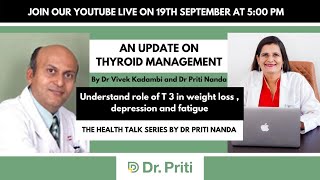
This content was created by Dr Priti Nanda Sibal. This content was uploaded by Dr Priti Nanda Sibal. This is a YouTube interview titled "Understanding role of T3 in weight loss, depression and fatigue" (published 2020-09-20) from the series "Food, Medicine, and Lives Today." The clip is a conversational expert discussion hosted by Dr Priti Nanda Sibal with guest Dr. Vivek Kadamni. They review the physiology and clinical importance of T3 (vs T4), reverse T3, factors that impair T4→T3 conversion (stress/cortisol changes, estrogen dominance, Hashimoto's/anti-TPO, nutrient deficiencies, age, lifestyle, enzyme defects), diagnostic points (TSH vs free T3/free T4), therapeutic considerations for using T3, and links to conditions such as PCOS, hirsutism, insulin resistance and weight loss. The speakers emphasize that hormone optimization must be combined with diet, supplements and lifestyle rather than using T3 as a standalone weight-loss fix.
Chapters
I put full shares, full screen.
Hi, welcome to our new series of Food, Medicine, and Lives Today, and we have none other than Dr. Vivek Kadamni with us, who is pioneer in bioidentical therapy in Indian setup. So welcome, Dr. Vivek.
Thank you, thank you, Dr. Preeti. It's a great honor and pleasure for me to be here.
So today the topic which we are going to talk about is T3. I think some of us know and some of us don't that T3 is the active form of thyroid. And in the last few years, lot of research has been done on T3, and that's an area Dr. Vivek has really worked with his patients and learned the newer depths of using T3 for a better life. Dr. Vivek, I welcome you, and please share your thoughts on what do you think about T3.
Yes, so, uh, thank you very much, Dr. Preeti. So let's get straight to the point. Let's now put the spotlight on T3. Uh, as you had very rightly, uh, introduced the topic, uh, most people when they use the word thyroid or hypothyroidism they are not aware of the fact that there are two types, at least two major types of thyroids. One is called the T4 and the T3. And what is very commonly used for treatment of hypothyroidism is a, you know, you must have heard of drugs called thyroxine, L-thyroxine. These are drugs that contain essentially T4. And it's very important to understand that while T4 is a very effective drug, it works very well. Uh, it really doesn't solve all the problems that are associated with hypothyroidism, particularly because it's not the active form. The body has to convert that into T3, and the T3 is what really gives all the benefits, uh, for anybody that is trying to use that, uh, for treatment of hypothyroidism. So just so that, uh, you understand, in very simplistic terms, the thyroid gland, which is located in the neck Produces two types of thyroids. One is called as a T4. 80% of it is the T4 that it produces, and about 20% of T3, which is active form and 10 times more potent. You can also say that the T4 is a precursor with low potency to the T3. And these drugs like thyroxine, L-thyroxine, what we normally take for the hypothyroidism, always prescribed is nothing but the T4. Now, uh, although this may look a little bit complicated, it's quite simple to understand. Here you have the thyroid gland. 80% of the thyroid hormone that is being produced is the T4, but 20% of T3 is being produced. And this T4 gets converted into the T3 in the peripheral tissue. It could be in the liver, as you could say, in the brain, the kidneys, the muscles, etc. And this T3 is the one that gives the real action of the thyroid, and we will come to what the T3 does. These are— there are a couple of important enzymes here which is called the deiodinase, and the deiodinase 1, deiodinase 2, and the deiodinase 3. Now these are the enzymes that actually remove one molecule of the iodine, and that converts the T4 into T3. And there's also a very interesting, uh, subset of this hormone called the reverse T3 or RT3. Until now, not much of importance was given to RT3, but remember that this also is a T3 but with the molecules of the iodine slightly in a different position, almost like a mirror image. And this actually is inactive form of T3, and therefore very often, even if you have enough T3, but if you have If one has more of rT3, you don't get the clinical effects. Now, having said that, let's just simplify. I'll just try and understand certain things that can increase this T4 or increase the T3 production and certain factors. Yeah, go ahead.
I have a question. Yes, this slide is like, you know, it has deeper and deeper and deeper layers into it. So there are two questions which are coming to my mind, and I'm sure to the viewers' mind, is Yes, you said T4 has to be converted to T3. Yes, right. So what are the 2-3 things which you have found in your patients which actually decrease or inhibit this conversion?
All right, so in general, I would say that almost, almost every patient that comes to me are the ones that are not converting T4 to T3, because if they were, they would probably not come to me, or they would not find me, because, you know, the T4 was serving the purpose. But the commonest thing that I have seen, because I suppose that the kind of patients that come to me are those with PCOS, fibroids, menopause, etc., estrogen dominance seems to be— as you can see over here, estrogen dominance, it seems to be very, very common among those who come and, you know, seek my help. The other factor that I have seen in Hashimoto's— I've seen almost 80% or more, 80% or more of my patients, they have antibody, anti-TPO positive, and they have what's known as autoimmune thyroiditis and Hashimoto's. So, uh, that is the second factor which I've seen very common. And therefore I can safely say that in these patients, the reverse T3 is much higher. As it is, the T4 connected to T3 itself is very low, but in addition, they have a high rate of reverse T3. And stress being a very, very common factor, many of them have this raised cortisol levels. That's one. Okay, so these are the common what I come across. But, uh, you know, your question is very, very relevant. There are so many factors which I shall now talk about, and you will realize why it's, it's so common, uh, to find somebody who's taking L-thyronine for long periods of time but, uh, really not getting the complete benefit from that. So I hope that answers your— does that answer your question?
Yes, but something is coming in my mind, Dr. Vivek. I had started working a lot on cortisol issues.
All right, very good.
I've come from a corporate background and I have, you know, lived that life of working 16-17 hours a day, traveling from one place to another, always with your reports and your team and stress. Yeah, so what I realized was that high cortisol has now given way to having low cortisol. So currently I'm running a group of 12 people in it where we are helping people increase their cortisol levels, because over the years, in the last 8 to 10 years, their cortisol first went higher and now it has come so deep down that their body do not have the necessary fuel which they need.
I get it, I get it.
Yes, so I think the way, you know, the focus on T3 has increased and the requirement for T3 has increased, like you said, in estrogen dominance, in, you know, vitamin D deficiencies, in ferritin deficiency. Similarly, yeah, similarly, I think cortisol also now has started becoming low in a lot more cases than what, you know, at least I had seen in my practice in the last 3 years.
So let me put that in perspective. Yeah, no, no, let me put that in perspective. And you're absolutely right. And since the topic of cortisol came, and, uh, you know, one, one general rule I like everybody to understand, that you can't take one hormone in isolation. If you're talking about thyroids or T3, you cannot, uh, you know, ignore cortisol, insulin, and other hormones. So let's just say cortisol initially stress, uh, when you're high-strung, your cortisol levels are high because body is trying to overcome the stress. So when the cortisol levels are high, just imagine what's happening behind the scenes. More and more of reverse T3 is being produced, therefore less and less of the main T3. And again, you are getting the same symptoms as you would get of hypothyroidism getting worse. That means low energy levels, weight gain, all those kind of things. Now, there's— after some time, there is something called adrenal fatigue. So the adrenal fatigue and the cortisol levels actually start falling down. Now when the cortisol levels start falling down, then at that point of time, theoretically, even if you would assume that the T3 will rise, you know, just for as an assumption, the fatigue or the low energy levels or that symptom does not go away. Only the reason for the symptom shifts from not enough T3 to not enough cortisol. So you need cortisol also to be balanced. And you're absolutely right, we are seeing now more and more cases of low cortisol. So in those cases, it's very important to make sure that you have the entire picture clear. If you only measure the thyroids, you might miss, like you talk about, a large number of cases that have low cortisol, and therefore you might be treating with a wrong, you know, with the wrong supplementation. You may be focusing so much of the thyroids that you will be ignoring others, just as we talk about vitamin D and other things. So you're absolutely right. If you, if you are looking at a clinical scenario, you have to make sure that you have All these put together, and high cortisol as well as low cortisol both have the same effect on the thyroid and clinically, but for— through different mechanisms.
Through different mechanisms. Thank you, Dr. Vivek, for bringing this up so clearly, because somehow I think a lot of doctors also are, you know, missing this little connection there.
That's true. That's true. And also remember, when the cortisol starts falling down, that could be adrenal fatigue. But the cortisol actually is there to protect your body also. So it is trying to control inflammation. So if the cortisol starts falling down, the inflammation starts going up, and the inflammation again can affect the thyroid, the insulin, and the other hormones. So again, there's an indirect effect. So therefore, when you— when we look at hormone balancing, the science is very well known, but there is an art of balancing both the science and the art. That comes through, of course, you know, training, taking the right courses, understanding, doing your research, and also through practice. So there's no doubt about these things. Now I wanted to highlight one factor that you can see there, the T4 medication. Now this is very interesting that you're taking T4, it starts giving you effect, the L-throxine, and then after some time, very classically I've heard my patients say that I've increased the dose from 50 to 100 micrograms and more But now actually I'm getting worse. So as you can see, this is a very fine balance that if you give more T4, and the same will apply to iodine also. Iodine here to some extent it promotes T3, but T4 after some time it increases the RT3. So clinically you'll have that issue. And when I go to the next slide here, you can see here that if you, uh, all the factors— this may look like a slide with a lot of noise, but if you understand, uh, don't focus on, on those text that is all around. I'll come to that. If you understand that there is some phenomenon common, and that as the T4 increases, it actually gets bound by a protein called, uh, ubiquitin protein, and this binds to T4, doesn't allow it to go to T3. It's a sort of protective mechanism, but that actually makes it worse from the clinical point of view, that your T4 after a certain level actually stops converting to T3, even in those who normally would have converted. Similarly, I've highlighted excess iodine. So person is taking iodine, so iodine is more to do with those who have goiter and iodine deficiency. So if you over-treat the iodine, again you have a problem that excess iodine also, uh, prevents this conversion. And then now look at all the factors: age, stress, sleep— lack of sleep, sorry— lack of exercise, obesity, alcohol, smoking. Now anybody who's watching this, if you have any 2 or 3 of these, I'm sure that you look at it and say, yes, I think I have 1 or 2 of these. And therefore I would say that not just 50% of the population— now more than, I would say, 80% of the population will have some of these factors. Therefore, in the clinical settings, although they say that, that, that T4 should be the first line and then only use T3 in those cases where the T4 does not work, in the clinical setting it almost comes to practically at least more than 50%, if not more. I would say 80% will come into this category. And lastly, there is an enzyme defect which is seen in 12 to 36% of cases. And this D2 enzyme Yeah, this D2. So you can say 25%, they are already not able to do it. So that is why it is significant. Yeah, so that means if you're looking at just the statistics alone, and unfortunately most of our statistics we get from American studies and studies done, you know, European-American studies, but you know, we have to apply them to India also. India-specific studies would probably also show a similar thing, but assume a large section of the population have this enzyme defect. So enzyme defect, environmental factors. So when you look at all this put together, I am not surprised that a large section of this, uh, of the population who are taking T4 or taking the normal treatment for the hypothyroidism, they take it but they have to work very hard. They have to do a lot of exercise, really control their diet, and, and, and then finally they say that, look, I'm doing everything, I'm killing myself, but I am not losing weight, I'm, my, my moods are still low, etc. So this is where that— which seems to be a very common scenario today.
Dr. Vivek, I can really relate to what you just said because, you know, I practice majorly in obesity.
Oh, I see. Yeah, you told me that very much.
Yeah. And as I told you that, you know, I also work on cortisol and estrogen dominance, uh, stuff more. I have observed two things recently. One, I have observed that hypothyroidism is increasing. Because of multiple reasons, multiple reasons. Some of them could be, you know, some people have just stopped taking iodized salt at all. They don't even take a pinch of it. And on the contrary, there are some people who eat so many, so much pesticides, they are so stressed, they are obese, that all that is not working. And I think one, one even bigger factor which comes to the foreplay when I talk to them is That other than the fact that they don't have to eat, you know, cabbage or cauliflower or bok choy or broccoli, they don't know anything much about what can they do to increase T4 to T3 conversion. Like, we're not talking much about the supplements like selenium and all which are required, like good levels of ferritin which is required for proper functioning of thyroid. And so much more which your, you know, slide is saying, because low progesterone, low testosterone, and low HGH is— yes, I think majority of people are going through this.
Yeah, anybody over the age of 40, 45 will definitely have these, and even younger.
I see them in practice every day. So I think this slide which you've shown is, it's so complete in itself. Thank you for putting that up here. Because this gives a whole perspective to the thyroid at a very different level.
Absolutely. Yeah, I think that my— yeah, my reason for actually putting this is that there are so many factors which you can't help. For example, we take processed food. The food has pesticides. Much as I would like to have my home-cooked— I mean, homegrown food and organic, etc., in practical life is so difficult, and all these seem to affect. The point I'm trying to bring up from here is that at least let us be aware of it. The first step towards taking any action is to first at least be aware that this problem, as it's been put, was that, okay, the way it was put to me, if you had asked me 10-15 years ago, was that, come on, most cases with thyroid, with T4, L-thyroxine, they're good enough. You don't have to worry about it. Very few, you know, small percentage of cases may need the T3. But I have seen it's actually the other way around, that yes, it depends on what your goal is. If you want to say chalta hai, just good enough, yes, anything will do. Exactly. If you're looking at optimizing your health and a good lifestyle and quality of life, then you should try and understand. And the best example I give is that somebody has a post— has a surgery, post-thyroidectomy. Now post-thyroidectomy, if you do not give them the T3, they have a lot of— because 20% immediately, 20% of T3 which is being produced by the thyroid, that is gone. You have all the other factors that come in, because a large number of post-thyroidomyomas is also because of the thyroid cancers. And therefore, there we find how beautifully the T3 works. So my point is, why wait for an extreme condition where you have to remove the thyroid surgery and then start thinking of T3? You can think of T3. And, and let me give you some guidelines. Yeah, you were asking questions. Sorry.
Yeah, Dr. Vik, no, something is coming to my mind. You know, once I was reading the book— so my younger son is doing law and we keep having debates between medicine and law, you know. You know how lawyers are. So he was telling me, mom, ignorance is not enough to get you out of the court if you have been screwed up, right? So when you were saying this, I think ignorance about not knowing the benefits of T3 and how it can help our patients live a fuller, healthier, energetic life right, doesn't, you know, put us on the right side. All of us should know about this because it creates a significant change in the lives of the patient.
I understand. So I, I, in a nutshell, I totally agree with, uh, very rarely I agree with lawyers, but in this case I have to agree with a lawyer, a lawyer's son, that, uh, that, you know, uh, that perhaps ignorance can also be a crime. So you cannot get away, you can't absolve yourself.
Let me put my punches back.
Let me pull my punches back. You can't absolve yourself from the ignorance after having the fact. You can decide whether, you know, you, you can, you believe in it, you have conviction, or you want to use that information or not. But not having the information, at least today in today's world, that's, that's not acceptable. So how do we know? Look at the, this, the one here on the right-hand bottom corner, that many people have normal TSH. And I'm quoting, quote unquote, normal, because it's a big range, 0.4 to 5, 0.5 to 5.5, etc. The T4 looks normal in the lab, and they say T3 also looking low or low normal, but the symptoms are there. All the symptoms of hypothyroidism is there. So every time they, you know, would go to a doctor and look at the levels, they say, my levels are okay, but why am I not feeling good? Then usually they get this answer that, no, no, you're not— you're unhealthy, you're a glut— you know, you're cheating on your diet, you're not doing enough exercise, you are depressed because psychologically you're depressed, you have to work on that. So they also get a bit frustrated. And therefore, this is a very typical sign that everything looking good on your labs, but you're not just feeling better. So that is one of the first, uh, uh, it should raise a red flag for, for anyone. Now, sorry.
Yes. Okay.
Yeah. So this is— yeah, good. You asked me the question. I think I anticipated it. So there you go. So, uh, I knew that you would be coming to that because some of the symptoms. Now the question over here is, this is the— this is the difficult part. Because there are so many symptoms, okay, that you can practically relate any symptom to thyroid, okay? This is the reality. But when I say thyroid, let me correct myself, let me be more accurate. You can attribute any symptom to an imbalance in the hormones. Now thyroid, if you take among the various— go ahead, you are saying something.
No, I, I said this is such a beautiful way of putting it. Because now role of hormones is being talked about more and more because I think somehow they are coming on the forefront, right?
And, uh, very— I mean, gradually, of course, everything seems to be related, finally coming down to the hormones and the balance of hormones. And it's, it's, uh, sometimes the thing— answers are very simple, but it's not easy. I always say that it's, it's simple to understand, yes, imbalance of hormones, but to balance them is not easy. It takes a lot depending on, you know, it takes a lot of effort, it takes a lot of knowledge, it takes a lot of expertise. But what the point I'm trying to also say is, why does this talk about thyroid so much? So look at it, if the hormone was a corporate— you've been from the corporate world, you said, uh, you know, so, Dr. Preeti, so if the entire hormone system, if you corporatize it, the thyroid is the CEO, the chief executive officer is the thyroid. Okay, so what happens is, that's exactly why that a lot depends on the thyroids, and a lot of the symptoms are affected by the thyroid. Okay, the other, you know, COO, if you were to call, would be insulin. So the other hormones would actually also, you know, they will be there. But the CEO of the hormonal, uh, incorporated hormones incorporated the human body would be the thyroid. And therefore, whenever we talk about hormone imbalance, let's say that a large part of it depends on the thyroid. Large part, I mean, it's not necessary all. So if you look at brain fog, mood swings, frequent headaches, infection. So if you just look at this picture And there are many more, so it doesn't really help. But the person who is, uh, who's having the problem will know which is the main problem, which is the problem that I am facing. And I can tell you, for some people it is the mood, for some people it is the hair fall. The skin and hair fall is the worst, you know, kind of thing. For others it is the weight issue.
Cold intolerance, Dr. Vivek.
Yes, cold intolerance. And then they're not often taken very seriously because, uh, yes. Who's suffering from cold intolerance while everybody else is laughing at the person saying, look, it's not that cold and you are in the sweater and you are putting this rajai and all that, something must be wrong with you. So, you know, it actually doesn't help. And if you are really sensitive to what's happening in that person, it could well be that the thyroids are not well balanced in that person. So, you know, that kind of, uh, the impact of hypothyroidism is so much on the psyche and the personality also of the individual that I feel it is just more than just physical health. It really gets into a person's, uh, not just the psychological health but the social health also, because it really makes a person very embarrassed, almost to the extent that feels, uh, gets an inferiority complex also. Because when they have these symptoms and nobody seems to understand, you can imagine, uh, you know, where they are. And that's why where I see a lot of gratification when I help my patients, you know, get into, you know, get into a better, better social environment.
Definitely. So Dr. Vivek, I see that, you know, in my practice I've seen that use of T3, I find a lot of benefit being given to patients when they come for weight loss, for depression, and for energy loss.
What is your thought? Yeah, in fact, I can, I can tell you, I must, I must compliment. I have seen your, uh, your various programs and even books on, on how to cook healthy. You do so much on cooking and healthy, which, uh, you know, which I don't do. But I would love, uh, you know, you to take care of some of my patients when it comes to their diet and cooking because It doesn't— we just play the T3. The T3 is not a magic wand. It has a lot of power, but you also need to have someone that will guide you correctly. So you have a good combination because I can see that you also use a T3 in your practice, but you rely a lot on healthy diet, on actually teaching people how to cook. And fundamentally, I think in the long term, that's what gives the foundation. What we give the thyroids, or if you need insulins, or the estrogen, or the progesterone over and above that, uh, it is, uh, cannot be sustained unless you have a very strong foundation in the diet and lifestyles, which is what you do very much.
And you know, that's why, yes, I, and I see people transforming on it.
Yes, yes. And as you can see that, uh, in fact, let me make a bold statement here. It, it appears that thyroid, or hypothyroidism, or thyroid is the most misunderstood topic in the medical world. It is also the most, uh, most undertreated condition that I can think of. And, and this testimony to that is if you just go on online and you see the number of books that have been written on this, you know, Why Do I Still Have Thyroid Symptoms, Stop the Thyroid Madness, A Healthy Thyroid, Thyroid Healing. So you see the number of books that have been written on the thyroid itself shows that the Majority of the population, they are looking for answers, they're looking for solutions, and what we are providing the medical world unfortunately is not enough. And they— it often gets hidden because it's under that water of the iceberg. You know, you see the tip of the iceberg, we see the diseases, we see diabetes, we see hypertension, we see fibroids, we see all the tumors, cancers, but its relationship to thyroid and hormones is often— it comes too late. And hence, if you, if you look at the number of books itself that have been written on it, should actually is testimony to the fact that in general people are looking for answers. It's not thyroid as the management, present management of thyroid that we are offering. I'm collectively, I'm talking about the medical profession, definitely is not satisfied. It's, it's not up to the mark as far as the general public or the population is concerned. So we can't, uh, we can't ignore that.
Uh, Yeah, yeah, no, and I definitely agree with you, Dr. Vivek. So I'll tell you something, you know, I was a medical advisor with Cipla about 20 years back, right? And we were— I was in the respiratory division. Okay, right. So we were discussing internally and said, why do cardiac drugs sell so much but asthma drugs don't? We saw data saying that asthma kills as many people as heart disease does. Right, right. And then this thing came up that maybe, you know, cardiac disease is more talked about. There are surgeries and other stuff which can be done there, so more people are talking about it. And when you said thyroid today, I think I could relate it to asthma. People don't know. People think these symptoms are just coming because of nothing. Maybe it's just a mental thing, or maybe, you know, there's no problem because the levels are also so wide. And the consequences of unmanaged thyroid are also not talked too much.
Yeah, I do agree. And in, in, to draw a good analogy, you know, it's always the celebrity, you know, the star of the show, the hero out there who gets all the attention. So cardiac surgeries and the cardiac disease, you know, which kills suddenly with pain in chest and all those kind of things, we get more attention. And very often the, you know, the other workers or the back, the backstage workers, they don't get credit. Yeah.
And thyroid kills you every day because the same type of symptoms you have with thyroid is actually killing you every day. So don't give me—
don't forget that. Yeah, go ahead.
Your thoughts on weight loss.
All right, so I'm coming to this now. The 3 things which you particularly specifically mentioned. Now when I look at the, uh, you know, once you get optimal levels of the free T3 or, uh, oh sorry, let me explain to you what free T3 is. So now most people, they check what is known as a TSH, and that is known all over that if a TSH is high, you your thyroid is bad. If your TSH is coming as normal or low, that's good response to treatment. Unfortunately, TSH is a very poor independent indicator of thyroid status. Whenever you do the TSH, always do the free T3 and the free T4, especially the free T3. So once you get optimal free T3 levels— so when I talk about a treatment of the thyroid, I'm talking about reaching a level of free T3 from the labs, but not necessary. Sometimes you have to override the labs and go by the clinical symptoms and even go higher. So don't always think that it's a free T3 level that is going going to guide, but it's a starting point as far as I'm concerned. Now, among these various benefits that I have listed out, and you know, this would take us all day if you were to talk all of them, you have taken 3 important ones: energy, weight loss, and the better moods. Okay, so let's just take these 3, and I will summarize very quickly for somebody to understand. Energy, weight loss, better mood. So let's take energy. Now, the fundamental The role of T3 thyroid is to increase the basal metabolic— increase metabolism, increase metabolism right at the level of the mitochondria, intracellular, all over every cell in the body. And that is fundamental, and that's how why it becomes so important that you find the symptoms right from the brain, head to the toe. All the symptoms will occur when you don't have enough thyroid. Now, the basal metabolic rate contributes as much as 70% of your energy. Physical activity is another 20%, and the calorie thermogenesis is another 10%. So basal metabolic rate is one of the things you can even measure that when you actually have hypothyroidism or not enough T3, the BMR or basal metabolic rate is low. So it brings that up. So once that brings up all the energy, every cell— and remember, when we talk about energy, it is not this energy that makes you jump and run, etc. Energy that also improves the efficiency of every cell, the liver, the kidneys, functioning of the brain. So the energy that is generated from there comes in all the tissues. So you, you can understand that every cell in the body where the metabolism is going up. But also remember, thyroid cannot do this alone. It works along with insulin, and it's a two-way— if you see the arrow over there, it is going both ways. Insulin— if insulin is deficient, the thyroids have a problem. Thyroid is deficient, then insulin. So both these, as I said, the CEO and the COO of the, of Hormone Incorporated, if they don't work together, it's a mess. But don't forget testosterone, progesterone, and others also, and the human growth hormone. They also will contribute to this. But this is how— this is the one who's running the show. So it's easy to understand.
We have a question very beautifully put which says, any relationship of hirsutism to hypothyroidism?
All right, so whenever somebody asks me this, uh, it's like this. It's always to, uh, the cause-effect is very important to understand. But sometimes if you just say they coexist is good enough. So let me tell you, let's say that a person has got low thyroid, I mean not enough thyroid, and hence that has given rise to insulin resistance or worsening insulin sensitivity and therefore leads to PCOS, etc. And therefore the— let's say in a young girl that the ovulation is affected and therefore there is a little bit of excess of testosterone DHT being more. So now you see the indirect relationship. So when the thyroid is being affected, you're affecting one, it sort of cascades, and you will definitely find in many of these cases that the free testosterone level in a, in a woman is high. And therefore, or even in menopause, you could say the similar situation arises, and therefore you will find that they have hirsutism. But that doesn't mean that every case of hypothyroidism or low T3 will necessarily go in that direction. But in a large number of cases it will. And because it affects the estrogen, progesterone, testosterone, if you were to find that, yes, therefore when you handle it, it's not only question of thyroid, you must address. So there is an indirect, or in some cases direct, relationship between hirsutism and hypothyroidism. Therefore you will find, yes, and the PCOS also, Dr.
Vivek. Yes, I was about to say that, that I work very closely with PCOS girls And I have seen that most of the PCOS girls land up being hypothyroid, and then, you know, having hirsutism, and all this picture come together in these patients comes up very commonly, very commonly.
Yeah. And then as you've seen in the beginning, as we explained, the cause for the hypothyroidism may be as simple as a vitamin D deficiency. It could be as much as not having enough B group vitamins. So it's not— it's like fundamentally they all have to work together. Once you understand in functional medicine that you cannot, uh You cannot approach hormones unless you approach the nutrition and diet first. It's not the other way around. You can't first do the treatment with the thyroid and then do something about nutrition and diet. Nutrition, diet, lifestyle, exercise should always be the first level. That's a foundation. Then a lot of the other factors come. So we've seen that in PCOS. You would have seen that most of the time it is related to that. So now that we have a lot of energy levels, obviously this energy has to go somewhere. So if the energy, the calories are being burnt more then it will lead to a healthy weight loss. But now let me tell you that the thing about the weight loss, and this is a very, very tricky, uh, tricky condition. Now let us say that along with insulin, testosterone, growth hormone, and they all work together, you have better insulin sensitivity. Because insulin sensitivity also, uh, because if you have insulin resistance, you get deposition of fat around the abdomen, weight gain, etc. There is, uh, increased, uh, energy levels will come because of the improvement of T3. Then the stamina goes up, you can do more exercise. And there is a motivation. Motivation is important because even the mind starts becoming very positive, and therefore good sleep, nutrition, fitness, energy, all that put together will lead to the healthy weight loss. So if somebody says that, yeah, take the thyroid and you will get weight loss, I think you're raising false hopes. There's a lot of expectations, and I will have a lot of disappointed. So very important, and I'm saying this and I cannot stress this more, do not abuse thyroid for weight loss or slimming. Healthy weight loss occurs gradually, and it's a result— I would say it's a very pleasant side effect of thyroid optimization along with diet and exercise. So if you have that perspective clear— yeah, you were saying something?
Yes, yes, I was saying that basically I tell my patients that, you know, weight is just an indication that the hormones are in imbalance, right? You just put your hormones in balance, weight will just flow out like water from your body, and you will you know, be your optimal weight.
That's true. So, uh, therefore I'll bring out one very important point. It's— I— we have a system that any time a patient comes, as you know, I'm 100% on a telehealth platform. The first part is that counseling. And during the counseling, if we realize that this person is here for weight loss, this person is not interested in anything else, they are just talking about weight and weight and weight, we actually discourage the patient and say perhaps we are not for you because you're going to be disappointed. Because if If you, if you gauge the results by weight loss and you're going to be a couch potato and you're not going to do anything and thinking that taking these thyroid pills is going to make you lose weight, uh, well, both of us are going to be disappointed. That's not going to be happen— that's not going to happen. So while I— yeah, while I know that yes, it can help a lot, it— and there are many those who will even go to the extent of abusing this, that's, that's there, you know, this is the reality. But you know, uh, the statistics will never be known. While that is there I believe that if a person understands that by optimizing my thyroid, I will have better energy, better stamina, better motivation, and whatever exercise I do, I say you will get more, uh, you know, bang for the buck for the same amount of exercise or same amount of gym that you do. You know, you will feel, uh, that you will get a better weight loss. But remember, if you put on more muscle, and it's not necessary that weight will come down, but you'll be slim. Yeah, you'll be, you'll be trim. You can really go trim, and therefore you'll be fitter. So fitness doesn't always necessarily mean that it's a weight loss. In fact, there'll be a balance. There'll be some weight loss because of loss of the fat, loss of, uh, you know, uh, even the excess weight that you have. But if you actually put on more muscle, then you, you have taken enough proteins, it would sort of even balance. So it's not always all about the weight. Don't, uh, do not— you don't put so much focus on the weight that you lose, you know, sight of all the other benefits that you can get. So this is always my biggest issue, and I make sure that everybody understands this. So I don't even talk about weight loss till about 6 months since that. 3 to 6 months, we only talk about making sure vitamin D, B12, and your thyroid and the other hormones are all well optimized, and we make sure that you're on a good program. And then after that, you're on cruise control, and very effortlessly— I will put it this way— very effortlessly, you will not put on weight. And you reach that stage.
All right, exactly.
So that is why that weight issue is a bit tricky. But, you know, if you're very clear about it—
I have a question. If patient has insulin resistance and hypothyroidism, yes, should they be treated together or start with hypothyroidism?
Yeah, so if you have a patient, a person of insulin, insulin resistance, let's say, and clear-cut defined, I would first say, okay, vitamin D, B12, lifestyle, etc., has been done. then I would look at thyroid as the option. Because what do I have options? I have option between thyroid and using drugs like metformin, using injections like Victoza. There are so many other options I can use for treating the insulin sensitivity or insulin resistance I can do. So how do I go about doing this? I often see that is the— are the other symptoms very prominent? If it is only a question of insulin and it's not very bad, fasting insulin levels are like 15, 16, and no, it should be less than 10, but let's say It's not very high, 12, 11, 12. And I said, okay, let's, uh, let's just give the thyroid a chance because the thyroids are— or if the thyroids are really bad, you know, if there's autoimmune thyroiditis, so then in favor of thyroid. So whenever you take a decision clinically, it is not based on one factor alone. So yes, insulin resistance, I would rather treat first with thyroids, then with metformin, because once I get into the medical part, they're very good medicines— metformin, Victoza, a lot of medicines that are often used for insulin, they work very well. But just as a, as a protocol, my first thing is that first hormones and then the, uh, then the medicines that you can use, or simultaneously also depends on—
also, Dr. Vivek, if insulin resistance is not very steep, it's not very— exactly, a slight change in diet and exercise protocol. Yes, and set it right. And you work with thyroid, so the patient starts, you know, coming back on track very, very nicely.
I'll give a very good example. Suddenly you have a person has gluten, you know, sensitivity or something else. If you have missed that, then you are wasting your time with all this. All the— but all the same, do not overdo the gluten. Now everybody seems to be going, going for gluten-free without even, you know, thinking. You know, everybody seems to be rushing. We kick the ball in the air and everybody rushes towards it. So the question over here is that if you are looking at some factor, it should— when you look at it, yes, I'm seeing the inflammatory markers are high, antibodies are going high. Let me see what's happening over there and let me try to get those into all balance. So it's exactly like this. Do not try and only fix one problem. Try and get all the problems together. And, and this is how you have to guide the patient and they will manage. And secondly, you have somebody who says, I can't tolerate this medicine, I get gastritis, I can't tolerate metformin. Yes, okay, then we have to sort of shift the balance. So individually you have to customize it to the individual. Even the T3 dose, T3 dose, unlike the T4 has to be customized. You need the right balance. 1:4 balance is an entire science and art in how to customize this. And luckily, we have a compounding pharmacy. We compound these medicines that can make these combinations. You yourself have been prescribing so many of these compounded various combinations. So that is how you will discover what works for that one individual. What works for one individual will not always work for the next. But if you look at the— and I'm using the word holistic not as Ayurveda or homeopathy and that sort of terminology of holistic. I'm using it— holistic is you approach the condition in a holistic manner. Don't only focus on thyroid or insulin or testosterone, just make sure that in a holistic way— diet, exercise, other hormones— address that. And also find out what is it that the patient wants, what is it that drives them. You may want a perfect health in them, but for that person it may be, I want peace of mind, I want good sleep, and I want enough energy. So sometimes it's more important what they want.
Also a very important point, Dr. Vivek, you brought up, because you know what, I think I was in one of the panel discussions 2-3 years back at ASSOCIAN, right?
I see.
And this came up saying, what will you do if the patient comes with these reports? The best answer which was given there was, it doesn't matter. Reports are just a tool, right? Patient has to come and tell me what is his problem. Why is it that he has walked from his house to my place? And that is the thing where I will start to work on.
Yeah, and when we also work on telemedicine, therefore I insist on video conferencing. I don't like pure audio because by looking at the body language, looking at the expression, looking— you can see, you can see the, the hair, the skin, so many things that come on. So when we do a teleconsult also, while many patients feel embarrassed to come on the video, I often insist and I tell them, it's for you. Imagine if you had come to me face to face, I would have, you know, you would have walked in But, uh, you know, right now this is equally important, you know, the body language, the tone in which they say. You can, you can sense that. So I'll go to the next, uh, yeah, next part, which is— this is just for information. People often ask me, okay, they just say, where are the studies? You know, show me the studies. There are hundreds and thousands of studies. I'll just pick a few of them. One says that reduced body weight, uh, if, uh, the substitution of T3 for T4 at equivalent doses resulted, uh, relative to pituitary, reduce the body weight, resulted in greater thyroid hormone action and lipid metabolism. In anybody who has a cholesterol issue, my answer is not to use statins. You balance everything, balance the thyroids, and beautifully the thyroid, the lipid will also balance by themselves. It's all there. As you see, it's there in the journals. Terahi tota keta hai, sort of thing, I would say. There is there in the journals.
Right, right.
So again, they have used it for female sexual functioning is better, or reproductive functioning is better. Then improve mood and psychological function. So there That it is known that T3— and now comes the most important part here— that I believe that the most useful aspect of T3 will come for treating depression or mood disorders. And this I am seeing more and more, because otherwise we have to depend on therapy, we have to depend on medicines which don't— which have so many side effects and actually just makes your emotional— dull. It dulls your emotion. That's not the idea. We don't want people who are, you know, depressed to just have no feelings. They need to be— you need to feel down when it's a sad event, you need to feel up. That's the only question of relative degree. So when I look at anybody who's talking— when you talk about depression, it is criminal if you do not investigate for simple things like vitamin D deficiency, a low testosterone, low progesterone, and a low thyroid. So it is so common that in menopause, when they say is depressed, they often say, no, no, she's depressed because, you know, the hair is becoming thin, the skin is putting on weight, etc. That's the secondary cause. The primary cause is the lack of the hormone itself is causing the depression. Now, this is, uh, again been proved that T3 is used, actually been using therapy. And I'm again stressing this fact, in other forms, in other cases, other case scenarios, you can use combination of T4 or T4, T3, whatever. But in psychiatry, in fact, psychiatry journals, psychiatry psychiatrists were the first one to use T3 as a therapy for depression. And when they found that we use T3 along with the SSRIs, that is the serotonin selective serotonin receptor inhibitors, they found that it augments. Now again, do I— am I saying this out of my head? No. All these are published in the journals right from 19— 2009, 1999, if I remember, that it says that it is of interest that number of psychometric scores improved significantly with just 12.5 micrograms of T3. That's one. There is an augmentation. This is very interesting. Supraphysiological doses of T3. That means psychiatrists, they have this privilege that if I have a psychiatrist supervising my patient, I can go to even supraphysiological doses, even what is considered as a hyper or a dangerous dose. It's not dangerous, it's one of the safest because you are allowed to go. If you look at the cost, if you look at the benefit versus the downside of using high doses, it is much better than the antidepressive medicines that we use. So psychiatrists are actually allowed to use supraphysiological. Now that should tell us something.
Yeah, so Dr. Vivek, when you say supraphysiological doses, what are the doses you've seen people using or you have used in your practice, which is the highest?
So I would say that most of the time people use about— see, there are a lot of people I see, they're so scared they use 5 micrograms and 10 micrograms. I believe that nothing happens with 5 or 10 micrograms, although I have seen a few patients with as much as 2.5 micrograms, they even get palpitations or they get some symptoms. So I'm not, I'm not going to individual, but if you were looking at a good dose of average of thyroid, it's about 25 I mean, 20, 30. And remember, T3 is often— should be given twice a day, unlike the T4, because it's got a short half-life. If you— whatever T3 you give in the morning, by late afternoon that has already been metabolized because it's got a short half-life. So let's say in a day the person gets about, uh, anywhere between 20 to 50 micrograms. Now when we go for treatment of depression, you could go as high as 50, 100, and for a short period of time even I've seen cases that take 50 twice or even thrice a day. So The question over here is that, uh, whenever you go for the supraphysiologic doses, I'm not saying that you should just give the dose and just leave it at that. You have to closely monitor also. So therefore, whenever you go for the higher doses, the rule is they should be more frequently monitored also, not just by the blood levels, but by clinically how they're doing. And look for the pulse, simple things like pulse rate. Today you have all these devices, you know, that measures the— and also, you— one very easy thing is that you just ask the person to do that. Or if I sometimes believe that the person is not honest about the pulse rate, I say, come on video, put the finger, show me, and I can actually visualize. So I can actually make sure that I'm monitoring the pulse rate. So pulse rate is a very fairly accurate— you can't have a person that is getting excessive T3 and the pulse rate is normal. But you could have some people with high pulse rate but they're still in the T3. So that is how you should be able to monitor. So my point is this, uh, I've heard of doses that even go 50, uh, 100 or 150 also. Uh, I don't think I have exceeded more than— I don't think I have exceeded more than 100, uh, per day. Uh, but as I said that if you are able to supervise and you're confident that this person is not going to abuse it, you can imagine a person who's depressed may actually land up taking more of these. But the good thing is that no matter how much they take it, if they, uh, you know, people have taken doses you won't believe, 1,000 times the dose where there was a mistake between milligrams and micrograms they have taken 1,000 times the dose. They have become very sick, but they have not died. So what really is— yeah, what I'm trying to say is that it is a very nice way of putting it, that it's not as lethal as one would think.
Yeah, lots of benefits.
Yes, often said that— if I, I had to say this because people may be sensitive about it, but I must say this, uh, in— and I hope people take in the right sense— that it is said that if you want to commit suicide, don't go for the thyroid. It's the worst drug to try and attempt. You may swallow the whole bottle you'll be sick, but it's not going to kill you. Except of course, I'm not either— exception, somebody has a heart disease, existing pre-existing condition. So let me not trivialize that part. But yes, so this is, this is what has come out, that psychiatrists have been using supraphysiological doses. And therefore, the— all the benefits of T3, all what advancement where T3— the credit goes to psychiatrists. I'm sorry to say, not to endocrinologists. And I— it's not their fault. It's only that the psychiatrists have this privilege because they can, they judge, they can judge the case. Which, uh, endocrinologists cannot. So remember, a lot of research, a lot of data has come from the psychiatrists. Now look at this one: triiodothyronine with selective SSRI. That's again published over there. Then they say that there is an enhancement of antidepressant effect of, uh, of Cetraline, etc., with this. Now, uh, partial substitution of T3 may improve moods and neuropsychological functions. So there is There are so many such studies over there that at least if, if you believe that today, and a lot of us believe that depression is becoming a major issue, it's, it's, it's much, much more than we, uh, the statistics tell us. So if someone is not using the thyroid and vitamin D and other things and only using medicine for depression, I think that is a grave dis— that's a disservice that you're doing to the society and patients. I'm not saying you should only use this, you should not use antidepressants, but not considering Not considering this, I think it's very important that, you know, you realize that you're doing a great disservice and you're not looking after the general interest of patients. Because the simplest thing is to give the medicines and give them antidepressants and knock them out. Just a warning over here that it's slightly different in bipolar patients. So do not couple up bipolar patients along with the depression. Bipolar patients have— they have these components, but very often I've been asked, you know, by the person that, you know, after If you're not sure in bipolar, be careful. Bipolar patients are not the right kind of patients, but pure depression patients, yes. So I have covered all the 3 points that you wanted me to cover. So now the last one is here like this. I'm— I say that everybody should have the knowledge and you should consider. Do not jump at it. Do not say that this is great, fantastic, I'm going to get my T3 and soon I'm going to be well. So what you do is if you're not happy, your symptoms are not going away and your TSH is normal, you're taking the T4 or whatever, it's not happening for you. One, first ask your doctor that maybe the TSH target is wrong, because every time we say that 0.5 is the lower one, now they say no, 0.3. And there, those targets are changing day by day, and they're saying no, actually they, they could be a large people who were previously considered abnormal, but actually they are fairly normal. So that you should make sure that the target TSH is also correct. If you ask me, I'd like to keep everyone below 1. I'm not even looking at 2.5, but that's me, uh, you know, uh, there are many others who may disagree. Then you always do a lab test and check the metabolic, check the cortisol, check the other hormones, and ask about the compounded T3. Because here what happens is, unlike in the US where you have Armour thyroid, you have many preparations available in the market. In India, we have— don't have that. So you need to compound it. And even there, there are those thyroids that come from natural desiccated from pigs, and those which are not from pigs. And I prefer not to use anything that has pigs in it for multiple reasons. But my idea is to compound the thyroids which is not from any of these animal origins and see that they are That's how we do it. But then it's a matter of choice. So you can get it compounded. You— there are many doctors like Dr. Preeti, and in your city or online, if you go, you will find doctors who will— do not do it, uh, on your own. In any case, you will not be able to do because the prescription will be required. Under the supervision of a doctor, you will definitely do well. Sometimes even other brands, even within the thyroxine, if you change, it might work. So this is where I would end over here. Preeti, you can, uh, yeah, thank Yeah, thank you, Dr.
Vivek, for such an insightful discussion. I know T3 was new and it had so much to say in between, and in fact, I enjoyed every word of what you said. If we have any questions later on, Dr. Vivek, I will send them to you and we will answer them. Thank you very much, everybody. And if you have any questions, do write to us and we will get back.
Thank you, thank you.
Yeah, thanks. Bye-bye.
More from Dr


Understanding Chronic Acidity: A Holistic Approach to Better Digestive Health 🌿


BHRT - transformational health journey if a 42 year old women #BHRT #HormoneBalance




Transform Your Health Naturally with Functional Medicine | Dr. Priti Nanda’s Success Story


hypothyroidism and ozone therapy - talk at Ozone Conference by Dr Priti Nanda Sibal
