Vitamin D Defence - Must for Today | Vitamin D for immunity
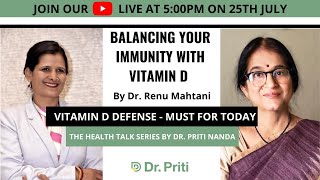
In this live YouTube session titled “Vitamin D Defence – Must for Today,” Dr. Priti Nanda Sibal hosts Dr. Renu Mathani, a functional‑medicine physician trained in the Coimbra Protocol, to discuss the widespread vitamin D deficiency in India and its impact on immunity, especially during the COVID‑19 pandemic. The conversation covers the alarming prevalence of deficiency (over 90% of the Indian population), the inadequacy of dietary sources for vegetarians, and the limited protection offered by casual sun exposure. Dr. Mathani explains the physiological role of vitamin D beyond bone health, emphasizing its presence in virtually every cell and its ability to modulate immune responses, reduce cytokine storms, and improve outcomes in infections. She critiques the commonly accepted “normal” range (20‑30 ng/mL) and advocates for higher target levels (50‑80 ng/mL) as recommended by the Endocrine Society and the Vitamin D Council. The session details how to interpret lab results (nanograms vs nanomoles), the importance of checking magnesium and B12, and presents a practical supplementation protocol called the “vitamin D hammer”: a loading phase of 60,000 IU daily for 3‑5 days followed by weekly or bi‑weekly maintenance doses, with adjustments for high‑risk groups (diabetics, obese, seniors, autoimmune patients). Safety concerns are addressed, noting toxicity is unlikely below 100 ng/mL and that calcium monitoring is the primary safeguard. The hosts also answer audience myths about sun‑bathing, recommending 15‑20 minutes of midday exposure with 70% of the body uncovered for adequate synthesis. Throughout, they stress that vitamin D is a food‑like nutrient, not a drug, and encourage viewers to have their levels tested, discuss supplementation with their physicians, and consider vitamin D as a core component of COVID‑19 preventive protocols.
Chapters
Wow! Hello viewers, and I am so happy today to bring to you our next live session of Food, Medicine, and Lies. As you all know, this channel was started some time back keeping in mind that there is so much on Google and WhatsApp. How do you get to know what is right information and what is not? So I thought, let me get experts to know you who are the masters in their field and let them share right knowledge for you so that you can stay healthy and happy always. So I am very, very happy to welcome Dr. Renu Mathani today with us. I think she is one doctor I have met in last many years who just touches your heart with her passion and compassion. Towards healing people. She is an MBBS, MD, fellowship in functional medicine, and has been specially trained on Coimbra Protocol for autoimmune diseases. She has her own beautiful story to share, and without taking much time, I will now welcome Dr. Renu and let her talk to you and fill you with knowledge which you can use right now and not even wait for Monday morning. Welcome, Dr. Renu.
Thank you so much, Dr. Preeti. It's such a pleasure to come on this platform with such an energetic, such a positive personality like you, you know. Thank you so much for this opportunity.
Thank you, Dr. Renu. Dr. Renu, so the topic for us today is vitamin D must for today, right?
Get this point— sorry, can you repeat it?
So the topic today is Vitamin D, must for today. Why did you give me this topic, and what is it that, you know, you know, which I think a lot of viewers don't know about vitamin D?
You know, vitamin D is— you can call it the chemical gift of sun god to us, right? No life is possible without sun. Right, right. And the same sun gives us vitamin D. But the sad part is we have taken it for granted. We feel that we are getting it. The sad part is today vitamin D deficiency is a global pandemic. Even in a country like India, which is a tropical country, vitamin D deficiency is in more than 90% population. And we don't realize what harm it can do to us. And one, we are seeing it nowadays. We are all sitting at homes scared of this so-called COVID-19. Why? Why has our immunity gone for a toss? Why are we so vulnerable to all these infections? And vitamin D deficiency magnifies with all this homestay And we are all suffering. So vitamin D is so important. It is like an umbrella. It's like an umbrella vitamin that protects. Yeah. And when it comes to the immune system, it starts from protecting the nose, the air pathways, the lungs, the blood, the immune cells, the organs. There is enough papers, enough evidences for that. Now, point number 2: we do not get vitamin D from food. Vegetarian food is completely devoid of vitamin D, right? So our ancestors who had enough vitamin D would do it by farming as their profession. 90% of the vitamin D was met by outdoor lifestyle. How many of us are ready to do that? We are all sitting inside our homes, AC everywhere, covered with clothes and using sunscreens of all types. We are actually scared of the sun, to be very honest.
Exactly.
Yes, yeah, we are having this deficiency to a proportion of a pandemic proportion. So it's very important to take care of it.
So Dr. Renu, I agree with a lot of things you said, but the first thing I would want to share is You know, so vitamin D, of course, in our family also, whenever we used to get it checked, it used to be low. But what shocked me was when my son, who was 21 then, 3 years back, he came home and said, I am having aches and pains, and he was not able to handle infections. And I got him tested and his vitamin D was 3. 3. And since then I have seen there is no patient who comes to my practice whose vitamin D is more than 20-30. And they— and when they come, they say a doctor has said this is okay, right? And I keep telling them it should be higher. So what is your opinion on that, and what is the number you think everybody should check on their blood test reports to know whether they are okay or not.
Uh, Preeti, I totally agree with you. I also see such reports, and I'm one step ahead of you. I have seen a blood report of less than 2 vitamin D, less than 2, right? Well, nanograms per ml, a unit I would like to highlight because there are certain labs who measure in nanomoles. Right? And you may say, oh, it is 59 nanomoles, it is 60 nanomoles, it's fine. Nanomole has to be divided by 2.5 to come to the top terms. Okay, so viewers, please be careful when you look at the unit. So it's very shocking. Even I see vitamin D deficiency in almost all my patients, especially we city dwellers, semi-urban livers. Even athletes, sports people. And there are many reasons for it, that despite being— having at least a semi-outdoor going, even those people are having low vitamin D levels because of various, you know, dysregulations occurring inside the body, deficiency of magnesium. So keep all that aside, let's come to the level that you asked me for. So 20 to 30, which we feel it's okay, these were not even we have studied in medical school in the past, and they were advocated to just prevent a bone disorder called as rickets. Okay, so to prevent rickets, fine, 30. In fact, now it is known that you need a blood level of 40 to prevent fractures. Okay, so these are all the things that have evolved. Vitamin D was thought to be just a vitamin for the bones. But bones is a fraction. It's like a tip of an iceberg. Vitamin D receptors are present in every cell of the body. Every cell, the nucleus, the genes are influenced by it. Our forefathers, our ancestors had blood levels of— can you believe it, how much? As outdoor personalities, 70 to 80 nanogram per ml were their blood levels of vitamin D. Where are we? Less than 10, even 20, 30. It's not on the cap, okay? For our immunity, for good immune functions, the blood levels should be 60 or above.
Wow.
Yeah, 50 minimum, 60 good, above 60 excellent. So we have to understand, we doctors also have to understand all these points. And well, it's there, papers are there, enough proof. And I must share this with you, that the Endocrine Society has recommended a level of 40 to 100 as the normal range. So what are we scared of? 40 to 100 nanogram per ml is normal blood level toxicity. It's not above 100. I am sitting in front of you today with blood levels of 110 right now. Okay, toxicity is way above 150-200 nanogram per ml. Okay, so we are very safe by taking vitamin D. It's better to take vitamin D than stay on 10, 15, 20 levels, stay at home and be vulnerable to all the infections. So, Preeti, I must do— people who are taking vitamin D they— even if they get COVID, it's a part of it. We have to build immunity. They don't even get to know that they have had symptoms. It comes like a symptomless or a very mild flu because their immune system can handle it. And it is found with all these past experiences of COVID in other countries, people who had fatalities, their vitamin levels were all very, very, very low. And people who had adequate vitamin D levels, it was a transient flu, flu, and it got over. So let's target blood of at least 50 to 60 nanogram per ml in today's time. I hope the message—
yeah, and Dr. Renu, what I hear loud and clear from you is that if we can keep our vitamin D between 50, 60, and 100, right, we will be able to feel and be safe from corona?
Yes, definitely. You have to have vitamin D to protect you because it's found that vitamin D can even abort the cytokine storm. You know, deteriorates with the corona infection suddenly, huh? It's chemicals, inflammatory chemicals released in the body called as cytokines. So it's like a storm that comes in the body and If you want, I can share with you a couple of papers right now on the screen. Vitamin D has been found to abort the cytokine storm too. So if somebody gets a COVID, it's like a flu. It gets it, but they may not even get to know, or it's like a mild flu and goes away and builds the immunity against it without vaccination.
You get that point? So vaccination is not required actually. But these simple things are needed. So, Dr. Renu, yesterday I got a call from one of my patients and he said, doctor, I had fever on 18th and now I am perfectly all right, but my son got it from me and my wife got it from me. And I said, wow. And he was a diabetic, so I was, you know, helping him reverse his diabetes. And he was on 10,000K vitamin D daily.
All right.
And even being a diabetic, I think he had COVID because he had visited hospitals 4-5 days back, and it just went away like flu, like, you know, nothing happened.
Absolutely. And I had similar experiences with people. It just goes. Yeah.
So very interesting. So, Dr. Renu, one thing you have said which is, you know, uh, that's going on in my mind, and I will want to ask that. You said our ancestors had vitamin D between 70 and 80, right? And because they were farming, right? And we are having such low vitamin D. And of course, one reason you mentioned was some infections or gut dysbiosis and all, everything. But, but one major myth I see among people when I do, you know, immunity workshops for corporates and people outside, they say we go out in the morning and take sunbath for an hour or two. So our vitamin D should be fine because we are getting sunshine. What is your opinion on this, Dr. Reno?
Right, so even I face this, huh? I say best is get your blood level done. Proof is tasting the pudding. And I have found, I have found that checking vitamin D is not really diagnostic for me because I know it's low. It's therapeutic because when they see the report, who— I never thought it's going to be so low. I always tell them before checking, fine, you check it. If your levels are 50 nanogram or above, agreed to whatever, I have nothing to say. But if it's lower, you have to take some supplement because if you don't supplement now, you'll have to take medicines later in life. Choice is yours. You can prevent so many problems. You can have a much better health. Even diabetes, obesity management, PCOD— 50 to 60 nanogram per ml is recommended even for good ovarian functions. And those autoimmune diseases which I treat— psoriasis, multiple sclerosis, rheumatoid, lupus— these are people who have resistance to vitamin D at the receptor level. And they need more vitamin D than a non-autoimmune patient. So we have to medically— and we are able to reverse, I can say confidently, a very happy, good success rate by just giving the right food to ourselves. Our cells are like a car running on reserve. You have to give— you have to give the petrol for any pathy to work. Without petrol, how will a patty work? So it has to be taken. Wow.
So Dr. Renu, I, you know, I'm intervening here. I know you could have given us a few more tips here, but another thing what I see is a lot of people come and when you say you have to take supplements, they go back saying we don't want to take supplements and Whatever you can, you might do, some of them still feel supplements are not the right way. And you initially only said that vegetarian diet has no sources of vitamin D. Mushroom is one source, but that also gives you so many— yes, that it is of no use at all. So for such people, what is your take?
See, one is, let's know one thing, our ancestors got 90% of their vitamin D from their outdoor lifestyle. And 10% from food, right? It means we have no option but to take the supplement. That's number one. So when people don't want to take it, I say, fine, number one is check it. See, the beauty of this vitamin D is you can check the blood levels, right? You can check B12 simultaneously. Check B because the deficiencies are important. To be taken care of. And once they see it, they will agree. And then, well, I actually also talk to them some scientific papers, studies I share, and it's clear that if you don't take it now, you will need it later. And they land up with some or the other symptom— aches and pains, poor sleep, headaches, fatigue. Everything need not be a disease. Vitamin D and B12 in their lifestyle. If you can boost up your energy, what's the harm, right? Then one more thing which helps me is vitamin D need not be taken every day. That's the— so you can take it once in a week. Later, once the levels come up, once in 15 days. And I think that is very acceptable. To the people that, okay, I'll take it. Okay, once in 15 days later for a maintenance dose, I can take it. So vitamin D, being a fat-soluble vitamin, need not be taken every day unless I give it for autoimmunity treatment. Then we may have to give smaller doses on a daily basis because treatment— so it works. They understand. Test the report. Proof is in that pudding. Yeah.
Perfect. I really like hearing that. And Dr. Renu, you had mentioned about some of these slides you would want to show to the viewers.
Sure, you want me to share right away? Okay. Yes, if we can come to the doses, that how much we need in today's time. See, we can't wait at this moment. We are all going through a global health crisis, and we gain by improving our vitamin D status. So why not? Why not do it? So I would like to share that concept as well. Should I do?
Yeah. Yes, please.
Sure. Can you see it?
Yes.
And yes, I think I will just quickly run, huh? So this shows how in our country vitamin D deficiency is so rampant. And so prevalent, which we are not really aware of. Some of the latest papers that vitamin D supplementation can reduce the risk of COVID-19 infections and deaths. This slide was how the green part is the people who have adequate vitamin D levels. In them, the problem was very, very mild, right? And the ones had very low levels of vitamin D, red color ones. Okay, quickly moving. Possible role of vitamin D in suppressing that cytokine storm. Yeah, right. Mortality with COVID-19. If you look at the graph above, you can see that the red line shows the mortality or the death rate. The death rate comes down as the vitamin D levels in the blood increase. The same picture in a magnified way, right? So yeah, vitamin D today is not an optional supplement. I'll take it, okay, I'll see. It is a non-negotiable cellular necessity. If we don't take it now, we will need more medicines later. So the choice is ours whether we take this or we bank upon medicines later on in life, because it is our life health support system.
Wow. Yes, how the word beautifully said. So beautifully said, Dr. Renu. And I think if this is one takeaway people take today, it will make our lives easy and their lives better.
To make their lives easy, we will have less patients, and I'm happy about it.
Exactly, same here, Dr. Renu. Yes, please, Dr. Renu.
Absolutely. Yeah, so let's move ahead. The vitamin D levels which used to be above 50 nanogram per ml in early '80s, see the downfall, see the trend. And now it has even come down to less than 10, less than 5, and all these scary figures we see when we are dealing with people in our clinics. And I was thinking, what is the healthy vitamin D level? Well, I've highlighted the blue box The blue box, 80 nanograms, which is recommended by the Vitamin D Council. See the next column, the Endocrine Society, which the medical community follows worldwide. It says 30 to 100. My attention to you is to take the upper limit in mind. It's 100 nanograms per ml. You are safe. There's nothing to fear about consuming vitamin D, okay? And this is a very interesting part I want to share. When there was an H1N1 or influenza epidemic in the West, they did a technique which they called as vitamin D hammer. See, if my levels are like 3 or 2, we see, and I decide to take vitamin D once a week, okay, it will take 2, 3, 4 months to come up to some substantial level. But today we want immediate protection right now to fight this fear of the infections. So this is what was done during H1N1 time. They gave 50,000 international units, which is available in the West. In India, 60,000 IU per preparation. All right, so they gave that 50,000 IU or international units daily for 3 days, like a hammer. So that the levels go up, and then they went on a maintenance dose weekly or whatever it was. So in today's time, friends, we need this hammer. If we have not been taking vitamin D and our levels are— even if they are 20, 30, don't hesitate in taking the 60,000 IU daily for 3 days. One dose, 60,000 IU increases your blood level by 8 to 10 nanograms per ml. Know that. So if today I'm sitting on a level of 10 and I take 60K daily for 3 days, I can expect my levels to reach about 35 to 40. But I have to take it daily. If I take it weekly, it will remain little high, maybe 15 or so, but not go up high because the body is consuming also the vitamin D. In those 7 days in between. So this is the most, uh, what should I say, slide which I share. I just don't want to talk that take vitamin D because dose matters. Taking vitamin D 60,000 once a month is a very common practice, right? It's not enough, friends. It can prevent you from rickets but cannot prevent you from the problem of infections, immunity problems. For getting boost up to the immunity, we need the level of 40 to 60. I'm playing very safe, 40 to 60, but personally, me, 60 to 80, I'm very happy. Okay, but it's not— we can't let the body— so I have to—
yes.
So if you see the first, uh, headline, not taking any vitamin D Or taking once a month, it's like not taking it, huh? So blood levels average 10-20, less than 10, very common. So we take the vitamin D hammer, 60,000. 60K stands for 60,000 international units daily for 3 days, no harm. And then take the same weekly, means once a week for 2 to even 3 months, no problem at all. That's the normal physiological dose. Our ancestors used to make 10,000 IU daily in sunlight, minimum production. Okay, that is our unit. You've taken 60,000 once a week, it's an average of 8,000 daily. So we are absolutely safe with that weekly dose. All right, alternative number 2 I prefer the first one. 2 is okay. Take 60,000 twice a week because the, the tank is in the reserve. You have to fill the petrol. So take twice a week for 2 weeks and then follow it by once a week for a total period of 2 to 3 months. Ideally, a blood test should be done to see what should the maintenance dose be. But since I'm talking on a very friendly positive platform, there is no harm continuing at least once in 15 days.
How long?
Always. Okay, because if you stop it, it's like your car is again coming on the reserve and you're waiting for that to fill up the petrol again. It makes no sense in today's time. So there has to be a maintenance dose, which is a very, very safe dose. Option 2, for people who are taking, okay, a better form of vitamin D, on an average 1,000 to 5,000 IUs per day, blood levels even if they are 20 to 30, what they can do instead of taking it, you know, you can take a little more boost right now, take that 60,000 weekly for 2 months and then go on the maintenance dose. So I think it is clear Right, we need vitamin D. Once a month is not adequate, right? I'm giving—
like, we are not taking anything.
Yes, you know what, if you think— this is the next slide, huh, which gives a very beautiful, uh, understanding to the fear of toxicity. Dr. John Cannell, who is a vitamin D researcher, has very beautifully said, worrying about vitamin D toxicity is like worrying about drowning when you are dying of thirst. Today we are all thirsty, means there is so less vitamin D in the body, and we are not water— we are not taking vitamin D. We will drown. It's never going to happen. You have to quench your thirst first. You have to build up the levels. And what doses have been recommended? They will never take you above 100. Impossible, impossible. Okay, so you are well within the recommendation of the Endocrine Society, upper limit 100. You are not going to cross it. You will remain 50, 60, 40, depends upon individual metabolisms. So we are pretty safe with these doses. So don't worry about the toxicity, just maybe Some people who have, let us say, who are on dialysis, let us say, or who are having end-stage renal disease, even they need little vitamin D. But we will say get your calcium levels checked because vitamin D alone is never toxic. It is the high calcium which comes in the body due to better absorption that can be an issue. So we monitor those people medically. And take it. Otherwise, people who are diabetics, hypertensives, obese, senior people— by the way, senior people need more vitamin D than young people because mechanisms are more deranged. Diabetics, hypertensives, obese people, their requirement of vitamin D is more than a thin person. 2 to 3 times it has been recommended. So friends, vitamin D is a friend. It It is not a— what do you call it— a foe, huh?
Yes.
And I'm unable to join you. One second. Can you see me on this?
Yes, yes, we can see you, Dr. Renu. I have just taken away your screen. And thank you for that PowerPoint because I think it really shared the information in a very, very proper way so that, you know, people don't have any doubts. Dr. Renu, I have another question.
Please ask.
So in COVID times, the dose you have just shown, is that what we are recommending people to take, or, you know, you would want to share something more on that? Got it.
Very good question, because I'm seeing it every day. Uh, these doses are for prevention, and this is a minimal dose. Even if you take There are people best in New York. We are a team of doctors working together who have given even this 60,000 daily for 10 days to prevent. Okay, this was a situation in New York, right? To just boost it up so that people can get the benefit of it. Okay, friends, so what I have recommended is very safe. 3 to 5 days hammer dose once a month, and this is for prevention, but If somebody is COVID positive, okay, and they have not taken vitamin D, we have to give them more than this recommended dose which I have shared with you, okay? And that I really cannot share on a general platform, is, uh, we have to decide individually for the patient based on their history, based on what dose they have taken in the past, when, how much. But if somebody has COVID positive, has not taken vitamin D at all, they will need more dose. Maybe we can— we may recommend taking it twice a day. I will not share right now. It's very— yeah, but know one thing, then the dose requirement is high. And Preeti, I am ready to give, and I'm already doing it, free service to people who have unfortunately— who are feeling lost, who are feeling very nervous because they are found to be COVID positive. They are in quarantine, their family members, if they need any guidance on dose, you can please channelize it and I'll be very happy to do that part of my service.
Thank you, Dr. Renu. But I will also want to submit for the viewers that please ask your doctor about the dose. And if you are in your prescription, vitamin D is not there, I think you are now aware of the benefits of vitamin D. Australian government, UK, uh, you know, food lobbies, US food lobbies, any country. If now you see, they are coming out with papers and strong recommendations that vitamin D should be a part of COVID protocol.
Absolutely right.
And if you see it is not there on your prescription, I think as an aware, informed citizen You can ask your doctor about vitamin D and get it prescribed. And of course, as Dr. Renu has said, you can always reach out to me or to her, and we can direct you, and you can seek help. Dr. Renu, I have one more question, and the time is up, but I will want to take this question. How much sun exposure is required in Indian subcontinent to meet the adequate vitamin D levels?
Right, see If somebody exposes 70% of the body— 70%, huh? Right. Using sunscreens just between 10 AM and 2 PM, right? In the morning, 10 AM, 2 PM, with at least 70% of the body exposed, then 15 to 20 minutes of exposure to the sun will give you the vitamin D requirement for that day. For that day.
Perfect.
Got it, right? So are we ready for it is the question, which I leave it to the viewers.
Perfect.
Or take vitamin D supplement. It's not a medicine, friends. It's food. It's food for yourselves. It's food for your nucleus, for your genes. It is the sun energy coming. So let's be grateful to technology to be able to give us vitamin D in the form of tablets, pills, soft gels, powders in the present time. So take it like food, it's not medicine, right?
So as people say, Dr. Renu, these days it is food in the pill, right? And this is the best way to take it. Of course we understand your belief system. We understand that you are not ready because of the old myths, but as Dr. Renu clearly showed in her slides, till 1980-90 we had good vitamin D levels, but suddenly vitamin D levels have dropped steeply since 1990. And therefore, we need to change accordingly our beliefs and our eating patterns and add supplements to the list of our food items.
There's a number one supplement to be added, number one. And don't forget B12 also. Yeah, yeah, right.
Thank you, Dr. Renu. Thank you for being with us. And I'm getting some nice messages about very informative session. Alka says very informative, helpful. Preeti Sekho says very nice information. I will spread this information as much as I can. Shivani and Sakshi says great information, Dr. Renu. We're very happy to have you here. Thank you, thank you, thank you very much, Dr. Renu.
I know that I could do that, I could spread it to the people, to my country, and I really want everyone to be happy, very healthy all the time. Thank you so much, Preeti, for the opportunity once again.
Thank you, Dr. Renu, and have a great evening.
Thank you. Be safe.
Thank you.
Take care.
More from Dr


Understanding Chronic Acidity: A Holistic Approach to Better Digestive Health 🌿


BHRT - transformational health journey if a 42 year old women #BHRT #HormoneBalance




Transform Your Health Naturally with Functional Medicine | Dr. Priti Nanda’s Success Story


hypothyroidism and ozone therapy - talk at Ozone Conference by Dr Priti Nanda Sibal
