Workshop on Fermentation and Health | Dr Priti Nanda Sibal | Roshan Kumar Singh | Cinny Gaurav
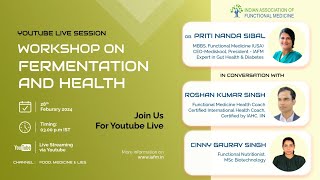
In this live YouTube workshop, Dr. Priti Nanda Sibal moderates a discussion with Roshan Kumar Singh and Cinny Gaurav about practical home fermentation, probiotic usage, and broader health mindset concepts. The session covers concrete questions such as whether the probiotic can be taken on an empty stomach, the optimal timing of intake (away from food to avoid acidic kill‑off), and the suitability of different milk types (UHT pasteurized versus A2 milk) for fermenting probiotic yogurts. Participants exchange recommendations for external resources, notably a YouTube video on homocysteine and cleansing, and acknowledge the influence of thought‑based health factors like gratitude, suggesting that a mindset beyond simple gratitude may amplify health benefits. The conversation also touches on the economics of personalized health consulting, with Roshan explaining his fee structure and Dr. Sibal framing knowledge as an energy exchange, illustrated by a joke about surgical fees. Throughout, the tone remains conversational and supportive, emphasizing mutual learning, practical troubleshooting, and the value of evidence‑based guidance for gut health.
Chapters
Hi, welcome everybody for this amazing workshop, and I'm sure, you know, you are as excited as I am because we all know gut is equal to our health, which is equal to our wealth, right? And for gut, if there is one important thing, that is probiotic. So I won't waste any time and introduce and give this show off to Roshan and Sini, their husband and wife. And I think they've been using fermentation as their hack to treat and heal people for many, many years now, right? And over to you, Roshan. We— I am personally very excited to learn from you whatever you have to teach us today.
Thank you, Dr. Preeti.
Thank you, Dr. Preeti.
Thank you.
So we'll be talking about the probiotics or specific bacteria. You know, I mean, the bacterias were there from for ages and we had no refrigerator long back and we used to get a lot of bacteria through the food and the daily intake. So now the process of sanitization and antibiotics and the environment has degraded the bacteria and they are almost like they have exited. So, so, I mean, so some of the bacteria which are very, very essential for, uh, like a healthy person, and also if someone is suffering, so we have— we usually do a like a platter of different microbes, you know, like one can choose, uh, what the health benefit they are looking forward. Like someone want to look for a better skin Someone want to look for like be relief from the pain, someone is suffering with diabetes. So we have, we are going to discuss a little bit about different, different strains. And strains means like suppose there's a bacteria called, for example, simply Rhamnosus GG or L. reuteri. So that doesn't mean that anything you find in a probiotic supplements and is written L. reuteri, it is have same effect. So each microbe has another strain, like they have species. For example, this is a very famous company called Biogea, and this has two strains, and their details will be— you can find detail about the strain. Rotry has DSM 17398, and there's another ATCC 7469. So similarly, there will be another product with same companies. And for example, this has a different strain. So, so it's the same roti rice. So I mean to say, look for the bacteria, uh, the species which has a lot of data and research, and the benefit what they are there are what you are looking forward. Not just buy anything on the shelf or, or online and considering this is probiotic is going to help. And also measure whether this is helping you. So, and anyone, so what we are doing here especially, Dr. Um and all the viewers, uh, we are looking forward because any probiotics product will have some billions. And the currently the kind of situation we have, like a lot of autoimmunity and a lot of chronic disease, so we need more billions of bacteria. So there is a way to like ferment them. That's the reason we are here to teach the art of fermentation. So, so we'll be fermenting it today in the milk form, which is the A2 milk. Again, A2— there's a reason to choose A2 milk because we don't want to have an inflammatory effect of the A1 beta casein. So A2 is a little bit better form, more close to the human breast milk. So we will be teaching that today, but one can make in coconut milk, they can make in fruit juices, they can make hummus, they can make like Indian chutneys, what we call. So they can ferment in any form what they want, but we need to source the bacteria and you only need to seed them initially. Like, what usually we teach people, like to do a monoculture rather than combining everything together. Monoculture you can ferment for lifelong. Once you only need to just procure the strains. But if you are doing a multiculture, then, you know, when we know that there will be a competition and some bacteria will dominate, some bacteria will may not able to grow as same like growing growing vegetables or the fruits in a garden. Like, if you grow too many things, some will not come at all. So this is the same process here. So we will be doing— so one has to see what benefit they are looking. We have bacteria or probiotics for arthritis, cancer, kidney disease, diabetes, and pain management, for fertility, for old age people who wanted to have more of muscle mass and bone density. We have for autism, Parkinson's, I mean any disease you name it, and there are specific bacteria.
Perfect. Roshan, here I will just want to reiterate to people. See, we all know when we are born, the microbiome we get as a child is from the mother's vagina, and then the breastfeeding, and the love and care of our loved ones. That is where our gut microbiome starts to build, and that is where all the nutrition in our body is created. And nutrition— but unfortunately, during this growth from our birth to wherever we are now, multiple times we have infections. We go through stressful situations. That are the times. Third, love and care, which situation? Every generation microbiome is depleting. I agree with you, Roshan, on that. Number of bacteria, virus, fungi in our body, they are becoming less and less and less. Number come, type of bacteria, and other bacteria, health issues. So this premise, we have to balance that microbiome back in a form that it can keep us healthy. Now we all know we live in a symbiotic relationship with the gut microbiome. Symbiotic relationship means and for our patients and clients, by giving them the right probiotic at that time. And that is what Roshan has very successfully done in his practice. Now here, before I give the floor again to Roshan, I want to highlight one more point, which is probiotics are like antibiotics. Please ask questions. Roshan, myself, Sini, we will be happy to answer as many questions as you ask. But don't do anything if you are in doubt, because if this is such a powerful tool for gut health, then it can be a very, very potent player for breaking our gut health also. I am sure, right? And therefore, don't take this lightly. I'm sure a lot of people here and who would later on listen to this video will agree, antibiotics are not good. No, and I was in Cipla at that time, and I, I remember in one year I did 500 talks on antibiotic resistance. 500. So therefore, now whenever I talk about probiotics, I am very careful that I say this again and again and again because this is so powerful. Because this can be single game changer tool for your health, you have to use it very, very, very cautiously and with complete information, right? Thank you, Roshan. I really thought that you started giving so much information. Yeah, right. So I thought it's very important that I tell them that They can ask questions again and again and again, but till they are very confident, don't try it.
Yeah, thank you. Add to Dr. Preeti, um, so the colonization for a child happens in first 2 years. Ideally, it is 365, I mean, kind of days. Or, or so if, if they miss that period, you know, like they are not best fed, they are not if they are not vaginal born, then they don't have that kind of, like, a lot of microbes transfer from mother to child to the skin. And so if they miss that and the mother doesn't have those kind of microbiome, then the child is no way they're gonna get that. So, and then if they miss that colonization time, then whatever you're doing in future is just trying to restore and restore and restore. And again, to add, like, you know, probiotics you have to be careful when you start, you know, like especially this fermentation, the yogurt, because here you get in half cup, you can, you can get like 200 billion or more bacteria. So we need trillions of bacteria, but again, if someone have an immune compromised system or, or someone having too much of endotoxins, like, like an inflammation in the body, so in those cases they have to start slow. They need to monitor because they may have die-off reaction, what we call as a kind of a reaction where your skin will show, or may having diarrhea, or maybe having constipation, or maybe— so these are the some symptoms can come. So you need to be very careful when you start something new. And then, and then you— but they are, I mean, those, those symptoms can be mostly managed, uh, and you are choosing. And some, some cases like if some body producing too much histamine, so someone having allergy and too much histamine, so you should choose a strains which doesn't add histamine productions. Like, like this, this Biogar, this Rotrye, this produce histamine as also. And some strains like, uh, Bulgaria, what we get in the normal curd, also produce histamine. And Heliveticus is another one. So there are many strains which produce histamine. So we have to be careful to degrade histamine and not to add to the histamine. So, uh, so I will be talking about a little bit before we go to the step of the fermentations. So we'll be talking about some of the bacterias which are very important to be used for even if you don't have health issues, you know. So this is one I told, like, this is one of the favorite because this has many benefits. It has a benefit of like it can help to build better skin, it helps for the hair growth, it helps for bone density, thyroid. I mean, there are like 10 different things. It also helps to boost oxytocin. So this is L. reuteri which I'm talking about. This is one of the favorite, and the curd comes a little bit sour, but it is not like that cannot be eaten.
Yeah, it can be consumed in different ways. You can make a yogurt parfait, you can make buttermilk, you can put it in chia seed pudding, you can use it in variety of form, and it will give you the same benefit.
Yes, and the second one which I wanted to show is about a product called— this is a spore-based This is a company called Digestive Advantage, and this has a B-coggulans. So this is very useful for digestive, immune, reducing inflammation, reducing CRP. People having arthritis can benefit from it. And in general, like, it can help to maintain that— like I said, like, we need to restore Lactobacillus, some of the strains. We need to restore some of these spore-based strains, some of the Bifidobacterium, because there's a kind of team required inside to work, not just one strain to take in a high dose. We need a kind of a synergistically team inside our colon. And there's another strain, like for example, this is mostly used for many cases, like Rhamnosus GG. So Rhamnosus GG is, uh, is very effective for a lot of detoxification. It's effective for immune system. Someone having a mast cell issues or immune compromise, they can be also effective for them. It helps for reducing a lot of heavy metals. So it also binds with heavy metals. Adding to that, I think there is another strain which is, which is called Lactobacillus plantarum 299v, and that is very effective for— so plantarum is— there are many companies who makes. This is a Metagenics who makes, and there's a company called Zaro Formula which makes it. So LP 299v, you can search a lot of research articles that They have been proven for, uh, like binding heavy metals, for autoimmunity cases, for IBS, Crohn's disease. And some of— just I said about the IBS, so there's one probiotic which is E. coli. You know that E. coli is a bad bacteria, but this is one strain which was actually made by a scientist in Germany in 1917, and that's the reason the probiotic name is E. coli 1917. And this has been proven to help for people having ulcerative colitis and Crohn's disease. I have tried for some of my patients who are not able to tolerate anything at all, not even water. So, and this can be fermented in yogurt also. So we have tried—
I want to add something here because this is a very important point and I might forget. E. coli is one thing which if I find it high in GI MAP or anywhere I will not treat it with antibiotics. Strong recommendation as per functional medicine protocol that you have to balance the microbiome. So this probiotic really, really is very, very helpful there.
Yes, yes. And, and we talk about women, you know, women is the main center of the family, you know, if they are not well, everything goes. So there are some strains definitely required for their health, you know, this This is one you can ferment. The strain name is crispatus, which is most important for women's health. So, and it has other strains also in the product. So if you ferment this as a yogurt and take it like, start slow and then try to culture at least 2-3 different yogurt, like you can also co-ferment some of the strain together. And there are some temperature rule like any spore-based bacteria, they can withstand high temperature like something above 40 degrees to 50 degrees. But anything which is a Lactobacillus or Bifidobacterium, they can withstand temperature up to like a human body temperature, 37 to 40 degrees around. And so, so these are a few things that children help. For example, there are like some strains like Evivo. This is very popular for, for the children, B. infantis. Infantis name itself is infants. This is only given for like children even below 6 months old, and this can really help to boost other bacteria. So when we take this bacteria, it's not that it's only— it's not only boosting itself, like it helps to colonize other bacteria through the fiber. And as we take probiotic, fiber becomes the most important thing, like through the different vegetable, fruits. And prebiotic fiber and soluble fiber. So someone having a constipation, like they take more of insoluble fiber. Someone having a very sensitive, like, gut, then they choose something like parahydrolyzed guar gum, which is very used for sensitive cases. So there are different, different prebiotic fiber, and they are really required to boost this bacteria when you are taking this probiotics. So any, any questions to be answered, or we can start?
A lot of questions. So Let's take some questions and then you can start demonstrating.
Sure.
Shubhakar Saad is asking, for gut-related issues, are there different strains to treat IBS and loss of appetite due to anti-TB medication?
Yes, so for IBS, as I mentioned, there is a product there. I think the Plantarum 299V, that is the most important. But then, you know, just one strain is not sufficient. So the L. reuteri, the Biogea one, and the B. Cogglands. They too are very effective. So it can be co-fermented. And there's another product called BNR-17. This has been made from, I think, this has been formulated from Korea. And this is also acquired by Dr. Merula. So he has a product. So these 3 strains, if you combine, this can help to address the inflammation and also the colon where the mucosa is damaged. So it will help in restoring the bacteria there, reducing the lipopolysaccharide toxins from there, and then the LP-299V will be very effective. And then you need to also support your immune system, your detox pathways, and rest other things are required to be done same time.
So Ankita wants to know, are you doing any tests to determine the microbiome of the client? How do you decide what sort of probiotic needs to be prescribed?
Okay, so there's this one test.
So we do a lot. So only for critical cases, like chronic, like chronic suffering for, and they have tried everything possible and they are not getting better. So those cases we do GI map or like Gut Zoomer kind of a detailed stool analysis, which is DNA based, and they give a lot of data about. And when we are giving them probiotics to them, we see that our bacteria are there present in the stool test. Like, for example, we will be— some cases we are boosting the Akkermansia, which is the one bacteria which we cannot ferment because you need an oxygen-deprived environment. So you need a different kind of lab setup to ferment it, not at home. So we can see that bacterial— whatever the bacteria are, we are blooming. We can see in the report what is not there and other I mean opportunistic bacteria, the bad bacteria, we also can see in the stool test. But that is only we do when— because expensive test, so we don't like blindly do that in the beginning. But in case the client has not, uh, everything has not helped for like 3-6 months and they are not getting better, then we go for this deeper analysis. And coming back to the questions of how do we choose what to give to whom, so it again depends on We do a detailed health history analysis, which is like all your blood markers we see, and we see whether what is the inflammation numbers, what is your diabetics, uh, like sugar, uh, like HbA1c, fasting insulin, thyroid status, you know, uh, so all the organ analysis. And a little bit add, we add a little bit more like homocysteine and some markers which are again part of functional medicine. And then sign and symptoms what the patient have, and And then also the history about their family had any disease or so, all those kind of combination thing. Then we decide, okay, what strains are really good to start with. Someone having stress, for example, and if I don't address stress or if they don't address sleep, we have some strains for sleep, like deep sleep. Like Yakult, what you get in the market, and that if you ferment as a yogurt, not the one you buy from commercially because that has a lot of sugar. So that itself helps in deep sleep. This bio, this blue one, uh, this also helps with deep sleep because it boosts oxytocin. It also supports the melatonin productions. It boosted other like serotonin and oxytocin, so which are happy hormones. So it helps in the deep sleep and REM sleep can be extended. And stress, stress, so like stress, like there are some strains for the, like for example mood, and a lot of people have to go through stress. They don't know how to manage stress. Like, um, that when they are reacting to the stress situation— everyone has stress, the cortisol rise, uh, from morning to night, it has to go up and then gradually fall down so that melatonin can go up. But in case of those people who are like, they are reacting and if they feel that, okay, I'm not able to cope up with the stress situations, then they can add some stress-related probiotics. So it's like we have to choose based on the complete evaluation.
Great, thank you for such a detailed explanation, Roshan. Roshan, I will take last question now and then rest of the questions we'll take after demonstration. Sukhmeet wants to know, Biogea gastrus that we get in India has palm oil, is that fine?
So the India, what you get strains, it is only DSM 17398, which is one of the strain of Biogea gastrus. That has some benefits. And, and the palm oil, even if it is there, I mean, if when you're fermenting it, the palm oil will not regrow. It is a one-time effort. And, and then once you have made a culture and then you are using that culture to re-ferment again and again, you are not using that, uh, but if you are, because that has very low, like not in millions, I think 1 billion basically. It's a very low strength because the protectives what you get in the market is for children health. Is not for adult. So you have to use like 10 tablets, you have to crush, and then you have to make a yogurt. But then palm oil in that is not— no problem, because you are not gonna use tablet again and again.
You are using the curd to remake again, unless you have a specific inflammation issue with palm oil or any of the compound present in palm oil, then you couldn't.
I really love this answer. Thank you, right? Because I think, um, I strongly feel that when we come towards functional medicine We become too biased on certain things, but we have to give this credit to our body that a little of something, if we are not overloading with that, the body has the ability to tackle it, to handle it, to detoxify it. So, you know, little quantity, if used for the right purpose, is okay, is okay, perfect. So we will go with the demonstration, Roshan and Sini, and then we will come back to more questions. I have a lot of them for you.
Just a second, I'll just do the setup so that you can see what I'm doing as I explain and I go forward.
Perfect, but we can't see you, so the camera has to be shifted a little.
Sure, just a second, because we have like a whole plethora of probiotics that Roshan wanted to talk about and explain. So that has what has taken away maximum space. So I'm just going to avoid my face and talk here step by step so it's easier to understand. So for this, the first requirement would be inulin. If you can see on your screen, this is a prebiotic fiber, basically a starch that is derived from many vegetables, let's say asparagus and even in wheat, a lot of different fruits and vegetables. So what is inulin? This is very important to make curd or yogurt. For specific bacteria. Why? Because this helps them in doubling the number. So there could be a question, you know, why do I need to even make yogurt as such? Why can't I just take capsule? Easier, more convenient. So when you take capsule, the potency might not be as same as when you take a yogurt because you're taking a live culture of bacteria, okay? But it has a dose, recommended dose to be taken as per the condition, age, gender. Okay, so this is inulin, which is very, very important.
There is some disturbance happening. Is there a mic there which is being touched with something?
There's no mic, but I can—
you don't have a mic, but can you hear me now?
I can. Off the—
that sort of noise is coming because of some loose connection.
Okay, is it better now? Yeah, yeah, okay, so this is inulin. This is what we're gonna use. So for anything, we will be using organic milk which has to be pasteurized. A reason to use pasteurized milk and A2— A2 is easily absorbed by the body, has more phosphorus, calcium in absorbable form, and omega-3. So this is what we personally use and we recommend to our clients, which is Akshakalpa A2 organic milk, which is pasteurized. Again, pasteurized because we do not want any other bacteria to grow since we are adding inulin. Any opportunistic bacteria can grow. We do not want that. So what we're going to do is we're going to boil this milk as usual, as we boil, and then bring it to room temperature on its own. We do not have to cool it down. You can switch on fan if you're in a rush, that's fine. But what you're going to do is just cool it down, that's all you're going to do. So I already have that. You will take a glass container or a ceramic container. Mostly glass containers are what we recommend for the usage. You take a glass container, then you start adding inulin, which is I am using here 1 liter of milk. So for 1 liter of milk, I'm gonna add 2 tablespoons of inulin to it. So here goes.
A little bit of shifting of the camera is needed.
Okay, 2 tablespoons. So 2 tablespoons of inulin has been added to an empty glass jar. Is it okay now?
Yes, yes.
Okay, what I've done is I've taken a clean sterile glass container and I've added 2 tablespoons of inulin. Anything and everything that I'm using here is sterilized. Very, very important. How do you sterilize at home? You just use an organic, you know, natural dishwash soap, wash it off, and then use hot water to just swirl around, sanitize, and then you are good to go. Over in this, I'm gonna add just few ml of milk because I want this inulin to be dissolved. So this is the milk that has been boiled and brought to room temperature. I'm just gonna slowly make some swirls and I'm gonna dissolve this inulin completely. We do not want any lumps because we, we want the texture of the yogurt to be thick, creamy, so that we can eat it. You know, anything which is good in taste is easily consumed, not just by us because we understand it's important, but also by elders in the family which is very difficult to feed, and the kids in the family. And twins especially. Even, you know, if I have to feed my own mother-in-law or my mother or father, it has to taste— it has to taste good because, you know, for them taste does matter, you know. Yeah, so this is why we use inulin. There are a lot of papers and studies that talk about, you know, how inulin give you the best result. You can use gorgon, but again, the texture would not be the same. So after trial and after going through a lot of papers, we know that, you know, inulin is the prebiotic that is required and that works brilliantly for the curves that we're going to use. So this is not strain-specific. Inulin is not strain-specific, you know, it can be used for any strain. Today the strain that I'm going to use is this particular strain called Sugar Shift. If you can see. So this is very good for diabetes, which is very common in India, very, very common in India, um, especially as this era is considered. But it also helps you with other metabolic factors, gut health, you know, other beneficiary bacterial and bacterial strains are there. So now I have completely dissolved my inulin. There's some lump here that I'm trying to dissolve as fast as possible.
Just to add, SugarShift has been— they do clinical studies a lot. So they check the patient before giving the SugarShift. They withdraw the blood and they check LPS, the lipopolysaccharide. And after like 8 weeks of giving SugarShift, they also recommend to take yogurt if you can make it at home. And they check LPS, and LPS usually drop like 30-40% in like 8 to 10 weeks. So that is the reason it is quite good multistrain for reducing inflammation.
Yeah, so now I'm going to take 1 capsule for 1 liter of milk. So for 1 liter of milk, I repeat myself, 2 tablespoons of inulin and 1 capsule. Please make sure that the capsule or the strain bacteria, whatever you're using, should be more than 2 billion in count. It is very much required, okay, for you to have a thick creamy structure and a good amount of bacteria per serving because That's the aim. That's why we are taking the yogurt and not the capsule itself, because we want live bacteria. Because please understand, as the age progresses, we cannot colonize these bacteria very efficiently in our system, okay? So the more amount of bacteria, live bacteria that we take, the better it is. So this is almost there, and now I'm going to take another sterilized container that I have with me. So this is the biggest sterilized container where I'm gonna add the small because I wanted to mix it properly. I do not want any lumps to be there. I want the bacteria culture very, you know, nicely inoculated every inch of this. And then I'm just gonna pour this seed part over here. There's some more inulin that I have it here. I'm gonna just dissolve it in a little more milk. And while I am giving demonstration, I'm speaking and I'm making sure that I'm very, very far away because again, this is just inoculating a bacteria into a culture. That's what we are doing. Even then, you're making yogurt, so make sure that there's no dust particle around. We are not speaking over it.
You are not making this yogurt close to your— when you are cleaning your house, you know, like a lot of dust in the air, so you have to be, uh, careful. Exactly, like no, no, uh, dust cleaning and close to the yogurt making.
So now that this is ready, I'm just gonna pour over all the 1 liter of milk that I have with me, and then I'm gonna use a yogurt maker. Why do I use a yogurt maker and not a regular fermentation, like, you know, just keep it in a dark place? Is because these bacteria are specific bacteria. They require a specific temperature. You know, okay, the container that I will use because I don't want to fill it to the brim, okay, I want to give it some space. So this is ready. Everything that I'm using is sterilized and I prefer using glass, but you can use ceramic. Glass gives you a better result, better texture, and the better growth. So you understand there is a bacterial growth curve, right? We want it in a particular growth curve where it is highly potential, multiplying very fast and producing the specific compound in our gut that we require from them. So this is all prepared. Now I'm just going to keep it aside. This is a yogurt maker. This is one version of the yogurt maker. There are many versions available in the market. You can buy it on Amazon, on specific sites. So this is a yogurt maker. What I have done here is I've just added some water into it. I hope you can see. I have added water because I want the temperature to be uniform. In this. Okay, so this is a yogurt maker. You can use a slow cooker, you can use an oven if you can maintain, because the fermentation will go till 36 hours. That is something to be, you know, remembered. So you can use a slow cooker if you have at home, um, you can use a conventional oven if you can maintain the temperature to its lowest, um, whatever is convenient to you. So this is the particular one that we're using as of now. What we're going to do is just open it. I have already plugged it. In. I'm just gonna place this particular box inside which has my inulin, bacteria, and milk, okay? And now I'm just gonna set. So you can see the reading, okay? It will take me a minute because it's for me. Just a second. So we're gonna press set over here. Let me bring it closer for you to understand. This is visible now.
Yeah, this is it. Yes.
So I have just pressed set here. Okay, you can see there are certain numbers that are appearing. That is the regular number which we do not want. We want— just a second, let me see what is the last. Okay, so this is 06. So it is— we want to increase this. This is what we are setting as temperature, right? One second. So the temperature over here, if you see, is 42. We want the temperature to be 42 because I use it regularly. This temperature is set. Generally it starts somewhere at 24, okay, and then you have to increase. For increasing, you have to press the plus button which is over here, the plus. So you press this first, then you press the temperature is, uh, sorry, yeah, the temperature is set. Once the temperature is set, you will start the green Turn. Roshan, do not unplug it in between.
Okay, okay. Roshan is not used to staying idle.
No, it was already on. So like you see, like first is the temperature, like 42, and go ahead.
It's okay, go ahead.
And now next is, you say, if you wait first So Dr. Preeti, if you— this machine, it is automatic. So if you wait, automatically it says 8 hours. If you see, there's 8 hours. Yeah, so you— so we cannot wait. So yeah, so there's a reason I have to unplug again because LED on. So I'll unplug and show you how to set the time. You know, time is very important. So now it is— now it is 42. Say for this strain, suppose we want 38 degrees, the human body temperature. So we decrease 38 and then we set the timer and then we increase the timer to 36. So this is how it does, otherwise it is automatic.
Yeah.
And then it will— this one will both will turn red, that means that it is all ready.
So it will slowly raise the temperature and the water will spread the temperature uniformly for the bacteria to grow in the culture. And after 36 hours you can— you should refrigerate it for like an hour or two. This is only for the texture to become a little thick and creamy for the consumption, and then you go ahead, use it as you like. But in case you're making a shake or a buttermilk, anything, please do not, you know, pulverize it or do not mix it for too long, more than let's say 30 seconds. So if you're making a smoothie, add all your content of the smoothie, whatever you want to add, pulverize it nicely, make it in a smoothie, and in the end, the last 30 seconds, you add the yogurt just one go and stop for 30 seconds because we don't want the bacteria to split open. We want them live, intact in our rectum. So that's the whole thing.
And one troubleshooting here. So you see this, this is a PS-128, the one for the mental health, mood and thing. So if you see that there's all water behind, which is whey, and the top is like a cheese, like kind of paneer, you know. So when we— when you make first time from the capsule, the bacteria's environments are changed. So it is normal to have this kind of yogurt in the first iteration, like the first time when we make. So we don't have to throw this away. We can use the whey portion to reculture again. You don't have to use capsule again, and then the second batch will come delicious.
So Roshan, when you say reculture again, Right, what frequency we need to do it and for how long we can use which probiotic? Any tips on that?
Most probiotics can be stored for 7 days to 10 days. If you put it in the freezer, you're good to consume. But what we suggest to our clients at Wellness by Rosh is once your curd is ready, you've kept it in the refrigerator, let's say for 2 hours, the first you remove the seed culture. Seed culture is basically the first, the few, 2 2-3 tablespoons, you save it in a separate sterilized container that can be used, okay? It can stay there for 10 days, not a problem. But if you're using whey, for example, as suggested, you can freeze it for up to a month.
Yeah, you can do more than like many months. Like the water portion, you can make as an ice cube.
Yeah.
And you can store it in the freezer. So that is like your— that should be from the first time when you made, so that the bacteria are pretty good and all. But yeah, But anytime when you are making like the choice, for example, if I have a diabetic patient and also having hypertension patients, if I'm doing 2-3 different curds. So we do week 1 like, like Sugar Shift, and there's a product called Heart Centered. So we do like 2 curds is easily possible for clients to do in a week 1, and then we add another 2 varieties in the week 2, and then we keep alternating them. So at least they are getting like 15-20 different kinds of strains and then the benefit they can see, and they are boosting fiber, uh, as we know that the bacteria build the starch and fatty acid, so they are helpful for a lot of prob— a lot of health issues they can resolve internally.
And we have certain clients who are currently maintaining, uh, you know, and they do not have any symptom that has come up, only via fermentation. Not just yogurt, you also have juice fermentation and other fermentation that can be done, and they're solely able to manage a lot of conditions just by using yogurt.
Could you elaborate on juice fermentation? What types of juices have you used successfully and how do you do that?
Any fruit juice that has high content of sugar, we need high content of sugar for the fermentation to happen. And one particular strain that we use is S. bulardi for fermentation that has very good, you know, results for IBS, we have seen.
So S. bulardi is anyway very majorly used for, you immunity, autoimmunity, so many health issues, Candida yeast. So that is— that ferment very well. But other than that, like the whey, what you saw, that the whey portion we can mix in any fruit juice, like pineapple, for example, pomegranate, apple, grapes, which are like more sweeter side. And then it comes very well. We need to do a little longer fermentation, like 48 hours to 72 hours.
That was my question. Good. That how many hours we need to keep that to you know, ferment that.
Because it also depends on the temperature. If you're in colder region, it may exceed 48, um, you know, maybe it's few hours more than that. But if you are in a, you know, very pleasant weather, or like let's say beach area— India is mostly humid unless it's winter, but generally not.
Like in winters, I tell people to keep it for 4-5 days, but normally 2-3 days.
Yeah, so that's, that's all it works, um, in a dark cupboard it works It's really fine, and you can have it as a bubbly drink instead of the regular bubbly drinks that we enjoy.
Yes, and it's very delicious. Perfect. Any comparison of this with kefir, kombucha?
So I initially, when I started, you know, my art of fermentation in 2020, I started doing with kefir and kombucha. And then, and it was— I was enjoying the drinks, but I was not seeing if this benefiting me, because we don't know the what bacteria are there. They may have yeast also. And they— and we don't know the, the— I mean, we don't know exactly the strains in that one. So this is unknown strain, and then I know the strain, I know the clinical research, okay, this L. plantarum can help me in this problem, then I will probably choose the one I know rather than unknown area. So, but it helps overall, like, to maintain the diversity. As we know that it's not like booming one, uh, or blooming one bacteria can give you the benefit. You need to create that diversity and the ecosystem from inside. So kefir, kombucha, and other things are good, but not commercially what is available. Make at home. If you cannot make at home, then you leave it on the countertop for a few hours so that it gets over-fermented, so that you have less sugar. Because the commercial one will have more sugar because they have to sell so much and they have a target.
It has to please people, you know, a certain genre of people to be able to have some products selling and everything. But there are good, you know, products available in the market. You need to do your research before you pick up one from the shelf.
So the data says that yogurt has, if 3.2 something like that billion CFU, then kefir has 9 point something.
So what we are making, this yogurt, they are at least like, if you take like 100 ml of the yogurt, this is somewhere around 150 to 180 billions of bacteria.
Exactly, I was coming to that. So that is the comparison of the plain curd or yogurt which we make with kefir. Similarly, sauerkraut is known especially very, very beneficial for H. pylori cases.
Yes, cabbage.
Gut cases, right? So different things for different purposes. But yes, this is a way to enhance, you know, your health very, very effectively. I started using bacillus coagulans for this I think in 2019, because that was the time I was working for my son and I could make all the effort on this earth to do something, you know, because this is extra effort. This you have to do by your own, whereas the normal curd, your maid will do it and it will still come out nice. So I started doing that. I saw very beautiful results with that, and then I stopped it. And then I saw Roshan's messages in the group that he's doing it, and I said Why did I stop doing it?
Yeah, we get bored with doing same thing, you know, like we need to—
and it's not easy, but if you get into the habit, then I think it becomes very easy. Only first time you need to make the effort.
And it's also a lifestyle practice, you know. Once you get into habit and you see no more symptoms, you see the kind of improvement, it's just a lifestyle that you adopt and you Yes, the way we used to have buttermilk before, we're just making it in a different way.
Great. So we have a lot of questions for you, right? And I will quickly ask the questions, and you know, it's like 30 seconds answer, Roshan.
Okay, okay, sure.
Okay.
Yeah. Um, Sini is saying, I don't like this.
No, no, no, looking at him, just keep it 30 seconds.
Okay, thank you. Uh, so let me start from here. Perfect. Are all these probiotic brands available in India?
They are not, but you can source through iHerb. Yeah, great.
Um, and we will share the links in the description of the video, so anybody who wants, just directly go to the link and order. You don't have to do any other effort. Is taking prebiotic more beneficial than taking probiotics?
So if you don't have the bacteria who gonna consume prebiotics, the prebiotics will give a lot of symptoms. So it's very important to first start restoring the bacteria and then give the food to feed the bacteria.
Yes, exactly. I also want to tell you here that using the same probiotic for long duration is something I would be cautious about, and I'm sure your Russian would be too, because we don't want to shift the scale from here to here. So, uh, Hindi, but health is all about balance, right? When you are low, you do these probiotics to come to neutral and then work on your nutrition and your thoughts and your lifestyle and your sleep and your stress in a way that more and more comes from the generic things. You don't have to choose brands. But you've gone out, you have cold, then you know what you have to choose. 5 years, your sugar levels are all right, but again your sugar levels are playing with you, you know what to choose. So it's a tool. Like in winters, you take out your coat or your blazer, and in summers you keep it in your almirah, which is locked for the next 6 months. Right, Rashid?
Yes, very true. Yes, great.
Can multi-strain probiotic capsules be used for fermenting yogurt?
Yes, we use some of them, like, and we choose also the strains mentioned in that one. So especially we look for Acidophilus longum, Rhamnosus GG, B. lactis. So yes, so you can ferment, but you need to reseed them after 15-20 iterations. Suppose you have made 15-20 times, you need to reset them because they will be— some will be dominant and you may taste bitter after, uh, after some time.
Okay, can we use VSL3 also for this purpose?
VSL3 can be fermented, but the VSL3, as we know, the original strains are no longer there. The Dr. Simon formula is no longer in VSL3. This converted to a new company called Visbiome. So I would say that it has some benefit I mean, but again, this doesn't mention what strains are there. So always choose— like as I mentioned, the L. reuteri, you get different types of L. reuteri, but which one is important is very important. So it's very important to verify that.
What sort of probiotics we use for Parkinson's?
So Parkinson's, as I said, the— there are 2 or 3 which is very important. The one, the Biogaia, the L. reuteri which I mentioned, Then we use a Ramess GG. And then the third one, the most important, is the Neuraly, which has PS-128, the plantarum, which has a 128. This is a company who makes, and especially for Parkinson's. And, and also the Sugar Shift can help as a multi-strain because it reduces the lipopolysaccharide, the toxins. So it helps, very helpful to reduce the brain inflammation.
Perfect. And Roshan, will it be too much work if I ask for the viewers that you make a table sort of a thing and share this disease and what you use. Not saying that this is medical, but whatever you use.
Then there is a lot of condition, you know, we cannot be very specific.
We can tell you a disclaimer because what you are saying people will not remember.
Yeah, yeah, we can do that. Also, if they can buy this book, for example, LifeBridge, so it has, it has mentioned in the last, like, okay, what bacterias help in what disease. It's a detailed description, but they don't know what product, you know. So product-wise, yeah, I can help.
Yeah, you know why I dared to ask Roshan to do this? Because he's very good with writing and tabulating. If somebody would ask me that, I would never be able to do it, right? But thank you, Roshan, for agreeing to that demand. Yes, um, how can we make this yogurt with any vegan milk?
Yes, so coconut milk gives good result.
Coconut, the potency of the bacteria is good. We add there inulin, like same as what the Sini demonstrated today. We also add a little bit of raw sugar or jaggery, just because the coconut milk doesn't have enough sugar and there's no lactose there. Some cases we put a little bit of gorgon. So you buy a coconut milk which has pure coconut milk and cream and gorgon, but nothing else. This should not be mixed like glycerin or some emulsifier. So buy a product, uh, there's a company, a lot of company in India which they have. So coconut milk is best. You can do soya, you can do hemp milk, you can do cashew, almond, oats milk.
But yeah, coconut milk is the best.
We have seen is with coconut milk, uh, adding little sugar and gorgon. You also get coconut milk which has gorgon already in it and full fat. For— so that's what gives you the best.
I just made 2 days ago, so it was delicious. I mean, so I was having pomegranate.
Very nice. How soon do we experience positive effects after regularly consuming these yogurts?
I would say the effect on the blood markers, maybe like 3-4 weeks, but on the, on the body, like for example, uh, digestion getting better having sleep improvement, having the deep sleep basically, not just sleeping on time, you know, in also helping with— if someone has a constipation, then it can result in 1 or 2 days they can see benefit. And then other benefits in terms of the psychological benefit, it will take a little bit time. But more— and then other thing we need to measure in the blood markers.
So it takes like 1 week for you to see the symptoms getting improved, and that's the you know, mark that we say that it is working for you.
Perfect. Can we add two different brands of prebiotic capsules in the inulin dissolved?
We have done that many times. Like, for example, I have L. plantarum from a company called Metagenics and L. plantarum from Zaro. Though they both mention 299V, I combine them and make one culture, one yogurt.
With inulin something?
No, inulin itself should be sufficient. Please understand, inulin is not absorbed by our body, but when you consume it along with the bacteria, it also helps the gut bacteria to multiply faster. So it's only for the bacteria to be multiplied faster, and inulin gives best result, as I explained before.
And it's the most simple and non-controversial prebiotic.
Yes, so I mean, I mean, mixing two will not gonna increase the bacterial count. But if you wanted to take consumption-wise separately or along with yogurt, you can— you need to choose a variety of prebiotics like inulin, gorgon, pectin, FOS, and GOS. There's so many things are there.
Since you mentioned about taking great care while using probiotics, would you kindly share a checklist? Rajini already told Roshan, and Roshan has agreed to it.
Thank you.
For mental health, which probiotics should be used and how to make it? So making path stays similar, Anjali. Which probiotics to use? I think Roshan did show Mood probiotic.
Yes, Mood is one. Then there's something, the new research by the Microbiome Lab called ZenBalm Dwell. Again, it's a long gum. What is important, the Bifidum longum, which is really helpful. Even the, the one I mentioned about the Parkinson's, they are also very helpful. Just the Biogaia, the Rotri itself, is very helpful because it boosts oxytocin.
Mahesh wants to know, do fruit juices need temperature control during 48 hours?
So it is good if you have temperature control. We have seen, I mean, the bacterial count will be more. Yeah, but if you are— but then as I said, we have to—
normal temperature also works well. That's what I have seen.
Yeah, and longer fermentation you can do, like say juices, if you're doing 48 to 72, you do maybe a little bit extra and you taste the, the because every fermentation of juice will make some kind of alcohol. So you taste how much you like it, that you're— and then you can decide on that.
Just keeping it in a cupboard in a warm place should be sufficient at home, right?
So Mangala says, can you do a demo for fermenting fruit juices? Mangala, maybe next time, right? Thank you. Um, but there are videos available on YouTube if you just go there, fermenting fruit juice. You will find some very simple videos there. I've been using them, my patients have been using them, and I think that's simple. You can try that. Rajini, would any strain help with vaginal yeast infections such as Candida?
Yes, so the one I mentioned about the women probiotics, right? The Metaphilus, that has got L. crispatus. So that's the most important one. I mean, that is very important for women to take them. And also help for pregnancy time also, and not to get infection, I mean, not to have preeclampsia kind of conditions. So there are a lot of studies there that, that has been proven very effective.
But just want to add a quick note is, um, if you have— if you're suffering from Candida or H. pylori, there also has to be some cleansing protocol that has to be done, and then probiotic has to be in.
Thank you very much. I was about to say that because I see in my practice that patients who need cleansing and cleansing is not done, all this does not give them a cure which they are looking for.
Yes.
And therefore, I in the 6R protocol am very clear that the remove part is exceptionally important in some cases, not in all, but 20% of gut infection cases, unless you've done remove aggressively, this might not give you the result you are expecting.
Yeah, it's just like if you don't decorate your house, you don't like to live there, you know. Like if you—
is all like clumsy, thrown things here and there, you need to declutter before you start reorganizing.
So it's very important for acne.
So acne, there are a few strains which are helpful, like Rhamnosus gigi. Yeah, and the B. coggulans is helpful there. And then, uh, and because all also coming from histamine and hormonal imbalances, so anything we do on hormones and histamine reduction is helpful. So long gum acidophilus Ramana said GG plantarum is very helpful there too.
And even before, please do not take them as Roshan is saying. Please understand where your acne is coming from. It can be hormonal, it can be gut related, it can be other underlying condition. So depending on toxins, yeah, wherever it is coming from, we look at the core cause of it and then we will start with probiotics.
Yes, some, some cases we see like our clients start probiotic and they start getting 2-3 acne.
Yes.
And that is all the lipopolysaccharide, all the toxins, endotoxins.
And then they are very disappointed.
Yes, yes. So we tell them beforehand, you know, like, these are the die-off reactions, don't have to react it, use silver or some kind of, you know, tea tree oil and some, some natural things.
What are the difference in fermenting juice and milk in terms of, you know, benefits they give?
So milk, as an A2, we have seen people having lactose intolerance also did well.
Yeah, like 36 hours of fermentation, so lactose goes really low.
Yeah, so I will say milk, we know the count of bacteria and we are knowing the benefit and it is quick. Juice is— there are high chances that, you know, like fruits, we cannot sanitize the fruits. Yeah, milk I am able to pasteurize and sanitize. So there might be other microbial there, it could be bad one, we don't know. So then it can lead to a growth of other bad ones, but since you're fermenting for long, so that is one thing we have to be very careful.
And yeah, milk, what we choose is organic over here, but fruits and vegetables that we say, even though they say organic, you have to really look at certification and all that. Even for the milk, it's same, but the amount of pesticides, the amount of artificial, you know, fertilizers used over there could be high. So that is again one thing that we need to understand.
Perfect. So, uh, PD1 is saying, currently I'm fermenting with the probiotic and adding curd along with A2 milk. Is that all right?
So adding curd means while fermenting they are making like normal curd, like commercial curd?
Yeah.
So commercial curd have only 3 bacteria.
Yeah, yeah.
So that is a— have bulgarius and thermophilus, which which can boost histamine. So not that powerful.
Yeah, in this I don't think you need curd. What strain can help with constipation?
So constipation, the most effective is L. reuteri, the Biogastris. That's the most effective. And if someone having more chronic constipation, then the E. coli which I mentioned is very helpful too, especially for people having IBC, IBSC categories. Or ulcerative colitis.
Yeah, thank you, Anjali. Mahesh wants to know how to decide which ones will thrive in the same temperature while making a single curd for multiple strains.
So when we are making a single curd for multiple strain, either different you are putting together or you are using a multi-strain probiotic, we will never know which strains will dominate there. But if you are doing, as long as you are doing 3 or 4, it is still okay. You are getting 25% of each, or maybe like—
yes, but Mahesh wants to know, Roshan, whether temperature differs according to the strain we use, or temperature always has to be 42 degrees.
So any, uh, any, anything Lactobacillus or Bifidobacterium, the temperature is like 38 to 40, 41. I mean, uh, and then say the, the one I have shared for the weight loss, the, by the Merula one, which is also used for reducing inflammation, that can go up to 109 Fahrenheit. So that is something like 42 degrees, 42 degrees to 43 degrees. Spore-based can go higher. Yeah, so when you're mixing many strains, then choose a common ground temperature.
Thank you. I think, Mahesh, this answers your question.
Like 40 degrees will work for every kind of bacteria.
This is our Right, but I think then I would suggest that we choose similar type of bacteria. Like you said, weekly basis for 52 weeks we use one and then for 2 weeks the other one.
This is all convenient. So if convenience is a problem, like if they want— suppose I have a sous vide device which is— I can't show in the camera. It's like a big device with water full and I'm making like 6-7 different yogurt, you know. So those kind of same situation, then We can choose a common grounded temperature. So maybe the spore will not grow that much, but it's still okay. You will get— still benefit is there.
Yeah. Are probiotics contraindicated for patients with SIBO?
So Rajini, people, if they take probiotics and if they get flare-up and symptoms get bad, that means they have more problem because this is the upper GI and small intestine. So they have to go slow. They might need to add charcoal to bind with the toxins. They might have to do the remove protocol.
Remove protocol properly, Rajni, then.
Yes.
Right. So generally for SIBO, my now go-to is I don't start with probiotics. I do the reset and remove and then come to probiotics. Because if the symptoms aggravate now, the patient loses trust in this new type of therapy.
Yes, so, so we again depend on case to case. If they have a mild SIBO, for example, then yes, then probiotics will help. Yes.
Yeah, I agree with you. Enjoy. So IBS OCD for 15 years, tried everything. Do you have any recommendations when it comes to yogurt, with which probiotic?
So you have to do that, some of the few strains, you know, like the B. Cogglands the L. reuteri from the Gaster, the BNR17, the L. gasseri from the Muricula, which I have shown. And then you can add Plantarum and the Mutaflor, the E. coli one. So I mean, you can combine this 3 or 4 to make one yogurt, and E. coli you make separate, and then this can help. But again, if you are not gone through the proper, uh, the cleansing protocol, if you have a problem with detoxification system, then we don't recommend the cleaning, cleansing protocol, because then everything will be recirculated back. Yeah, so that all thing have to be evaluated, and then you have to go slow.
Detoxification also has to be worked on, and that's the reason I think you need to work with somebody to get results, right? Great, very valuable point brought forward, Roshan.
Especially he said 15 years, you know.
Yeah, it's a long time.
So I mean, he has already probably done many different kinds of approach. So it's very important to be in good hands and someone can guide and support them.
Exactly, especially with OCD and all. Perfect. Have you tried inoculating cabbage with any strain for helping people with H. pylori?
Yes, so cabbage fermentation also has plantarum. You know, plantarum also helps in eradication of H. pylori. And there's also a probiotic called Pyloguard, P-Y-L-O-G-U-A-R-D. Which has a L. reuteri strain, and this is from Microbiome Lab. So that also is effective for, uh, in the eradication of H. pylori.
Perfect. What is best for endometriosis and endocrine issues?
So endocrine issues, definitely start with the women probiotics, the Zaro formula or the Culture. There are two companies who makes it, the L. casei. And then maybe work on the SIBO because most of the endometriosis cases is they have some kind of SIBO or SIFO, fungal or— so they have to work on both.
Yes, they have both. Yes, Rajini, pre-cleansing routine will have to be personalized because then that means the patient is really in bad shape and you should personalize it. Haji Nafi wants to know, can A2 milk powder be used?
You can use, but again, how you're going to sanitize it? So you don't know, so if it is made like inulin powder, like properly done and there is no contact.
Yeah, I think A2 milk powder can be used. I was working with a research company about 7-8 years back with Nestlé and one more company where I was surprised to know that the quality of the powder milk is much better than the liquid milk because most of the powder milk is exported out.
Yeah, but sometimes they do contain gluten, so please make sure that if you're using a powdered milk, you do not have any form of gluten.
Other fillers, I mean, yeah, there could be fillers for sure, like stabilizer and other things, right?
But you know, most of the powdered milk, because it's exported, the guidelines are pretty strict, so label would definitely generally have it. You get to know what it is.
Of course, yes.
And I did not know this till I was involved as a part of that research which they were doing, and I was surprised because till then I was very anti-powdered milk because I used to think that's processed.
Yes, not all processed food are bad.
I agree with you, because just of the regulations and because 80-90% is exported, they said this quality is much, much, much better. And therefore learning continues, that can never end, right?
That is true.
What's your view on fermenting rice overnight and having it next day? I've seen some videos, even beetroot kanji. How do we know which kind of probiotic is better for whom?
So all this process, the old traditions, there we don't know what microbes coming from the air. So it is still helpful, but not like if someone really want to see some results. So you can choose the whey part of this probiotic, like curd what we make, and put in the beetroot kanji or rice kanji. So you know that, okay, you are at least getting some strains which you know already, okay, I'm looking for this benefit.
Mangala, session on cleansing protocol I will definitely plan. But before that, I had done last year this session with the IFM founder. I'm forgetting her name. Can— Rashan, do you know the IFM founder's name?
Anish Musa? Dr. Anish?
No, no, no, no, IFM.
IFM. Okay, um, okay.
I really love listening to her. She's a great orator, very good with knowledge. So I think you should go on the, um, YouTube and figure out homocysteine and all where it is complete, very nicely discussed. She had brought up a lot of relevant points um, which can add a lot of value when it comes to cleansing, right? Um, I would recommend that video to be seen by everybody again. Every time I listen to that conversation, I add one note that this is one thing I'm going to look into. It's that deep and beautifully articulated. And I think this was last year, and unfortunately I'm forgetting the name, but I will have Renuka share the link in the section below. So you must also listen to that if you have not heard that before.
Yeah, I think I would.
Yes, perfect. Um, yeah, can this probiotic be taken on empty stomach? We are already very late. Quickly, 10-second answers now. Can this probiotic be taken empty stomach in the morning?
Yeah, it is helpful in many cases.
When is the right time to take this probiotic?
Away from food. We don't want the acidic environment to kill more of the microbes.
Akshayak Palpa now offers UHT pasteurized milk but does not mention A2. Roshan and Sini, will this milk work for fermentation?
Uh, will it stick to A2? It's better for the body to absorb compared to A1. You can go Google what is the difference between A1 and A2.
Dr. Sandra, how— just kept my mind— Dr. Sandra just mentioned she had come for for an interview with me, and amazing talk. The few talks where you, you know, after the talk really think, wow, you learn so much. That's one talk you must listen to. Beautiful. Jeffrey and Susan Bland founded and funded. Okay, perfect. Thank you for giving me all this information. I'm not always very good at remembering names, but perfect. I can't scroll down now any further for questions. Which means this is time to say bye-bye and thank you, uh, Cindy and Roshan. Cindy, I did listen, you know, see a lot of messages from Roshan in the group, and that's how I reached out to him. Uh, but, uh, you are nowhere seen, so I'm extremely happy to see such a pretty face with such a nice smile, and I look forward to seeing you more often. In your messages and in person to teach us more. And of course, do join our live sessions. We do talk sense.
And, and, and Dr. Preeti, I want to also give a credit to Dr. William Davis. He is the master of yoga, you know, like, so, so this is a good book, but what I've learned in the beginning when I started 2020 is all through him.
Yes.
So it is, it is, it is a— I have to give the credit to gurus, you know. Absolutely. So it's very important.
Yeah, I am all into gratitude these days, Roshan. I feel 50% of health can be sorted. And now there are studies, research, scientific papers saying all about your health, 50% is all in your thoughts. And simplest way to correct it is not being in gratitude.
Yes.
And that's a quiz. No, no, no, not being in gratitude. I will like to hear from you. If it is not being in the space of giving gratitude, what space you need to be in to harness the benefit much, much, much more than be only giving gratitude? What angle you have to change? Figure it out. I'm sure that will add a lot of value to our life, to our health, to our relationships, to our community. And thank you very much, Cindy and Roshan, for your time, for sharing knowledge so openly. And, um, you will have a lot of questions, and I will request that please take out time to answer them. Renuka will be in touch with and I will be eagerly looking forward to that table which you have promised.
Sure, thank you.
I'll do that.
Yeah, thank you. It's a mutual learning. We learn, we are learning every day, and we will continue to learn and grow. And I think along with us, we want to take everyone on this pathway of lifestyle change and health. So thank you so much for having us.
Great. Brian wants to know why your fees are so high. Now this question is for Roshan, I'm sure.
Why are your—
my brand fees are high. So my fees are very low as compared to a lot of other practitioners. If you go to other practitioners, then you will see how much they are charging.
I think I have a very different way of looking at it. Money is only an energy exchange.
And I also feel that people should understand that it takes a lot to be able to give you a personalized guideline, to be there And for most of us, you know, we provide guidelines 24/7. Let's say answering on Saturday, 6 o'clock in the morning.
I have a very different viewpoint on that, and we can end on that. There is this joke I was reading, but this is very powerful. So a guy had an appendix operation in US, and he was told to pay $1,000 out of his pocket in addition to insurance or whatever, or he did not have insurance. And he asked the doctor, why so much? He said, $1 for taking your appendix out, but $999 for knowing what is to be taken out. So guys, no fees is not always the reason to go to somebody. Please remember, $999 for just knowing what is the right, shortest, smartest, and sustainable way to help you reach your health goal. Thank you very much. All the best. Stay healthy, stay happy, stay in gratitude. Keep sharing, keep asking, keep growing. All the best.
Thank you.
Thank you, everyone. Thank you, everyone. Bye-bye.
Take care.
More from Dr


Understanding Chronic Acidity: A Holistic Approach to Better Digestive Health 🌿


BHRT - transformational health journey if a 42 year old women #BHRT #HormoneBalance




Transform Your Health Naturally with Functional Medicine | Dr. Priti Nanda’s Success Story


hypothyroidism and ozone therapy - talk at Ozone Conference by Dr Priti Nanda Sibal
