3 Things to Inspire People and Lead Growth for Health Leaders
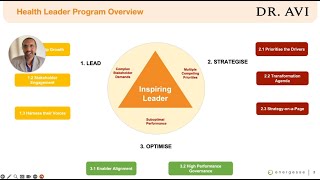
Dr. Avi Ratnanesan outlines a leadership maturity model for health leaders moving from ad-hoc to inspiring stages. He focuses on three areas: evolving your leadership, clarifying priorities in a one-page strategy, and aligning HR, IT, and finance to fix processes and governance.
Chapters
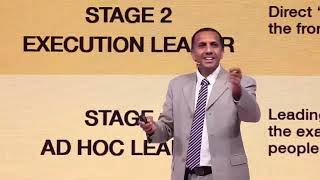
Hi, it's Dr. Avi here. I promised you a video on the three steps on how to inspire your people and grow your impact as a health leader. Now, these are steps that we've discovered from research and implementation with hundreds of CEOs and senior leaders from around the world. I'm really excited to share this with you. So let's step over to my studio and let's get deep into it. Okay, so what are the three things we need to do? Well, first, before we get into that, one of the clear ideas we've got to understand is that leadership and becoming a leader and a greater leader is one that takes several stages. And so we have a leadership growth maturity stage model here that we've developed and leveraged other sort of market insights to develop this. But one of the things to realize is that when we all start off as a leader, initially we start off in this kind of ad hoc leader approach where we're either given an opportunity to lead a team, lead a matrix project, or lead sort of a matrix team function in a more kind of informal capacity. And that's something that we've built up throughout our childhood, throughout our school age, and then start entering into our first positions or formal positions in roles where we start to become that ad hoc leader. We then build up our expertise and we start to become an execution leader. So we execute tasks, we build relationships, we manage projects, and we go to that stage two, which you can see here is part of the growth. After that, we start to become enabled or empowered to lead bigger teams. But what tends to happen is that because we've risen from technical roles, it could be a clinical role, it could be an engineering role, it could be something that's still quite technical orientated, and we've performed well in those roles. We get given the title of team leader. However, we're still in this execution mode because that's how our mind thinks and that's how we've been brought up. That's how we've developed, that's how we've been incentivized to perform. And so often the expert leader still is using a lot of technical expertise to lead the team. However, some of the things that happen when an organization grows or occasionally when an organization underperforms, is that it's not the right time for the expert leader to dive deep and deal with it technically. Instead, what that expert leader needs to do is actually let go and allow the team to execute some of those challenges. And that's when they become the empowering leader, the empowering leader actually helps the members of the team or leaders under themselves or managers under themselves, execute the task themselves. And they then step up to empower them, to troubleshoot and to really energize and motivate them to complete the task and achieve their KPIs or KRS. The next step of that journey is the inspiring leader. And the inspiring leader is the one that actually inspires a movement, inspires a change, inspires a transformation and, and works across many organizations, a portfolio perhaps that creates a big change in the world and inspires others to follow in their path as well. But the big challenge for many of you who are potentially expert leaders is that transition to empowering leader. The ability to let go, but also maintain strategy, maintain good execution, and in that journey up to become that inspiring leader that makes the biggest impact you can make and achieves your greatest potential. There are several different steps that you need to take with yourself and with the organization as well. So what are those three things now that we've shared a bit of context? So really if you look at what are the challenges that an inspiring leader has or an execution leader has and so on and so forth? Well, one is complex stakeholder demand. So here's where you've got, you know, customers, patients, employees, board members, shareholders and various parties actually drawing on your time and attention and actually requiring you to achieve many different objectives. Sometimes a disaster may happen, sometimes it's a crisis in the media, sometimes it's, you know, the ministry, you know, is requiring a report or so. And so you're getting these complex stakeholder demands and medium to long term objectives that are very differing from these different parties. That's one of the big challenges that many leaders experience. The other bit is multiple competing priorities, which is different to the stakeholder management. So multiple competing priorities means that you've actually got many different tasks, many different projects, many different programs that you've got to execute upon. And they're different to the demands because the demands come from the stakeholders. But the competing priorities are almost self generated and a workflow that you've generated for yourself. But they're too many. They're coming at you fast and thick and you know, it's tricky to kind of manage them. And the third bit is sub optimal performance. So this is where you currently don't have optimal performance occurring or execution problems occurring throughout the organization, whether it's in service delivery, whether it's in some kind of product, whether it's in an important report or compliance area that you're falling down on. And so these are three big challenges that I commonly see inspiring leaders achieve, even for execution leaders, and empowering leaders as well. These three big buckets are part of the areas that you need to address. So what are the three big things that you need to work on in order to address some of these challenges and these demands in your time? Well, the first thing to do is to lead, and to lead better, to evolve your leadership. And what that actually looks like is several things. So the second thing is strategize. So clarifying your strategy and getting clear on absolutely where you need to focus your time on a daily basis and where the organization needs to focus its time over the next 3, 6, 9, 12 months and several years out. And thirdly, it's optimized. And that optimizing involves improving on and addressing some of the key processes and systems in the organization to enable execution to occur. And when I say process and systems, that's also cash flow, that's also people, talent and capability management, and so on and so forth. So if you had to break leadership down to three buckets, lead, strategize, optimize, are the three big things that you need to do to address some of these challenges. Now, there's a lot more here behind leadership, which is around leadership growth, stakeholder engagement, and harnessing the voices. Harnessing the voices of employees, customers or patients, as well as shareholders and funders. Key when it comes to strategize, prioritizing the drivers. And this is something that is often not really done well when it comes to strategy development. Creating a transformation agenda, which is all about looking at the change or transformation you need to make in your organization in order to be successful and where you are today and what are the steps to get there. And then articulating a strategy on a page. I find very often strategy plans for many health leaders are incredibly complex. They almost don't achieve anything. Everyone's lost in the gray. That includes your immediate team and the people below that they don't know where to focus at any point in time. So having a clear strategy on a page is critical. Next big thing is then aligning your enablers under the optimized piece. The enablers include your hr, your it, your finance, and people who are still your greatest asset, aligning them up to the new direction, aligning them up to the new focus, and ensuring that the governance behind that is in place. Which is where we come to high performance governance. High performance governance involves having the right measures, having the right visualization, and not just having the right data, but empowering yourself or enabling yourself and your teams to actually be able to have the skills to interpret the data and evolve and make changes as you go, as the environment transforms, changes and you can continue to enable a high degree of performance whilst all those changes are occurring. Often this doesn't occur because of resource capacity gaps, this doesn't occur because of skills gaps, this doesn't occur because of a lack of a process that's underway. This sometimes doesn't occur because there's high turnover in senior management itself. So one of the key things here is to clarify clamp up those bottlenecks, firstly identify them, then clamp them up as part of your governance model and ensure that improvement. So takeaway, message, lead, strategize, optimize the three big things you need to take away. I hope this video has been useful. If you're interested and you're having some of these challenges and you need help, do reach out to me below and I'm looking forward to helping you on your leadership journey as a health champion as well. I'm Dr. Avi. Bye for now.
More from Dr.

EGN Webinar: How to Boost Your Revenue with Neuroscience and AI Techniques - Masterclass with Dr Avi


How CEOs Overcome Sales Deficits & Rebound to Profit with Neuroscience & AI - Masterclass Highlights