Beyond Hormones: The Cellular Health Secrets to Aging Well
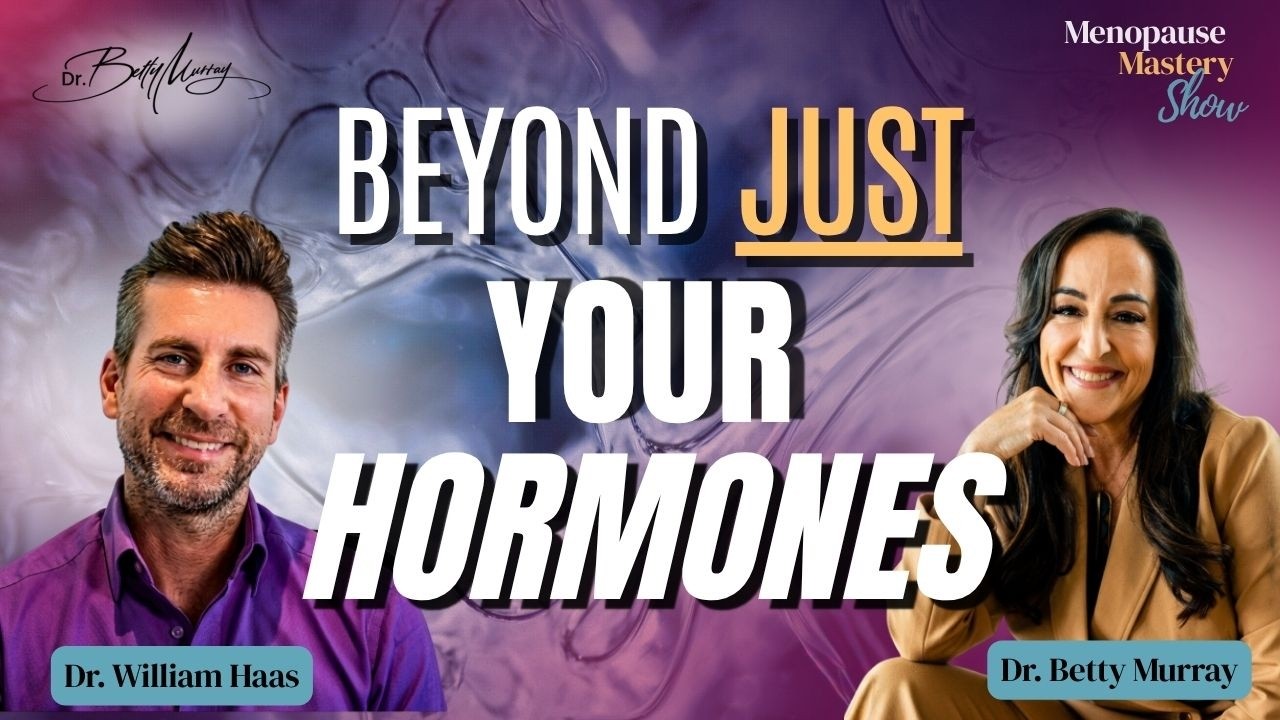
Dr. William Haas explains why fixing your cells matters more than hormone replacement alone. He starts with basics like consistent wake times and morning light, then moves to micronutrient panels and therapies like IV infusions and hyperbaric oxygen. Protein before coffee and creatine timing are measurable levers for energy and longevity.
Chapters
So today's guest, Dr. William Haas, is an MD and an MBA, and he's actually refreshing to talk to, and he's redefining how to age well. And so today's conversation, we're really talking about some of the unmet needs that often aren't discussed, especially within the women's health arena. We tend to focus very much on replacing hormones and sort of helping a woman navigate perimenopause and menopause, but we also have our cells, our mitochondria, our ability to utilize antioxidant and And help those cells sort of clear out debris and create more energy. And so, today's conversation with Dr. Haas is all about your cellular health, your energy, and we go into quite a bit of detail on when to and how to use some of the most popular biohacking tools, things like IV nutrition, therapeutic peptides, HBOT or hyperbaric oxygen, or ozone therapy, otherwise known as EBOO. And how to really do that to create measurable results and how he tends to look at it in a very therapeutic and methodical way to help his patients get better. So, join me today with Dr. Will Haas on Menopause Mastery. So, Dr. Haas, you have had, I would say, a wide variety of experience because you really came into medicine through the kind of family practice environment. How did you go from family practice and say, you know what? I really want to dig in and get into root cause medicine. My experience has been it's almost always something that we go through and it's like, oh, wait a minute, this toolbox isn't really working anymore. Tell me yours. You know what I mean? Like, you're like, I need to understand my toolbox is missing some pieces.
Yeah, I'd say until my 40s, my toolbox didn't really seem to miss pieces. And we can definitely talk about when I had my aha moment. Really, I kind of got sent down and kicked down this pathway when I was 13. If I kind of trace it back to watching the '96 Olympics, I'm going to age myself a little bit there, and watching Michael Johnson just kind of crush world records and just being fascinated by how intricate the human body is and the great feats it can put out if given kind of the right inputs and the right training variables. And, I was like, hmm, I'm really interested in optimization, health, and human performance. And, And, what tracks with that? And, at the time, it was really the only thing out there was the space of integrative medicine that was speaking about things like nutrition, food as medicine, and supplementation, and body medicine. And, those are the things that kind of really started to resonate with me as an athlete looking to kind of perform at the peak abilities in my 20s and 30s. And, I'd say I felt like I was crushing it in my 20s and 30s. And, It wasn't until my 40s that then, okay, all those tools that I thought about in terms of foundational lifestyle tools to become an elite-level athlete didn't hold up anymore. I remember very clearly sitting in front of a long-term patient of mine and blank stares. And she's like, Doc, you're scaring me. I was like, why? She's like, you're so quick to respond.
Right.
And here she is pouring a really important health concern out. And I'm sitting here just thinking through a fog, trying to pull my thoughts together. And then that was not who I was. I was the high performer, overachiever, type A, and I just could not pull my thoughts together fast enough to have this conversation that provided comfort and trust to the patient sitting on the other end of me. And that's when I really kind of realized, whoa, I need to be looking at things differently. I need to be looking at my own health differently and what's kind of blocking. So, there was a bit of that kind of health journey if you will, but it wasn't so much later in life where I realized at the core, my cells weren't kicking out enough energy to fuel my brain to keep up with those thoughts. So, that's kind of how I kind of journeyed into the space. It started as kind of optimization, health, and human performance. And then, kind of when I hit a brick wall from energy fatigue brain fog level. Yeah.
Yeah. So, you're now explaining most women's perimenopausal experience.
If you're a man, yes. Yeah.
But, men go through similar changes, it's just not as dramatic and it's often missed, andropause.
Yes, yes. And so, that's the thing that I was kind of teasing apart here is a lot of times it's not just the hormones, it is the cells that produce the energy that go along with the hormones. So, be it perimenopause, be it menopause or andropause for that matter, it's the It's not always just a hormone issue. They're really important, but the energy that the cells produce have a pretty dramatic impact along with how those hormones end up performing in your body.
Oh, you're absolutely right. And, in today's sort of social media, you know, quick hook kind of wording, everybody thinks, oh, if I have an energy problem, I need thyroid or this or that, or I'm going to get on sex hormones and everything's going to be eradicated. And it, you know, the truth is, is that for any part of our body to fail, the cell has to start at least downregulating, if not failing to some degree. So, let's, let's go into that cellular function. When you're talking about cellular health, help my, help my listeners kind of understand what does that mean? They're probably like, oh my God, that's like health class from 9th grade.
Going back to thinking about the little powerhouse of the cell, the mitochondria, right?
Right.
So, it's kind of this idea where I'm always thinking about kind of recharging the cell before repairing. So, this redox concept of charging the mitochondria to produce more energy before you can go on to repair it. So, it's just really your body's capacity to have the energy it needs to do that repair. So, you enter that substrate of the hormone and does the body have enough energy to do the repair that that hormone kind of requires or modulates is really kind of the crux of that. And, there's a lot of things that go into balancing. And that balancing energy act, but that's really kind of at the foundation of what we're really after.
Yeah. So, this is where I think the nuance of nutrition comes in. You know, if you look at more conventional, whether it's dietetics or whatever, they're like nutrients don't, you know, you can get your nutrition from your food, you can get this, you can get that. But, we already know either through genetics and just through testing that you can tell that there's a wide variety of capacity for mitochondrial function or redox or oxidative stress or detoxification. So, how do you start to tease out what's really happening there? Because I know you take a very scientific approach, which I think is important. It's not just, here's a bunch of supplements, let's go.
Yeah. I think it kind of starts in 2 different ways. You kind of alluded a little bit more towards maybe the testing that you're getting at, which you can go into. But, even before the testing, you're looking at symptom patterns. So, there's even just kind of a test I do with my patients and asking a few questions. which is where are you struggling with energy the most? Is it kind of first thing when you wake up in the morning or are you crashing at 2 o'clock in the afternoon and getting kind of a second wind and recharging? So, I'm starting to kind of ask some of those questions to get a bit of a pattern. I find that one of the best tests, energy stress tests if you will, is kind of determining how your body responds to exercise.
Mm-hmm.
Right. So, asking my female patients to go to the gym And do a little bit of an interval trial. So, you know, you end up doing exercise for a minute, rest for a minute, exercise for a minute, rest for a minute, go through that cycle 5 times, and then kind of tune into your body. Are you more drained after that, or are you more kind of charged and energized from that? The answer is that you're, you're drained from your high-intensity interval training. Very well could be a mitochondria charging.
Mm-hmm.
And so, that's where I'm kind of starting is looking at those patterns in terms of how that shows up in your everyday life.
Yeah.
Then, you can go to the next step, which is like, okay, now let's dig deeper and find out what patterns I'm looking at. And, to your point, kind of nutrients. I think you're kind of flirting with this idea of MTHFR gene mutations and how people make use of these B vitamins. But, I'll usually go kind of one step deeper and then start doing a wide-spectrum micronutrient analysis.
Yes.
So, I'm doing a deep dive of over 55 different micronutrients. And honestly, I'm looking more for patterns, not single nutrients, right? We all know that things like CoQ10, an important nutrient to fuel and power those mitochondrial cells, right? But, I'm looking in terms of maybe just that whole pattern of a bunch of different antioxidants. Is there kind of an oxidative stress pattern because I'm seeing CoQ10 and alpha-lipoic acid and glutathione levels All kind of down. If that's the case, I'm kind of hearing like, okay, I see this pattern that is showing up in this person's life, this perimenopausal female who says, I feel worse after exercising than I do better. Now, you can always kind of start to pull the pieces together. That's one area that I'm going to start looking at when it comes to labs alongside the hormones. But, what is that pattern for recharging the cells because there's too much oxidative stress in the picture.
Yeah. And, I know this from my own clinical kind of experience over 22 years, but then also talking to some other researchers, that oxidative stress, even if you're optimizing for a lot of other things in perimenopause and menopause because of the hormonal shifts, tends to increase. So, I would say almost any woman, you need to be paying attention to oxidative stress at any given time, probably more so than you ever did before.
And, in the wrong environment too, I mean, I think the one thing we forget is to produce energy, those cells kick off oxidative stress.
Right.
It's an oxidation process to begin with. So, it is kind of trying to find this balance of do I have enough recovery and inputs to balance that? Do I have those antioxidants to be able to kind of balance this whole thing? It's kind of this delicate kind of teeter-tottering. Because of the inherent nature of kicking out oxidative stress as a result to produce energy. So, if you constantly are demanding from that cell and not giving it enough chance to recharge, you're actually kind of spitting out more free radicals and creating more damage than you are repairing.
Yeah, absolutely. So, as you're working through supporting cellular health and antioxidant and all those other things, what are your favorite tools to do that?
Again, it comes, you get the foundational tools and you kind of have the more complex tools. Alright. And, one of the foundational tools that I always kind of talk with my patients is waking up at the same time every day. And, it sounds simple, but just the commitment to doing that 7 days a week including on Saturday and then getting yourself exposed to morning light within that first 30-minute window of time. Your mitochondria kind of have this clock to it. And so, if you have kind of a faulty clock, you have faulty recharge and you're not able to kind of recharge those cells because they're not getting kind of that morning light exposure to kind of set the cycle for those mitochondria. So, that's kind of one of the foundational tools that I'll kind of recommend, which kind of dovetails to the other end of the spectrum, which is getting the same kind of sleep time set and then backing that up 3 hours with the timing of your last meal.
Yeah.
Right. So, your mitochondria are busy recharging and repairing, using that energy to then repair in the evening. But, if it's spending all that time digesting food at night, you're not kind of leveraging the mitochondria to do what they need to be doing the most at the right time, the most important time of the day. So, kind of Always have to think through those fundamentals before we kind of jump into some of the more advanced tools, right?
Absolutely. I wanna go into the advanced tools just a little bit because I think there's a fascination with kind of the biohacking movement, which I'm all for. I think we are at an N-of-1 sort of stage of medicine and healthcare where we really need to be looking at people individually. But, I also think people are really premature to go buy the latest tool or whatever or go do things when maybe their foundational pieces aren't in. Where does things like HBOT, IV therapy, where do you put those in that continuum? How do you look at that? Because I do think a lot of people jump to that and almost jump to it more quickly than necessary.
So, I think you need to go back to start seeing those patterns, right? To me, the kind of a combination of a couple things in terms of how do I actually start thinking through which tool is right for that patient? And the micronutrients, if I have a patient with a lot of those micronutrient deficiencies that we talked about, I think IV nutrient therapy can be a fantastic tool. Why? Because you're bypassing the gut. You're getting direct absorption into that. And so, when I think about the nutrition piece and nutrient deficiencies, I'm thinking about one, are we getting enough of this in the system? Are we absorbing enough of this in the system? And then, are we using more of it than we need, right? So, if you're creating more oxidative stress, you are pulling from that demand. And, that's assuming you're getting that from the gut into the cells.
Yeah.
So, let's take for instance somebody who is doing all the right things and eating clean and they're taking their supplements, right? So, we have enough going in, but that may not be the fact that in my practice, a lot of women end up having digestive issues.
Yes.
We think that bloating is just because we're females or we have hormones, right? A lot of times, that's not the case. There's a lot else going on down there including your intestines and the health of the microbes in that intestinal environment. And, that determines how well we pull in those nutrients that the mitochondria need to power themselves. And so, if that part is off, then we kind of might be kind of running amiss. And, I know I'm kind of going down a bit of a rabbit hole when you kind of asked about Some tools, but the IV therapy can be a great way to bypass the gut. And, I'm happy to double back on the gut and talk about that as well. And then, in IV therapy, I might kind of stratify the different tools, right? So, you have your foundational nutrients that the mitochondria need like your B complexes and your magnesium and the CoQ10s and the glutathione that I talked about. But then, there may be kind of a step above that where I'm trying to kind of just direct charge the mitochondria. So, one of the tools I'm a big fan of using is going to be ozone.
Mm-hmm.
And, I always talk about the mitochondria need kind of 2 things. They need oxygen and they need nutrients to make energy, right? Ozone is simply a molecule of oxygen attached to O2 and you're infusing that into the body, right? So, you're basically giving one of the main substrates the mitochondria need to produce that ATP and energy, right? And, just in a very efficient manner. Now, We have to be careful here with ozone because just like I talked about kind of exercising and the mitochondria can create too much oxidative stress, too much ozone in the system can create oxidative stress. So, back to your point around the biohacking movement, I love kind of this new profound interest in people taking charge of their own health and the N-of-1. But, I still think you need to do it with guidance to be able to determine what is—
Yeah.
the right dose? Is the timing of ozone right for my body? Can I handle that? Will it create more harm and damage my system than help? Another oxidative oxygen-based therapy that you talked about was hyperbaric oxygen, right?
Mm-hmm.
Also, another kind of fantastic tool that I think people miss the boat on that one in terms of 1 or 2 sessions is not enough to cut it, right? I might be able to do a lot of work with EBOO-based ozone therapy, whereas hyperbaric oxygen, that's a tool of time.
Yeah.
So, we're talking about 10, 20 sessions. So, where I sometimes see people miss the mark on hyperbarics, they think they're just going to pop into the chamber once and recharge their mitochondria, right? Or suddenly have a dramatic change. And, that one I usually tell patients, if we're dealing with more chronic issues, gear up for 20 to 40 sessions at an hour a clip. That's a commitment. So guiding my patients through, you know, medically what makes the most sense, you know, how much time do we have to kind of pull together a treatment plan? And also, you know, what's kind of the right— where's the best place to put your dollars and invest your dollars as well as the other thing?
Absolutely. All right. So let's jump into a little bit about, you know, we were talking earlier about kind of your mix of patients. You do see men, but again, a lot of your Patients are women and they're probably kind of high performers and wanting to kind of, you know, keep going at the pace they probably have already been doing for a long time. Where do you, where do you sort of jump in and start addressing hormones and how do you sort of integrate those into the idea of cellular health and, and, you know, really kind of going from the smallest mechanics inside the cells out?
So you can ask me a little, like, when am I going to incorporate hormones into this?
Yeah.
Yeah. Yeah. That could It's usually not in isolation, right? So, in that kind of initial kind of foundational assessment, I do what I call my kind of cellular health diagnostic panel with all of my patients. And, that is going to include things like the micronutrients we talked about, but it's going to include a pretty robust panel on hormones from sex hormones to thyroid to cortisol. I'm getting a pretty clear picture of where that patient sits. And, that's kind of looking at that balance, right? Sometimes you have to ask yourself, And, if the sex hormones are down, why are they down? Not just because we're getting older, but what impact does cortisol and stress have on that system to produce enough of those hormones? And, it may be kind of a different environment, you could have healthier hormone production, right?
Yeah.
But, let's assume cortisol looks fantastic, we meditate, there's no stress in life, And, we've just kind of gotten to that point where the ovaries or testes aren't making enough of those hormones anymore. And, I view those as kind of foundational. I can spend all this time talking about mitochondrial health as well, but if I don't address the hormones, it's always kind of the whole picture that I'm working about. And, I kind of had this old adage back to kind of my early days as an athlete. One of my coaches kind of mentioned something that stuck with me as an athlete, which is you can try to work on— try to fixing one thing or improving one skill by 20%, or you can try to improve 20 skills by 1%. Which one's easier? And I always take that same approach with my patients, right? Which is I'm always telling them I'm working on a couple different levels, levers to optimize their health, right? We may be kind of pulling this hormonal lever over here because it's sitting us like staring us at in the face. And it may not just be Estrogen females, right? That brain fog and that fatigue and that kind of fluffy midsection may not just be estrogen, right? It can be the testosterone that unfortunately gets overlooked too often in the conventional world, right? And so, the testosterone level is a lever I'm having to pull alongside the same lever for the mitochondria as well.
Absolutely. Alright. So, let's get into a controversial subject. Let's talk a little bit about peptides because we know the FDA right now this week, it'll happen before we get a chance to air this, But the FDA are actually looking at about, I think, 9 different peptides for research purposes that, you know, have some clinical but mostly limited data, although they are being used quite a bit within the integrative community. And then you definitely have kind of the biohackers online buying gray market peptides, which I find frightening. We can talk a little bit about that. Where, where do you see peptides going? What do you see sort of happening in this world?
Yeah, I think the next week will be very telling and I'm kind of really excited to see that. You know, I think regardless of what happens, I think that the conversation is a lot of us, a lot of practitioners have been using peptides for a long time, right? And I think a lot of us are kind of aware of what peptides are now, right? The fact that peptides are just cell signaling molecules. The first peptide we ever created was insulin, right? An example Of a peptide. I talked about another peptide as an antioxidant earlier, glutathione. It's just 3 amino acids strung together. That's a peptide, right? And so, this categorization of peptides are all good or all bad, I think, is missing the bigger picture, right? And, I think that the thing that we're kind of seeing right now in the kind of the conversation is really kind of focusing on 2 things, which is what is the amount of information to determine whether these peptides are safe and where are we actually getting them and where they produced safe is I think what's really at focus. And I'm hearing a little bit of the conversation focused a little bit more on, well, there's not a lot of evidence around some of these peptides. Some there are, luckily there are, and others that there's not. And I think a lot of people, responsible people in the industry, pharmacists, clinicians, they're doing their best to kind of pull together and pull data on the fact that You know, these peptides have been used on hundreds of thousands of patients, just not in randomized clinical controlled trials funded by powers that have a financial interest in doing those sorts of things. Right. And so I think a lot of us are trying to make the case and the arguments to the PCAC, the committee kind of voting that, hey, these have been used very safely under supervised environments, you know, prescribed to the patient for the right reason, not that I'm just buying something offline and experimenting it because an influencer told me about it, right? And that's the second piece of that, which is where are you sourcing this from? And I think if things go the way a lot of us hope they do, you'll end up kind of putting in a little bit more of a controlled environment where you kind of have this kind of closed chain of, hey, we know the raw material is coming from an FDA-approved facility. We know the raw material is being then produced and manufactured in an FDA-approved facility. Facility and that it is being overseen and prescribed by a clinician with that direct patient oversight. So, hopefully, we can kind of get to the place where all of that's kind of happening and it's done in a safe manner. I don't think peptides themselves are inherently unsafe. I think how they're being used right now by people is definitely in an unsafe manner. I mean, I had a conversation with somebody who was You know, just kind of in conversation, they're like, hey, yeah, I've been trying this reta. You know, I was like, okay, where'd you get it from? Yeah, this guy at the smoke shop sells it to me. How much? What's your dose? I don't know, I just put as much liquid as I could in the vial and then pulled up 6 units. I was like, so you're telling me you don't know how much you're actually injecting yourself with, right? I think peptides in that sort of state is a very scary place.
Yeah. I mean, I would agree. You know, it's As somebody who's a researcher, you know, I keep looking at it and, you know, having conversations with compounding pharmacies and others. And I was like, if we can pull together a multicenter, let's do it where we can control the raw materials, control where it's being compounded. We'll contribute to the research, right? I was like, we have no problem capturing data and really be able to look and be able to give what's missing there. And so I certainly hope that the FDA actually does what we hope they will do, which is say, okay, we can compound these in compounding pharmacies so we can Have some control of the raw material. Because I'm sorry, but right now, that cat's out of the bag and I don't think there's any way you'll be able to get gray market peptides off the market.
I think it's a public health angle that we're like, I can't, like, I'm not hearing really talked about, which is like, what's the overall, what's the good for the overall public health at large, right? Because to your point, you're not putting that cat back in the bag and people are going to go find it elsewhere. And I think you're just going to create a bigger black market if we don't find a way to do this responsibly.
I, yeah, I agree. 'Cause, well, and the other thing that I think is very interesting is a lot of the users are very young individuals. You know, you've got almost like MLM structures with the gym bros and everything selling it to each other. And I was like, wow, I don't know if I would inject something coming from Steve that did a weekend certification to be a personal trainer, but, but, you know, and so I'm like, the only way you put a kibosh on that is that you put it in the hands of clinicians that can learn how to treat it, and they're actually contributing to that science.
Yeah. And monitoring for side effects and keeping patient safety in mind. And, you know, they're thinking about— I mean, I'd like to think most clinicians still think about, you know, the patient overall health first, right? And not the finances of, you know, how much can I make off this vial?
Totally. Well, yeah. And I think that's, you know, that's a good— since you've been doing peptides for a while, it sounds like, you know, how do you look at that? Because I know You know, when I talk to a lot of other clinicians, it's not the first thing. It's often as you've worked on cellular health and as you worked on these other things that it's probably part of the picture maybe, but not in every case, but it's certainly not the first thing, you know, that somebody would do.
Yeah. And that's why you kind of heard me spending a lot of time talking about what are those foundational lifestyle things that we need to put in place, right? Because you're not going to override a signal on a faulty foundation, right? So Kind of part of my methodology, we spend a lot of time talking about recharging before repairing, right? The other piece to kind of how I approach my patients in my practice in cellular health is detoxing before you redox, right? So, we spend a lot of time talking about recharging that cell, right? But, if you're putting those signals in an environment that is not primed to make use of those peptide signaling, right? So, we have processed foods, where we have a lot of stress and cortisol, we have a poor gut function and dysbiosis, right? You can put all the peptides you want in there, but you're not going to be able to override that signaling with those peptides because there's too much bad noise hanging out beneath that.
Yeah, absolutely. What do you think about exosomes and stem cell and where those are kind of going? Because that's the other area, right? So, there's a lot And it's had its heyday in like 2016, 2017 and sort of, you know, calmed down a little bit and it's been having another heyday. How do you feel about those from a longevity standpoint?
It still kind of goes back to kind of this, the, the timing and the foundational structure of things, right? So again, it goes back to recharge before you repair. So I put those tools very much in the repair bucket, right? So, you know, if the, the cell, cellular environment is not primed to do all that repair. And the repair process is a very energy-demanding process, right? So, without sounding too much like I'm repeating myself or bringing up broken mitochondria and just kind of hammering it back home, right? Those cells are trying to do the repair and they're just sputtering out because they don't have enough energy. You just wasted a lot of money infusing some repair signaling into the body that you're not making the most out of.
Definitely, definitely. Okay. So now, now that my listeners have kind of learned about cellular health and sort of how to address that, what would you say if you were to pick like 3 things for somebody listening today? What are the— you talked a little bit about the sleep and circadian rhythm. I think that across the board doesn't matter what's wrong with you, you must do that. But what would be 3 other things that you're like, no matter what, these are the 3 levers that every person should be pulling at some level? I'm sure there's nuances to all of them, but what would those 3 levers be?
Yeah. So, I think we talked a little bit about kind of nutrition and micronutrients, but if I kind of broaden that out and talk a little bit more about macronutrients as opposed to the micronutrients, I'd say it's putting coffee in front of caffeine. So, that means kind of 30 grams of protein within an hour of waking up before your coffee, not afterwards, before that. Because if you're ultimately kind of putting Coffee kind of in an empty tank and a kind of low estrogen, low testosterone body, that's going to spike your cortisol. And then you're kind of set up with this kind of glucose crash throughout the rest of the day that your mitochondria can't recover from. So I think that's kind of, that's one I always kind of recommend. The second one is kind of also kind of piggybacking on that one at the same time, which is, you know, if you're going to do that coffee, Consider another kind of biohack, if you will, and if you want to get a flavorless creatine and put that creatine in the coffee.
Yeah.
So, skip the sugar, skip the white powdered sugar, and put unflavored creatine in that coffee because now you're providing direct substrate for the mitochondria to produce energy. Because we talked about earlier those substrates that it needs, it needs oxygen, it needs these nutrients. Well, creatine ends up coming of those nutrients mitochondria need. So that'd kind of be number 2. Third and foremost, kind of coming up with, with 2 of them more, so I'm actually stretching myself for 5 in total. The 5th one here that I, I probably say kind of in order that I talk with my patients about, it's, it's almost like what not to do in a popular thing that I'm seeing at the expense of mitochondria and cellular senescence, if you will, which is Intermittent fasting done wrong.
Okay, awesome. Let's go into that a little bit.
What I see is intermittent fasting done right is getting all of your calories in a smaller window. What I see commonly happen is people basically treating intermittent fasting as a justification for skipping a meal. And so, now we end up with this chronic caloric deficit. So, we're not actually fueling the mitochondria to get enough calories to keep up with the energy demands, right? So, we end up looking at— we talked about kind of before you and I jumped on, do you do resting metabolic rate in the practice? And what I'll end up finding is people who do say, oh yeah, I do intermittent fasting, and we look at the resting metabolic rate and we look at the calories that they consume, there's this huge deficit happening day in, day out. And they're wondering why they're doing all the right things and the scale's not moving. It's because their body's in a state of starvation, which then Dramatically taxes those cells that are supposed to be producing energy.
Absolutely. Absolutely. So, let's talk about resting metabolic rate because we had this other conversation. We were talking about how hard it is to get women to do the other half of this. So, resting metabolic rate is obviously your ability to burn calories. But, another part of it is often VO2 max. And, there was just another article that came out over the weekend about how much VO2 max, and I'll let you kind of go into it, How much VO2 max is a predictor of longevity, particularly healthspan longevity. So, talk a little bit about that because I know you and I were both lamenting that most of the time women are like, I don't want to do VO2 max. Yeah.
And sometimes I'll meet— I'd spend a lot of time meeting my patients where they are, right? So, is it a fantastic tool as a marker? Yes, but it's also kind of a benchmark, right? So, you use it as a benchmark. Well, what does that mean? You need to repeat that benchmark. So now you have to get somebody to do that more than once. So I'm not big on kind of pushing that, but it, you know, it is a, is one of those tools that I rank up there with like heart rate variability in terms of how I am viewing their overall kind of longevity marker. And I don't think we kind of fully understand all the ins and outs, or I think we, we know it's multifactorial.
Yeah.
In terms of why it is having such a direct impact. And, a lot of it has to do with metabolic rate. We know VO2 max, there's a direct correlation with metabolic rate. We know it has direct correlations between how much oxygen you're delivering to your muscles and the muscle tissue connection to brain-derived neurotrophic factor and longevity in brain. So, there's so many different mechanisms here that if you had to sum it up of So, one marker impacting so many different cellular pathways, I think, is the power of the VO2 max and why I would suggest and advocate that if you are really thinking about tracking and mapping your longevity and healthspan, that's to just kind of suck it up, sweat for 20 minutes, be prepared to get exhausted, but know that you're going to have a fantastic marker to track all these different things that we've talked about alongside.
Right.
Because there's no point in doing all these things if you If you don't know whether you're making progress or not.
Oh, I agree. I agree. Because, you know, the first time I did VO2 max, you know, it wasn't great. I hadn't been doing, you know, a lot of like intense interval training and other stuff. But, you know, during the middle of COVID I got on a bike for the first time in a long time. It was just, you know, because cycling is one of those things to get the value out of it, you have to have time. And I had plenty during COVID And I got on a bike and, you know, was using that for interval training and I was tracking things like VO2 max. And then when I started seeing it really climb, Right? Then mentally, you start becoming competitive with yourself. You're like, wait a minute, if I can raise it another couple points, that means my longevity is going to be even better because I'm working under stressful conditions maximizing oxygen intake. So, I always try and think about it that way. I'm like, I don't think— if you become better at this, then all other things work better. So, maybe it's twice a year. Maybe we get our hair messy and we get sweaty in the doctor's office twice a year instead of 4 times a year.
Thank you.
For sure, for sure. So, so tell me, so if, if our listeners were wanting to find you and find out more about you, how can they find out about you, Dr. Haas?
Yeah, best way is to, to head over to kind of our clinical website, vyvewellness.com. You can hit the, the get started page and book a free discovery call. We also have a cellular health optimization kind of assessment on the main homepage just right below the, the main fold. So you can kind of click that and take the, the cellular health quiz.
Awesome. Awesome. Well, thank you so much for being on Menopause Mastery. It's been a great show. Yeah, it's been fantastic. Okay, everybody, if you are listening to this show on your favorite podcast platform, don't forget to leave us a review, a 5-star please. And if you're watching us on YouTube, please don't forget to subscribe and then comment below because we like to hear your comments. And then if you have subject matter you'd like for us to talk about, Please let me know, and then I will be back with you next week.










