DNA Is Not Destiny: The Future of Personalized Menopause Care
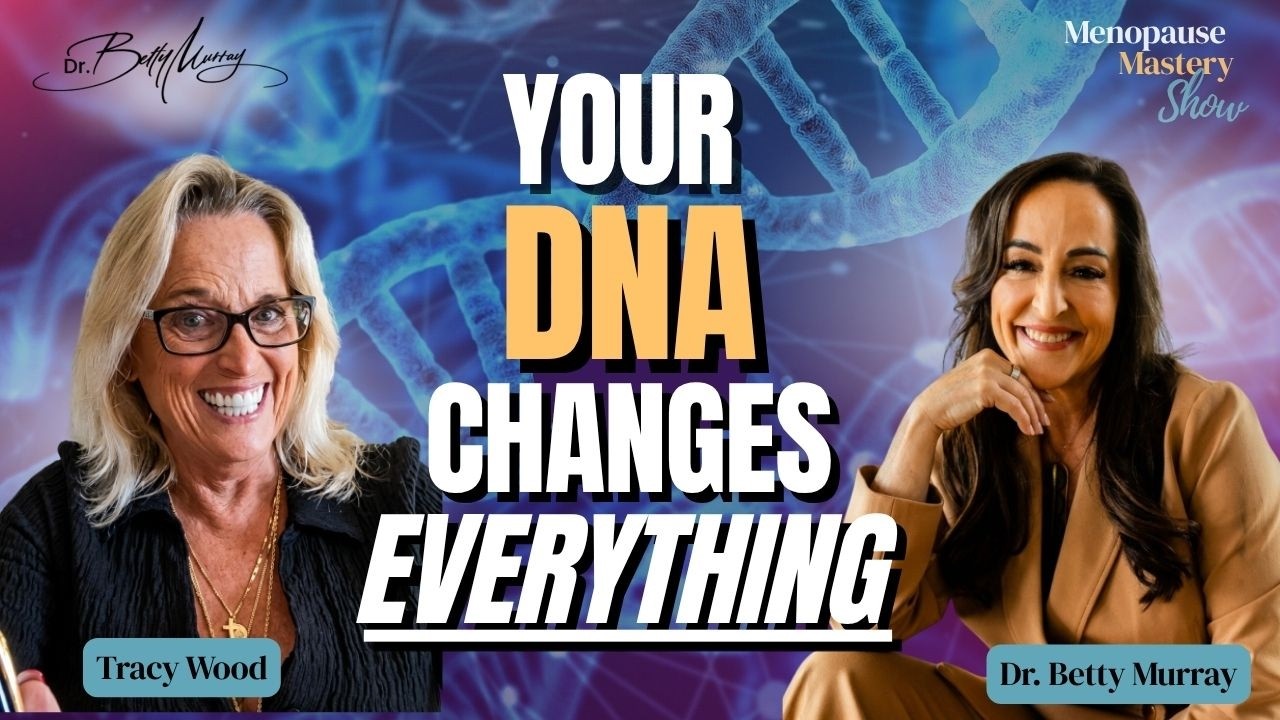
Dr. Betty Murray and Tracy Woods discuss how genetic testing can personalize menopause treatment instead of using one-size-fits-all approaches. The DNA Code 360 test expanded from 62 to 146 genetic markers to identify how your body metabolizes hormones, handles inflammation, and responds to drugs like GLP-1. They warn against buying unregulated peptides online and stress that genetic results need a clinician to interpret them properly.
Chapters
Imagine walking into your doctor's office at, oh, I don't know, 45. You're exhausted, your joints ache, your sleep is broken, you've put on about 15 pounds around the middle, you're really frustrated and irritated. And let's say your provider just tells you that's what you should look forward to because that's midlife. I think most women have already been through this. Or maybe they run some tests and they go, hey, guess what? You look average for your age. Or if you even get lucky that they even address anything that's going on with you, they give you some generic response or generic protocol of hormone replacement therapy without actually looking at you. They give you a one-size-fits-all approach. And here's the thing with that. We know through the Human Genome Project and through research that really what we have is Medicine 3.0, and 3.0 comes down to an N of 1. What does that mean? That means you as an individual are the N of one. And what is the basis of that very first part of individuality? 99% of our genes are shared, meaning there's no difference between me and anybody else on my street or anywhere else on the planet. However, that little 1%, that little 1% of genetic mutations and SNPs and variation can have impact on everything. From your mitochondria, your body's ability to burn fat or sugar, your body's ability to metabolize and utilize hormones or recover from stress. All of those things are very individual. And the reality is, is this is an emerging market, an emerging science that we really had for 20 years, but it's always changing and evolving. And today I'm joined by The DNA Company CEO Tracy Woods. And what we're going to talk about is, is a new release they have of their, of their uh, groundbreaking DNA company test and what you can use it for and how it can help you understand as a piece of the functional experience of your life. Genes are not determinant. They give you function and capacity and where your body is wired to be stronger or weaker in certain areas. Not a good thing or a bad thing. It's just how we got here and how our ancestors had to evolve to survive the planet. Those things led to genetic mutations. But when you're able to understand that foundation, you're actually able to make better decisions about what you eat, how you sleep, your exercise choices, your lifestyle choices, the foods that you eat, your medication management, hormone challenges, thyroid, sex hormones, and on and on. And so we're going to get into that today and talk. And I have to warn you, we're both a little spicy today. There's some serious F-bombs and swearing going on in there, but it's all meant in good faith and the use of the word judiciously, inappropriately, because of the passion involved. So if you've got sensitive ears, it's just a little bit of a warning. Today we got a little bit spicy on Menopause Mastery. Okay, Tracy. Tracy, Tracy. So first off, yeah, good morning. So I said this earlier, but we might get a little spicy. So if you don't like four-letter words, this may not be the episode for you. But, but the reality is Tracy and I are really great friends and we're going to go in deep and talk a little bit about DNA and really what's, what's true there, what's not true there, what's the opportunity and where, where the research is really going because there's a lot of noise in this space, isn't there, Francie?
For God's sake, right?
Yes.
There's a lot of noise in this space, mostly from influencers that never went to school. I'm just throwing that out there. No, 100%.
I mean, we, I think we have to separate the wheat from the chaff and, and there's a massive difference between commercial genomics that are looking for ancestry and commercial genomics that are looking for disease-related genes, which are very, very, very selective. And then, and then the idea that there's 1 to 10 specific genes that everybody needs to test for, and that these, they're the end-all be-all of some genetic, you know, wizardry, and that that's the only thing that's necessary. If we were that fucking simple, we wouldn't need medicine now, would we?
I mean, I'm just being honest. Like, Agree. And I love that you swore first. Yeah, there we go.
I got it out of the way. No, but it makes me crazy because I'm like, if we were that simple and there was only 10 genes that we needed to know about, we wouldn't need the massive, you know, healthcare engine that we have worldwide today.
Right. Well, think about it, Betty. If we were that simple, we would have been included in research before the mid-'90s. If we were that simple, menopause would have been required education across the board in medical school as opposed to snippet modules unless you're an OB-GYN. I mean, if we were that simple, we wouldn't be discovering that insulin's really a hormone and all of these things that are like, "Oh, fucking newsflash," right? But people like you that have been doing this research in this space, people like you that have spent decades in your education, you knew this way back when, and the American industrial medical complex did not want to catch up. We gotta ask ourselves the question, why?
Right?
Why didn't they wanna catch up? Well, there's no fucking money in it, right? There's no money in it. And if there's no money in it, why are they gonna look?
Right, right. Yeah, that's exactly it. So I have you here today because you're the CEO of The DNA Co. And we've had a longstanding relationship, long, longstanding relationship and friendship. Yes. And I want you to kind of talk about how, how did you get into this world? Cuz this wasn't your initial world. Like people probably like, who is Tracy and what did, how did she get here?
You know what? This was not my initial world, right? So for the longest time I worked in telecom and VPN, virtual private networks, frame relay, but big data type things during the, the dot bomb. And I worked for anyone with 3 letters in their name, right? Fucking MCI, GTE, anyone. Of them, right? And really, tech was my thing, okay? And I was in major accounts, so I dealt with multinational groups and banks and stuff like that. And, you know, all of a sudden, in, in 2004, my eldest child got a really unique diagnosis of ITP, and they said she could die. And I didn't even know what the fuck ITP was. And so that was our first big engagement, if you will, with, you know, the big healthcare system. And we went to, you know, CHOC Hospital and we went through the treatments and stuff that my little girl had to endure were horrific. And in that, I realized my, the amount of time that I spent in my day job was going to come away from my daughter. And they said my daughter, I mean, it's a form of leukemia, right? They said my daughter could die. And I went, I'm not, I'm not missing any more time. Right? So I literally, I went and got a broker's license and I went into real estate and I came out of my day job. And I believe for whatever reason, I was kind of smacked back into thinking about tech and healthcare. And on February 3rd, 2007, my eldest sister died of a drug overdose. And Jackie was 45 years old. She left behind two young children, one 16, one 21. And I say he's young because he's developmentally delayed, right? So during this, Jackie had told the whole family that she had cancer and all of this stuff, and something was never right. And a lot of people don't know this part of the story in our industry, but she, there wasn't, there was something not right. And when they came out to declare her, the fire fire chief called this doctor that had been treating her and it was a doctor at UCI. So it wasn't like Joe's healthcare, right? This was a massive nationally recognized and respected institution. And this guy had been treating her and treating her for 5 years, but he was a psychiatrist and he wrote scripts for schizophrenic meds, which we knew nothing about. And he also wrote scripts for every pain medication you could imagine. Oxycodone, OxyContin. Vicodin, Xanax, Soma. My sister had a concoction of drugs that had anybody have gotten their hands on them, you could have wiped out a small city. And this guy called her 16-year-old daughter and said, hey, those drugs are chemotherapy drugs. You need to get them back to the pharmacy because it's dangerous to dispose of them. Well, no, they weren't. What happened was, is he told the fire chief that night He was gonna sign Jackie's death certificate, and then he ghosted the mortuary. So there was no investigation on Jackie's death until the Orange County coroner came in on, and in fact, I'll never forget, it was Valentine's Day, came in and said, listen, you are her next of kin because you are the conservator for her son, which was true. I was. And I said, okay, what do we do? And he said, you have to release the body. And I did. So it took 7 months to figure out what really had happened here. Jackie was schizophrenic. She was being treated by this doctor for schizophrenia, but she had told this doctor she also was being treated for cancer at Yale and that she couldn't get in with oncology to get these drugs refilled. So he just refilled them on autopilot for 5 years. He never checked into the EMR. He never looked into the story. I have to tell you, Betty, to this day, I'm still gutted, right? My sister was a young woman. Was she schizophrenic? Yeah. Did that mean she deserved to die? No. So that's what got me into it. And during all of the work that I did on myself, on my family, I went through years of therapy just trying to reconcile with all of this. And during that process, I recognized that there was a behavioral health model that was missing. Now, Teladoc was already a company and I actually got visited by the chief medical officer. From Teladoc. So this guy came and said, hey, listen, you've got this privately developed, which I did, behavioral health model. And I developed this model while going through my own therapy for what happened to my sister. So fast forward, built the model, expanded it. During all of that, I was diagnosed with multiple sclerosis and I went, my brain's shaking. And the doctor said, no, no, there's no sensation in your brain. And I'm like, dude, listen. I have my own earthquake, my brain shaking. So, I did a lot of research. I met up with T.S. Wiley, who is the inventor of the Wiley Protocol, which is an internationally very well-known hormone system. And, she said, "Listen, let's get you on HRT now." I was 42, 43. "Let's get you on HRT and let's see what happens." Well, sure enough, I mean, I had 5 lesions on my right frontal lobe. It then went to 7 bilateral. There was a permanent plaque. I mean, All of this was documented at Loma Linda, at Cedars-Sinai. I went through all of this testing. I even did 2 years of low-dose chemotherapy because that was standard of care, right? Betaserone and interferon. And that was standard of care. And T.S. Wiley said, Tracy, this stuff's going to kill you. And I, you know, I felt horrible and I looked horrible and I was as unhealthy as I could possibly be. I went on hormones, long and the short of it, I no longer have any active lesions on my brain. And they went, oh, you don't have MS anymore. I'm like, well, you guys don't have in the medicine books that y'all teach from, you don't have that as being an option. And they're like, well, no, it's remission and you're fine. And you don't have to do anything. Just keep doing your hormones, keep working out, eat good.
You're good.
So that's really what got me here. And I ended up bumping into Kashif through a couple of mutual friends. And he said, listen, I want to go do all of these other influencer things, I think you would be the CEO that I would put in place. So long and short of it, we all got together. I took over and Kashif exited and did and still does now all the things he wants to do. Kashif still only uses our testing because our testing does drive foundational humans, right? So that's how I got here. And during this time, My thought was, we've got this great test, but the test was developed so long ago. A lot of shit has happened from then to now. So I drove that activity with Dr. Kostroman, Dr. Steady, Dr. Adipoli, Justin Harris, Kashif. I drove kind of that bus getting Dr. Kostroman to really delve into the research. And that's how we've, that's how we've expanded to where we are today.
Yeah, so let's talk about that because you, you've obviously had the DNA 360 test that has been out for several years. Let's, let's talk first because DNA Company was unique in the fact that they didn't just come out with a DNA test, but you guys actually did kind of clinical trials looking at not only what are the DNA patterns, but what are the behavioral and other things that show up here, which is unique in, in and itself. Long before you came out with what we're going to talk about today.
Yeah, we did. I mean, you know, in the old report, there was, there was so many areas that we could have impacted. You look at the Department of Corrections. Department of Corrections works with people that are incarcerated for a variety of reasons, but they don't understand the executive function mechanism of these men and women in the system. We could inform for a lot of that. We can tell you if they're likely to have a recidivism issue. We're likely to tell you if they're able to take in and actually change based on an authoritative position. There was so many things we could do that nobody ever knew we could do. So we did start working with, I know we worked with different branches of the military up in Canada. I know that there's stuff that we've started here in the US. So there was a lot that we could do. That was not, you know, do you detox well? Do you methylate well? Right? I mean, those things are important. I'm not minimizing those things because they are important. But if you look at the human brain and how we process and how we change, we can't, we can't just do that randomly. If our, if our genetic predisposition is wired completely opposite of that.
Right, right. Absolutely. You know, it's, uh, you know, almost every woman who's got a significant other, particularly of the male persuasion, every single time they're always like, I think he's like, how many women will go, I think my husband's on the spectrum. I'm like, no, he's a man. I don't count that. Like there, like you were saying, there are, there are genetic patterns that show up with, you know, your ability for neuroplasticity and, and, and being self-directed change. Like I have high efficiency on both sides of that. Right. So it's very easy for me to go, nope, not doing that anymore. I'm gonna go over here. Whereas other people, that's a monumental task cuz they're not wired for that. And it's, their brain says it's scary. Their brain says that's not the direction I wanna go comfortably, or I need a lot of support. And I think that that's where you get into DNA as a functional test that starts to help you understand a much deeper consensus of how your body really operates. It's not just about, you know, the combination of genes you have around the methylation pathway. Dear Lord, if we can beat that horse. But, but it's more so about how all those things come together and really develop how your body operates within your environment, and then how to address your environment in a way that reduces or improves, ideally, or makes worse those genetic risks.
Yeah.
And I think that's, that's where DNA Co has excelled above the commercial, you know, direct-to-consumer genetic testing that's out there.
Well, and you know our testing better than I do, Betty, right? I mean, you're a doctor. I just play one on television. You know, you just to be clear, PhD, PhD in medicine. Right. But you, you do, you do understand our testing. You do understand how it impacts each person. You know, people ask me all the time, what makes yours so different? It's really simple to me. We'll spend, as Americans, our life savings buying a house. We will go through, we'll buy that house, we'll go through investigating that house, we'll hire someone to inspect that property, we'll hire someone to do termite inspection and structural inspection, and we get all of that data. Right? And when we've got all of that data, we then look at the report and go, okay, so there's some wood rot by the garage. I'm not gonna get too crazy about that. But holy shit, there's a crack in the foundation. Now, that foundation is gonna shift. So, how do we solve for that? Because I love this house. I want this house. How am I gonna solve for that? Well, I'm gonna put some patch shit on there. Right? I'm gonna have them put some, some little black tar in there. We're gonna put some little patch over the top and my house is not gonna crack. Well, bullshit. If you don't deal with that foundation and give that foundation the support it needs, that house is not gonna be right. And while it may never come down, it's not gonna be right. And then you're gonna have other problems. You're gonna have a plumbing issue. Then you might have an electrical issue. Your DNA is the same. If you don't understand your functional genomics, if you don't understand that you should never have gluten in a million years, I am one of those people, but I never got diagnosed with celiac, but I did get diagnosed with MS. MS, there's a direct correlation with removing gluten and having improved outcomes with multiple sclerosis. So in, in my house, my foundation had some jacked up shit. It just did. Right? And that's what we tell you. But we don't tell you like it's this diagnostic, you know, you're going to die. Gosh, we're gonna fucking miss you. That's not what we do. We say, hey, you've got this celiac thing here. You've got some insulin resistance issues. You definitely have some problems in the mitochondria. You need some support. You need some support with methylation. Here's different things you can do that are natural, that are not expensive. Anyone, in my opinion, in our space that comes out and says, listen, go buy this $10,000 machine that's gonna solve all your shit. I call bullshit.
Yeah. No, that's 100%.
You look at biohacking, the fatalities, right? Everybody was on oxygen therapy. That was hydrogen peroxide infusion. Let's call that what it was. And people were on it. Then there was Miracle Minerals, right? Where people were using that for detox and COVID and autism. It resulted in death, Betty. It resulted in dead people. I mean, that's a fucking problem, right? That's a massive problem. So for me, when I look at our tests, I say, listen, if you don't know how your body's going to use these therapies, how your body's going to accept them, If you don't know that, all you're doing is filling that crack in your foundation. Your other shit's going to break somewhere else and it's going to keep breaking until— because your body is the smartest fucking doctor on the planet. Your body knows you better than anybody. And if you don't make an appropriate change that's in alignment with that body, you're going to end up You're gonna diminish how long you're gonna live. Your quality of life is gonna go to shit. So that's why our test was so important. And for me, I had to be able to prove that my shit was accurate. So I went and did, I went and did this epigenetics test and it was this test outta Harvard and very, very well-respected epigenetics test. Now it's important to know when I first started with Kashif, I did the test. I was 57 when I started and the test said I was 61. And it said that my liver was shot. It said that my pancreas had issues. I mean, you name it, I had it. I went through and during this change in, in what we're testing for and how we're testing, I was one of our crash test dummies, right? So I was part of that group, that clinical group in, in the next round of testing. And I've, I've lived in alignment with that plan only for a year. Okay. I will be 60 years old in 40 days, I think 45 days.
Happy birthday.
Thank you very much. My epigenetics test says I'm 47. Do the math that I got 16 years back. I got 16 years back by looking at the foundational crack. And saying, okay, we got a crack in here. Rather than filling it in and hoping for the best, I'm gonna go back to that foundation and I'm gonna move things in alignment with how that's supposed to be, and I'm gonna level this house. And that's what I did. And honestly, Betty, I'm stronger than I've ever been. I mean, I played racquetball and golf and weightlifted in high school. I'm stronger than I was back then. It's important to know I'm the same size in my clothing. Well, with one exception, uh, that I was, that I was in high school. And I feel like a million bucks. I sleep great. I use my HRT every day. I, you know, I follow things that are in alignment with my blueprint. And that's why it's so important to get that foundational information. It can change your life straight up.
Yeah, I agree. I'm glad you used the house analogy because that's always been mine. I'm like, look. You concrete foundation, you know how wide, you know how deep, you know where the plumbing comes up. But if you built a house, you can't tell jack shit else. There's nothing else to tell you what that house is gonna look like until you design the outside, shaker, colonial, whatever. And like, I have the genetics of a single-story ranch home, right? I have some genetics that are unfavorable for cardiovascular health long-term and some detox pathways and mitochondrial pathways. So, but if I build a 3-story condo complex and I'm having a rave every weekend, with a pool on top of that, that top of the roof, I am going to tear up my foundation. And it doesn't mean you can't enjoy a great life, but it tells you where your guardrails are and where are the things that are the biggest levers you can move to improve healthspan, lifespan, and quality of life. And, you know, I think, you know, there's, there's new things that you have brought in the new DNA Code 360, new genetic combinations, new genetic pathways, and some things that look highly determinant that can help sort of people navigate a better understanding of what they may need to do to improve their healthspan. So let's kind of dig in, because like, you, you even brought up a little bit about like nitric oxide and the NOS2 pathway. Like, let's talk about some of the big levers that you guys found here that really isn't something any other genetics test can really talk about.
Yeah, well, I mean, NOS, of course, NOS2, NOS3, very important. TNF, very important. GSTP1, very important. All of these contribute toward understanding if the peptides you're going to use or the HRT you're going to use can actually, through a mechanistic pathway, can it be used for you or against you? It's really that simple, right? People are spending hundreds of dollars a month, Betty, and again, you know this better than anybody. People are spending hundreds of dollars a month. People don't have a lot of leftover income right now. And none of these things are being covered by the medical industrial complex, which is a problem because some of this testing could lead to elimination of chronic condition management. And chronic condition management is the big beast in the system, right? So when you're testing somebody and you're looking at, you know, the inflammatory, I can never say this word, cytokines. How do you do this shit? I am not that person. I'm just like, you know, there's this little fucking gene, right? And it's a problem. But when you're looking at that inflammatory cytokine, you're recognizing that it's repeatedly associated with things like TNF, like your IL-6, right? Same thing. So, when people come to us now and before, you know, the OG test was revolutionary. Right. The, the original DNA test was revolutionary and it still is. People are still trying to copy that shit all over the world. Right. Not to mention we do white label it to people all over the world, but I can't say anything other than that.
Yeah.
That's Smile.
That's the one.
So, so the OG test was a great test. So I've, I've literally made that the 180 because the new 360 We went from 62 SNPs to 146, right? We went from 38 assessments to 48 assessments. We went from 51 insights to now 73 insights. These insights are actionable. These are things that move the needle in your body. If you want to go into this space in peptides, and please, if you do, please find reputable sources. Please talk to your primary care practitioner. Please make sure that you are in reasonable health in order to go down these paths. Right. And I really, I really want people to hear that. I'm not bashing anyone that wants to try something new. When I got diagnosed with MS, I went to HRT. They weren't, they weren't talking about HRT back then. So I, I am all about trying things outside the bubble, right? But just make sure you know what you're getting. I mean, I've seen statistics where the peptides coming in from China and from India, less than 10% are the active ingredient. Well, what the fuck is the other 90%? And I'm going to inject that shit?
Yeah, no, 100%. Yeah, you can't. If you're buying it off Instagram or you're a gym influencer that's got an MLM, you know, agreement with one, you're probably getting something that is nothing or largely harmful. True story.
And I saw a commercial the other day of some guy that walked into a bodega with a body cam on in New York City. He asked for, I think it was, uh, I think it was the BPC-157 he was looking for. He went in there and asked for it and they fucking gave it to him.
Okay.
It's a bodega in New York City. There was no pharmacy.
There was no medical personnel. Yeah. Cause there are, there are people prescribing, right? There are people prescribing. It is not being 100% gatekept. I would agree. So, I want to take the word salad that we went through a little bit and make sure that people kind of understand a little bit about what we're talking about. So, a couple of the genes that you mentioned, nitric oxide, NOS2, NOS3, have to do with our ability to basically perfuse or bring oxygen and nutrients all the way down to the end of your capillaries. And, when that doesn't work well, you have higher oxidative stress, you have an inability to recover from things like intense exercise, your antioxidants are part of that pathway too, but they're not, they're not exclusively that. So if you have glutathione issues and other ones, it starts to compound, which is the GSTP, GSTM1, all of those. And then if you have inflammatory cascades that are wired to be overly inflammatory because that protected us millions of years ago when we got sick, interleukin-6, TNF-alpha pathways, all of a sudden that word salad of things that you might not be very good at, a whole lot of them I have, means you shouldn't be doing triathlons, right? You're doing different types of exercise. You should be fueling yourself with anti-inflammatory in a way that's greater than someone got the Keith Richards genes. Like, I don't know what these are, but damn, that guy's got to have some good genetics somewhere.
Like, you know what, him and cockroaches, it's all— that's the only thing that's going to be left at the end.
I always say that, and I'm like, heaven forbid I ever meet him, you know, the reality.
But I'm like, how does somebody just beat their body up like that?
Because Like, I can give a really good personal example. Like, I have, you know, estrogen dominance. I have estrogen toxicity risk. I have poor genetics for detoxification and glutathione and methylation, all these things. So I could look at that and go, oh my gosh, I'm not very good. I can't do hormones. I do hormones because I need hormones. And I can check my genetics against epigenetics, like urinary testing, and confirm that I'm, I'm doing the right levers to make that better. But, what really is interesting is those levers change radically if I take other medications, right? Like, see what P3A4, if I add a statin, if I add ezetimbe, which works in the gut and reduces absorption of cholesterol, all of which I have issues with genetically. But, if I add those, my liver enzymes go up, right? Because the compounding factor. And so, what that means for people is the word salad of all the genes that you put together and you start looking at them in these combinations that the DNA code has put together, you start to understand than the diet lifestyle lever, the exercise lever, the supplementation, yes or no. Like, cuz it's not everybody takes a methylated support. That's complete and utter bullshit. And in many cases that could be turning on things that we don't do because we shouldn't hypermethylate things either. And we don't know what it's like to take 15 milligrams of methylfolate a day. That's, that's, that has never happened in human history. And so, you know, I think that's the big thing that people need to understand. Many of us have probably done DNA testing, but maybe we didn't get those kind of insights because it wasn't put together in a way that allows you to understand how these things work together in combination. And I think that's the really important take-home too, that it's not a single gene and it's not—
Absolutely. Yeah. You've got to, you've got to look at, like you said, the cascade of them. There's, there's different, there's different bits and pieces of the jigsaw that if you put them together, they look like they might fit. But they're not exactly right. And then, you go to that other piece. I mean, there's so many people that struggle with breaking down things like NSAIDs, related drugs like that. That's your CYP2C93. And, we look at that. When you look at your TCF7L2, that's how we look at how are you going to do on a GLP-1. I have a girlfriend of mine, she's a good friend, we've been friends for 25 years, and she got to her most unhealthy last year. And she came to me and said, I just don't know what to do. I'm in menopause. I'm a mess. I've gained 100 pounds. I'm just, I can't do this anymore. And I said, if you're ready to get real, we got to figure out how you're made. And she goes, you know, is this just another pseudoscience thing? And I said, listen, I said, I hear you. I said, we all get grouped in with some of these guys that are, you know, influencers and they're not practitioners. I said, my people are all science. So let's take the test. And we did. And we put her through a program and she took off 52 pounds from August to December 31st. She's in her mid-fifties at when it's supposed to be the hardest for us to build muscle, the hardest for us to lose weight. And she did all of those things, but she literally took her life from one day to the next, flipped the switch and went, okay, I'm gonna get in alignment with this. And one of the things that I know you and your practitioners all over the country say to everybody, with the right diet and exercise, let me tell you something. If everybody that sat in front of a doctor didn't blow off that sentence, we would be a healthier world today. But That's why GLP-1s are doing so well, because it is hard and it does feel defeating. And when some doctor comes in and looks at us and goes, yeah, you need to diet. It's like, I'm going to throat punch you. Okay. So come here. You and me are going to get into it right now. Cause you're an asshole. And you don't know that in menopause, I gained this in menopause. I'm struggling. I'm not sleeping. My brain is foggy. I want to kill everybody. I'm looking for a dog to kick on a daily basis.
Right? Yeah.
But, but diet and exercise, kinda like what you just said a few minutes ago, it does come down to following those things. You cannot, you cannot fill the crack in the house and then throw a rave and then throw another one and then do it every weekend. And as you hit your 50s, maybe you do it 2 weekends out of the month. When you hit your 60s, You're partying like it's 1999, just one weekend a month. You are not going to be able to sustain. And I think that that's an important part of the message. Yes. All of these things can come together. Genetic functional genomics is very confusing and it's very complicated. And one of the things that we did, in my opinion, that I think makes it easier is the new tech stack that I built. So we had, you know, you know what our old school reports looked like. There were 140 pages and they were a PDF and it It was not good. People could not navigate. And we had this kid that was actually the son of one of the founders, brilliant kid. He came in and he said, you know, hey, Tracy, I've got an idea for an app. And I said, all right, Devin, let's see what you got. And he put this thing together. And now the, in fact, the whole website was updated. The portal, the clinician portal, the patient portal, everything over 4th of July, we redid it. And it's phenomenal. And the insights are so clear and the recommendations are so easy. We wanted people to be able to take all of these genes, all of these understandings, and say, you know what, I can't, I can do this. Yes. You know, SOD2 and COMT and all, and I'm looking at all this and I'm going, it's so overwhelming. That's not the feedback we're getting now. Now we're getting, oh my gosh, you guys have made this so easy for me.
Yeah.
Now I can make some of these changes. So I think that, you know, it, it's like you said it, you There's a lot to digest. There's a lot to understand, but everybody's a bio-individual. Everybody's different. And what works for you, even though we've got 99% of our genetics the same, what works for you and me, there's 3.2 million differences, right? In that 1%. And that's, that's the part that's really hard for people to wrap their mind around.
Yeah. And I, you know, I'm glad you kind of brought up the weight argument because of course we're still calling obesity a behavioral problem and a follow-through problem, which makes me crazy. It is a disease state because we now understand, especially with the GLPs, GIPs, glucagon, all of that, that there's mechanistic things going on in the brain, which is where those drugs primarily act, that make it very difficult. And I get super pissed off at the Chad influencer gym guy who's 27 that says it's just as simple as calories in, calories out. And I was like, okay, let me remove your testicles. I'm going to castrate you and you tell me how well that works, sweet pea. Because the reality is women go through chemical castration that is equal to castration for men. And if you don't think that there's a metabolic effect of that, we already know the difference. And, when you can understand, do I respond to a GLP better or a GIP better, or is this going to help me or not? I have been very critical not of the drugs themselves, but the people prescribing them. Right. Because I think we, we do have people prescribing them to people who don't need it, you know, and then it's perpetuating sort of the skinny talk and all this other stuff. But the reality is too, it's, it would be easier if we knew whether it mechanistically worked, right? Like which one's gonna work better for you rather than do you get it and go to the bathroom and throw up all day? Right. Like what, what is the right mechanism? And I think, you know, genetics help hold that answer and the more and more we know these patterns, the better off we are. Right. And, you know, and, and I think most people would prefer that kind of precision.
Absolutely. I mean, if you look at, at, at MC4R, right, how that affects your dopamine receptors, like DRD2, right? So if we understand that mechanism, we can understand if the signaling to the brain that you're still hungry is gonna keep going, or if it's not. And if it keeps going or gets worse, God forbid, if it gets worse and you're doing that GLP-1, but it's making it louder, you're going to gain weight. We've got to know how you're made. We've got to start with that simple, simple explanation. How are you made? And, and a lot of people don't want to do that. Good old Chad over at the gym is 27 years old. Let me tell you something. His junk ain't going to work at 40. Because he's injecting God knows what, right?
Yeah, in many cases.
Sit down, bitch. Right? No, I'm Chad. Do not, and don't fucking message me on my Instagram because I will make fun of you. I, this, this conversation is not an equivalent conversation. What men think women should do with their bodies and women who live it. You put any of these men that are advising on HRT or advising on women's health issues. Have you had a hot flash?
Yeah.
And if the answer to that question is no, my answer to you is sit down, bitch. I, you can't, that's like going to an electrician and saying, hey, listen, I need that front toilet done. I think there's something going on out to the street. And the electrician's like, "Oh, yeah. No, fuck it. I'll go do it." No.
Yeah. You're going to— It's just not that. I think, yeah, because it's so much of it. Talking to patients and clients all over and the resounding, like, "I don't have food noise." I know people are going to be like, "Damn, I hate her." That's not my thing, right? My thing is completely different. And I have never been naturally skinny, so it's not like I'm a naturally thin girl, whatever. I've always had to fight for it, but I don't have food noise. That's not my— But the understanding when that turns off for the first time, It's like, "I am not thinking about food. I'm not hungry." All of that, that is enormous. And I think it's understanding that when you understand how you're wired and you understand how your detox and your mitochondria works and your cardiovascular risk and your recovery risk, when you start putting those pieces together and especially in midlife where, let's face it, we weren't designed to live another 30, 40 years, so the cards are stacked to be harder, right? If I understand those things deeply, then I can personalize dietary changes that actually work for my genetics. They're not just generic because a lot of the diet and lifestyle that gets left behind is because the doctor doesn't know jack shit about how to explain it. They hand you a pamphlet or they tell you just something stupid like calories in, calories out and exercise more, which is not helpful and not going to fix the problem because you can't find another 20 minutes in your day because you're doing unpaid labor every moment of the day. And so, like, all of those things are a failure of our medical system to really address what's going on. But at least being able to understand what works better for you is more helpful. Like, I know, and I knew in my late 20s and early 30s, my body responds to lifting heavy shit. Like, my body loves it when I lift heavy stuff. And if I sprint, you know, no more than 50 meters, my body's like, I love that. But what did I do in my 30s? I got out of that because I hurt my back. So I did yoga and, and I did, uh, you know, triathlons because I wanted to check that box because I'm crazy. And I have all these little checkboxes. I felt so bad, Tracy, doing that. I gained weight doing 2-a-day trainings. I did Olympic distance. I went straight to the mid-distance, right? And I mean, I was burning so much fuel and trying to fuel for it, and I gained weight. So if it was calories in, calories out, what does that mean?
Right.
And, and so, you know, I think, but, but looking at my genetics, once they were available, it was like everything's illuminated. I was so inflamed. I had such bad NOS pathways. I have all of these things that leads, you know, the, what is it? P9P21. I'm 6 copies of that.
Yeah. All of those.
So it's like, oh, now I know. Right. And so, you know, for the perimenopausal and menopausal woman, you know, yes, HRT is always on the table for you. Always on the table for you as a conversation. But then knowing these other things helps you move those other levers. So you feel better, feel more at home in your body, and you can do the changes that you want to make. Because this should be the next best couple decades. That's all I'm saying.
It absolutely should. And you know, that was one of the things for me too, right? I never had food noise, but at one time, Betty, I weighed 331 pounds.
Oh my, yes.
Now I was very active in high school. And when I got out of high school, a couple of years into it, I drank like it was going out of style. I may or may not have allegedly used a lot of recreational drugs. You can't prove it. There was no digital footage, but My body was a mess and I ended up with pneumonia. And then I had 3 masses on my right lung that, that pneumonia attracted to, and I had it repeatedly. And so I was treated for almost a decade with high doses of prednisone. I mean, 120 milligrams a day just to breathe, right? I put on 100 pounds like that.
Yeah.
I had no idea that that's what that did. And it took me a long time to get it off because I did not qualify because of my lung issue. I did not qualify for bariatric surgery. I was fucking big enough. Make no mistake. I was a big girl. I still dressed really nice, but I was a big girl, but I didn't qualify because they were worried that I would die on the table.
Right. Yeah.
And so I had to battle to get this weight off. And after Jackie died, I do. And I have, from then to now, I've lost— the time I started when Jackie passed, I was like, I don't know, 260, 270. So I've lost 130 pounds. But one of the things that I noticed that was way bigger is exactly what you were just talking about. And that was inflammation. So I have my suits made for me. I have a tailor. He's a lovely man. And like 2 years ago I had, I don't know, half a dozen suits made. And you go in and they measure everything right down to your ankles. So I went in and when we started working on some of the new jeans and I started working with Dr. Steady Murray, I said, you know, I, I'm lifting a ton of weight. I mean, I lift, as you know, I lift 4 days a week. I do 20,000 pounds in most of my workouts. So I can pick up some shit, right? So as I'm lifting weights, I never lost any size and I never, I never moved the needle from my fat ratio to my muscle ratio. And so when Dr. Steady Murray said, we're going to have you make all of these changes. You can't eat certain proteins. Look at your genetic report. And she was right. I mean, I can't have cow dairy. I can have sheep. I can have goat, but I can eat beef. So it was really interesting, the stuff that I learned. Long and the short of it, I go back to PJ and said, listen, my suits are too big. And I've only lost 20 pounds and I had only lost 20 pounds from one year to the next. And I'm like, dude, it's like they're falling off. He goes, Tracy, you look like you've lost like 80 pounds. I'm like, you know, first of all, fuck you. I didn't have 80 pounds to lose. Okay. That was just rude. And then he goes, let me measure you. So. He measured me. He goes, you've lost 8 inches off your hips. He goes, Tracy, as a tailor, for every inch off your hips, that represents 10 pounds. And I said, but PJ, I'm only 20 pounds different, maybe 25, if that. And he goes, but you've lost all of this inflammation in your body. He goes, so now you've got better muscle definition. You've converted so much fat to muscle. And now you've lost, I mean, I went down, Betty. In fact, I don't think you've seen me live.
I haven't. Yeah.
No, from then to now I went down like 4, almost 5 sizes.
Yeah. That's it.
I only lost 25 fucking pounds, but I lost the inflammation and now I don't wake up right with MS. You have a lot of pain, right? That's just a given. I don't wake up with that. I don't wake up with the swelling. I don't wake up with the feeling like every step. You know, it takes a bit out of you. I don't have that anymore. And I have to tell you, when I go out to eat, which is very seldom, cuz I'm very careful about what goes in my food. When I go out to eat, if somebody makes a mistake and there's some butter in there, I feel it the very next day, even the littlest bit in cooking. So diet and exercise is huge. Inflammation, that inflammation doesn't mean weight, but it does mean mass.
Yeah, it definitely does.
And especially for women. Yes.
Right.
Women in our, in our age group, right? Especially. I hear that all the time and it's like, girls, listen, if you don't do anything else I tell you, I, I'm not a doctor. I, I'm not. If you don't do anything else I tell you, I've been on your path. I will be 60. Like I said, in a couple of weeks, just get your genes looked at. And eat in alignment. Don't change nothing else. Don't go joining the gym. Don't go fucking running marathons like Betty, cuz that's just crazy. I don't run unless somebody's fucking chasing me. Okay. I, the only time I'm running is if somebody's fucking chasing me. But just, just eat in alignment and just do it for 21 days. Get through 21 days, girls. Do that. And if you don't feel better, then email me and tell me that I'm an asshole. If you do feel better, go another day and then just keep going one more day.
Yeah.
And I honestly, I am healthier than I've ever been. My blood work has come back. I mean, my doctor was like, he goes, you've never had labs this good. He goes, not even when you were a skinny bitch. I'm like, fuck you. What?
Yeah. Right.
So it's, it's, it's foundational. What we're doing here is foundational. And it can drive what's next. Hormones are important, but you've gotta have somebody that knows what they're doing when they're talking to you about those hormones, right? Make sure that you're talking to licensed, trained medical practitioners, people that know what they're doing, because, you know, you look at some of these DIY injectables, what could possibly go wrong? Um, let's see, death. Death is a side effect.
Right.
Yeah.
Yeah. Right. Lead, arsenic, you're injecting lead and arsenic every week, right?
Yeah.
You know, it's funny because we were talking about peptides before we jumped on here and, you know, our medical team online does not prescribe them because they're not FDA approved. But, you know, here's the thing. As a PhD, there are a subset of those that at least have some clinical studies in animals, most of which don't have a lot in humans, if at all. But, there's reason to believe that they're valuable. Like I would, as a PhD, I would love to be part of an IRB-approved with the FDA. Let's research and study these so we can actually move the world forward. But I worry about like the buying of these online just indiscriminately, that we're going to have a ricochet effect and it's going to take away the opportunity to actually go out and do human clinical trials. And you're going to love— I had somebody tell me, Betty, Betty, you don't understand, they studied these in Russia. They just haven't been translated yet. And I'm like, well, why don't you go ahead and give them to me and I'll have Claude translate them right now while we're on the—
Well, Betty is hieroglyphics. Yeah.
Yeah. So let's, let's, let's, let's, you know, so there's opportunity here, you know, so, so, you know, because, because again, we have to be highly critical of our own environment and make sure that we're doing the sniff test on both sides because it's people's lives that are at stake. Right. And, and especially like young people that are taking it that don't need it. And we have no indication for that, all of that. You know, going back to what you kind of said, I think, you know, for everybody, they should understand their genetic underpinnings so they can make better decisions. Because the one thing I can say after doing this for God, oh, now we're at, let's see, we started doing it about 14, 15 years ago with the first commercial available DNA test. Cause I've always been like, what's better? What's better? What's better? And when you start to understand, that's why I act the way that I do. Like why my brother acted very different than I did, or my sister was this way and I am this way. And it's not that you, it's not. Not just nurtured, like there was differences in how you're wired, that I think brings an extraordinary amount of freedom, right? Because, because now you can understand exactly what you need to do to, to help you individually and not compare yourself to somebody on SkinnyTok or whatever, whatever issue you've got going on.
Right. No, I, I agree. And I think, you know, people, people have to have agency, right? You and I talk about this all the time. People have got to have agency. I came from Great Britain. We didn't ask doctors questions because we were just commoners and they were doctors, right? There's always been that class distinction. And I was very sick as a little kid. Yet when I came to America and I became a grownup, no one could tell me what was wrong with me, but I was on a ward for terminally ill children. Well, I'm still fucking here, so they missed the boat on that one, right? So when you, when you don't go in and question, and I was the worst, I did not question anything these doctors did when I had chronic pneumonia and chronic lung dysfunction, right? I didn't question anything. And it wasn't until I got married that my partner said, you need to start to question this guy. And I was like, we don't do that where I come from. And when I did, it was like, holy shit. And it changed everything. So that agency is something I had to learn to become comfortable with. And as women, we have been told, now, now take your little meds and move on. And I'm not man bashing. I'm not, but it's true. That has been the majority of the dismissive behavior that we have encountered. I literally went to my doctor less than 2 months ago because I get these weird bruising things, right? And again, I lift a lot of weight, so I look like someone's kicking my ass, right? And I have no idea what it is. So this guy is godfather to both of my children. Okay, so I love him. Scale of 1 to 10, fucking 10. And I went to him and I said, dude, what is this? And he goes, look right here. And he put a piece of paper in my face and I go, what? He goes, what does that say right there? And I go, that's my date of birth. He goes, you're old. He goes, this happens. And I looked right at him and I said, are you fucking kidding me? And he goes, he goes, Tracy, he goes, you know, look at, look at how your folks aged and blah, blah, blah. And the truth is my father did have this. Now my father, God rest his soul, he died at 75. My mother, she's 86. She no longer ambulates. Mm-hmm. I will not be them.
Yeah.
So I wanna know what this is and I wanna know how it gets here and more importantly, how it doesn't. Mm-hmm. And for me to go to a doctor and for him to know who I am and what I do and be entrenched in my family, for him to say to me, this is your age. That was so dismissive. And I said to him, I said, you know what? I go, you need to think about some of that shit. And he goes, I wasn't trying to be mean. I go, I hear you. I go, and I love you. I said, but it is dismissive. I said, and Jay, you're going to do that to the wrong fucking woman. I said, and she's going to throat punch your ass.
Yeah. Yeah. We shouldn't have to accept that at all for sure.
But that's what happens. You know, look at your practice. Look at all of the women. You guys see all over the freaking country. You hear it every day. I guarantee it.
Yeah. And that's, you know, that's the stuff we've gotta stamp out, right? Yeah. It's the, it is the dismissal. So tell my listeners, you know, where they can get the new DNA 360, what they can look forward to so we, we can make sure that they get the right data and, and, and people that have taken the DNA test before, like what is their scenario also?
So here's the great thing about the new tech stack, and this is the last part of my commercial. So what I wanted to do was I wanted to be able to always be doing this research from now until the end of time, long after I'm gone. And I wanted everyone from now to be able to get all these insights for free as we go. That's science, right? Learning, proving, and sharing.. And I didn't want people to have to keep buying these fucking upgrades, right? Because I just, I just don't feel good about that as a CEO. I want us to make an impact, right? Our, our vision is one more life. Yeah. One more life, positively impacted, positively cared for, and so on. So, so what we did was we built the tech stack that if you get either of our tests now, the OG test, which is the 180. The new 360, from now until hell freezes over and I'm long dead, any of the new insights will automatically roll down the tech stack. So we built it that way because I think that's fundamentally fair. So anyone that tested before December of last year, December 15th last year, you have to do the upgrade. Now the upgrade, we had that as a special for, I think it was $199 all the way through. The beginning of April. And now the price for the upgrade is $329. Now what I will do for your community is I will honor that $199, but they've got to send me an email because I have to do a manual code to do it. So all they got to do is email CEO@thednaccompany.com, say that they heard it here on Minerva, and I will approve them at the buck 99. Now my chief marketing officer is going to lose his fucking mind, but whatever. It's important. Right? And then if you want to do any, you know, if you want to just buy, if this is your first test and you wanna just start with the 180, the 180's only $299. You still have the option to upgrade to the big test within a year. And I think that's still at a buck 99. So I think that, that the most important thing people can do is one, find out when you did test, if you did. If you need that special, go ahead and just email me. I'll do it for you directly. And it'll be clunky cuz I don't do paperwork very well when it comes to marketing, but just don't tell Westerners.
That's why CEOs don't directly do marketing.
That's why I'm not allowed in any of that part. But I think that's the most important thing they can do, right? Get tested if you haven't. Buy that 360. Why the 360? Because I'm going to tell you twice as much shit and it's going to cost you less money. So definitely do that. And you guys have, you guys have a code for you. So give them that code and whatever that discount is, give that to them. I want everyone to be well. I mean, it's not a big, that's not a big lift, right?
Right.
And I think that the more we as women stay in community, and keep learning and keep sharing, right, with, with that openness that I think that women can do, I think that we're going to see massive changes, but we're not going to stop R&D. Dr. Kosterman is going to continue and we're going to release every couple of years. Yeah. You'll get it all for free.
Yeah. I mean, that's really important because, you know, science is ever evolving because we have new knowledge and new patterns and the job of a scientist is to notice patterns, ask questions about it and then go try and run experiments. That's the scientific method. And so anybody that doesn't understand that, that is how it works and that's how the planet works and nature and everything else. And so we're gonna constantly— there's never something that this is the end-all be-all because we have new information that comes out. And so it's super valuable to constantly be sort of in the know and upgrade what you're understanding about your own body, you know, for sure. Well, Tracy, this has been amazing. And for everybody, all the spicy languages here, Yeah, sorry, sorry. It's all right, you know, sometimes we have to be hostile and we have to be real, right? Like, they're, you know, downplaying some of that language de-emphasizes the true emotion behind it, I think. And so if anybody found that offensive, sorry, that's just—
it's a word, it's a word. Betty started it. I just want to throw you under the bus right there. Betty started it.
I wasn't gonna say fuck not one time and she did it, so Yeah, but yeah, you know, it's cause it's a post Fourth of July and I'm not feeling very free at the moment. Anyway, you know, sometimes I have my days and so today might be one of them, but I want to thank Tracy for being on, on the show today and talking about, you know, this accommodation and sharing your story because that's how we also understand and sort of live in our own world. We live in other people's stories as well. And so thank you.
It was very fun. Thank you very much for having me and I love what you're doing. I love how you're doing it. I've been alongside you since the very beginning. I'm super excited. I love, love, love your passion and how much you give back to women's health. It will be remembered for decades to come, Betty. So good for you.
Thank you. Thank you. Thank you. And thank you everybody for listening to Menopause Mastery. If you happen to be on your favorite podcast platform, don't forget to subscribe and give me some stars. And if you're on YouTube, Don't forget to subscribe and ask some questions. Let me know what else you'd like to hear about in the comment section, and I'll be back with you next week.