Your Gut Is Talking to Your Hormones: The Menopause Microbiome Connection
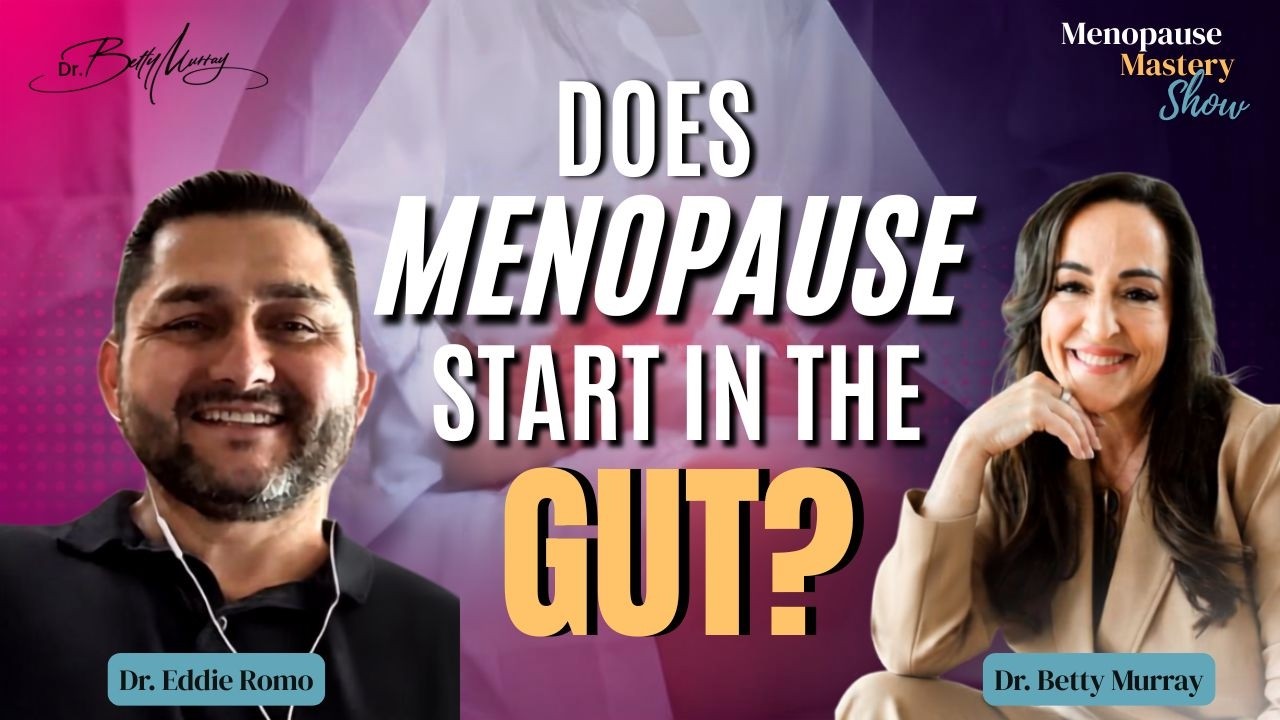
Dr. Eddie Romo explains how gut bacteria recycle estrogen through an enzyme called beta-glucuronidase, affecting inflammation and brain health during menopause. Most probiotics and stool tests miss the full picture. PHBio is building tests that track hormones, gut bacteria, and urine together to personalize treatment.
Chapters
Welcome back to Menopause Mastery. I'm your host, Dr. Betty Murray. You know what? We think of menopause, especially in the traditional world, and perimenopause as an ovarian event, a reproductive event, but it's equally a microbial event. If your gut ecosystem can't metabolize estrogen, whether it's the hormone you make or the hormone you take, your brain and your body pays the price decades later. Today, I'm joined by my dear friend, microbiologist, Dr. Eddie Romo. He's got a PhD in molecular integrative biology from the University of California at Davis. He's also a former professor at the William Jessup University, where his research actually focused on the microbial strategies, particularly preventative strategies for neurodegenerative diseases and Alzheimer's. He's now leading the scientific efforts at PHBio, and we're going to go deep into the gut-brain-astrobiome axis. We talked a lot about that. What is the astrobiome? It affects your hormone levels.
Yeah.
And it changes as you go through menopause. And we explore why, you know, probiotics may work sometimes and not others, and how your gut may silently be driving other things like cognitive decline and Alzheimer's risks, and even metabolic and weight loss risks. And so we're gonna talk a little bit about all those things today on Menopause Mastery and how to protect your brain and body from the inside out through your microbiome. So, Dr. Romo, you know, all of us have a unique, I think, road to where we get to as adults. How did you end up getting involved in microbiology and science really?
Well, yeah, I mean, I've always been interested in working with people. And so, and, you know, I really had a heart for helping, serving, you know, people in need and stuff. So, Then I did also have a passion for science. I just, I felt like science really didn't have that component to it where I was able to, to help and serve and, and, you know, interact with people. And so I kind of did find my path that, that was a way that I can really do science and translate it, right? So I was, I was concerned. I was studying science and I understood that a lot of it was not necessarily as translatable as I was hoping. So I kind of was discouraged in a way. And so I started finding, thinking about what was my path to translating science to discovery, you know, from discovery from the lab directly to application. And, you know, so this is kind of the path that I found was interacting with professionals like you, you know, that are, you know, that are practicing, that are interested in cutting-edge today with you. And I'm excited that, you know, that all of my hard work and my dreams are coming true because I have found my path to really, you know, implementing the stuff that I've found really important, you know, in science.
Yeah. Yeah. Now you're, you especially dove in, in your research to the relationship between the microbiome, not as just static bacteria. I mean, let's face it, most people probably 20 years ago, or even maybe as close as 10 years ago didn't even realize we had bacteria in our body and around our body and that we had more bacterial cells than we do human. But that I think most people don't recognize also that it's kind of its own metabolic system and how that ecosystem really plays into Alzheimer's. Because that was where a core bit of your research, you actually made some findings here that didn't exist before about the relationship between our microbiome and Alzheimer's. Talk a little bit about those, like how, how the microbiome kind of in a broad stroke plays role in, plays a role in systemic inflammation. And particularly when we look at that, you know, as the dreaded Alzheimer's, because every, let's, let's face it, everybody's fearful, if not terrified of Alzheimer's.
Yeah. You know, of course, you know, Alzheimer's is one of those that, you know, it's, it's especially nowadays has probably touched pretty much everyone in one way or another. And so of course it's, it's probably the worst way, one of the worst ways to go. You know, it, you start, of course it's a, a debilitating condition and it, and it's a, it's a, it's a drain on resources and, and, and life, you know, enjoyment of, of your time of retirement and stuff. Yeah. You know what I started thinking about when I was doing microbiome research, I worked in the lab doing microbiome research early on when, when it was Barely starting out when people were super excited to be involved with microbiome. And, you know, and when I started doing it, I found out that it wasn't as glamorous as people thought it was. You know, for one, you're, you know, you're, it's kind of a dirty job, you know, and two, you know, a lot of the, the way that they were looking at the microbiome wasn't very satisfying to me. I felt like the information, the data that I was, you know, that we were producing was, was at that moment not very useful. Like I said, I was, I was searching for actionability. And so it wasn't until I really started thinking about the relationship between the gut itself and the microbes. So it wasn't just the bacteria that were there, the individual microbes, cuz that's how everyone was looking at the microbiome. I started thinking about what's the relationship between the bacteria and the actual intestine itself, the immune system itself, you know? And so, you know, I come to find out that the immune system is extremely active in the, in the In the, in the intestinal tract, you know, so whatever's happening in the gut when it comes to your microbiome has a direct impact on the, your gut health, your inflammatory health, you know, all of, of, of your, your health in general.
Right.
And so when it comes to Alzheimer's, you know, I started realizing that Alzheimer's wasn't just a disease of the brain, you know, because everyone is looking for the way to think about Alzheimer's and it's a disease of the brain and we got these tau. You know, we got these, these, these plaques. And what I'm realizing and what we realize at pH Bio is that the, you know, the, the, the, I would say that the next medical revolution, as we say, is here now. And I think that that medical revolution is based on systemic biology, right? Systemic biology, because Alzheimer's isn't just a disease of the brain, right? There's lots of different things that are influencing the onset of disease. Or increasing your risk of disease. So it's not necessarily one disease, you know, one gene, one disease. We found out that out real quick in the Human Genome Project. We thought once we sequenced the whole genome that we were gonna figure out all the diseases and we didn't. Unfortunately, there was only a few that were one gene, one disease. And it's the same thing with the microbes, right? You think that once we've solved this one bacteria, we figure out this one thing, but it, it's bigger than that.
Yeah.
It's systemic. So what I mean by the, the, the, the, the current medical revolution is that we have now at our disposal powerful technologies and people that are looking at Alzheimer's differently, looking at the gut microbiome differently as a part of the bigger picture, as a part of the system. So Alzheimer's is not, like I say, it's not just a disease of the brain. It's being increasingly understood as being a systemic You know, biology problem that we're solving. And so, you know, when you're— yeah, yeah, go ahead.
I'm sorry, go ahead. I was just going to say the, uh, you know, the, the thought that, you know, we, all of the drugs that were originally created in the first several decades of innovation in Alzheimer's were all like, we got to get rid of the plaques, right? Like the whole idea was, let's see if we can strip the plaques off the brain. And what they saw was, yeah, it might make symptoms slightly better for the people, but it actually accelerated the disease. the disease itself. Like it wasn't helping, right? So it's not really occurring there, right?
Exactly. You know, and I actually just more recently met a couple, you know, it's a devastating story. The lady just suddenly started, you know, forgetting everything and just, but she was going to the doctor and she was getting the scans of the brain and they didn't see the plaques. They didn't see the plaques. So she didn't get a diagnosis and she got a second 3rd, 4th opinion. She finally, they actually finally, one doctor was able to capture an image of some of the plaques, but she had already progressed before the plaques were even significant. So it's not just about the plaques. And so what happens is that things like intestinal, you know, permeability, leaky gut, inflammation, systemic inflammation, these are the driving factors of the inflammatory issue that becomes The plaques in the brain, you know, so the inflammation is actually agitating the things in the brain, degrading the blood-brain barrier, activating the immune system in the brain. This is actually what's driving the accumulation of those plaques. So you can already start having, you know, symptoms or be at risk even before you start seeing these plaques, you know? And so, and, and that's not the good thing, but it's It's good news for us because there are ways that we can intervene early in life. There are things that we can look at earlier in life before a diagnosis, because essentially, you know, Alzheimer's is, by the time you get a diagnosis, essentially kind of, you know, not to be, you know, negative, but, you know, it's too late in a sense. And so, you know, these drugs, you know, there's a drug that came out that was supposedly degrading. It would remove the plaques, but it was inflaming the brain of 30% of the people. You know, the brain was bleeding. You know, so I mean, your brain is swelling. And so the plaques aren't the problem. It's the things before the plaques that are the problem. And that's what we're looking at. And that's what we're targeting. And that's what I'm excited about, that there's something we can do about that. And it has to do with the microbiome and it has to do with other things, genetic, you know, factors. But the microbiome, I believe, is central to not only Alzheimer's, but also women's health, hormonal health, men's health, just health in general. It's in, it's the center of everything.
Oh, absolutely. Absolutely. I mean, I agree with you. So you kind of brought this up. So let's talk a little bit and kind of bridge that sort of relationship between the microbiome and endocrinology, because you and I both have dug so deep into this arena professionally.
Yeah.
And I think it's important that people understand that the microbes in our gut and our hormones are interlaced. They have this crosstalk and this intermingling and behaviors between the two. So, let's talk about the microbiology and endocrinology. And particularly, I want to dive into the estrobolome because you and I both spent probably way too many years looking at the estrobolome and more years to come and how our microbiome plays directly with our hormone levels both when we're cycling and even in menopause.
Yeah. You know, so for what, you know, I like to think about the, you know, the hormone concentration in your blood, right? In your body, the hormone concentration is just one piece of the big picture, right? There's a, there's more. It's not just about like what hormones are there. It's about like what the hormones are doing. Like what is your body doing? What are the systems around the hormones? How are they influencing the hormone? And how are they influencing the way that your body cycles hormones, right? And so the microbiome is, is really important, as you know. You know, there are bacteria that are in your gut, and depending on if you have the, the right types of bacteria, as they say, you know, you know, you can have dysbiosis, you can have what we would consider an abnormal microbiome. But what does that really mean? Because everyone is so different. It's, you know, everyone is so unique. And when it comes to the, the gut microbiome, I mean, if it's, is, is some say it's as unique as a fingerprint, you know? So it's hard to say, hey, you know, your microbiome is, is perfect for this particular, you know, risk factor or not. But we definitely understand that there are bacteria that have certain enzymes that contribute to the concentration of hormones in your systems, probably a lot more Going on there than just that, but that's a good starting point for us to understand that there is most definitely some microbial genes that are that are metabolizing these estrogens. So your body's you know packaging up the these hormones to eliminate them, and then the microbes have the ability to to you know cleave off this this marker for elimination and reintroducing them into your system. And so you know that's one thing that the the the Estrobolone does, but when you think about the the inflammatory risk factors as well, you know when your body's inflamed. So you think about a hormone. A hormone is is a signaling molecule. It's not just some random isolated molecule that's doing this thing. It's a it's a it's a response to a systemic issue, right? So your your gut signaling, your your body signaling, your brain, the vagus nerve, this connection from the intestine to the brain. For your brain to release these types of hormones, and so the concentration of the hormone right are in direct relationship to you know your menstrual kind of you know your your life stage or also your gut of course is a major player in that. And so you know and so what we're doing at PH Bio and and what we're doing with you is we're really passionate about making sure that we're thinking about. All of the factors that contribute to health, that contribute to, to the hormonal, how to our target kind of strategy techniques to, to improve the individual's health. And so the microbiome is central to that as well. I like to say that everyone thinks this guy's biased. He's a microbiome guy. Of course he thinks it's the center of the world, but it's essentially, it really is a major player in everything.
Yeah. Yeah. You know, I was thinking about, you know, when I was looking in my research, you know, if you start looking at the estrobolome, so the bacteria that have beta-glucuronidase, for everybody who wants to be nerdy, that's the enzyme that bacteria make. We make it also in our body, but that's the one that allows estrogen compounds to get recirculated in through the hepatic or liver kind of pathway back into the blood. What's really interesting to me is that, you know, we had a very binary way of looking at it when we first identified it. It was like, this is bad. Right? This is bad. Bacteria making it is bad. But then when we started looking at it, it was more about concentration of the activities, like how many bacteria can make beta-glucuronidase and how, how much are they doing it? And in response to what? Because the other thing that became pretty clear as we started looking further and further was that the bacteria that actually make this enzyme that allows us to recirculate estrogens actually increases as our natural hormones come down through menopause.
Mm-hmm.
And, it's understanding that we have a symbiotic relationship with our bacteria. We may not understand everything that's happening in there and we don't have the science yet to distinguish all of those reasons, but the estrobolome increases in numbers on average as a woman goes through menopause. And, you go, okay, well, that's probably because we both benefit. We know women benefit from having more estrogen circulating. They probably do too. And, I think the microbes in these cases also are such that they're never really binary, right? There are some pathogenic bacteria, but in general, whether it's a bacteria that makes the estrobolome or it's part of the estrobolome or a bacteria that could be potentially pathogenic, in general, a small number of those things are not bad. It's about the concentration and what they're up to. And I think that's why, like, your research and some of the products and things that you're bringing to the market as pH Bio is really, really valuable because so many of the commercially available stool tests today are trying to be very binary. It's, this is bad, this is a bad microbe, this is a good microbe, this is a bad microbe, this is a good one. And they may be misclassifying a lot of them, you know, as pathogenic when they're not really because of the type of technology they're using. But it's the— we don't have that kind of data to say for sure this single bacteria that's, let's say, not truly a pathogen in itself is bad. It's more about that relationship. And you're able to really bring that gap together.
Yeah. And, you know, getting the bigger picture of, of the data. So we'll start seeing, you know, for you, high concentrations of this particular enzyme is good or it's bad, or these, you know, interventions that we did resulted in this, uh, you know, response or that response instead of like blindly, uh, intervening. You know, a lot of people do that and I'm not saying you do that. But I know the gastroenterologists do that. You know, they, their frontline strategy of intervening for their patients is dietary, and they're not tracking the, the microbiome. They're just, you know, throwing whatever they know at it, hoping it works, you know? And it's not that simple. As you know, you know, everyone's microbiome is, is so different. And so, you know, you might have this particular healthy, you know, as we say, healthier bacteria at this higher concentration, but then you also have this other guy that kind of Cancels them out a little bit, you know? And so, and so that's the thing is it, that's not, that used to be discouraging to me, but now I'm becoming more encouraged because we do have technologies like AI that are able to actually kind of make sense of data. Previously, all this data, even the lacking, you know, didn't have the data previously, gaining the data, accumulating the data, working with people, making these interventions and tracking. the changes and using technologies to really make sense and be able to, to see with better clarity what, what our interventions are doing. I think this allows for us to intervene more hyper-personalized, and that's the, that's the future of, of health. And it always, you know, we've always thought of that precision, you know, functional health is, is, is per— personalized health. And, and so I think that, you know, the generation that we're in, we're truly gonna be able to Dial in well, much better, our, our care, our treatment for people. And I'm excited that we get to be a part of it in any small bit. And I'm thrilled for what you've been doing, Betty. And, and so, and we're all so excited about the future of, of Nerva and, and, and women's health. And so, you know, people are finally starting to open their eyes to women's health, you know? And so, yeah, unfortunately, you know, that's the thing is that it's been ignored for, for far too long.
Yeah.
And so, uh, you know, I've had some mentors at UC Davis that were passionate about it. Actually, one of my mentors, he was the first one to, to under— to know what was in, in the mother's milk. Nobody knew. He actually was like, you know, this was about 20 years ago, but, you know, you know, 25 years ago, but still that was not that long ago. You know, time's flying by. And they were like, what's in mother's milk? We don't know. You know, so like they literally had no idea what was even in the most You know, it's important part of the development of a human and we didn't know what, what, what was there in the, in the milk. And so, you know, and I'm excited to see, you know, the science grow and science change. You know, this is research. This is what we're doing is research. You know, we're going to be able to, to feed this data into the scientific, you know, body of, of literature and, and I believe make a huge impact.
Yeah, absolutely. You know, so going back to the estrobolone, you know, the other thing that I studied when I was digging around, you know, I started out kind of with hormone metabolism, then sort of centered in on IBS. And so much of what I was interested in was the fact that estrogen plays such a significant role in supporting intestinal lining integrity, otherwise known as leaky gut. And, and, and again, supporting microbial diversity by, by being available, it actually helps our microbes be more diverse. And, you know, when we look at the kind of landscape of perimenopause and menopause, you know, when we see that dropping of estrogen, you know, unpredictably, obviously we see the estrobolone change and we often see them grow. Have you seen other things? Like I would say anecdotally, I haven't seen this very much in research, but I would say anecdotally, we often just see a lot of shifts in some of those more healthy microbes, like the Bifidobacterium, some of the Lactobacillus. Have you seen changes like that as well, particularly as a woman goes through menopause?
Well, yeah, you know, like you said, these, you know, when you have a, a, a change or a reduction in estrogen, you start seeing this, this alteration in the microbiome and you see that in aging in general. You know, so the cool part is that, you know, research like yours is able, is shining light on The reality that, you know, these microbes are, are, they require this cycle. They need it, you know, and we don't think about estrogen that way. And we don't think about bile salts that way. You know, we don't think about that as you age, your microbiome is, is changing, not just because you're aging or your diet's changing because you're old, you know, whatever. That's what used to be the, the, the, the, the reason why we thought, because there's an entire field called inflammaging. As you age, you become more inflamed.
Yeah.
And, you know, the, the theory is that, you know, your diet changed, you're on medications, your, your, your immune system's aging. But the reality is that things like this, changes in concentration and, and estrogen do indeed have an impact in the microbes because they are actually a part of the cycle. Now that's being depleted or reduced in concentration and they're being impacted by it. You know, and so I, I've actually, you know, I was so fixed on This specific bacterial strain, leaky gut, endotoxin. And I'm glad I was because I really got to, to understand it well. But I'm now understanding much more about that. It's not just the LPS, this, this gram-negative bacteria that I'm focused on that is causing inflammation.
Yeah.
It's other things as well. It's the estrobolome. It's, you know, it's other specific types of cells that are sensing The environment of the microbiome that are actually become, that are responding. And the inflammation is being, uh, uh, as a product of the, the gut itself in response to things like, uh, you know, shifts in, in, in concentrations of hormones. So yeah, this inflammation that is, is wreaking havoc in people's body is not just as a single factor either. It's multifactorial also, which is, you know, complicating things a little bit more, but also we're figuring out. So this is great news. Because we're, we're understanding that, you know, that estrogen does matter. The microbes in your gut do matter. You know, a healthy diet does matter. And so we are making a difference. Some people will say, I, I feel like I'm not really making a difference. I'm not sure if I'm making a difference. You don't always are gonna feel better immediately. So it, it, you know, when you understand mechanisms of disease, we're figuring this stuff out. We're bringing it to the, to the, to the patient. We start making these shifts and they will then, you know, sum, they'll summate, they'll, they'll start contributing to reducing your risk, improving your health. And so, and, and improving your, your wellbeing overall.
Absolutely. You know, and that kind of brings me to kind of the idea of, you know, a lot of women come into perimenopause and menopause and hopefully now for the first time in many cases are looking at hormone replacement therapy. I mean, obviously I'm an advocate. For that, I think every woman deserves the right to explore it. Doesn't mean every woman needs to be on it, but every woman deserves the right to explore hormones. But, you know, the fact that the hormones have an interaction with the microbiome and then vice versa, you know, if we were to talk about it and look at it, if a woman has kind of major dysbiosis— so for everybody listening, dysbiosis is a jacked-up gut, right? It's— you— if you think of it as a jungle and we're supposed to have woodland creatures and And squirrels and monkeys, and you got just basically a lot of snakes and cockroaches, your microbiome isn't going to be really, really healthy. And, you know, we haven't had a ton of research here, right? Let's face it. We haven't done much with women's health in 22 years, but, but, you know, part of what we're looking at, and I'm super excited and I'd love for you to talk to, is, is if we're putting hormone replacement in and we go around and we look at hormone metabolism through the urine, and we also look at the microbiome and the estrobolome. You know, what things do you think we'll likely see if somebody has kind of a jacked-up dysbiotic gut? You know, I would think that we would see variations in concentration of hormones or availability of hormones because there is this symbiotic back-and-forth relationship, but there's a lack of research here.
Yeah. You know, understanding that hormone, you know, treatment, the body, you know, it's not just about the concentration of the hormone. increasing in, in your, in your, in your tissue, in your blood, your body has to transport it. It has to metabolize it. It has to conjugate it. It has to recycle it. It has to eliminate it. So there's this whole process that still has to be done with that. And so, you know, and that's why I really like to think about how we're combining endocrine biology with, with gut biology. Because understanding that, you know, when we're giving the individuals, uh, you know, For, like you said, not everyone needs hormone replacement therapy, but it's most definitely, you know, helping people and it's becoming even more recognized in, in, in society to be important. And so, but also understanding how that, you know, relates to the, the gut and, and how, you know, those interventions can not only improve your, your wellbeing, mental wellbeing, but also your gut. It can, it can reestablish a healthy gut microbiome. It could contribute to that. So maybe you have issues with your gut and you're taking prebiotics or probiotics, or, you know, you're trying whatever you can to make yourself feel better and it's not working. Guess what? It could literally be hormone replacement therapy that helps to, as that one missing part, to help regulate your microbiome. And so, you know, that's the thing is that it's so interconnected. That we definitely need to be looking at things systemically. And I'm so glad that we are because the, you know, there's no other way. And, and, and the time is now and, and I'm so thrilled to, to be a part of it for sure. Yeah.
I mean, we, we at least have the research, especially in women and with IBS, you know, depending on the cycle, the follicular phase of the cycle tends to be, you know, a problem. But then when you get to the luteal phase, we tend to see, you know, more disruption in IBS. But then when women go through menopause, it tends to go down, right? Like some of the cycle-dependent sort of changes with bowel frequency and symptoms, except for the few— except for when those women do have IBS, it tends to be a whole lot worse when they're in menopause, right? So it's like it goes down generally as a population, but if you do have it, it's likely to be more problematic. So there is like all of these things where there's this sort of back and forth, and until we really get pH Bio and the things that I'm helping you guys work with, where we're really looking at that interaction together. I don't think we'll have the data. It's going to be, it's going to be pH Bio bringing that data to the market where we can actually see it. Because I do, all day, every day we hear from women. I did a webinar right before we got on this interview today. And so many women struggle with digestive problems and the classic taking a probiotic or Adding fiber or whatever doesn't really help, you know?
Exactly. Yeah.
So I, so I've got a question since you're a microbiologist and, and can answer this. I've got my opinions, but I'd love to hear. There's endless marketing hype about probiotics and we have some companies out there selling some really expensive probiotics. And, and I would say there's, you know, strains that we've got research on. There's a lot out there that we haven't, and then there's mixed data in the, in the research. The data don't really support a lot of these. What are your, what are your opinions on just taking a probiotic in general and then some of these very specific ones?
I'm not against probiotics or prebiotics. I think that, that some people get relief from, from taking them. The issue is that your, your, your, your gut microbiome is kind of established early in life. And so, you know, when you're a child, You had a very specific ecosystem in place that is kind of like the, the keystone, like the major groups of microbes that are thriving in your intestinal tract. And, and it's not just because of, of, uh, you know, what mom fed you. That's a part of it, but also a part of it are your genetics, the folds of your intestine. And what's a really interesting thing that I found in, and when I was doing research at the School of Medicine and I was, I had a practitioner actually showing me pictures. of the lining of the intestine that had sugars. The lining of the intestine had sugars. It was feeding a very specific strain of bacteria. And so I understood that the intestine itself was actually giving these groups of bacteria the, the, you know, the, the food they needed. And so they were actually able to, to thrive in these specific regions of the intestine because the intestine was feeding them. So I was like, wow, like, so it's not just About what you ate. It's not just about, you know, what mom, how mom fed you, breastfeeding or formula. It has to do with a lot of, a lot more than that. And so when you have dysbiosis, you know, a lot of that has to do with your entire environment. So it's not just one thing, right? It's not just if I introduce a probiotic or prebiotic, I'm good to go. No, there's more things that need to change because guess what? Your exercise changes your microbiome. Your activity level, your sleep level, you know, having pets or not having pets, the where you live, who you live with, all of these things can disrupt your microbiome. And so if you think about you having this very well-established microbiome, but you have dysbiosis, so your, your microbes microbiome wants to go back to the original intended state, right? And so how do you get there? That's the question. And so sometimes probiotics can help. alleviate issues for some people, but I would say the general population would be better off understanding their microbiome, their specific microbiome through longitudinal study. And what I mean by that is that's what we're producing. I'm not saying that just because I have a product that I can, I can give you. I believe in probiotics and prebiotics, but I believe in them if you're taking a good close look at your microbes. And how they're actually altering your microbiome. You could be taking a probiotic, spending a lot of money, and it's not doing anything for you. You could be spending a little bit of money and it could be, you know, doing great wonders. But it's not until you really get a good close look at your microbiome over time and understand how these interventions are, are truly impacting your gut. I think that it's just like anything else. We're kind of just hoping that it helps.
Yeah.
But sometimes it's not, you know, and then sometimes that could be an expense if it's not. You never know. It could be, you know, causing even more problems than good.
Yeah.
Yeah.
You know, it's, you know, since I've been, I've been doing stool testing, I mean, you know, all of them have their strengths and their drawbacks and, you know, and, and we're learning more every day. And I think that's the important part is when we're looking at stool testing is that there's constant iteration and improvement, you know, because a lot of companies, they bring something to market and they don't really change it when the science changes. But one of the things that I did over the 22 years of my career seeing, you know, clients and patients was, you know, very early on I was very much supportive of probiotics and I used them a lot. And at one point I would've been like, you know, you always take fish oil, take vitamin D, and you always take a probiotic, right? You know, and then when I really dug in and started getting deeper, deeper in the research, I use probiotics and I use them very targetedly for different things. But what was clear was, you know, like your conversation, those keystone groups kind of set up their houses and they don't let their friends in. They let their friends come in the front yard and they hang out and picnic, but then they tell them to leave. The probiotics don't actually colonize in most cases when you're looking at the pills. We just don't see that, like what we would expect in research. But then when you look at like fermented foods and your prebiotics and your, you know, polyphenols and all of those other things that feed Yeah. Our microbiome, like, I very much sort of skew that direction now. Like, yes, we use targeted probiotics, but we want to integrate if somebody doesn't have a histamine problem, you know, some fermented food every day. We want to integrate fibrous foods and the foods that our microbiome likes, you know, because we're feeding large swaths and giving them the prebiotic, postbiotic, and everything else that they're making. Is that kind of where you would center and say, Hey, if I was going to make some just general lifestyle changes, that these are probably the areas that are most effective.
Yeah. You know, and there are, you know, microbes, probiotics that have been around for a long time that we know are beneficial. You can find them in yogurt, you can find them in kombucha and stuff like that. But you must have, and you most definitely can benefit from those, especially if you got issues with the gut, if you're taking them just constantly, right? You're just like, you would have to take them all the time. And, you know, like you said, because The guys that are in your gut don't want them there. If you're forcing them into there, they'll stick around longer. But if you're just taking it every once in a while, it's probably not going to work. If you're taking it and you kind of have a very specific target, I think it's useful for sure. And, you know, like you said, it's not just, it's not just probiotics or prebiotics, you know, fiber, it's polyphenols, you know, it's estrogen. There's many things that these bacteria are interacting with that are help, you know, reestablishing that appropriate ecosystem. Like you said, this jungle that is then more diverse and, and, and, and better overall.
Yeah, absolutely. All right. So switching, switching gears a little bit. So we've talked a little bit about this. And so when you're looking at bringing stool profiles to market, cause I know a lot of, I have inside view because I'm, I'm helping a little bit with pH Bio and some product development from my research, but looking, you're looking much more closely at targeted microbiome testing along with other, other testing. It might be blood, might be serum, it might be, or serum, might be urine, looking at specific areas or concerns like a neuro, you know, or in our case, looking at hormones and hormone metabolism. What do you, what do you see kind of coming in the future, especially as you drive towards changing, you know, stool testing and microbiology in the marketplace?
Yeah. You know, I, I see microbiome testing kits still having their place where you're, you're testing the microbes. And so, and, and you're kind of getting a snapshot of what, what's happening. And so that's kind of where the microbiome market is really. It's just kind of a snapshot. And I would say it's kind of a blurry snapshot. It's not even really a great snapshot. That's just because, you know, we talk about how there's trillions of microbes, you know, In our body, and you know it's not just you know a few that you don't see. It's literally the contents of your intestinal tract is is in your small intestine and your large intestine that are the bacteria, pounds of bacteria. So these guys, you know, from meal to meal, from day to day, sleep pattern to sleep pattern, stress, you know situation has an impact on the way your microbes. Are you know fluctuating because that's what they do; they fluctuate, and so they're fluctuating. You know, based on what you're eating, they're fluctuating based on how you're sleeping, and they're fluctuating throughout the day and throughout you know the week and throughout the month. And so we all do that; all our microbes are fluctuating. I think, and so that's the direction that we're going is really that needs to be done is understanding the the the the way your microbes are responding to certain. food items, certain sleep patterns, certain environments. And so it's not until you really take a closer look at how your specific microbiome is impacted by these things, and that's done through testing, you know, so, you know, even in, you know, blood testing, people are doing this, you know, where they have the glucose monitoring is continuous glucose monitoring, because you know that that one snapshot isn't really indicative of the individual's metabolic state, right? So it's the same thing with the—
Yeah.
Even more so. With the microbiome, because there's so many things that influence your microbiome and there's so many things that you can do to improve your microbiome. Better sleep, you'll start seeing shifts and fluctuations. So say we're testing the microbiome at several time points, you can actually start seeing how your microbe is responding to certain meals, certain food items, and we can start then prescribing, you know, or recommending You know, certain food groups, certain types of prebiotics and probiotics to target your own unique microbiome. We're seeing that your particular microbiome is responding really well to this. Let's keep doing this, you know? And so, and the microbiome, you know, to be brutally honest, when I was in research doing microbiome, it was early on. And so I was really discouraged by the lack of standardization. There was a lot of lack of standardization and people were, you know, I was bringing in stool samples and we were just defrosting and just getting a little bit off the top. I was like, I don't think that that's, you know, representative of the full, you know, microbes that are in there. I think that that's not good enough. And so that's just the reality that one little piece of, of, of, of material is not going to give you the full picture of what's really going on in your gut. And it's going to take a little bit more work. To really understand it, but it's worth it. And I think that what we're doing with traditional microbiomes, we're, we're specializing them. We're making them more specific. They're, you know, our microbiomes have more specificity to them. And I think that that's, that's exactly where we are and where we're going, especially working with you, Betty. You're helping us see more into the world of, of women's hormonal health and, and just medicine in general. And especially your expertise in, in the field. It was, if it wasn't for that, I don't think that we would be where we're at today. Because you're able to really contribute, but also see with clarity what we're bringing to the market. And so, and that's because, you know, the, when you're looking at the gut microbiome, you know, you're, you're paying whatever hundreds of dollars for a kit. And usually when people take a microbiome test, say I have a, I, an issue sleeping or I have stomachaches or, you know, family history of Alzheimer's disease. And I, I heard that it was related with the gut microbiome. You know, so I go to my doctor and I say, hey, I want to take a microbiome test. So the available tests today, they're getting better. They're getting better. But usually, traditionally, they're kind of a big picture of what's going on in there. Doesn't really tell you too much about very specific things. We're trying to figure that out now. But I think that when you, if the individual is concerned with hormonal health, I want to look at the microbiome because at this moment in life, I'm concerned with my hormonal health because of how I feel. I'm in menopause. Or in this time of my life, I'm concerned with losing weight or my neurological wellbeing. And so what we, what we have done is we've developed microbiome testing kits that are specific to those conditions. And so together with you, Betty, we're, we're, we're building N1 Hormone, which is the big picture, the systemic biology.
Mm-hmm.
Big picture testing, you know, kit that is the Estrobloom. It, you know, it's all of the different components of, of hormonal health. And so we do that also with, with the, with the neuro, you know, neurological health. Your microbiome is specific to neurological health, mental health, you know, everything that pertains to, to your mind, your brain, neurology, you know, we have a kit just for that. You know, so, and, and we're building kits that have specificity and neuro— and, and neurological health, you know, and, and just general microbiomes or pathogens, you know, uh, there's, I got one performance, you know, that we're working with people when it comes to exercise and, you know, athletics and stuff. And so, because, you know, I think that that's what is needed and that would make more sense to me, uh, if I was gonna be ordering a microbiome testing kit. And if I really had something that I was mostly focused on, I would like to see results that spoke directly to that. And so that's what we're doing at PHBio. And so it's very exciting.
Yeah, no, I mean, it is exciting because you're right. Like the generalized gut test is great if that's kind of your thing that you've got going on. But when you're starting to look at these conditions of aging or the things that we're doing for longevity, a lot of times we have to get much more granular and be much more focused on the things that we know they're And when you put it together and you have a stool test that's along with serum testing and urine, you're able to start capturing a much broader understanding inside that one area of condition. And in the case of what we're doing together, obviously the hormone and hormone metabolism, anybody that's listened to my podcast knows that I'm frustrated by the fact that we've got a standard of care that says, don't test hormones as long as your hot flashes go away, you're fine. Which is complete BS that we wouldn't do that on any other endocrine deficiency. We can't even prescribe testosterone for a man until you test the blood work, but heaven forbid you'd want to look at blood work for women. It's like, oh, okay, that's a double standard. And then urinary hormone testing, which actually shows free levels and how you metabolize it. All the commercial tests out there today are inadequate. They miss the latter half of that pathway and whether you're actually excreting things properly. And then if you don't have the gut, You don't know. And so I'm so happy that we're bringing that kind of entire pathway together. And with you at PHBio, I'm super, I'm super excited cuz we're actually gonna be not only creating something, but we can actually contribute to the research. That's a, a, a gigantic Winnebago-sized gap at the moment.
Absolutely. Yeah.
Yeah. That's very, very exciting. That's very exciting. So yeah. So if, if people wanted to look up PHBio, so PHBio is going to be available through your clinician. It's a new lab. It's a new lab. It, where can they, they can follow you, Dr. Romo, on Instagram, right?
Yeah. That's gonna be Dr. Eddie Romo, PhD on Instagram. Mm-hmm. And so yeah, you could follow me there. And we have a website, phbio.ai. And so, and we're, we're still working on, we're focusing so intently on the science and getting things going that, you know, we're, we need to focus more on the website and stuff like that, but we, We definitely have a website available and we're going to be working directly with practitioners such as yourself. And, you know, you will be the point of contact, but definitely we'll have online content. You can hear more from me on Instagram and then you can reach out and add me on, follow me, whatever it is on Instagram.
You're like, I'm a scientist. I don't do social. I get it. Yeah. Well, and everybody listening, like, you know, when we're working together, we're working out the science right now and especially the educational materials for both a patient and a practitioner. But we'll have you, Dr. Roma, we'll have you back on when the hormone N1 hormone is available and really talk specifically about that test. And what I'll do, people, I'll do the test. I'll take one for the team. I'll do the test and we'll walk through mine online. How about that? Because I have no shame. I give my body up to science, but we can have you back on. But it's coming, people. It's coming and it's very exciting. Yeah. Awesome things coming. Absolutely. Yeah. So Dr. Bromo, Eddie, it's been so wonderful to talk to you. Thank you for coming on Menopause Mastery.
Thank you, Dr. Betty.
Yes. Thank you. Thank you. And everybody, thank you for listening to Menopause Mastery. If you happen to be listening on your favorite podcast platform, please don't forget us to give us a 5-star review because that's how we reach people. And if you happen to be watching this on YouTube, don't forget to subscribe and then leave a comment because I do read those comments. And especially if there's some content or something you'd like to know or learn. Leave that in the comment because we will go out and I will create a podcast on that. And then I'll be back with you next week.